
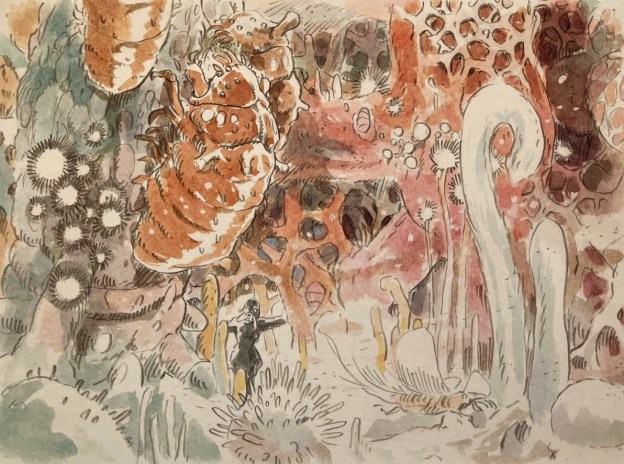
Original interview and imageboard from Hayao Miyazaki Imageboard Series Volume 1: Kaze no Tani no Nausicaä (風の谷のナウシカ・宮﨑駿イメージボード全集 1).
Hayao Miyazaki’s imageboards are his defining trait.
— This “Hayao Miyazaki Imageboard Series” was originally your idea, Suzuki-san.
Suzuki: When Hayao Miyazaki makes a film, three things define his process: first, the imageboards; second, the storyboards; and third, the layouts. As for Miya-san’s imageboards, their greatest strength is, to borrow Director Takahata Isao’s words, that “they’re dense with information. Probably no one in Japan but Hayao Miyazaki has ever given us drawings that truly live up to what an imageboard is meant to be”. That’s the crux of it. I hold this quote by Takahata-san in high esteem. What it means is, Miya-san‘s imageboards encapsulate the entirety of the information that is required to craft a film. On a single sheet of paper, he packs everything in: not just the characters’ facial expressions, but the props too, and every other detail that evokes the story. That’s why, if you’re doing an exhibition or an artbook of Miya-san’s work, I believe his imageboards are the most fascinating thing you can show people.
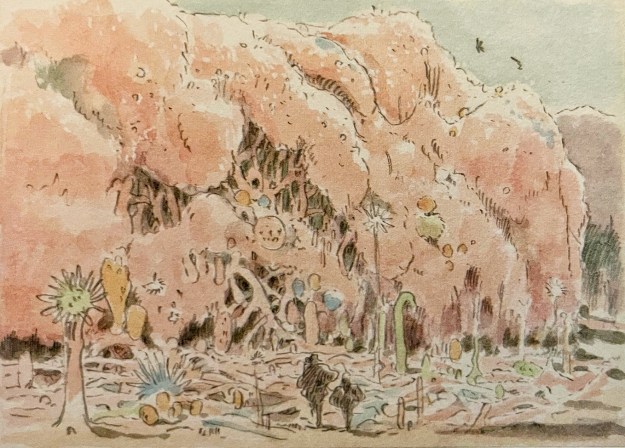
Suzuki: Next, working from the imageboards, Miya-san draws his storyboards while working out the story. That’s the second element. Weaving a great many imageboard-like drawings into those storyboards is one of Miya-san’s defining traits; no one had ever done anything like that before him. Doing so meant he had to take on many roles by himself, which is why Miya-san never let even the slightest opportunity pass; he was always drawing, anytime, anywhere.
And then, building on top of that are the layouts. Everyone thinks layouts define the composition of the drawings; however, in Miya-san’s case, it’s completely different. His layouts embed everything: what characters are there, what objects are placed around them, and even how those characters act. What’s remarkable about Miya-san’s movement is that, even though it happens on a flat surface, you can sense the breadth of the space. The scene that surprised me the most was the final battle of “The Great Adventure of Horus, Prince of the Sun” [太陽の王子 ホルスの大冒険, 1968]. Just when you expect someone to come at you from the background, they cross from right to left. Then they go from left to right, and then from the foreground into the background. Through this, you gradually come to understand just how big the main battlefield is. In this very sense, Miya-san‘s defining traits are his imageboards, and his layouts. This, too, wasn’t something I came up with myself; it was something Takahata-san taught me.
— It’s quite odd how, before this one, there was basically no other artbook specialized in the imageboards. Even the existing “The Art” series [ジ・アート・シリーズ, Tokuma Shoten] only includes a selection of the key ones, and they’re printed small.
Suzuki: Miya-san didn’t like “The Art” series. Imageboards are blueprints for making a film, so I think he wondered what it could possibly mean for something like that to be put out into the world. I believe that, as their creator, he felt resistant to the idea of his imageboards and layouts being made into publications and circulated widely among the general public.
Why not make an epic?
— The manga serialization of “Nausicaä of the Valley of the Wind” [Kaze no Tani no Nausicaä, 風の谷のナウシカ] began in the February 1982 issue of Monthly Animage [Tokuma Shoten]. At the time, Director Miyazaki was preparing the ground for “Sherlock Hound” [Meitantei Holmes, 名探偵ホームズ, 1984] at Telecom Animation Film, the studio he was affiliated with. Before that, the August 1981 issue of Animage ran a special feature titled “Miyazaki Hayao: The World of Adventure and Romance”, which also included imageboards for a new project he was envisioning.
Suzuki: It’s certainly true that the seeds of Nausicaä took shape while he was mulling over all sorts of ideas. One of them was “Rowlf” [ロルフ], another was “Yara of the Valley of the Wind” [風の谷のヤラ]. “Princess Mononoke” [もののけ姫] and “Totoro” [トトロ] were also among those. And in the midst of all that chaos, it was eventually decided that Nausicaä would be published in Animage.
To fill in some background: the film “Lupin The 3rd: The Castle of Cagliostro” [ルパン三世 カリオストロの城, 1979] was a huge financial loss, and Miya-san resolved to quit animation for good. No one, not the producers, not the staff, stood by his side on that film. So, as far as Miya-san was concerned, there was no point in him staying in that world any longer. Meanwhile, I had already started working with him through Animage, and he came to me for advice: “Suzuki-san, lend me your brain for a bit”. I wondered what it could be, and he said: “I’ve got a family, so I have to make a living, but I want to do it with picture books. I’m done with anime”. The moment I heard “picture books”, I told him: “That’s impossible”.
I turned him down once, but Miya-san persisted: “It’s no good?”. When I told him “No” again, he asked: “What am I supposed to do, then?”. I said, “Well, manga or comics, for example, might be workable”. To which Miya-san replied: “And what would I draw?”. That was right at the height of the rom-com boom, with “Touch” [タッチ, Adachi Mitsuru] as the prime example. So, I suggested something that was the exact opposite of all that: “How about an epic?”. And Miya-san said: “What do you mean, an epic?”. Off the top of my head, I answered, “Well, something like Greek mythology…”. Then, out of nowhere, Miya-san asked me: “Suzuki-san, do you know Nausicaa?”. I’d never heard of any Nausicaa, so I said, “No, what’s that?”. And Miya-san said: “She’s from the Greek mythology you just mentioned”. The Nausicaa of Greek myth isn’t all that well known, but she really does exist. And in Japan, there’s “The Lady Who Loved Insects” [虫愛づる姫君] in “Tsutsumi Chūnagon Monogatari” [堤中納言物語]. Nausicaä came from both of those, the West and Japan.
Telling everything with the tapestry.
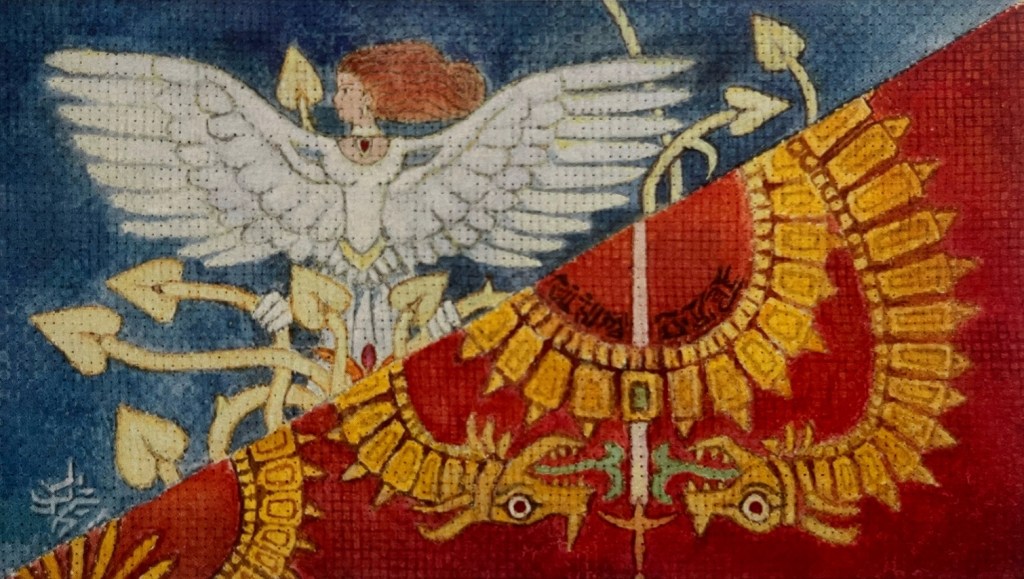
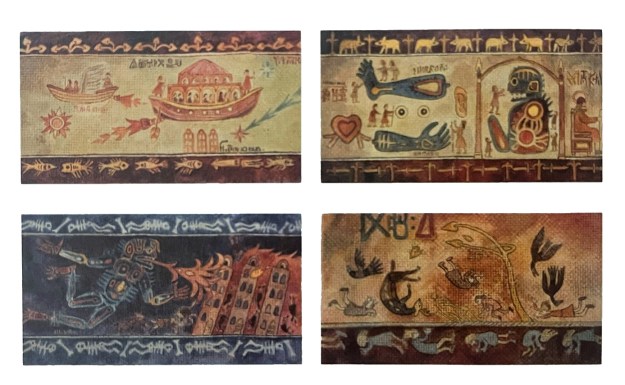
Suzuki: The tapestry shown during the opening sequence was producer Takahata-san‘s idea, and it’s stunning. If you look at it in order, even though it’s just the opening, it already tells the whole story from start to finish.
— It’s exceptionally cinematic, isn’t it? The first time I saw it I didn’t notice, but the second time I watched the opening, I realized it showed the story in its entirety.
Suzuki: These weren’t painted on paper but on cloth: long, horizontal strips of fabric. They’re all the same size, and Miya-san painted every one of them himself. But the first one just wouldn’t come together, and Miya-san was really struggling with it. I remember us going back and forth about whether or not to flip it upside down. He even asked me things like, “Suzuki-san, which way do you think is better?”.

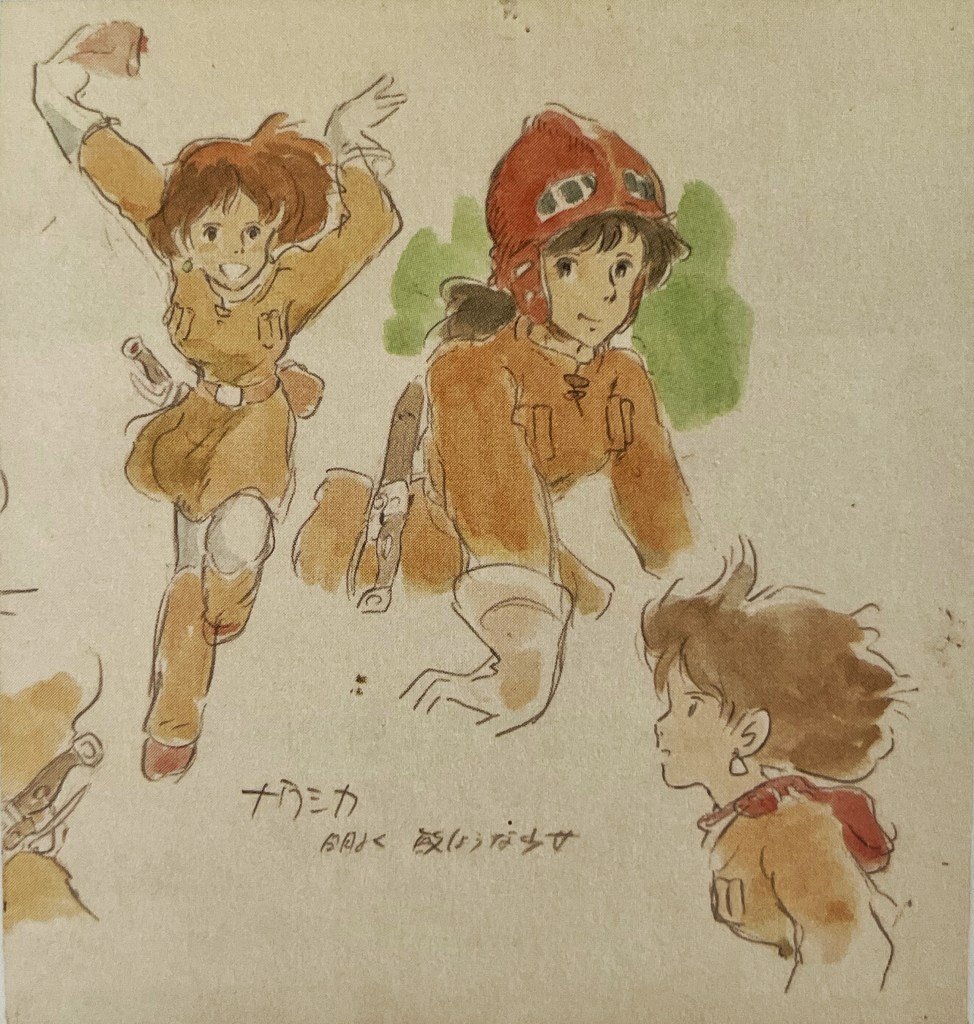
Young Nausicaä had been in his mind since the film was first being planned.
Suzuki: When it came to the art, I don’t think Miya-san ever consulted Takahata-san. What he went to Takahata-san about was usually something else. For example, Takahata-san wrote a good deal of the dialogue.
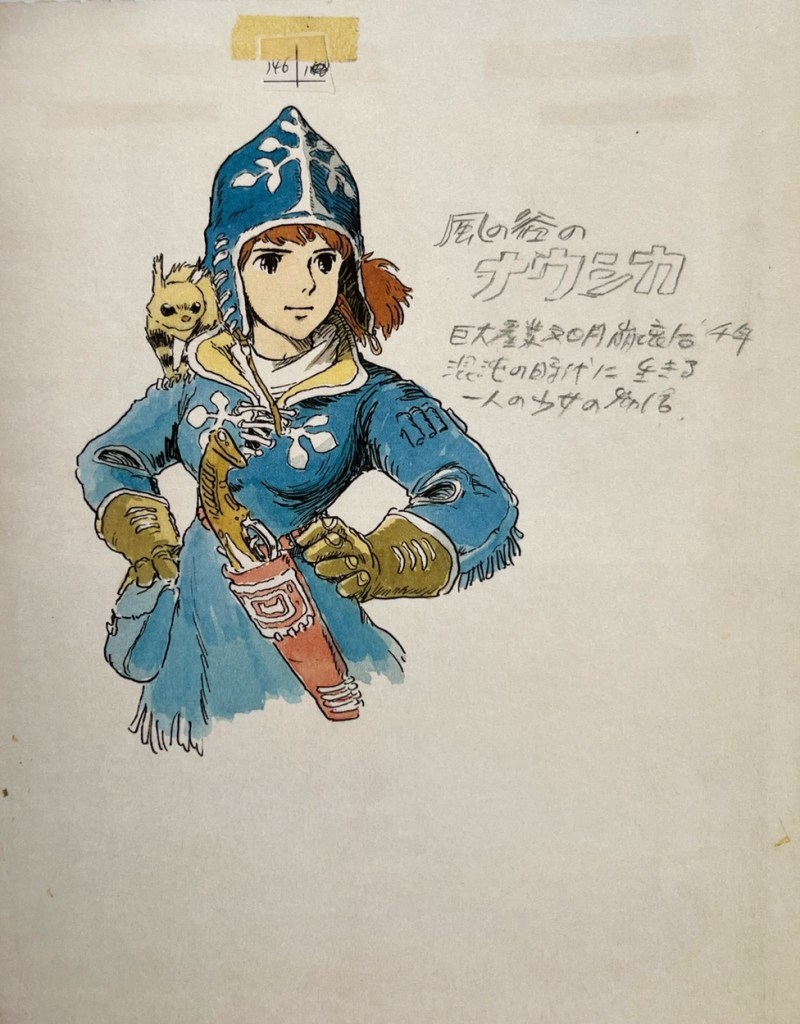
Suzuki: Miya-san held on to things like this, too.
— So, he drew several of these for the announcement.
Suzuki: I thought this drawing also showed some influence from the popular manga series of the time. And I just remembered that when I told that to Takahata-san he said: “You absolutely must not say that to Miya-san”.
— What about this drawing? Was it meant for the film, or maybe for the TV special that was part of the early plans?
Suzuki: I believe it was made when we started talking about making the film.
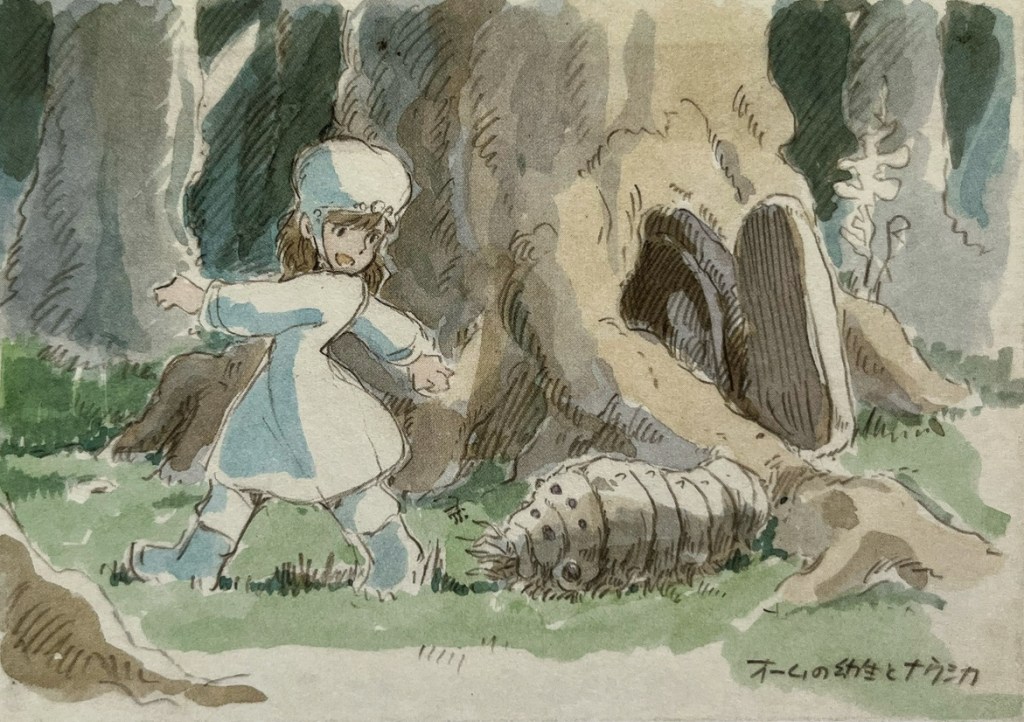
— In books about Ghibli, it’s described as being “for the TV special,” but…
Suzuki: I don’t think Miya-san had the room for anything like that back then. I wonder how that idea came about.
— The serialized feature “The Road to Nausicaä” [ナウシカへの道, Animage] said it was for an original video.
Suzuki: I believe that by the time we first discussed making the film, this scene was already very clear in his mind.
— Reading “The Road to Nausicaä”, I got the impression that this one piece stood entirely on its own. I wondered whether it was something he dashed off to go with a project proposal…
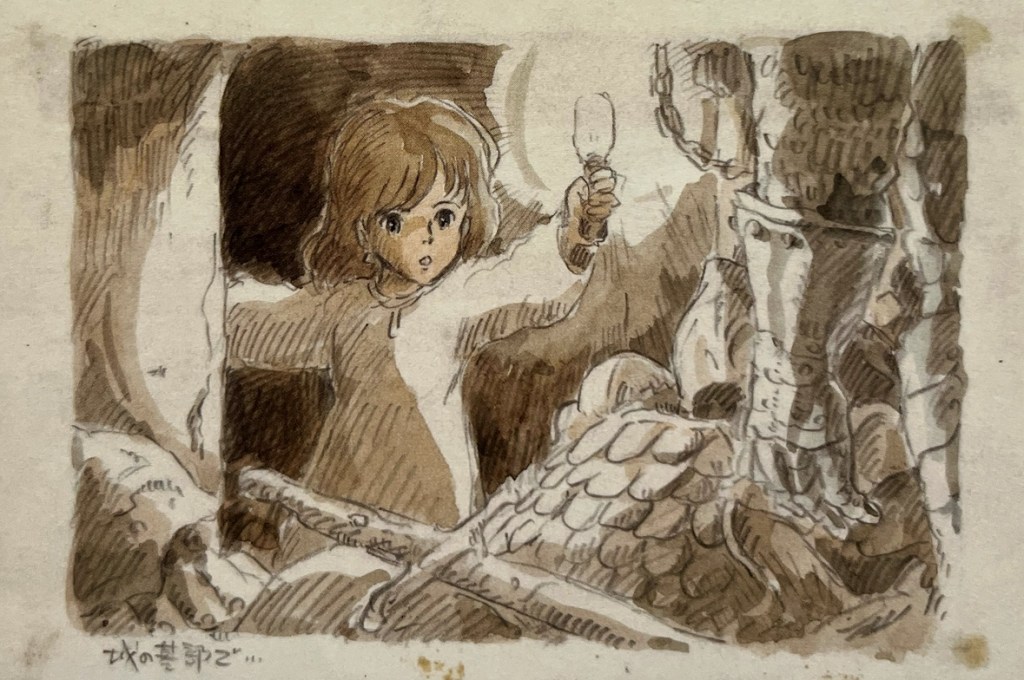
Suzuki: That was not the case. I believe it was drawn for the movie. After all, Miya-san always did like drawing young girls; that’s why he drew this sort of thing first.
He likes seeing things piece by piece.
— Nausicaä has its original manga, so I assume that’s why there aren’t as many imageboards of the characters.
Suzuki: It was actually because there was no time.
— So had he already worked out, at least, things like the opening scene that he couldn’t fully depict in the manga?
Suzuki: I think he restructured it all over again as the film. The manga itself became the project proposal, in a way.
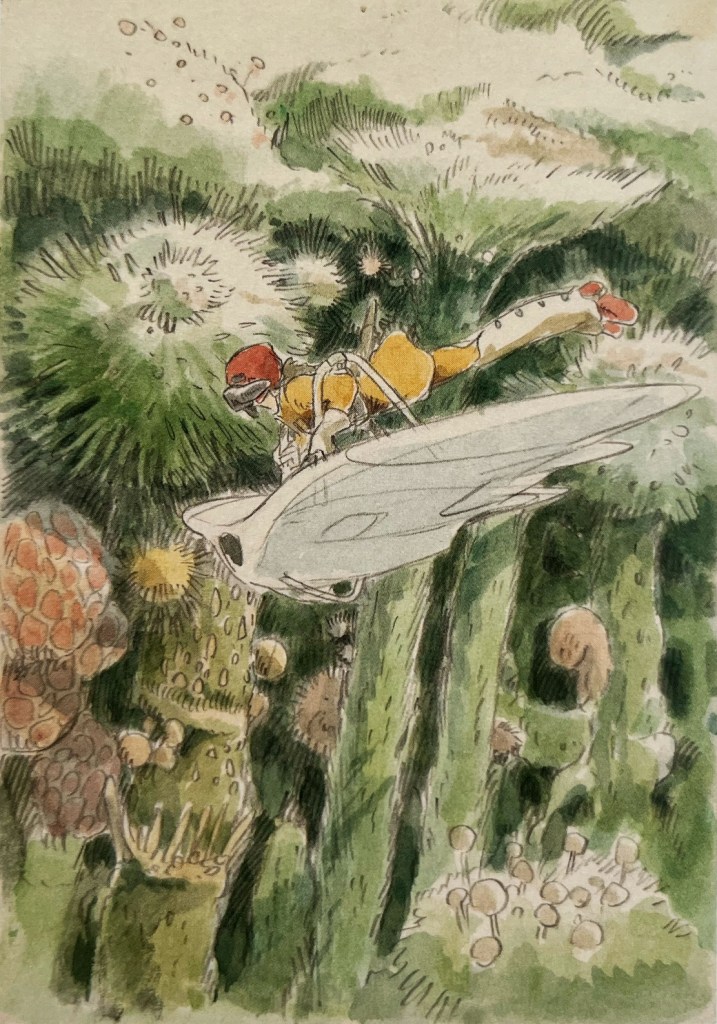
— This drawing has pink in it: a really psychedelic use of color. The depictions of the Sea of Corruption have quite a lot of pink in them, and he went for cute, pastel color choices.
Suzuki: This one is rather powerful, isn’t it?
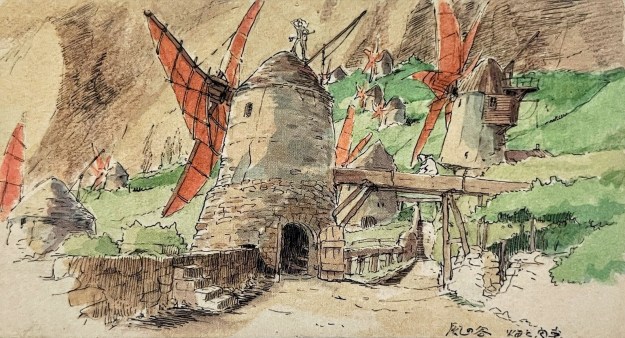
— Also, there are quite a lot of drawings of the Valley of the Wind. Do you think Miyazaki-san felt he hadn’t been able to fully capture it in the manga?
Suzuki: Miya-san’s drawings don’t take in the whole from above. He sees things piece by piece, doesn’t he? A film needs the full picture, but Miya-san doesn’t like that. So, on that front, Takahata-san and I, to put it nicely, “persuaded” him.
— But Miyazaki-san loves things like giant ships, so I would have thought he’d want to draw the whole thing as well…
Suzuki: For example, in “Castle in the Sky” [天空の城ラピュタ, 1986] there’s the scene where Sheeta and Pazu look at Laputa from the sky. That scene wasn’t there at first either. Miya-san kept going on about it: “Whose eyes are these supposed to be?”. Takahata-san and I managed to persuade him somehow, but it was like that every time. Wanting to know only the part: to him, that feeling is the real thing. What we actually see is always just a part. I suppose that’s what he’s getting at.
— That’s true. It’s only because you’re looking with God’s eyes that you can see the whole picture at all…
Suzuki: That’s why what defines Miya-san’s films is, above all, taking those parts, those points, and turning them into a line. One time, I asked him, “What kind of era is this? If you look down on Nausicaä’s world as a whole, what kind of age is it?”. And Miya-san told me: “Don’t talk nonsense, Suzuki-san!”. He’s a strange man. He likes not knowing where he is. He wants to savor that frightening feeling. There’s no point asking why; that’s just the kind of person he is.
— That’s particularly true in “My Neighbor Totoro” [となりのトトロ, 1988]; you keep getting deeper and deeper into the woods, until you don’t know where you are anymore.
Suzuki: He truly hates talking about things objectively.
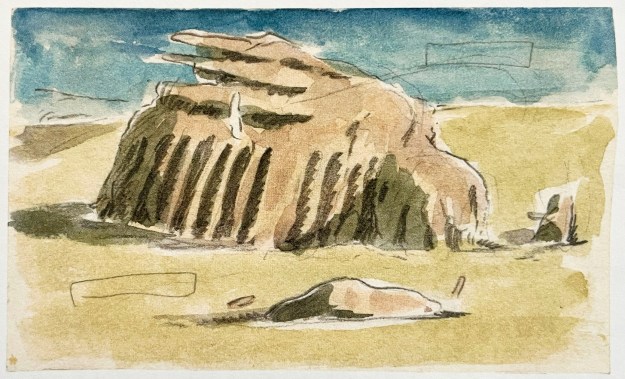
— This drawing wasn’t used in the film, was it?
Suzuki: You’re right.
— I’m not quite sure whether this is an imageboard or a storyboard.
Suzuki: It was made to be a storyboard.
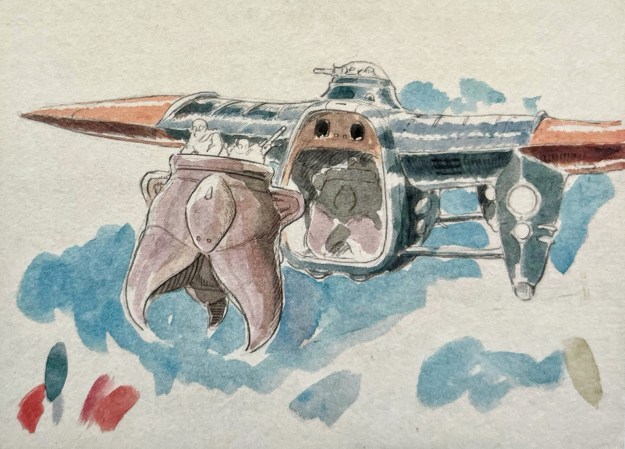
— This one wasn’t used either… I wonder if it’s an imageboard?
Suzuki: I believe he drew this one to take a breather.
And the fact that even the drawings he made to relax are connected to the project he was working on gives us a glimpse into how fundamentally serious his personality is.
What matters most to Miya-san is, after all, Nausicaä.
Suzuki: A lot happened along the way, but Nausicaä, which started out the way I’ve described, ended up becoming one of Miya-san’s signature works. And yet, at the same time, do you know what Miya-san started saying after he made Nausicaä?
“I never want to make a film again.”
Nausicaä was a hit, and on one hand, Miya-san felt he had managed, with this film, to make up for the box-office failure of “The Castle of Cagliostro”; on the other hand, there was also a lot that was painful. Miya-san made Nausicaä at Topcraft, but right before that, he had been at Telecom Animation Film. He thought it would be too difficult to make Nausicaä with just the Topcraft members, so he brought in staff he knew to work on it part-time. However, when the film was completed, the names of the people who had done the most for it weren’t in the credits, and for Miya-san this was the bitterest of regrets. The names that were missing were mainly those of the Telecom people, and he felt deeply ashamed that he hadn’t been able to get them credited.
And the other thing was that, to get his vision realized, he’d had to say a lot of harsh things to staff members he was close to. To borrow Miya-san’s words, with Nausicaä he “lost friends”. That’s what led to his saying he’d “never make another one”. It was a real shock, but some time later Miya-san called me in, saying, “I need to talk to you”, and asked me: “Could you throw away the negative?”. We’d already struck about a hundred prints of Nausicaä, and I think Miya-san knew that full well and said it anyway, out of that deep sense of shame. In short, he hadn’t been able to make the film the way he wanted.
Miya-san had been that adamant about refusing to make another film, but in the end, for all sorts of reasons, he went on to make the next one, “Castle in the Sky”. And yet, the seeds of everything from “Laputa” onward all exist in Nausicaä. He hasn’t made anything truly new since Nausicaä. What matters most to Miya-san is, after all, Nausicaä. That’s the history of it.
