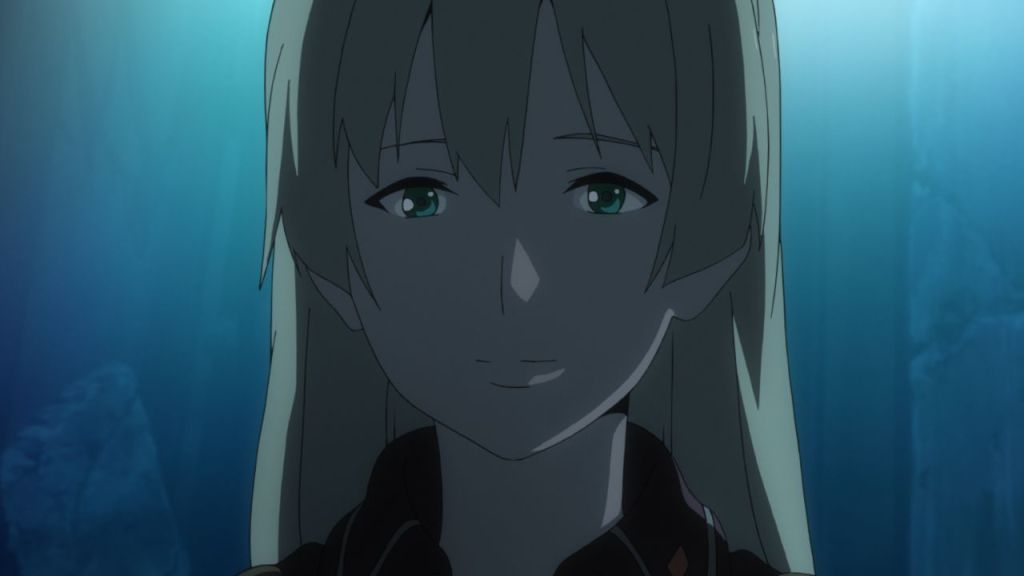
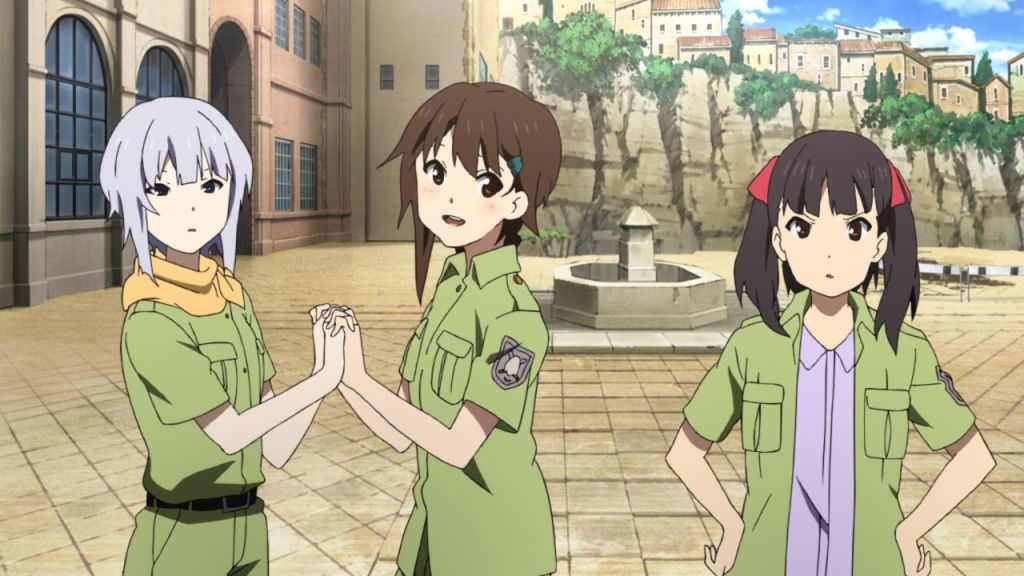
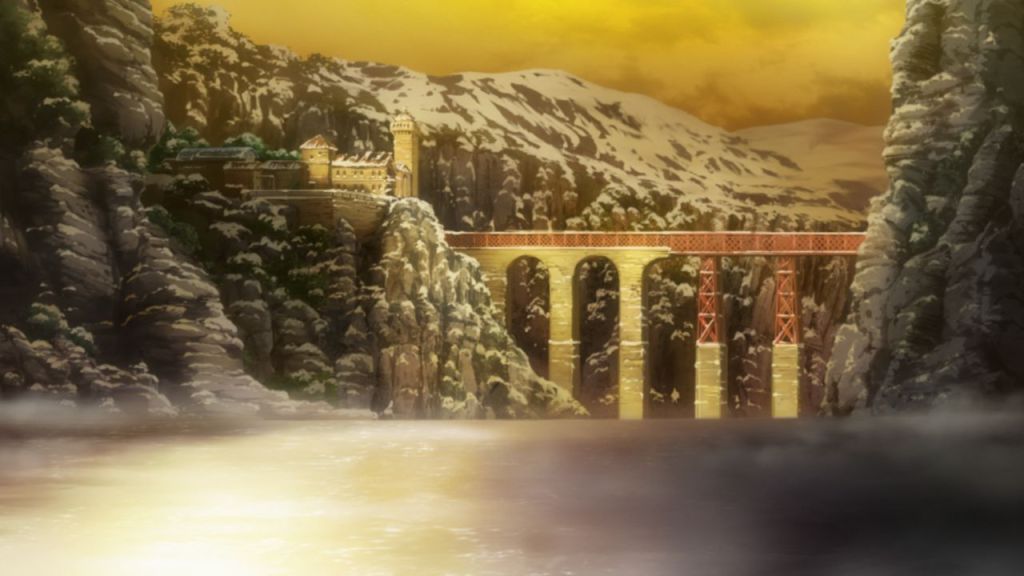
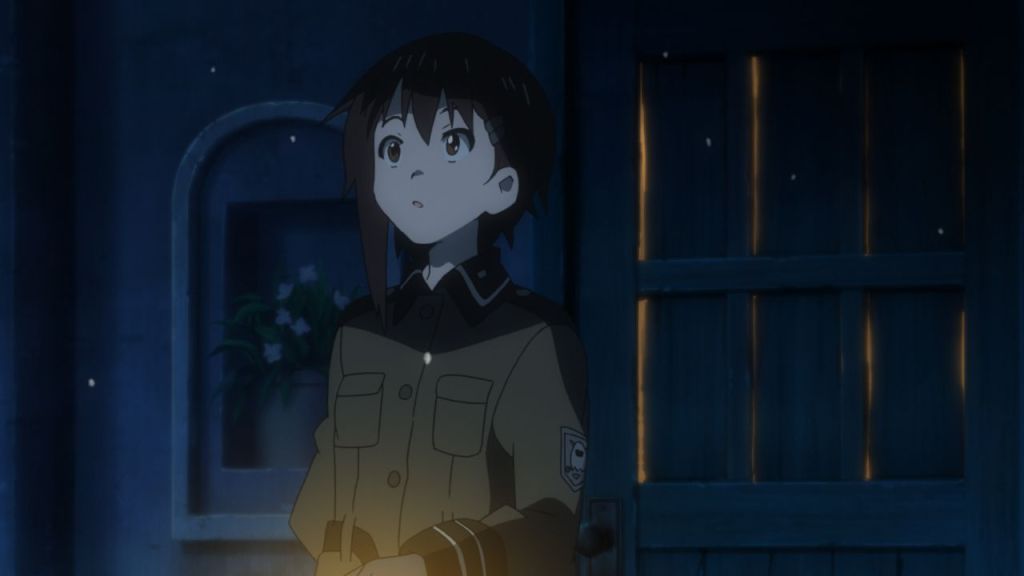
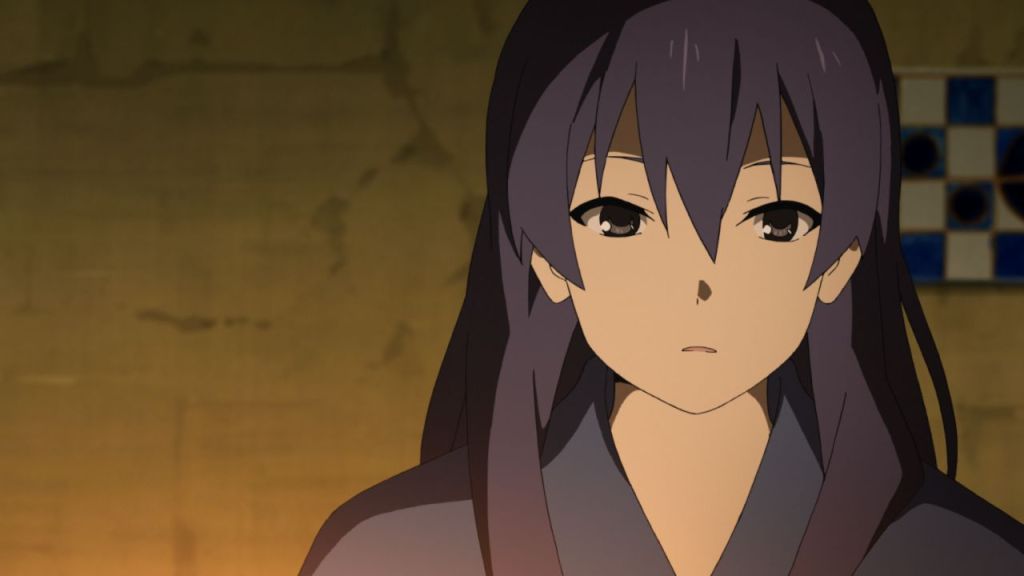
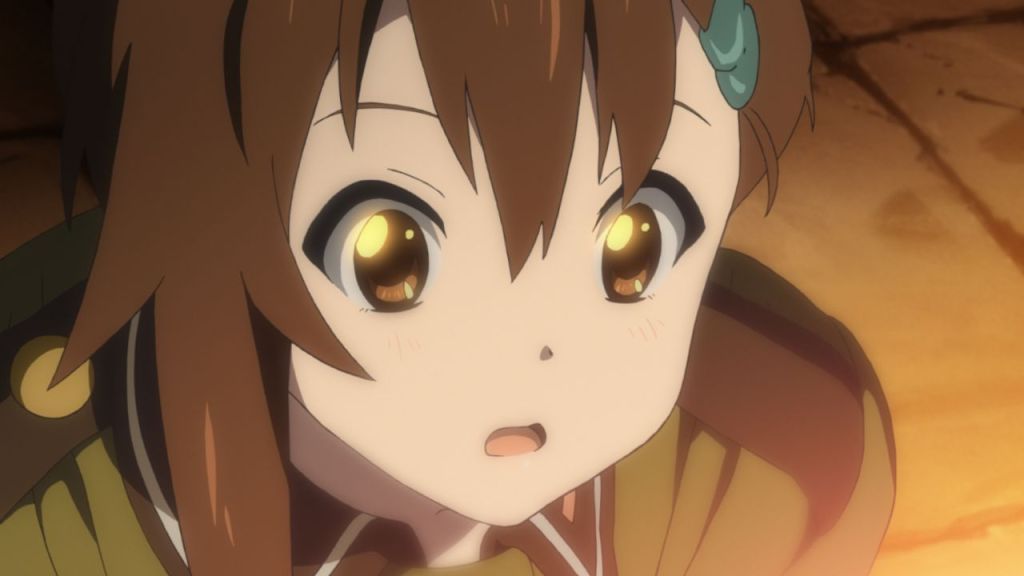
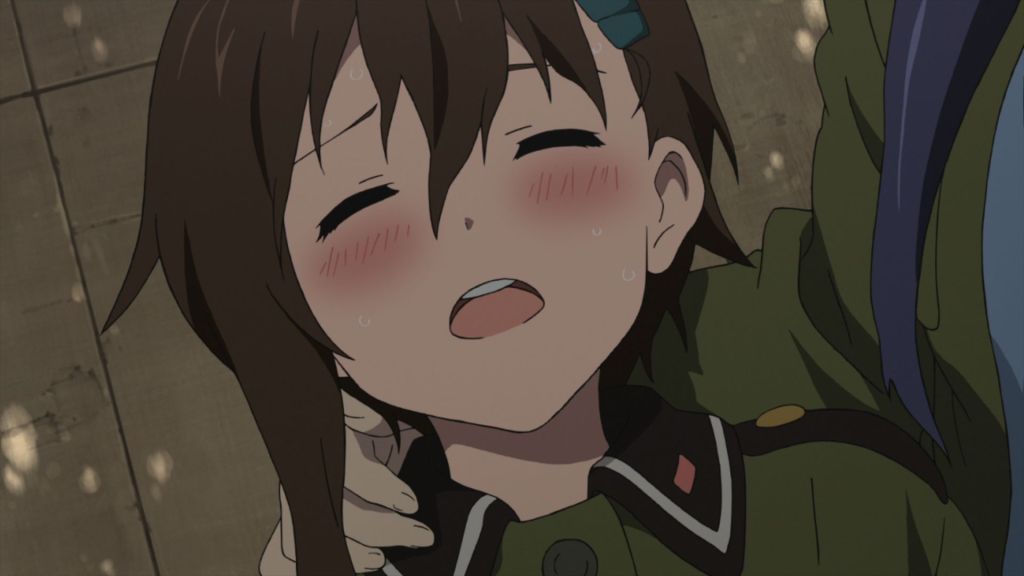
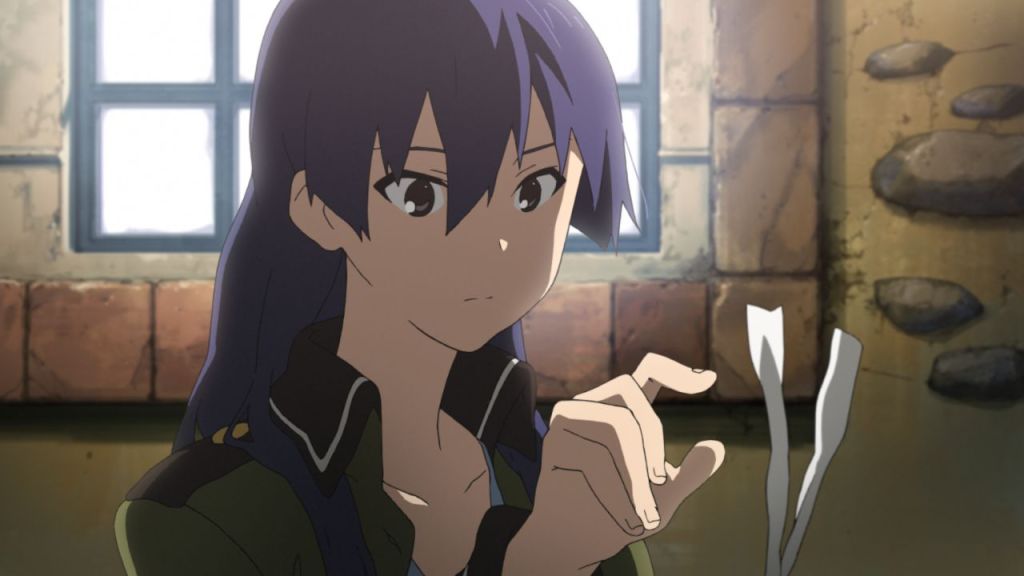
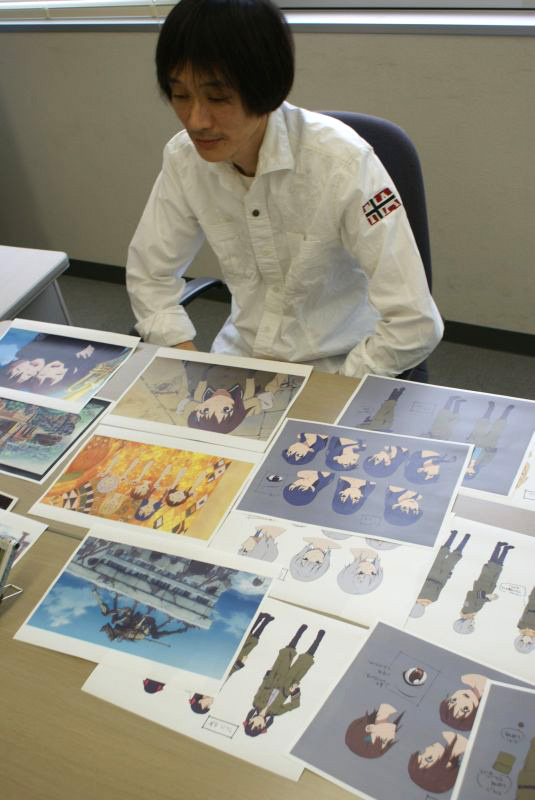
Original interview from ASCII.jp, published in two parts, Part 1 and Part 2, on July 17th 2010 and July 24th 2010, original interviewer: Watanabe Yumiko 渡辺由美子.
Even in anime, I don’t want to create a “miniature garden” [Part 1]
— Kanata and the others live in a world that may soon be coming to an end, and as soldiers, they have been stationed at the fortress. With a premise like that, one might expect the story to carry a much heavier, more tragic tone. Why did you choose to portray the girls’ warm and peaceful everyday lives instead?
Kanbe: That was something we decided from the very first meeting. Since it was set to air in a late-night slot, we wanted it to have a warm and comforting atmosphere, that would let viewers go to sleep feeling relaxed after watching.
Akira Shimizu(A-1 Pictures): So Ra No Wo To was broadcast as part of Anime no Chikara[アニメノチカラ], a late-night programming block that started at 1:30 a.m., so a large portion of the audience consisted of adults. Creating something people could relax and watch quietly at home after coming back from work was a request from our side.
Kanbe: When the idea of creating an original anime first came up, the initial concept I proposed was a reincarnation story centered around a man and a woman traveling along the Silk Road. However, the feeling was that the Silk Road setting wouldn’t attract many viewers, so it didn’t go through in that form.
Though, overall, I think I was able to incorporate just about all of the elements I originally wanted to explore into So Ra No Wo To.
“What viewers of late-night anime tend to enjoy these days are warm, easygoing worlds where girls happily go about their everyday lives”, says Shintarou Komatsu of Aniplex. With those audience preferences in mind, the direction gradually took shape: on the one hand, to create a fun and relaxing series that viewers could watch comfortably, and on the other, to make it a work with enough depth that, if one chose to think about it seriously, there would always be more to consider.
A world with a sense of continuity
— A work that could be enjoyed peacefully, and on top of that, offer deep thoughts about its story. This is the foundation of So Ra No Wo To, but what direction did youin particular want to give it, Director?
Kanbe: During the initial discussions, it was proposed that the story’s world should have a sense of continuity, and I thought that was a really interesting concept.
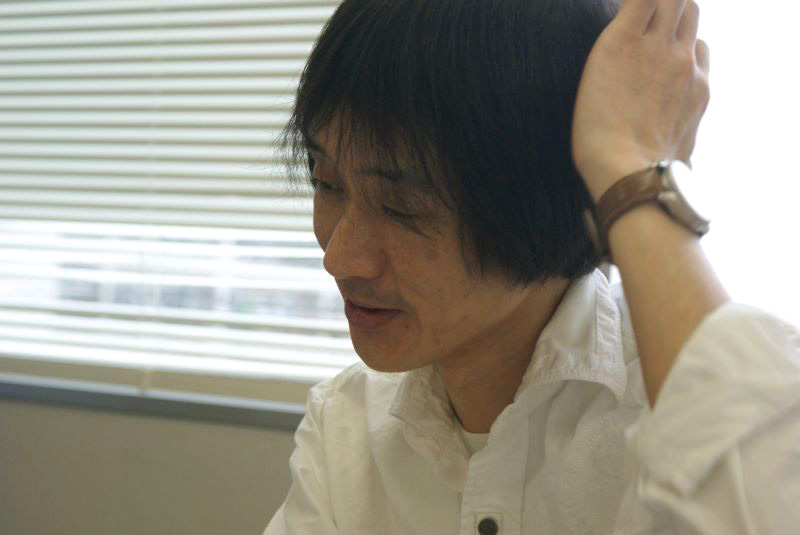
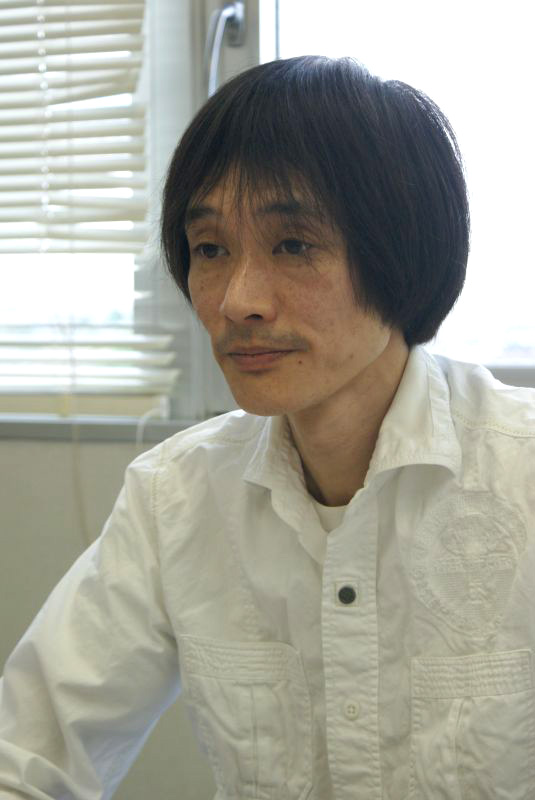
Director Kanbe, as he mentioned having troubles figuring out how to convey the “sense of continuity” in a fantasy world.
— Sense of continuity…?
Kanbe: For example, when people watch So Ra No Wo To, they should be able to imagine what the world Kanata and the others live in was like five years earlier, or what it might become five years later. That way, the story would become much more convincing, and its world would feel more familiar and real to viewers.
When I first heard about this idea of a “world with a sense of continuity”, I immediately thought it was a matter of “realism”. And in that case, I thought setting the story in contemporary Japan would be the best choice. It would be set in a city, a scenery like the one that can be seen from this window right now, with the Chuo Line speeding by, many houses standing in rows, and there would be schools, too. I proposed we set the story in a realistic landscape like that.
But then, someone said such a setting would lack fantasy appeal, and maybe choosing something different from modern-day Japan would attract viewers more decisively. So, we started discussing how to convey realism in a fantasy world.
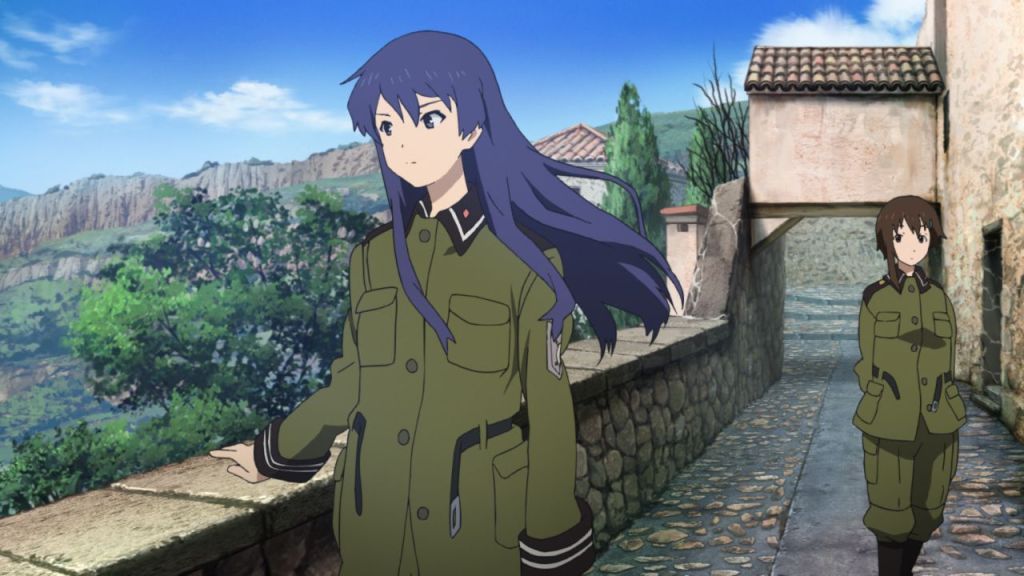
At that point, scriptwriter Yoshino Hiroyuki-san, who had just happened to see a television program about World Heritage Sites, had a flash of inspiration and made a suggestion: the fortified Spanish city of Cuenca and the Alarcón fortress. And everyone immediately thought: “Oh, this is interesting”.
Building a setting based on a real-world region, one that feels continuous with Japan, yet belongs to a country with a different culture. This aspect was what made it work for everyone. After that, we all agreed on the setting and decided right away to go on a location scouting trip.
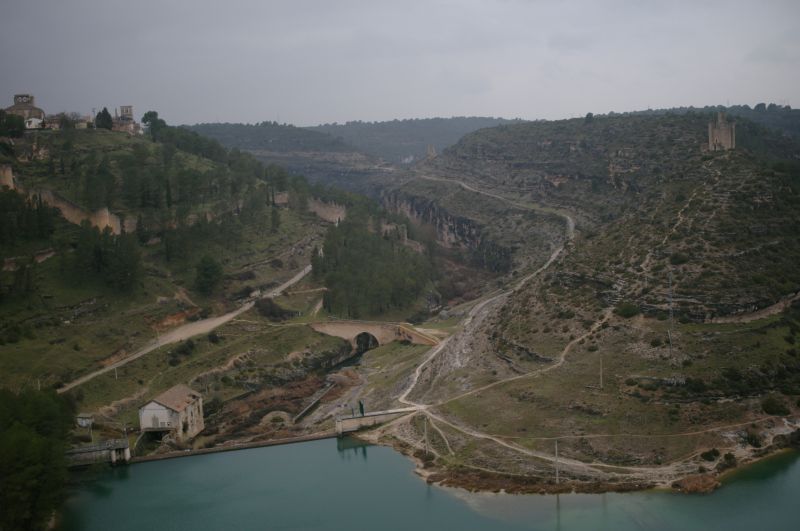
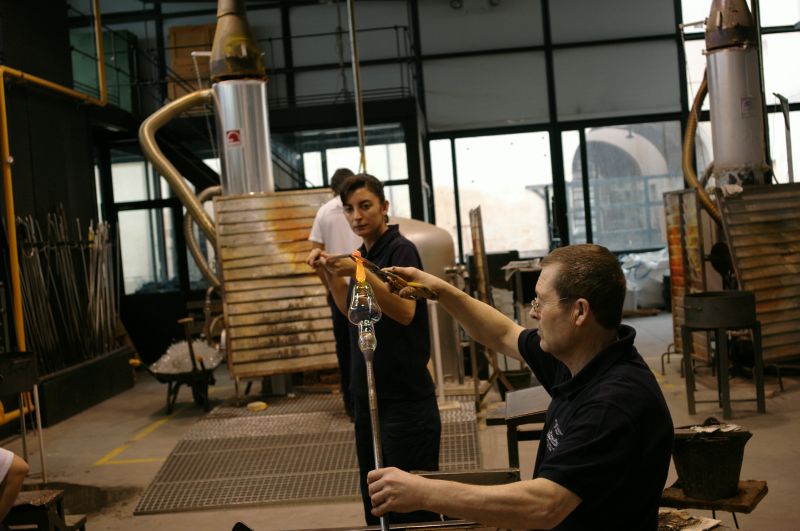
Director Mamoru Kanbe and the rest of the staff carried out location scouting for So Ra No Wo To. They visited the fortified city of Cuenca in Spain’s Castilla-La Mancha region, as well as the Alarcón fortress, a glass factory, and the House of Cervantes. In the end, the fictional town of Seize, which became the setting of the story, was designed as a place with a hybrid culture blending European and Japanese influences. This, too, was done with the goal of creating a “sense of continuity” in mind.
The fortified city of CuencaThe glass factory
— So, by visiting the real place directly, you were able to “convey realism in a fantasy world”?
Kanbe: Yes. Maybe that’s what they call a “first-hand experience”. Cuenca in particular was under Arab occupation for some time, and because of that, its taste is somewhat different from what you’d normally find in the rest of Europe. It also has wooden architecture. And over the years, due to various circumstances, some of those buildings ended up with slanted floors. Standing in them gives you a strange sensation. But the locals just use them as they are. It must be a peaceful, serene place to live in. The slanted floors for example, you really can’t get a feel for them until you’ve actually stood there yourself.
Ultimately, we didn’t replicate the slanted floors directly in the anime, but the people I worked with have all been to that place too, and I believe that‘s what really mattered. Set designer (Tomoyuki) Aoki-san, background artist (Masatoshi) Kai-san and scriptwriter Yoshino-san too, we all went together.
— What would you say is the biggest difference between going to scout the actual location and not going?
Kanbe: I believe it changes your notion of reality. It was small details, like the shape and placement of doorknobs. In Cuenca, the knobs were mounted right in the center of the doors, and we found ourselves wondering: “How are you even supposed to use this?”.
In Japan, doors like that would be unthinkable, yet the local people used them as if it were perfectly normal. When it came to conveying the sense of realism, I think being able to grasp that feeling of “normality” was the most important aspect. From our perspective, these things seemed strange, but for the people living there, they were completely ordinary. It wasn’t like: “Wow, how unusual!”, they didn’t find it surprising at all.
After the location scouting trip, I started thinking again about what exactly this “sense of continuity” really meant. In the end, I think it comes down to creating a world the audience can perceive as tangible and substantial, even if they had never been there personally. Even in a fictional, fantasy world, if Kanata and the others live their lives treating things like those unusual doorknobs as perfectly normal, portraying that sense of everyday life creates that feeling of continuity with reality.
I wanted to add a sharp sting of “reality”
— What feelings did you want to evoke in the audience by portraying the world of the anime as normal and ordinary?
Kanbe: Simply that “that’s reality”. The world where Kanata and the others live is theirreality, after all.
This ties back to what we said earlier about making the series comforting and relaxing while still giving it depth, but the idea of “adding some sharper, more bitter elements to the story” also came from me. Because in reality, there’s no such thing as a world completely free of those harsher sides.
I didn’t want the series to remain just a sealed-off “miniature garden”, shut away with nothing but pleasant things in it. I may have felt that way to some extent.
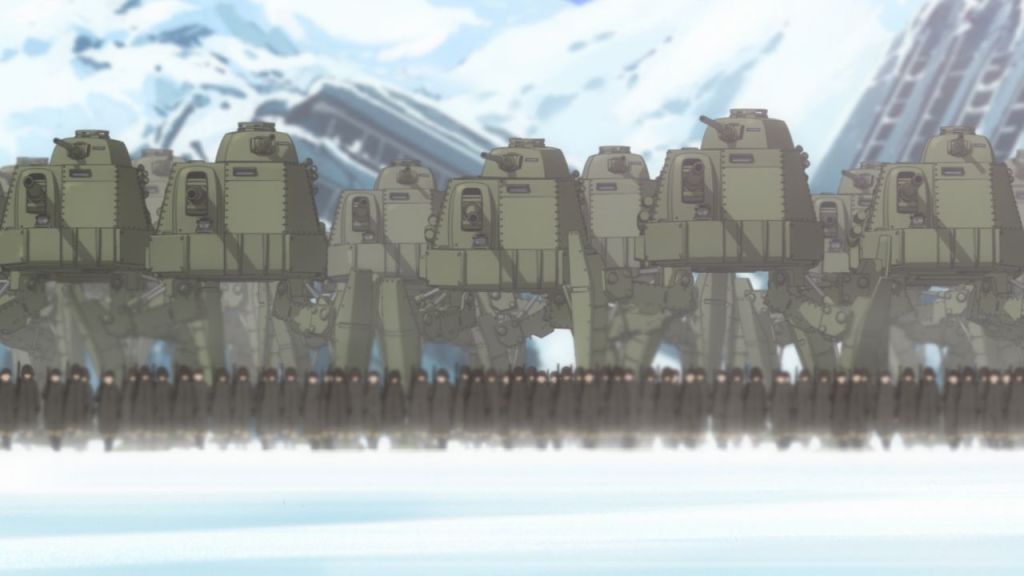
The battle field, conveying the sharper and harsher realism of the anime.
— Like adding something more raw to the easygoing atmosphere.
Kanbe: Exactly. An element of realism I wanted to add in So Ra No Wo To was the presence of parents. I didn’t want to make a story where parents simply never appear at all. After all, these characters must have been born to parents.
In anime, it’s quite difficult to put the spotlight on “adults” in a prominent way, and there’s also the fact that it would drift away from the audience’s interests. I, personally, wouldn’t mind an anime with a 35 year old guy as the protagonist.
“Parents” especially are often viewed by teenagers as intrusive and overbearing presences. Adolescence is an age of rebellion after all. I used to be pretty much like that too, there was definitely a time when I thought: “Parents, who needs them?” (laughs), but as you get older, you start to think: “Wow, parents are amazing!”. Everyone is born because their parents were there, so let’s take care of them, that’s how I feel now.
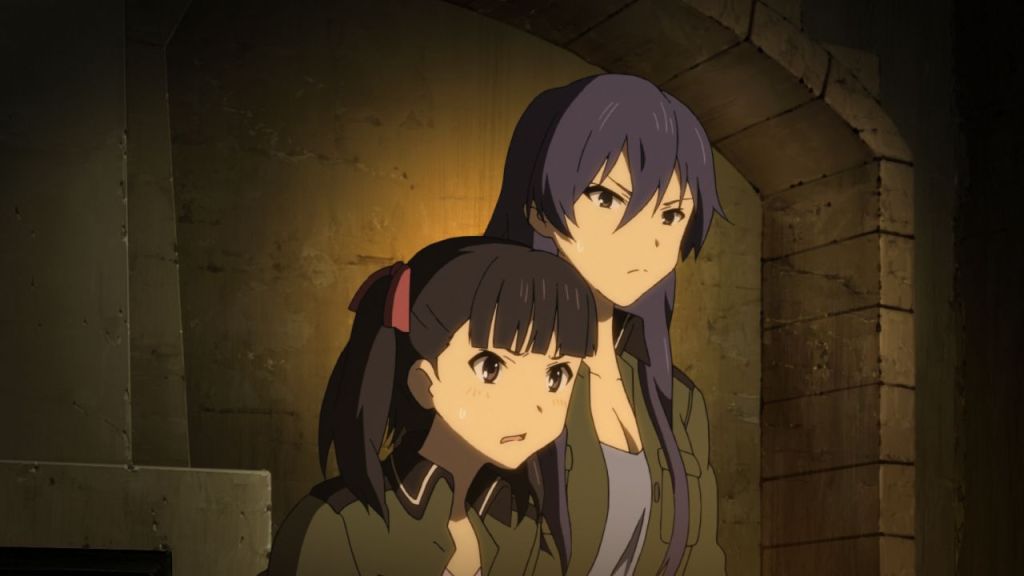
So, that’s why I asked Yoshino-san to make sure the presence of the parents of Kanata and the others was clearly established, even if they never actually appear on screen. With things like Kanata receiving a letter from her parents, and the contrast between that and Kureha revealing hers had died in the war. Even if they never appear directly, I was always mindful about their presence in the story.
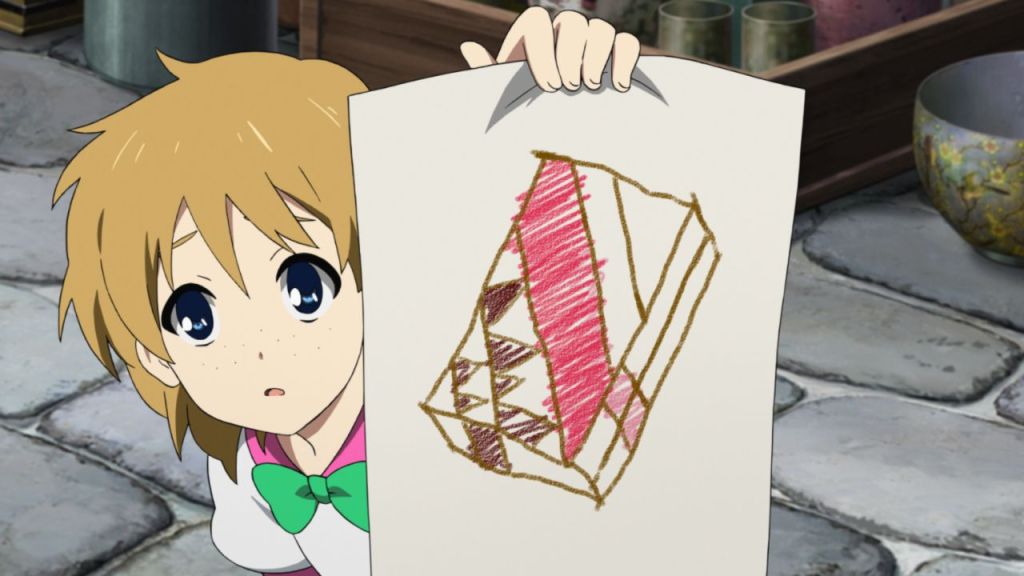
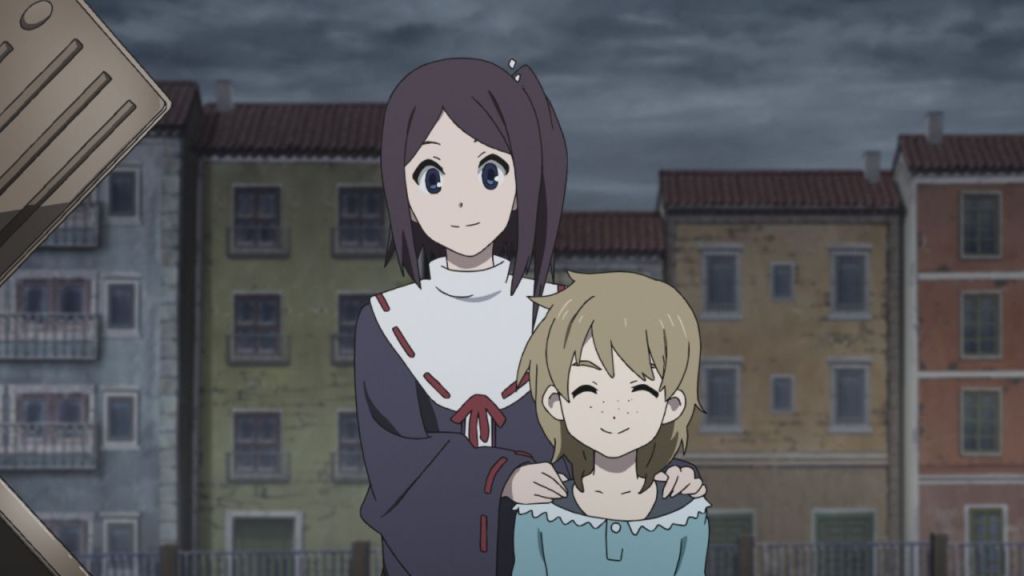
Various scenes from the anime bringing into the story the presence of the characters’ parents.
Bringing out the realism of war within the easygoing atmosphere
— Talking about this inclusion of realism in the story, Kanata and the others live in a world where war exists right alongside their everyday life. How did you approach the depiction of war as normal and ordinary for them?
Kanbe: In the end, that aspect ended up leaning more into the fantasy realm, didn’t it? That’s because none of us has ever experienced war first-hand. However, one thing I believe we managed to depict in a slightly more authentic way is first-hand accounts of war. In my case, generationally speaking, my father, mother, and uncles all lived through the war.
What struck me most about the stories from my father, who was born in Showa 10 [1935], was just how much they struggled to find food. Every single memory he had was tied to eating in some way. What he called “playing”, it seems, was sneakingfood.
There was a strawberry field near where he lived, and he and his friends used to sneak in, crawling on their bellies to pick strawberries and eat them lying right there on the ground. Gritty with dirt and everything. And when the owner of the field spotted them, they’d all scatter in a panic. That was their idea of “play”.
If there’s anything we truly managed to capture in this work, it would be the experiences of people like them.
— As a way of conveying the reality of war, one approach would be through meticulous depictions of battle itself, but in So Ra No Wo To, you chose to convey it through the portrayal of human beings instead, is that right?
Kanbe: Yes. That’s why this show depicts the atmosphere of the “post-war”. In the story, it’s actually a ceasefire, but I hoped to bring out something like the sense of relief that comes with the end of a war. The people of the town still carry raw and vivid memories of the war, but at least it’s over now. “What a relief!”, that sort of feeling.
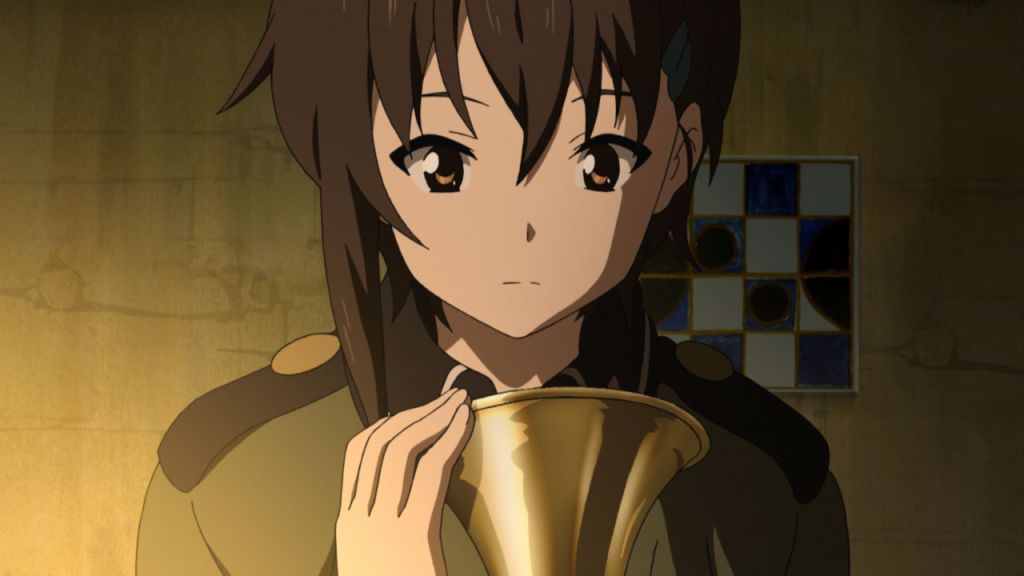
The opening sequence of Episode 1, when Kanata is on the train heading towards her destination, the town of Seize, is a scene that I hope managed to convey that kind of post-war relief. I asked the voice actors to perform as if a long-held sense of tension was finally beginning to lift.
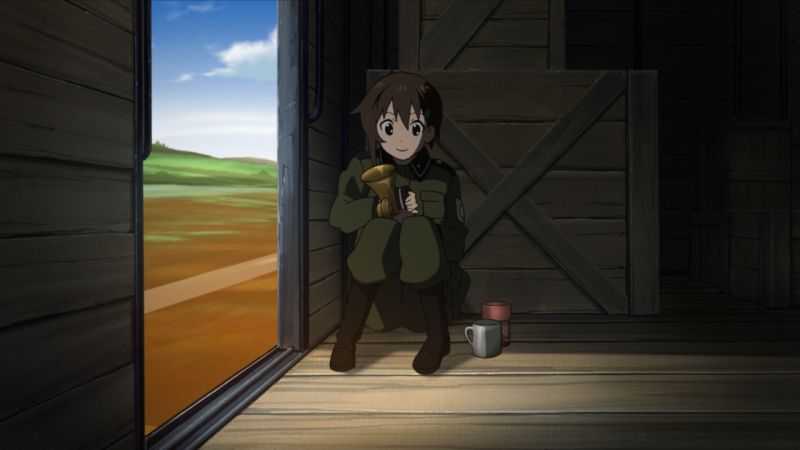
Kanata, moving to the town of Seize on a shaky freight train, with the caramel can she received from a kind soldier (from the opening sequence of Episode 1)
A happiness with a slight sting to it
Kanbe: What I wanted to portray in So Ra No Wo To wasn’t a “miniature garden”-like world where the girls could live happily without obstacles, but rather the warmth and happiness that emerge from never losing hope, no matter how desperate the situation may be seen to be.
— The “happiness” portrayed in the show feels somewhat hard-earned bittersweet. An episode that left a lasting impression on me was the one featuring the old lady that kept waiting for the man who left her when they were young [Episode 10]. She believed in his promise to come back for her, and then one day, she ran out of her house and vanished into the snow.
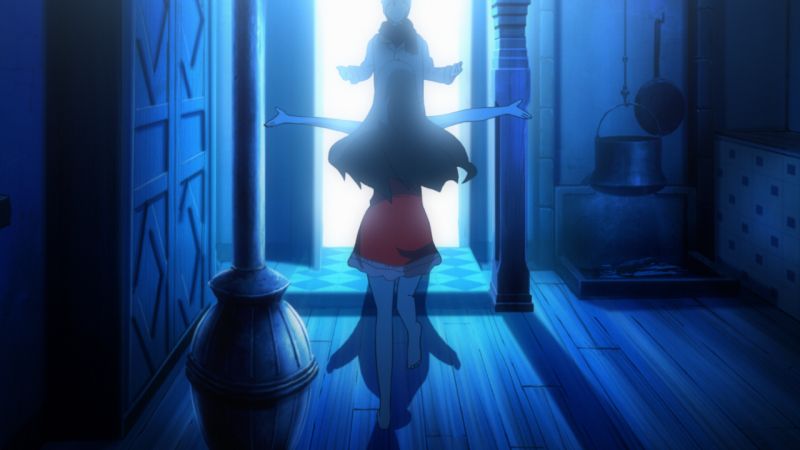
The long-awaited lover finally had returned to her, and young again, just as she once was, she flung open the door and ran out to meet him. After that, the “old lady” vanished into the snow.
Kanbe: That’s based on a real story I heard from a friend who was also part of the staff, it’s something that actually happened, or so they say. In a certain countryside town of France, an old lady was building a house and all of a sudden, one day, she left, bare-foot, and disappeared into the woods. I thought it would work well visually, so we tried to add it into the show.
— In that moment, Kanata said: “People can keep on living because they have memories of when they were happy”. Would you say that, to you, that’s one of the shapes happiness can take, Director?
Kanbe: It was Yoshino-san who came up with that line, and essentially it means that if a person believes they’re happy, then they probably really are. The perception of what’s “normal” changes from person to person, I believe. And so does happiness.
My eldest uncle once told me a story about an air-raid. He lived near a large river, and when everyone was burned out of their homes, they’d make their way to the river looking for water. But the river was full of dead bodies. The many corpses strewn along the river were treated as if they were no longer human.
He said that once you reach that point, your senses go numb, and that sight becomes just another “normal” part of the landscape. He told me this at a funeral, and what he said next has stayed with me ever since: “The fact that we can have a proper funeral like this today, it really shows how incredibly peaceful things are now”.
The story conveys the message that what’s “normal” differs depending on what your eyes have witnessed.
— Being able to hold proper funerals really means that we’re living in peace.
Kanbe: It does. Hearing my uncle’s story got me thinking. My father’s tale of sneaking strawberries, if you consider that they were always hungry, it must have been truly a hard time, and yet, the fact that he framed it as “playing” speaks to a sensibility quite different from ours. The fact that he told me the story more than once too means he must have enjoyed it to some extent. He was able to eat, so he was happy, that might be it.
— You’re saying that happiness too differs from people to people?
Kanbe: At least, that’s what I believe. Even if others wouldn’t understand it, if you feel happy in that moment, then that moment really is happiness.
I have some of those myself, moments of “happiness” that, thinking about it now, I’m not sure I could explain to anyone. When I was working as a Production Assistant on Kaze no Tani no Nausicaä[Nausicaä of the Valley of the Wind, 1984], all I looked forward to back then was sleep. I barely got any, you see (laughs). That moment of finally getting to sleep, that was when I was happiest.
In the end, it really comes down to whether you’ve experienced it first-hand or not. For both happiness, and working on a show. Your own, personal experiences are truly the most important.
Portraying a connected world in anime [Part 2]
— In So Ra No Wo To, Kanata, a bugler, goes through many experiences and comes to convey something of her own through “sound”, that’s the kind of story it became, wasn’t it?
Kanbe: The story is set in a world roughly 250 years from now. Our current civilization has collapsed and the world has been rebuilt from the ground up. The survivors are creating new towns, and throughout those towns, there are ruins reminiscent of the past civilization.
A large portion of the Earth’s surface has become a sterile land, impossible for people to inhabit, and it is said that the remnants of humanity scattered around the rest of the world are heading towards their end. However, even in a landscape like that, there are things that have been inherited from the past. And Kanata’s bugle is one of them.
— What’s the reason you chose “sound” as the means to convey this concept?
Kanbe: As they say, music transcends language. Like how songs made in Europe can reach even Japan, crossing all kinds of borders to connect with people all around the world.
As for the song Amazing Grace, I remember choosing it from all the possible candidates because I felt everyone in the world must have heard it at least once. The original composer is actually unknown, and that carries over into the story too: even in Kanata’s time, it’s a song where no one knows who made it or how. And yet, it still comes through. I thought that was fascinating.
Passing it on, from person to person
— What significance do you personally think “conveying things to others” holds, Director?
Kanbe: This might be a bit of a leap, but I think it means “leaving something for the next generation”. That applies to having descendants, and also to passing on the experiences we’ve lived through to those who come after us.
For example, lived through the war when they were children, and if I were to have children, I would pass those stories on to them. There are many different ways of conveying something to the next generation, and I believe festivals and folklore are among those methods.
In So Ra No Wo To too I tried including the “Water-Splashing Festival”, and apparently festivals that recreate events from the past are found scattered all around the world. And by repeating those festivals every year, the children become parents, then elders, and experience them along the way. And in this repetition, things from the past get conveyed and passed on to the next generations.
On the “Water-Splashing Festival”
The day when Kanata reached the town, in Seize the “Water-Splashing Festival” was taking place. In the distant past, the town of Seize was attacked by a demon, and the 5 Maidens of Fire offered their lives to protect it. The festival is held every year to console the spirits of the Maidens.
Kanbe: The festival depicted in the show is fictional, but there’s actually a very similar tradition in Southeast Asia. The part where a Maidens hold the demon’s head in the flames is almost identical.
— What I found fascinating was that the legend of the “Fire Maidens” passed down in the town of Seize was conveyed in a different form in the enemy nation [the Roman Empire]. According to their version, it wasn’t a demon who caused the Fire Maidens’ death.
Kanbe: The narrative had been swapped out for a more heroic version. The demon [who is an angel in the Empire’s version] came in a near-death state, and the Maidens, knowing it would soon die, chose to let it pass on peacefully. But the townspeople, who were afraid of the demon, ended up killing the Maidens along with it. It was out of a sense of guilt, feeling they had wronged the Maidens, that they rewrote it as a more noble tale. Those who passed the story on twisted it to suit their own convenience.
— Some aspects always end up getting twisted as things are passed on. I believe that happens all the time in reality as well, not just in fiction.
Kanbe: I’m sure the majority of what gets passed down from the past carries the biases of those who narrated it, with their own interests taking priority. Otherwise, there would be no way to explain why historical interpretations differ from country to country.
Facts not being passed on accurately is something that happens close to home for us too, I think. Even without any deliberate distortion of reality, there’s also the matter of distance from the subject, whether physical distance, or the distance in time, causing details to get lost in the process.
A thing that made me realize this was a story from an acquaintance of mine in Alaska. I meet with him when he comes back to Japan, and one time I lightheartedly asked whether the effects of global warming were visible over there. He said they were in plain sight, in a very tangible way.
Alaska’s land is basically all made out of sand, apparently. The ground is formed by hard and compact lumps of this sand, and that frozen ground is starting to thaw. Depending on where it does, the coastline is getting closer and closer, and the portion of land where people can live is actively in decline. In So Ra No Wo To too, one of my personal themes was the idea that “what is visible to us right now is not all there is to reality“.
— What is visible to us right now is not all there is to reality…?
Kanbe: No matter the context, there always is something that we cannot see from our side. For instance, the situation in Alaska is not something we can see by being here in Japan. Despite it happening on the same Earth.
In the series too, we depicted this by showing how Kanata and the others didn’t know how their nation was perceived from the outside, until a girl from the enemy army told them directly. Passing things on, and the misunderstandings that come with it; I wanted to explore these themes in the work as well.
The role of letting the next generation “imagine”
— In the process of conveying things, misunderstandings arise. What do you think of the facts that get distorted along the way?
Kanbe: I don’t think it’s either a good or a bad thing. After all, when something happens and people talk about it, they do so from the perspective of their own convenience, don’t they? Leaving out the bad parts, or changing the story a bit.
— So, you believe it’s truly inevitable for misunderstandings to occur?
Kanbe: Well, rather than it being “inevitable”, that’s just how it is. I personally am extremely attracted by relics and ruins, after all, relics are the history of mankind itself. The buildings and structures that are left behind aren’t preserved in their entirety, so we have to imagine how the world of the past was based on what’s left.
We’ll never know exactly what it was like, but people of the generations that come next will come up with different interpretations, “I think it was like this”, “No, I think it might have been like this”, and so on. I think this process of imagination is genuinely fascinating and fun.
In the show too, Kanata and the others have discussions about how they believe the building they’re currently using as a fortress was once a school. There are things like textbooks or blackboards that have been left behind, and the characters try to imagine what kind of people used to use them.
— Regardless of how reality actually was, it’s those who inherit it who imagine its form as they please.
Kanbe: Exactly. They imagine it and interpret it as they please. It’s imagination, so there must be some aspect they get wrong. But I believe there’s a significance to the act of imagining by the next generations. In other words, the people who once lived there are passing on traces of their existence to future generations.
The repeating endeavor of mankind, history of mankind
— In Kanata’s world, there really are many places with ruins or relics from the past. It’s a world where humanity over-developed its civilization, and eventually headed towards its ruin. Why did you choose to depict it that way?
Kanbe: The story is very extreme in its portrayal, but I suppose the idea was that even if mankind has made mistakes in the past, the history of those mistakes is passed on along with everything else.
There’s no such thing as a never-ending civilization. Past civilizations too, at some point just faced their ruin, in the sense they aren’t directly connected to us, living in the present. It’s ultimately what humans do, and I feel like it’s something that’s bound to repeat over time. So much so that we have sayings like “history repeats itself”.
In the Aomori Prefecture there’s the Sannai-Maruyama, a huge historical site from the Middle Jōmon Period, from a civilization that lasted for about 4000 years. And that civilization too came to its end by the end of the Jōmon period. The reason why it ended is still under investigation, but on top of a global-scale cooling event, it’s also thought to be linked to the cultivation of chestnut trees in Japan.
Given the excessive presence of chestnut trees around the site, the theory goes that the uncontrolled increase in chestnut cultivation led to environmental destruction. In other words, what happened there was that humans reshaped nature to suit their own needs.
The very things that drive humanity forward can, at the same time, be seen as mistakes. Technological advancement is a good thing, and we reshape the environment and advance technology to suit the way humans live, but then, even if we say: “Let’s stop global warming, let’s stop emitting CO2”, getting rid of all cars would surely cut emissions significantly, but our current way of life would become impossible to sustain.
Humanity keeps on living, even as it repeats its mistakes
— You could say that humanity keeps repeating its “mistakes” throughout the course of history.
Kanbe: I believe that’s what history is. Our actions might be viewed as “mistakes” by future generations. And yet, people do the best they can with what they have in each moment, and as long as human endeavor continues, the same things will keep repeating.
— And you’re saying that even so, there’s still meaning in inheriting them, right?
Kanbe: Yes. That’s something I tried to be mindful of in So Ra No Wo To as well. In that world, humanity made mistakes, and it’s heading towards its ruin. Nevertheless, in the story there still are things inherited from that past, like technology, music or decaying buildings. At some point in the show there’s the line: “That’s what history is”, and I believe that sums it up.
Even in a world said to be on the verge of collapse, Kanata and the others take in what they receive from the people around them and from what past generations have left behind, and think about what they themselves should do going forward. They too are part of history, and in that way they carry it forward. That’s the kind of connection I hoped to convey.
— To convey her feelings to everyone else, Kanata plays Amazing Grace. And through its repetition, it passes from person to person, like a relay.
Kanbe: The lyrics in Amazing Grace are really good. It means something like “God would forgive even someone like myself”. Tying back to the idea that there will always be mistakes in people’s actions, and that’s part of what gets passed on.
Everyone is born from their parents, we experience many things throughout the course of our life, and eventually meet our death. And in this process, we leave something behind for the next generation. I believe every single one of us is a “bearer of history”, Kanata and her friends, myself, and you too.
In the past few weeks I’ve been making my way through the 1998 anime series Cardcaptor Sakura, which I know very well needs no introduction. I initially meant it as nothing more than a “personal” watch, just a show I wanted to watch for myself and by myself, without necessarily writing anything about it. Well, that original intention lasted for a whopping 16 episodes out of the total 70, when the storyboard and direction for episode 16, “Sakura and the Rainbow of Memories“, completely caught me off guard with their nuanced and expressive visual approach. That alone was already enough to ignite my writing fuels, but as the credits started rolling and his name popped up, I totally couldn’t help but put together a (somewhat messy) thread about it on Twitter. The person I’m referring to is, of course, director Mamoru Kanbe (神戸 守), whose name should sound very familiar to those who have comeacrossthis blog in the past few months.
To my surpriseーwhich was mostly due to my bad habit of never doing my research before watching something newー I learned that he was involved in multiple episodes of Sakura as the storyboard artist and episode director. Throughout my watch, I ended up writing and posting a handful of threads on the (then) bird app about some of the episodes directed and boarded by Kanbe, as well as an artist whose name was new to me, Shigehito Takayanagi (高柳 滋仁). My intention with this post, then, is to compile all of those rather short write-ups into a single, more substantial and consistent piece, along the lines of my “Episode Notes” series of posts. The primary focus will be the storyboard and direction of each episode, all in the hope of providing some interesting insights on the techniques used to achieve the distinctively captivating visual presentation at play.
Episode 16 – さくらと思い出の虹: Sakura and the Rainbow of Memories
絵コンテ・演出: 神戸 守|SB/ED: Mamoru Kanbe
As hinted at before, episode 16 was the first one to actually make me invested in its visual language beyond the pure personal enjoyment I started watching the series for. Despite not being the first episode of the show directed and storyboarded by Mamoru Kanbe ーhe worked on episodes 5, 9 and 12 before this oneー it definitely was the first one where I recognized his style and approach, or to better put it, the first episode whose visual presentation really grabbed my attention to the point that finding out Kanbe was the man behind it didn’t feel all that surprising.
I absolutely love it when anime (and visual media in general) make purposeful use of their many visual elements to subtly embed meaning into their shots and frames, effectively realizing their full expressive potential. This kind of approach to tell purely on a visual basis enhances the viewer’s experience from something passive to an active engagement, and Kanbe has proven to be truly a master of this style.
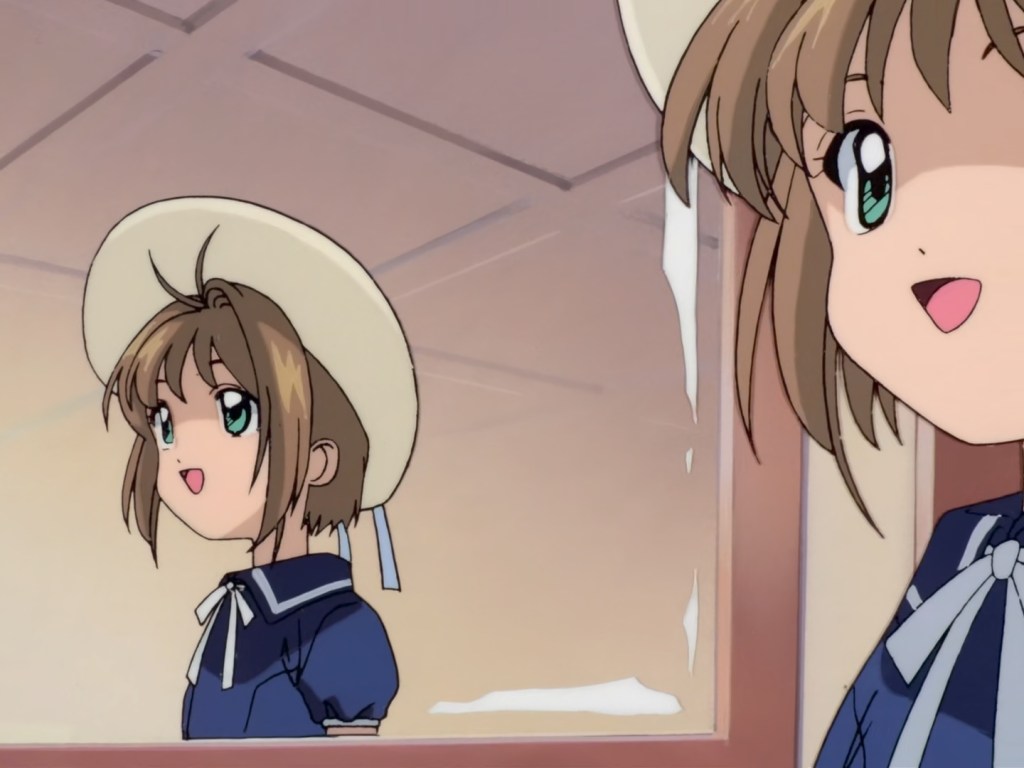
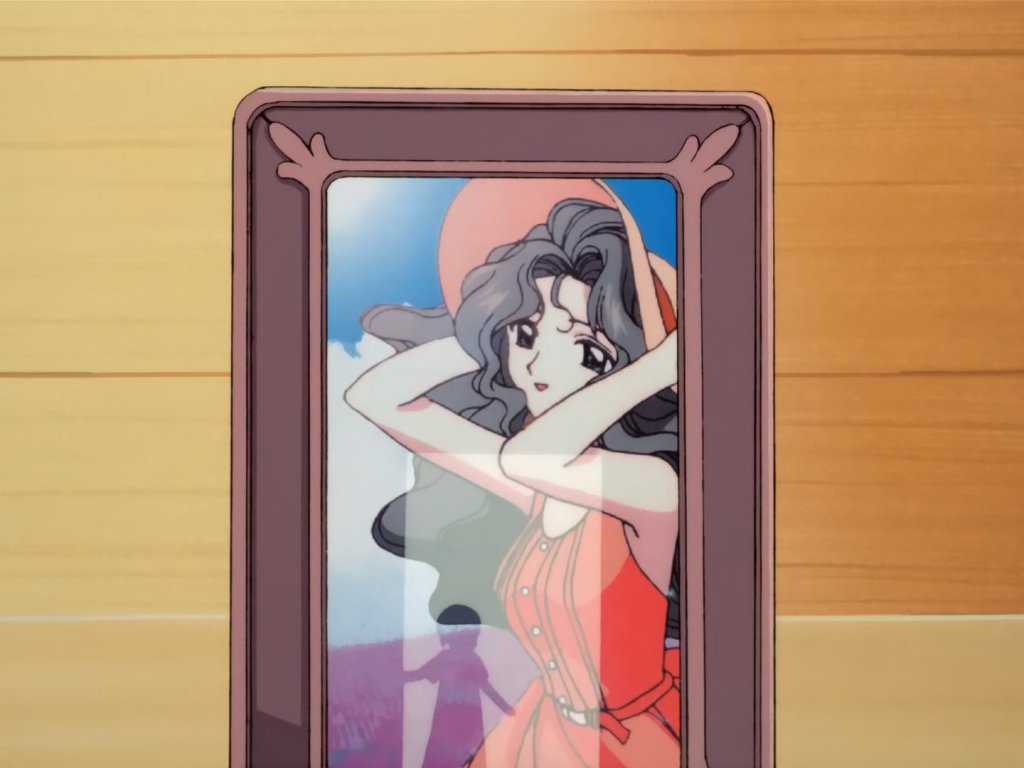
In Cardcaptor Sakura episode 16, elements like the reflections on mirrors and glossy surfaces hint at “reality” parallel to the one being presented through the dialogues and script, providing many visual cues throughout its runtime regarding a certain existing connection between Sakura and the seemingly unrelated vacation house she’s visiting every day. The deliberate placement and focus on Nadeshiko, Sakura‘s mother’s portrait photo, also plays an important role in suggesting the context behind this connection; as ultimately unveiled at the end of the episode, the house was in fact deeply connected to Sakura, belonging to Nadeshiko‘s grandfather, her great-grandfather she’d never met before.
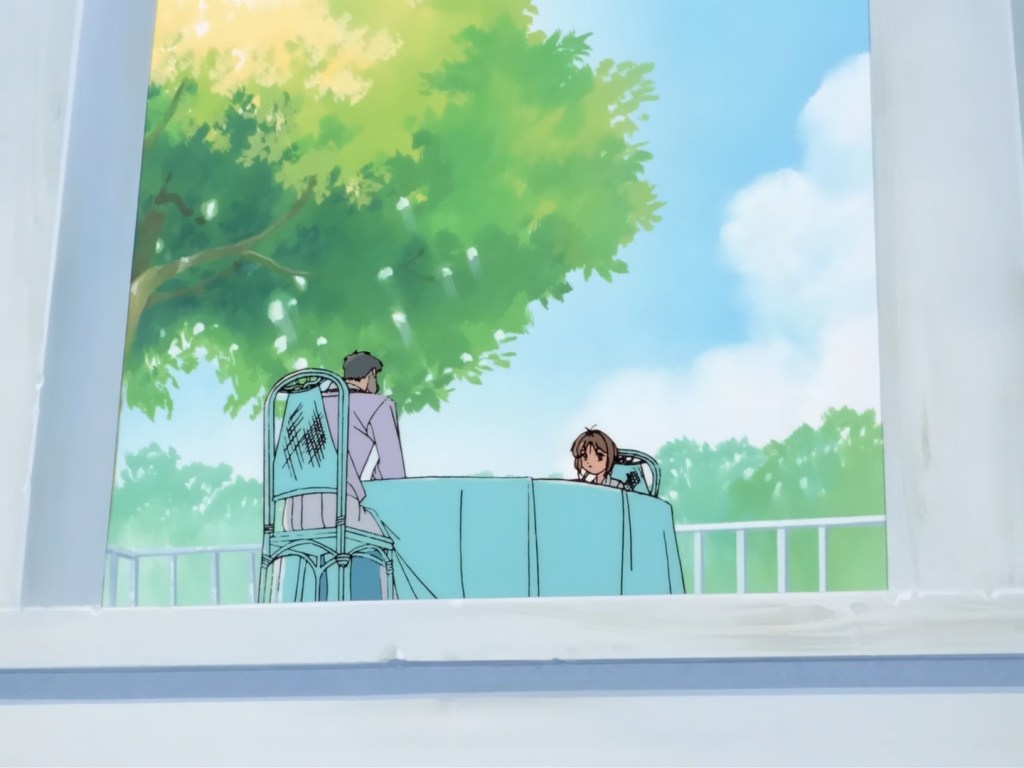
Another element that feels very familiar, especially coming from Kanbe‘s work on Shoushimin Series, is the expressive use of framing and foreground smacking to envelop the characters within the environment around them. In this case, Sakura being enclosed by the terrace’s fences suggests a stronger significance being attributed to her presence at the vacation house, as though the location inherently suits her despite this being her first visit to the place. Additionally, this also serves as a device to place further emphasis on the importance of the setting within the episode’s narrative.
It was quite the welcome surprise to learn that this suite of techniques has long been an integral part of Mamoru Kanbe‘s style and repertoire since the early days of his directorial career ーa discovery I certainly didn’t expect to make thanks to my clueless first watch of Cardcaptor Sakura.
The next episode to have caught my attention was episode 33, featuring once again Mamoru Kanbe in the director’s seat. This episode as well is filled with the same familiar visual quirks already presented in the previous section, this time carefully adapted to fit the context and narrative of the new self-contained story.
The icy setting, highlighted since the very first few sequences, allowed for an extensive and substantial use of reflections as the main visual theme of the episode throughout its 25-minutes runtime, primarily in Part B. As it’s common in Kanbe‘s episodes though, the story’s key elements are briefly and subtly introduced at the very beginning, and only later developed upon as the story progresses. Visual elements are not exception to this: one of the first things to meet our eyes as the episode starts is in fact Li‘s reflection on the ice slate outside of the school’s gate.
Unlike with episode 16, this time there isn’t much hinted meaning or subtle nuance attributed to use of reflections ーrather, they’re simply utilized as a recurring visual theme that also plays a significant role in the action choreography.
I also couldn’t help but notice (and appreciate) the peculiar and distinctive shot compositions deployed all throughout the episode; whether it’s the juxtaposition of the characters’ cels with the foreground or the background elements, or the unusual and, to some degree, eccentric camera angles that make the scenes so eye-catching, they always really stand out to me and in Cardcaptor Sakura‘s case somewhat gave away Kanbe‘s involvement in the episode even before I could read his name in the credits.
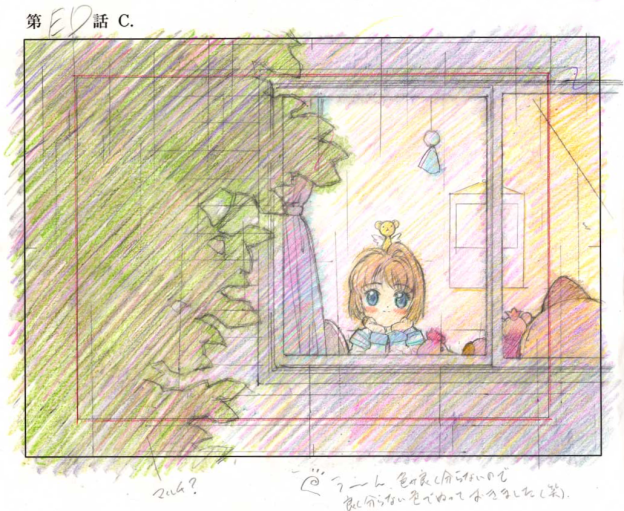
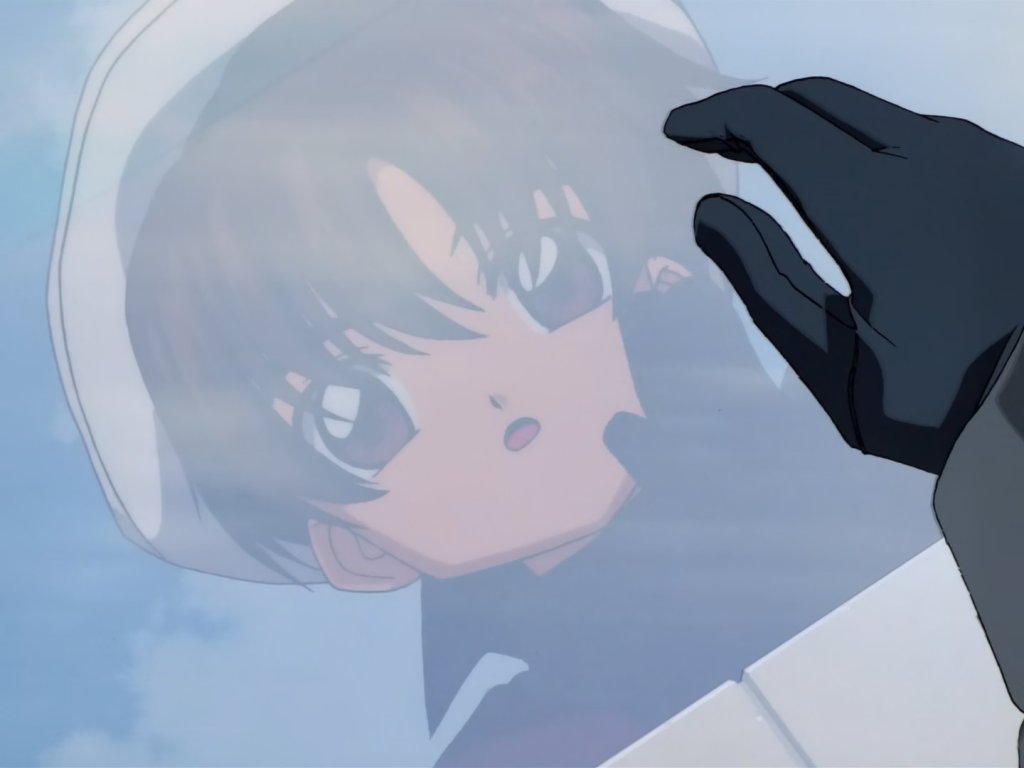
Lastly, there was a shot in particular that I found extremely clever and reminiscent of Kanbe‘s ability to unmistakably convey something to the audience without using a single line of dialogue. Without the need for words, this seemingly unremarkable cut in the beginning phases of the episode clearly foreshadows how Kero-chan won’t play any role in helping Sakura out this time, by physically dividing the two with the window’s glass and using a high camera angle to further increase the distance between them.
It’s subtle details like this that have the biggest impact on how the presentation of an episode is perceived, making even the simplest scenes not only more visually compelling to the viewer but also properly meaningful and worth paying active attention to.
Episode 37 – さくらと消えた知世の声: Sakura and Tomoyo’s Lost Voice
絵コンテ・演出: 神戸 守|SB/ED: Mamoru Kanbe
Episode 37, which is the first one directed and boarded by MamoruKanbe in the second half of the show, features a familiar yet experimental-feeling approach that introduces some new interesting photography techniques in its vocabulary.
As already hinted at before, it’s customary in Kanbe‘s episodes to have the opening sequence serving as a container for the whole episode, introducing the key elements to both the episode’s “mystery” and visual approach. In this instance, the sakura tree as the former and the shift in camera focus as the latter.
One of the “experimental” photography quirks I mentioned in the first paragraph is indeed the focus pull, here used to create a sense of anticipation in the scenes. While it’s nothing truly remarkable on its own, the extensive use of this visual effect throughout the episode is a declaration of intents on Kanbe‘s part, audibly hinting at his will to experiment with this trope for this episode’s direction, resulting in a very fresh-feeling presentation.
The vignette is the other yet unexplored photography effect that plays a prominent role in this episode’s visual language. Creating a stark contrast in lighting between different zones of the frames is a trick deployed to highlight and remark the ominous and oppressive atmosphere of the many scenes it’s featured in, especially when used in combination with uniform and continuous camera movements such as horizontal pannings.
As expected in a MamoruKanbe directed episode, the layouts and camera angles do a particularly great job at isolating the characters in the frames, a job especially important in an immersion-focused episode such as this one, where even the minimal use of the soundtracks is designed to maximize the eeriness of the scenes.
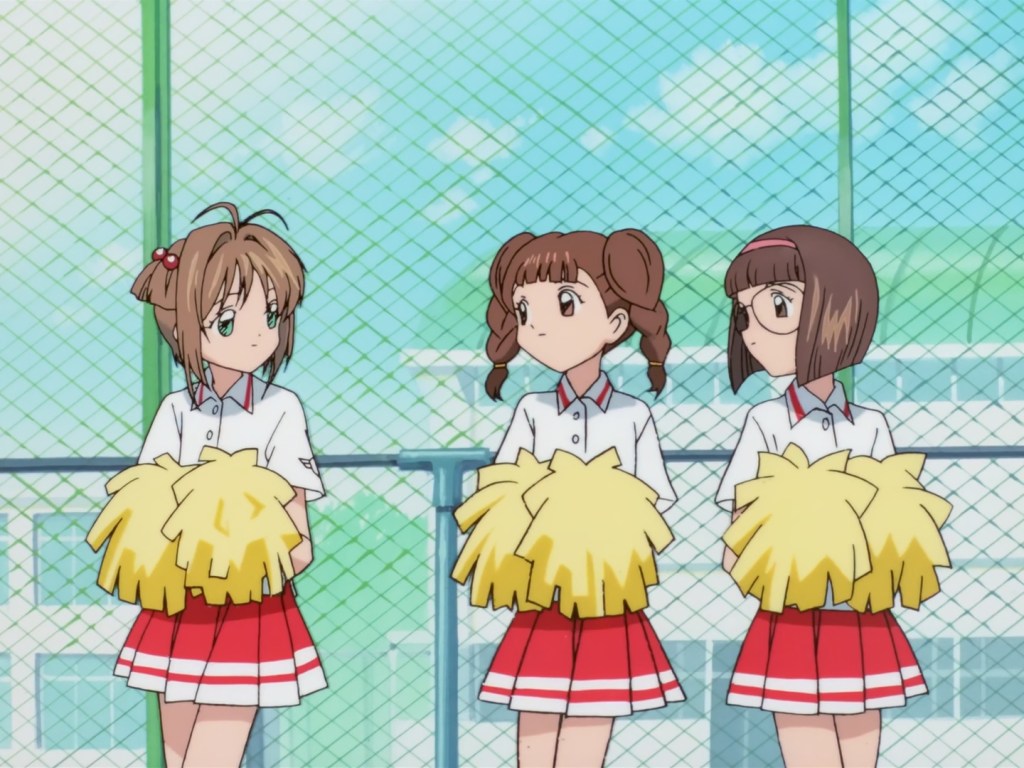
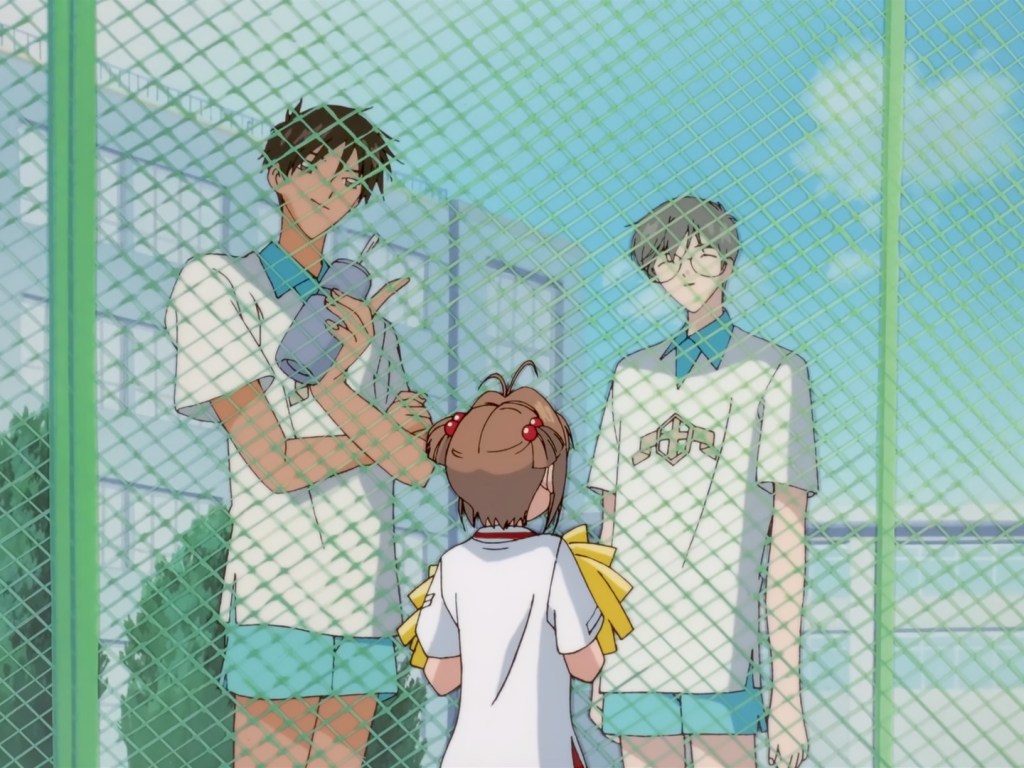
Another extremely familiar technique in Kanbe‘s repertoire, that was also prominently featured in the recent work of his I mentioned at the beginning of this article, Shoushimin Series, and that I’m always looking out for when watching episodes or shows with his name in the credits, is visually grouping the characters via a clever positioning of their cels in relation to the background or foreground elements, implying a remarked sense of distinction and separation between them. Needless to say, Cardcaptor Sakura episode 37 excels at this, using elements like fences and window frames in the background to partition the shots into smaller portions, each assigned to a particular character, or group thereof, to logically divide or separate them.
Episode 40 – さくらと夢の中のさくら: Sakura and the Sakura from the Dream
絵コンテ・演出: 高柳 滋仁|SB/ED: Shigehito Takayanagi
As Mamoru Kanbe‘s presence in the production of this show grew less and less frequent to then completely disappear by the time the Sakura Card story arc entered its initial phases, another director by the name of Shigehito Takayanagi caught my attention thanks to his methodical approach to direction, full of precise and distinct recurring traits. Episode 40, the first one being directed and boarder by Takayangi, has surely left a long lasting impression on me to the point I feel confident in saying it’s distinctly one of my favorites in the entire series.
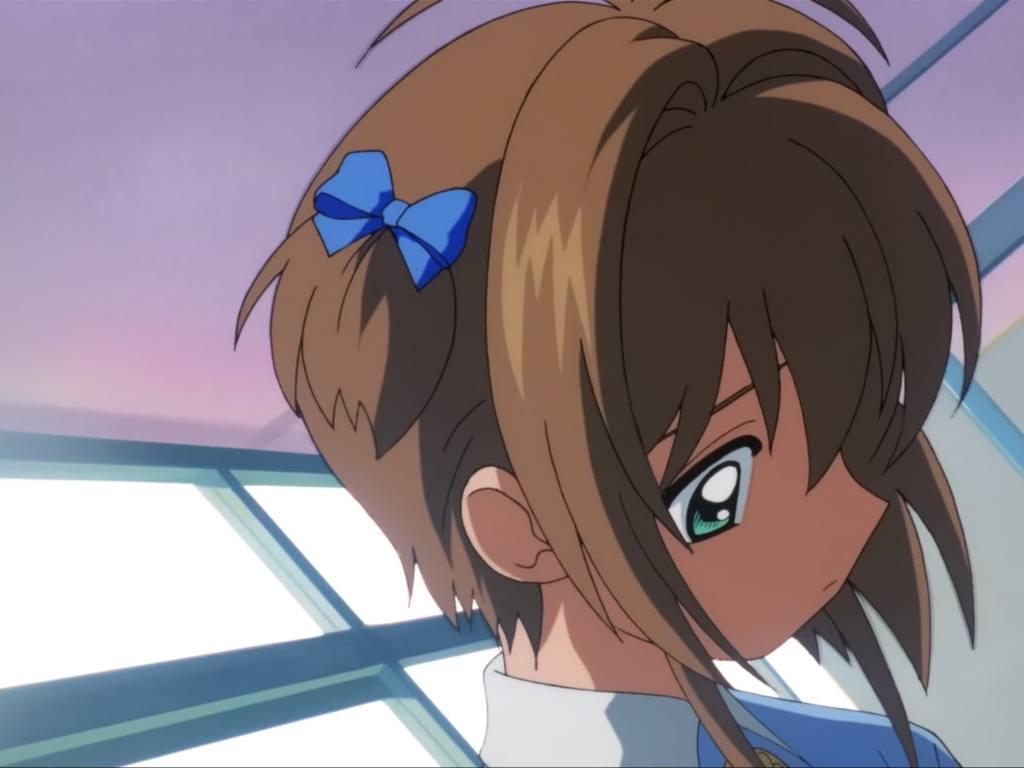
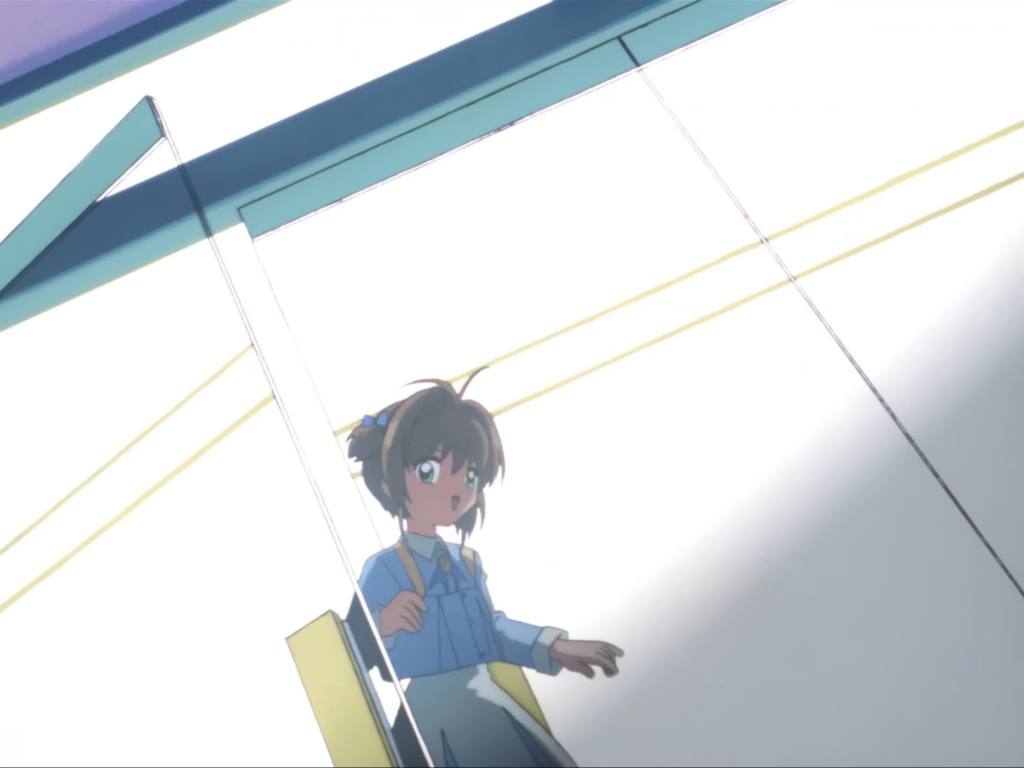
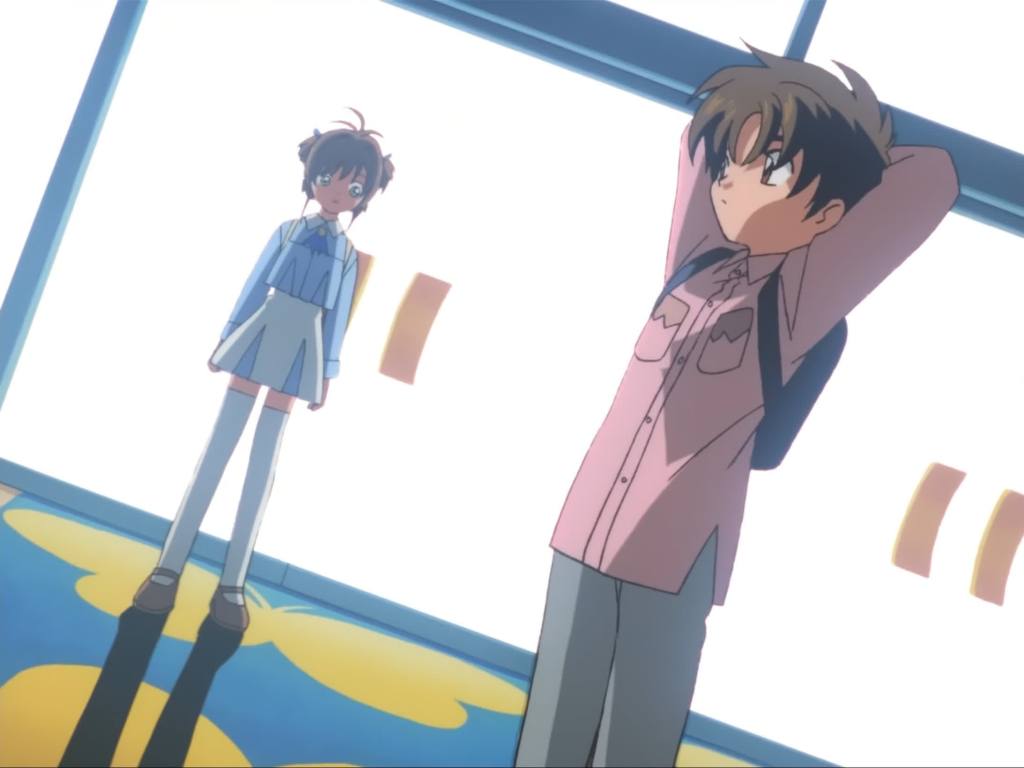
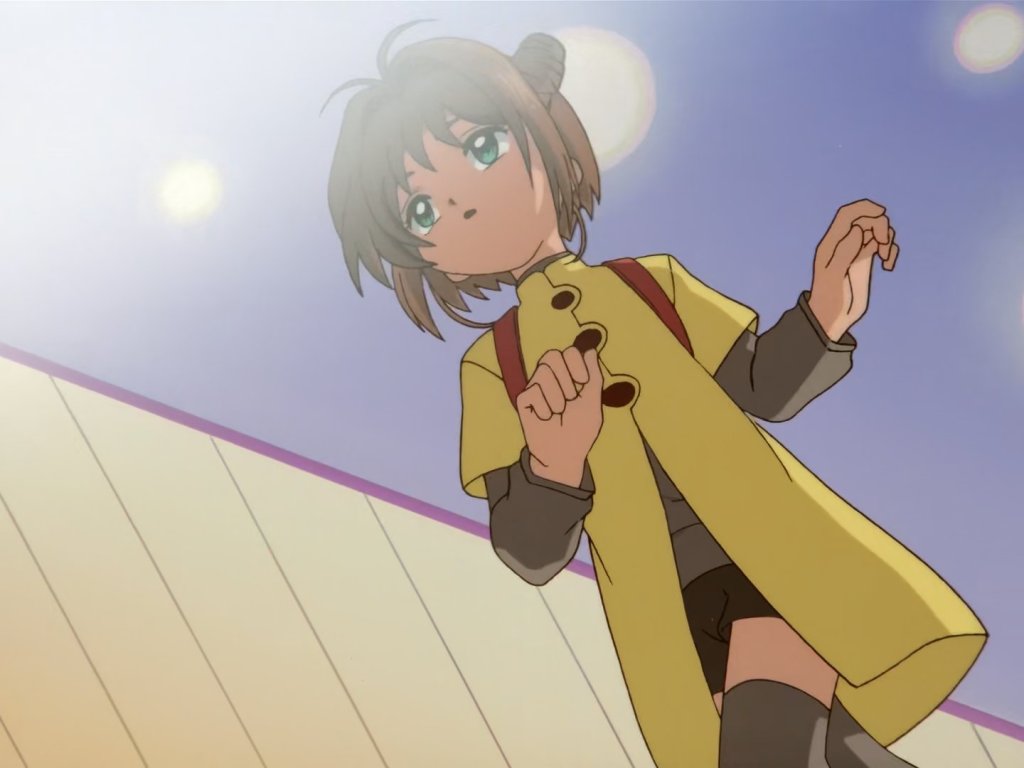
The episode revolved around the concepts of dreams and omens, and was certainly backed up by a strong vision paired with an outstanding execution. While it was great all throughout, coming after a whole first half worth of set up, B Part in particular stood out to me in its stunningly oneiric presentation of Sakura‘s dream sequence, one of the best I’ve seen in recent memory. The second half of the episode was almost entirely shot using dutch angles, in such a tasteful way that didn’t end up feeling overwhelming or forced at all. As we’ll see in the next episode too, this methodical use of well-established filming techniques is core to Takayanagi‘s style and directorial language ーthe textbook use of dutch angles being the most evident and noticeable one.
During this sequence, the thorough sound design played its part too, mainly featuring high-pitched and dissonant tones to remarked the ever increasing tension throughout the scenes.
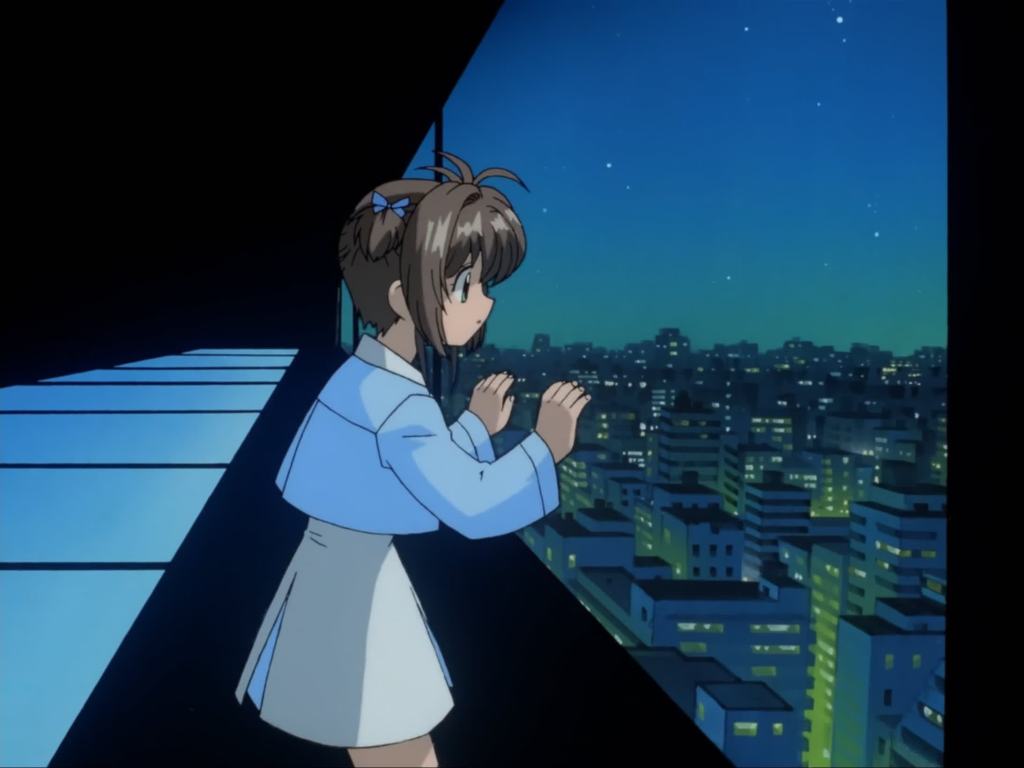
The setting too greatly contributed in depicting the eeriness of the whole sequence; the transparent glass doors and walls allowed for the extremely bright and indeterminate backgrounds to shine through, reinforcing the dreamlike and otherworldly appearance of the location, almost as if they were trapping Sakura and the others in a place completely detached from reality.
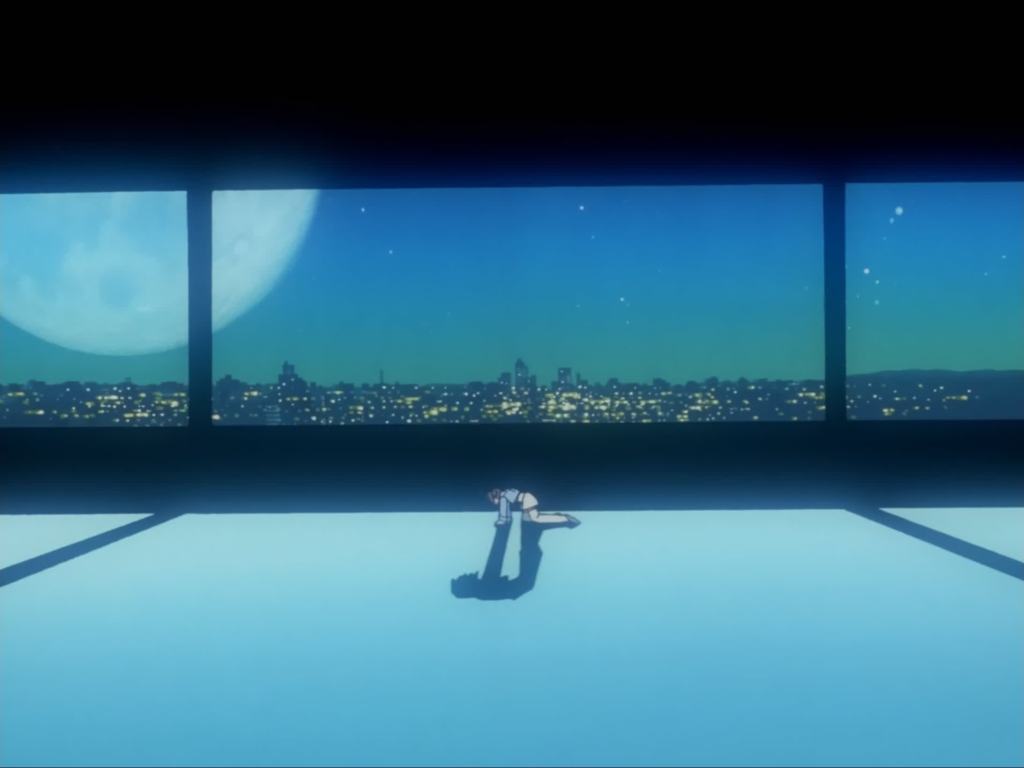
Another visual element I especially liked was the use of negative space towards the end of the sequence, isolating Sakura in the frames and effectively “erasing” the space around her with a very deliberate palette choice, featuring black as its the predominant color, in complete contrast with the previous scenes. This choice not only enhances the presentation of the sequence but also carries a narrative meaning, since the space around Sakura starts blacking out as she slowly realizes she’s being held captive inside of a dream.
Playing around with perspectives was one last trick deployed in the final moments of the episode in order to effectively upgrade the “space”‘s role to a proactive one in the visuals, also featuring some pretty ambitious rotation cuts as well.
This exhaustive control over every aspect of the visuals ーeach element being carefully designed to specificallyfulfill the task of conveying a distinct set of emotionsー served as a great presentation of Shigehito Takayanagi‘s qualities as a director, unmistakably outlining his distinctly holistic and systematic approach.
Episode 57 – さくらと小狼とエレベーター: Sakura, Syaoran, and the Elevator
絵コンテ・演出: 高柳 滋仁|SB/ED: Shigehito Takayanagi
The last episode on this list is episode 57, this time too unsurprisingly crafted by the meticulous hand of Shigehito Takayanagi. If Mamoru Kanbe was the director whose endeavors grabbed my attention the most throughout the first half of the show, Takayanagi definitely became the standout in the second half, to the point I could effortlessly infer his involvement midway through the episodes. It doesn’t boil down to particularly effective observation skills on my part, though; rather, I’d say it was all mostly thanks to the very distinctive and recognizable approach on his end.
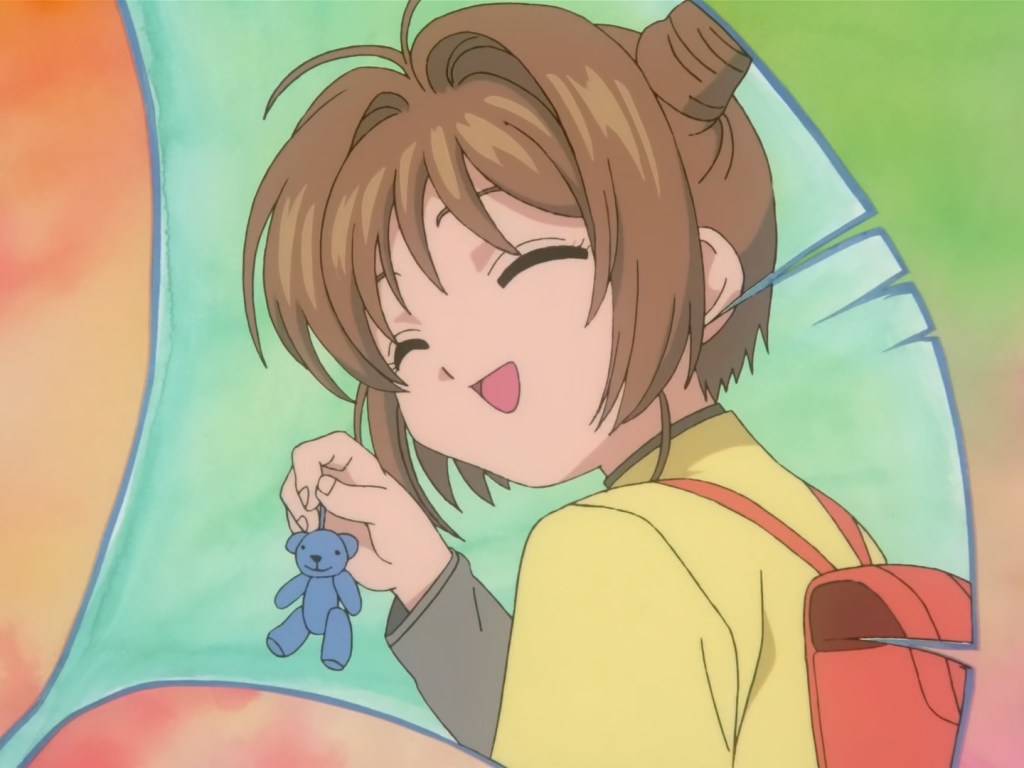
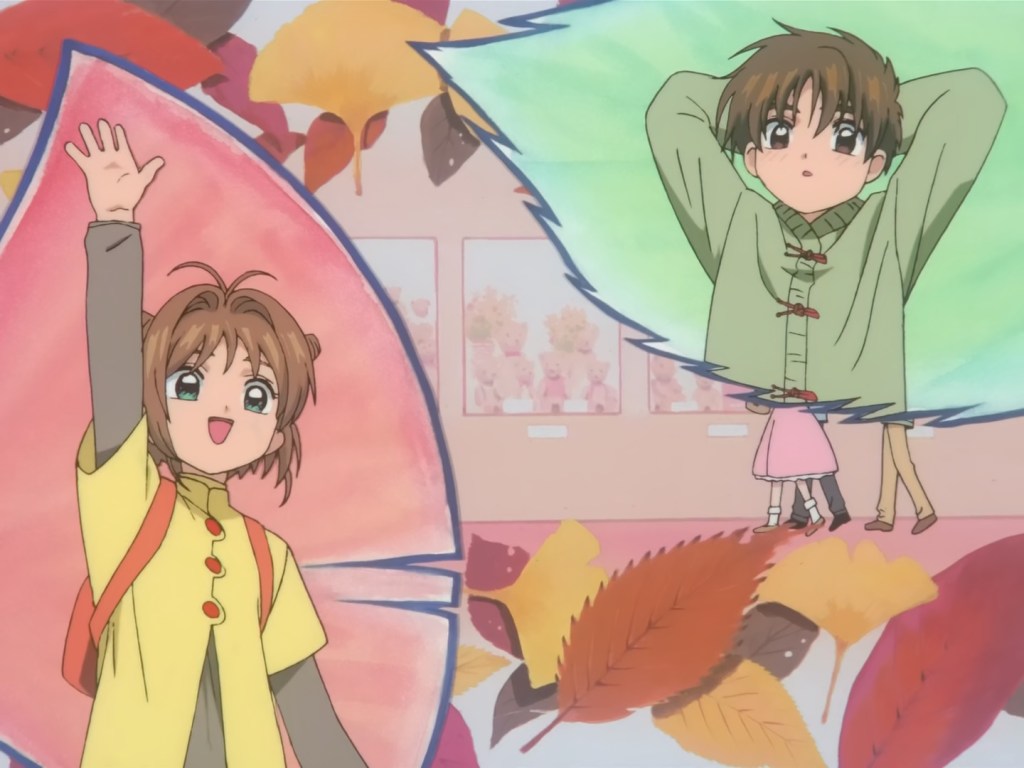
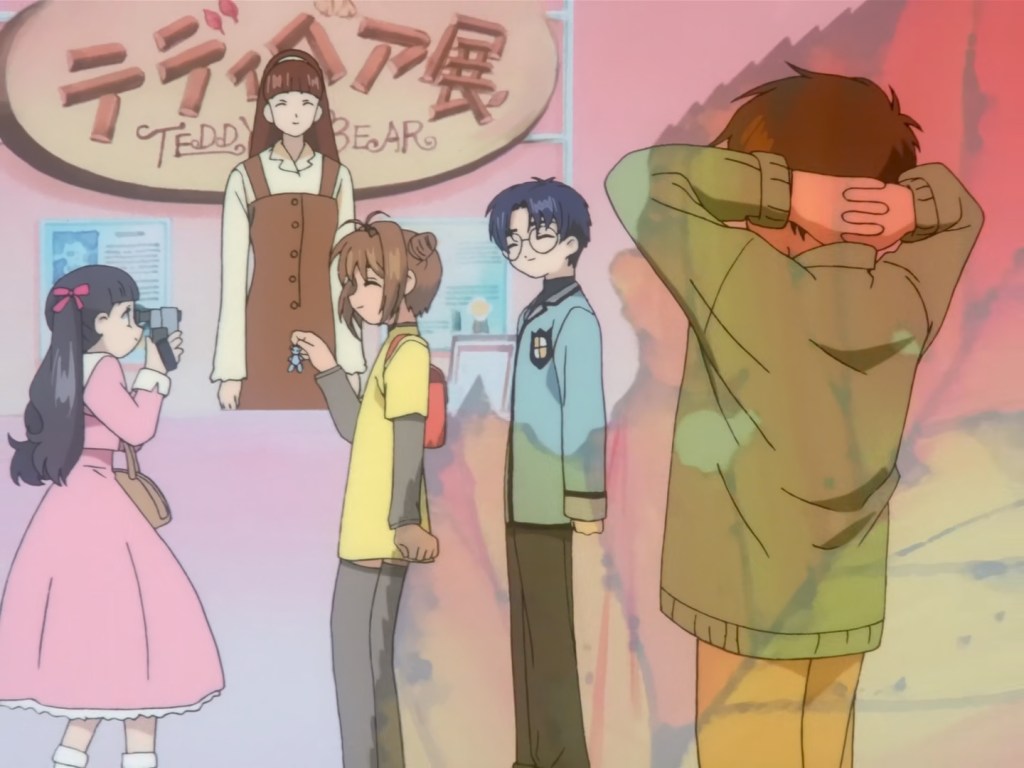
What caught my eye first in this episode was the very simple and straightforward yet effective visual symbolisms at play during the teddy-bear-eventmontage in B Part, focusing on Syaoran‘s acceptance of his feelings for Sakura. Dry leaves are obviously the main visual theme of the whole sequence, but while Syaoran is always framed within or in relation to a plain, “regular” leaf, Sakura is instead represented by a more unique-looking and distinctively pretty Ginkgo leaf, strongly suggesting how she is the one who stands out in his eyes.
These by-the-book tricks Takayanagi deploys throughout his episodes, as hinted at earlier, are an integral part that defines his style. What makes them stand out is the designed effectiveness they gain under Takayanagi‘s comprehensive direction; even the more straightforward techniques like these can result in a strong and compelling presentation if realized with the due attention to details and an exhaustive and careful control over every audio-visual element, like composition, colors, transitions, rhythm, and soundtracks.
In some instances, the image of the “normal” dry leaf overlaps and envelops Li‘s entire figure in the frame, effectively isolating him from the other characters on the screen, perhaps to reinforce how this montage ーwhich, by the way, is not the first one featured in a Takayanagi episodeー is all about his personal feelings towards Sakura.
Using the interactions between the two distinct type of leaves, as they make ripples on the water or as the consecutive images of Sakura make Li‘s last bit of defiance towards the acceptance of his own feelings tremble at the mere sight of them, to describe the concrete interactions between the actual characters during their visit at the event was another really impactful and tender idea, expanding on the otherwise unadorned symbolism.
That of the dry leaves is not a theme introduced only in the second half of the episode though; reminiscent of Kanbe‘s habit, that key element is present since the very beginning, with the fragmented sequence slowly following the brown leaf as it floats on the pond until it reaches Syaoran‘s reflection on the water playing throughout the entirety of A Part.
As the events of the episode unfold and get closer to the end, we are yet again grated with a very extensive and appropriate use of dutch angles, time time as well paired with an appropriate soundtrack choice to unmistakably denote the impending threat of a sinister event. Another of Shigehito Takayanagi‘s methodical touches, once again executed with the utmost care and meticulousness.
As a closing note, I have to say I really enjoyed the commitment to present all of the events in this episode solely from Li‘s POV. Episode 57 was also possibly the first one (or at the very least, the first self-contained story) to not include any sequence of Sakura summoning a card or performing a spell at all.
This concludes our little journey through the episodes of the 90s classic Cardcaptor Sakura, which was really just a compilation ーthough not without a few substantial additions here and thereー of the otherwise unorganized thoughts and write-ups I produced while watching the series for the first time. I hope this piece provided you, dear reader, with some interesting insights on the direction of this timeless show, or at least entertained you throughout your reading. Until next time~
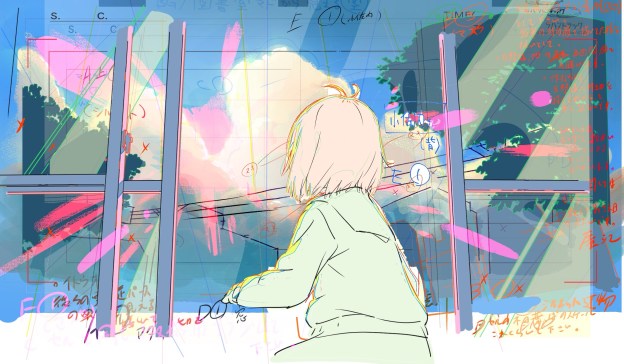
Original interview from Newtype (September 2024 issue), original interviewer: Haruyo Igeta; genga corrections by Keisuke Hiroe.
I hope it becomes something different from the usual
~ Incorporating new techniques to make this work’s world move ~
— Please, tell us the details on how you became involved in this project.
I received the offer directly from animation producer (Masakazu) Watanabe-san. Since the original work is a novel, adapting it into a visual medium is difficult, so my first reaction was: “What do I do now?”, I was perplexed (laughs).
— When you first read the novels, what were your impressions and your thoughts from the director’s perspective?
There were two points I felt I had to pay particular attention to when adapting it into an anime. First of all, the mystery approach that is crucial to this work. I thought I had to carefully depict the various elements typical of the mystery genre, such as the tricks and alibis. Second, the evolution of the relationship between (Jougoro) Kobato-kun and (Yuki) Osanai-san. I felt that that was the true charm of the story, so I had to portray it properly.
— Did you empathize with the characters or feel connected to them?
Upon reading the original work, my honest first impression was: “I really don’t understand these two”. It was while working on the storyboards that I gradually began to grasp what it was all about, and I felt my understanding of them deepened. I’m sure that (Toshiya) Ohno-san figured out a lot of things while writing the script, but in my case, I start to see things only in later stages. There are things you can only understand by actually getting your hands dirty.
— What kind of discussions did you have with Ohno-san?
We didn’t have very detailed or thorough discussions. We’ve already worked on several projects together, and this is our second mystery work. Ohno-san is good at grasping the concept quickly, so I trusted him and left it to him.
— Did you receive any specific request from Honobu Yonezawa-sensei?
When he said that “the novel and the anime are separate things” it left an impression on me. Also, we spent just one day scouting the locations together. In that occasion, I suggested making Kobato’s house into a traditional sweets shop, and he promptly approved of it.
— What kind of conversations did you have with character designer (Atsushi) Saito-san?
I think I just told him not to feel bound by the designs on the cover illustrations. Ultimately, I asked him to draw the designs based on the impressions he personally had.
— And what about art director (Akira) Ito-san?
Ito-san was busy and couldn’t participate in the location scouting, so I hand him over some pictures. It was an enormous amount, but he carefully inspected them and in the end, he became far more knowledgeable than us. Personally, I asked him to make the sky bluer than usual.
— In regards to the recording sessions, what kind of directions did you give to the cast?
Above all, I focused on asking them to speak in a whispery tone. I asked (Shuichiro) Umeda-san[Kobato’s voice actor] and (Hina) Yomiya-san[Osanai’s voice actor] to speak softly, almost as if they were in a quiet library. I wanted their acting to feel as realistic as possible. To the other voice actors, I asked to adapt to the atmosphere between the two [Umeda and Yomiya] and express themselves naturally.
— What did you discuss with sound director (Katsunori) Shimizu-san?
I’ve known Shimizu-san for a long time and I’m very familiar with him, so rather than the voice recordings, we talked more extensively about how to use the soundtrack. I wanted minimize the background music as much as possible… since it’s a dialogue-heavy work, I thought that the visuals would hold up well enough with just the dialogue alone.
— So, what kind of instructions did you give to composer (Takahiro) Obata-san?
At first, I thought it would have been a nice idea to make a couple of songs with lyrics and have them playing during the deduction scenes. After discussing this, Obata-san made a demo and it turned out to be so good that we ultimately decided to go with just that one song. He also incorporated elements of folk music and suggested using a 12-string guitar.
— You were in charge of the storyboard for episode 1. What were the key points you focused on, and what did you want to convey to the staff members who worked on the storyboards afterwards?
I had already decided to use the main theme song, so I made sure to draw the storyboard in a way the track would fit the climax well. Also, during dialogues, I made frequent use of a presentation technique where the location suddenly changes. For example, when in the mystery-solving scene Kobato reenacts the culprit’s movements. To prevent the dialogue-heavy drama from becoming tedious, I incorporated this technique as a unique element of this work’s presentation.
— Was there any idea from the other staff members that stood out to you?
Many ideas came up when writing out the script. From the order of the scenes to the ways of omitting or replacing the lines from the original work, I found myself thinking “I see” every time we had a meeting. I’ve acquired many great ideas from the people who were in charge of writing the script.
— What new things did you discover or gain from engaging in this project?
There are many things. The fact that using CinemaScope, which was a first for me, is surprisingly easy and convenient is one of them. I also think it kind of matches the atmosphere of this show. I experimented a bit this time, like with the technique to change the location in the middle of a dialogue, and I believe it turned out to be quite effective. I wanted this work to become something that differed from the usual imagery. I hope the viewers will notice in what ways it’s different.
— Lastly, a message for the readers.
From episode 5 onwards, this show becomes even more akin to a mystery. Especially between episodes 8 and 10, there’s a shift in the approach as the plot takes significant turns, so I hope you look forward to it. I also hope you’ll keep an eye on how the relationship between Kobato and Osanai evolves.