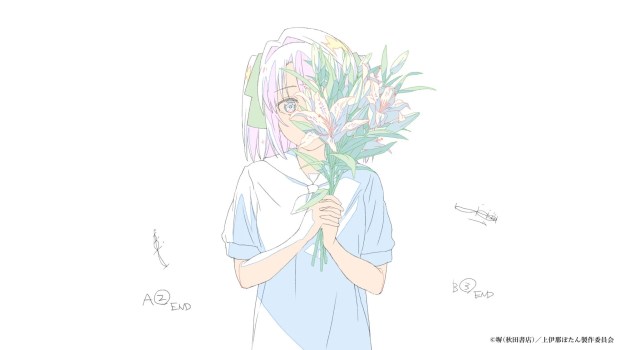
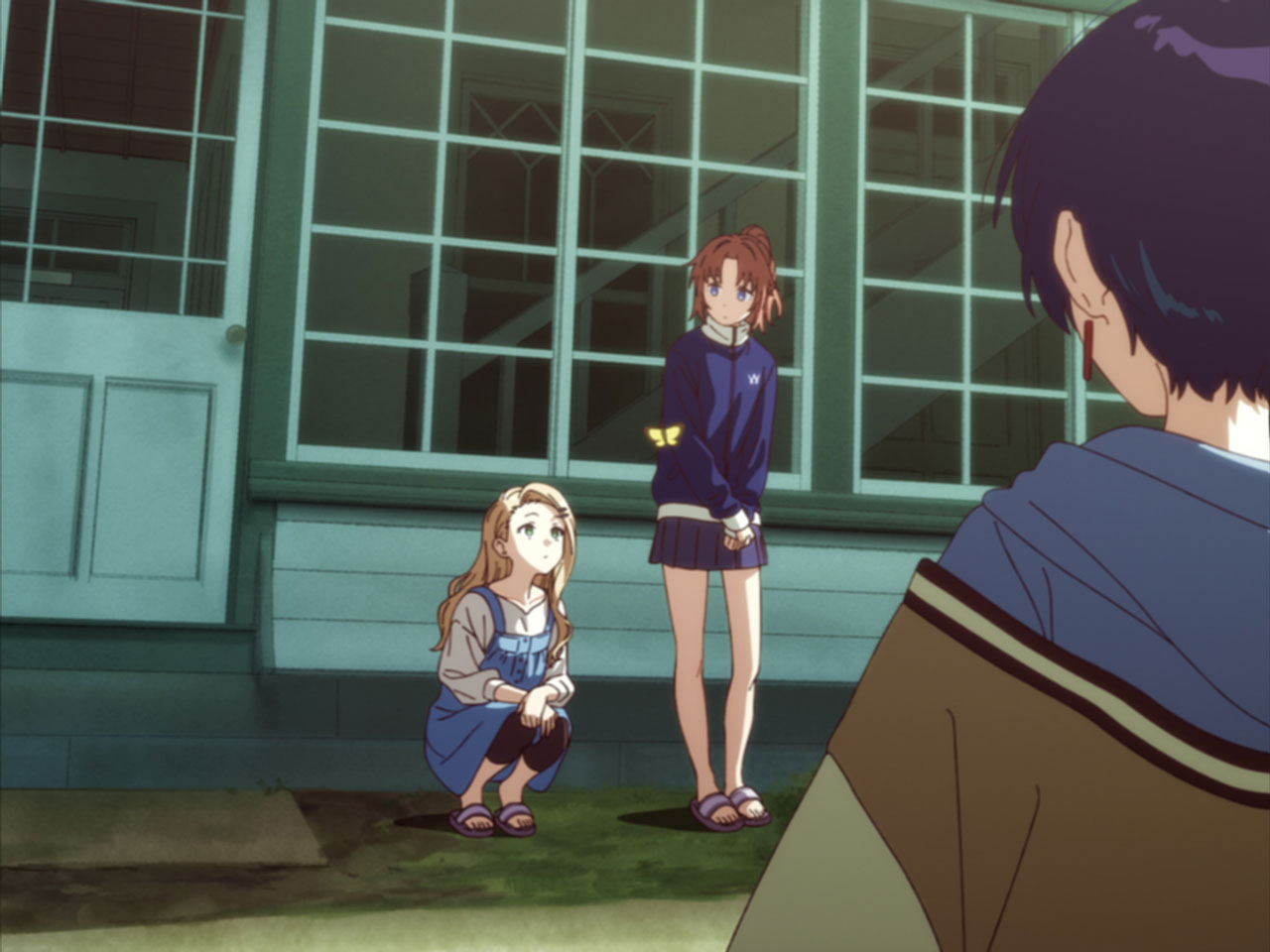
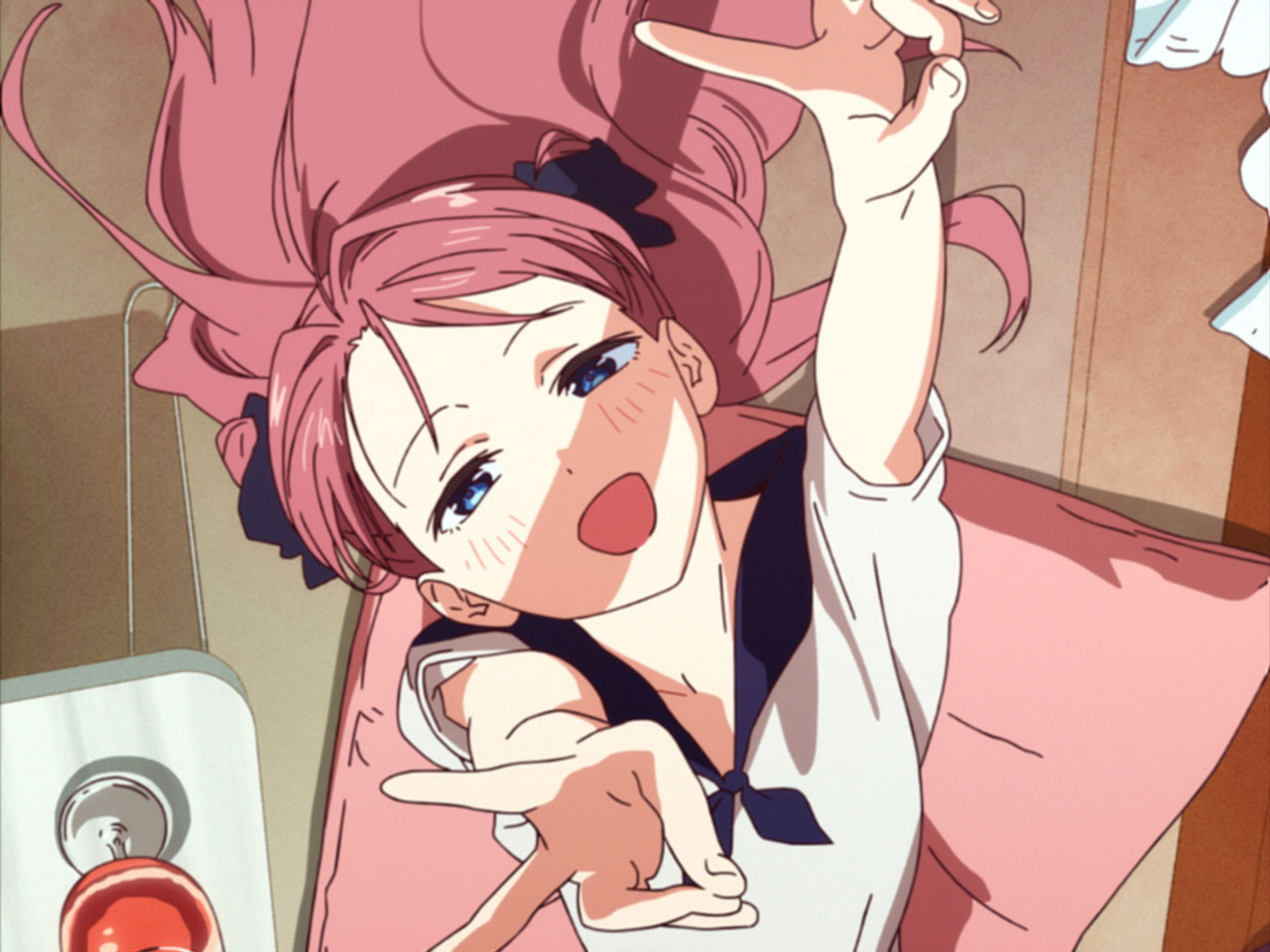
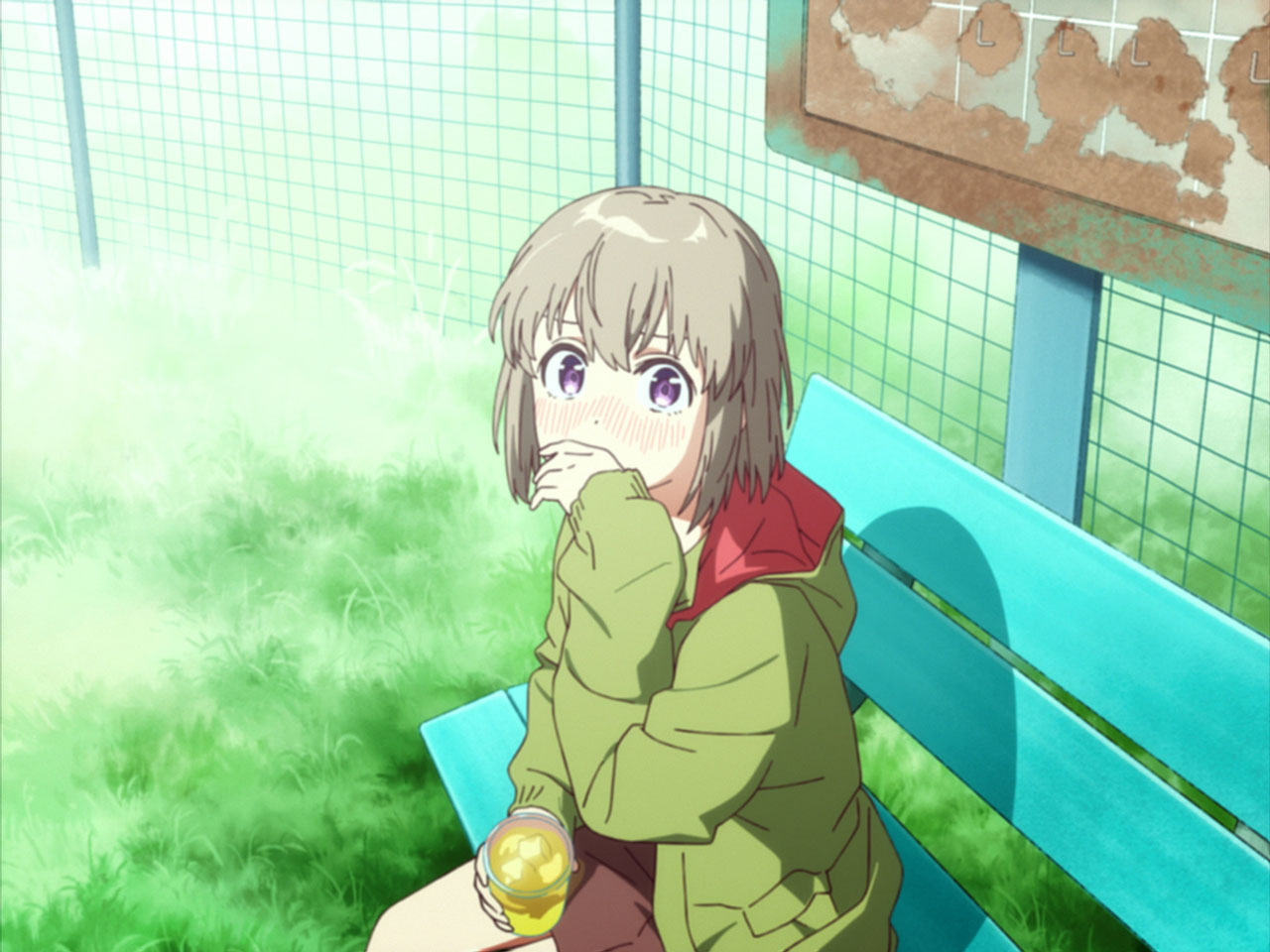
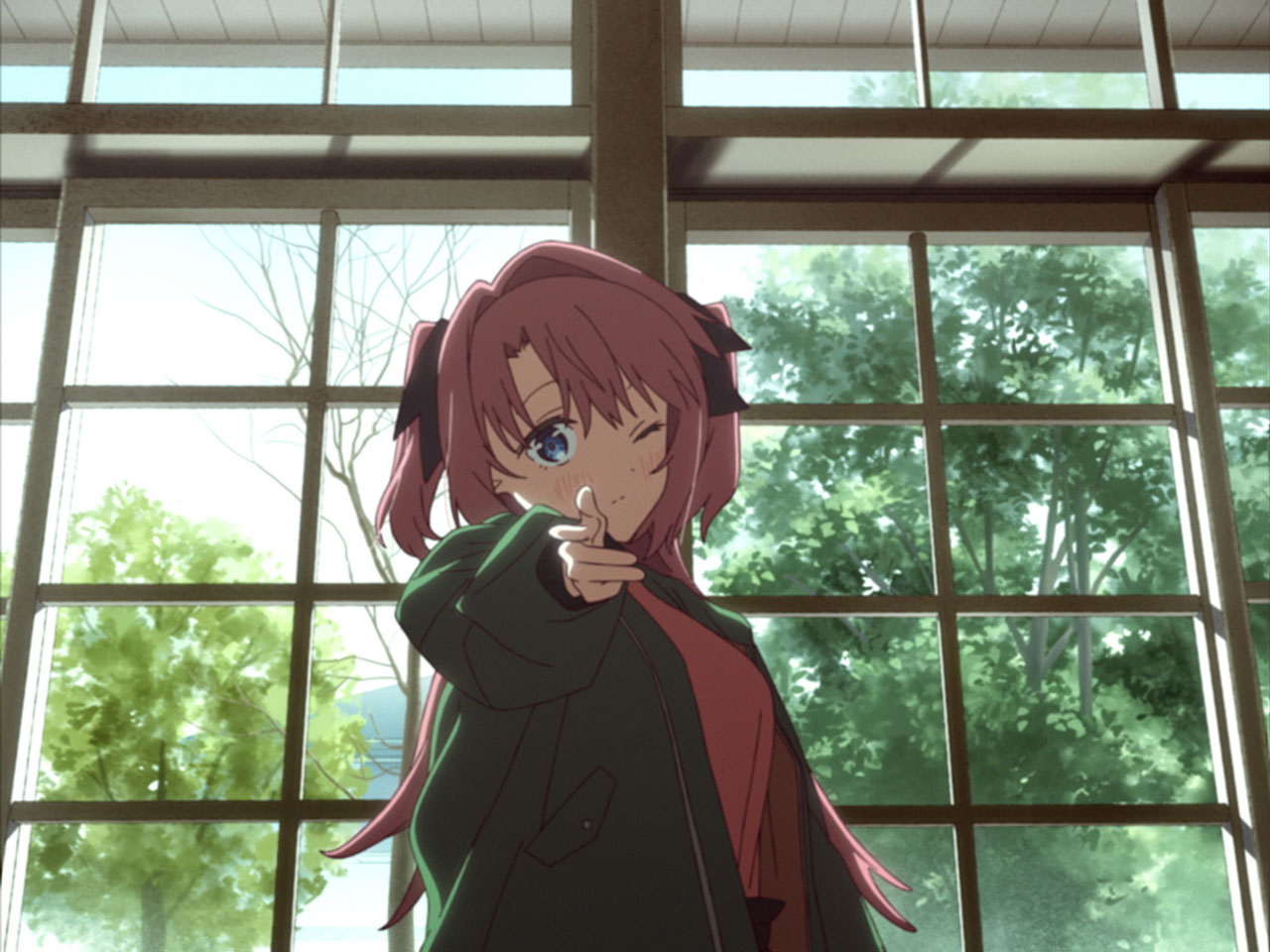
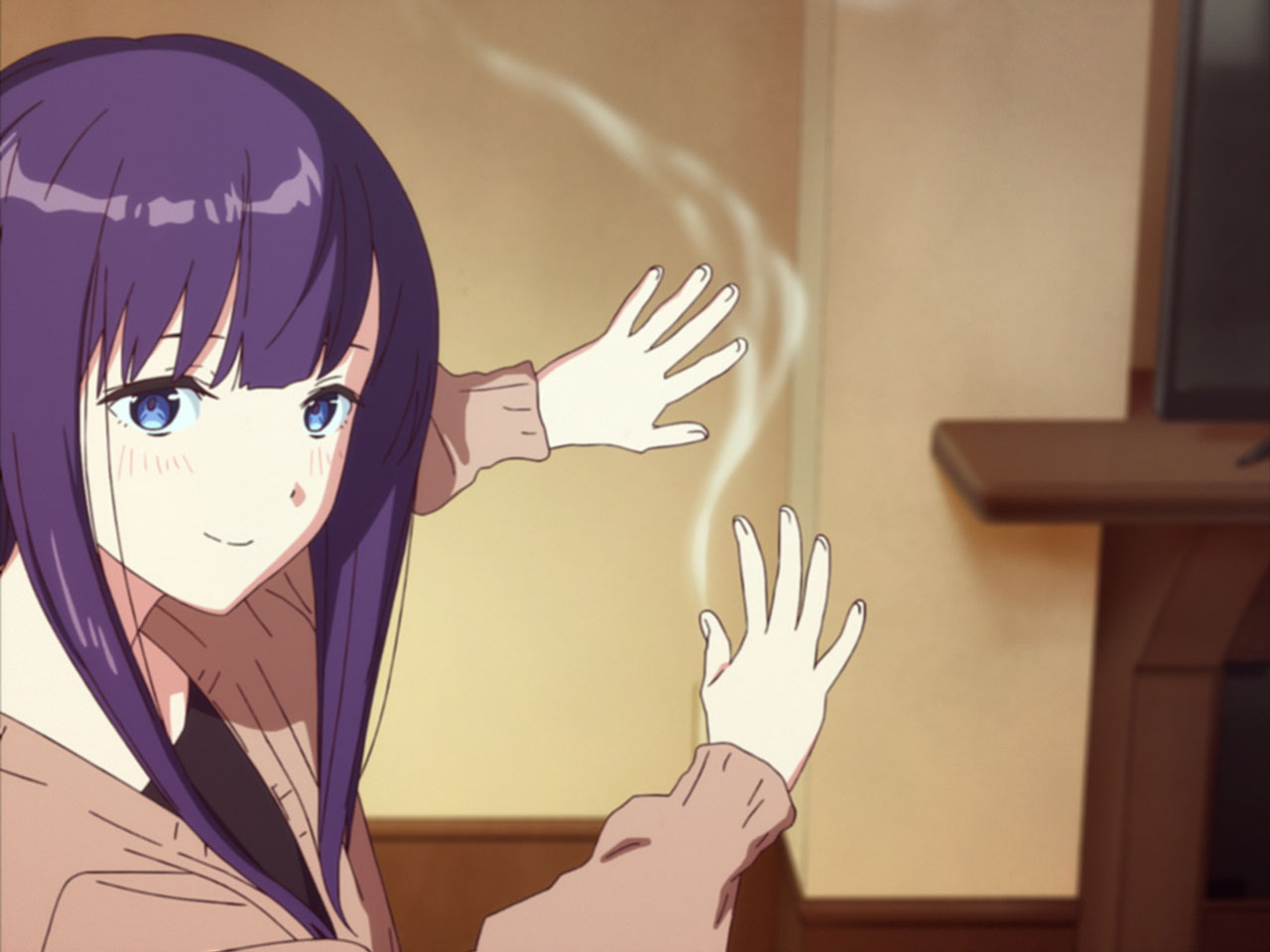
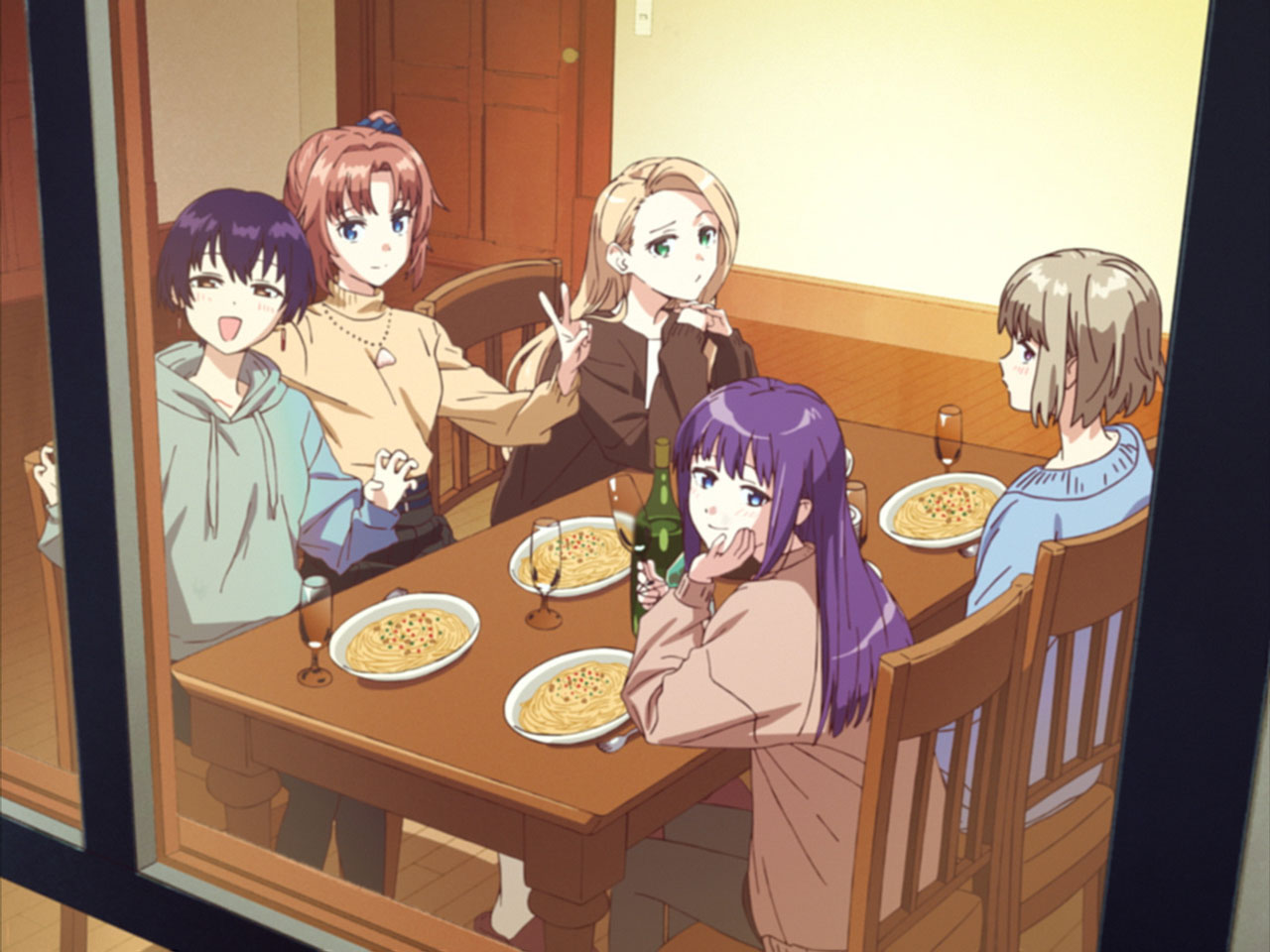
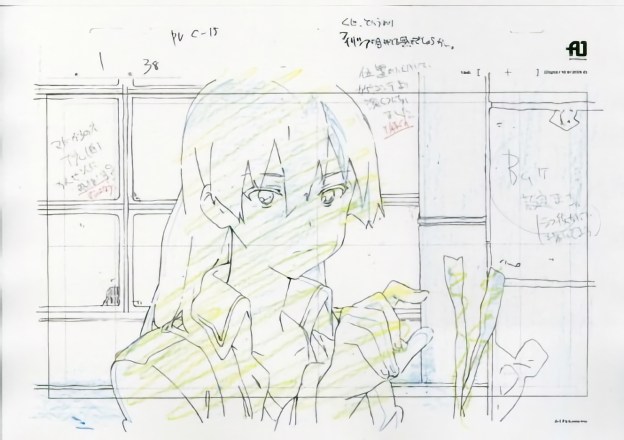
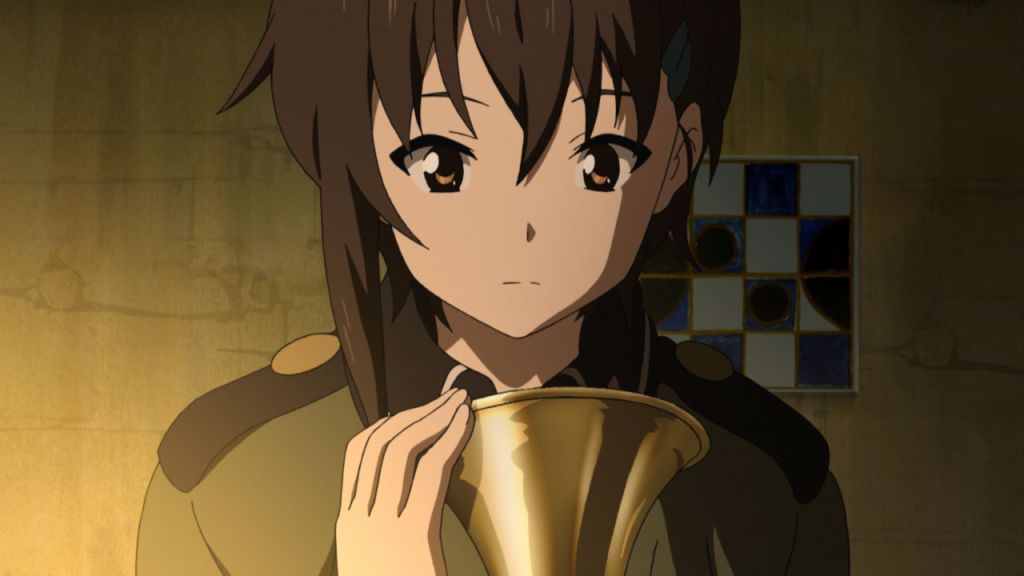
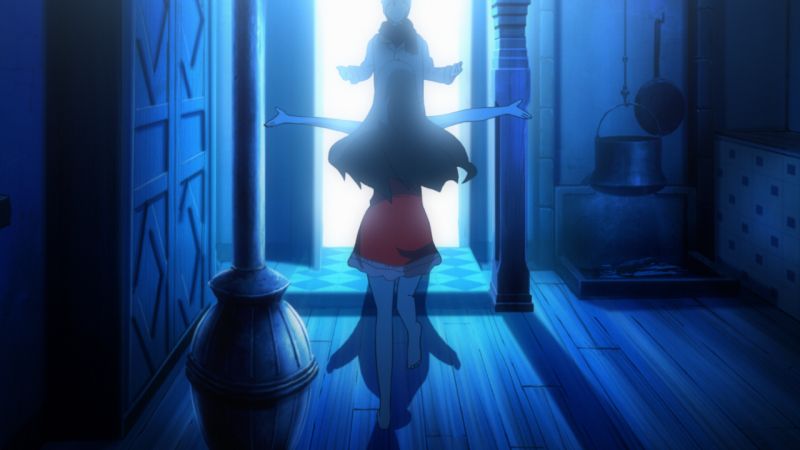
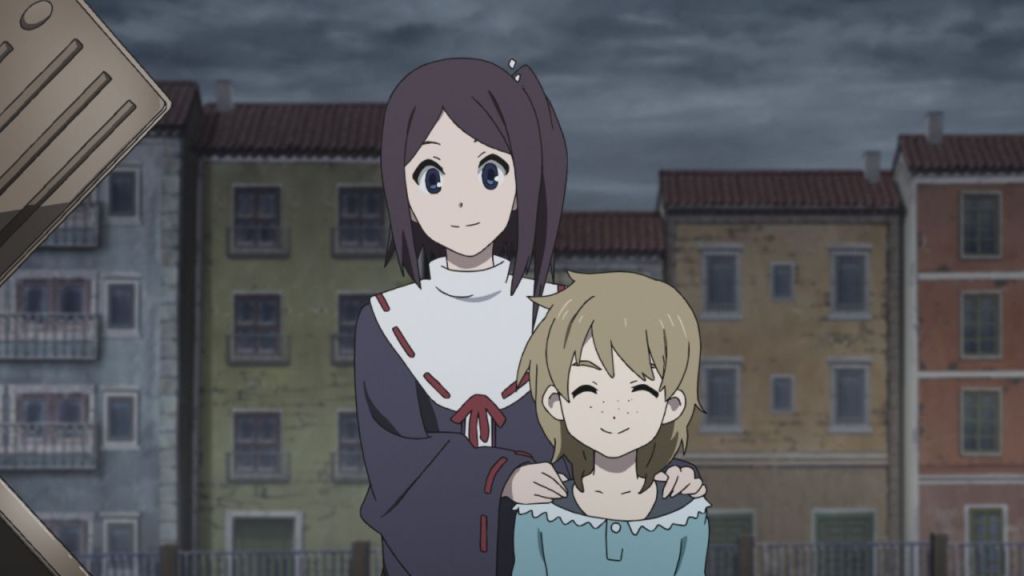
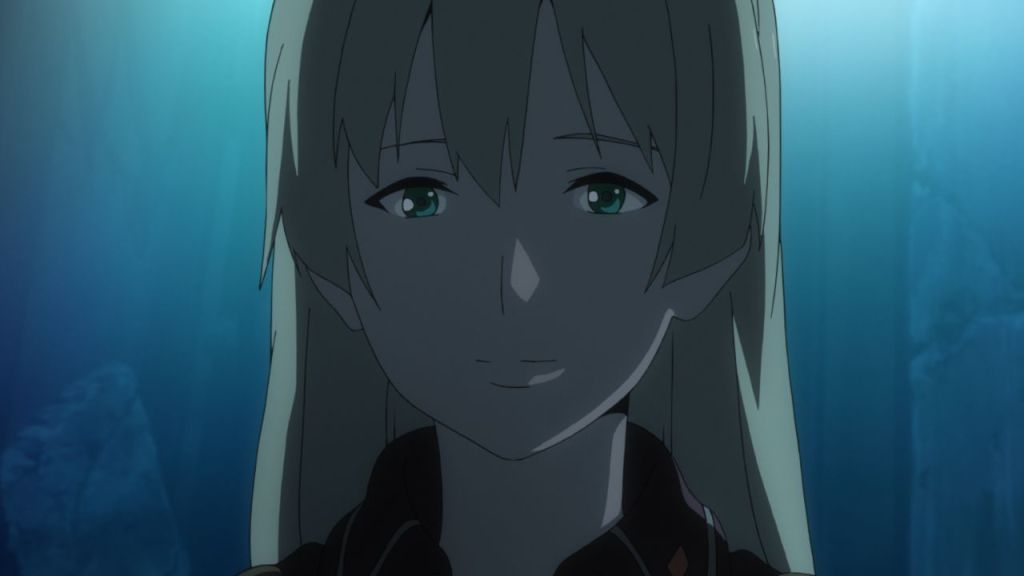
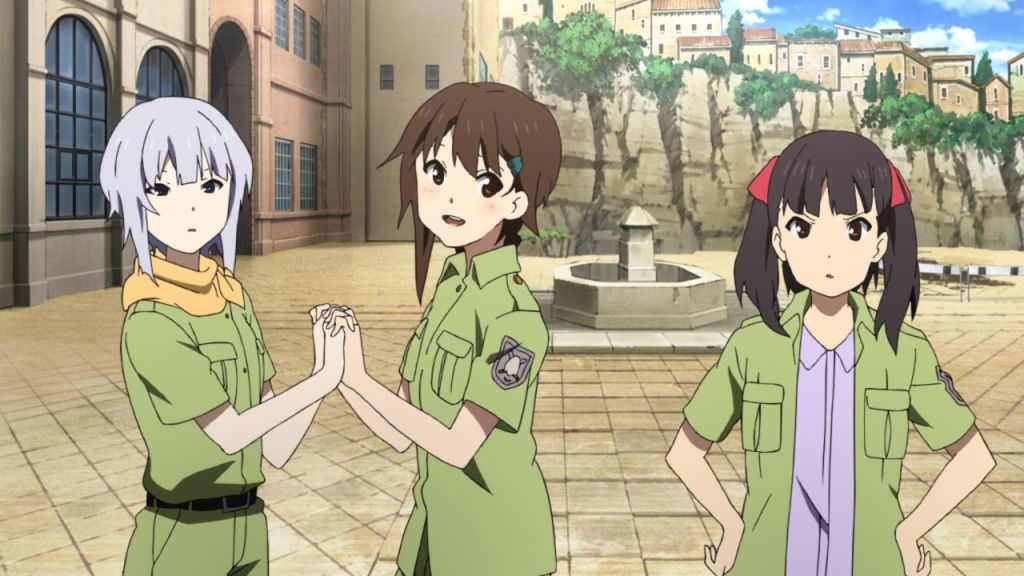
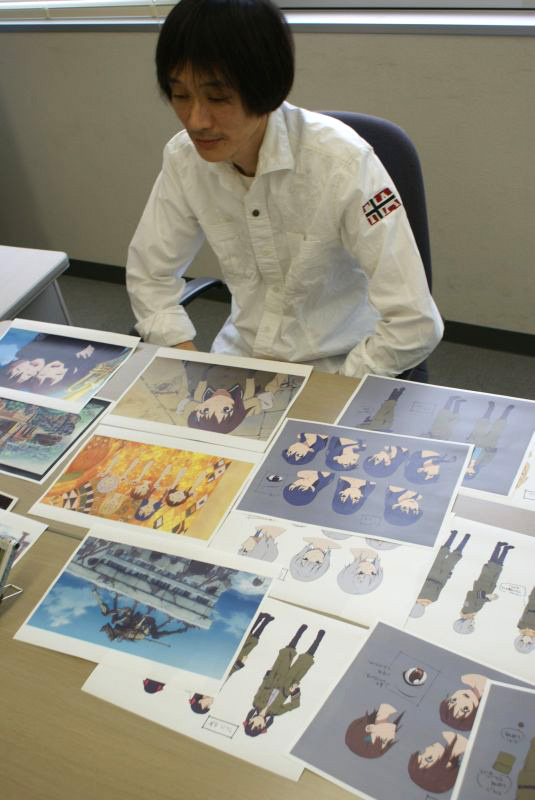
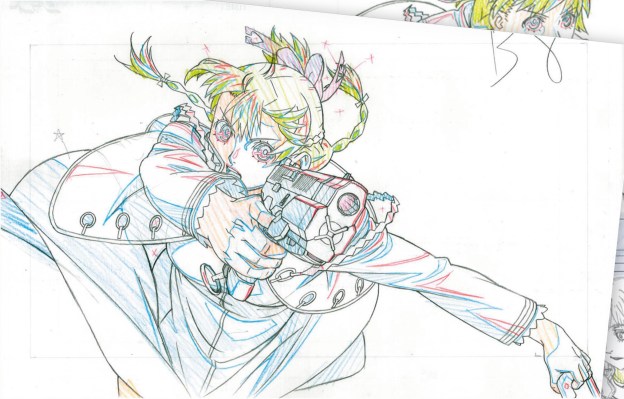
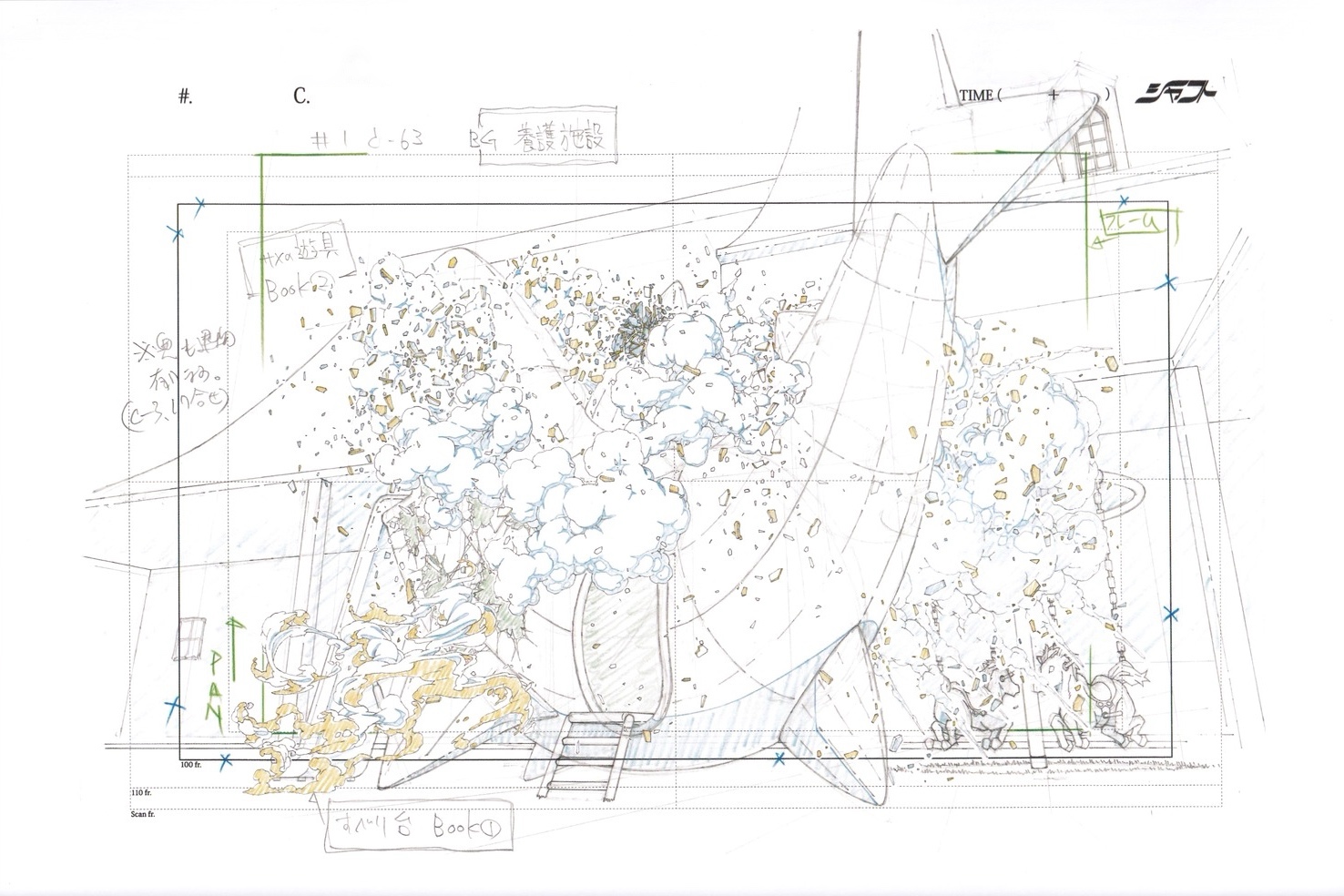
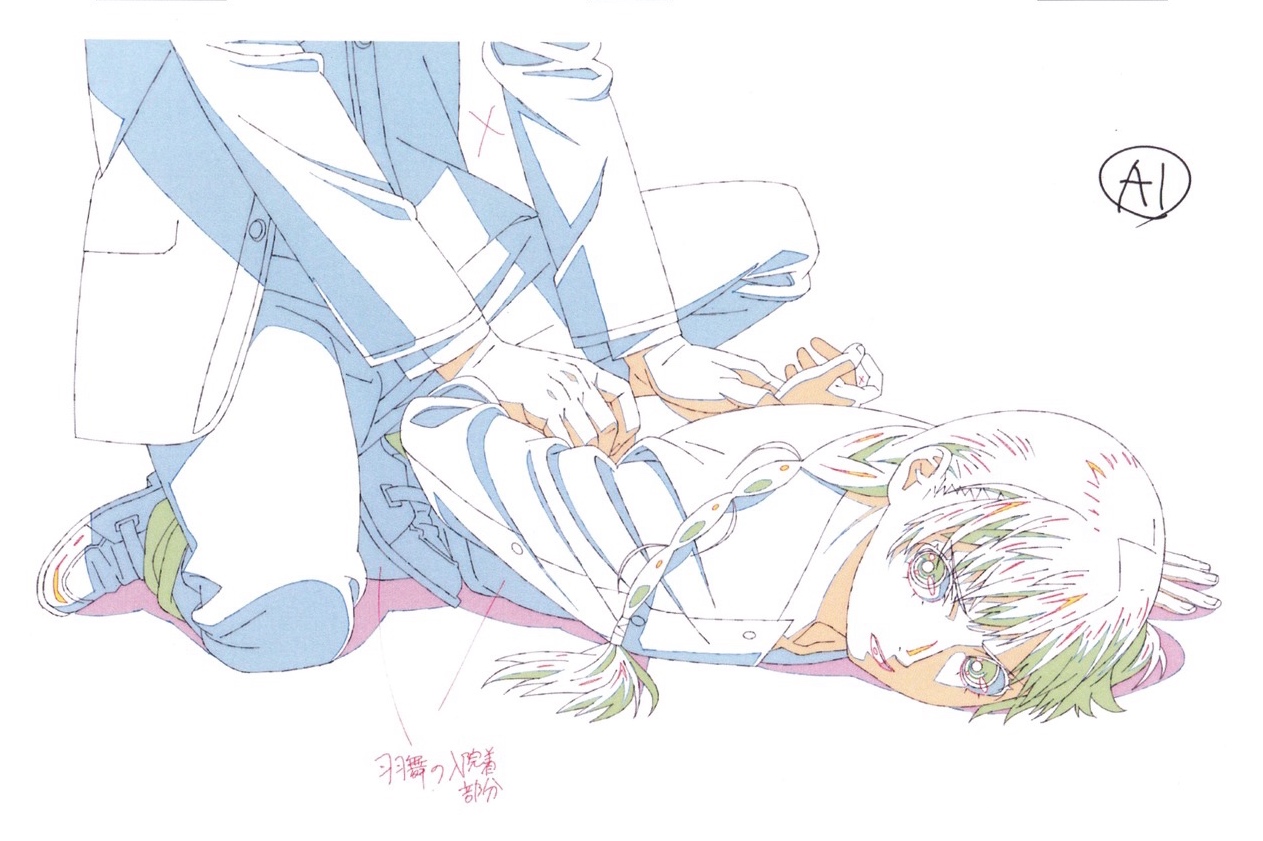
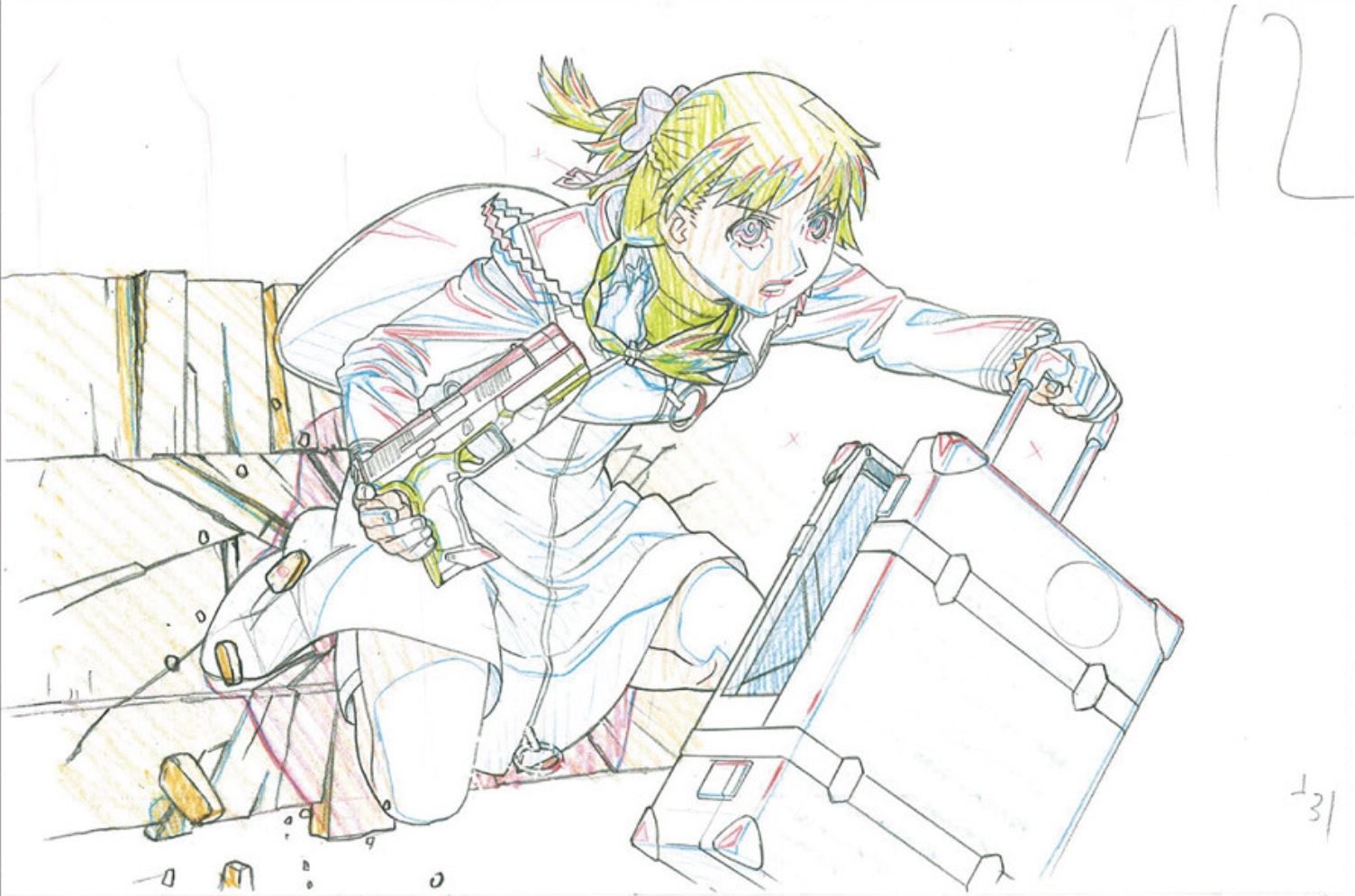
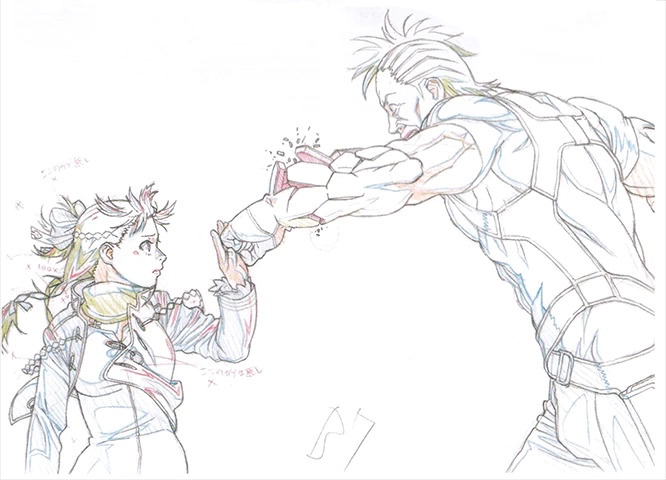
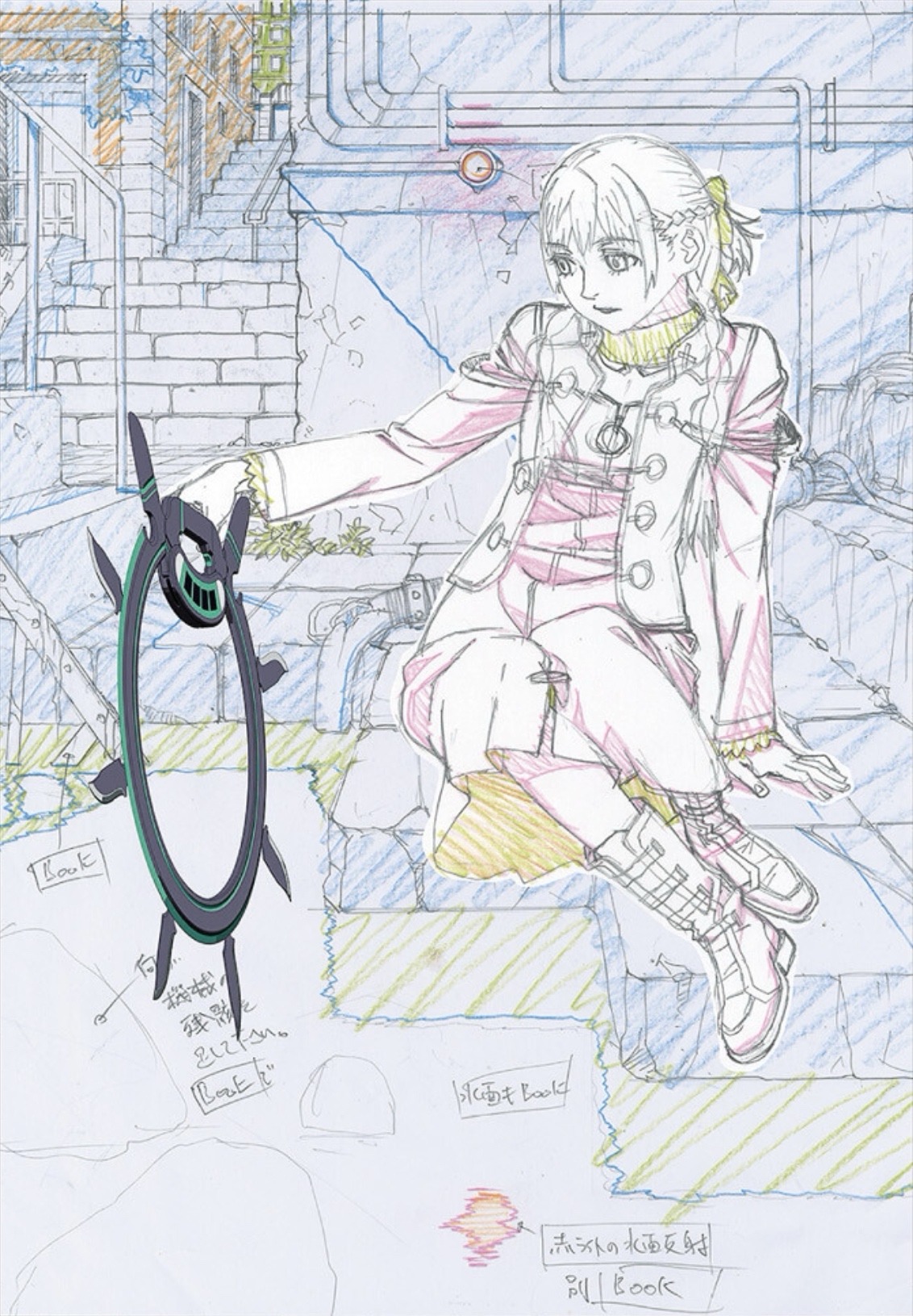
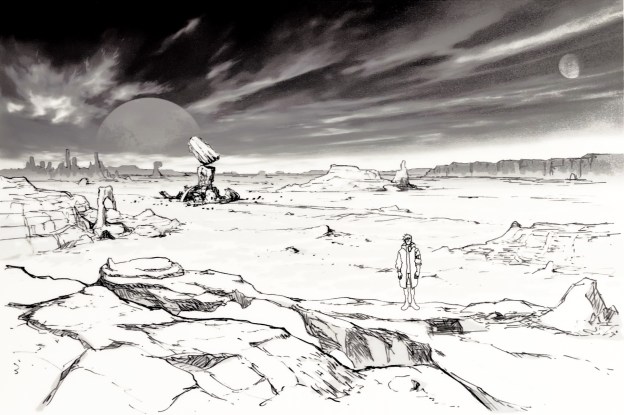
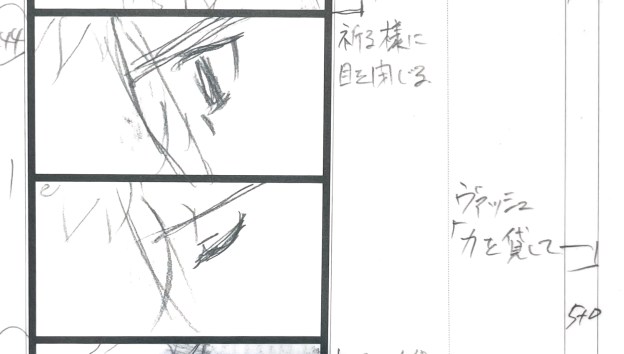
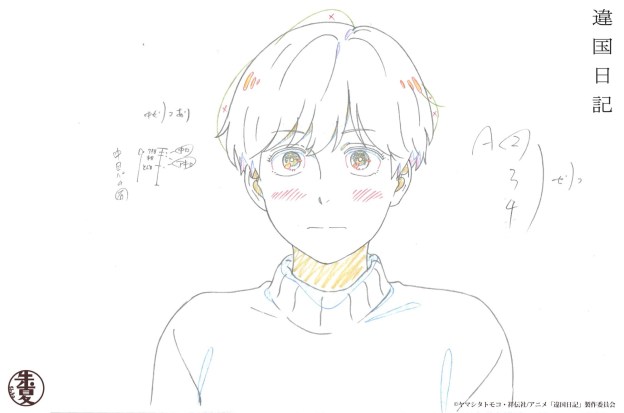
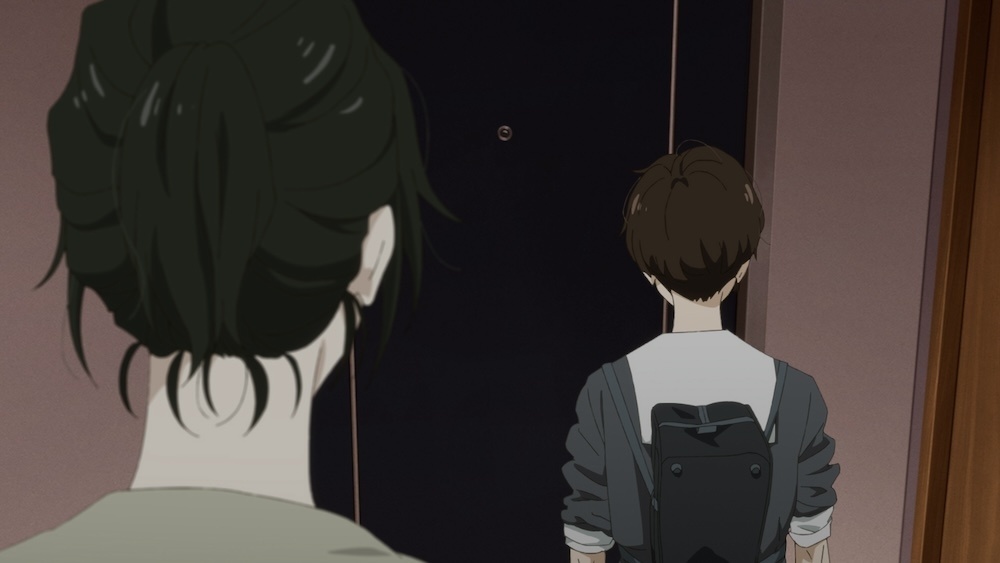
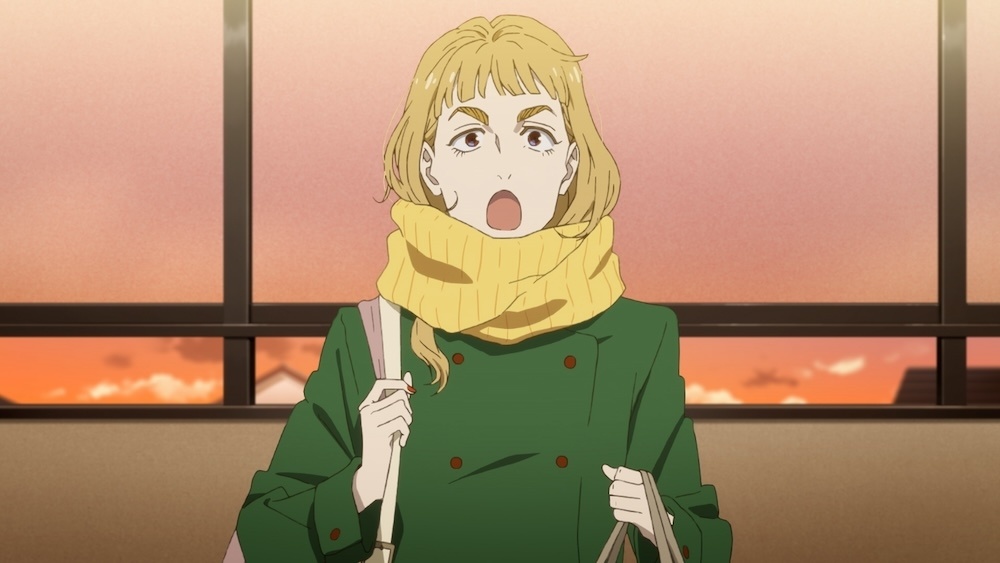
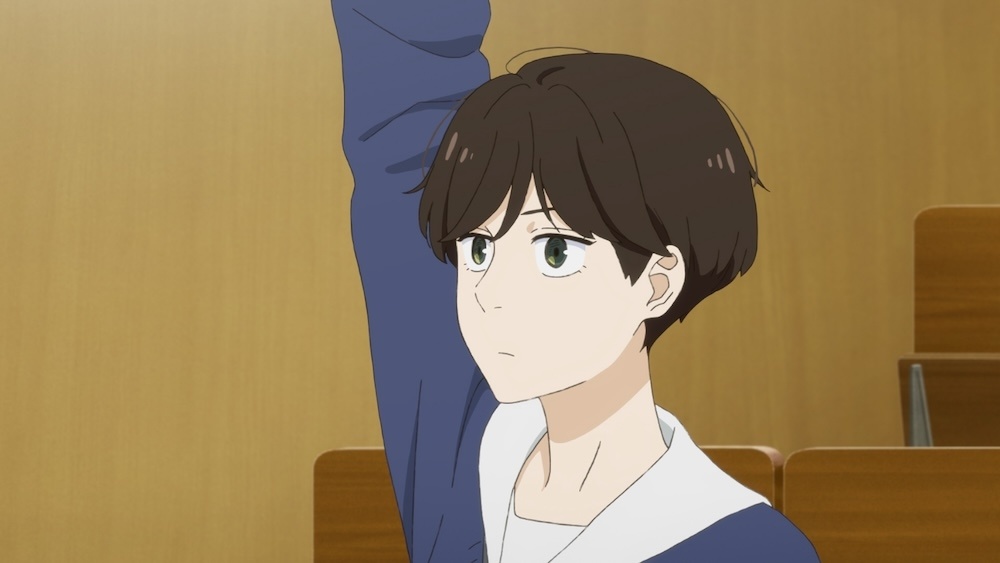
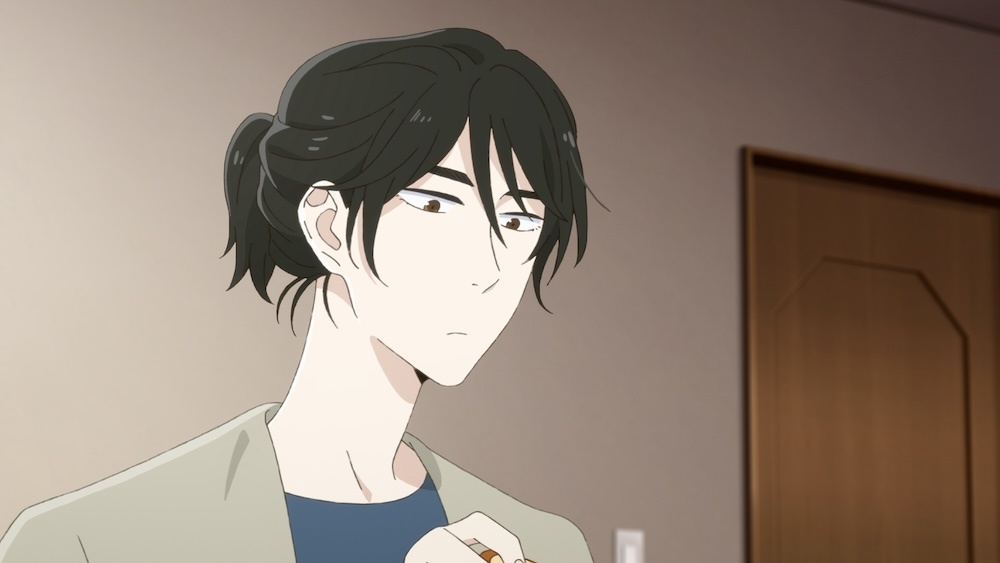
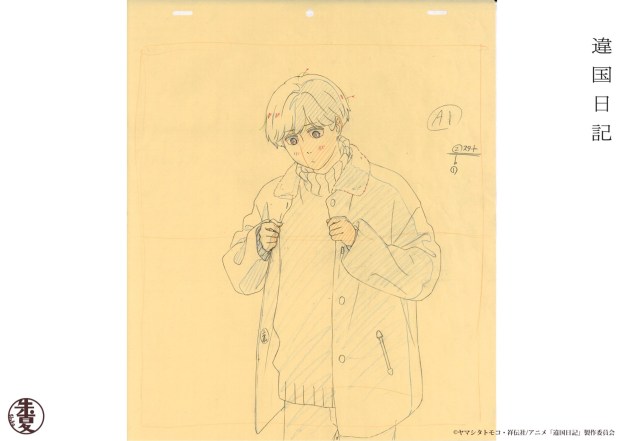
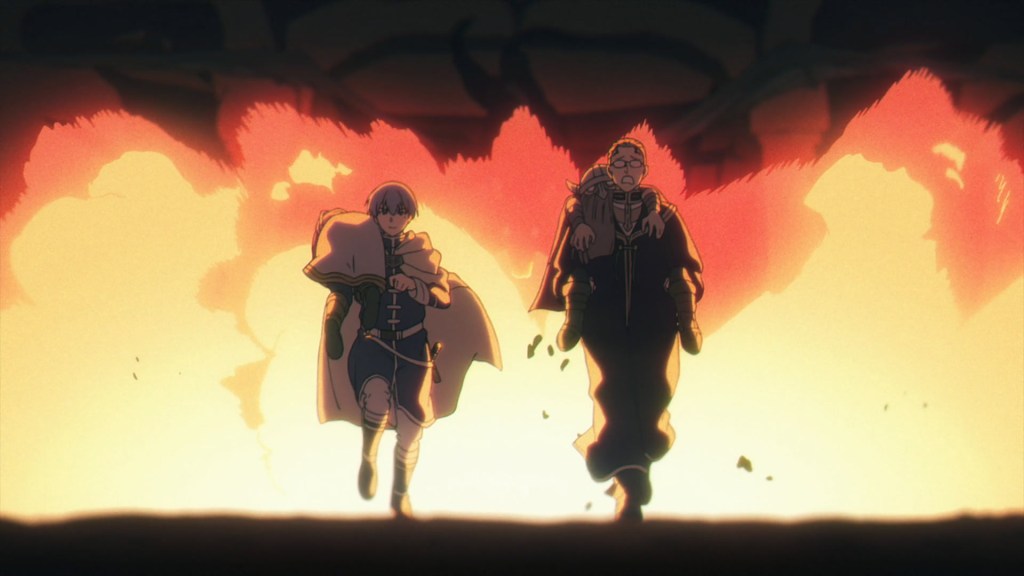
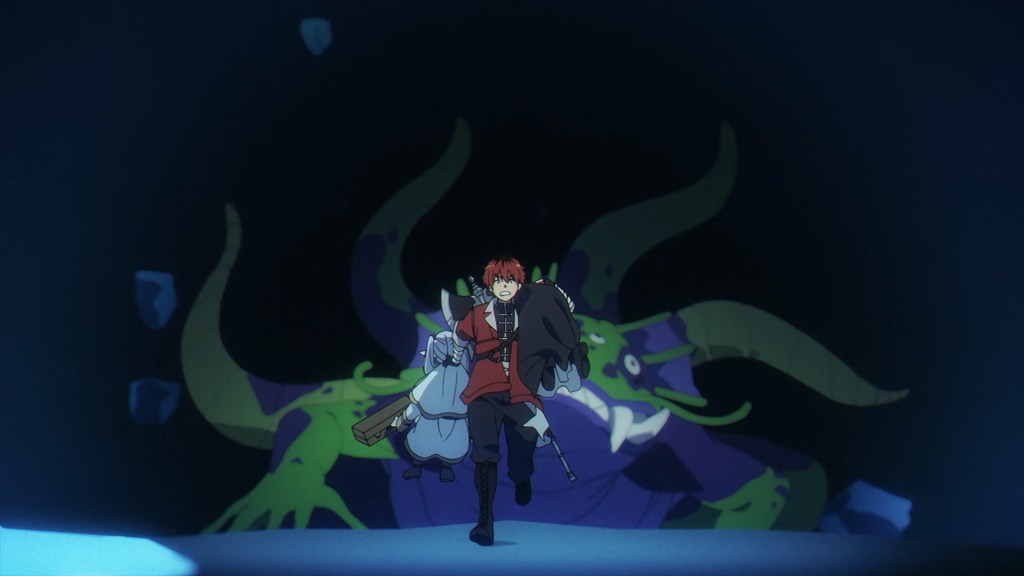
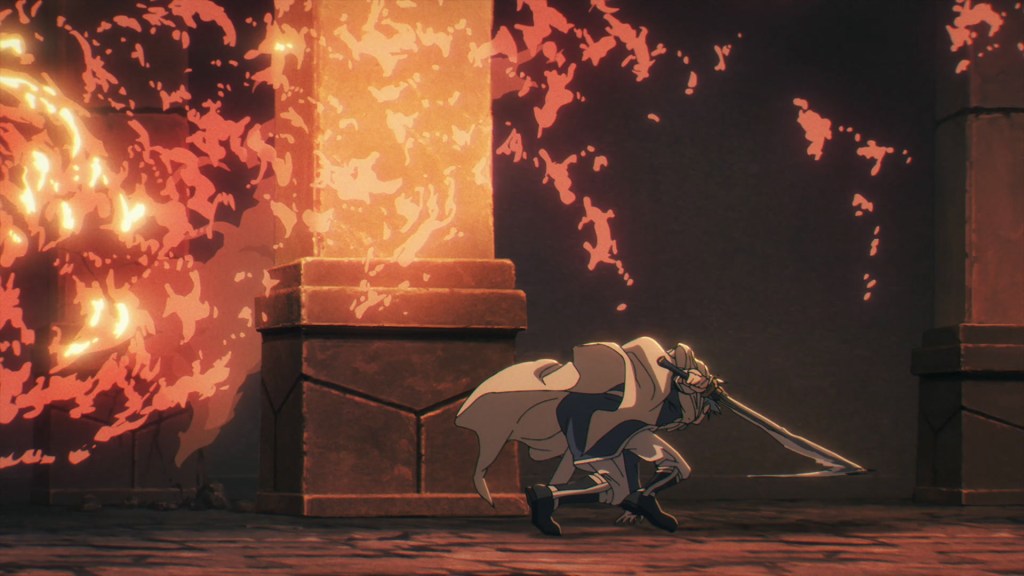
Original interview from SCREENα vol.8 2026, original interviewer: 横森文; genga from the official 2nd PV.
Ghost in the Shell had a huge influence on me, both creatively and in how I see life.
— First of all, please tell us about your encounter with Ghost in the Shell.
I encountered Shirow Masamune-sensei‘s manga [“攻殻機動隊”, 1989-1991] and Director Oshii Mamoru’s “GHOST IN THE SHELL: Koukaku Kidoutai”[“GHOST IN THE SHELL / 攻殻機動隊”, 1995] movie around the same time. I loved both, and both influenced me. What personally struck me the most—and this is true of both—is the way they turn even the outermost frame of the work itself into part of their expression.
— What do you mean by that?
For example, the original author Shirow Masamune-sensei usually writes notes in the margins of the page, essentially a declaration that “this is manga”. It’s as if there’s another layer on the outside of the body, and his expression feels multi-layered. Director Oshii does the same thing, on top of establishing that “this is anime”, he then turns that expression back on itself to create meaning, with something like “but it’s incredibly and relentlessly dark”. I suppose it can be described as making the meta-layer itself into a site of expression. I feel like Ghost in the Shell opened the door to that sensibility for me. That’s why both the manga and the movie had a huge influence on me, both creatively and in how I see life. Even as I live my own life, I feel like there’s always an annotation coming in from a layer above.
— What would you say Director Oshii’s influence was in particular?
I believe Director Oshii’s works are actually really humorous and wonderful. The direction is never monolithic. Characters mutter away without moving a muscle. Watched on that layer, it feels serious, but if you watch it one layer above, it’s like, hold on, this is anime…!? What do you mean it’s this dark and static for an anime!? That’s how it starts to feel. It’s like he builds a “waiting for you to call it out” structure right into the work, on the very top layer. I always get the feeling that he’s trying to surprise you, or make you laugh. In life, we sometimes get swallowed up by our own emotions, but no matter what the emotion is, it only holds true within that particular “field of meaning”. I’d like to keep that in mind, and hope I can always go about my life with a smile on my face. The one who showed me that approach, of building in a multi-layered structure and planting humor within it, was Director Oshii, I think.
— Ghost in the Shell, made by the very person who opened your eyes to all this, already stands as a masterpiece. In this context, what made you decide to instead deliberately lean closer to the original manga in adapting the same work?
From as early as the proposal phase, it was already decided that this time it would be “based on the original manga”. That said, how closely to adhere to the original was left up to me; they kept it vague, without pinning down anything specifically. But once we were actually about to begin, listening to the opinions and inputs of various people made me change my mind, and I decided that: “We’re actually going to adapt the original itself into anime”. The reason being, the original manga The Ghost in the Shell has a very long history, and it’s a work packed with as many personal feelings to it as there are people who love it. To take that, reinterpret it, and put my own version out there felt somehow wrong, like I’d be appropriating the work. That’s what made me change my mind. After all, I’m an anime-maker, a moving-pictures director. It’s up to the original author to decide what to depict, and what’s up to me is the how… That’s the mindset I intended to approach this project with. So… anyway, I just gave it everything I had (laughs). I mean, Shirow-sensei‘s original manga is anything but easy to follow, you know. What does this even mean, why does this particular phrasing show up here… Of course all kinds of puzzles came up, so at that point all I could do was give it my all.
— I agree, the original really is a challenging read.
I went into it feeling it was okay to admit the things I didn’t understand. When you think about it, human beings actually understand very little about the world. It’s even hard to say we truly understand ourselves. And in reality, even the pros don’t really know how to make an anime that works. In the end, I’ve come to feel that whether you understand it or don’t, whether you have some intention behind it or not, none of that actually matters all that much. What really matters is to open your heart and let your body act, I guess? When I let my hands move on their own, the phrasings and the comedic sense that I struggled to grasp at first justclicked. In that instant, I felt the original work and my heart melting into each other. I think what I was trying to do was fuse with the original manga spiritually, somewhere beyond intent or understanding. Whether I actually pulled it off, I don’t know, but that was my approach. So, yeah, all I could do was throw my whole body into it.
— And as part of your approach, it seems you chose to use very little CG in the production.
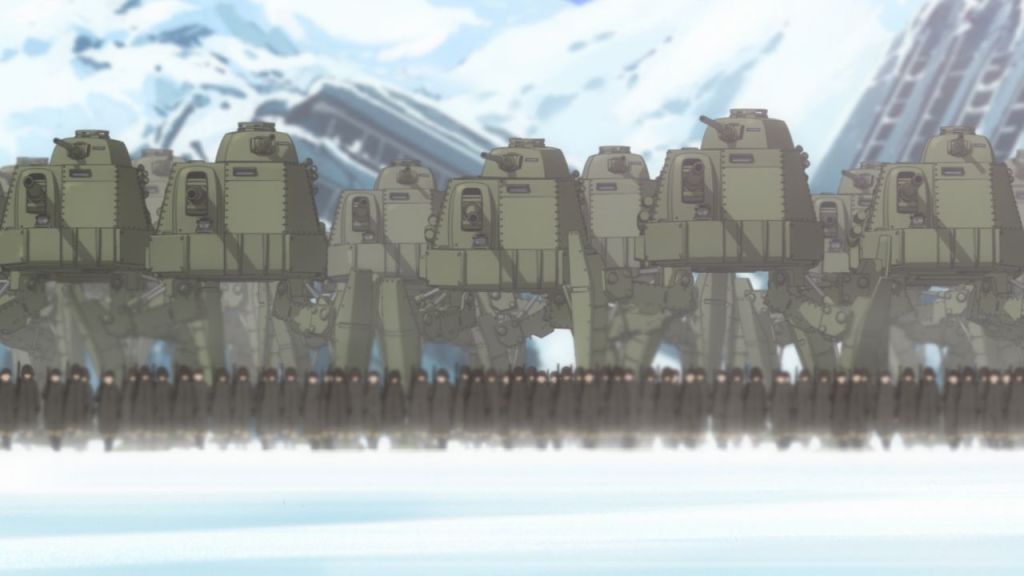
Since I was trying to do things the way I just described, I chose to stick to hand-drawn animation. I thought it would be beneficial to challenge the limits of the body. Even the scenes with the Fuchikomas (the AI-equipped tanks) rolling around were hand-drawn to a considerable extent. But it’s not like I intentionally tried to lower the usage of 3DCG. Before the production started, I tried my hand at some 3D software, and I feel like there are many interesting expressions that you can only achieve with 3D. So, for this project, the desire to do the things that you can only pursue in 3D became a sort of underlying theme in my own mind. Anything we could pull off by hand if we put in enough effort, we drew by hand; in exchange, the idea was that this would free up the energy to pour into the spots that could only be achieved in 3D. For example, the action sequence where the Fuchikomas get shot at and scramble to escape; I wanted to swing the camera around freely, so we built a set in 3D exactly to the art-direction specs, and shot the scene within the three-dimensional space where we actually had the Fuchikomas run around. We made the entire set for just a handful of cuts, so it was really a luxurious use of 3D. But ultimately, the richness of the result came through on screen, so I’m glad we did it. It turned out a really, really fun cut. I’m truly grateful. Additionally, we meticulously used 3D for a bunch of other things, like the cars and roads. It made me re-evaluate the strengths of 3DCG, and I think it’s that the depiction of space is more mathematical than what humans can draw. Hand-drawing is a world of physicality, so when mathematics—something the body can’t intervene in—suddenly enters that world, it’s as if you’re being shown, forcefully, that the world doesn’t belong to humans. There was a floaty kind of pleasure in that, and I found it a lot of fun.
— In leaning closer to the original’s artwork this time, what did you come to newly appreciate as the appeal of Shirow-sensei’s work?
Shirow-sensei‘s art feels very warm, soft and gentle. His drawings have a lot of heart. That feeling was something I wanted to treasure in the animation itself. As I said earlier, I wanted to challenge this project purely as a moving-pictures director, delegating all the decisions regarding its ideology and philosophy to the original work. However, during the actual production, there were some scenes where it was necessary I made those decisions myself. On those occasions, I gazed at the manga, and tried to think my way into the mindset of the person who made those drawings. So, what I was really doing was assimilating myself as much as possible with Shirow-sensei through his art, sort of like a spirit medium channeling the dead [Shirow Masamune is, for the record, still very much alive, t.n.]… It really was quite a spiritual way of working.
— I have to say, I’m very surprised. This project is your directorial debut, and usually you’d want to stamp your own personal touch on your first work. To set that aside and devote yourself to channeling Shirow-sensei‘s worldview like a medium… that’s a pretty remarkable thing to do.
I mean, I can’t confidently say that I understandGhost in the Shell. That said, I couldn’t very well make it while still not understanding it either, so I think that was the only way. It meant entrusting my own body and career to someone else’s soul, so that part really did take some resolve and felt like a real challenge, even to myself. But I wanted to venture into territory I didn’t understand, and I did actually manage to reach that unknown place, so it was fun. I feel like I became a different person after working on this. In terms of the visual construction, I believe the aspect Shirow-sensei treats with the most care is the fact that “the characters exist in their world”. So, I particularly paid attention to the credibility of the space, and to make the movement that exists there feel authentic. There are all sorts of ways to perceive space and motion, so unless you unify everything under a single cognitive tendency, the whole worldview starts to unravel. I did my best in that regard… However, unifying things right down to the cognitive tendency of space in a TV series did feel like a pretty tall order. I’ve heard that with theatrical films, you can chase this kind of attention to detail much further. So, if I could someday carry this world all the way to a feature film, that would make me really happy.
The Movies that Influenced Director Moko-chan
There are multiple works that influenced me. “101 Dalmatians”, which demolished the boundary between dog and human; “Jurassic Park”, which made me want to be a velociraptor; “Titanic”, which made me want to be rich. I also love “Congo”. It was after I saw the remake of “Dawn of the Dead” that I first thought I wanted to make films myself. (Stanley) Kubrick’s “Eyes Wide Shut” is the work that made me realize that even the choice of camera lens is a form of expression. Basically, I’m drawn, above all, to works with astonishing visuals.
Original interview from Febri, published on May 05th 2026, as part of the Kamiina Botan Staff Relay Interview series, original interviewer: 太田祥暉 (oriminart); genga from the official website.
“Kamiina Botan, Yoeru Sugata wa Yuri no Hana” (from now on, just Kamiina Botan) has showcased the personality and idiosyncrasies of the enshutsu & animators in each episode, and this policy isn’t limited just to the show itself, but has been applied to the opening movie as well. Today we invited China, who was in charge of the enshutsu and storyboard, to talk at length about this peculiar opening movie, which exists in two versions, the regular one from the broadcast and a “complete version” in a 4:3 aspect ratio.
I realized they wanted an OP movie that would express my personality
— The OP movie for Kamiina Botan has a “complete version”, different from the one included in the broadcast, which was made in 4:3. What was the occasion that first drew you to this aspect ratio?
The first time I directed an MV [“Sore wo Ai to Yobu Dake”, それを愛と呼ぶだけ, 2020], this was my chance to work in a format different from TV Anime, so I thought I’d make something I simply couldn’t do for TV. That time was the first occasion. For that MV, at first I drew the storyboard using Cinema Scope [2.35:1], but when I asked Tsuchigami Itsuki, who was participating as an animator, for his feedback, he suggested: “Rather than using Cinema Scope to emphasize space, wouldn’t it suit you better to place the emphasis on the characters with 4:3?”. I took his advice, and while making anime in the 4:3 aspect ratio, I realized that kind of frame is a perfect fit for the expressions I want to evoke on the screen. From that moment onward, I kept using that aspect ratio in the works I directed, like “Detarame na Sekai no Melodrama”[でたらめな世界のメロドラマ, 2023] and “First Line”[ファーストライン, 2024], and perfected it with a trial-and-error process.
— I see. So, while you were still experimenting with it, the offer to work on the opening movie for Kamiina came in.
Yes. However, this time, I wasn’t planning on using 4:3 from the start. During the brainstorming session with Production Assistants (Shota) Hiyama-san and (Norimasa) Fujita-san, and Animation Director (Sakura) Watabe-san we had before I started working on the storyboard, we discussed with the assumption that it would be made in 16:9. But as I started working on it in 16:9, I couldn’t quite put it together in a way that felt good… So, I once again tried to reconsider my approach towards this work. I was invited on this project by (Hikaru) Murakami-san, who I’ve known since “Yama no Susume”, and not only that, but I knew this show would feature a solo-key animation episode by (Yuusuke) Matsuo-san, and the ED movies by (Kou) Yoshinari-san… Since I was called on this kind of production, I realized I too should have made something that would truly express my personality. So, I thought I’d make “something I wouldn’t be able to do in TV anime”, and “if I go too far, I’ll let Director Sakuma or Hey-sensei pull the brakes”. So, I changed the canvas’ aspect ratio to 4:3 and started redrawing the storyboards.
— And that idea got accepted as-is. The OP movie tells a short story, how did you go about its composition?
First of all, when I was reading the original, I thought the protagonist, Kamiina Botan, was a very elusive and inscrutable character. My first idea was that it would be interesting to explore the relationships between the girls at the dorm, while presenting the question of who she really is in a documentary-like fashion. That said, not much of that suspense element actually remains… As for the visual gimmick, the movie is structured around the dorm girls taking turns filming each other with an 8mm camera; the idea being that by evoking the relationship between the character holding the camera and the one being filmed, I wanted to portray the “direction” of their relationship, like an “arrow”, which is one of the work’s key concepts. Also, in order to bring out a sense of realism, I made the OP at 18 frames per second, as if it were filmed using the same camera they have in the show. Due to equipment-related reasons, this caused a lot of trouble to the photography and editing teams, but I felt that by not just going for an 8mm-like visual aesthetic, and instead also matching the frame-rate to that of the actual film Botan and the others are taking, we could bring out a greater sense of reality.
— The OP also makes frequent use of cinecalligraphy-like cuts [a technique where text, lines, and drawings are created by physically scratching the film surface], could you tell us more about that?
When I was trying to figure out what sort of things Botan and the others would likely play around with, I thought of cinecalligraphy. It’s a technique used in some trendy MVs, and I thought they might be watching those kinds of things. By the way, each character has her own defined handwriting, so we used reference material for each of them to make those cuts.
The only request was: “Don’t make the Director’s credit too big”
— Well then, I’d like to talk about things following the order in which they appear. From the intro into the opening vocals, Botan turns around and rises from her chair, and the A-section of the song features candid shots of the dorm residents.
The concept for this OP was “the dorm girls pointing the camera at each other”. How would each of them react to the camera being pointed their way? What expressions would they make? Or even, with what sense of distance would they point the camera? I thought up each cut while keeping these questions in mind. I was also conscious of using lighting to indirectly imply the feelings the character filming has for the subject. And I chose the shots by thinking what moments would the girl recording think of as dear of the girl being filmed. The shot of Kanade looking at her PC with hollow eyes was also perceived as dear and lovely by the character filming it… that was the idea behind it.
— When B-section starts, balloons appear, and the outside of the dorm also makes its appearance.
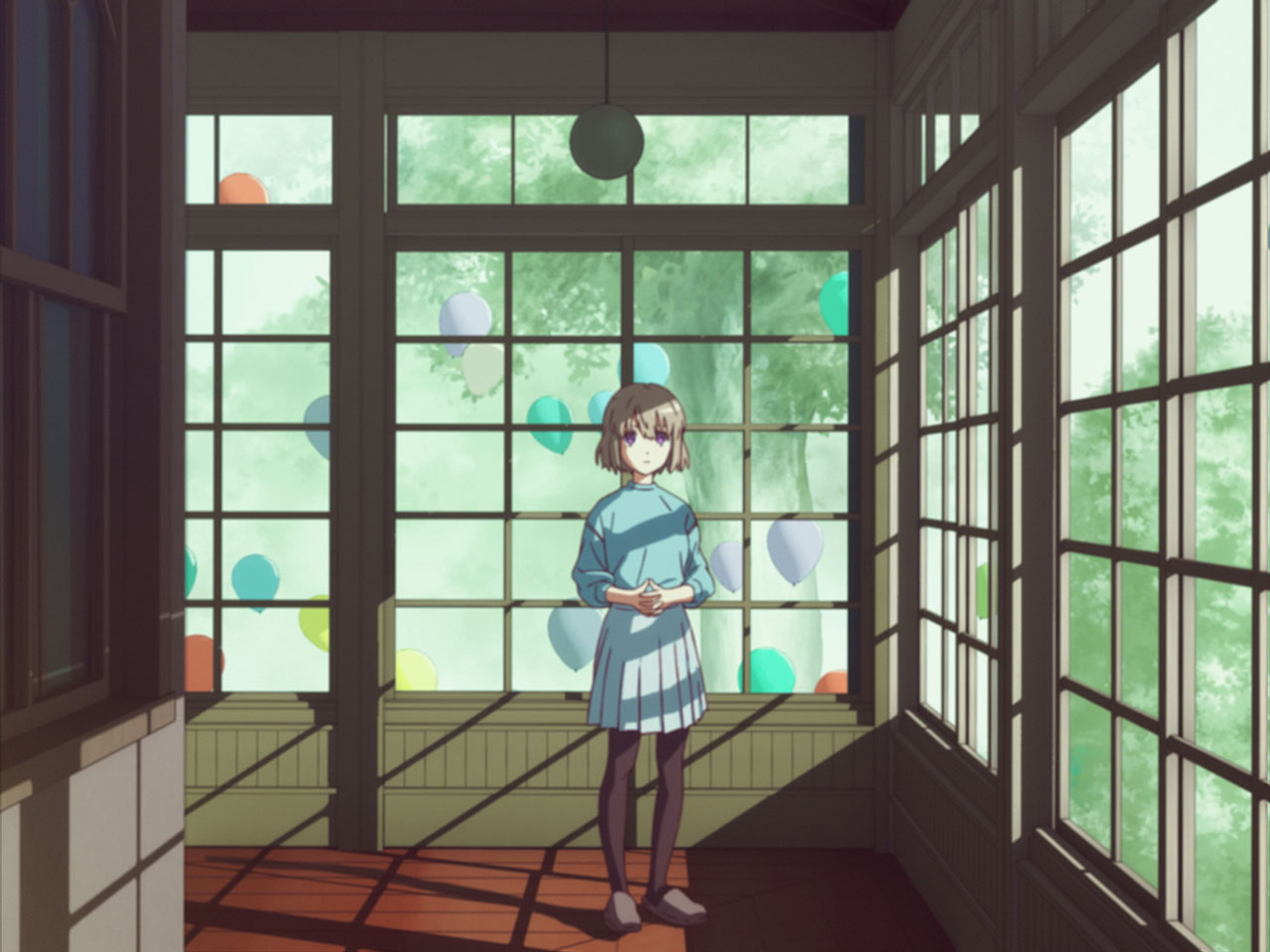
I was thinking of Botan and the others trying to set up a surprise for Ibuki, and those shots are the result. I wanted the balloons to release at the beginning of the chorus, so I started from there and worked things backwards. Also, the reason I made the dorm the setting for the OP, is because I believe the main characters of Kamiina Botan aren’t just the six students residing there, but also the dorm’s building itself. If it weren’t for it, the six of them wouldn’t have met, so I wanted to beautifully portray the dorm as a proper character as well.
— And when the chorus starts, the lyrics “Nee” appear on the screen as cinecalligraphy.
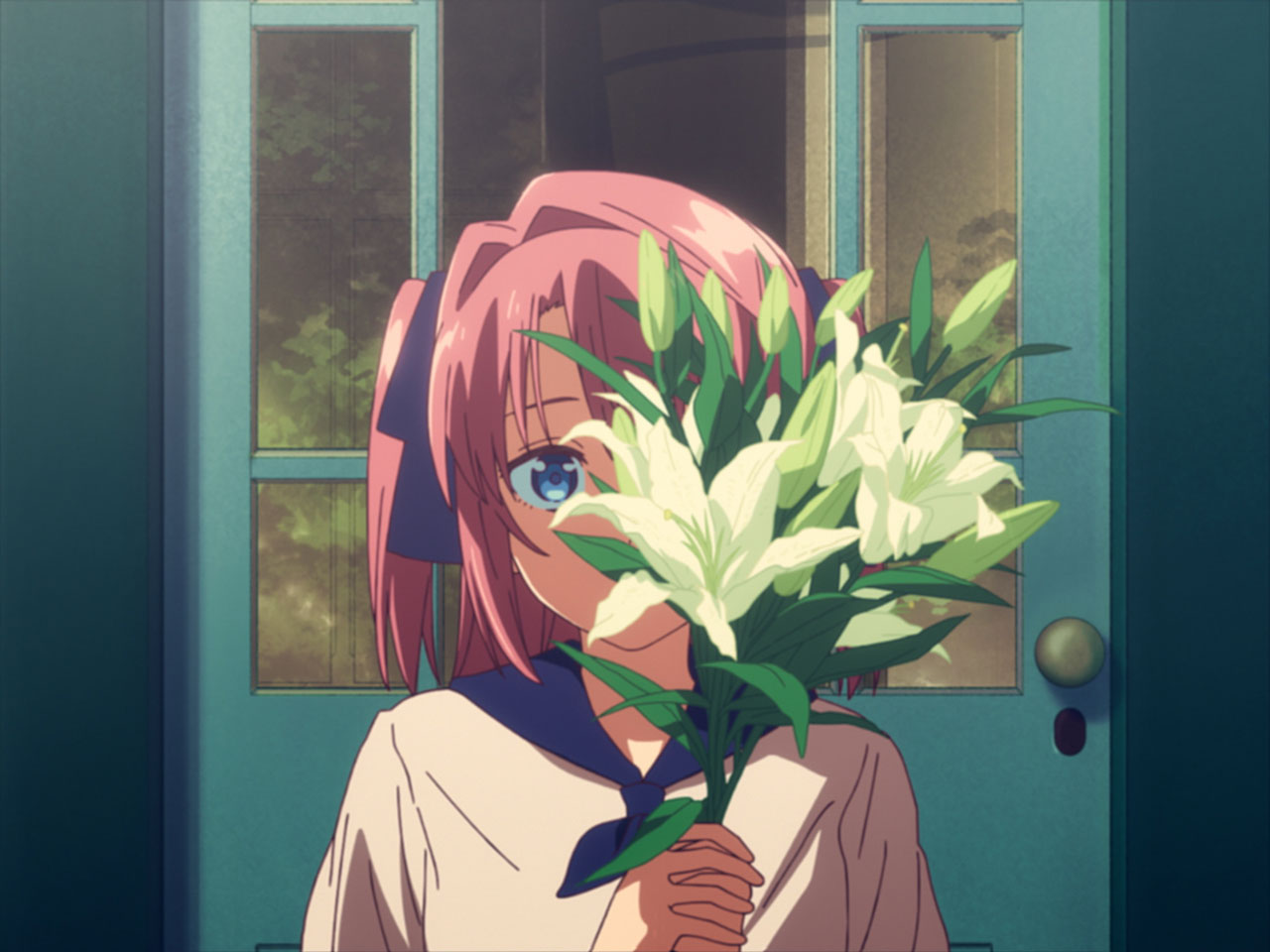
The “Nee” followed by the cut of Ibuki turning around, was something I really wanted to do from the very beginning of when I started working on the storyboards; I designed the OP around that cut. At the start of the OP, there’s also a cut of Botan turning around, and I wanted to emphasize the contrast between them. The opening cut is filmed from a distance, highlighting the blur of the automatic zoom, while the chorus one features the blur of the character filming physically pulling back from the subject. In both cases, I held the shots longer in order to make the most of that handheld camera feel. This chorus cut was built on the camera work by the 3D team, with (Naoya) Morotomi-san handling Ibuki’s key animation, and the team at Production I.G taking care of the in-between animation. I’m truly grateful that everyone, including Animation Director Watabe-san, stuck with me patiently through the many retakes. I think it came together into a really good cut.
— During the chorus, we move around the dorm’s garden, and then land on a very cute cut featuring Botan lying down, correct?
It connects back to the theme I was originally thinking about―“who is Botan?”. I wanted to capture the many different sides of Botan, even just in her smiles. I asked (Manami) Honda-san to handle the key animation of the cut in the garden, and (Komoto) Yusei-san the peace-sign cut. The latter in particular, I thought of it as the second defining cut of the OP, and it’s also the one where Soigne‘s name comes up, so I’m really glad it turned out so cute.
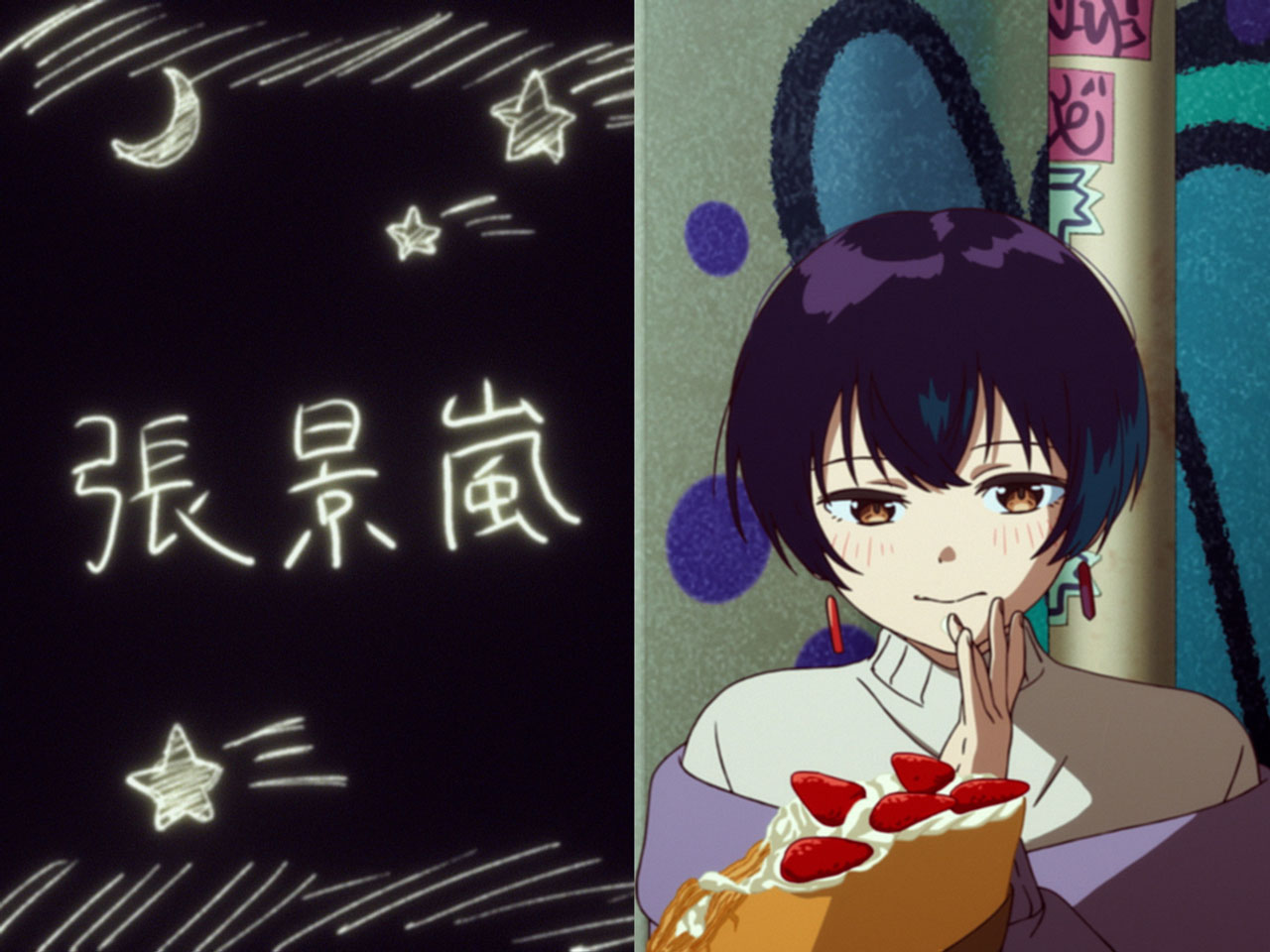
— Then, there’s a series of cuts showing each character’s name, but in the storyboards, they were supposed to show the song’s lyrics instead. What happened?
When drawing the storyboard, I tried to present it in kind of a meta way, by lining up the characters with parts of the lyrics that would match them. However, as the production went on and I got more and more absorbed in the world of Botan and the others myself, I felt that kind of approach was somewhat misaligned, so I reworked it into its current form. The cinecalligraphy cuts involved trial and error right up to the end, and ultimately I was able to push through by directly inputting the TP [trace-and-paint] materials myself.
— Toward the final stretch, starting from the cut key-animated by Miyahara Takuya-san where the five girls are filmed through the glass, cuts featuring larger groups of characters appear for the first time. What was the reasoning behind that?
As the frame gets more crowded, I feel the shots start to feel more anime-like… so I wanted to avoid that kind of compositions in the early parts. So, the basic approach was to focus on one character at a time, but I also wanted to leave room for the camera to turn toward the kind of inconsequential everyday scenes you might find in the dorm, and that’s the nuance I tried to build into the structure.
— After that,there are a few cuts featuring the relationship between Botan and Ibuki.
I lined up the “Kimi”[“You”] and “Asu”[“Tomorrow”] lyrics with Botan and Ibuki, respectively. Here too, in the original storyboard, the actual lyrics “Kimi” and “Asu” were supposed to show up… But this movie is supposed to be something that the characters themselves are filming with an 8mm camera and then editing, so I thought that making the song’s lyrics appear would be somewhat wrong.
— At last, after making the “Bang!” gun-firing gesture, Botan steps out of the frame.
That’s the cut where Director Sakuma’s name gets shot. At the storyboard meeting, the only request I had from him was: “Don’t make the Director’s credit too big”. So I honored that (laughs), and thought: “Well, if I can’t make it big, I might as well shoot it”. I always put a lot of care into how the title appears in rhythm with the music, so I’m glad a fun idea came to me this time as well.
I’d like you to enjoy the differences with the broadcast version too
— By the way, the peace sign at the end of the “complete version” isn’t there in the storyboard…
At first, the storyboard closed off with Botan doing the firing gesture, but once we put it all together, I felt it was missing something. So, I let my imagination run with the question of what the particular girl holding the camera would do next, and that’s how it took its current shape.
— Now that I look at it again, there certainly are a lot of cuts of Kanade smoking, aren’t there? (Laughs).
I’ve seen so many great cigarette scenes in movies, but since entering the anime industry I’ve rarely had the chance to depict them. So, I’m afraid I got a little carried away this time (laughs). It was a lot of fun being able to try out all sorts of ideas just with the way she exhales the smoke. My smoking deskmate animator once told me that “when you inhale and exhale, the smoke gets filtered by the lungs and comes out thinner”, and I incorporated that into the animation.
— What are your feelings now that the production is complete?
In the past works I directed or did enshutsu for, the “realism of the characters” has always been a central theme for me personally, and I’ve always wanted to achieve its culmination at some point. This time, I’m satisfied I was able to merge the atmosphere of the work Kamiina Botan with my personal taste into a movie everyone can enjoy. Also, I’m really glad I was able to have Watabe-san take on the full scope of animation direction duties. Watabe-san worked as a key animator on the “Kusuriya no Hitorigoto” episode I directed [Season 1 Episode 4, 2023], as well as many others, and I’ve always wanted to work on a proper project with her. I love how her sensibility is a hybrid of Kishida Takahiro’s approach to line selection and Kobayashi Keisuke’s approach to movement. In practice, it’s not even just a matter of sensibility, Watabe-san oversees the animation with extremely meticulous care, right up to the deadline, down to the level of whether to add or remove a single in-between drawing, or add or erase a single shadow line. Without her passion, we never could have reached this level of quality. Beyond that, I was fortunate to have talented people at the core of the production, the animation checkers, colorists, background artists, 3D and photography teams… all of them delivered beyond my imagination, at 120% of what I had envisioned. I’ve mentioned a number of the wonderful staff members involved, starting with the key animators, but almost all of them were brought in by Fujita-san and Production Assistant Hiyama-san. I am simply in awe of the network of connections that Soigne has built up. It was a wonderfully fulfilling production to work on as a director, one where I could be as demanding as I wanted.
— There are also all the differences with the broadcast version to look out for.
Absolutely. The broadcast version is in 16:9, but I put a lot of care in the way the credits show up against the song’s rhythm… It has always been a guiding principle of mine when working on OP movies to create something that will make viewers remember the names of the key staff and the studios involved. So, this time, I had fun with making the credits stand out too. On a finer note, the Soigne logo has actually been adapted into a Kamiina Botan-specificversion, and other touches like that in the credits can only be found in the broadcast version. I’d be happy if viewers could enjoy the “broadcast version” as the OP for Kamiina Botan, and the “complete version” as a home movie filmed by Kamiina-san and the others.
Original interview from ASCII.jp, published in two parts, Part 1 and Part 2, on July 17th 2010 and July 24th 2010, original interviewer: Watanabe Yumiko 渡辺由美子.
Even in anime, I don’t want to create a “miniature garden” [Part 1]
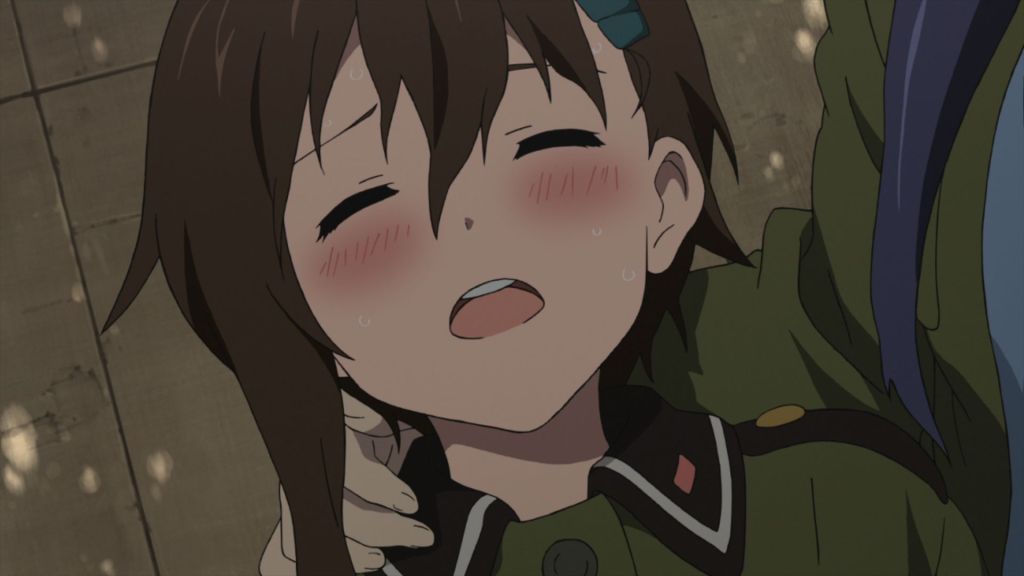
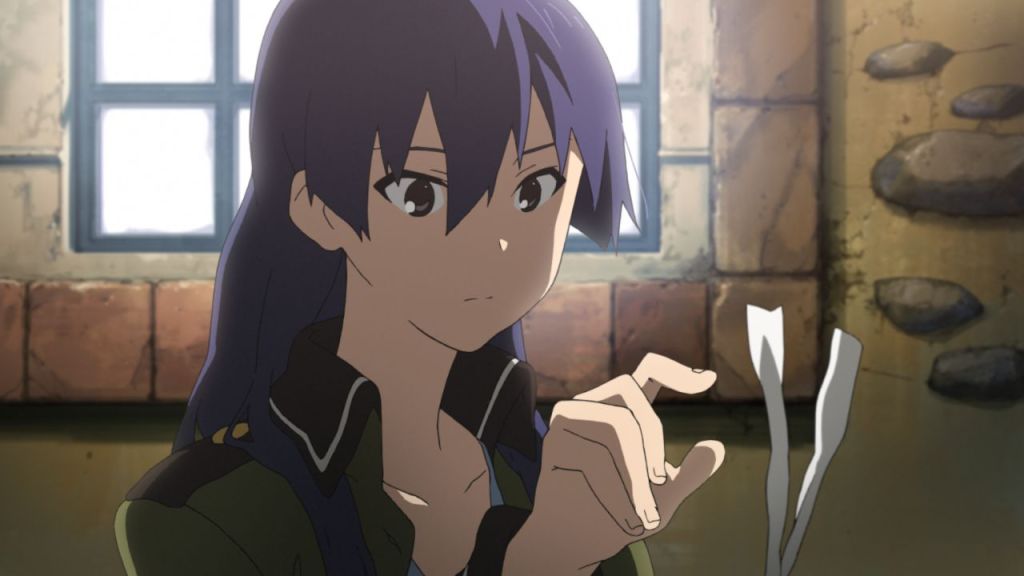
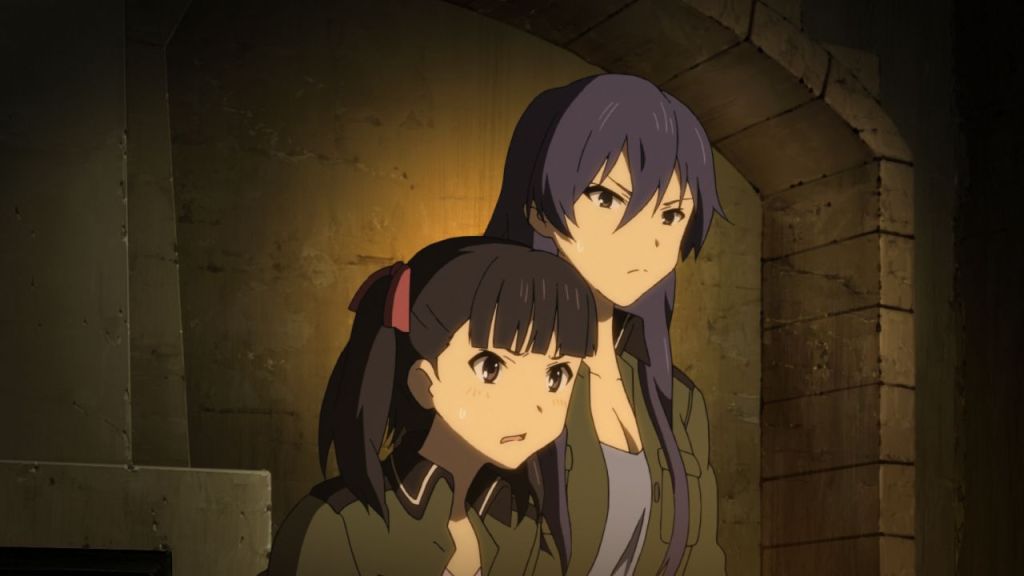
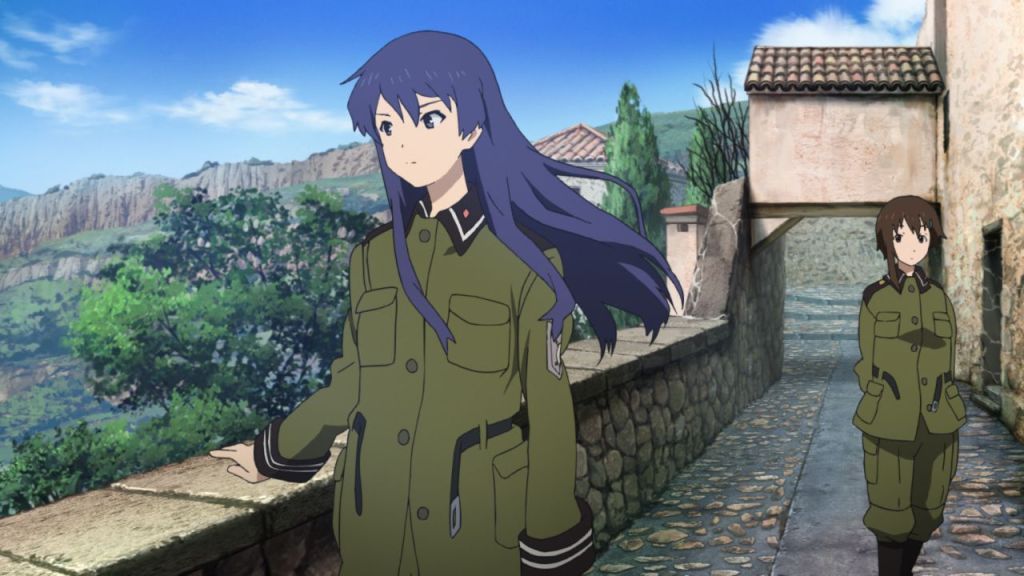
— Kanata and the others live in a world that may soon be coming to an end, and as soldiers, they have been stationed at the fortress. With a premise like that, one might expect the story to carry a much heavier, more tragic tone. Why did you choose to portray the girls’ warm and peaceful everyday lives instead?
Kanbe: That was something we decided from the very first meeting. Since it was set to air in a late-night slot, we wanted it to have a warm and comforting atmosphere, that would let viewers go to sleep feeling relaxed after watching.
Akira Shimizu(A-1 Pictures): So Ra No Wo To was broadcast as part of Anime no Chikara[アニメノチカラ], a late-night programming block that started at 1:30 a.m., so a large portion of the audience consisted of adults. Creating something people could relax and watch quietly at home after coming back from work was a request from our side.
Kanbe: When the idea of creating an original anime first came up, the initial concept I proposed was a reincarnation story centered around a man and a woman traveling along the Silk Road. However, the feeling was that the Silk Road setting wouldn’t attract many viewers, so it didn’t go through in that form.
Though, overall, I think I was able to incorporate just about all of the elements I originally wanted to explore into So Ra No Wo To.
“What viewers of late-night anime tend to enjoy these days are warm, easygoing worlds where girls happily go about their everyday lives”, says Shintarou Komatsu of Aniplex. With those audience preferences in mind, the direction gradually took shape: on the one hand, to create a fun and relaxing series that viewers could watch comfortably, and on the other, to make it a work with enough depth that, if one chose to think about it seriously, there would always be more to consider.
A world with a sense of continuity
— A work that could be enjoyed peacefully, and on top of that, offer deep thoughts about its story. This is the foundation of So Ra No Wo To, but what direction did youin particular want to give it, Director?
Kanbe: During the initial discussions, it was proposed that the story’s world should have a sense of continuity, and I thought that was a really interesting concept.
Director Kanbe, as he mentioned having troubles figuring out how to convey the “sense of continuity” in a fantasy world.
— Sense of continuity…?
Kanbe: For example, when people watch So Ra No Wo To, they should be able to imagine what the world Kanata and the others live in was like five years earlier, or what it might become five years later. That way, the story would become much more convincing, and its world would feel more familiar and real to viewers.
When I first heard about this idea of a “world with a sense of continuity”, I immediately thought it was a matter of “realism”. And in that case, I thought setting the story in contemporary Japan would be the best choice. It would be set in a city, a scenery like the one that can be seen from this window right now, with the Chuo Line speeding by, many houses standing in rows, and there would be schools, too. I proposed we set the story in a realistic landscape like that.
But then, someone said such a setting would lack fantasy appeal, and maybe choosing something different from modern-day Japan would attract viewers more decisively. So, we started discussing how to convey realism in a fantasy world.
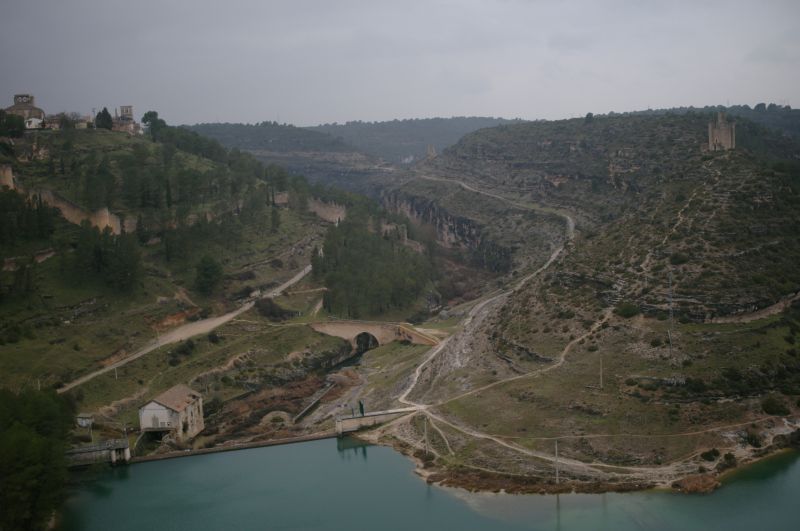
At that point, scriptwriter Yoshino Hiroyuki-san, who had just happened to see a television program about World Heritage Sites, had a flash of inspiration and made a suggestion: the fortified Spanish city of Cuenca and the Alarcón fortress. And everyone immediately thought: “Oh, this is interesting”.
Building a setting based on a real-world region, one that feels continuous with Japan, yet belongs to a country with a different culture. This aspect was what made it work for everyone. After that, we all agreed on the setting and decided right away to go on a location scouting trip.
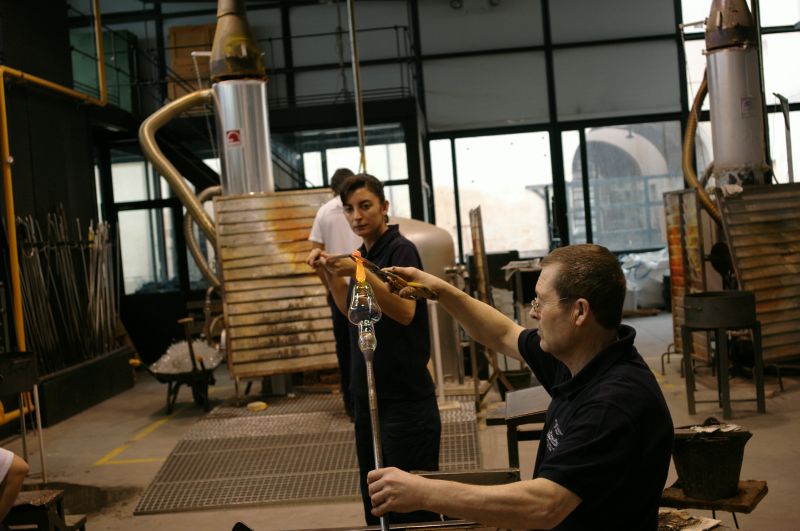
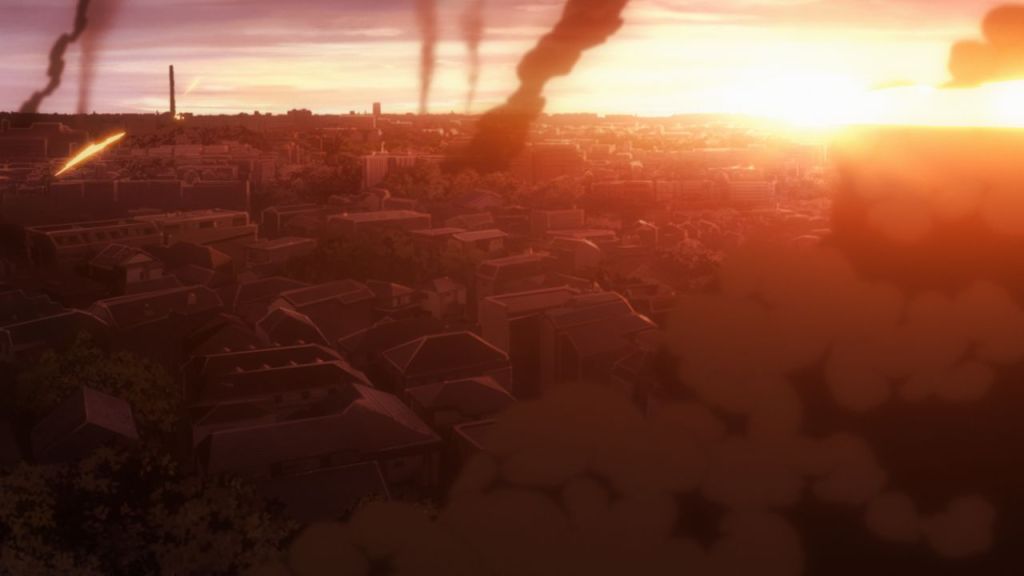
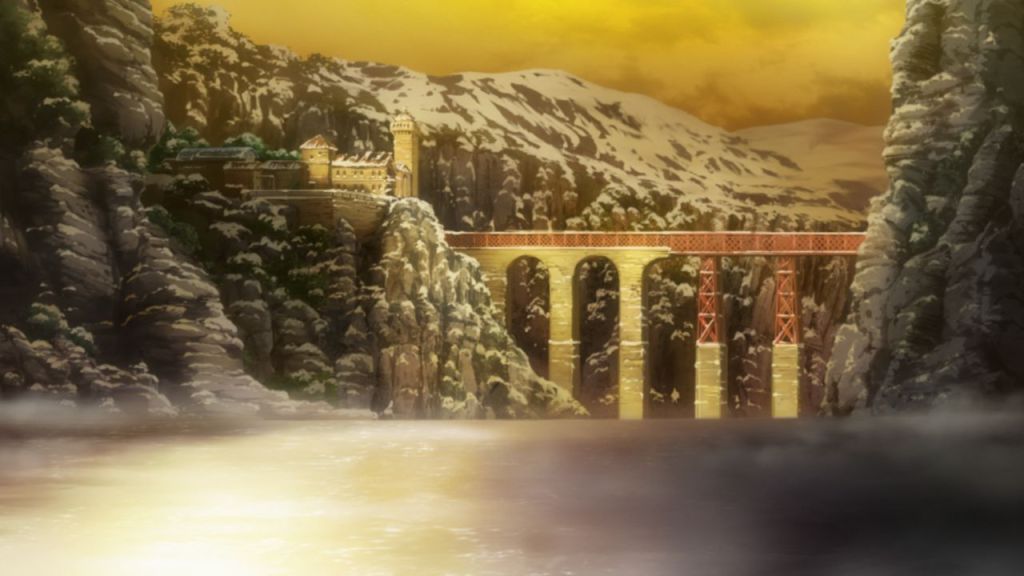
Director Mamoru Kanbe and the rest of the staff carried out location scouting for So Ra No Wo To. They visited the fortified city of Cuenca in Spain’s Castilla-La Mancha region, as well as the Alarcón fortress, a glass factory, and the House of Cervantes. In the end, the fictional town of Seize, which became the setting of the story, was designed as a place with a hybrid culture blending European and Japanese influences. This, too, was done with the goal of creating a “sense of continuity” in mind.
The fortified city of CuencaThe glass factory
— So, by visiting the real place directly, you were able to “convey realism in a fantasy world”?
Kanbe: Yes. Maybe that’s what they call a “first-hand experience”. Cuenca in particular was under Arab occupation for some time, and because of that, its taste is somewhat different from what you’d normally find in the rest of Europe. It also has wooden architecture. And over the years, due to various circumstances, some of those buildings ended up with slanted floors. Standing in them gives you a strange sensation. But the locals just use them as they are. It must be a peaceful, serene place to live in. The slanted floors for example, you really can’t get a feel for them until you’ve actually stood there yourself.
Ultimately, we didn’t replicate the slanted floors directly in the anime, but the people I worked with have all been to that place too, and I believe that‘s what really mattered. Set designer (Tomoyuki) Aoki-san, background artist (Masatoshi) Kai-san and scriptwriter Yoshino-san too, we all went together.
— What would you say is the biggest difference between going to scout the actual location and not going?
Kanbe: I believe it changes your notion of reality. It was small details, like the shape and placement of doorknobs. In Cuenca, the knobs were mounted right in the center of the doors, and we found ourselves wondering: “How are you even supposed to use this?”.
In Japan, doors like that would be unthinkable, yet the local people used them as if it were perfectly normal. When it came to conveying the sense of realism, I think being able to grasp that feeling of “normality” was the most important aspect. From our perspective, these things seemed strange, but for the people living there, they were completely ordinary. It wasn’t like: “Wow, how unusual!”, they didn’t find it surprising at all.
After the location scouting trip, I started thinking again about what exactly this “sense of continuity” really meant. In the end, I think it comes down to creating a world the audience can perceive as tangible and substantial, even if they had never been there personally. Even in a fictional, fantasy world, if Kanata and the others live their lives treating things like those unusual doorknobs as perfectly normal, portraying that sense of everyday life creates that feeling of continuity with reality.
I wanted to add a sharp sting of “reality”
— What feelings did you want to evoke in the audience by portraying the world of the anime as normal and ordinary?
Kanbe: Simply that “that’s reality”. The world where Kanata and the others live is theirreality, after all.
This ties back to what we said earlier about making the series comforting and relaxing while still giving it depth, but the idea of “adding some sharper, more bitter elements to the story” also came from me. Because in reality, there’s no such thing as a world completely free of those harsher sides.
I didn’t want the series to remain just a sealed-off “miniature garden”, shut away with nothing but pleasant things in it. I may have felt that way to some extent.
The battle field, conveying the sharper and harsher realism of the anime.
— Like adding something more raw to the easygoing atmosphere.
Kanbe: Exactly. An element of realism I wanted to add in So Ra No Wo To was the presence of parents. I didn’t want to make a story where parents simply never appear at all. After all, these characters must have been born to parents.
In anime, it’s quite difficult to put the spotlight on “adults” in a prominent way, and there’s also the fact that it would drift away from the audience’s interests. I, personally, wouldn’t mind an anime with a 35 year old guy as the protagonist.
“Parents” especially are often viewed by teenagers as intrusive and overbearing presences. Adolescence is an age of rebellion after all. I used to be pretty much like that too, there was definitely a time when I thought: “Parents, who needs them?” (laughs), but as you get older, you start to think: “Wow, parents are amazing!”. Everyone is born because their parents were there, so let’s take care of them, that’s how I feel now.
So, that’s why I asked Yoshino-san to make sure the presence of the parents of Kanata and the others was clearly established, even if they never actually appear on screen. With things like Kanata receiving a letter from her parents, and the contrast between that and Kureha revealing hers had died in the war. Even if they never appear directly, I was always mindful about their presence in the story.
Various scenes from the anime bringing into the story the presence of the characters’ parents.
Bringing out the realism of war within the easygoing atmosphere
— Talking about this inclusion of realism in the story, Kanata and the others live in a world where war exists right alongside their everyday life. How did you approach the depiction of war as normal and ordinary for them?
Kanbe: In the end, that aspect ended up leaning more into the fantasy realm, didn’t it? That’s because none of us has ever experienced war first-hand. However, one thing I believe we managed to depict in a slightly more authentic way is first-hand accounts of war. In my case, generationally speaking, my father, mother, and uncles all lived through the war.
What struck me most about the stories from my father, who was born in Showa 10 [1935], was just how much they struggled to find food. Every single memory he had was tied to eating in some way. What he called “playing”, it seems, was sneakingfood.
There was a strawberry field near where he lived, and he and his friends used to sneak in, crawling on their bellies to pick strawberries and eat them lying right there on the ground. Gritty with dirt and everything. And when the owner of the field spotted them, they’d all scatter in a panic. That was their idea of “play”.
If there’s anything we truly managed to capture in this work, it would be the experiences of people like them.
— As a way of conveying the reality of war, one approach would be through meticulous depictions of battle itself, but in So Ra No Wo To, you chose to convey it through the portrayal of human beings instead, is that right?
Kanbe: Yes. That’s why this show depicts the atmosphere of the “post-war”. In the story, it’s actually a ceasefire, but I hoped to bring out something like the sense of relief that comes with the end of a war. The people of the town still carry raw and vivid memories of the war, but at least it’s over now. “What a relief!”, that sort of feeling.
The opening sequence of Episode 1, when Kanata is on the train heading towards her destination, the town of Seize, is a scene that I hope managed to convey that kind of post-war relief. I asked the voice actors to perform as if a long-held sense of tension was finally beginning to lift.
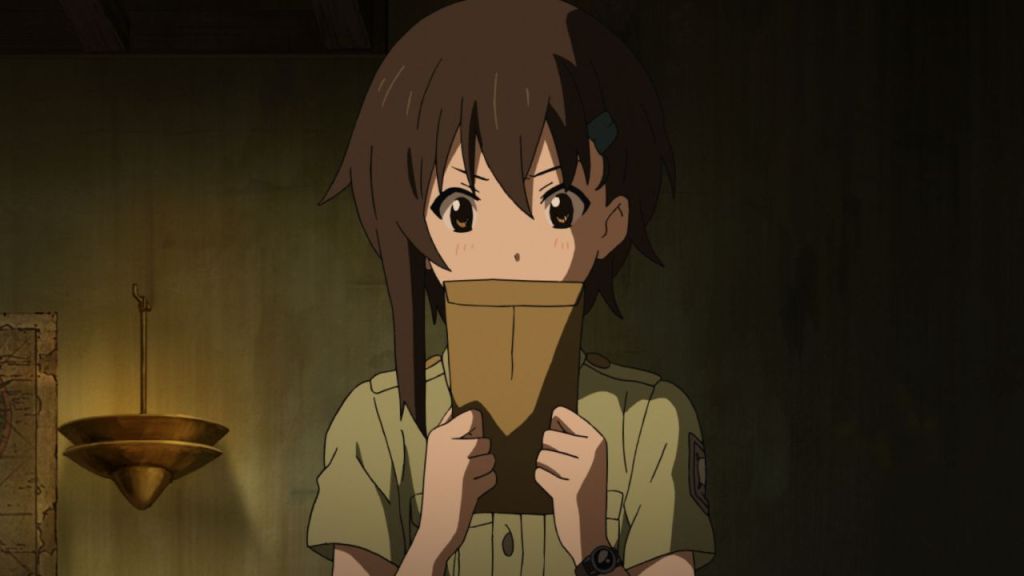
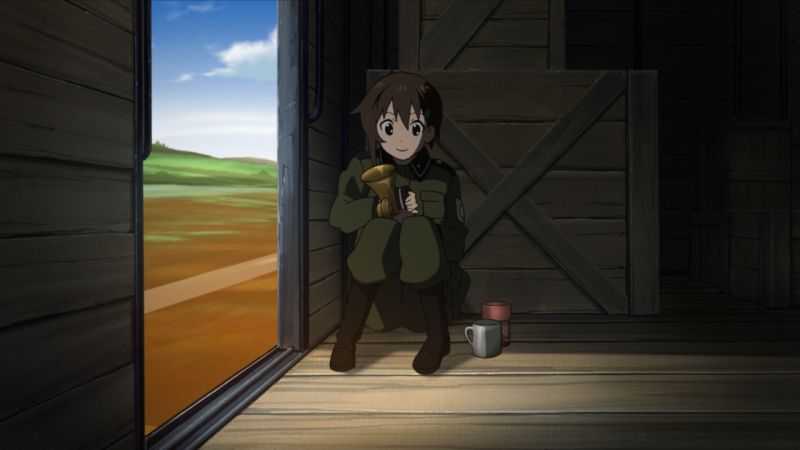
Kanata, moving to the town of Seize on a shaky freight train, with the caramel can she received from a kind soldier (from the opening sequence of Episode 1)
A happiness with a slight sting to it
Kanbe: What I wanted to portray in So Ra No Wo To wasn’t a “miniature garden”-like world where the girls could live happily without obstacles, but rather the warmth and happiness that emerge from never losing hope, no matter how desperate the situation may be seen to be.
— The “happiness” portrayed in the show feels somewhat hard-earned bittersweet. An episode that left a lasting impression on me was the one featuring the old lady that kept waiting for the man who left her when they were young [Episode 10]. She believed in his promise to come back for her, and then one day, she ran out of her house and vanished into the snow.
The long-awaited lover finally had returned to her, and young again, just as she once was, she flung open the door and ran out to meet him. After that, the “old lady” vanished into the snow.
Kanbe: That’s based on a real story I heard from a friend who was also part of the staff, it’s something that actually happened, or so they say. In a certain countryside town of France, an old lady was building a house and all of a sudden, one day, she left, bare-foot, and disappeared into the woods. I thought it would work well visually, so we tried to add it into the show.
— In that moment, Kanata said: “People can keep on living because they have memories of when they were happy”. Would you say that, to you, that’s one of the shapes happiness can take, Director?
Kanbe: It was Yoshino-san who came up with that line, and essentially it means that if a person believes they’re happy, then they probably really are. The perception of what’s “normal” changes from person to person, I believe. And so does happiness.
My eldest uncle once told me a story about an air-raid. He lived near a large river, and when everyone was burned out of their homes, they’d make their way to the river looking for water. But the river was full of dead bodies. The many corpses strewn along the river were treated as if they were no longer human.
He said that once you reach that point, your senses go numb, and that sight becomes just another “normal” part of the landscape. He told me this at a funeral, and what he said next has stayed with me ever since: “The fact that we can have a proper funeral like this today, it really shows how incredibly peaceful things are now”.
The story conveys the message that what’s “normal” differs depending on what your eyes have witnessed.
— Being able to hold proper funerals really means that we’re living in peace.
Kanbe: It does. Hearing my uncle’s story got me thinking. My father’s tale of sneaking strawberries, if you consider that they were always hungry, it must have been truly a hard time, and yet, the fact that he framed it as “playing” speaks to a sensibility quite different from ours. The fact that he told me the story more than once too means he must have enjoyed it to some extent. He was able to eat, so he was happy, that might be it.
— You’re saying that happiness too differs from people to people?
Kanbe: At least, that’s what I believe. Even if others wouldn’t understand it, if you feel happy in that moment, then that moment really is happiness.
I have some of those myself, moments of “happiness” that, thinking about it now, I’m not sure I could explain to anyone. When I was working as a Production Assistant on Kaze no Tani no Nausicaä[Nausicaä of the Valley of the Wind, 1984], all I looked forward to back then was sleep. I barely got any, you see (laughs). That moment of finally getting to sleep, that was when I was happiest.
In the end, it really comes down to whether you’ve experienced it first-hand or not. For both happiness, and working on a show. Your own, personal experiences are truly the most important.
Portraying a connected world in anime [Part 2]
— In So Ra No Wo To, Kanata, a bugler, goes through many experiences and comes to convey something of her own through “sound”, that’s the kind of story it became, wasn’t it?
Kanbe: The story is set in a world roughly 250 years from now. Our current civilization has collapsed and the world has been rebuilt from the ground up. The survivors are creating new towns, and throughout those towns, there are ruins reminiscent of the past civilization.
A large portion of the Earth’s surface has become a sterile land, impossible for people to inhabit, and it is said that the remnants of humanity scattered around the rest of the world are heading towards their end. However, even in a landscape like that, there are things that have been inherited from the past. And Kanata’s bugle is one of them.
— What’s the reason you chose “sound” as the means to convey this concept?
Kanbe: As they say, music transcends language. Like how songs made in Europe can reach even Japan, crossing all kinds of borders to connect with people all around the world.
As for the song Amazing Grace, I remember choosing it from all the possible candidates because I felt everyone in the world must have heard it at least once. The original composer is actually unknown, and that carries over into the story too: even in Kanata’s time, it’s a song where no one knows who made it or how. And yet, it still comes through. I thought that was fascinating.
Passing it on, from person to person
— What significance do you personally think “conveying things to others” holds, Director?
Kanbe: This might be a bit of a leap, but I think it means “leaving something for the next generation”. That applies to having descendants, and also to passing on the experiences we’ve lived through to those who come after us.
For example, lived through the war when they were children, and if I were to have children, I would pass those stories on to them. There are many different ways of conveying something to the next generation, and I believe festivals and folklore are among those methods.
In So Ra No Wo To too I tried including the “Water-Splashing Festival”, and apparently festivals that recreate events from the past are found scattered all around the world. And by repeating those festivals every year, the children become parents, then elders, and experience them along the way. And in this repetition, things from the past get conveyed and passed on to the next generations.
On the “Water-Splashing Festival”
The day when Kanata reached the town, in Seize the “Water-Splashing Festival” was taking place. In the distant past, the town of Seize was attacked by a demon, and the 5 Maidens of Fire offered their lives to protect it. The festival is held every year to console the spirits of the Maidens.
Kanbe: The festival depicted in the show is fictional, but there’s actually a very similar tradition in Southeast Asia. The part where a Maidens hold the demon’s head in the flames is almost identical.
— What I found fascinating was that the legend of the “Fire Maidens” passed down in the town of Seize was conveyed in a different form in the enemy nation [the Roman Empire]. According to their version, it wasn’t a demon who caused the Fire Maidens’ death.
Kanbe: The narrative had been swapped out for a more heroic version. The demon [who is an angel in the Empire’s version] came in a near-death state, and the Maidens, knowing it would soon die, chose to let it pass on peacefully. But the townspeople, who were afraid of the demon, ended up killing the Maidens along with it. It was out of a sense of guilt, feeling they had wronged the Maidens, that they rewrote it as a more noble tale. Those who passed the story on twisted it to suit their own convenience.
— Some aspects always end up getting twisted as things are passed on. I believe that happens all the time in reality as well, not just in fiction.
Kanbe: I’m sure the majority of what gets passed down from the past carries the biases of those who narrated it, with their own interests taking priority. Otherwise, there would be no way to explain why historical interpretations differ from country to country.
Facts not being passed on accurately is something that happens close to home for us too, I think. Even without any deliberate distortion of reality, there’s also the matter of distance from the subject, whether physical distance, or the distance in time, causing details to get lost in the process.
A thing that made me realize this was a story from an acquaintance of mine in Alaska. I meet with him when he comes back to Japan, and one time I lightheartedly asked whether the effects of global warming were visible over there. He said they were in plain sight, in a very tangible way.
Alaska’s land is basically all made out of sand, apparently. The ground is formed by hard and compact lumps of this sand, and that frozen ground is starting to thaw. Depending on where it does, the coastline is getting closer and closer, and the portion of land where people can live is actively in decline. In So Ra No Wo To too, one of my personal themes was the idea that “what is visible to us right now is not all there is to reality“.
— What is visible to us right now is not all there is to reality…?
Kanbe: No matter the context, there always is something that we cannot see from our side. For instance, the situation in Alaska is not something we can see by being here in Japan. Despite it happening on the same Earth.
In the series too, we depicted this by showing how Kanata and the others didn’t know how their nation was perceived from the outside, until a girl from the enemy army told them directly. Passing things on, and the misunderstandings that come with it; I wanted to explore these themes in the work as well.
The role of letting the next generation “imagine”
— In the process of conveying things, misunderstandings arise. What do you think of the facts that get distorted along the way?
Kanbe: I don’t think it’s either a good or a bad thing. After all, when something happens and people talk about it, they do so from the perspective of their own convenience, don’t they? Leaving out the bad parts, or changing the story a bit.
— So, you believe it’s truly inevitable for misunderstandings to occur?
Kanbe: Well, rather than it being “inevitable”, that’s just how it is. I personally am extremely attracted by relics and ruins, after all, relics are the history of mankind itself. The buildings and structures that are left behind aren’t preserved in their entirety, so we have to imagine how the world of the past was based on what’s left.
We’ll never know exactly what it was like, but people of the generations that come next will come up with different interpretations, “I think it was like this”, “No, I think it might have been like this”, and so on. I think this process of imagination is genuinely fascinating and fun.
In the show too, Kanata and the others have discussions about how they believe the building they’re currently using as a fortress was once a school. There are things like textbooks or blackboards that have been left behind, and the characters try to imagine what kind of people used to use them.
— Regardless of how reality actually was, it’s those who inherit it who imagine its form as they please.
Kanbe: Exactly. They imagine it and interpret it as they please. It’s imagination, so there must be some aspect they get wrong. But I believe there’s a significance to the act of imagining by the next generations. In other words, the people who once lived there are passing on traces of their existence to future generations.
The repeating endeavor of mankind, history of mankind
— In Kanata’s world, there really are many places with ruins or relics from the past. It’s a world where humanity over-developed its civilization, and eventually headed towards its ruin. Why did you choose to depict it that way?
Kanbe: The story is very extreme in its portrayal, but I suppose the idea was that even if mankind has made mistakes in the past, the history of those mistakes is passed on along with everything else.
There’s no such thing as a never-ending civilization. Past civilizations too, at some point just faced their ruin, in the sense they aren’t directly connected to us, living in the present. It’s ultimately what humans do, and I feel like it’s something that’s bound to repeat over time. So much so that we have sayings like “history repeats itself”.
In the Aomori Prefecture there’s the Sannai-Maruyama, a huge historical site from the Middle Jōmon Period, from a civilization that lasted for about 4000 years. And that civilization too came to its end by the end of the Jōmon period. The reason why it ended is still under investigation, but on top of a global-scale cooling event, it’s also thought to be linked to the cultivation of chestnut trees in Japan.
Given the excessive presence of chestnut trees around the site, the theory goes that the uncontrolled increase in chestnut cultivation led to environmental destruction. In other words, what happened there was that humans reshaped nature to suit their own needs.
The very things that drive humanity forward can, at the same time, be seen as mistakes. Technological advancement is a good thing, and we reshape the environment and advance technology to suit the way humans live, but then, even if we say: “Let’s stop global warming, let’s stop emitting CO2”, getting rid of all cars would surely cut emissions significantly, but our current way of life would become impossible to sustain.
Humanity keeps on living, even as it repeats its mistakes
— You could say that humanity keeps repeating its “mistakes” throughout the course of history.
Kanbe: I believe that’s what history is. Our actions might be viewed as “mistakes” by future generations. And yet, people do the best they can with what they have in each moment, and as long as human endeavor continues, the same things will keep repeating.
— And you’re saying that even so, there’s still meaning in inheriting them, right?
Kanbe: Yes. That’s something I tried to be mindful of in So Ra No Wo To as well. In that world, humanity made mistakes, and it’s heading towards its ruin. Nevertheless, in the story there still are things inherited from that past, like technology, music or decaying buildings. At some point in the show there’s the line: “That’s what history is”, and I believe that sums it up.
Even in a world said to be on the verge of collapse, Kanata and the others take in what they receive from the people around them and from what past generations have left behind, and think about what they themselves should do going forward. They too are part of history, and in that way they carry it forward. That’s the kind of connection I hoped to convey.
— To convey her feelings to everyone else, Kanata plays Amazing Grace. And through its repetition, it passes from person to person, like a relay.
Kanbe: The lyrics in Amazing Grace are really good. It means something like “God would forgive even someone like myself”. Tying back to the idea that there will always be mistakes in people’s actions, and that’s part of what gets passed on.
Everyone is born from their parents, we experience many things throughout the course of our life, and eventually meet our death. And in this process, we leave something behind for the next generation. I believe every single one of us is a “bearer of history”, Kanata and her friends, myself, and you too.
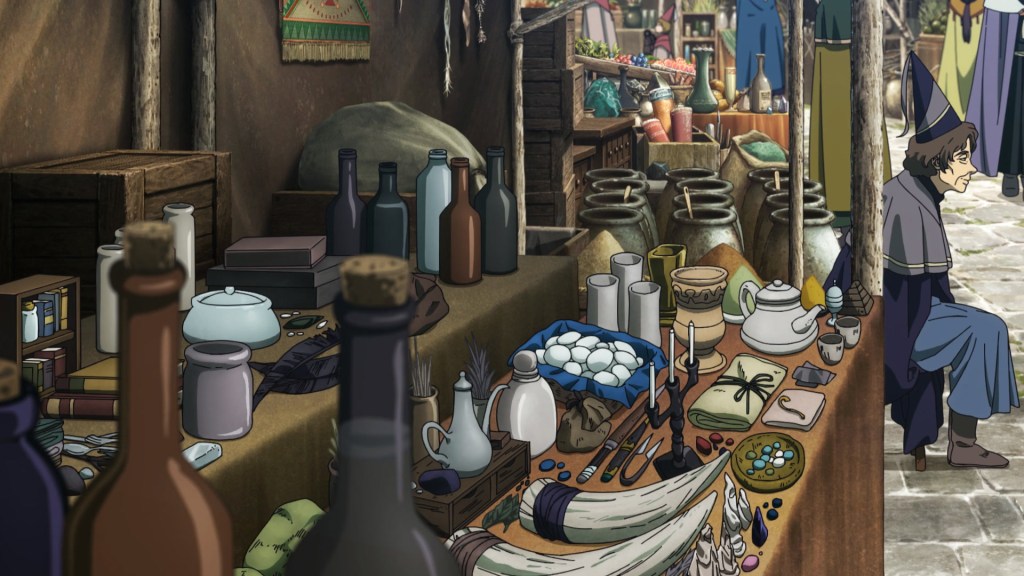
This year’s fervent spring season has finally kicked off, and amidst its rich lineup of intriguing productions, I was sure to find at least one episode to feature in this series. The question remained which show in particular would warrant a full write-up, and given the wide variety of genuinely viable options (as well as the unusual frequency in which I’ve been performing my fair share of translation wizardry lately), I anticipated this post coming out in the latter half of the season at the earliest. What I didn’t anticipate however, was for a certain magic-adjacent adaptation to be this goodthis early, forcing a premature bloom of my writing instincts. So, here I am, after a mere four weeks, briefly exploring the brilliant cinematography of Tongari Boushi no Atelier Episode 4.
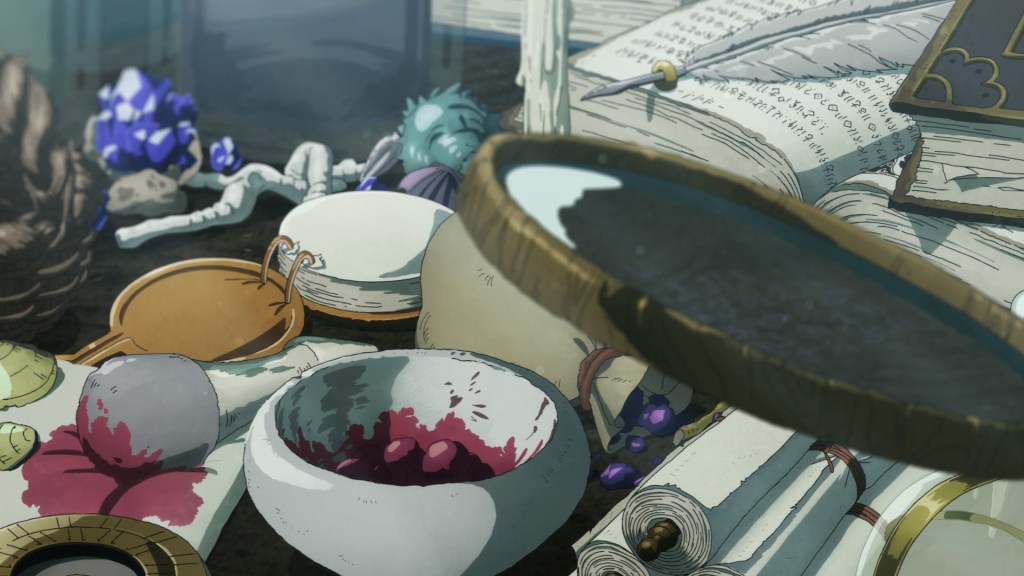
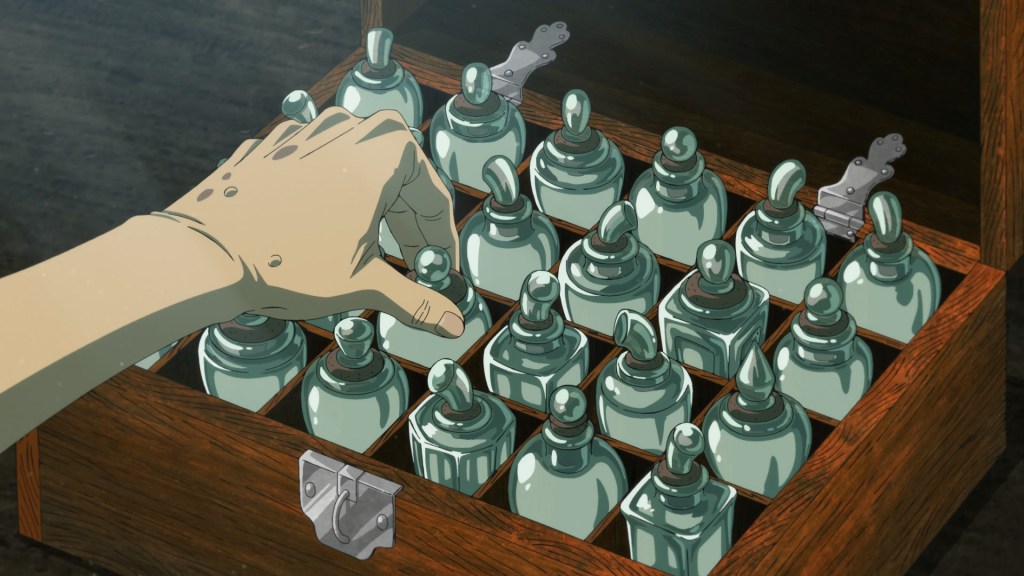
Right from its two-episodes premiere, Tongari Boushi had never been shy about showcasing the resourcefulness of its production, with its enchanting art direction, the mesmerizing character art & animation, or even the incredibly thorough prop design. A fully-fledged toolkit this adaptation made use of right off the bat, emphasizing the core concepts of this story without failing even for a moment to capture the magical nature of its world.
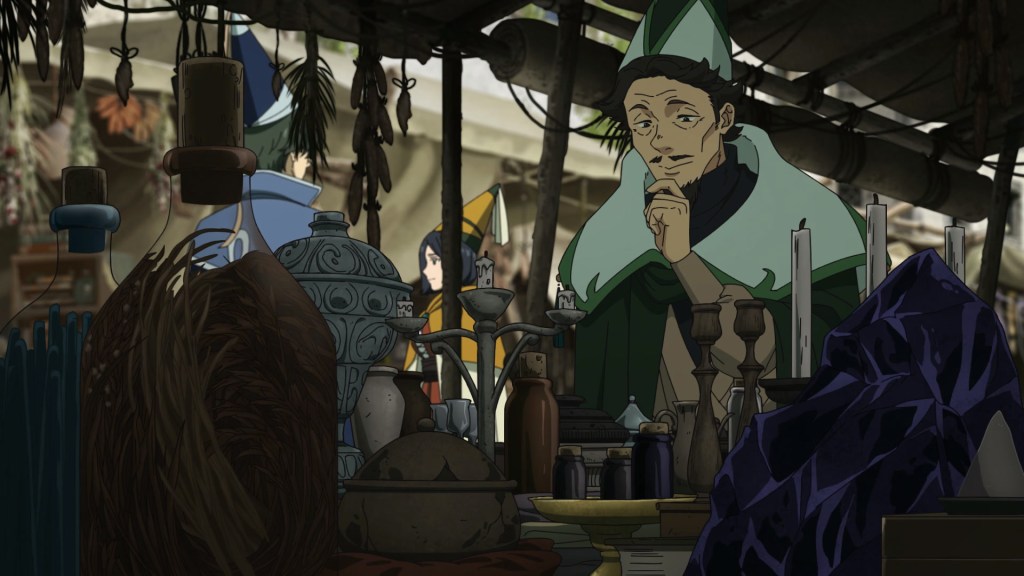
Episode 4 certainly isn’t exempt from this, and Noritaka Suzuki & Gouichi Iwahata’s prop design is in fact the undisputed protagonist of the opening sequence. Realizing Episode Director Masamitsu Abe’s storyboards to their full potential, the carefully detailed and vastly varied magic equipment is the primary vehicle through which the town of Kalhn is presented to the viewers. On a purely technical standpoint, the staggering amount of cels featured throughout this portion of the episode is a truly remarkable feat, especially for a TV production.
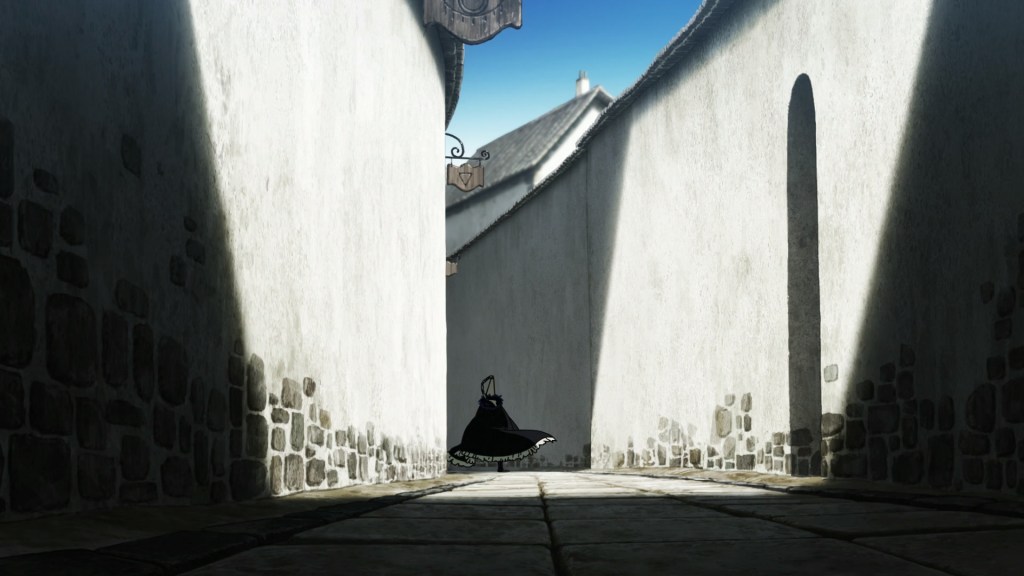
This brief detour in the town’s marketplace serves as the perfect expedient to paint the picturesque atmosphere of the witches’ society through its culture. The many wonderfullybusy layouts describe the depth of this world and its multi-layered nature in a rather concrete and pragmatic way, by correlating their visual structure to the qualities intrinsic to the narrative. At the same time, the themes of depth and perspective are also consistently rendered in a radically graphical sense, with shot compositions that deliberately place all the emphasis on the dimensional aspect of the frame.
In a visual medium like animation, space represents a fundamental tool of communication—arguably the most essential and intentional one—and the aspects that come into play in its definition are often overlooked. In itself, this isn’t necessarily a surprising thing, given that these expedients are exactly meant to be subtle and discreet. This episode in particular however, thanks to its extensive and masterful use of them, offers quite the exquisite pretext to talk about two of these unfairly understated factors: shape & line motif, and contrast (or affinity) of tone.
There are limitless ways in which space can be characterized, even more so on the canvas of animation, which is inherently bound only by the limits of one’s creativity. Nevertheless, space can be classified in a particular type, between deep, flat, limited and ambiguous. In reality, this distinction is relatively blurry and behaves more like a spectrum of sorts, but for the scope of this post, emphasizing this categorization is more effective than it is inaccurate.
Many different depth cues are deliberately used to control which kind of space is created, and the type of space you use has different implications on how the shot, the cut or perhaps the whole scene is perceived in the end. Tonal contrast is one of these cues, and Tongari Boushi #4 makes consistently great use of it, especially during the final portions of its A Part.
A very noticeable detail of the episode, is how uniform the shots start to look from the moment Coco and the others enter the magic supply shop. This is usually referred to as “affinity of tone”, or “tonal reduction”, and it’s a quality of the overall brightness of the scene used to create the impression of flat space. After emphasizing the depth of the town scenery with layouts that intentionally highlighted the dimensionality of 3D space as I discussed earlier, the interior of the shop appears much more stable and fixed, with the movement initially happening parallel to the picture plane. Elements in the background have more texture compared to the foreground, flatting space, and shapes too start to look more uniform, mainly resembling squares. The line motif—another essential visual descriptor—of most shots is composed of the intersection between straight lines, vertical and horizontal, which grants an overall sense of stability and rigidity to the sequence.
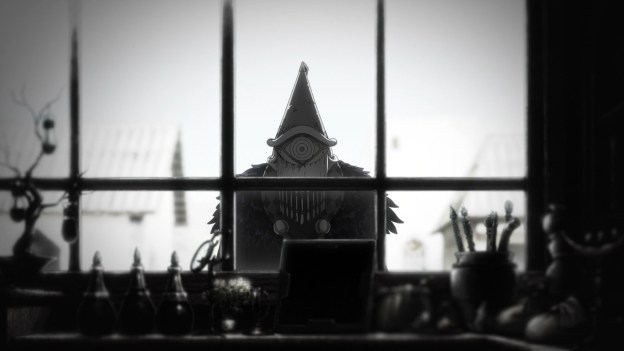
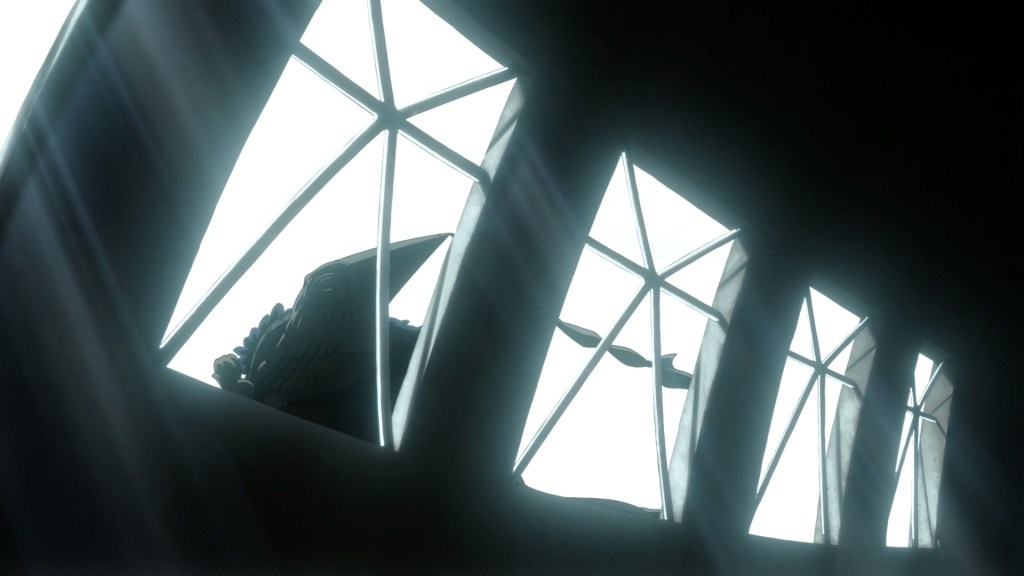
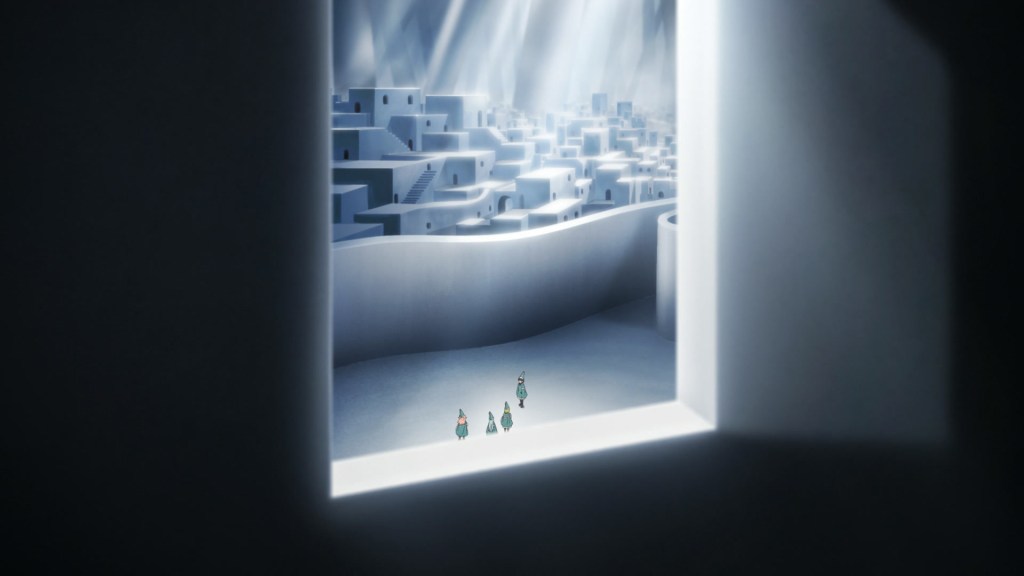
It’s exactly in this context that with just a single shot, the sudden appearance of the Brimmed Cap member vehemently shutters this perception: by increasing the tonal contrast to the maximum, effectively creating a black & white shot, the unusual lines of the foreigntriangular shape created by the witch hat, previously hidden due to the persistent coincidence of tone, introduces a lot of tension to the scene, and it’s also strongly emphasized by the physical, simulated reduction of the aspect ratio through the frame of the window. It’s interesting to note how this shot still abides by the same space-flattening rules: conventionally, objects that are dark appear farther away, while objects that are bright appear closer to the screen. In this case, making the background extremely bright, and the foreground and middleground almost pitch black, is effectively coercing the space into looking more flat.
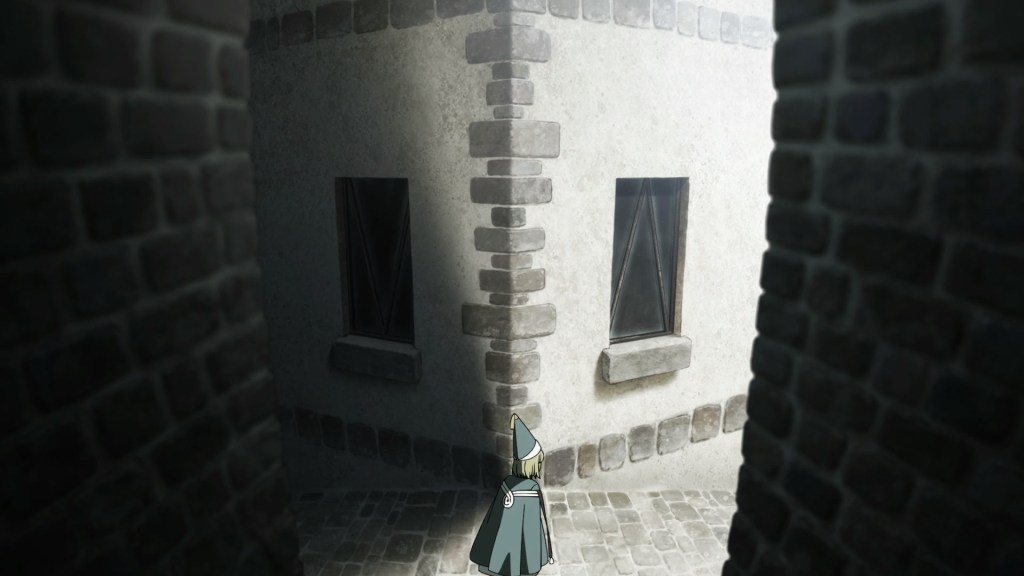
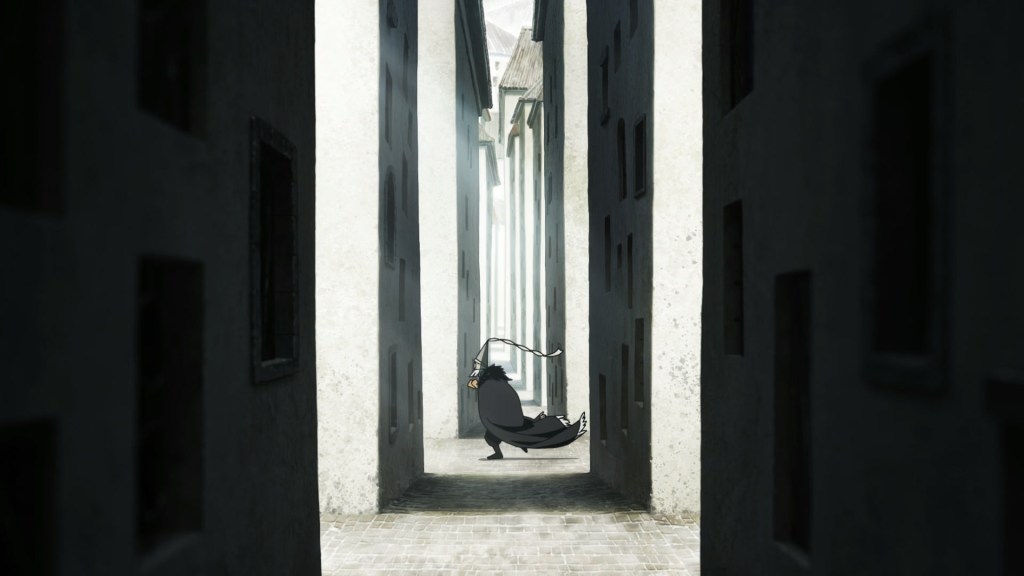
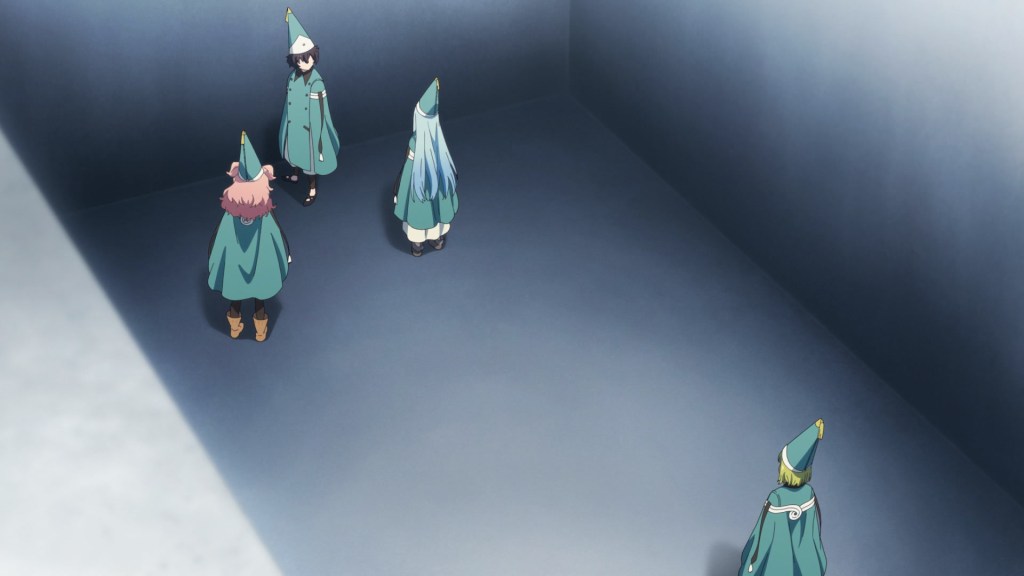
Frame 1Frame 2Frame 3Frame 4
As Coco runs out of the store to chase after the rogue witch, the space becomes deep again, with the depth cue of movement now happening perpendicularly to the picture plane (like in Frames 1 and 3), and the shot compositions emphasize the point of convergence (Frame 4), an unmistakable indicator of depth. Occasionally, ambiguousspace is also used very loosely, distorting the proportion of the physical relations to convey a sinister sense of instability, like in Frame 2.
Contrast of tone is still very much present throughout this short sequence, and the continuously interchanging pattern of dark and bright patches disorients the perspective of depth, and blends the longitudinal planes together into a single convoluted stage that feels bewildering and unsettling.
The comprehensive control over how space is defined in this brief sequence really struck me when I first saw it on the screen, as it’s somewhat unusual, at least in TV anime, to find such a textbook application of tonal contrast this prominent and intentional.
The latter half of the episode keeps on building upon the by-now established channel of space, with its very unequivocal implication of distance and isolation. The tonal affinity makes the space exceedingly flat again, but this time, the almost total absence of textural details in the backgrounds shifts the focus entirely on the foreground, making the negative space around Coco feel all the more excruciating.
More conventional directorial tricks are also used to emphasize this sense of dissonance between the characters, like the quick succession of opposite shots, evenly spaced cuts that get closer and closer to the camera, or compositions that physically separate Coco from the others. Additionally, as it’s something that happens quite rarely, I appreciated the peculiar employment of sound direction in this depiction of distance: lowering the volume of the girl’s voices in favor of Coco’s to create contrast between the two was a very effective way of viscerally conveying their growing separation.
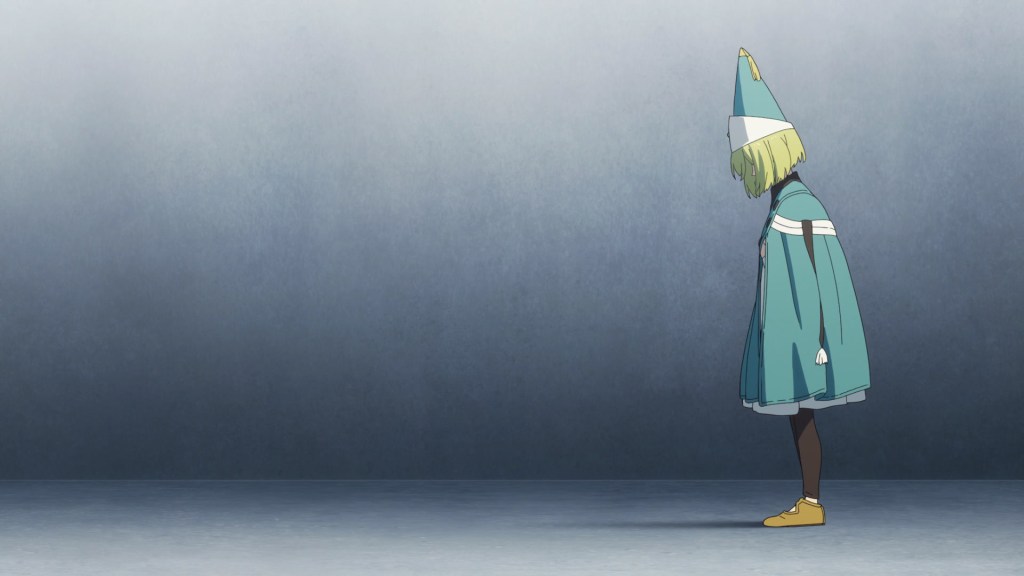
The main tool that contributes to B Part’s implication of isolation however, is definitely the shape & line motif. This surreal world in which the four apprentices are transported gains its otherworldly quality not only from the monotony of tone as I mentioned earlier, but also from the overwhelming affinity of shapes and lines. Houses and walls are all described by straight lines, creating many squares and rectangles on the screen, and this rigid pattern that persists throughout the second half of the episode is constantly emphasized by the framing, which makes the borders around the characters feel insurmountable and oppressive.
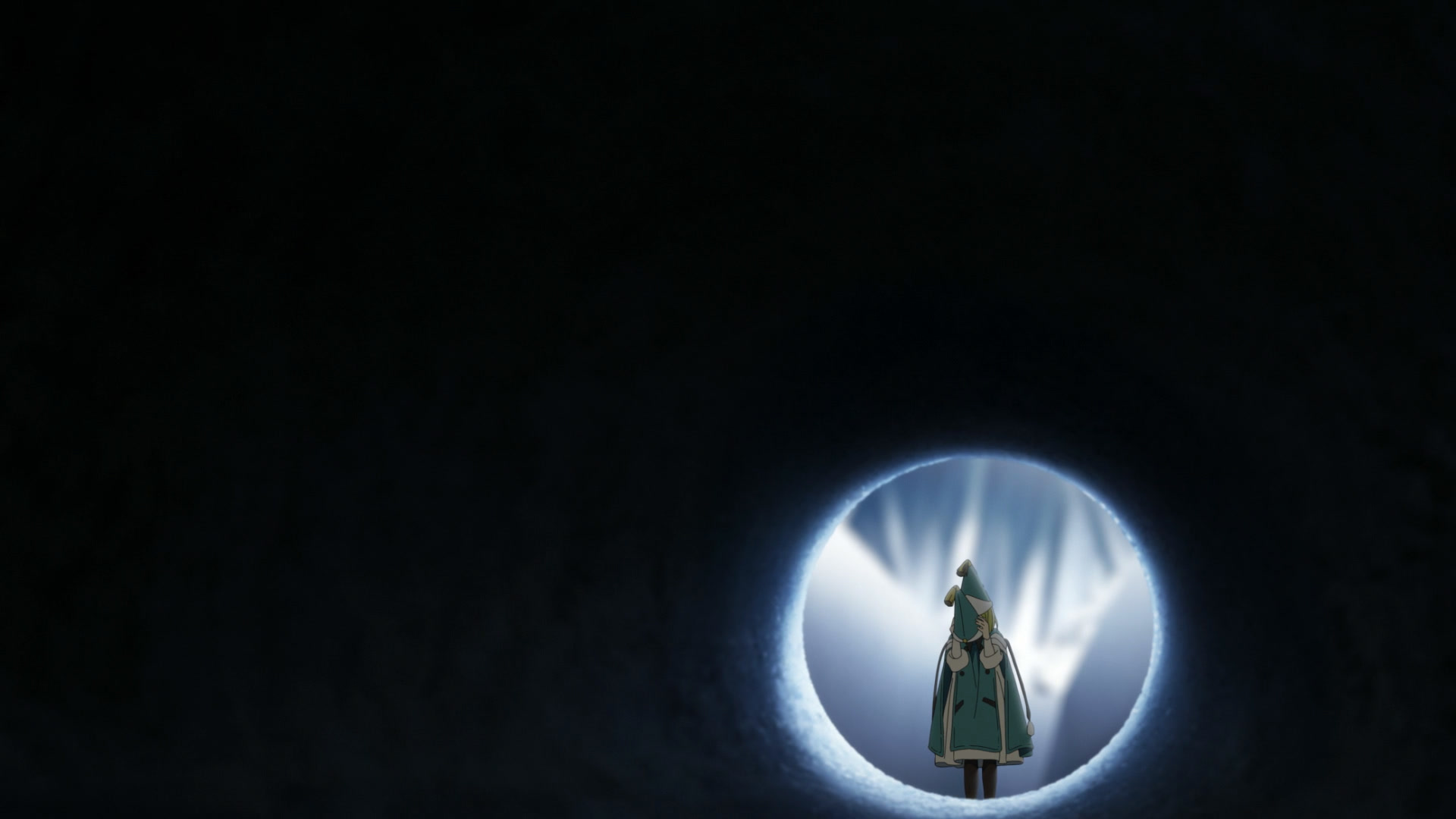
Towards the end, as we’re seeing Coco through the hole that Richeh managed to open with her magic, the newly introduced circular shape, radically incompatible with the world around her, capitalizes on this structural oppressiveness making her feel even more out of place than ever.
Finally, to alleviate all this tension, the episode closes on a positive note (at least visually), bringing us back to the real world, that is now soaked in the tremendously warm colors of the sunset.
Finding the right balance between technicalities and intention is always a tough task, especially when the two are so deeply intertwined. I hope this brief attempt at presenting some notions of cinematography through tangible examples didn’t come across as too rigorous or stiff. Maybe, in the future I’ll find other opportunities to explore more of these concepts, and it’s not unlikely that time will come sooner than I expect, given the absolutely insane amount of incredible shows coming out this year. Until then~
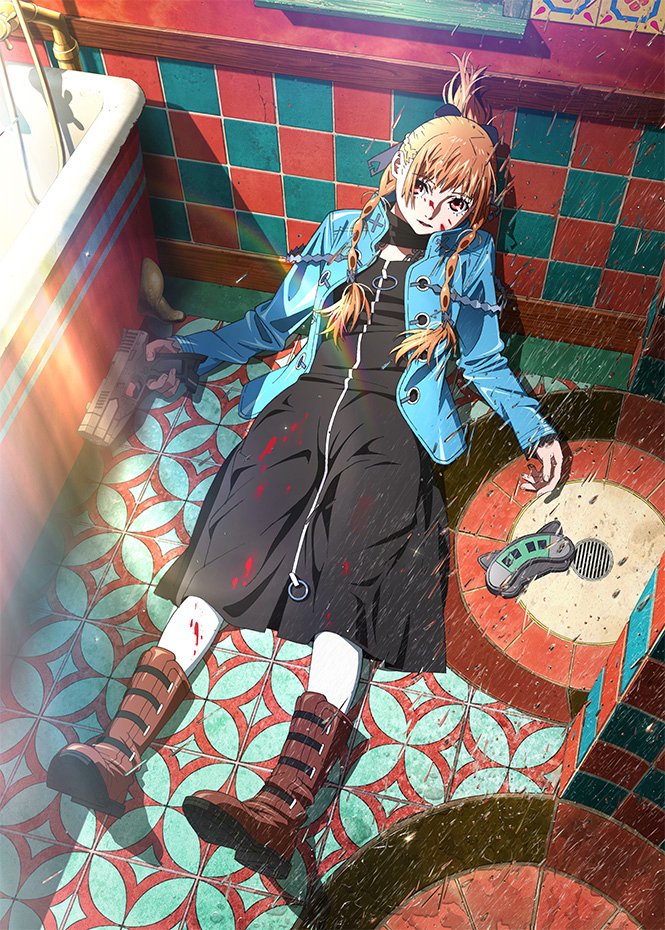
The deluxe edition is packed with bonus content, but personally I’d especially recommend the staff-drawn illustration booklet. It contains illustrations and messages from the staff, and Shinya-kun contributed a piece drawn in the style of a commemorative photo. It was so heartwarming that I too decided to do a “group photo”-style illustration with everyone together. I tried drawing Ubu with the kind of carefree smile you never get to see in the main story (laughs). There are also prequel-like illustrations, some depicting Elegance’s delusions, others with the children at orphanage… it’s all a lot of fun, and I think it turned out to be a really delightful little booklet.
Director’s Comment #2 (Blu-ray Illustration)
We had a request from the Aniplex Assistant Producer to set it in the shower room of the Spa. Originally I planned to have Ubu undressed, but due to various circumstances we ended up keeping her in her usual outfit, drenched in blood from the battle. The image was that with her clothes already ruined from the fight, she just showers with them on (laughs). The nude version is being saved for store-exclusive bonuses.
Behind the scenes of the gun action
Excelling at both effects and character animation
— This feature will focus on gun action, one of the signatures of Umetsu-san‘s works, with questions centered around that theme. Joining us for this discussion are Director Umetsu and Takahashi Shinya-san, who is credited as “Main Animator” and “Weapon Designer” on this project. To start things off, could you tell us how and when you two first started working together?
Umetsu: Personally, I have no idea when Shinya-kun and I first ended up working together (wry smile).
Takahashi: It was that time, wasn’t it? When you moved over to Pierrot Plus[currently “Studio Signpost”, the studio changed its name from “Studio Kikan” to “Pierrot Plus” when it became a subsidiary of Pierrot in 2009, then changed it again to the current “Studio Signpost” in 2019, t.n.] for the preparation of the new project.
Umetsu: Oh, it was for Cecil[Wizard Barristers: Benmashi Cecil (Wizard Barristers), 2014]?
Takahashi: Yes, I believe Cecil was the first project you had me on board for. At the time, an acquaintance of mine was working on a different project at Pierrot Plus, and he recently told me he was the one who introduced me to you, Umetsu-san.
Umetsu: I remember asking you to help me out with the openings for SoreMachi[Soredemo Machi wa Mawatteiru (And Yet The Town Moves), 2010] and BLOOD-C[2011], but I wonder if those were after that?
Takahashi: To be precise, the first time was actually when I worked on key animation for the pilotversion of Cecil. I believe the openings you mentioned fell between the pilot and the main project. After that, I had the opportunity to serve as animation director for the first episode of the main Cecil series.
Umetsu: Which means, counting from the main Cecil series, we’ve be working together for about 13 years…
— Takahashi-san, at the time, what impression did you have of Umetsu-san‘s works?
Takahashi: Umetsu-san was someone I had looked up to since my school years, through works like Megazone [Megazone 23 PART II Himitsu Kudasai (Megazone 23 Part II), 1986], long before I became an animator myself. His style was in a league of its own compared to anything that came before, and whether it was the density or the movement, I couldn’t help but think: “This person is something else”. That was the impression he left on me. I had always followed his work as a fan, and I wanted to make something that could get as close to his level as possible, even if I could never quite reach it.
Umetsu: The first time I noticed Shinya-kun, was in Evangelion[Shinseiki Evangelion (Neon Genesis Evangelion), 1995] when I saw his name in the key animation credits. At the time, he’d just sort of caught my eye, and I didn’t think about working with him or anything like that. Then, we teamed up for the first time on the Cecil pilot, and I thought: “This guy really is an all-capable animator, he can handle anything”.
— Practically speaking, what was that about?
Umetsu: He could draw action, and his effects animation was amazing too. That was the first thing that surprised me. I have the impression that from the late 90s, animators split into two categories: those who are mainly proficient it character animation, and those who are in effects animation. So, when we were working on Cecil, almost no one could do both. But Shinya-kun could, and skillfully so, which I thought was very impressive.
Takahashi: Speaking of animators who excel at both character and effects animation, to me, you Umetsu-san and Nakamura Takashi-san were the very definition of it. The first time I watched Genma Taisen[Harmagedon, 1983] at the theater, I was shocked.
Umetsu: That’s because at the time, to everyone, including Morimoto Koji-san and Nakamura Takashi-san, drawing both the effects and the characters together was the norm. (Hiroyuki) Okiura-kun and (Takeshi) Honda-kun too can draw both, but if you look at the generation right after theirs, specialization took over and animators started gravitating toward one or the other as their field of expertise.
Takahashi: Though, I feel like recently, partly thanks to digital animation, the number of animators who can handle both is increasing.
— So, after Cecil concluded, you two worked together on Virgin Punk?
Umetsu: After Cecil, I always made sure to invite Shinya-kun to work with me, like in Koufuku Graffiti[Gourmet Girl Graffiti, 2015], Dimension W[2016], Sousei no Onmyouji [Twin Star Exorcists, 2016] and various openings. Of course, I wanted him on Virgin Punk as well.
The role of the Main Animator
— For this project, Abe Genichiro-san, Kando Maho-san and Takahashi-san are the three names credited as “Main Animator”. How was the workload divided between the three?
Umetsu: Abe Genichiro-kun is a Shaft in-house, and he’s just exceptional at effects animation. So, he mainly worked on… oh, well, he’s actually outstanding at character acting too, isn’t he? (laughs). He was the one who volunteered, and so he joined the project as Main Animator. As for Kando Maho-san, I’ve known her since she was doing douga at a certain studio, and now that she moved to a different studio where she’s working as a key animator, I invited her over to work on this project. Young animators who can draw realistic acting are rare these days.
— What parts did Kando-san mainly worked on?
Umetsu: She can draw everything, so I had her work on many different things… but she’s particularly good at crowd scenes. I didn’t have to make any correction to the crowd scenes for this project. She animated people in a way they genuinely looked like they inhabited that town.
— These days, it’s common practice to make crowd scenes in CG instead, and the number of animators who can draw them by hand is decreasing, isn’t it?
Umetsu: Kando-san pulled off something that most young animators nowadays would struggle with. It’s not an overstatement to say that she did almost all of the crowd scenes in Virgin Punk. And as for Shinya-kun, well, that goes without saying (laughs). I wanted him to do a lot of cuts, and with the overall delays in the key animation, I ended up forcibly asking him to work on many different scenes all over the place.
Takahashi: That’s right (laughs). I did a lot of stuff, from explosions to character action.
— According to the pamphlet, you mainly worked on the action sequence inside the church, is that right?
Takahashi: The church sequence was the first one I was assigned, I handled a few dozen cuts there. After that part was done, I went on helping around with the other scenes.
Umetsu: Originally, the plan was for Shinya-kun to work only on the church sequence, but because of various circumstances, we were completely stuck with the other action scenes… (wry smile). There was no other way, so I asked him to help with them too, and he took care of it. As a result, Shinya-kun took over basically all the tasty parts (laughs).
— You also worked on the “Weapon Design”, does this mean weapons are one of your strengths?
Takahashi: I’m sorry, but I’m not good enough to confidently say it’s one of “my strengths”. I think weapon enthusiasts or designers who mainly work on them would laugh looking at my designs, that’s my current level. Anyways, when working on them, I focused on realism; including the firearms, I tried drawing something that could actually exist in reality. That’s my idea of weapon design.
Umetsu: Judging from the designs you submitted, I don’t think that‘s the level you’re at. The guns you draw are extremely convincing and persuasive. I believe they’re awesome.
The High-Performance Boomerang was the hardest one to make
— What‘s the process behind the creation of the Weapon Design?
Umetsu: At first, mechanical designer Ni0-kun proposes a concept for the weapon. Then, I ask him to draw an approximate draft for it, and lastly, Shinya-kun finalizes it into a proper gadget. That was pretty much the process behind the design. That’s also why in a previous interview I said it was Shinya-kun who wanted to make Ubu’s gun a CZ P-10 C, but it was actually Ni0-kun‘s idea. Let me correct myself on that.
— The guns are essentially based on real models, but to what extent did you adapt them when creating the actual designs?
Takahashi: Rather than adapting them, I adjusted and rearranged the lines. It’s just physically impossible to draw all the lines by hand, in these cases you have to choose which to keep and which to remove.
— So, you tidied up the designs to make them more easily usable in animation.
Takahashi: Yes, exactly that. Things like making asymmetric guns symmetric in the final design to facilitate animating them. Or, in terms of direction, for one of the designs we also decided that when fired, the barrel would stay level rather than kicking up the way it actually would in real life.
— Which gun was that in particular?
Takahashi: Mr. Elegance’s Government 1911 Custom.
Umetsu: That was because I wanted to convey a sense of stability when Elegance shot his gun.
— I see. So that‘s a directorial choice. Was there anything about firearms specifically that made them “easy to draw” or, on the contrary, “difficult to draw”?
Takahashi: As long as there were references to check the details, I wouldn’t say there was anything particularly hard to draw per se… but there’s almost no gun that’s smooth and featureless, so if you’d call it all a pain, then sure, it was all a pain (laughs). But if I had to pick one thing, that would be firearms with a longer body-type, because when animating them, it’s quite hard to find the right balance with the character’s body.
— What do you mean by longer body-type
Umetsu: Firearms with long barrels, like rifles or machine-guns. Among the ones featured in Clockwork Girl, Maggy’s MINIMI and Gaudi’s KRISS Vector are an example.
Takahashi: If we extend the discussion to weapons other than guns, Ubu’s High-Performance Boomerang was probably the hardest one to make. Starting from Ni0-san‘s drafts, I approached its design from an animator’s perspective, focusing on the areas that would likely be troublesome to animate later on. The transformation process between its folded and open states was also pretty complex from a structural standpoint… it was one of the earlier designs too, which certainly didn’t help, and it was really quite a struggle. I still remember hearing Umetsu-san sigh (laughs).
Umetsu: Did I really? (laughs). For Virgin Punk, I was really mindful of getting all the pre-production properly wrapped up before starting animation. “There’s no settei so I can’t draw it” is the number one excuse animators use (laughs), so to make sure there would be no room for that, I wanted everything to be fully set-up beforehand. Shinya-kun worked hard and completed all the designs for the guns and the Boomerang in time.
— Did you get any kind of response to the depiction of guns in Clockwork Girl?
Takahashi: Gun enthusiasts have a very discerning eye, so if you picked through it meticulously, I’m sure there’s plenty being said… But fortunately, it doesn’t seem like we’ve received much criticism overall. Though I have seen comments about the MINIMI…
Umetsu: Yeah, but I mean, you can’t say that was anything too critical or negative (laughs).
— What kind of comment was that?
Umetsu: The MINIMI doesn’t normally fire with a magazine, so I think those comments were something along the lines of: “It’s interesting that it’s firing with one”.
— What does that mean in practice?
Umetsu: Machine-guns are normally fired from a fixed position, using a linked belt to fire hundreds of rounds in succession. But since Maggy can jump around carrying it in one arm, she fires it with a magazine instead. It’s the kind of stunt she can pull off exactly because she’s a full-body Somadea. I believe the comments picked up on the intent behind it, and that’s why they found it interesting.
— I see. So, if anything, it was positive criticism.
Umetsu: In Clockwork Girl we used guns and that Boomerang, but for Virgin Punk as a series we’re thinking of an even wider variety of weapons. It won’t be limited to simple and straightforward gun action, I’m aiming for a much more diverse range of action scenes.
The difference between the action of flesh-and-blood bodies and fully mechanical ones
— Umetsu-san, when asked about your favorite scene in a previous interview, you mentioned the one during the church battle against Tommy J, when Ubu reloads her gun with the sole of her boot while jumping. I believe it was handled by Takahashi-san, but what are your feelings in regards to that scene?
Takahashi: Personally, I had never seen someone reload a gun like that before, so I found it really innovative. If I have to think of a way to reload the pistol you’re holding in your right hand, while your left hand is blocked, I genuinely can’t think of anything besides using an object in your surroundings. But if you’re in midair, that also becomes impossible. In movies, you often see actors pulling their gun’s slide with their teeth, but I thought doing that wouldn’t fit a little girl like Ubu.
Umetsu: Exactly. She is a bishoujo after all, and I’d already seen scenes like that in live-action movies before, of actors baring their teeth while racking the slide. When I tried to think of another way she could pull it off, my mind went like: “She has her boots, doesn’t she!”.
— And what about Takahashi-san, what would you say are your favorite scenes?
Takahashi: For me too, I’d say around that part where Ubu is shooting in midair. And a little later, the scene where she comes falling through the smoke of the explosion and sweeps around into her landing. I had never really animated that kind of movement before, and I know it’s not my place to say, but I’m glad that scene turned out as well as it did.
Umetsu: That scene is the perfect example of how you’re great at animating both characters and effects, and that’s exactly why it came out so well. If you were only able to draw character animation for instance, you would have had to hand off the explosion part to someone else. In that case, the management of the work would have been a mess, and producing an action sequence with that kind of smoothness to it would have been nearly impossible.
— The action scene in the church is really a masterful display of fine craftsmanship. In order to highlight how her whole body has become a Somadea, the details of her depiction differ from the action scenes in the first half, where she’s still in her flesh-and-blood body.
Takahashi: That’s right! Now that she’s completely mechanical, her body weight increased considerably, so when she backflips and hits the wall, her feet sink right into it, and when she lands, they sink into the ground too. I wanted the details around her to really hint at the fact that she now has a fully mechanical body.
Umetsu: If Gaudi, with his flesh-and-blood body, falls from a high place, he gets hurt, whereas Ubu would be completely fine, for example. The intention was precisely to depict and convey the difference between a real body and Somadea, through subtle details like those.
— That also applies to the scene featured as a cel drawing in the pamphlet, where Ubu effortlessly catches Tommy J’s punch with just one hand, right?
Umetsu: Right, right. There’s also that scene, where Tommy J’s forearm gets damaged by the recoil of Ubu’s firmly stopping the fist he threw with all of his body strength.
Takahashi: I really enjoy coming up with that sort of little touches and adding them in. I think that’s where animators truly shine, obsessing over that kind of detailed depictions, and it was a lot of fun to draw.
Umetsu: With the action scene in the church, I essentially wanted to portray the feeling of the unparalleled strength Ubu gained by becoming a full-body Somadea. Most Somadea criminals don’t reinforce their lower bodies, so the fact that Ubu went straight for Tommy J’s legs without hesitation is key. She did the same even when she was still in her real, adult body; that’s because I wanted to remark how she’s a specialist when it comes to hunting down Somadea criminals.
A gun action that aims at realism
— On the topic of gun action, could I ask you both about works, manga, anime, or live-action, that have left a lasting impression on you?
Umetsu: I’d say Under the Dog [2016] directed by Ando Masahiro-kun. The action in that work is spectacular. Personally speaking, it is the anime that really impressed me.
Takahashi: I have many live-action movies that come to mind… but the one that gave me the impression of doing gun action like nothing before is Equilibrium[2002] starring Christian Bale. The idea of “Gun Katas“, fusing firearms with martial arts forms, was something genuinely new. I feel like action in anime has also slightly changed thanks to this movie.
Umetsu: I wonder… did it really influence anime? When I first watched it, I couldn’t help but chuckle (laughs).
Takahashi: That’s exactly what’s great about it! (Laughs).
— Speaking of katas, holding the gun sideways when shooting was quite a trend for a while, wasn’t it?
Umetsu: Gangsters in movies often shoot like that, yeah.
Takahashi: I imagine that’s all about prioritizing the visual appeal more than anything else, but…
Umetsu: For Virgin Punk, we had a firearm advisor. When we asked, the advice was not to do that. It does look cool, but we were told that if our goal was realism, we’d better avoid using that shooting style.
— What other advice did you receive from them?
Umetsu: All sorts of things came up… For example, there’s the scene were Ubu gets shot by Elegance, right? We were given specific instructions on exactly where to make him aim his shots in that scene. The right side of the body has a lot of vital organs, so basically we were told to avoid shooting that side too much. That kind of things.
— That was decided taking into account the fact that she becomes a full Somadea later on, correct?
Umetsu: Correct. In L.A. Confidential[1997] there’s a scene where a detective says something suggestive to a suspect, who suddenly turns around and shoots him. We used that as a reference for the scene where adult Ubu gets suddenly shot by Elegance.
— Umetsu-san, you once said that your style when it comes to action is dividing the scene into fine, shorter cuts. As a Main Animator, how do you approach such style, Takahashi-san?
Umetsu: Oh, he must think it’s a realpain (laughs).
Takahashi: No… to put it bluntly, it makes it easier for me working on shorter cuts. I think it’s perfectly fine to make longer, continuous ones if there’s an intention behind them, but with most of the long cuts you see nowadays, I often can’t find one. Umetsu-san‘s approach of cutting cleanly sequence by sequence, almost in a live-action fashion, is at least psychologically much less of a burden. When I’m given storyboards to work on, just seeing “10-something seconds” written there is enough to make me think: “Ugh, what a pain” (laughs).
Umetsu: That’s true! (laughs). When I’m both directing and doing animation direction for the same project, making cuts too long also means creating more work for myself. Of course, as Shinya-kun said, if there’s a reason for it, then I do make longer cuts as well. But outside of that, I firmly believe shorter cuts are simply more efficient. That said, when we took this approach all the way with Clockwork Girl, it ended up at 765 cuts for a runtime of 35 minutes. That’s way too many even by my standards, so considering it’ll be a series, I figured I’d at least limit the everyday acting scenes to just one cut. Action scenes are a different story though (laughs).
— Lastly, on the occasion of the Blu-ray release, could I ask you each for a word about what you’d like viewers to pay attention to in this version?
Umetsu: With the Blu-ray, you can take your time and watch it carefully, so I hope you’ll catch all the details you might have missed at the theater, like the subtle differences in the action scenes between a Somadea and a real body, as we mentioned earlier. There are many such small touches scattered all around, and I hope you’ll enjoy discovering them.
Takahashi: It feels a bit awkward to point to my own scenes (laughs), so I’d like you to pay attention to the other animators’ work as well. The action at the orphanage at the beginning is simply stunning, and the chase between Gaudi and Tommy J on the monorail is a real treat too. As you’d expect from a work directed by Umetsu-san, the action is full of highlights all throughout. But even outside of that, there are plenty of wonderful scenes you shouldn’t overlook. The part when Ubu escapes from the hospital ward and wanders through the town is also spectacular for example, and really, rather than pointing to any one scene in particular, I’d love for you to watch the whole thing with keen eyes.
Original interview from Animage (May 2026); concept art from the TRIGUN STAMPEDE Exhibition in Ikebukuro (March 2025).
I wanted it to close it as a story that carries hope and brightness.
— Can you tell us about how you come to be involved in this project?
The first time I received word about it was quite a while ago, around the end of 2021. TRIGUN STAMPEDE was being developed as an original story, and they asked me if I was willing to direct its second season. At the time, there were many different concepts being discussed for this project, and one proposal was to make it a sequel to the original manga, since STAMPEDE was something like a prequel to it. But I thought that after watching STAMPEDE, the viewers would rather see the story follow the original’s all the way through to the end, so we started working on it with the idea of adapting the manga Trigun Maximum up to its conclusion. However, Maximum is a very long story, and there was no way to fit it within our available runtime in its entirety. So, we carefully selected which parts of the story to include and which to cut, with the goal of depicting how the confrontation between Vash and Knives ultimately concludes.
— So, you’re saying it was quite difficult to adapt the full story into TRIGUN STARGAZE?
We struggled a lot along the way. As a fan of the original myself, I really wanted to see a complete and faithful anime adaptation of the story, but the circumstances just didn’t allow for it. We had to cut a lot of elements quite decisively, and the screenplay alone took over a year to complete. Nicholas in particular was a difficult case; if he were to die as he does in the original, we would have necessarily also needed to depict Vash confronting the weight of having taken a human life, something he had spent so long desperately trying to avoid. There was simply no way to fit that into the runtime, no matter how we looked at it. After a lot of back and forth, we ultimately decided to let Nicholas live in this version.
— I believe Nicholas meeting a different fate compared to the original is something long-time fans would be happy to see, even if it was ultimately the result of your deeply considered structural decisions.
If fans received it as a happy ending, that’s honestly a bit of a relief. Episode 3 of STAMPEDE was quite a brutal one, involving the mass slaughter of the people of the town, and I heard that after reading the script, the original author Nightow Yasuhiro-sensei was a bit skeptical, wondering if they hadn’t gone a bit too far. Yet, after it aired, the reception was quite positive. That made me feel just how difficult it is to judge where the right line is when it comes to the tone and balance of the storytelling in Trigun.
— Did you receive any specific request from Nightow-san when it came to making the finale?
It wasn’t exactly a request, but when we first talked about it, he said something along the lines of “For the people who haven’t read the original, this is what Trigun will mean to them”, and I remember that made me realize the weight of what we were taking on. Nightow-sensei is incredibly generous when it comes to anime adaptations. After that initial talk, we would show him our progress at key stages, like “We’ve gotten this far, what do you think?”, and he would give us thorough feedback along the way. But it wasn’t a matter of him stepping in heavily, it felt more like he was watching over us warmly from a distance.
— The setting of this story is No Man’s Land, a desolate and arid world. What aspects did you focus on in particular when creating the visuals for it?
At the end of the story, part of No Man’s Land turns into a green, fertile planet. I wanted to really emphasize how lush and moist the land becomes, so we steadily depicted the desert world as extremely dry and arid at first, in order to make that contrast land more decisively at the end. I remember discussing about whether we could express this contrast effectively through color. The portrayal of the desert was a key aspect, so we did quite a lot for it, like pushing the contrast harder, or making the sky a sharp, vivid blue. I also asked the photography team to add effects like the light reflecting up from below, or to convey the hazy quality of sand in the air. I think that paid off well.
— What about the acting and movements of the characters?
Essentially, all the every-day acting was taken via motion capture and then reworked by hand. In this season, thanks to the new character Milly, the atmosphere became considerably more joyful and lighthearted, but we were wary that leaning too far into the comedy would risk making her come across as just a silly airhead, so we made quite a few adjustments there. As for Vash and Nicholas, we were really conscious of their poses and demeanor in the original when capturing their movements. There were moments where Meryl would get pulled along by Milly and start acting slightly out of character, so we were careful not to let that go too far.
— Despite being a 3D production, it has such a natural feel to it that you might almost mistake it for cel animation. Would you say the technology has advanced considerably?
From the feedback I hear, even though Orange is a 3DCG studio, a lot of people say things like “I forgot it was even 3D” or “It holds up beautifully as cel animation too”. I’ve always worked with cel animation and this was my first time with 3D, but it’s not like we actively tried to achieve a “cel anime look” for this project. If you want something to have a “cel anime look”, then you should just work with cel animation, and on the other hand, if you’re using 3DCG, I believe the result should look like 3D animation. Quite some time had passed since STAMPEDE‘s production, and it seemed like what was achievable in 3D had expanded as well. On top of that, the individual animators had grown in skill too, and the expressions came out really well. We received a lot of praise along the lines of “They feels so soft and tender”. In this sense, if you felt it was more natural, I believe it’s all thanks to the hard work and efforts of the staff.
— Since it’s the final season, you had to properly portray the connection and relationship between Vash and Knives. What’s your understanding of the two characters, and what did you want to convey when portraying them?
I personally believe Vash and Knives are a pair, they’re like the angel and the devil that live within a human being. They each represent an opposite extreme. However, this season depicts sides of Knives that show he isn’t just a straightforward villain, as well as sides of Vash that show he isn’t simply a hero either. I wanted to portray them as flawed, “not infallible” characters who carry their own wounds. I also wanted to make sure the humans weren’t absolved either, and tried not to portray them as blameless.
— Compared to the original, the finale had a different tension to it. What feelings and emotions did you pour into the ending?
At first, I wanted to close this story with Vash and Knives annihilating each other. Then, scriptwriter Fudeyasu Kazuyuki-san suggested “What if we ended it with that lively, chaotic energy like the early key visual for STAMPEDE?”, and ultimately we adopted that idea. One thing I was very mindful of for this project, was making sure it never became a story that incites hatred. When working on the world of Trigun, it’s easy to fall into depicting people as consumed by hatred for one another. But when I thought about the viewers who might become fans of this work and want to keep enjoying it long after its conclusion, maybe through cosplay or by repeating and treasuring their favorite lines, I felt that sending them off with a dark and hopeless ending just wasn’t the right choice. I wanted it to close it as a story that carries the hope and brightness of the characters choosing to live their lives with admirable resilience on the harsh planet of No Man’s Land.
— Lastly, could you share a message for fans who want to keep enjoying this work even more deeply?
For the viewers who discovered the world of Trigun through STAMPEDE and STARGAZE, I really hope you’ll read the original manga from start to finish. Then, come back and rewatch the anime series to discover all the differences, and the things that are only possible in STARGAZE, like the Nicholas and Livio team-up, enjoying an even more complex and layered experience of this work.
Original interview from PASH! (April 2026), original interviewer: 佐々木玲佳; storyboard from the TRIGUN STAMPEDE Exhibition in Ikebukuro (March 2025).
It’s a story that starts from the question: “Why do humans kill each other?”
— What do you think is the appeal of the original work TRIGUN?
I think it’s a work that confronts fundamental questions head-on. “Why do humans kill each other?”. And “Can it be stopped?”. I feel like this is a message that many can empathize with, and that can move many hearts.
— Is there anything that left a strong impression on you from your talks with Nightow-sensei?
Nightow-sensei has continued to watch over us with a supportive stance, always respecting the anime production. He always says: “You’re free to do as you like”, and I’m really grateful for it. We also had many opportunities to attend events together, and through interviews and similar occasions, I had the chance to see him speak about his approach to this work. Things like how he imaged Vash and Knives’ characters back when he was drawing them, and quotes like: “I want to depict what lies between heaven and earth”. As a reader myself, I’m really happy I was able to hear this kind of backstage stories directly from the author himself.
— The title of this final season, TRIGUN STARGAZE, is very impactful. Could you tell us what feelings and intentions went into it?
It was a suggestion from the producer, but there are two reasons behind the choice. Firstly, one of the main elements of this season is the immigrant fleet coming from Earth, and secondly, more than anything, Vash is a dreamer at heart. So, we decided on this title with two meanings in mind: “One who watches the stars” and “One who dreams”.
— You mentioned that Vash is a dreamer. Could you tell us about your vision of Vash’s character in this work?
Fundamentally, he didn’t change from last season. He’s still chasing the ideal of not killing anyone and not wanting anyone to die, and in order to achieve that goal, he doesn’t mind if he gets hurt in the process. That’s Vash’s character. However, this time we are depicting a side of Vash that shows how he isn’t entirely a perfectly righteous person.
— A character who gets deeply involved with this Vash is Nicholas. What aspects did you place emphasis on in portraying him?
I believe he’s the character with whom the viewers can empathize the most in this story. Compared to the opposite extremes that Vash and Knives represent, Nicholas occupies a much more grounded position. His middle-ground role, having had a period of connection with Knives, while also being a dear friend to Vash, was something I was especially conscious of when portraying him.
— What about Meryl and Milly, what kind of position do they occupy as characters in this work?
Meryl is the “representative of humanity”, a bystander who has been following Vash and watching the story unfold since last season. I also think of her as a presence who carries the conscience of the story. Nicholas occupies a similar position, but he is even more pragmatic, whereas Meryl, like Vash, is someone who wants to keep chasing after an ideal. If Meryl and Milly were going to be in this show, I wanted them to truly have their moment. We do have some spotlight scenes prepared for them down the line, so I hope you’ll look forward to it.
— What struck me in the early scenes at the beginning of the season was how, even in the more serious situations, the two’s conversation lightened the atmosphere in just the right way.
Thank you! The scene where they first appeared together eating a banana split [they actually couldn’t eat it in the end] or Milly’s “Do you have any more?”[referring to bread she just called “so dry” and “not very tasty” t.n.] in the later car scene, both captured the two’s relationship very effectively. I believe they were two well-executed scenes.
A challenging script, shaped by the resolve to close this story.
— In regards to this works’s production, what’s the aspect that was the most troublesome and challenging for you, Director?
Definitely the script. This season stands in the very complex position of being the sequel to TRIGUN STAMPEDE, which substantially rearranged the content of the original’s story. I really racked my brain over how to build on that. I too watched TRIGUN STAMPEDE as a viewer, and felt that its ending was gut-wrenching and truly impactful. And TRIGUN STARGAZE had to take it from there. I felt that viewers would surely want to see it through to the end, so we decided to take the story all the way to the conclusion of the original. However, there simply wasn’t enough runtime to cover everything. Rearranging and adapting it was unavoidable, including all the parts that fans of the original had been waiting to see, so we spent a really long time talking it through.
— Nine episodes have aired so far. Is there a scene that has particularly moved you?
The performance by Vash’s voice actor, Matsuoka-san and Knives’ voice actor, Satou-san in episode 7. Listening to it, I felt something pressing deep into my chest, and I thought: “I’m really glad we could make this into anime”. They each have their own, strong conviction, and it really was a fierce confrontation between brothers. Vash and Knives are like the angel and the devil that live within a human being, and I believe that inner conflict is what their story is ultimately about.
— Is there anything that left a particular impression on you from the recording sessions?
If I have to bring up something other than episode 7, that would be episode 3, “Memento Mori”. The scene at the end where Vash says “I’m home” and breaks down crying. The actual take came out completely different from the rehearsal, and in that moment, something inside me clicked: “Yes, this is exactly Vash”.
— I heard that for this season, the voice work was recorded before the animation was finalized [“pre-scoring” t.n.]. Were there instances of the visuals changing in response to what the cast brought to their performances?
The animators have been working while listening to the performances, and the visuals themselves were heavily influenced by the voice actors’ work.
A CG that evolved in real time.
— Is there anything from the production that has particularly stuck with you?
This was my first time dealing with 3D animation. At the beginning, there were some expressions I was told would be difficult to make in 3D, but Studio Orange kept pushing their technology forward throughout production, and the parts that we had planned to handle with hand-drawn animation were replaced by CG one after the other. For example, the scene in episode 1 where Hoppered the Gauntlet combs Vash’s hair, or when Jessica breaks the egg’s shell in episode 4. And then there’s the metamorphosis sequence, where Knives, reduced to nothing but eyeballs, gradually forms bones and flesh from the energy of the Plants. Metamorphosis sequences have traditionally been the domain of cel animation, but this time, we took on that challenge with CG. I really hope you’ll pay close attention to the visual craft as well.
— The visuals really are a highlight of this season.
Thank you very much. The final battle between Vash and Knives is going to be the climax, both visually and narratively. I hope you’ll keep your eyes on how their conflict will ultimately resolve, and how Vash will confront the truth about what really lies in Knives’ heart.
— Lastly, a message to the fans.
To the fans who first met this series through TRIGUN STARGAZE, please consider giving the original manga a try. And to the fans who’ve been supporting this series for many years, we have something special in store that you won’t find anywhere else. I hope you’ll stay with us all the way to the end.
Original interview from the Animate Timesseries of interviews on Ikoku Nikki, published on March 29th 2026, original interviewer: M.TOKU; gengafrom the official studio Shuka Twitter account.
I believe there doesn’t exist another work that depicts negative emotions quite as plainly as this one.
— I heard that you already liked the original manga. What do you think the main appeal of this work is?
This is something I’ve only recently found the words for. This work depicts human emotions while telling simple stories of daily life; those emotions aren’t always beautiful or positive, they can also have negative parts, and in this work, the negatives are portrayed in a way that is intentionally not exaggerated. I believe this is the reason why I find it so compelling.
— I think this delicate and not overstated presentation makes it feel more real and relatable.
Exactly. There are so many human dramas out there, but I believe there doesn’t exist another work that depicts negative emotions quite as plainly as this one. I feel like there are more works that exaggerate the unpleasant aspects as unpleasant, and even go so far as to depict them as excessively negative, sometimes to the point of creating outright antagonistic relationships. This work however, isn’t like that, and that’s why it feels more realistic. I remember that Yamashita-sensei mentioned in some interview that she’s not “trying to create bad people”, and I believe that’s the main reason why I like Ikoku Nikki so much.
— Why did you think to adapt this work into an anime?
In part because I’ve been asked: “Is there any work you like?”, and also because, since I don’t think there are many anime adaptations of works with this sort of expressions, it felt a bit challenging. I wanted to test out if it was possible to translate it into moving pictures while also maintaining its atmosphere intact.
— I’ve always thought it would be quite a challenging work to adapt.
That’s right. I didn’t intend to direct it in a too unconventional way, but judging from the viewers’ reactions, I feel like it ended up being the kind of anime you don’t see often these days.
Don’t make the presentation excessively tear-jerking.
— When working on an anime adaptation, I believe that carefully choosing the members of the staff is especially important. For this project, Kiyasu Kohei-san was in charge of the script and series composition. Why did you ask him?
When I had the chance to read a bit of the scripts Kiyasu-san wrote for other works, I got the impression that he’s a writer who does some pretty interesting things. I also felt he was a stoic person, and potentially a good fit for this project, so I invited him. I’m glad he took an interest in the original work.
— What kind of conversations did you have with Kiyasu-san when discussing the script?
At the time, the original hadn’t concluded yet, so at first I told him I wanted to start with adapting Volumes 1 to 7 into a 1 cour anime. Then, I remember talking about how I wanted the anime to feel as close as possible to the sensations that reading the original leaves you with. We didn’t really discuss many practical things. After that, Kiyasu-san turned in the initial draft of the script, and it was already amazingly perfect, so I didn’t have to worry about anything.
— When it came to writing the script, did you get any specific requests from the original work-side?
In particular, they requested that we “didn’t make the presentation excessively tear-jerking”. I payed attention to this during the script-writing and story-boarding stages, but when you add the voice and music, the flavor changes substantially… Of course, I didn’t try to overdo it, but after episode 1 aired, I read a lot of comments saying: “That made me cry so much”. Maybe I really did exaggerate it…? That made me a little worried. I’d rather it be more subtle, like you start shedding tears before you realize it. That’s the ideal way for me (laughs).
— Let’s also talk about the visuals. Hayama Kenji-san was in charge of character design and the animation direction. What were your requests for him?
From the beginning, I had the impression that Hayama-san was very close to this work as a person. Additionally, he’s just overwhelmingly good at drawing, so I didn’t provide him with any specific instructions. There has never been anything I worried about in that regard.
— When we interviewed Hayama-san for this series, he said that he was “Very worried about his work and might have caused troubles to the staff”.
It’s true, he does have a reputation of drawing rather muscular and brawny male characters. But in a previous work titled “Kuragehime”[“Princess Jellyfish”, 2010] he also depicted more comedic-styled art, and the delicate linework you might associate with a female creator. So, personally, I wasn’t too worried. And watching his work as an animation director, I really realized how amazing he is. Especially when it comes to acting and expressions. He adjusted the facial expressions with his corrections in ways I didn’t expect, which resulted in the final drawings being even more compelling.
The higher the quality the better, but too much movement tends to pull your focus in that direction.
— Including the designs, please tell us about the things you particularly focused on and kept in mind when creating the visuals.
Now that I think of it, I didn’t want the animation to get in the way. If the animation is too intrusive, it distracts the audience from the story. So, I tried not to overdo it, while also handling it with care. It’s not like it’s a work that needs to be flashy about movement anyways.
— I feel like what you’re talking about nowis something on a different level of what’s usually referred to as “quality”.
Of course, the higher the quality the better, but when there’s too much movement, it tends to pull your focus in that direction. In a scene where I want the main focus to be on the voice acting and the music, if the drawings move excessively, they end up pulling the viewer’s attention away. That might be what people call “incredible sakuga”, but there are times when that’s not what I want to convey. What to move and what not to move is something I’ve been payed special attention to since the story-boarding phase.
— It’s about the balance of what you show.
Yes, exactly that! I think there are all kinds of anime out there, but personally, I’m the type who gets tired watching something that’s constantly moving. I believe everything should have a good sense of rhythm and variation in pace.
— Thank you so much for this valuable discussion. I also felt that this work put a lot of care into its cooking scenes.
It’s a drama about everyday life, so cooking scenes require a certain degree of realism to them. When I wanted the cooking to look tasty, I specifically asked for tasty-looking drawings, and when in turn I wanted the food to not look good, like the sushi in episode 1 for example, I adjusted the colors to be less vibrant.
— A direction technique to make the food look not tasty!
It was pretty difficult, you know. You also need technique to make it look not good. To figure out what “un-tasty food” would look like, we actually went and bought some sushi, and left it sitting in the fridge for a while. From there, we studied things like how the highlights fell on that dried-out sushi. Looking back now, eating that sad, dried-out sushi together with the staff is a fond memory I have of this project (laughs).
— Experimenting and seeing things first-hand is very important when you don’t understand them fully.
There really are many things you can’t understand unless you see them. Not just the animators, I think that we were able to bring upon that level or realism because we all observed and examined the real thing. I heard that the sound effects team actually went and made some deep-fried food to record the sound it makes. That’s amazing, isn’t it?
Makio was saying “I see”, not “I understand”.
— Ushio Kensuke-san was in charge of the music for this work. What kind of requests did you make to him at first?
I told him I’d love the piano to be the main instrument, and that’s about it. The music composition began around the time we had finished recording up through episode 2, and it was actually Ushio-san who suggested: “I’ll look at the materials and footage available at this point and try composing a few tracks based on the impression I get from them”. The tracks he created after that were already amazing, so we decided on that direction. Then, I lightheartedly requested for more tracks that could be played during everyday scenes, as well as a more bright and a more sad track, which he proceeded to compose right after.
— Personally, I had the impression that many of the tracks were quiet and gentle.
That’s likely what Ushio-san perceived from the work itself. Actually, separately from my meetings with Ushio-san, sound director Omori Takahiro-san and I had been talking about not wanting to score the music too densely. Omori-san already had the same interpretation, and he shared the same vision as mine. The music Ushio-san composed was already exactly in line with that intention as well. I had a lot of fun listening to his tracks.
— Please, tell us about the recording sessions and casting as well. The two characters at the heart of this story, Kodai Makio and Takumi Asa, are voiced by Sawashiro Miyuki-san and Mori Fuko-san respectively. What were the deciders for these castings?
Both roles were decided through an audition. Starting with Sawashiro-san, she was overwhelmingly Makio. When we first heard her voice, everyone went “She’s Makio”, and we all agreed on entrusting the role to her. The deciding factors for Mori-san were her bright and innocent tone. Her voice quality left a positive impression on me; the fact I couldn’t feel any darkness in her voice was really Asa-like. Another factor might have been that, including her freshness, she really reminded me of Asa.
— Did you make any specific requests to them in regard of the voice acting?
As for Makio, I felt like at first her emotions were coming through a little too strongly in some places. Sawashiro-san is very charming and considerate, she’s a very nice person. On the other hand, Makio is blunt and easy to misunderstand. I imagine there are quite a few differences between Sawashiro-san and Makio, and probably many aspects of her character she had a hard time grasping. A few times, I asked her to dial her emotions back a little, but without feeling downright cold, while still having a mechanical quality to her acting. I understand it was a very difficult request.
— I think you made such a complex request precisely because you knew Sawashiro-san could pull it off.
You’re right. One that stands out in my memory is the desert imagery scene in episode 1. There’s a line that goes: “I get it. This is what they call… loneliness”, but with the initial take, I felt that in that moment, she was leaning a little too close to Asa. It’s not like Makio is pushing Asa away in that scene, but she’s not quite trying to get closer to her either. But the difference in nuance between “understanding” and “sympathy” is particularly different to evoke. Sawashiro-san too was struggling to figure out how to express it. Then, Yamashita-sensei told her that “Makio was saying I see, not I understand”, and after hearing those words, Sawashiro-san‘s performance was truly magnificent!
— A single direction or piece of advice can completely change a performance. In every sense, I think this is what professional work looks like.
I agree. I’d be really happy if you watched that scene again. I believe Sawashiro-san had a hard time at first, but episode after episode, she gradually started to sound more and more like Makio and I was really moved.
— What about Asa’s voice actress, Mori-san? Did you make any particular request to her?
Mori-san has interpreted Asa naturally from the very beginning, and there was almost nothing I needed to ask her. She had clearly done a thorough read of the source material, yet she was also flexible enough to adapt in the many back-and-forths during the sessions. Also, she is really talented at singing. I believe you were all able to hear her by now. She did a fantastic job.
Daigo inhales while laughing, you know.
— Other than that, was there anything else from the recording sessions that left an impression on you?
The performance for Minori in episode 7 was really outstanding. Despite it being the same line, the emotional warmth of Ohara Sayaka-san‘s delivery in the opening scene where Minori is speaking, and in the later scene when the image of her appears as Asa is reading her journal, felt completely different. I was deeply moved. Ohara-san too happened to like the original work, so she acted with an extraordinarily high degree of understanding of source material. For (Shingo) Kasamachi-kun, Suwabe Junichi-san delivered a very sexy performance. Actually, it was a bit too arousing, so I had to ask him to dial it down a bit (laughs).
— So that was your request for him (laughs).
However, I believe Kasamachi-kun has this innate seductiveness to him, so it wasn’t entirely out of place. He was able to carefully enact a different performance for the younger Kasamachi-kun, which I thought was really remarkable. (Kazunari) Tono-san‘s voice actor, Kondo Takashi-san too immediately felt like he was a perfect fit for the character since the moment of the audition. He was such a perfect match it almost made me laugh. It moved me. (Nara) Emiri’s actress, Morohoshi Sumire-san was also super good. Especially in episode 3. I could see it form her performance that she was really worried sick for Asa until she finally called her. I found her acting to be incredibly convincing. The fact that she can make you cry with just her their voice is really incredible.
— So you were feeling, in every little moment, the added richness that the voice brings.
Exactly. Speaking of which, there’s Daigo (Nana) in episode 2. Actually, during the recording session, Yamashita-sensei mentioned to me: “Daigo inhales while laughing, you know”. And indeed, when I had read the lines written out in the original work, I did think they were a little unusual. But I never imagined they were meant to express that kind of laughter.
— Yamashita-sensei has a very clear image of her character in her mind, doesn’t she?
I was really surprised, but at the same time, I had to go with that. The only problem was that, when writing the script, we didn’t realize she had that peculiar way of laughing, so we had to adjust the timing of the lines. And Matsui Eriko-san was also able to adjust her performance accordingly, including this peculiar quirk. She tried right away, and asked: “Is it something like this?”. By the time Daigo appeared again in episode 7, Matsui-san had already mastered the inhaled laugh, and was able to perform her role smoothly and naturally. I realized how amazing voice actors really are.
— I believe this peculiarity of Daigo’s character became easier to notice thanks to the anime medium.
I believe the impression she gives off changed now that she actually has a voice. These shifts in perception between mediums is really interesting, isn’t it?
The creator’s intent is ultimately just one element that makes up and supports the story.
— Is there any other things we didn’t talk about yet that you focused on while working on this project?
When I first read the original, I figured that the scenes in the imaginary desert were a key of this work, so I absolutely wanted to recreate them in the anime. However, I thought that if I inserted those scenes with the same timing and flow as the manga, it would often end up feeling too abrupt. So, I added those scenes only at selected points, when they would feel as less obtrusive as possible. I wanted the timing to be as seamless as possible too. I started adding it little by little from the very first episode, in order to get the viewers gradually more acquainted with it, so that this change of setting to an imaginary landscape wouldn’t feel out of place.
— What you just mentioned is essentially one of those creative choices stemming from the inherent differences between “reading a comic” and “watching an anime”.
Exactly. In a comic, the passage of time can be defined as the space between panels. So, if when you turn the page, the setting has turned into an imaginary landscape, it doesn’t feel off. But as video, pictures come in sequentially, so it will inevitably feel out of place. That’s why I intentionally added many of those scenes, to the point a fan of the original might think: “Aren’t they overdoing it a bit?”… (wry smile). I did add them in on purpose, though. That said, without something like this interview, this kind of thing is hard to get across, isn’t it.
— Maybe it’s not something you should expect viewers to pick up on in the first place.
I think so too. That kind of intent is ultimately just one element that makes up and supports the story. If you’re making the audience conscious of your intentions, that might actually mean that they couldn’t properly focus on the story. And that would be putting the cart before the horse. I’m always striving to make sure the audience can just lose themselves in the story above all else.
— Thank you so much for the valuable conversation we had today. Lastly, with the show now approaching its climax, could you tell us once more what you see as its highlights?
In order to wrap things up as a single-cour anime, there are quite a few original developments woven in around the final episodes. I am a bit worried about how they’ll be received, but I believe it is shaped to end satisfyingly, so I hope you will enjoy it. There are also some hidden touches, so once you’ve seen the final episode, I’d be really happy if you went back and watched it all again from episode one.
Original interview from the Animate Timesseries of interviews on Ikoku Nikki, published on February 16th 2026, original interviewer: 西澤駿太郎; gengafrom the official studio Shuka Twitter account.
I walked in the direction the work itself led me.
— You’ve worked as the script writer for many different series, what feelings and sensations do you approach writing with?
I really just write down what I honestly think… If anything, I believe that when I’m entrusted with an original work and make it into a script, that work’s own atmosphere and wave-like thing are sure to have an influence on me. So, rather than me writing it, I think it’s more accurate to say that the original work itself, together with all the discussions I have during the various meetings, led me to write it. Therefore, I don’t really have a know-how or a secret trick, nor I have any established methodology.
— In episode 7, which aired just recently, Makio says that “After all, writing is a lonely craft”. What do you think?
It really is a lonely craft. It’s my profession, so whenever I say this, everyone ends up thinking “There he goes again…”, but… I’m really not cut to be a writer.
— There he goes again…
(Laughs). I’m really not good at the process of writing itself, or rather, it’s a really harsh craft. Because you have to think of everything by yourself. Sometimes, at night, I look at the totally useless single line I managed to write that day and think: “Wow, I really couldn’t write anything more than this”, and it makes me feel sad. I think it really is like Makio-san describes it: “a lonely craft”. Though, what I and Makio-san write are mechanically different things. I write scenarios and scripts, it’s something that’s written with the assumption that it will be handed to someone who stands before the viewers or an audience. I create it while discussing it with the very person who will receive it in the end, so the time spent talking about it is really a salvation for me. Makio-san is a novelist, an author. So, I believe the people she can talk to while working are very limited. I guess it’s probably just her editor. Therefore, in her case, the extent to which writing is a lonely craft is even larger. I really respect those who can write novels. When it comes down to novels, if you don’t actually finish writing one, no one will even take you seriously. Just saying “I kind of want to try writing something” doesn’t earn you any money. In the end, you really just have to write on your own, then take the finished piece to someone and say, “Please read this”. Moreover, you have to immerse yourself in the craft for the entire time. I believe that to its core, writing is a confrontation with your own loneliness. I think that Makio-san is a really tough person.
— Right. Ff you think about it, when she’s working, Makio doesn’t even talk to Asa.
But maybe a person like Asa coming into Makio’s life could potentially help stepping her up to the next phase as an artist. Sure, I also believe she feels that things have become more difficult because of that too… But maybe if she accepts it, the things she can write could also increase and become more proficient, and she might also encounter thoughts she would’ve otherwise never come up with by herself. I’d like to think that Asa will be a good influence to Makio-san as an artist.
— The comment you released last September began with the line: “It’s been two and a half years since I handed over the script for the final episode”.
Of course, I didn’t mean it in a weird way, but it felt like it left my hands quite a long time ago. How should I put it… it’s like when you see a relative’s kid you haven’t met in a while, and suddenly they’ve grown up so much (laughs).
— (Laughs).
It’s just like, “Wow, that’s amazing!” (laughs). It’s really moving. So, I just set aside any worries about “What’s become of my script”, and instead just think things like “The theme song is great” or “Oh, the PV even gives us little glimpses of scenes further ahead”, and I’m watching it with a really pure sense of enjoyment. The production of this anime is still constantly in motion, with everyone continuing to build it up piece by piece. That’s the kind of atmosphere I can feel.
— How was the screenplay written for this anime?
I’m essentially an “original work fundamentalist” no matter what, meaning, if there’s an original, my approach is: “It’s fine if it stays the way it is”. However, translating something that’s originally drawn on paper into moving pictures means changing the vehicle through which it’s conveyed. Even if I feel sorry about it, there are some parts you must change. For Ikoku Nikki, I didn’t want to harm the original’s unique atmosphere, but I also thought it was the type of original work that’s hard to preserve exactly as it is. Furthermore, it wasn’t just a matter of “translating it into moving pictures”; since it was a TV anime adaptation, I thought it would need to be treated properly as video, not only to keep the people watching it every week engaged, but also to capture the attention of viewers who might happen to come across the show unexpectedly. As a result, I had to rearrange the order of certain scenes, or fill in the gaps between panels or dialogues, or sometimes even cut a few. I ended up making quite a few modifications. Yamashita-san[the original manga’s author t.n.] kindly read the script very thoroughly and payed careful attention to every small detail, asking about my intent behind even the smallest change. She generously provided me with suggestions whenever I asked for advises on how to adapt certain scenes; the people on the original manga’s side of things, including the editor, took all actively part in the creation of the script.
— Is there anything that left a strong impression on you from your meetings and discussions with Director Miyuki Ooshiro?
I don’t recall having any intricate or complex discussions with Ooshiro-san. We already settled it at the time of the first meeting, with a brief “Ok then, so let’s approach it this way”. I thought our visions were already relatively aligned, and she really approached things in the same way as I do. So, personally, don’t really have any memories of the production being difficult.
— The process of writing scripts doesn’t always go smoothly; there are times when it naturally gets complicated, right?
There certainly are works like that. To put it oddly, when it comes to Ikoku Nikki, I didn’t really have to workhard on it. I was able to write it honestly without forcing myself to embellish or exaggerate it. I considered how to make it stand out when viewed in TV-size, but I had a strong desire to change it as little as possible. I think there were no misunderstandings or disconnections between the staff because, of course, the rest of the production team also understood the strengths of the original work.
— You were guided by the work itself, so to speak.
It’s exactly as you said. I walked in the direction the work itself led me.
I’m not sure if this really answers your question, though (laughs).
— Kiyasu-san, when you first encountered Makio and Asa, what kind of impression did they left on you?
As I kept reading it, the impression I had of the two changed between the earlier parts of the story and the later ones. I believe that wasn’t because of the characters themselves actually changing; instead, I think it was because I started to discover the bond between Yamashita-san and her work, or rather, the things she wanted write. Her degree of understanding of the characters gets gradually higher and more vivid. This was my first impression. When I reached the second half, the two characters become gradually more multi-faceted, and even so, or rather, because of that, they became easier to understand. I thought that was surprisingly interesting. Also, I too am pretty much of a creator myself, so of the two, I found myself to empathize more with Makio-san. Even in the way she deals with Asa, I feel it’s easier for me to understand Makio-san‘s distress.
— When watching the anime, I had the impression that you could strongly feel the perspective of both sides.
I haven’t emphasized this much, but episode by episode, I’ve been alternating, shifting the perspective just slightly toward one of the two characters (Makio or Asa). For example, episode 1 leans toward Asa. Makio comes across as something like a mentor figure to Asa. Episode 2, by contrast, I had decided would close on the “I’m going home”, so things unfold from Makio’s perspective. In the dialogues with her friends, Makio, who is supposed to be the mentor, is the one who gets unsettled. Then in episode three that follows, the first half is Makio, and from there it shifts toward Asa’s inner feelings. That’s the kind of thing I was mindful of. Rather than framing either of them as the protagonist, I thought it would be nice to compose the story in such a way the focus would be constantly placed on both of them, and they’d keep developing one after the other.
— That’s a very distinctive way of structuring a story, isn’t it?
It is. It’s not something you do all the time. But it’s not the type of story in which you can meticulously follow one character’s development and then go, “And before you knew it, the other one developed as well”. So, I wanted to structure it by shifting from one’s perspective to the other’s. Ikoku Nikki is Makio and Asa’s storyteller, as it is a story where they both grown together influencing each other.
— I believe it’s impossible to describe those two’s relationship in a handful of words, but how should we, as the spectators, understand and imagine them?
Right. Their dynamic isn’t quite that of a mother and daughter, not it is that of sisters. Given a little more time, they might become friends who are just a few years apart, but as friends, they stepped into each other’s lives more than a regular friendship would entail. That’s why I think it’s dramatic. You can’t express their relationship in a few words. That’s why you need Ikoku Nikki as a story. If it were about two people who could be described that easily, you wouldn’t need a story about them. So, I think leaning in a little toward the two of them, their hard-to-define relationship, the shifts in their positions, and the movements of their hearts, is the most enjoyable way to experience it. I’m not sure if this really answers your question, though (laughs).
— The sense of distance of an “aunt” and “niece” relationship fits this dynamic perfectly.
You can often say more than you could in a parent-child relationship, and I think it’s a wonderful dynamic. But seeing it portrayed like this in a work gives it a whole new perspective. In their backgrounds, things like the discord between sisters or the hollowness of the father figure are laid out, and they end up influencing the way they (Makio and Asa) act and talk. I believe this is also one of the main strengths of the original manga. Also, to the people looking from outside, Makio-san might seem like an unsociable and severe person, but as you come to understand her backbone, her struggles and the difficulties she faces in life become clearer. There are also moments when her background might overlap with ours, as readers or viewers. And it’s in moments like that that you start to understand many things, including those about yourself. It’s this kind of work. That’s why I think it’s so fascinating.
— Please, tell us about your impressions of when you first heard Makio’s and Asa’s voices.
At the beginning of episode one, Mori-san is singing, right? That song… she was really amazing! It got kind of funny, because then the opening started playing, but her singing matched the song perfectly, so it basically played twice… and I just laughed. In the manga, to express some like “being good at singing”, it’s sufficient to just write it. That’s a peculiarity of the medium. But in anime, you really have to be good at singing otherwise it won’t work. I think it’s a tough role for a voice actor. She (Mori-san) accepted it and played that role magnificently; I thought she was amazing. The timing between Makio and Asa… or you could say their harmony… In a way, I think that’s the heart of this work. Their conversations aren’t always comfortable; at times they’re painful, at times exciting. But if those conversations were to lack their charming force, the entire work would end up being tedious and uninteresting. I’m really glad that Sawashiro-san and Mori-san carefully captured their interactions happening in the room, and thanks to that, it’s a work I can keep watching without looking away from the screen.
— Please, tell us about the difficulties you had in structuring the rhythm and play of the many conversations present in the manga.
I started by thinking about “where in the story to place the climax”, but to put it bluntly, even if the two of them (Makio and Asa) are just talking in a room the whole time, it holds. That said, I still had to think about what would happen if someone unexpectedly stumbled across a scene from this anime; how do I get them to stop and stay in that moment? Working within the bounds of not undermining what makes the original great, while also sparking the curiosity of people who come to it through the anime first… I think it’s a very delicate process. If you get too carried away with it, you end up with a presentation that feels obnoxious and overstated, so finding that balance was difficult. Especially translating manga into moving pictures might be the most tricky and troublesome in a way.
— Why is that?
For starters, that’s because it already exists visually. And it’s not like you just have to connect together “finished” pieces either. In the case of a novel for instance, even if what you proposed to the audience was different from what they imagined, the two interpretations could complement each other and blend together well. But with a manga, it’s a process of deconstructing the image created by the drawings and the speech balloons, and reconstructing it into something new while maintaining the original’s goodness and strengths. I believe it’s much more delicate. With TV broadcasting in particular, viewers can’t go back and re-read like they can with manga. As I mentioned earlier, you have to make that moment count, and by the time it’s over, you need the viewers feeling like “I’ll tune in again next week”. As time flows forward, you constantly need to have some kind of hook in place to keep drawing the audience in. The way you think about the passage of time is a little different between manga and anime, so I mainly make adjustments like changing the order of lines in dialogue, reworking things so that the most important parts land in a place where they’re easier to take in.
— Can you tell usabout the sense of fulfillment you feel in your work handling scripts and series composition, and about why you do this job?
When I have the opportunity to participate in a work, I get to meet with the people who are crafting it, and if it’s an adaptation of an original work, I also get to meet and chat with the original authors. Being able to talk with people who are crafting things and hear their opinions is probably the reason why I decided to take this role. That’s because, as I said earlier, and I’m really not just being humble, I’m not a good writer. As part of my own personal work, I’d like to “gather” casual conversations. It really is nothing but casual chat… But out of my total working time, I want the writing itself to only take up to 10 or 20 percent. I’d like to spend the remaining 80 talking about something, or understanding something, or figuring something out. Then, use all the material I gathered as a foundation, and spend that 20 percent actually writing. This is my ideal workflow, and I write because I look forward to this time.
— It’s sort of a thirst for knowledge, or a drive to absorb it.
“This person has interpreted that book in this way” or “this is the direction they came up with”. It’s so interesting to hear all these things. Perhaps I write scripts as material for conversation, as something to exchange with others.
— And I wonder, is there any difference when writing a script for, say, an anime and a TV drama?
I think there is. There are differences, and I’ll tell you more, there even are differences between working on a “late night drama” and a “Sunday drama”. Of course, it’s the same for anime; I think it’s something that changes from genre to genre.
— So you have to be flexible, and adapt your output based on the context. That might be why you need so many inputs.
Exactly. If you really want to have fun in a certain place, you have to talk to many different people from that place and figure out how you can have fun there. It’s a feeling of listening to all kinds of people, taking what I’ve received from them, and carrying it forward, putting it to use at the next project, and the next, and the next…
Keeping a journal is much better than I thought.
— Connecting to one of the keywords of this show, “Journal”, I’d like to hear about your thoughts and memories linked to the idea of a journal.
When I was young I could never keep a journal at all, I was the type who would just make things up for those summer vacation journal assignments you get as school homework. I might have had the knack for writing since back then (laughs). I was even making up my book reports, after all.
— What parts of your book reports were you making up…?
I would write my thoughts about books that didn’t exist. When it came to writing book reports, the reading part felt really tiresome. I thought I would write the reports without reading the books, but I’d get caught immediately if I fabricated something about a book that actually existed. So, there was a time when I imagined a non-existing book and wrote my report about it. This was back in elementary school. Something like a slightly tweaked version of an existing children’s story. To that extent, I really was someone with absolutely no attachment to writing, and yet here I am at this age, keeping a journal consistently. On days when I’m really not feeling it, I just write down two or three lines about what happened, nothing more. But even so, I’ve come to feel that journals are a wonderful thing. They truly become a “lighthouse”, in the most literal sense.
— So it really was like Makio said.
It’s been a while since I started keeping it, and for example, when I inadvertently happened to glance at an entry from a year ago, I found a version of me that wrote something cheerful, and there was something reassuring about it. Thoughts like, “I did have good times”, and “It’s not like it’s always this bad”. From just a single line like “Today was this person’s birthday“, I can tell that on that day, I celebrated a birthday, and it lets me think that maybe the version of me on that day did something a little good. Also, I’ve come to feel that it’s a good thing to leave records behind. Even on days when it feels like a chore, I still write. And if I’ve slacked off for about three days and fallen behind, I’ll squeeze out all three days’ worth as best I can, writing down the memories I’d kept stored up, little by little. That’s how I keep it going. But I don’t think it’s something you do because you’re forced to. Rather, it’s something you write when there’s something within you that needs to come out. I just carry my notebook with me wherever I go so I can write whenever that happens, and I repeat the cycle of writing some days and not others, hoping that little by little it all accumulates. Keeping a journal is much better than I thought. That’s my current impression.
— Was there something in particular that prompted you to start keeping the journal?
Because of work, I have to spend many hours looking at a computer screen, and I started to feel like it was really tiring me out. I wanted to write by hand rather than on the computer from time to time. At first… I just noted down stuff like my lucky food that I saw on the horoscope on social media; I think that’s how it started. After that, I gradually began using it as a container for my ideas, and sometimes I’ll take a kanji that came up while typing on the computer, one I would never write by hand in my everyday life, and write it out large to practice it. Like 盥 (tarai), for instance. As I did that more and more frequently, I started thinking “I should just write down what happened today”. So, it’s never been about “keeping a journal” in the first place. Mine might be a peculiar case, though…
— When I was a student, I used to think writing by hand was annoying, but recently I started to feel like it’s good.
It feels pretty good, doesn’t it? And as you start feeling that way, you even start to care about pens, for example. It’s fun to choose things that match you (laughs). That’s why I think that rather than forcing yourself to write, you’ll keep going for longer if you start appreciating and having fun even with the equipment surrounding it. …I’m the type who finds even reminders from diet apps to be intensely annoying (laughs). It makes me feel like, “Alright, I get it already!”. So, maybe not everyday, but I also write down what I ate on a specific day. There are days where I’ll write something like “I’ve finished off Happy Turn [a popular rice cracker snack t.n.] three days in a row”, and it’s actually had a dieting effect.
— Writing on a journal is an “output” in itself, but you might also get some inputs from the very things you wrote.
That might be the case. And besides, when it comes to output, there’s no point in trying to look cool about it. It’s a crude way of putting it, but a notebook is something like a bathroom in a way. You write out everything that’s come into you and feel refreshed. A diary feels like an extension of that same thing.
— So, you should integrate this process as a natural part of your daily life.
In that sense too, I understand even more what Makio-san said. I also think that “You don’t have to write things you don’t want to write”, and even if it’s insults you want to write, you should write what you want. I feel like if you stop thinking that you must write things like “This is what happened that day, and this is what I thought about it”, everyone can actually keep a journal.
— Thank you very much. Well then, to close, could you tell us once more about the appeal of the TV anime Ikoku Nikki as you see it, Kiyasu-san?
The entire staff working on it, starting from the Director, are very fond and conscious of Ikoku Nikki‘s delicacy and warmth, as well as its sharpness that might end up cutting your fingertip if you try to touch it carelessly. They’ve worked to translate the original’s very feelings into moving animation, and I believe the professional staff deeply understands the significance of adapting such a work into anime. The places where it stays true to the original, and the places where I’ve deliberately made changes; if you have any interest in that, I think enjoying the differences between the two would let you experience the world of this work in a more multi-layered way. And on a personal note, in the parts of the story that come after this, there are a few scenes I wrote in ways that I think are going to be quite challenging from a directing standpoint, so I’m looking forward to watching them as just one viewer myself (laughs).
On January 11, just a handful of days before Season 2 started airing, one final PV came out, and amidst the sense of excitement and sheer joy that this sequence of mesmerizing visuals left me with, I realized I had never stopped to think about what it is that makes Frieren look and feel so unique. It’s been roughly two years since Season 1 ended, and all it took was a mere 80 seconds of montage to sharply evoke that very defined—yet hard to describe—set of sensations that finally, “Frieren is back!”.
Today, 29 years and roughly 3 days after the death of Himmel the Hero, we’ll be adventuring through the first episode of this long awaited return, in the pursuit of laying down a decent-enough outlook on Frieren‘s distinctive taste and idiosyncrasies.
While not much has changed in the grand scheme of things compared to season one, this second season of everyone’s favorite elderly elf anime came back with a major internal shift in terms of position of the creatives involved in its production. Essentially all of the core staff members, including the Scriptwriter, Art Director and Color Coordinator, as well as many Episode Directors and Animators, are still (figuratively) sitting at the same desks as two years ago, but the person in charge of coordinating the collective work of this talented crew, as well as defining the overall creative vision for the project, is no longer the man who goes by the name of Keiichiro Saito. Instead, while it might not be groundbreaking news to anyone at this point, Sousou no Frieren‘s second season’s Director is none other than Tomoya Kitagawa, who had previously covered the role of Chief Episode Director for the second cour of the first season (episodes 17 to 28), carrying out several storyboarding and directorial duties.
This significant change wasn’t something forced or imposed by any sort of sinister circumstance; rather, it was actually Saito‘s own intentional decision to step back from a more hands-on position to a more supportive and assistive one, that eventually get credited under the name of “Direction Cooperation”. Now, I don’t wanna delve into what that means practically, as the man himself answered this exact question in a recent interview. Instead, I want to take this as an opportunity to identify and discuss what I believe are Frieren‘s intrinsic strengths, and how this first episode of Season 2—unsurprisingly storyboarded and directed by Series Director Kitagawa himself—proved to have fully understood them and carried them over into this continuation of our party’s laid-back journey to Ende.
Right as the episode started playing, you get instantly overwhelmed by a strong sense of familiarity. For starters, that’s likely because the anime-original opening sequence directly mirrors the very first few cuts of season one’s first episode, this time featuring Fern and Stark by Frieren’s side, instead of the legendary Hero’s party. On a second analysis, you can’t help but feel the nostalgic warmth of Harue Oono‘s soothing & calming color design, that paired with the mesmerizing background art, plays a huge role in making the visuals feel vividly intimate.
The emphasis on natural landscape is one of Frieren‘s key ingredients that undoubtedly make up part of its identity, as Kitagawa pointed out in the aforementioned interview, and these familiar artistic choices, going all the way down to the Photography department, set up the perfect environment to make us feel the connection with seasons one, almost as if time never passed between them.
Things like the peculiar grainy filter are direct visual cues that help unmistakably recognize the specific taste that defines Frieren‘s imagery. Another example of this, are the very spacious and minimal compositions, where the background elements dilute into nothing but the very distinctive sky gradients, granting more room for the shots to breathe, and briefly aligning the visual space of the frame with the tide-like openness of the tempo.
The thoughtful sense of rhythm that permeates every sequence and modulates its pacing, is definitely another major player in establishing the show’s core identity. The contemplative nature of Frieren‘s direction was a distinctive trait of season one, and served as a very deliberate tool to control the flow of information on the screen, allowing the eye of the viewer to rest on specific shots, or redirecting the focus on specific portions of the frame.
The total and careful control over every visual aspect of the production, showcased at virtually any given moment throughout the episode, is what struck me the most while watching the premiere of season two. Maintaining such a high level of intentionality in the way the scenes are staged across the episode’s entire runtime is definitely not something you see often in TV anime. Kitagawa and his team—following Saito‘s experienced guidance—have been confidently building upon the incredibly solid foundation they consolidated throughout the previous 28 episodes. Their remarkable ability to make the most out of the fundamental building blocks of anime, synchronizing all of them under the sharp and essential vision they all believe in, is what ultimately makes Frieren feel so strongly coherent and uniform on the screen. In an way that’s almost meta, this fits really nicely with the story’s themes, when you consider the core principles that set Frieren’s and Fern’s magic style apart from other mages: an outstandingly solid & diligent approach to the very fundamentals of their craft.
Practically speaking, this overarching control is mainly exemplified through the harmonious mise-en-scène, which (as I briefly anticipated earlier) excels at its thoughtful use of space. When I say that the staging is always very deliberate, I mean that the shot compositions are consistently curated to convey a subtle sense of balance (or imbalance, depending on the need) within the main narrative context of this season, which, as Kitagawa made very clear, is our ever-so-goofy trio of main characters and their growing chemistry.
“Balance” is indeed a central theme of this first episode, and a necessary one to prepare the ground for the adventures that Frieren’s party will be going through over the course of the next nine weeks. Visually, it’s the clever use of compositions that equally distribute the density of the elements in the frame into neatly separated sections, that bakes this perception of balance directly into the geometry of the screen.
While also offering cues about the depth of the shot, this precisely three by three sectioning of the screen works almost too perfectly as a visual blueprint to frame Frieren, Fern and Stark as they leisurely find their own space within the party. Each one of them almost always takes up exactly one third of the screen, uniformly distributing the tension across the frame, and making the cuts feel more comfortable and straightforward to follow, as the eyes of the viewers are imperceptibly drawn towards the center of the screen. This framing also helps in conveying figurative distance between the characters, by creating invisible barriers that limit their individual scope of action.
“Alignment” is also a huge visual theme frequently featured in the show, and this episode is certainly no exception to it. Used as either an explicit connection between the past and the present, or a way of stitching together consecutive sequences, parallels always carry a lot of meaning in the visual language of Frieren.
A specific scene of this episode, where Stark and Fern have a brief chat to clear up the First Class Mage’s doubts on the Warrior’s attachment the the party, represents a remarkably well executed example of this theme. Combined with a strikingtonal contrast of warm and cold tints intrinsically creating distance between the two of them, the use contrasting but very much parallel shots of the same object—the lantern—perfectly mirrors the narrative of them finding a renewed alignment, by at first placing the prop disproportionately to the right side of the frame, and later exactly at its center.
The other kind of parallels this show makes conspicuous use of, is the juxtaposition of Frieren’s flashbacks with the present. It might seem like an over-used and perhaps even low-effort expedient, but given how pivotal of a theme the passage of time is to the story, it really contributes in making the transitions feel much more memorable, and in a sense, more weighty too.
As the story shifts its focus toward the growth of the current party, it’s a nice touch to see Frieren proactively drawing the connections between their present journey and Himmel’s party’s, rather than those memories simply occurring to her by coincidence. Maybe she’s really starting to grow more empathetic toward others…
As a closing note, it would be impossible to talk about this premiere without mentioning the stunning bits of animation by Kouta Mori, as well as the amazingly soft character acting towards the end of the episode. Another key to aforementioned consistency are without any doubt the blissfully many corrections by the solo Animation Director, Takasemaru (a.k.a. Akiko Takase).
As Saito recently said, this ideally balanced mixture of action, tender & lyrical sequences, and genuine comedy that comes across as natural, is one of the major reasons behind Frieren‘s immense success.
To be honest, I didn’t expect to write this all in one go. Instead, I started writing this with the idea of drafting a cumulative post, one that would cover more than just a single episode like I usually do on this blog. However, as I kept fleshing out my condensed thoughts after re-watching the episode, I realized it might have been better to have this piece come out as a single, separate instance to celebrate Frieren‘s return. I probably say this a lot over here, but very few things get me excited in the same capacity as Frieren, and I hope I was able to make at least a tiny bit of its greatness transpire through my words. Hopefully, throughout the next few weeks, I’ll manage to find the time and words to once again write about the chronicles of my favorite silly elf. Until then…