
This year’s fervent spring season has finally kicked off, and amidst its rich lineup of intriguing productions, I was sure to find at least one episode to feature in this series. The question remained which show in particular would warrant a full write-up, and given the wide variety of genuinely viable options (as well as the unusual frequency in which I’ve been performing my fair share of translation wizardry lately), I anticipated this post coming out in the latter half of the season at the earliest.
What I didn’t anticipate however, was for a certain magic-adjacent adaptation to be this good this early, forcing a premature bloom of my writing instincts. So, here I am, after a mere four weeks, briefly exploring the brilliant cinematography of Tongari Boushi no Atelier Episode 4.

Right from its two-episodes premiere, Tongari Boushi had never been shy about showcasing the resourcefulness of its production, with its enchanting art direction, the mesmerizing character art & animation, or even the incredibly thorough prop design. A fully-fledged toolkit this adaptation made use of right off the bat, emphasizing the core concepts of this story without failing even for a moment to capture the magical nature of its world.
Episode 4 certainly isn’t exempt from this, and Noritaka Suzuki & Gouichi Iwahata’s prop design is in fact the undisputed protagonist of the opening sequence. Realizing Episode Director Masamitsu Abe’s storyboards to their full potential, the carefully detailed and vastly varied magic equipment is the primary vehicle through which the town of Kalhn is presented to the viewers. On a purely technical standpoint, the staggering amount of cels featured throughout this portion of the episode is a truly remarkable feat, especially for a TV production.
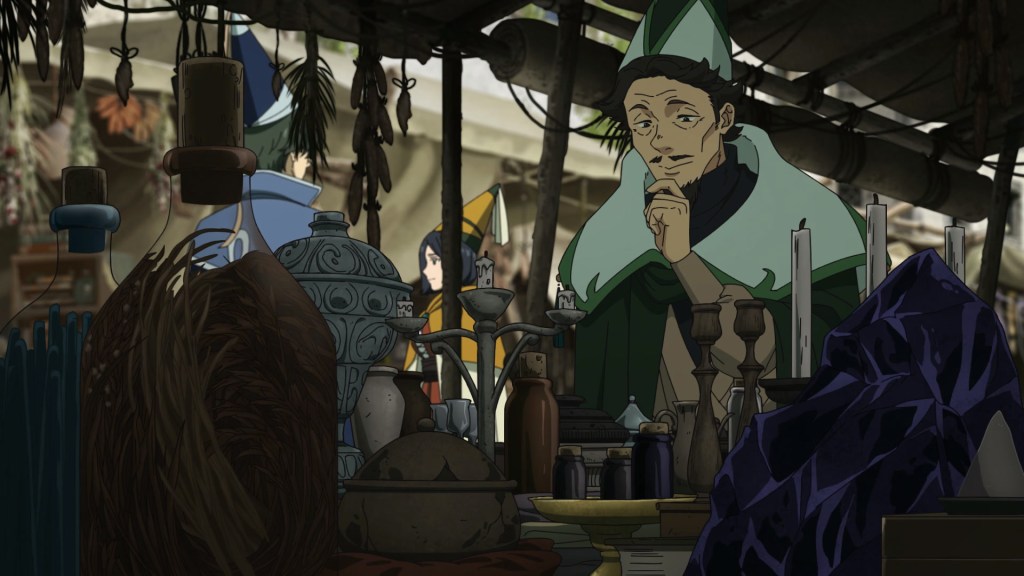
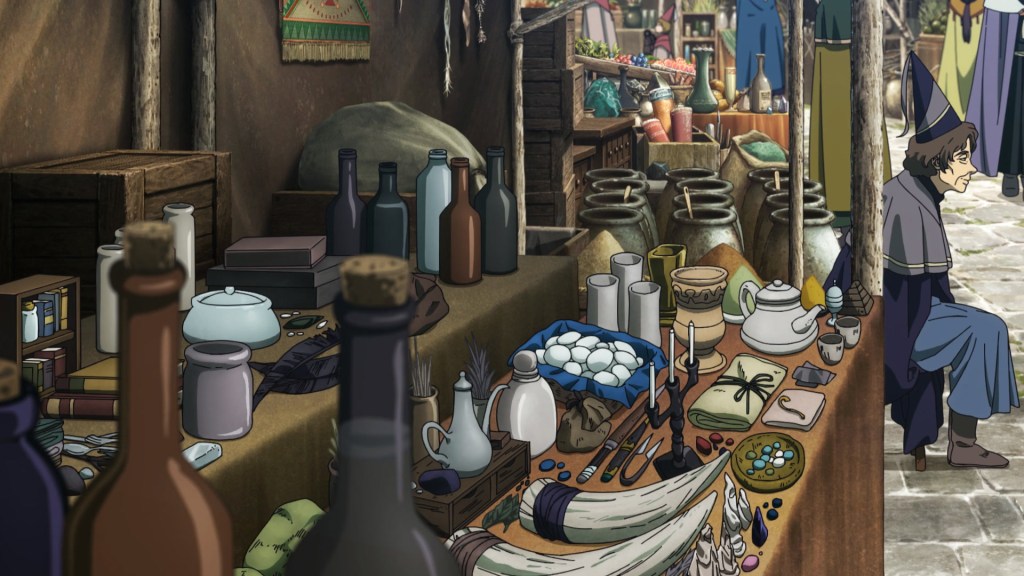
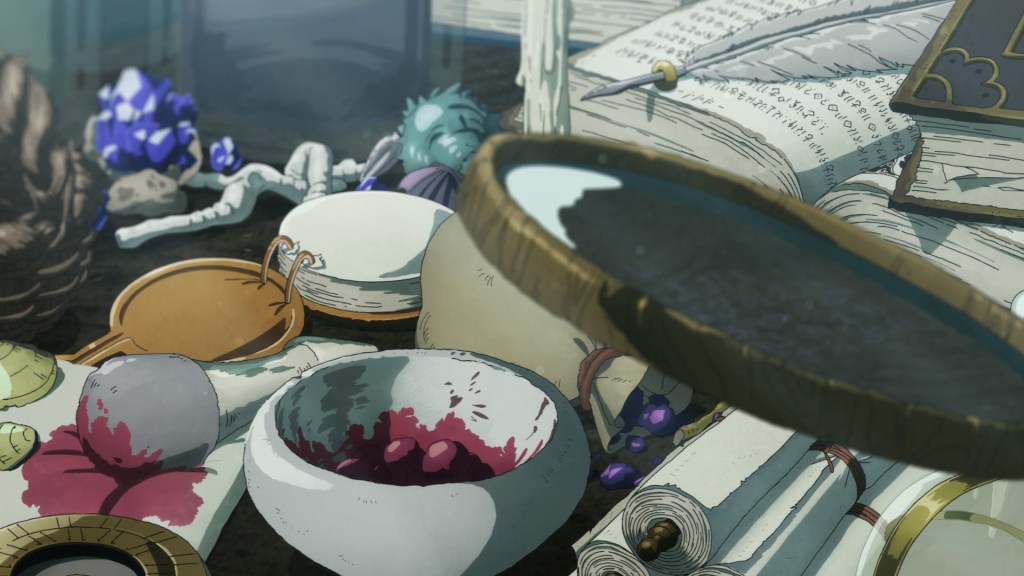
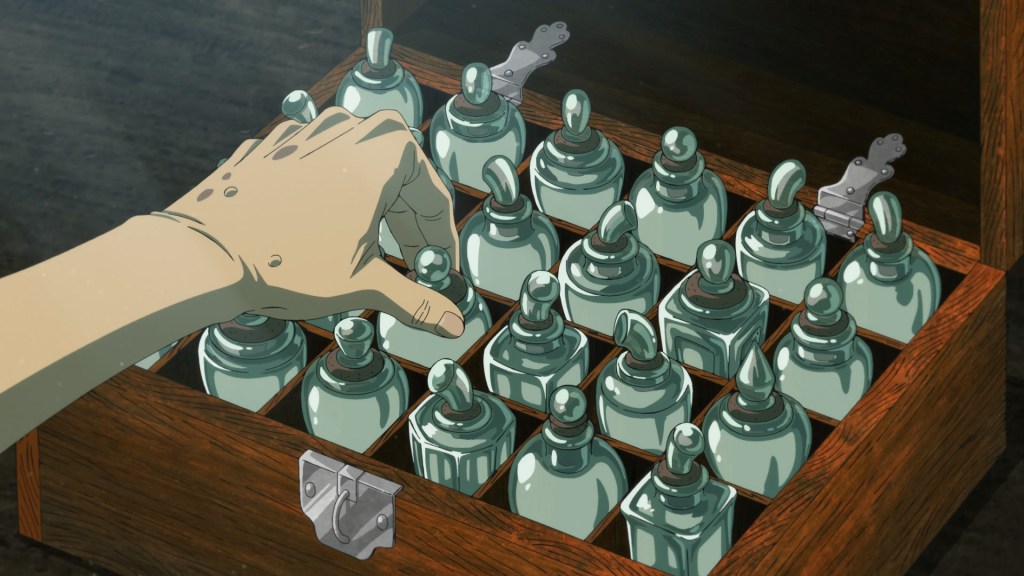
This brief detour in the town’s marketplace serves as the perfect expedient to paint the picturesque atmosphere of the witches’ society through its culture. The many wonderfully busy layouts describe the depth of this world and its multi-layered nature in a rather concrete and pragmatic way, by correlating their visual structure to the qualities intrinsic to the narrative.
At the same time, the themes of depth and perspective are also consistently rendered in a radically graphical sense, with shot compositions that deliberately place all the emphasis on the dimensional aspect of the frame.
In a visual medium like animation, space represents a fundamental tool of communication—arguably the most essential and intentional one—and the aspects that come into play in its definition are often overlooked. In itself, this isn’t necessarily a surprising thing, given that these expedients are exactly meant to be subtle and discreet. This episode in particular however, thanks to its extensive and masterful use of them, offers quite the exquisite pretext to talk about two of these unfairly understated factors: shape & line motif, and contrast (or affinity) of tone.

There are limitless ways in which space can be characterized, even more so on the canvas of animation, which is inherently bound only by the limits of one’s creativity. Nevertheless, space can be classified in a particular type, between deep, flat, limited and ambiguous. In reality, this distinction is relatively blurry and behaves more like a spectrum of sorts, but for the scope of this post, emphasizing this categorization is more effective than it is inaccurate.
Many different depth cues are deliberately used to control which kind of space is created, and the type of space you use has different implications on how the shot, the cut or perhaps the whole scene is perceived in the end. Tonal contrast is one of these cues, and Tongari Boushi #4 makes consistently great use of it, especially during the final portions of its A Part.
A very noticeable detail of the episode, is how uniform the shots start to look from the moment Coco and the others enter the magic supply shop. This is usually referred to as “affinity of tone”, or “tonal reduction”, and it’s a quality of the overall brightness of the scene used to create the impression of flat space. After emphasizing the depth of the town scenery with layouts that intentionally highlighted the dimensionality of 3D space as I discussed earlier, the interior of the shop appears much more stable and fixed, with the movement initially happening parallel to the picture plane. Elements in the background have more texture compared to the foreground, flatting space, and shapes too start to look more uniform, mainly resembling squares. The line motif—another essential visual descriptor—of most shots is composed of the intersection between straight lines, vertical and horizontal, which grants an overall sense of stability and rigidity to the sequence.
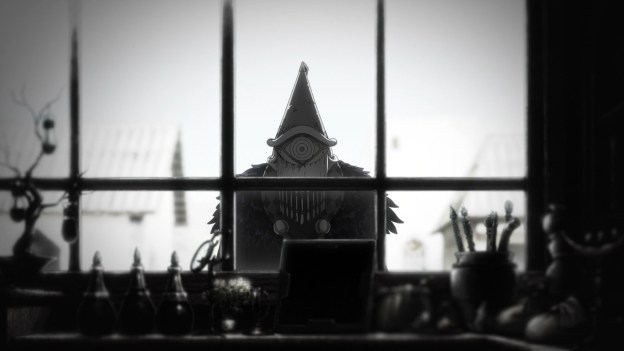
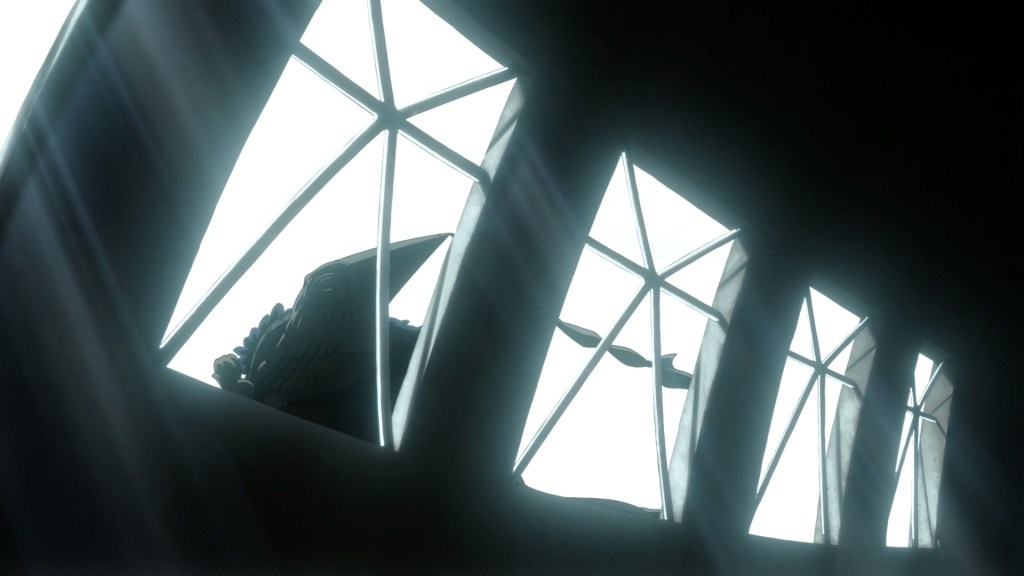
It’s exactly in this context that with just a single shot, the sudden appearance of the Brimmed Cap member vehemently shutters this perception: by increasing the tonal contrast to the maximum, effectively creating a black & white shot, the unusual lines of the foreign triangular shape created by the witch hat, previously hidden due to the persistent coincidence of tone, introduces a lot of tension to the scene, and it’s also strongly emphasized by the physical, simulated reduction of the aspect ratio through the frame of the window. It’s interesting to note how this shot still abides by the same space-flattening rules: conventionally, objects that are dark appear farther away, while objects that are bright appear closer to the screen. In this case, making the background extremely bright, and the foreground and middleground almost pitch black, is effectively coercing the space into looking more flat.
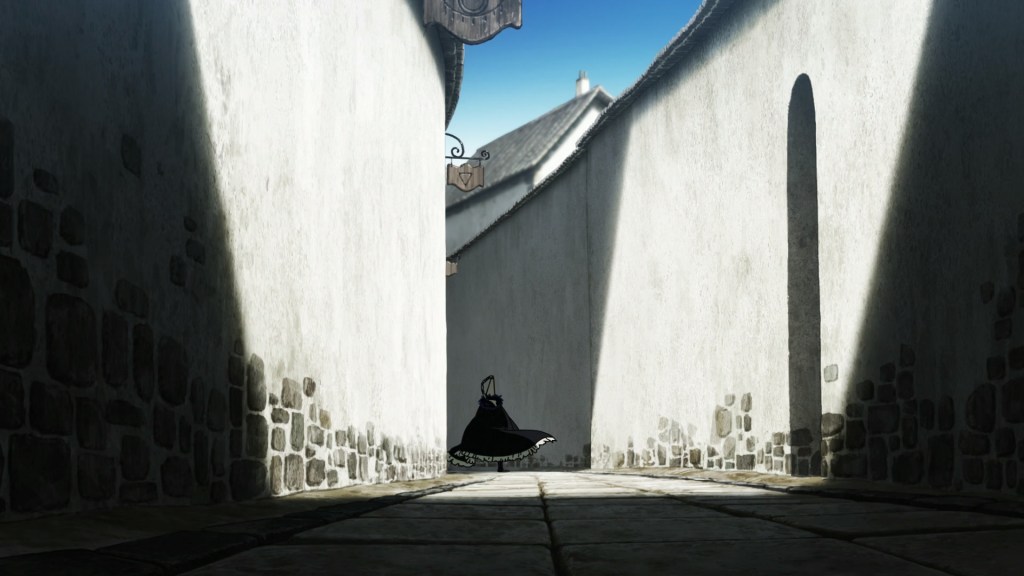
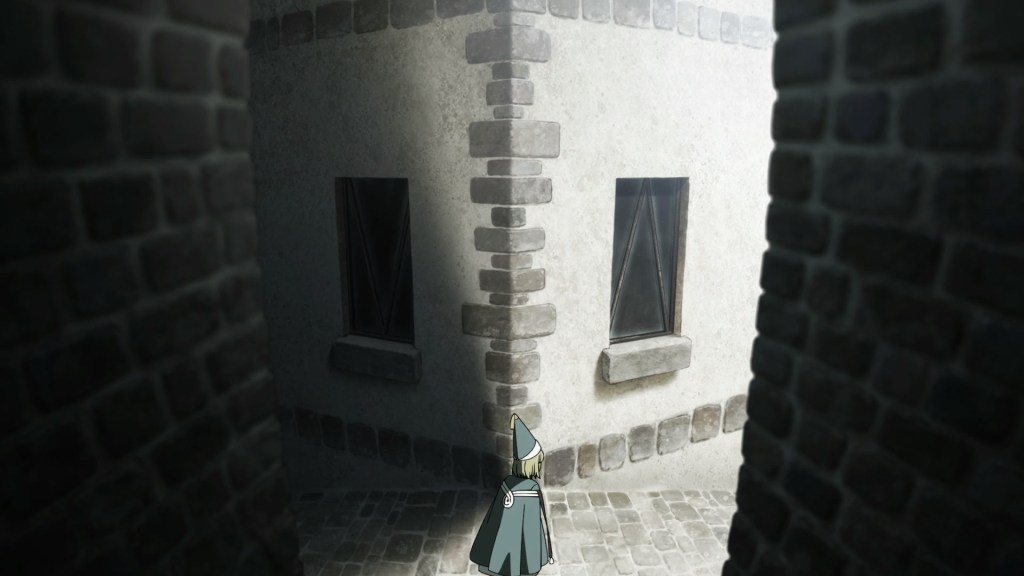
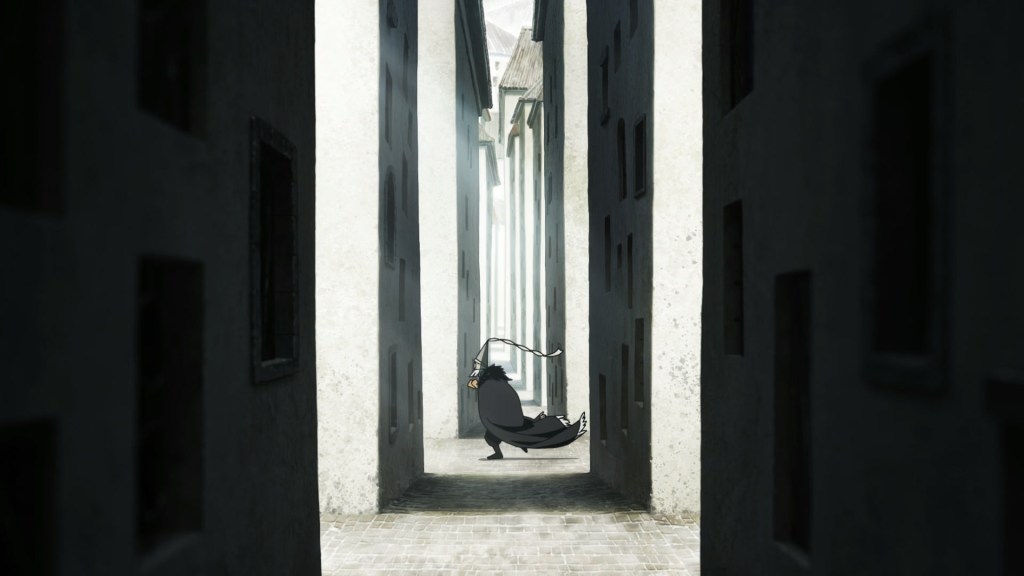
As Coco runs out of the store to chase after the rogue witch, the space becomes deep again, with the depth cue of movement now happening perpendicularly to the picture plane (like in Frames 1 and 3), and the shot compositions emphasize the point of convergence (Frame 4), an unmistakable indicator of depth.
Occasionally, ambiguous space is also used very loosely, distorting the proportion of the physical relations to convey a sinister sense of instability, like in Frame 2.
Contrast of tone is still very much present throughout this short sequence, and the continuously interchanging pattern of dark and bright patches disorients the perspective of depth, and blends the longitudinal planes together into a single convoluted stage that feels bewildering and unsettling.
The comprehensive control over how space is defined in this brief sequence really struck me when I first saw it on the screen, as it’s somewhat unusual, at least in TV anime, to find such a textbook application of tonal contrast this prominent and intentional.
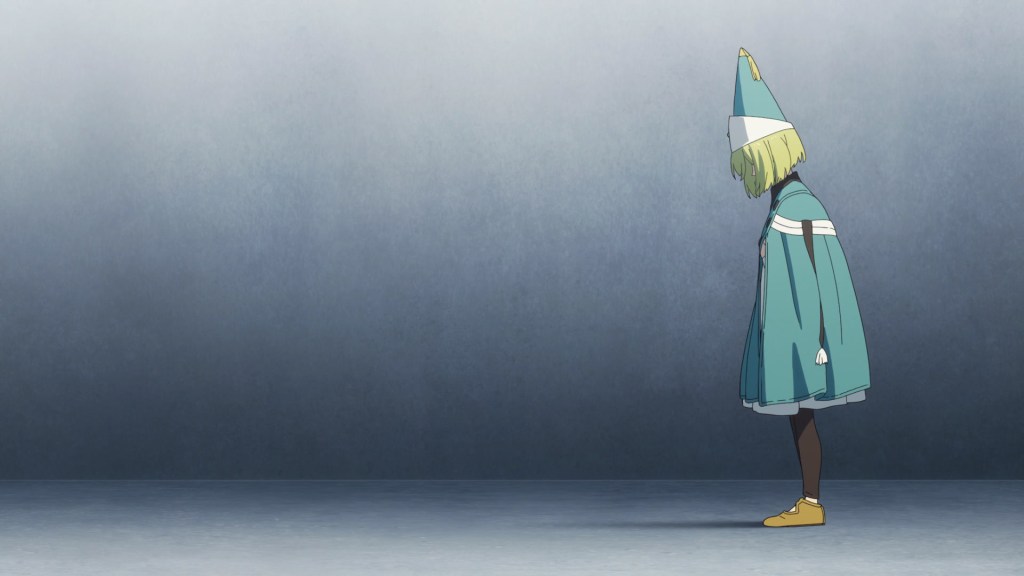
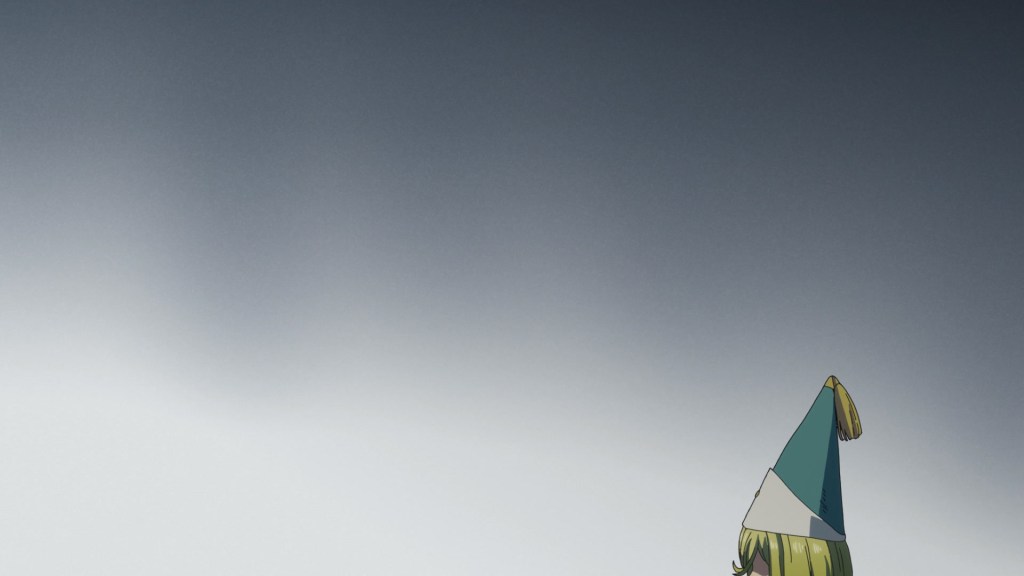
The latter half of the episode keeps on building upon the by-now established channel of space, with its very unequivocal implication of distance and isolation. The tonal affinity makes the space exceedingly flat again, but this time, the almost total absence of textural details in the backgrounds shifts the focus entirely on the foreground, making the negative space around Coco feel all the more excruciating.
More conventional directorial tricks are also used to emphasize this sense of dissonance between the characters, like the quick succession of opposite shots, evenly spaced cuts that get closer and closer to the camera, or compositions that physically separate Coco from the others.
Additionally, as it’s something that happens quite rarely, I appreciated the peculiar employment of sound direction in this depiction of distance: lowering the volume of the girl’s voices in favor of Coco’s to create contrast between the two was a very effective way of viscerally conveying their growing separation.
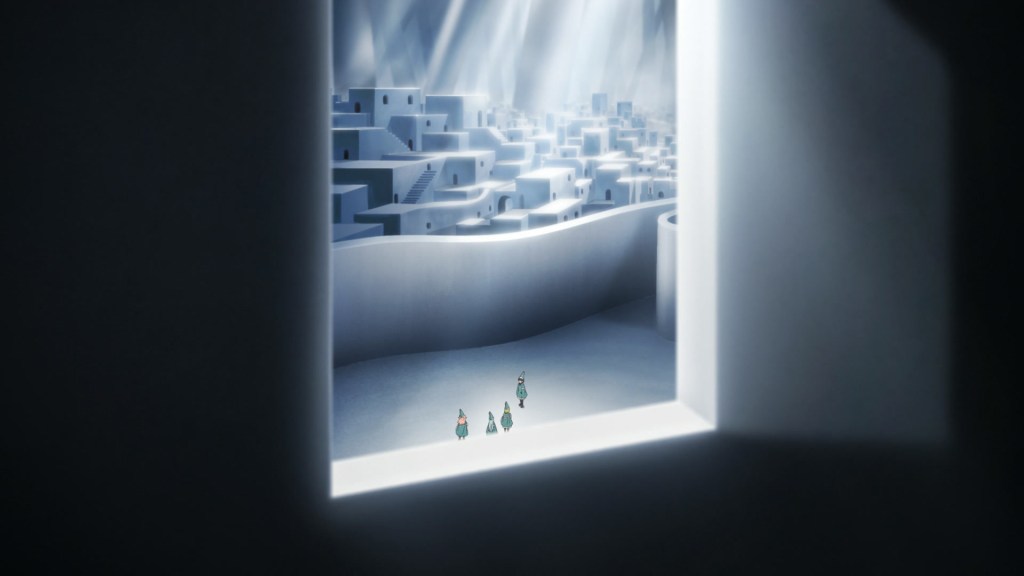
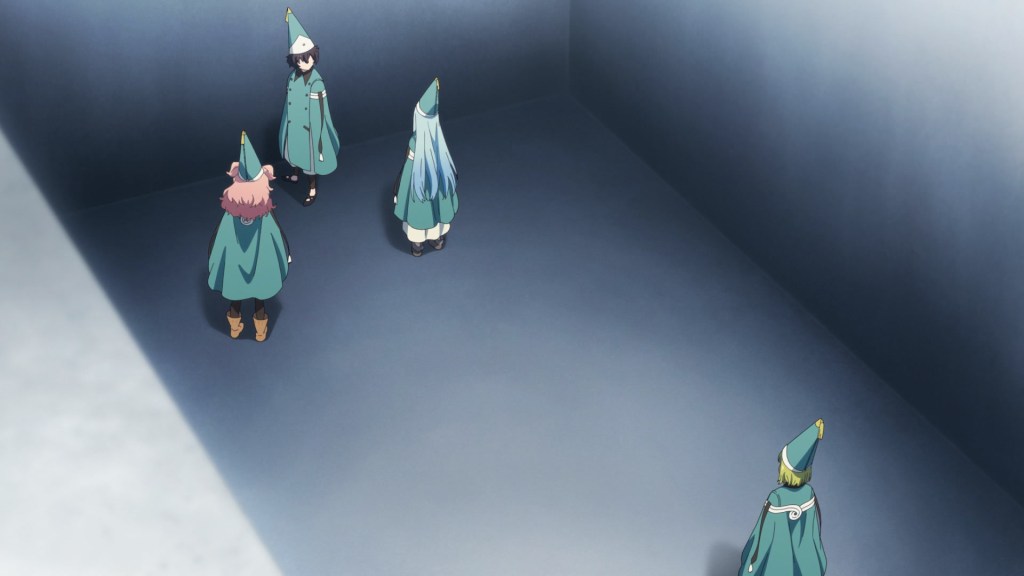
The main tool that contributes to B Part’s implication of isolation however, is definitely the shape & line motif. This surreal world in which the four apprentices are transported gains its otherworldly quality not only from the monotony of tone as I mentioned earlier, but also from the overwhelming affinity of shapes and lines. Houses and walls are all described by straight lines, creating many squares and rectangles on the screen, and this rigid pattern that persists throughout the second half of the episode is constantly emphasized by the framing, which makes the borders around the characters feel insurmountable and oppressive.
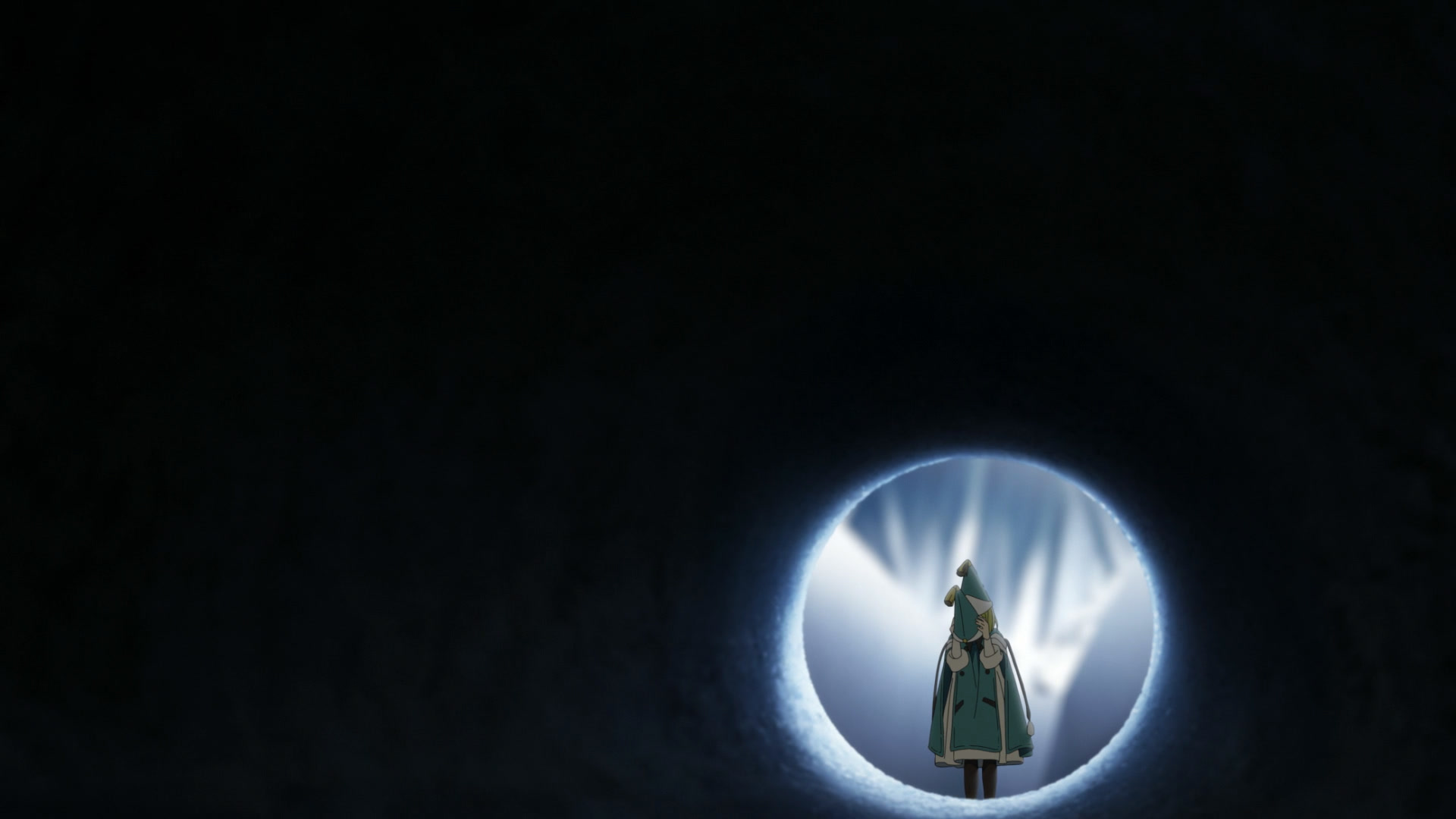
Towards the end, as we’re seeing Coco through the hole that Richeh managed to open with her magic, the newly introduced circular shape, radically incompatible with the world around her, capitalizes on this structural oppressiveness making her feel even more out of place than ever.
Finally, to alleviate all this tension, the episode closes on a positive note (at least visually), bringing us back to the real world, that is now soaked in the tremendously warm colors of the sunset.

Finding the right balance between technicalities and intention is always a tough task, especially when the two are so deeply intertwined. I hope this brief attempt at presenting some notions of cinematography through tangible examples didn’t come across as too rigorous or stiff.
Maybe, in the future I’ll find other opportunities to explore more of these concepts, and it’s not unlikely that time will come sooner than I expect, given the absolutely insane amount of incredible shows coming out this year. Until then~
