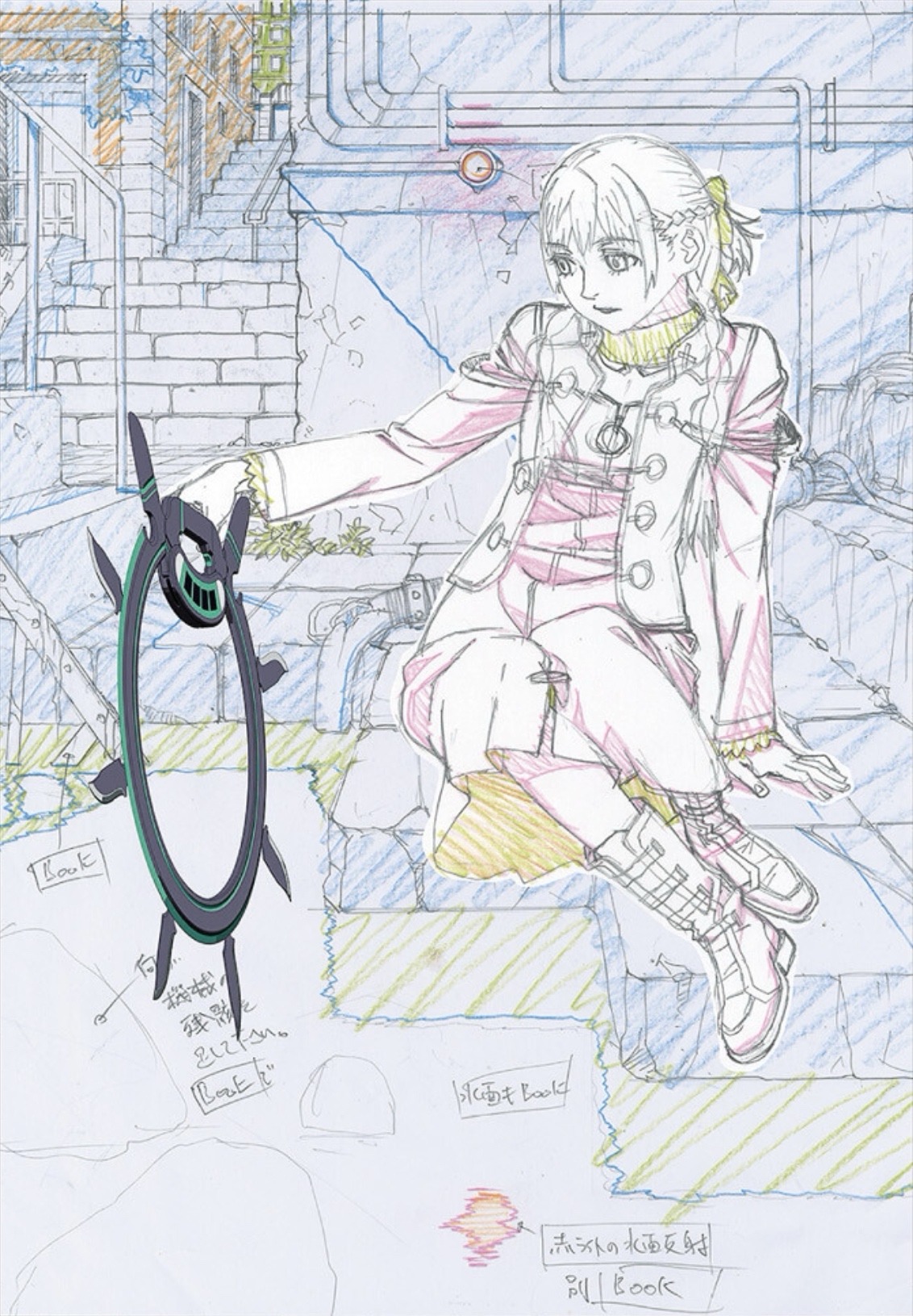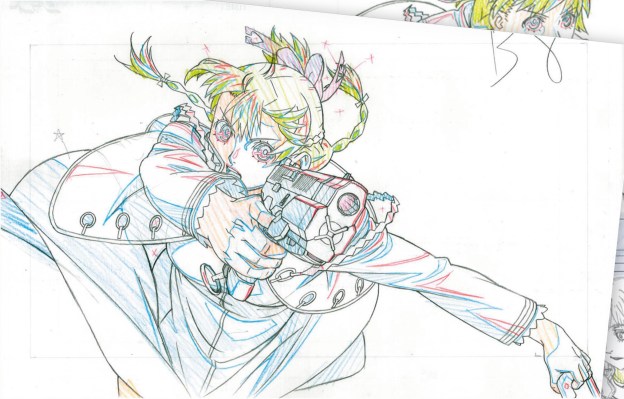
Original interview and genga from Animage (May 2026).
Director’s Comment #1 (Blu-ray Bonus Content)
The deluxe edition is packed with bonus content, but personally I’d especially recommend the staff-drawn illustration booklet. It contains illustrations and messages from the staff, and Shinya-kun contributed a piece drawn in the style of a commemorative photo. It was so heartwarming that I too decided to do a “group photo”-style illustration with everyone together. I tried drawing Ubu with the kind of carefree smile you never get to see in the main story (laughs). There are also prequel-like illustrations, some depicting Elegance’s delusions, others with the children at orphanage… it’s all a lot of fun, and I think it turned out to be a really delightful little booklet.
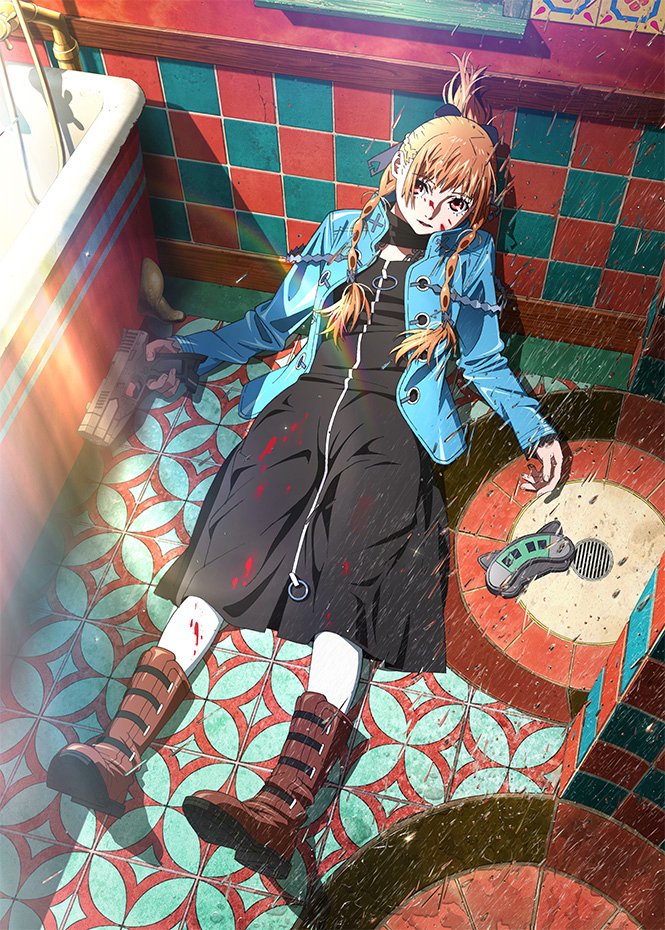
Director’s Comment #2 (Blu-ray Illustration)
We had a request from the Aniplex Assistant Producer to set it in the shower room of the Spa. Originally I planned to have Ubu undressed, but due to various circumstances we ended up keeping her in her usual outfit, drenched in blood from the battle. The image was that with her clothes already ruined from the fight, she just showers with them on (laughs). The nude version is being saved for store-exclusive bonuses.
Behind the scenes of the gun action
Excelling at both effects and character animation
— This feature will focus on gun action, one of the signatures of Umetsu-san‘s works, with questions centered around that theme. Joining us for this discussion are Director Umetsu and Takahashi Shinya-san, who is credited as “Main Animator” and “Weapon Designer” on this project. To start things off, could you tell us how and when you two first started working together?
Umetsu: Personally, I have no idea when Shinya-kun and I first ended up working together (wry smile).
Takahashi: It was that time, wasn’t it? When you moved over to Pierrot Plus [currently “Studio Signpost”, the studio changed its name from “Studio Kikan” to “Pierrot Plus” when it became a subsidiary of Pierrot in 2009, then changed it again to the current “Studio Signpost” in 2019, t.n.] for the preparation of the new project.
Umetsu: Oh, it was for Cecil [Wizard Barristers: Benmashi Cecil (Wizard Barristers), 2014]?
Takahashi: Yes, I believe Cecil was the first project you had me on board for. At the time, an acquaintance of mine was working on a different project at Pierrot Plus, and he recently told me he was the one who introduced me to you, Umetsu-san.
Umetsu: I remember asking you to help me out with the openings for SoreMachi [Soredemo Machi wa Mawatteiru (And Yet The Town Moves), 2010] and BLOOD-C [2011], but I wonder if those were after that?
Takahashi: To be precise, the first time was actually when I worked on key animation for the pilot version of Cecil. I believe the openings you mentioned fell between the pilot and the main project. After that, I had the opportunity to serve as animation director for the first episode of the main Cecil series.
Umetsu: Which means, counting from the main Cecil series, we’ve be working together for about 13 years…
— Takahashi-san, at the time, what impression did you have of Umetsu-san‘s works?
Takahashi: Umetsu-san was someone I had looked up to since my school years, through works like Megazone [Megazone 23 PART II Himitsu Kudasai (Megazone 23 Part II), 1986], long before I became an animator myself. His style was in a league of its own compared to anything that came before, and whether it was the density or the movement, I couldn’t help but think: “This person is something else”. That was the impression he left on me. I had always followed his work as a fan, and I wanted to make something that could get as close to his level as possible, even if I could never quite reach it.
Umetsu: The first time I noticed Shinya-kun, was in Evangelion [Shinseiki Evangelion (Neon Genesis Evangelion), 1995] when I saw his name in the key animation credits. At the time, he’d just sort of caught my eye, and I didn’t think about working with him or anything like that. Then, we teamed up for the first time on the Cecil pilot, and I thought: “This guy really is an all-capable animator, he can handle anything”.
— Practically speaking, what was that about?
Umetsu: He could draw action, and his effects animation was amazing too. That was the first thing that surprised me. I have the impression that from the late 90s, animators split into two categories: those who are mainly proficient it character animation, and those who are in effects animation. So, when we were working on Cecil, almost no one could do both. But Shinya-kun could, and skillfully so, which I thought was very impressive.
Takahashi: Speaking of animators who excel at both character and effects animation, to me, you Umetsu-san and Nakamura Takashi-san were the very definition of it. The first time I watched Genma Taisen [Harmagedon, 1983] at the theater, I was shocked.
Umetsu: That’s because at the time, to everyone, including Morimoto Koji-san and Nakamura Takashi-san, drawing both the effects and the characters together was the norm. (Hiroyuki) Okiura-kun and (Takeshi) Honda-kun too can draw both, but if you look at the generation right after theirs, specialization took over and animators started gravitating toward one or the other as their field of expertise.
Takahashi: Though, I feel like recently, partly thanks to digital animation, the number of animators who can handle both is increasing.
— So, after Cecil concluded, you two worked together on Virgin Punk?
Umetsu: After Cecil, I always made sure to invite Shinya-kun to work with me, like in Koufuku Graffiti [Gourmet Girl Graffiti, 2015], Dimension W [2016], Sousei no Onmyouji [Twin Star Exorcists, 2016] and various openings. Of course, I wanted him on Virgin Punk as well.
The role of the Main Animator
— For this project, Abe Genichiro-san, Kando Maho-san and Takahashi-san are the three names credited as “Main Animator”. How was the workload divided between the three?
Umetsu: Abe Genichiro-kun is a Shaft in-house, and he’s just exceptional at effects animation. So, he mainly worked on… oh, well, he’s actually outstanding at character acting too, isn’t he? (laughs). He was the one who volunteered, and so he joined the project as Main Animator. As for Kando Maho-san, I’ve known her since she was doing douga at a certain studio, and now that she moved to a different studio where she’s working as a key animator, I invited her over to work on this project. Young animators who can draw realistic acting are rare these days.
— What parts did Kando-san mainly worked on?
Umetsu: She can draw everything, so I had her work on many different things… but she’s particularly good at crowd scenes. I didn’t have to make any correction to the crowd scenes for this project. She animated people in a way they genuinely looked like they inhabited that town.
— These days, it’s common practice to make crowd scenes in CG instead, and the number of animators who can draw them by hand is decreasing, isn’t it?
Umetsu: Kando-san pulled off something that most young animators nowadays would struggle with. It’s not an overstatement to say that she did almost all of the crowd scenes in Virgin Punk. And as for Shinya-kun, well, that goes without saying (laughs). I wanted him to do a lot of cuts, and with the overall delays in the key animation, I ended up forcibly asking him to work on many different scenes all over the place.
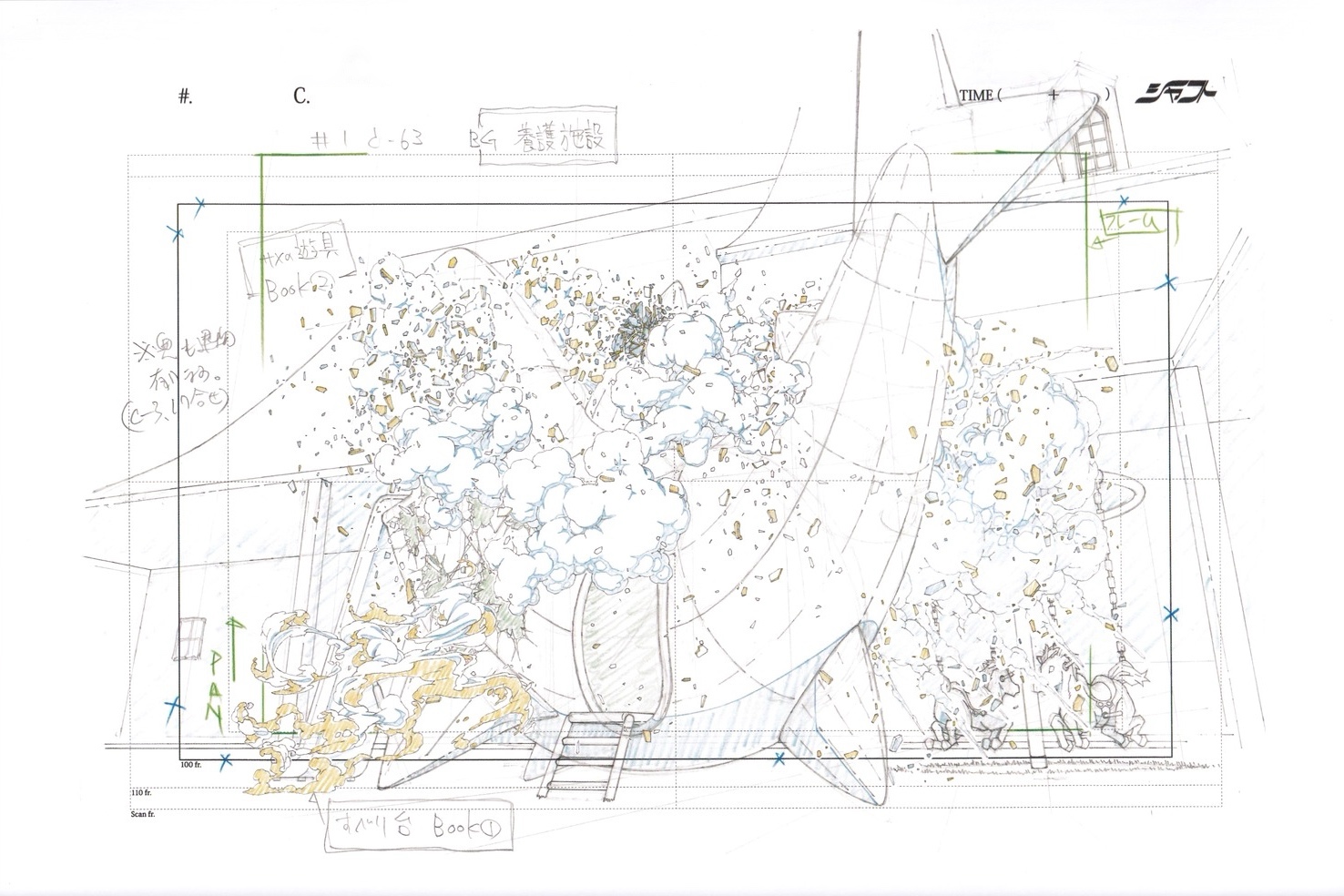
Takahashi: That’s right (laughs). I did a lot of stuff, from explosions to character action.
— According to the pamphlet, you mainly worked on the action sequence inside the church, is that right?
Takahashi: The church sequence was the first one I was assigned, I handled a few dozen cuts there. After that part was done, I went on helping around with the other scenes.
Umetsu: Originally, the plan was for Shinya-kun to work only on the church sequence, but because of various circumstances, we were completely stuck with the other action scenes… (wry smile). There was no other way, so I asked him to help with them too, and he took care of it. As a result, Shinya-kun took over basically all the tasty parts (laughs).
— You also worked on the “Weapon Design”, does this mean weapons are one of your strengths?
Takahashi: I’m sorry, but I’m not good enough to confidently say it’s one of “my strengths”. I think weapon enthusiasts or designers who mainly work on them would laugh looking at my designs, that’s my current level. Anyways, when working on them, I focused on realism; including the firearms, I tried drawing something that could actually exist in reality. That’s my idea of weapon design.
Umetsu: Judging from the designs you submitted, I don’t think that‘s the level you’re at. The guns you draw are extremely convincing and persuasive. I believe they’re awesome.
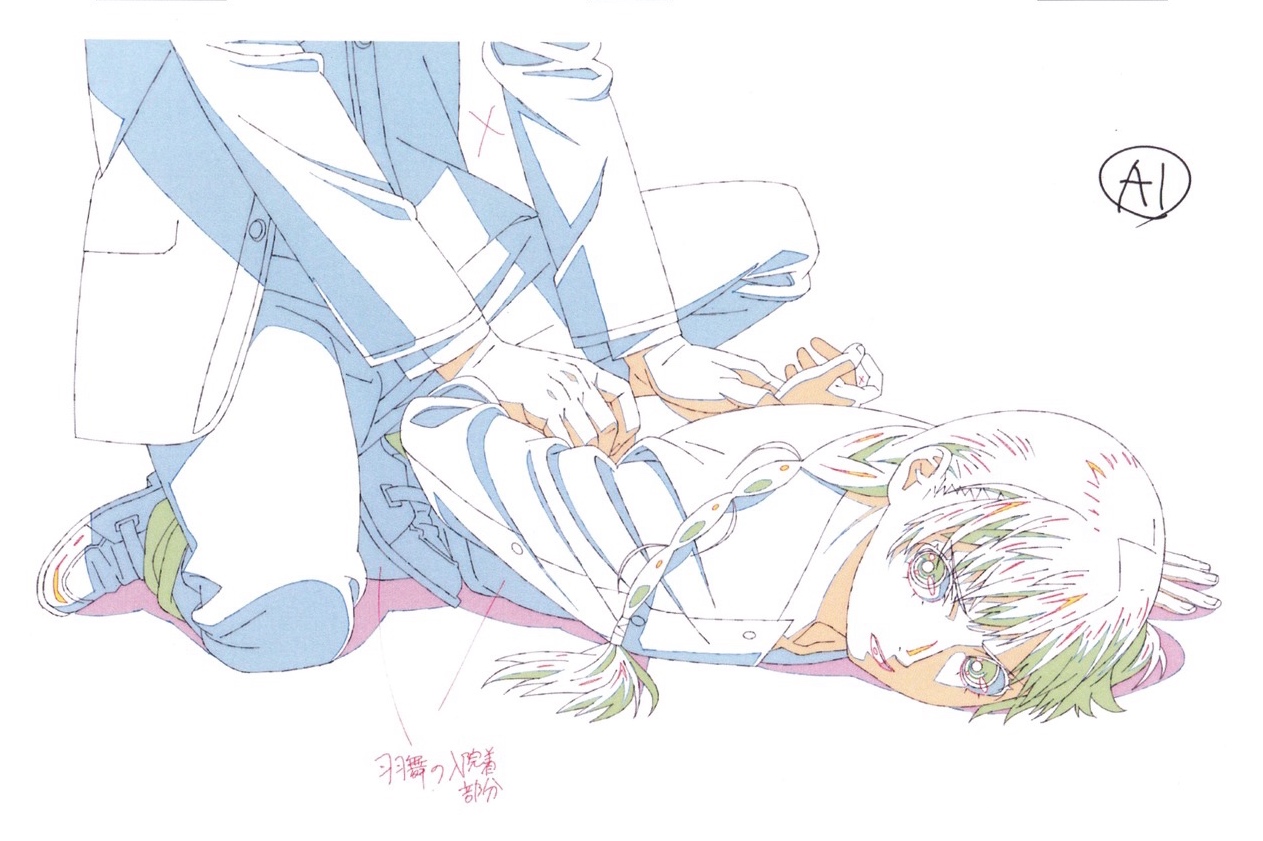
The High-Performance Boomerang was the hardest one to make
— What‘s the process behind the creation of the Weapon Design?
Umetsu: At first, mechanical designer Ni0-kun proposes a concept for the weapon. Then, I ask him to draw an approximate draft for it, and lastly, Shinya-kun finalizes it into a proper gadget. That was pretty much the process behind the design. That’s also why in a previous interview I said it was Shinya-kun who wanted to make Ubu’s gun a CZ P-10 C, but it was actually Ni0-kun‘s idea. Let me correct myself on that.
— The guns are essentially based on real models, but to what extent did you adapt them when creating the actual designs?
Takahashi: Rather than adapting them, I adjusted and rearranged the lines. It’s just physically impossible to draw all the lines by hand, in these cases you have to choose which to keep and which to remove.
— So, you tidied up the designs to make them more easily usable in animation.
Takahashi: Yes, exactly that. Things like making asymmetric guns symmetric in the final design to facilitate animating them. Or, in terms of direction, for one of the designs we also decided that when fired, the barrel would stay level rather than kicking up the way it actually would in real life.
— Which gun was that in particular?
Takahashi: Mr. Elegance’s Government 1911 Custom.
Umetsu: That was because I wanted to convey a sense of stability when Elegance shot his gun.
— I see. So that‘s a directorial choice. Was there anything about firearms specifically that made them “easy to draw” or, on the contrary, “difficult to draw”?
Takahashi: As long as there were references to check the details, I wouldn’t say there was anything particularly hard to draw per se… but there’s almost no gun that’s smooth and featureless, so if you’d call it all a pain, then sure, it was all a pain (laughs). But if I had to pick one thing, that would be firearms with a longer body-type, because when animating them, it’s quite hard to find the right balance with the character’s body.
— What do you mean by longer body-type
Umetsu: Firearms with long barrels, like rifles or machine-guns. Among the ones featured in Clockwork Girl, Maggy’s MINIMI and Gaudi’s KRISS Vector are an example.
Takahashi: If we extend the discussion to weapons other than guns, Ubu’s High-Performance Boomerang was probably the hardest one to make. Starting from Ni0-san‘s drafts, I approached its design from an animator’s perspective, focusing on the areas that would likely be troublesome to animate later on. The transformation process between its folded and open states was also pretty complex from a structural standpoint… it was one of the earlier designs too, which certainly didn’t help, and it was really quite a struggle. I still remember hearing Umetsu-san sigh (laughs).
Umetsu: Did I really? (laughs). For Virgin Punk, I was really mindful of getting all the pre-production properly wrapped up before starting animation. “There’s no settei so I can’t draw it” is the number one excuse animators use (laughs), so to make sure there would be no room for that, I wanted everything to be fully set-up beforehand. Shinya-kun worked hard and completed all the designs for the guns and the Boomerang in time.
— Did you get any kind of response to the depiction of guns in Clockwork Girl?
Takahashi: Gun enthusiasts have a very discerning eye, so if you picked through it meticulously, I’m sure there’s plenty being said… But fortunately, it doesn’t seem like we’ve received much criticism overall. Though I have seen comments about the MINIMI…
Umetsu: Yeah, but I mean, you can’t say that was anything too critical or negative (laughs).
— What kind of comment was that?
Umetsu: The MINIMI doesn’t normally fire with a magazine, so I think those comments were something along the lines of: “It’s interesting that it’s firing with one”.
— What does that mean in practice?
Umetsu: Machine-guns are normally fired from a fixed position, using a linked belt to fire hundreds of rounds in succession. But since Maggy can jump around carrying it in one arm, she fires it with a magazine instead. It’s the kind of stunt she can pull off exactly because she’s a full-body Somadea. I believe the comments picked up on the intent behind it, and that’s why they found it interesting.
— I see. So, if anything, it was positive criticism.
Umetsu: In Clockwork Girl we used guns and that Boomerang, but for Virgin Punk as a series we’re thinking of an even wider variety of weapons. It won’t be limited to simple and straightforward gun action, I’m aiming for a much more diverse range of action scenes.
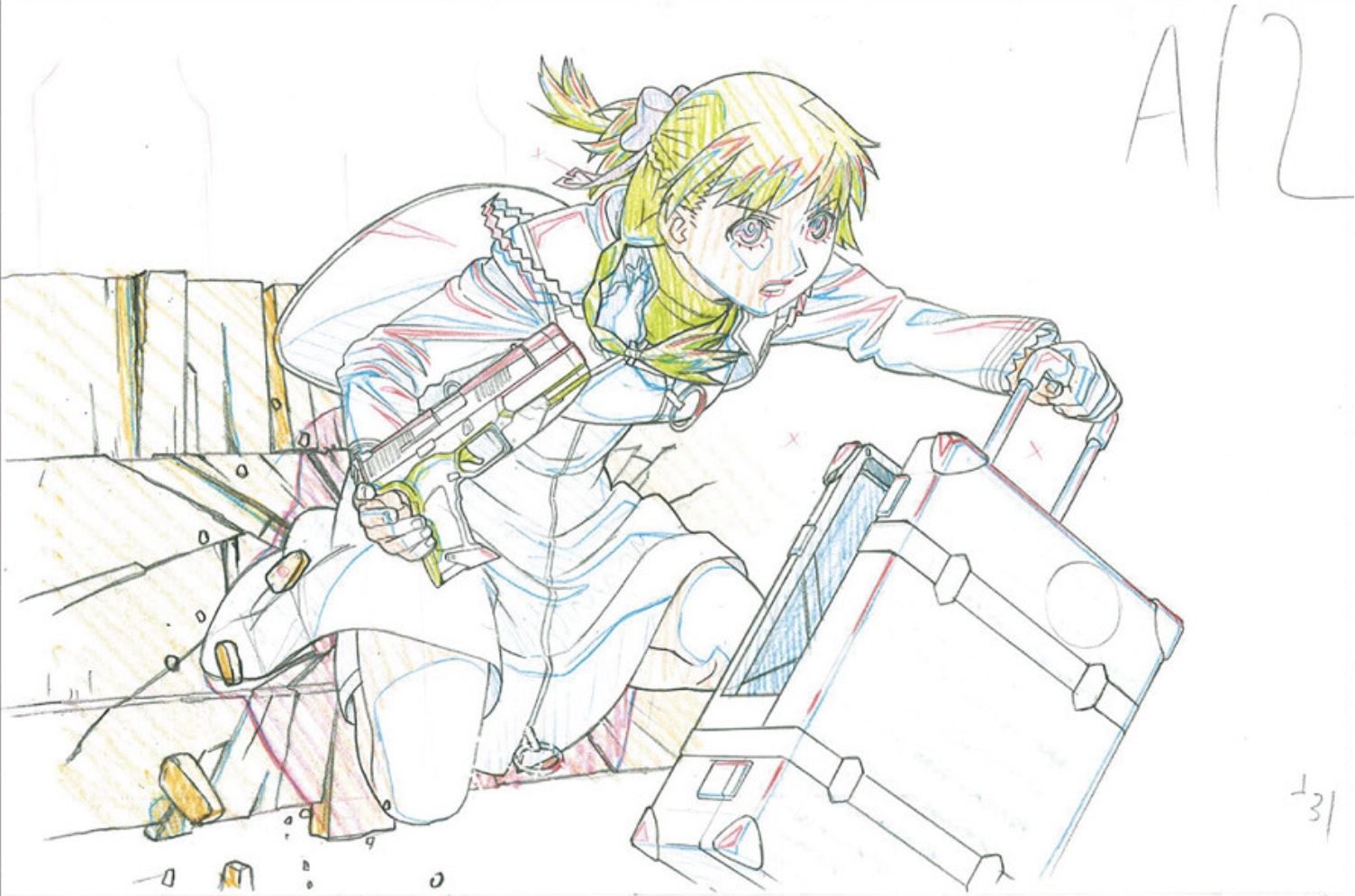
The difference between the action of flesh-and-blood bodies and fully mechanical ones
— Umetsu-san, when asked about your favorite scene in a previous interview, you mentioned the one during the church battle against Tommy J, when Ubu reloads her gun with the sole of her boot while jumping. I believe it was handled by Takahashi-san, but what are your feelings in regards to that scene?
Takahashi: Personally, I had never seen someone reload a gun like that before, so I found it really innovative. If I have to think of a way to reload the pistol you’re holding in your right hand, while your left hand is blocked, I genuinely can’t think of anything besides using an object in your surroundings. But if you’re in midair, that also becomes impossible. In movies, you often see actors pulling their gun’s slide with their teeth, but I thought doing that wouldn’t fit a little girl like Ubu.
Umetsu: Exactly. She is a bishoujo after all, and I’d already seen scenes like that in live-action movies before, of actors baring their teeth while racking the slide. When I tried to think of another way she could pull it off, my mind went like: “She has her boots, doesn’t she!”.
— And what about Takahashi-san, what would you say are your favorite scenes?
Takahashi: For me too, I’d say around that part where Ubu is shooting in midair. And a little later, the scene where she comes falling through the smoke of the explosion and sweeps around into her landing. I had never really animated that kind of movement before, and I know it’s not my place to say, but I’m glad that scene turned out as well as it did.
Umetsu: That scene is the perfect example of how you’re great at animating both characters and effects, and that’s exactly why it came out so well. If you were only able to draw character animation for instance, you would have had to hand off the explosion part to someone else. In that case, the management of the work would have been a mess, and producing an action sequence with that kind of smoothness to it would have been nearly impossible.
— The action scene in the church is really a masterful display of fine craftsmanship. In order to highlight how her whole body has become a Somadea, the details of her depiction differ from the action scenes in the first half, where she’s still in her flesh-and-blood body.
Takahashi: That’s right! Now that she’s completely mechanical, her body weight increased considerably, so when she backflips and hits the wall, her feet sink right into it, and when she lands, they sink into the ground too. I wanted the details around her to really hint at the fact that she now has a fully mechanical body.
Umetsu: If Gaudi, with his flesh-and-blood body, falls from a high place, he gets hurt, whereas Ubu would be completely fine, for example. The intention was precisely to depict and convey the difference between a real body and Somadea, through subtle details like those.
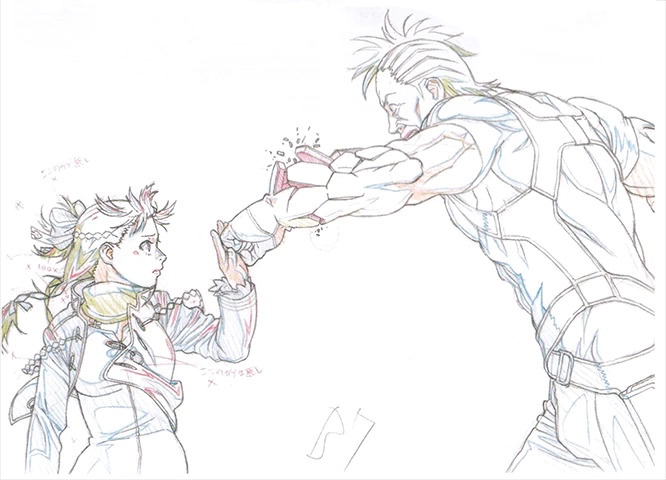
— That also applies to the scene featured as a cel drawing in the pamphlet, where Ubu effortlessly catches Tommy J’s punch with just one hand, right?
Umetsu: Right, right. There’s also that scene, where Tommy J’s forearm gets damaged by the recoil of Ubu’s firmly stopping the fist he threw with all of his body strength.
Takahashi: I really enjoy coming up with that sort of little touches and adding them in. I think that’s where animators truly shine, obsessing over that kind of detailed depictions, and it was a lot of fun to draw.
Umetsu: With the action scene in the church, I essentially wanted to portray the feeling of the unparalleled strength Ubu gained by becoming a full-body Somadea. Most Somadea criminals don’t reinforce their lower bodies, so the fact that Ubu went straight for Tommy J’s legs without hesitation is key. She did the same even when she was still in her real, adult body; that’s because I wanted to remark how she’s a specialist when it comes to hunting down Somadea criminals.
A gun action that aims at realism
— On the topic of gun action, could I ask you both about works, manga, anime, or live-action, that have left a lasting impression on you?
Umetsu: I’d say Under the Dog [2016] directed by Ando Masahiro-kun. The action in that work is spectacular. Personally speaking, it is the anime that really impressed me.
Takahashi: I have many live-action movies that come to mind… but the one that gave me the impression of doing gun action like nothing before is Equilibrium [2002] starring Christian Bale. The idea of “Gun Katas“, fusing firearms with martial arts forms, was something genuinely new. I feel like action in anime has also slightly changed thanks to this movie.
Umetsu: I wonder… did it really influence anime? When I first watched it, I couldn’t help but chuckle (laughs).
Takahashi: That’s exactly what’s great about it! (Laughs).
— Speaking of katas, holding the gun sideways when shooting was quite a trend for a while, wasn’t it?
Umetsu: Gangsters in movies often shoot like that, yeah.
Takahashi: I imagine that’s all about prioritizing the visual appeal more than anything else, but…
Umetsu: For Virgin Punk, we had a firearm advisor. When we asked, the advice was not to do that. It does look cool, but we were told that if our goal was realism, we’d better avoid using that shooting style.
— What other advice did you receive from them?
Umetsu: All sorts of things came up… For example, there’s the scene were Ubu gets shot by Elegance, right? We were given specific instructions on exactly where to make him aim his shots in that scene. The right side of the body has a lot of vital organs, so basically we were told to avoid shooting that side too much. That kind of things.
— That was decided taking into account the fact that she becomes a full Somadea later on, correct?
Umetsu: Correct. In L.A. Confidential [1997] there’s a scene where a detective says something suggestive to a suspect, who suddenly turns around and shoots him. We used that as a reference for the scene where adult Ubu gets suddenly shot by Elegance.
— Umetsu-san, you once said that your style when it comes to action is dividing the scene into fine, shorter cuts. As a Main Animator, how do you approach such style, Takahashi-san?
Umetsu: Oh, he must think it’s a real pain (laughs).
Takahashi: No… to put it bluntly, it makes it easier for me working on shorter cuts. I think it’s perfectly fine to make longer, continuous ones if there’s an intention behind them, but with most of the long cuts you see nowadays, I often can’t find one. Umetsu-san‘s approach of cutting cleanly sequence by sequence, almost in a live-action fashion, is at least psychologically much less of a burden. When I’m given storyboards to work on, just seeing “10-something seconds” written there is enough to make me think: “Ugh, what a pain” (laughs).
Umetsu: That’s true! (laughs). When I’m both directing and doing animation direction for the same project, making cuts too long also means creating more work for myself. Of course, as Shinya-kun said, if there’s a reason for it, then I do make longer cuts as well. But outside of that, I firmly believe shorter cuts are simply more efficient.
That said, when we took this approach all the way with Clockwork Girl, it ended up at 765 cuts for a runtime of 35 minutes. That’s way too many even by my standards, so considering it’ll be a series, I figured I’d at least limit the everyday acting scenes to just one cut. Action scenes are a different story though (laughs).
— Lastly, on the occasion of the Blu-ray release, could I ask you each for a word about what you’d like viewers to pay attention to in this version?
Umetsu: With the Blu-ray, you can take your time and watch it carefully, so I hope you’ll catch all the details you might have missed at the theater, like the subtle differences in the action scenes between a Somadea and a real body, as we mentioned earlier. There are many such small touches scattered all around, and I hope you’ll enjoy discovering them.
Takahashi: It feels a bit awkward to point to my own scenes (laughs), so I’d like you to pay attention to the other animators’ work as well. The action at the orphanage at the beginning is simply stunning, and the chase between Gaudi and Tommy J on the monorail is a real treat too. As you’d expect from a work directed by Umetsu-san, the action is full of highlights all throughout. But even outside of that, there are plenty of wonderful scenes you shouldn’t overlook. The part when Ubu escapes from the hospital ward and wanders through the town is also spectacular for example, and really, rather than pointing to any one scene in particular, I’d love for you to watch the whole thing with keen eyes.