This year’s fervent spring season has finally kicked off, and amidst its rich lineup of intriguing productions, I was sure to find at least one episode to feature in this series. The question remained which show in particular would warrant a full write-up, and given the wide variety of genuinely viable options (as well as the unusual frequency in which I’ve been performing my fair share of translation wizardry lately), I anticipated this post coming out in the latter half of the season at the earliest. What I didn’t anticipate however, was for a certain magic-adjacent adaptation to be this goodthis early, forcing a premature bloom of my writing instincts. So, here I am, after a mere four weeks, briefly exploring the brilliant cinematography of Tongari Boushi no Atelier Episode 4.
Right from its two-episodes premiere, Tongari Boushi had never been shy about showcasing the resourcefulness of its production, with its enchanting art direction, the mesmerizing character art & animation, or even the incredibly thorough prop design. A fully-fledged toolkit this adaptation made use of right off the bat, emphasizing the core concepts of this story without failing even for a moment to capture the magical nature of its world.
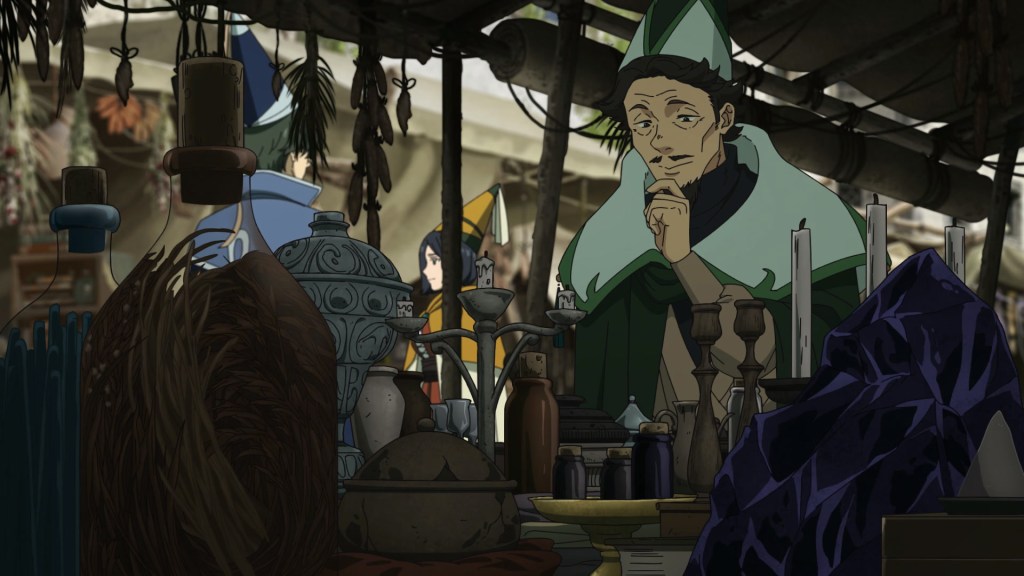
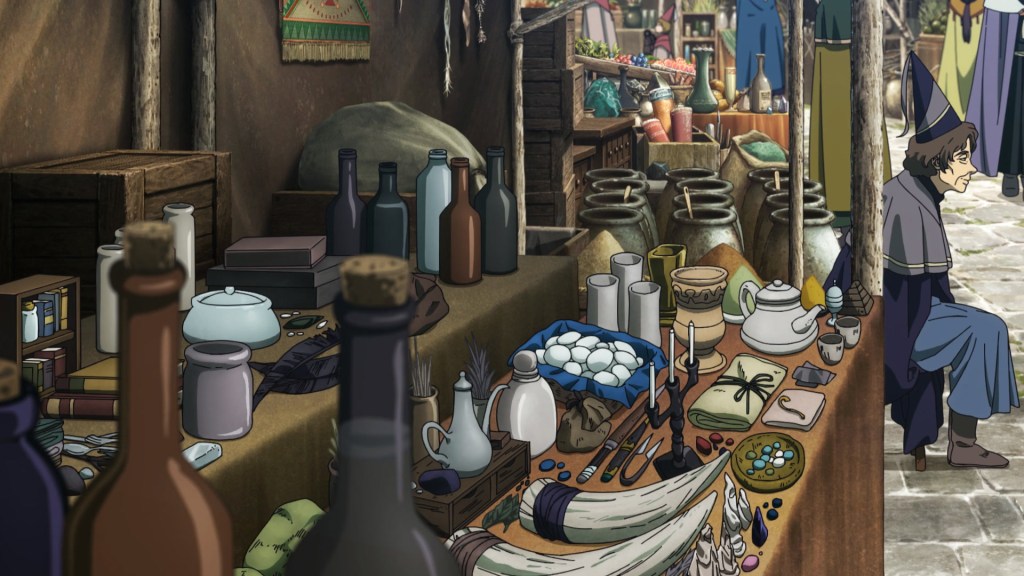
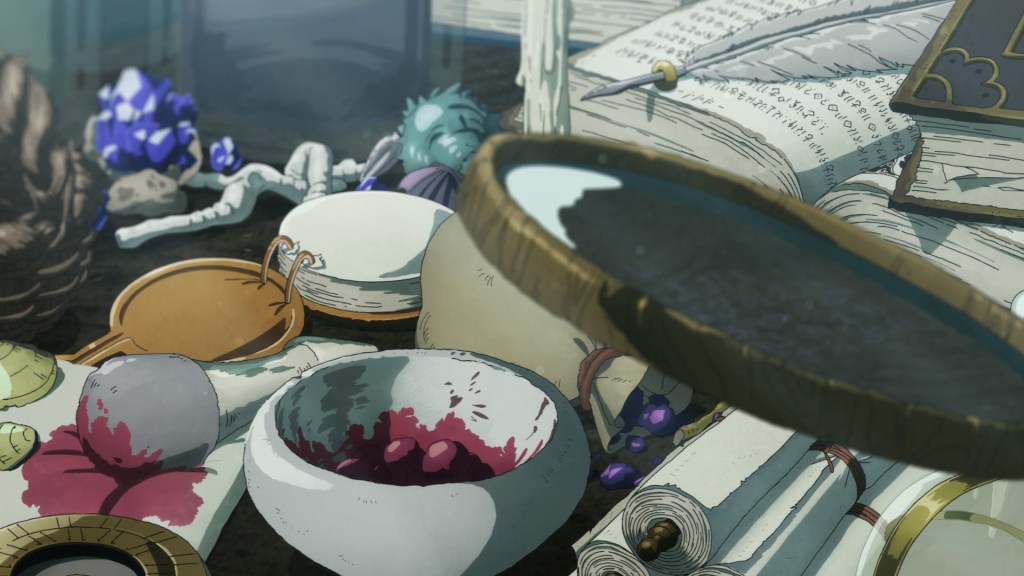
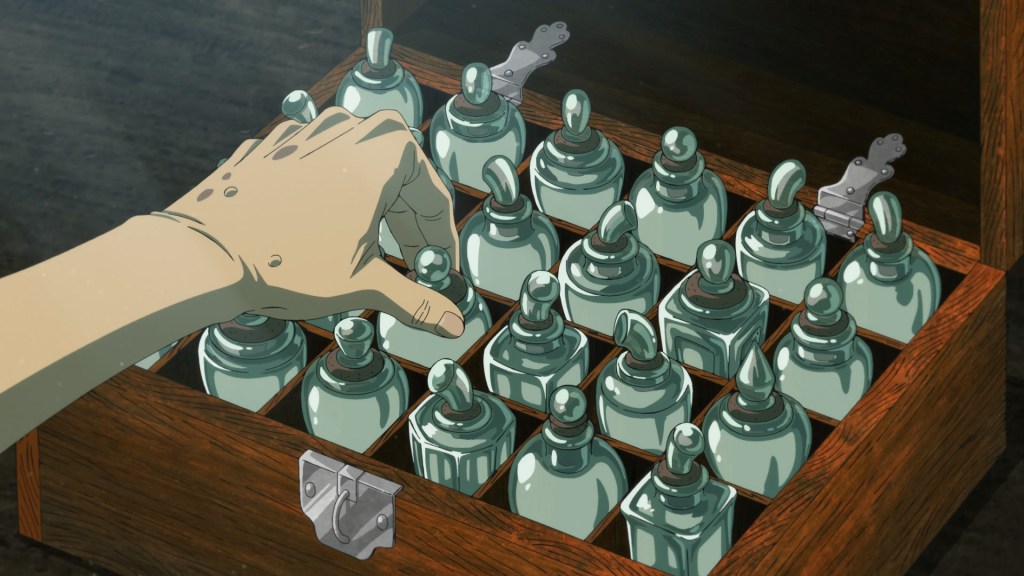
Episode 4 certainly isn’t exempt from this, and Noritaka Suzuki & Gouichi Iwahata’s prop design is in fact the undisputed protagonist of the opening sequence. Realizing Episode Director Masamitsu Abe’s storyboards to their full potential, the carefully detailed and vastly varied magic equipment is the primary vehicle through which the town of Kalhn is presented to the viewers. On a purely technical standpoint, the staggering amount of cels featured throughout this portion of the episode is a truly remarkable feat, especially for a TV production.
This brief detour in the town’s marketplace serves as the perfect expedient to paint the picturesque atmosphere of the witches’ society through its culture. The many wonderfullybusy layouts describe the depth of this world and its multi-layered nature in a rather concrete and pragmatic way, by correlating their visual structure to the qualities intrinsic to the narrative. At the same time, the themes of depth and perspective are also consistently rendered in a radically graphical sense, with shot compositions that deliberately place all the emphasis on the dimensional aspect of the frame.
In a visual medium like animation, space represents a fundamental tool of communication—arguably the most essential and intentional one—and the aspects that come into play in its definition are often overlooked. In itself, this isn’t necessarily a surprising thing, given that these expedients are exactly meant to be subtle and discreet. This episode in particular however, thanks to its extensive and masterful use of them, offers quite the exquisite pretext to talk about two of these unfairly understated factors: shape & line motif, and contrast (or affinity) of tone.
There are limitless ways in which space can be characterized, even more so on the canvas of animation, which is inherently bound only by the limits of one’s creativity. Nevertheless, space can be classified in a particular type, between deep, flat, limited and ambiguous. In reality, this distinction is relatively blurry and behaves more like a spectrum of sorts, but for the scope of this post, emphasizing this categorization is more effective than it is inaccurate.
Many different depth cues are deliberately used to control which kind of space is created, and the type of space you use has different implications on how the shot, the cut or perhaps the whole scene is perceived in the end. Tonal contrast is one of these cues, and Tongari Boushi #4 makes consistently great use of it, especially during the final portions of its A Part.
A very noticeable detail of the episode, is how uniform the shots start to look from the moment Coco and the others enter the magic supply shop. This is usually referred to as “affinity of tone”, or “tonal reduction”, and it’s a quality of the overall brightness of the scene used to create the impression of flat space. After emphasizing the depth of the town scenery with layouts that intentionally highlighted the dimensionality of 3D space as I discussed earlier, the interior of the shop appears much more stable and fixed, with the movement initially happening parallel to the picture plane. Elements in the background have more texture compared to the foreground, flatting space, and shapes too start to look more uniform, mainly resembling squares. The line motif—another essential visual descriptor—of most shots is composed of the intersection between straight lines, vertical and horizontal, which grants an overall sense of stability and rigidity to the sequence.
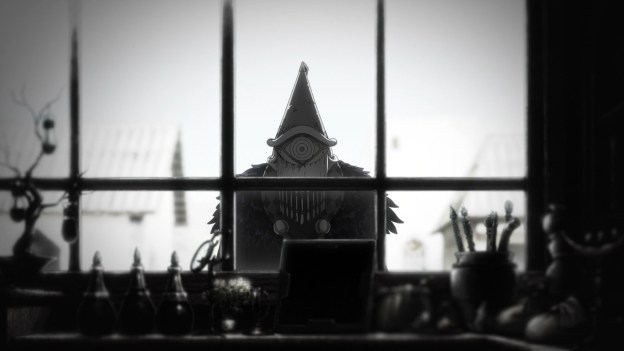
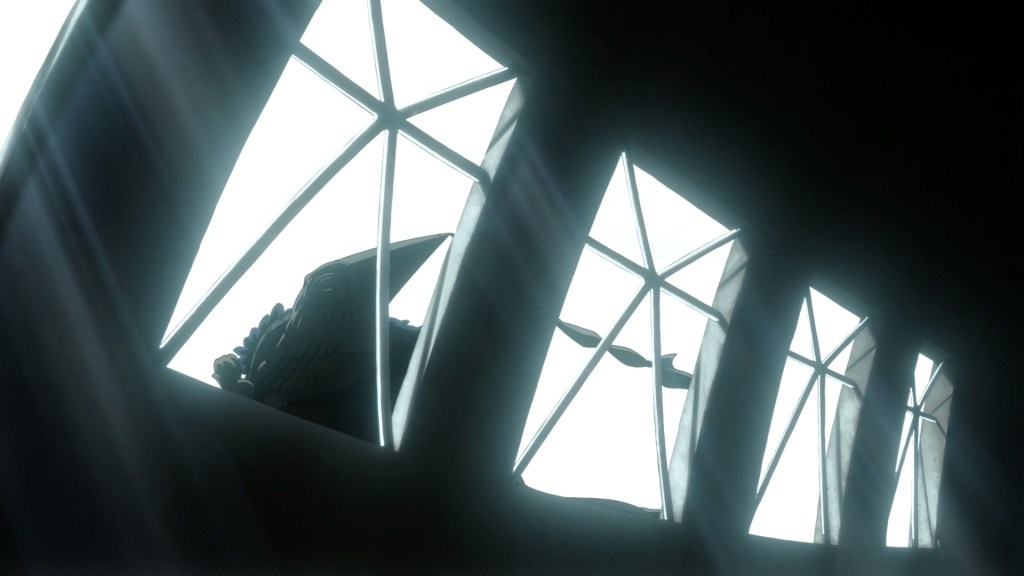
It’s exactly in this context that with just a single shot, the sudden appearance of the Brimmed Cap member vehemently shutters this perception: by increasing the tonal contrast to the maximum, effectively creating a black & white shot, the unusual lines of the foreigntriangular shape created by the witch hat, previously hidden due to the persistent coincidence of tone, introduces a lot of tension to the scene, and it’s also strongly emphasized by the physical, simulated reduction of the aspect ratio through the frame of the window. It’s interesting to note how this shot still abides by the same space-flattening rules: conventionally, objects that are dark appear farther away, while objects that are bright appear closer to the screen. In this case, making the background extremely bright, and the foreground and middleground almost pitch black, is effectively coercing the space into looking more flat.
Frame 1Frame 2Frame 3Frame 4
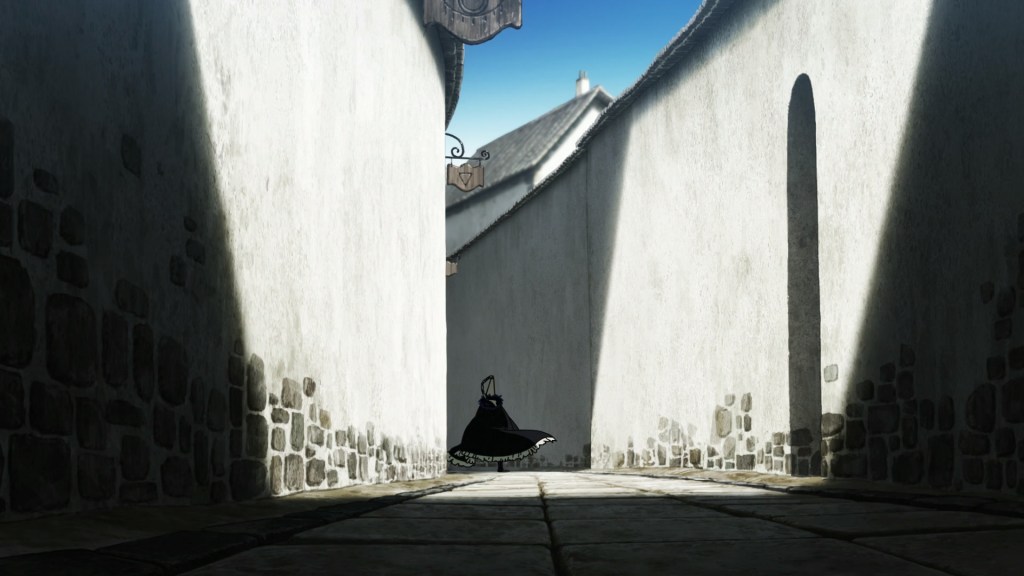
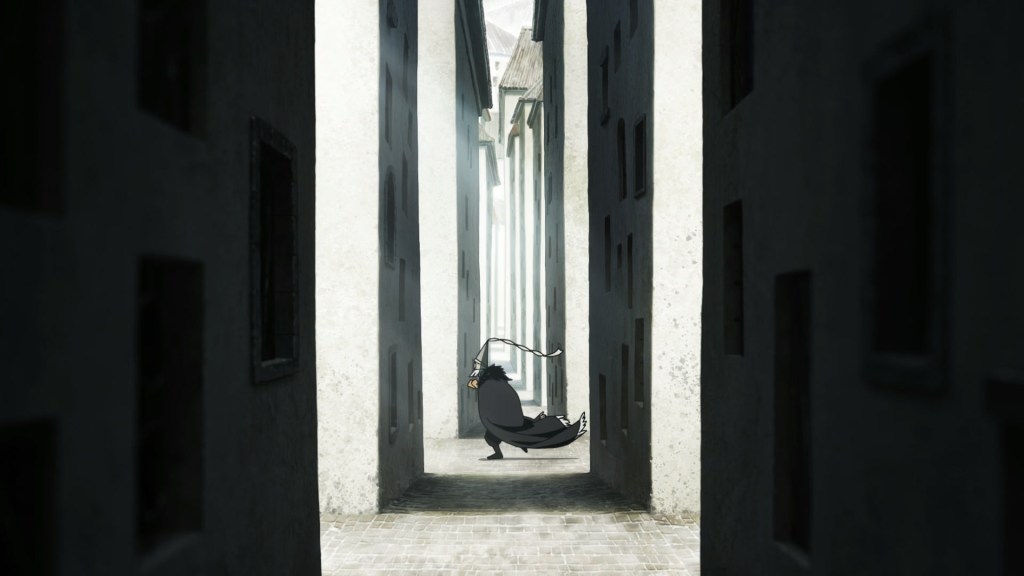
As Coco runs out of the store to chase after the rogue witch, the space becomes deep again, with the depth cue of movement now happening perpendicularly to the picture plane (like in Frames 1 and 3), and the shot compositions emphasize the point of convergence (Frame 4), an unmistakable indicator of depth. Occasionally, ambiguousspace is also used very loosely, distorting the proportion of the physical relations to convey a sinister sense of instability, like in Frame 2.
Contrast of tone is still very much present throughout this short sequence, and the continuously interchanging pattern of dark and bright patches disorients the perspective of depth, and blends the longitudinal planes together into a single convoluted stage that feels bewildering and unsettling.
The comprehensive control over how space is defined in this brief sequence really struck me when I first saw it on the screen, as it’s somewhat unusual, at least in TV anime, to find such a textbook application of tonal contrast this prominent and intentional.
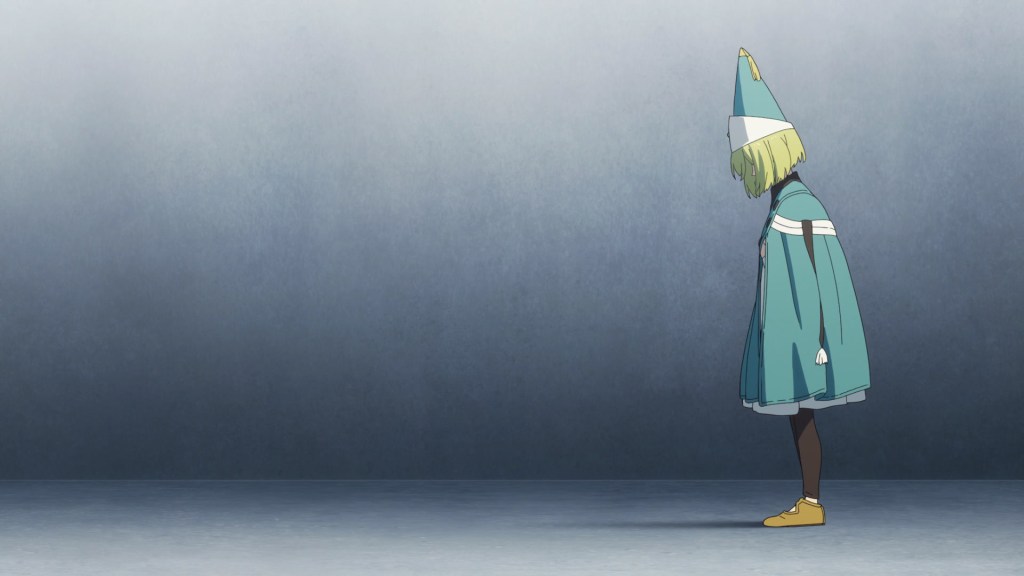
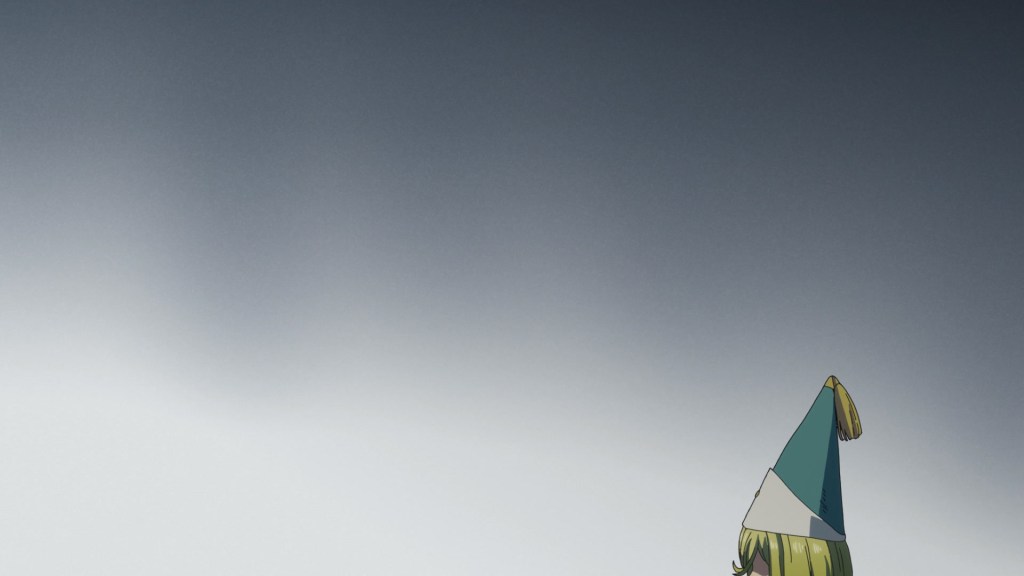
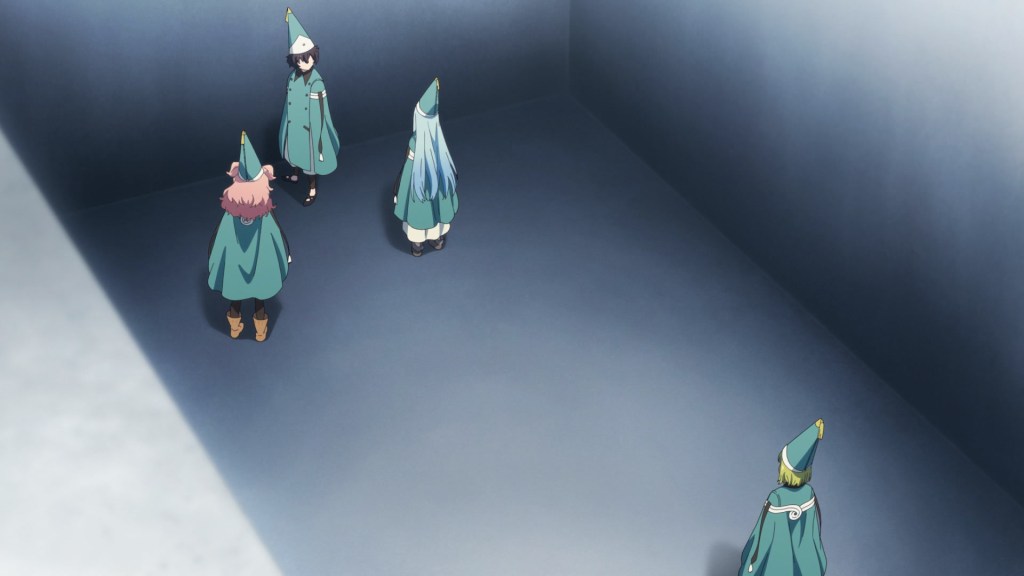
The latter half of the episode keeps on building upon the by-now established channel of space, with its very unequivocal implication of distance and isolation. The tonal affinity makes the space exceedingly flat again, but this time, the almost total absence of textural details in the backgrounds shifts the focus entirely on the foreground, making the negative space around Coco feel all the more excruciating.
More conventional directorial tricks are also used to emphasize this sense of dissonance between the characters, like the quick succession of opposite shots, evenly spaced cuts that get closer and closer to the camera, or compositions that physically separate Coco from the others. Additionally, as it’s something that happens quite rarely, I appreciated the peculiar employment of sound direction in this depiction of distance: lowering the volume of the girl’s voices in favor of Coco’s to create contrast between the two was a very effective way of viscerally conveying their growing separation.
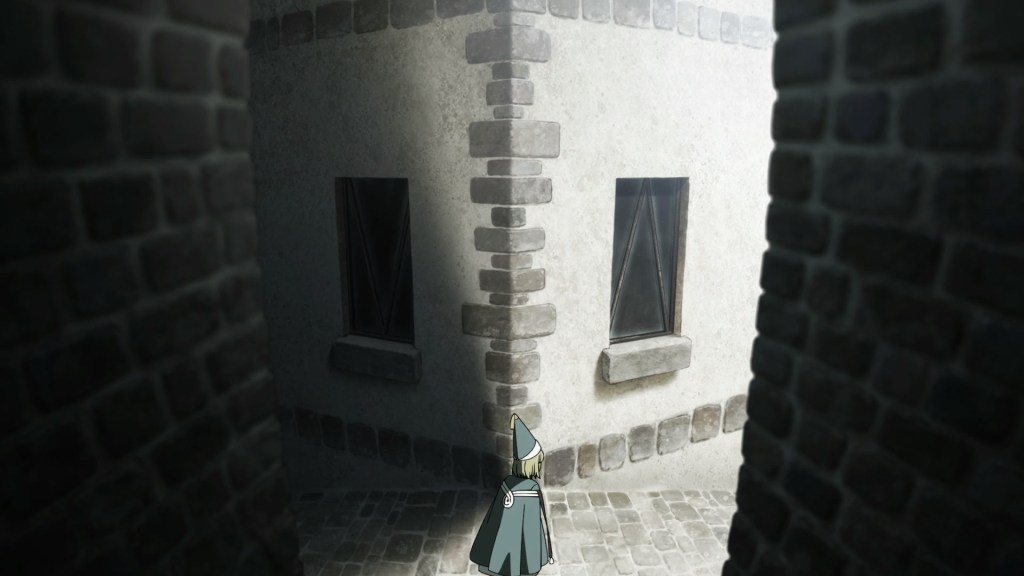
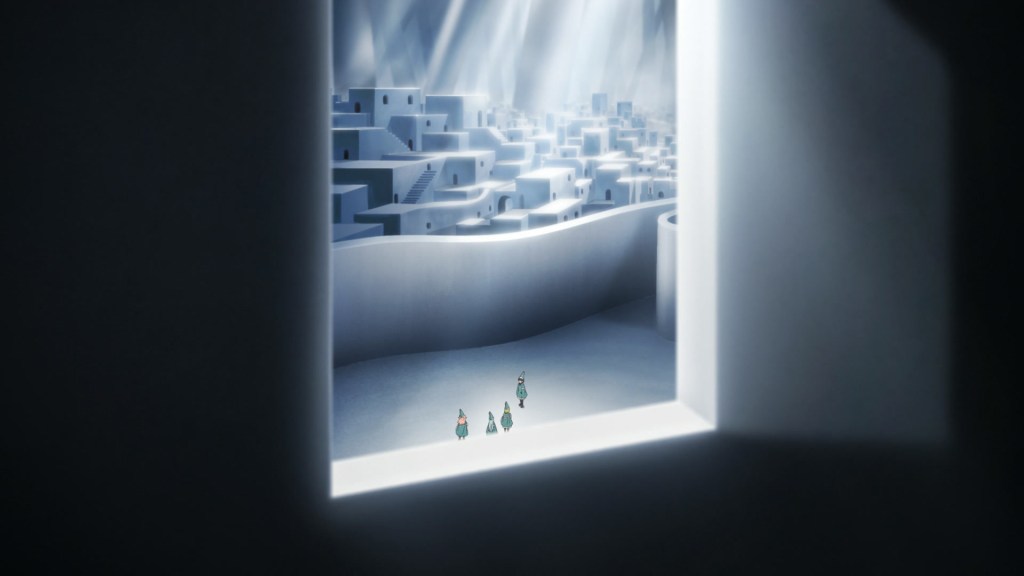
The main tool that contributes to B Part’s implication of isolation however, is definitely the shape & line motif. This surreal world in which the four apprentices are transported gains its otherworldly quality not only from the monotony of tone as I mentioned earlier, but also from the overwhelming affinity of shapes and lines. Houses and walls are all described by straight lines, creating many squares and rectangles on the screen, and this rigid pattern that persists throughout the second half of the episode is constantly emphasized by the framing, which makes the borders around the characters feel insurmountable and oppressive.
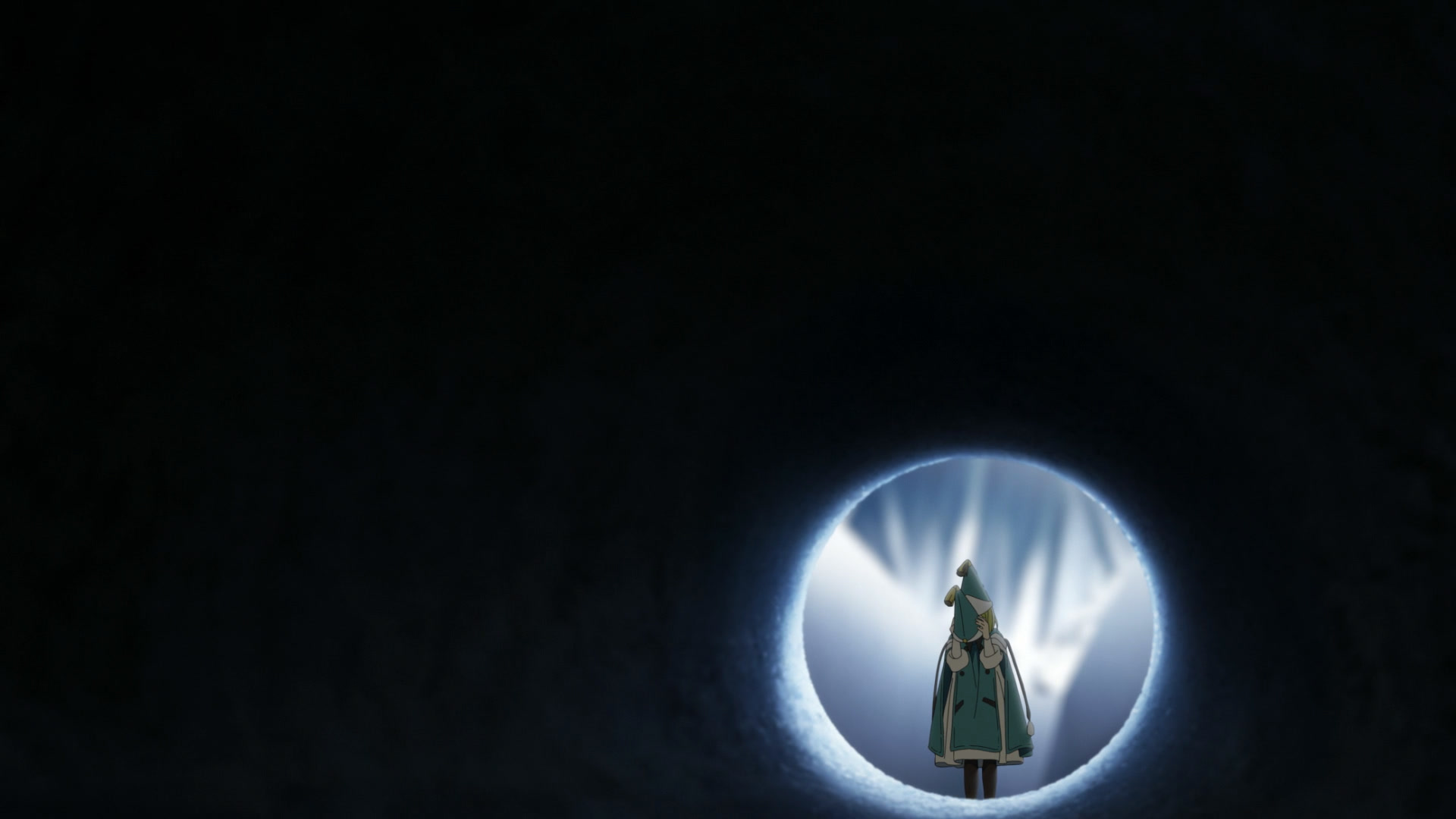
Towards the end, as we’re seeing Coco through the hole that Richeh managed to open with her magic, the newly introduced circular shape, radically incompatible with the world around her, capitalizes on this structural oppressiveness making her feel even more out of place than ever.
Finally, to alleviate all this tension, the episode closes on a positive note (at least visually), bringing us back to the real world, that is now soaked in the tremendously warm colors of the sunset.
Finding the right balance between technicalities and intention is always a tough task, especially when the two are so deeply intertwined. I hope this brief attempt at presenting some notions of cinematography through tangible examples didn’t come across as too rigorous or stiff. Maybe, in the future I’ll find other opportunities to explore more of these concepts, and it’s not unlikely that time will come sooner than I expect, given the absolutely insane amount of incredible shows coming out this year. Until then~
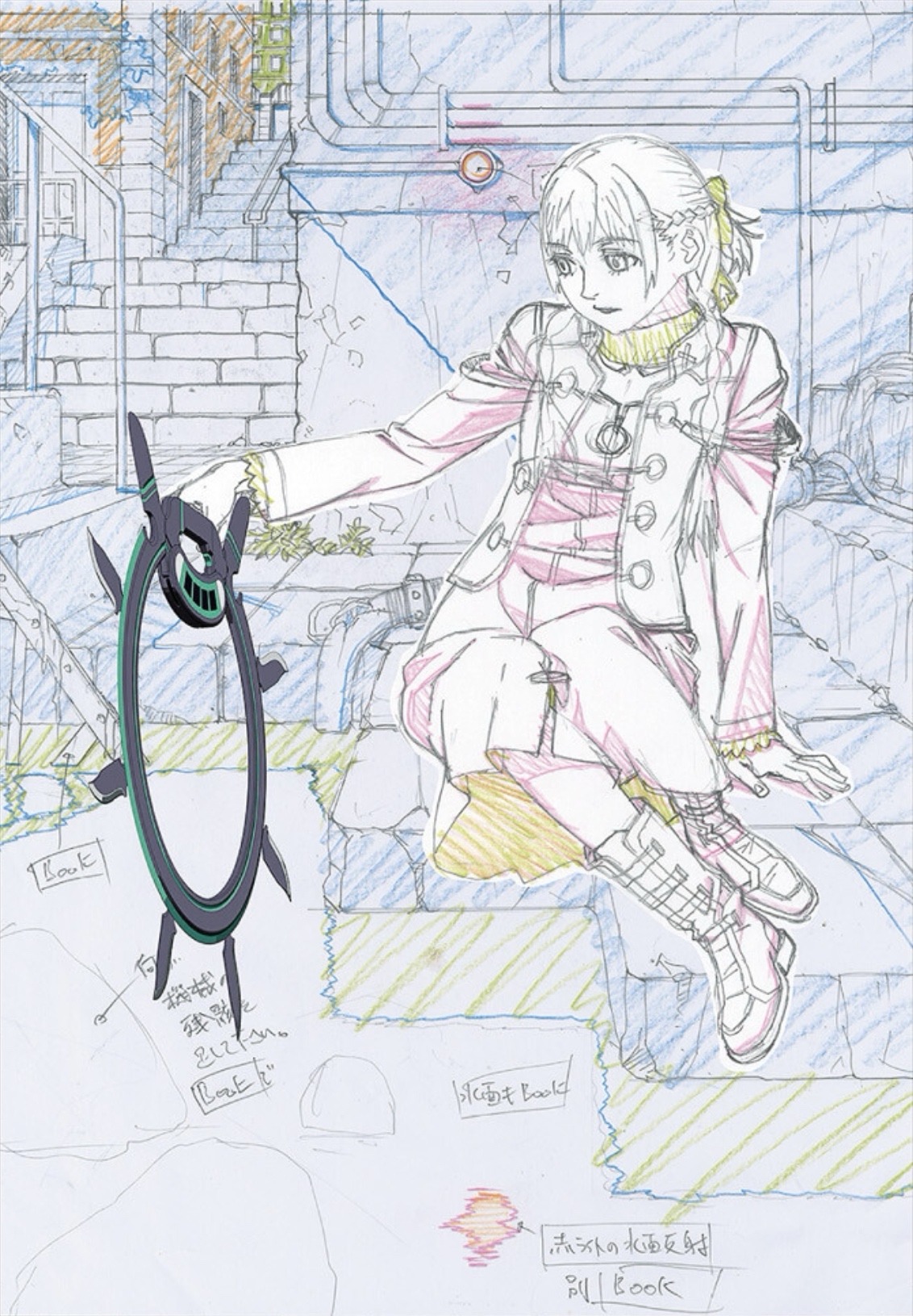
The deluxe edition is packed with bonus content, but personally I’d especially recommend the staff-drawn illustration booklet. It contains illustrations and messages from the staff, and Shinya-kun contributed a piece drawn in the style of a commemorative photo. It was so heartwarming that I too decided to do a “group photo”-style illustration with everyone together. I tried drawing Ubu with the kind of carefree smile you never get to see in the main story (laughs). There are also prequel-like illustrations, some depicting Elegance’s delusions, others with the children at orphanage… it’s all a lot of fun, and I think it turned out to be a really delightful little booklet.
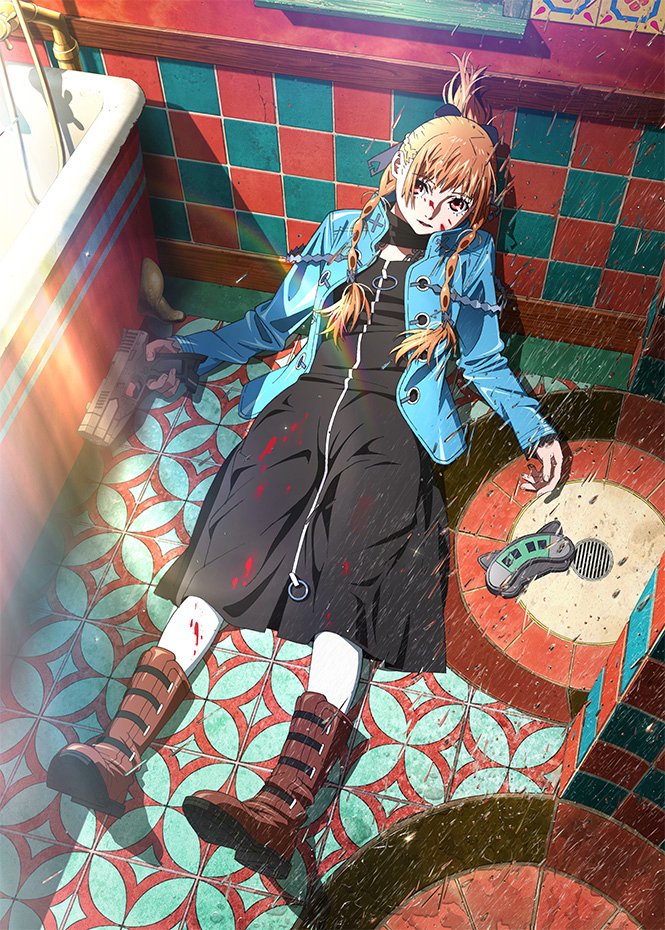
Director’s Comment #2 (Blu-ray Illustration)
We had a request from the Aniplex Assistant Producer to set it in the shower room of the Spa. Originally I planned to have Ubu undressed, but due to various circumstances we ended up keeping her in her usual outfit, drenched in blood from the battle. The image was that with her clothes already ruined from the fight, she just showers with them on (laughs). The nude version is being saved for store-exclusive bonuses.
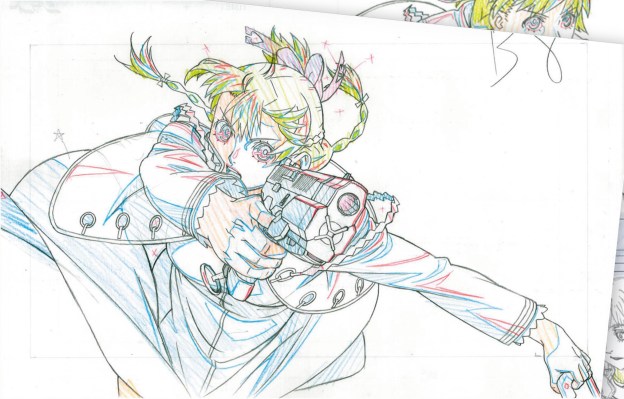
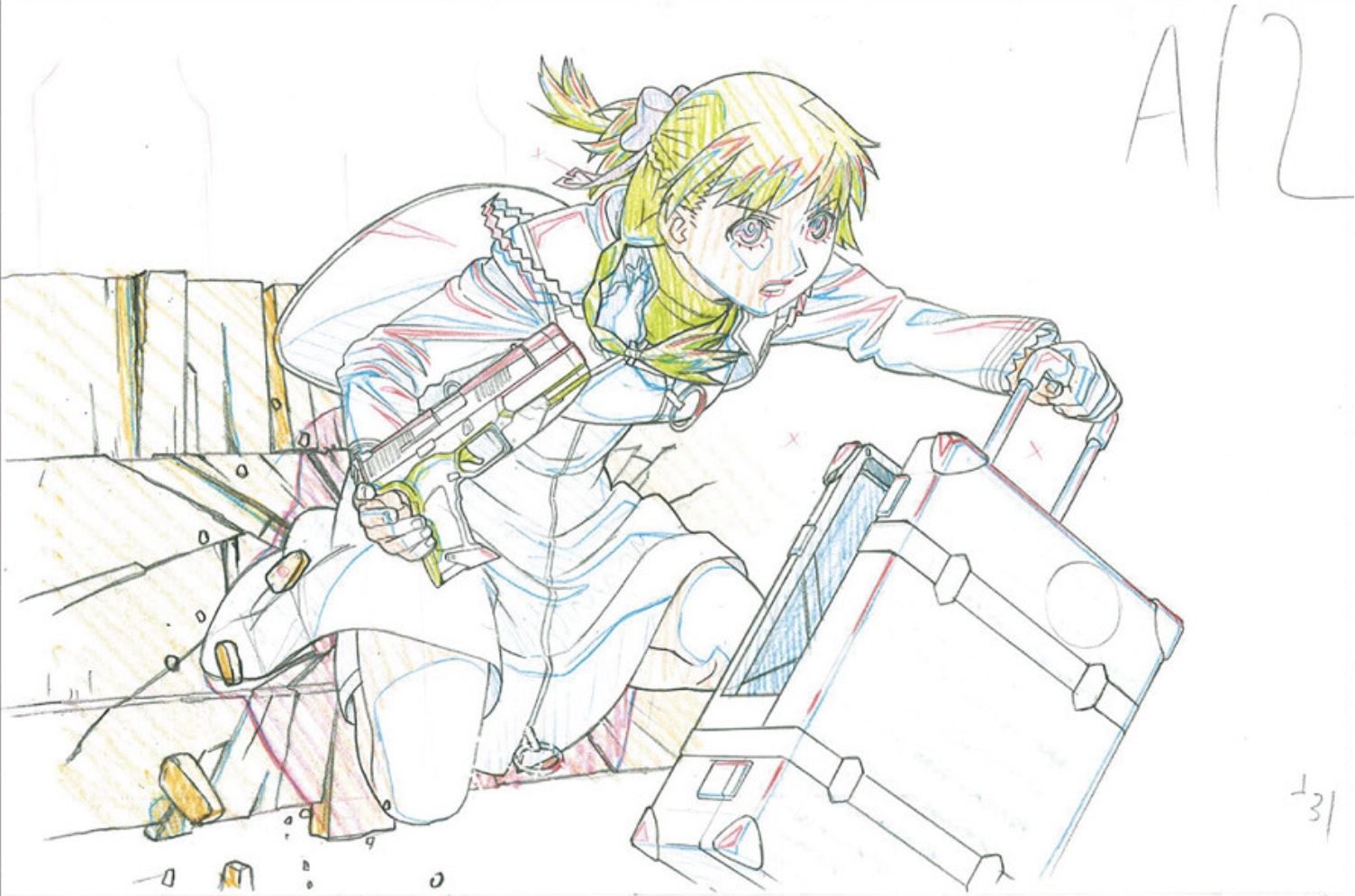
Behind the scenes of the gun action
Excelling at both effects and character animation
— This feature will focus on gun action, one of the signatures of Umetsu-san‘s works, with questions centered around that theme. Joining us for this discussion are Director Umetsu and Takahashi Shinya-san, who is credited as “Main Animator” and “Weapon Designer” on this project. To start things off, could you tell us how and when you two first started working together?
Umetsu: Personally, I have no idea when Shinya-kun and I first ended up working together (wry smile).
Takahashi: It was that time, wasn’t it? When you moved over to Pierrot Plus[currently “Studio Signpost”, the studio changed its name from “Studio Kikan” to “Pierrot Plus” when it became a subsidiary of Pierrot in 2009, then changed it again to the current “Studio Signpost” in 2019, t.n.] for the preparation of the new project.
Umetsu: Oh, it was for Cecil[Wizard Barristers: Benmashi Cecil (Wizard Barristers), 2014]?
Takahashi: Yes, I believe Cecil was the first project you had me on board for. At the time, an acquaintance of mine was working on a different project at Pierrot Plus, and he recently told me he was the one who introduced me to you, Umetsu-san.
Umetsu: I remember asking you to help me out with the openings for SoreMachi[Soredemo Machi wa Mawatteiru (And Yet The Town Moves), 2010] and BLOOD-C[2011], but I wonder if those were after that?
Takahashi: To be precise, the first time was actually when I worked on key animation for the pilotversion of Cecil. I believe the openings you mentioned fell between the pilot and the main project. After that, I had the opportunity to serve as animation director for the first episode of the main Cecil series.
Umetsu: Which means, counting from the main Cecil series, we’ve be working together for about 13 years…
— Takahashi-san, at the time, what impression did you have of Umetsu-san‘s works?
Takahashi: Umetsu-san was someone I had looked up to since my school years, through works like Megazone [Megazone 23 PART II Himitsu Kudasai (Megazone 23 Part II), 1986], long before I became an animator myself. His style was in a league of its own compared to anything that came before, and whether it was the density or the movement, I couldn’t help but think: “This person is something else”. That was the impression he left on me. I had always followed his work as a fan, and I wanted to make something that could get as close to his level as possible, even if I could never quite reach it.
Umetsu: The first time I noticed Shinya-kun, was in Evangelion[Shinseiki Evangelion (Neon Genesis Evangelion), 1995] when I saw his name in the key animation credits. At the time, he’d just sort of caught my eye, and I didn’t think about working with him or anything like that. Then, we teamed up for the first time on the Cecil pilot, and I thought: “This guy really is an all-capable animator, he can handle anything”.
— Practically speaking, what was that about?
Umetsu: He could draw action, and his effects animation was amazing too. That was the first thing that surprised me. I have the impression that from the late 90s, animators split into two categories: those who are mainly proficient it character animation, and those who are in effects animation. So, when we were working on Cecil, almost no one could do both. But Shinya-kun could, and skillfully so, which I thought was very impressive.
Takahashi: Speaking of animators who excel at both character and effects animation, to me, you Umetsu-san and Nakamura Takashi-san were the very definition of it. The first time I watched Genma Taisen[Harmagedon, 1983] at the theater, I was shocked.
Umetsu: That’s because at the time, to everyone, including Morimoto Koji-san and Nakamura Takashi-san, drawing both the effects and the characters together was the norm. (Hiroyuki) Okiura-kun and (Takeshi) Honda-kun too can draw both, but if you look at the generation right after theirs, specialization took over and animators started gravitating toward one or the other as their field of expertise.
Takahashi: Though, I feel like recently, partly thanks to digital animation, the number of animators who can handle both is increasing.
— So, after Cecil concluded, you two worked together on Virgin Punk?
Umetsu: After Cecil, I always made sure to invite Shinya-kun to work with me, like in Koufuku Graffiti[Gourmet Girl Graffiti, 2015], Dimension W[2016], Sousei no Onmyouji [Twin Star Exorcists, 2016] and various openings. Of course, I wanted him on Virgin Punk as well.
The role of the Main Animator
— For this project, Abe Genichiro-san, Kando Maho-san and Takahashi-san are the three names credited as “Main Animator”. How was the workload divided between the three?
Umetsu: Abe Genichiro-kun is a Shaft in-house, and he’s just exceptional at effects animation. So, he mainly worked on… oh, well, he’s actually outstanding at character acting too, isn’t he? (laughs). He was the one who volunteered, and so he joined the project as Main Animator. As for Kando Maho-san, I’ve known her since she was doing douga at a certain studio, and now that she moved to a different studio where she’s working as a key animator, I invited her over to work on this project. Young animators who can draw realistic acting are rare these days.
— What parts did Kando-san mainly worked on?
Umetsu: She can draw everything, so I had her work on many different things… but she’s particularly good at crowd scenes. I didn’t have to make any correction to the crowd scenes for this project. She animated people in a way they genuinely looked like they inhabited that town.
— These days, it’s common practice to make crowd scenes in CG instead, and the number of animators who can draw them by hand is decreasing, isn’t it?
Umetsu: Kando-san pulled off something that most young animators nowadays would struggle with. It’s not an overstatement to say that she did almost all of the crowd scenes in Virgin Punk. And as for Shinya-kun, well, that goes without saying (laughs). I wanted him to do a lot of cuts, and with the overall delays in the key animation, I ended up forcibly asking him to work on many different scenes all over the place.
Takahashi: That’s right (laughs). I did a lot of stuff, from explosions to character action.
— According to the pamphlet, you mainly worked on the action sequence inside the church, is that right?
Takahashi: The church sequence was the first one I was assigned, I handled a few dozen cuts there. After that part was done, I went on helping around with the other scenes.
Umetsu: Originally, the plan was for Shinya-kun to work only on the church sequence, but because of various circumstances, we were completely stuck with the other action scenes… (wry smile). There was no other way, so I asked him to help with them too, and he took care of it. As a result, Shinya-kun took over basically all the tasty parts (laughs).
— You also worked on the “Weapon Design”, does this mean weapons are one of your strengths?
Takahashi: I’m sorry, but I’m not good enough to confidently say it’s one of “my strengths”. I think weapon enthusiasts or designers who mainly work on them would laugh looking at my designs, that’s my current level. Anyways, when working on them, I focused on realism; including the firearms, I tried drawing something that could actually exist in reality. That’s my idea of weapon design.
Umetsu: Judging from the designs you submitted, I don’t think that‘s the level you’re at. The guns you draw are extremely convincing and persuasive. I believe they’re awesome.
The High-Performance Boomerang was the hardest one to make
— What‘s the process behind the creation of the Weapon Design?
Umetsu: At first, mechanical designer Ni0-kun proposes a concept for the weapon. Then, I ask him to draw an approximate draft for it, and lastly, Shinya-kun finalizes it into a proper gadget. That was pretty much the process behind the design. That’s also why in a previous interview I said it was Shinya-kun who wanted to make Ubu’s gun a CZ P-10 C, but it was actually Ni0-kun‘s idea. Let me correct myself on that.
— The guns are essentially based on real models, but to what extent did you adapt them when creating the actual designs?
Takahashi: Rather than adapting them, I adjusted and rearranged the lines. It’s just physically impossible to draw all the lines by hand, in these cases you have to choose which to keep and which to remove.
— So, you tidied up the designs to make them more easily usable in animation.
Takahashi: Yes, exactly that. Things like making asymmetric guns symmetric in the final design to facilitate animating them. Or, in terms of direction, for one of the designs we also decided that when fired, the barrel would stay level rather than kicking up the way it actually would in real life.
— Which gun was that in particular?
Takahashi: Mr. Elegance’s Government 1911 Custom.
Umetsu: That was because I wanted to convey a sense of stability when Elegance shot his gun.
— I see. So that‘s a directorial choice. Was there anything about firearms specifically that made them “easy to draw” or, on the contrary, “difficult to draw”?
Takahashi: As long as there were references to check the details, I wouldn’t say there was anything particularly hard to draw per se… but there’s almost no gun that’s smooth and featureless, so if you’d call it all a pain, then sure, it was all a pain (laughs). But if I had to pick one thing, that would be firearms with a longer body-type, because when animating them, it’s quite hard to find the right balance with the character’s body.
— What do you mean by longer body-type
Umetsu: Firearms with long barrels, like rifles or machine-guns. Among the ones featured in Clockwork Girl, Maggy’s MINIMI and Gaudi’s KRISS Vector are an example.
Takahashi: If we extend the discussion to weapons other than guns, Ubu’s High-Performance Boomerang was probably the hardest one to make. Starting from Ni0-san‘s drafts, I approached its design from an animator’s perspective, focusing on the areas that would likely be troublesome to animate later on. The transformation process between its folded and open states was also pretty complex from a structural standpoint… it was one of the earlier designs too, which certainly didn’t help, and it was really quite a struggle. I still remember hearing Umetsu-san sigh (laughs).
Umetsu: Did I really? (laughs). For Virgin Punk, I was really mindful of getting all the pre-production properly wrapped up before starting animation. “There’s no settei so I can’t draw it” is the number one excuse animators use (laughs), so to make sure there would be no room for that, I wanted everything to be fully set-up beforehand. Shinya-kun worked hard and completed all the designs for the guns and the Boomerang in time.
— Did you get any kind of response to the depiction of guns in Clockwork Girl?
Takahashi: Gun enthusiasts have a very discerning eye, so if you picked through it meticulously, I’m sure there’s plenty being said… But fortunately, it doesn’t seem like we’ve received much criticism overall. Though I have seen comments about the MINIMI…
Umetsu: Yeah, but I mean, you can’t say that was anything too critical or negative (laughs).
— What kind of comment was that?
Umetsu: The MINIMI doesn’t normally fire with a magazine, so I think those comments were something along the lines of: “It’s interesting that it’s firing with one”.
— What does that mean in practice?
Umetsu: Machine-guns are normally fired from a fixed position, using a linked belt to fire hundreds of rounds in succession. But since Maggy can jump around carrying it in one arm, she fires it with a magazine instead. It’s the kind of stunt she can pull off exactly because she’s a full-body Somadea. I believe the comments picked up on the intent behind it, and that’s why they found it interesting.
— I see. So, if anything, it was positive criticism.
Umetsu: In Clockwork Girl we used guns and that Boomerang, but for Virgin Punk as a series we’re thinking of an even wider variety of weapons. It won’t be limited to simple and straightforward gun action, I’m aiming for a much more diverse range of action scenes.
The difference between the action of flesh-and-blood bodies and fully mechanical ones
— Umetsu-san, when asked about your favorite scene in a previous interview, you mentioned the one during the church battle against Tommy J, when Ubu reloads her gun with the sole of her boot while jumping. I believe it was handled by Takahashi-san, but what are your feelings in regards to that scene?
Takahashi: Personally, I had never seen someone reload a gun like that before, so I found it really innovative. If I have to think of a way to reload the pistol you’re holding in your right hand, while your left hand is blocked, I genuinely can’t think of anything besides using an object in your surroundings. But if you’re in midair, that also becomes impossible. In movies, you often see actors pulling their gun’s slide with their teeth, but I thought doing that wouldn’t fit a little girl like Ubu.
Umetsu: Exactly. She is a bishoujo after all, and I’d already seen scenes like that in live-action movies before, of actors baring their teeth while racking the slide. When I tried to think of another way she could pull it off, my mind went like: “She has her boots, doesn’t she!”.
— And what about Takahashi-san, what would you say are your favorite scenes?
Takahashi: For me too, I’d say around that part where Ubu is shooting in midair. And a little later, the scene where she comes falling through the smoke of the explosion and sweeps around into her landing. I had never really animated that kind of movement before, and I know it’s not my place to say, but I’m glad that scene turned out as well as it did.
Umetsu: That scene is the perfect example of how you’re great at animating both characters and effects, and that’s exactly why it came out so well. If you were only able to draw character animation for instance, you would have had to hand off the explosion part to someone else. In that case, the management of the work would have been a mess, and producing an action sequence with that kind of smoothness to it would have been nearly impossible.
— The action scene in the church is really a masterful display of fine craftsmanship. In order to highlight how her whole body has become a Somadea, the details of her depiction differ from the action scenes in the first half, where she’s still in her flesh-and-blood body.
Takahashi: That’s right! Now that she’s completely mechanical, her body weight increased considerably, so when she backflips and hits the wall, her feet sink right into it, and when she lands, they sink into the ground too. I wanted the details around her to really hint at the fact that she now has a fully mechanical body.
Umetsu: If Gaudi, with his flesh-and-blood body, falls from a high place, he gets hurt, whereas Ubu would be completely fine, for example. The intention was precisely to depict and convey the difference between a real body and Somadea, through subtle details like those.
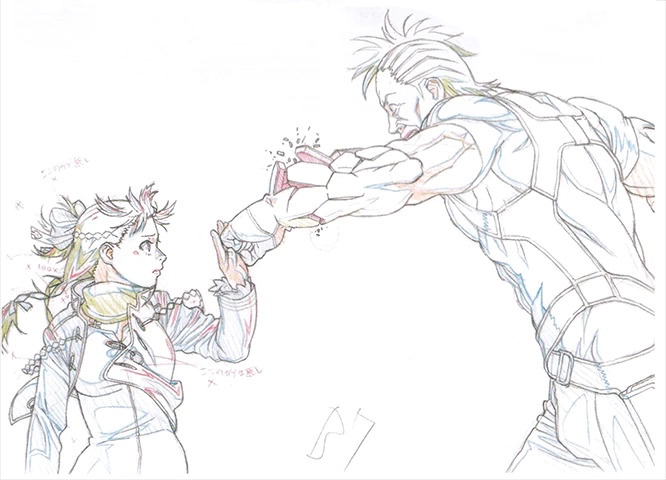
— That also applies to the scene featured as a cel drawing in the pamphlet, where Ubu effortlessly catches Tommy J’s punch with just one hand, right?
Umetsu: Right, right. There’s also that scene, where Tommy J’s forearm gets damaged by the recoil of Ubu’s firmly stopping the fist he threw with all of his body strength.
Takahashi: I really enjoy coming up with that sort of little touches and adding them in. I think that’s where animators truly shine, obsessing over that kind of detailed depictions, and it was a lot of fun to draw.
Umetsu: With the action scene in the church, I essentially wanted to portray the feeling of the unparalleled strength Ubu gained by becoming a full-body Somadea. Most Somadea criminals don’t reinforce their lower bodies, so the fact that Ubu went straight for Tommy J’s legs without hesitation is key. She did the same even when she was still in her real, adult body; that’s because I wanted to remark how she’s a specialist when it comes to hunting down Somadea criminals.
A gun action that aims at realism
— On the topic of gun action, could I ask you both about works, manga, anime, or live-action, that have left a lasting impression on you?
Umetsu: I’d say Under the Dog [2016] directed by Ando Masahiro-kun. The action in that work is spectacular. Personally speaking, it is the anime that really impressed me.
Takahashi: I have many live-action movies that come to mind… but the one that gave me the impression of doing gun action like nothing before is Equilibrium[2002] starring Christian Bale. The idea of “Gun Katas“, fusing firearms with martial arts forms, was something genuinely new. I feel like action in anime has also slightly changed thanks to this movie.
Umetsu: I wonder… did it really influence anime? When I first watched it, I couldn’t help but chuckle (laughs).
Takahashi: That’s exactly what’s great about it! (Laughs).
— Speaking of katas, holding the gun sideways when shooting was quite a trend for a while, wasn’t it?
Umetsu: Gangsters in movies often shoot like that, yeah.
Takahashi: I imagine that’s all about prioritizing the visual appeal more than anything else, but…
Umetsu: For Virgin Punk, we had a firearm advisor. When we asked, the advice was not to do that. It does look cool, but we were told that if our goal was realism, we’d better avoid using that shooting style.
— What other advice did you receive from them?
Umetsu: All sorts of things came up… For example, there’s the scene were Ubu gets shot by Elegance, right? We were given specific instructions on exactly where to make him aim his shots in that scene. The right side of the body has a lot of vital organs, so basically we were told to avoid shooting that side too much. That kind of things.
— That was decided taking into account the fact that she becomes a full Somadea later on, correct?
Umetsu: Correct. In L.A. Confidential[1997] there’s a scene where a detective says something suggestive to a suspect, who suddenly turns around and shoots him. We used that as a reference for the scene where adult Ubu gets suddenly shot by Elegance.
— Umetsu-san, you once said that your style when it comes to action is dividing the scene into fine, shorter cuts. As a Main Animator, how do you approach such style, Takahashi-san?
Umetsu: Oh, he must think it’s a realpain (laughs).
Takahashi: No… to put it bluntly, it makes it easier for me working on shorter cuts. I think it’s perfectly fine to make longer, continuous ones if there’s an intention behind them, but with most of the long cuts you see nowadays, I often can’t find one. Umetsu-san‘s approach of cutting cleanly sequence by sequence, almost in a live-action fashion, is at least psychologically much less of a burden. When I’m given storyboards to work on, just seeing “10-something seconds” written there is enough to make me think: “Ugh, what a pain” (laughs).
Umetsu: That’s true! (laughs). When I’m both directing and doing animation direction for the same project, making cuts too long also means creating more work for myself. Of course, as Shinya-kun said, if there’s a reason for it, then I do make longer cuts as well. But outside of that, I firmly believe shorter cuts are simply more efficient. That said, when we took this approach all the way with Clockwork Girl, it ended up at 765 cuts for a runtime of 35 minutes. That’s way too many even by my standards, so considering it’ll be a series, I figured I’d at least limit the everyday acting scenes to just one cut. Action scenes are a different story though (laughs).
— Lastly, on the occasion of the Blu-ray release, could I ask you each for a word about what you’d like viewers to pay attention to in this version?
Umetsu: With the Blu-ray, you can take your time and watch it carefully, so I hope you’ll catch all the details you might have missed at the theater, like the subtle differences in the action scenes between a Somadea and a real body, as we mentioned earlier. There are many such small touches scattered all around, and I hope you’ll enjoy discovering them.
Takahashi: It feels a bit awkward to point to my own scenes (laughs), so I’d like you to pay attention to the other animators’ work as well. The action at the orphanage at the beginning is simply stunning, and the chase between Gaudi and Tommy J on the monorail is a real treat too. As you’d expect from a work directed by Umetsu-san, the action is full of highlights all throughout. But even outside of that, there are plenty of wonderful scenes you shouldn’t overlook. The part when Ubu escapes from the hospital ward and wanders through the town is also spectacular for example, and really, rather than pointing to any one scene in particular, I’d love for you to watch the whole thing with keen eyes.
Original interview from Animage (May 2026); concept art from the TRIGUN STAMPEDE Exhibition in Ikebukuro (March 2025).
I wanted it to close it as a story that carries hope and brightness.
— Can you tell us about how you come to be involved in this project?
The first time I received word about it was quite a while ago, around the end of 2021. TRIGUN STAMPEDE was being developed as an original story, and they asked me if I was willing to direct its second season. At the time, there were many different concepts being discussed for this project, and one proposal was to make it a sequel to the original manga, since STAMPEDE was something like a prequel to it. But I thought that after watching STAMPEDE, the viewers would rather see the story follow the original’s all the way through to the end, so we started working on it with the idea of adapting the manga Trigun Maximum up to its conclusion. However, Maximum is a very long story, and there was no way to fit it within our available runtime in its entirety. So, we carefully selected which parts of the story to include and which to cut, with the goal of depicting how the confrontation between Vash and Knives ultimately concludes.
— So, you’re saying it was quite difficult to adapt the full story into TRIGUN STARGAZE?
We struggled a lot along the way. As a fan of the original myself, I really wanted to see a complete and faithful anime adaptation of the story, but the circumstances just didn’t allow for it. We had to cut a lot of elements quite decisively, and the screenplay alone took over a year to complete. Nicholas in particular was a difficult case; if he were to die as he does in the original, we would have necessarily also needed to depict Vash confronting the weight of having taken a human life, something he had spent so long desperately trying to avoid. There was simply no way to fit that into the runtime, no matter how we looked at it. After a lot of back and forth, we ultimately decided to let Nicholas live in this version.
— I believe Nicholas meeting a different fate compared to the original is something long-time fans would be happy to see, even if it was ultimately the result of your deeply considered structural decisions.
If fans received it as a happy ending, that’s honestly a bit of a relief. Episode 3 of STAMPEDE was quite a brutal one, involving the mass slaughter of the people of the town, and I heard that after reading the script, the original author Nightow Yasuhiro-sensei was a bit skeptical, wondering if they hadn’t gone a bit too far. Yet, after it aired, the reception was quite positive. That made me feel just how difficult it is to judge where the right line is when it comes to the tone and balance of the storytelling in Trigun.
— Did you receive any specific request from Nightow-san when it came to making the finale?
It wasn’t exactly a request, but when we first talked about it, he said something along the lines of “For the people who haven’t read the original, this is what Trigun will mean to them”, and I remember that made me realize the weight of what we were taking on. Nightow-sensei is incredibly generous when it comes to anime adaptations. After that initial talk, we would show him our progress at key stages, like “We’ve gotten this far, what do you think?”, and he would give us thorough feedback along the way. But it wasn’t a matter of him stepping in heavily, it felt more like he was watching over us warmly from a distance.
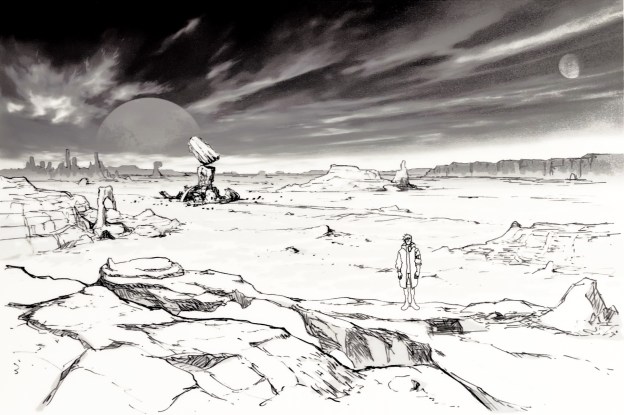
— The setting of this story is No Man’s Land, a desolate and arid world. What aspects did you focus on in particular when creating the visuals for it?
At the end of the story, part of No Man’s Land turns into a green, fertile planet. I wanted to really emphasize how lush and moist the land becomes, so we steadily depicted the desert world as extremely dry and arid at first, in order to make that contrast land more decisively at the end. I remember discussing about whether we could express this contrast effectively through color. The portrayal of the desert was a key aspect, so we did quite a lot for it, like pushing the contrast harder, or making the sky a sharp, vivid blue. I also asked the photography team to add effects like the light reflecting up from below, or to convey the hazy quality of sand in the air. I think that paid off well.
— What about the acting and movements of the characters?
Essentially, all the every-day acting was taken via motion capture and then reworked by hand. In this season, thanks to the new character Milly, the atmosphere became considerably more joyful and lighthearted, but we were wary that leaning too far into the comedy would risk making her come across as just a silly airhead, so we made quite a few adjustments there. As for Vash and Nicholas, we were really conscious of their poses and demeanor in the original when capturing their movements. There were moments where Meryl would get pulled along by Milly and start acting slightly out of character, so we were careful not to let that go too far.
— Despite being a 3D production, it has such a natural feel to it that you might almost mistake it for cel animation. Would you say the technology has advanced considerably?
From the feedback I hear, even though Orange is a 3DCG studio, a lot of people say things like “I forgot it was even 3D” or “It holds up beautifully as cel animation too”. I’ve always worked with cel animation and this was my first time with 3D, but it’s not like we actively tried to achieve a “cel anime look” for this project. If you want something to have a “cel anime look”, then you should just work with cel animation, and on the other hand, if you’re using 3DCG, I believe the result should look like 3D animation. Quite some time had passed since STAMPEDE‘s production, and it seemed like what was achievable in 3D had expanded as well. On top of that, the individual animators had grown in skill too, and the expressions came out really well. We received a lot of praise along the lines of “They feels so soft and tender”. In this sense, if you felt it was more natural, I believe it’s all thanks to the hard work and efforts of the staff.
— Since it’s the final season, you had to properly portray the connection and relationship between Vash and Knives. What’s your understanding of the two characters, and what did you want to convey when portraying them?
I personally believe Vash and Knives are a pair, they’re like the angel and the devil that live within a human being. They each represent an opposite extreme. However, this season depicts sides of Knives that show he isn’t just a straightforward villain, as well as sides of Vash that show he isn’t simply a hero either. I wanted to portray them as flawed, “not infallible” characters who carry their own wounds. I also wanted to make sure the humans weren’t absolved either, and tried not to portray them as blameless.
— Compared to the original, the finale had a different tension to it. What feelings and emotions did you pour into the ending?
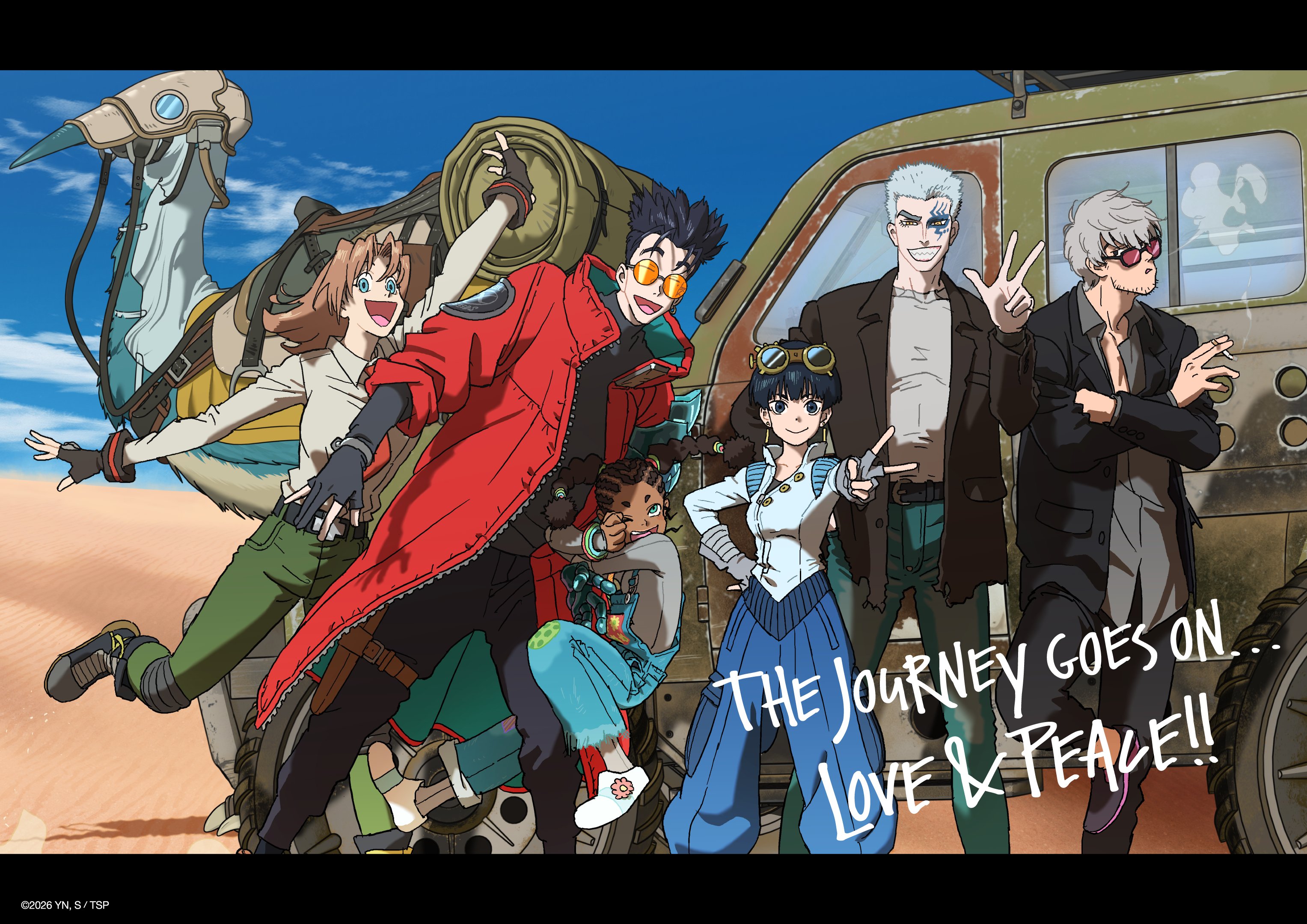
At first, I wanted to close this story with Vash and Knives annihilating each other. Then, scriptwriter Fudeyasu Kazuyuki-san suggested “What if we ended it with that lively, chaotic energy like the early key visual for STAMPEDE?”, and ultimately we adopted that idea. One thing I was very mindful of for this project, was making sure it never became a story that incites hatred. When working on the world of Trigun, it’s easy to fall into depicting people as consumed by hatred for one another. But when I thought about the viewers who might become fans of this work and want to keep enjoying it long after its conclusion, maybe through cosplay or by repeating and treasuring their favorite lines, I felt that sending them off with a dark and hopeless ending just wasn’t the right choice. I wanted it to close it as a story that carries the hope and brightness of the characters choosing to live their lives with admirable resilience on the harsh planet of No Man’s Land.
— Lastly, could you share a message for fans who want to keep enjoying this work even more deeply?
For the viewers who discovered the world of Trigun through STAMPEDE and STARGAZE, I really hope you’ll read the original manga from start to finish. Then, come back and rewatch the anime series to discover all the differences, and the things that are only possible in STARGAZE, like the Nicholas and Livio team-up, enjoying an even more complex and layered experience of this work.
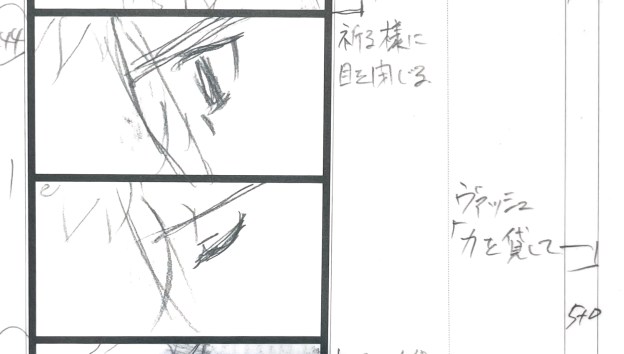
Original interview from PASH! (April 2026), original interviewer: 佐々木玲佳; storyboard from the TRIGUN STAMPEDE Exhibition in Ikebukuro (March 2025).
It’s a story that starts from the question: “Why do humans kill each other?”
— What do you think is the appeal of the original work TRIGUN?
I think it’s a work that confronts fundamental questions head-on. “Why do humans kill each other?”. And “Can it be stopped?”. I feel like this is a message that many can empathize with, and that can move many hearts.
— Is there anything that left a strong impression on you from your talks with Nightow-sensei?
Nightow-sensei has continued to watch over us with a supportive stance, always respecting the anime production. He always says: “You’re free to do as you like”, and I’m really grateful for it. We also had many opportunities to attend events together, and through interviews and similar occasions, I had the chance to see him speak about his approach to this work. Things like how he imaged Vash and Knives’ characters back when he was drawing them, and quotes like: “I want to depict what lies between heaven and earth”. As a reader myself, I’m really happy I was able to hear this kind of backstage stories directly from the author himself.
— The title of this final season, TRIGUN STARGAZE, is very impactful. Could you tell us what feelings and intentions went into it?
It was a suggestion from the producer, but there are two reasons behind the choice. Firstly, one of the main elements of this season is the immigrant fleet coming from Earth, and secondly, more than anything, Vash is a dreamer at heart. So, we decided on this title with two meanings in mind: “One who watches the stars” and “One who dreams”.
— You mentioned that Vash is a dreamer. Could you tell us about your vision of Vash’s character in this work?
Fundamentally, he didn’t change from last season. He’s still chasing the ideal of not killing anyone and not wanting anyone to die, and in order to achieve that goal, he doesn’t mind if he gets hurt in the process. That’s Vash’s character. However, this time we are depicting a side of Vash that shows how he isn’t entirely a perfectly righteous person.
— A character who gets deeply involved with this Vash is Nicholas. What aspects did you place emphasis on in portraying him?
I believe he’s the character with whom the viewers can empathize the most in this story. Compared to the opposite extremes that Vash and Knives represent, Nicholas occupies a much more grounded position. His middle-ground role, having had a period of connection with Knives, while also being a dear friend to Vash, was something I was especially conscious of when portraying him.
— What about Meryl and Milly, what kind of position do they occupy as characters in this work?
Meryl is the “representative of humanity”, a bystander who has been following Vash and watching the story unfold since last season. I also think of her as a presence who carries the conscience of the story. Nicholas occupies a similar position, but he is even more pragmatic, whereas Meryl, like Vash, is someone who wants to keep chasing after an ideal. If Meryl and Milly were going to be in this show, I wanted them to truly have their moment. We do have some spotlight scenes prepared for them down the line, so I hope you’ll look forward to it.
— What struck me in the early scenes at the beginning of the season was how, even in the more serious situations, the two’s conversation lightened the atmosphere in just the right way.
Thank you! The scene where they first appeared together eating a banana split [they actually couldn’t eat it in the end] or Milly’s “Do you have any more?”[referring to bread she just called “so dry” and “not very tasty” t.n.] in the later car scene, both captured the two’s relationship very effectively. I believe they were two well-executed scenes.
A challenging script, shaped by the resolve to close this story.
— In regards to this works’s production, what’s the aspect that was the most troublesome and challenging for you, Director?
Definitely the script. This season stands in the very complex position of being the sequel to TRIGUN STAMPEDE, which substantially rearranged the content of the original’s story. I really racked my brain over how to build on that. I too watched TRIGUN STAMPEDE as a viewer, and felt that its ending was gut-wrenching and truly impactful. And TRIGUN STARGAZE had to take it from there. I felt that viewers would surely want to see it through to the end, so we decided to take the story all the way to the conclusion of the original. However, there simply wasn’t enough runtime to cover everything. Rearranging and adapting it was unavoidable, including all the parts that fans of the original had been waiting to see, so we spent a really long time talking it through.
— Nine episodes have aired so far. Is there a scene that has particularly moved you?
The performance by Vash’s voice actor, Matsuoka-san and Knives’ voice actor, Satou-san in episode 7. Listening to it, I felt something pressing deep into my chest, and I thought: “I’m really glad we could make this into anime”. They each have their own, strong conviction, and it really was a fierce confrontation between brothers. Vash and Knives are like the angel and the devil that live within a human being, and I believe that inner conflict is what their story is ultimately about.
— Is there anything that left a particular impression on you from the recording sessions?
If I have to bring up something other than episode 7, that would be episode 3, “Memento Mori”. The scene at the end where Vash says “I’m home” and breaks down crying. The actual take came out completely different from the rehearsal, and in that moment, something inside me clicked: “Yes, this is exactly Vash”.
— I heard that for this season, the voice work was recorded before the animation was finalized [“pre-scoring” t.n.]. Were there instances of the visuals changing in response to what the cast brought to their performances?
The animators have been working while listening to the performances, and the visuals themselves were heavily influenced by the voice actors’ work.
A CG that evolved in real time.
— Is there anything from the production that has particularly stuck with you?
This was my first time dealing with 3D animation. At the beginning, there were some expressions I was told would be difficult to make in 3D, but Studio Orange kept pushing their technology forward throughout production, and the parts that we had planned to handle with hand-drawn animation were replaced by CG one after the other. For example, the scene in episode 1 where Hoppered the Gauntlet combs Vash’s hair, or when Jessica breaks the egg’s shell in episode 4. And then there’s the metamorphosis sequence, where Knives, reduced to nothing but eyeballs, gradually forms bones and flesh from the energy of the Plants. Metamorphosis sequences have traditionally been the domain of cel animation, but this time, we took on that challenge with CG. I really hope you’ll pay close attention to the visual craft as well.
— The visuals really are a highlight of this season.
Thank you very much. The final battle between Vash and Knives is going to be the climax, both visually and narratively. I hope you’ll keep your eyes on how their conflict will ultimately resolve, and how Vash will confront the truth about what really lies in Knives’ heart.
— Lastly, a message to the fans.
To the fans who first met this series through TRIGUN STARGAZE, please consider giving the original manga a try. And to the fans who’ve been supporting this series for many years, we have something special in store that you won’t find anywhere else. I hope you’ll stay with us all the way to the end.