Tag Archives: Keiichiro Saito

Tomoya Kitagawa & Keiichiro Saito & Tomohiro Suzuki – Interview on Sousou no Frieren (Frieren: Beyond Journey’s End) Season 2

Original interview from MANTANWEB published on January 2nd 2026, original interviewer: 阿仁間満; genga corrections by Akiko Takase, from the official studio Madhouse Twitter account.


The second season of the anime adaptation of “Sousou no Frieren”, the manga series written by Kanehito Yamada and illustrated by Tsukasa Abe currently serialized on “Weekly Shōnen Sunday” (Shougakukan), is airing every Friday at 11 p.m. on NIPPON TV’s “Friday Anime Night” slot, starting January 16th 2026. The manga series boasts a total circulation of more than 32 million copies, and the first season of its anime adaptation aired on “Friday Anime Night” from September 2023 to March 2024, attracting widespread attention for its careful direction and visual beauty.
This second season features Season One’s episodes 2 & 8 and second cour’s chief Episode Director Kitagawa Tomoya-san as the Director, and Season One’s Director Saito Keiichiro-san supporting the production as Direction Cooperation.
How will the second season take shape under a new Director? We spoke with Kitagawa-san, Saito-san, and Series Composition & Scriptwriter Suzuki Tomohiro-san.

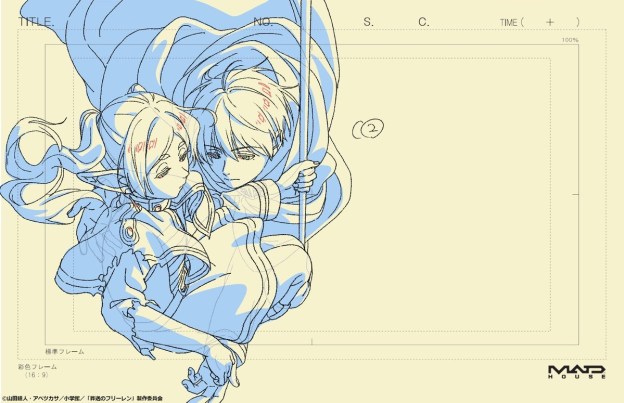
What does the “Direction Cooperation” do?

— What’s the division of roles between Kitagawa-san and Saito-san, and how did this team come together?

Saito: When Season One ended, discussions began about what to do for Season Two. I had already poured all of my energy into the first season, and when thinking about how to deliver “Frieren” to the world in an even stronger form, I realized I genuinely wanted to take a short break from on-site production, and assist the team by sharing my know-how and knowledge with them. That’s how I ended up participating under the Direction Cooperation credit. I supervised the script and storyboards, and worked as an advisor, suggesting corrections and revisions. I also took on practical tasks when it was necessary. For the second episode of Season Two, I was in charge of part of the storyboard, and in connection with that, I was also present during editing as well. At first, I intended to be involved in pre-production only, but ultimately I ended up lending a hand in post-production as well.

— What’s the reason Kitagawa-san was selected as the Director?

Saito: When working together in Season One, I felt like Kitagawa-san‘s thinking and technique were really solid and on point. There were things I really should have overseen myself, but I couldn’t keep up with everything and Kitagawa-san helped me a lot with them. When it came to asking someone for the Director role, there really was no other candidate except for him, so that’s the why I asked Kitagawa-san.

Kitagawa: When I was offered the Director role, I was genuinely very happy, but also felt the pressure of being in charge of such a popular series. I’ve put my best effort into this production, in order for it to live up to the viewers’ expectations.

— Have you two worked together on other projects before?

Kitagawa: I worked on the TV show “Sonny Boy” [2021] in the same roles of Storyboarder and Episode Director. At that time, I had Saito-san participating as a key animator in an episode I supervised, and we’ve been working closely together ever since.

— Are there many members of the staff who also worked on Season One?

Kitagawa: Yes. There are many, including main staff like the Art Director, Color Designer and Director of Photography, as well as many Episode Directors and animators, who have continued to participate, and it’s really reassuring. There are some new entries too.

Saito: Fukushi-san (the Animation Producer, Fukushi Yuuichiro-san) has continued managing things on-site, and the talented team from the first season is once again bringing the full extent of their strength to this second season.

— Since you’ve been building upon the know-how of Season One, are there even more things you could achieve in this new season, compared to the first one?

Saito: I believe there are. At times, overseeing the works for Season Two made me feel a little jealous (laughs). Aspects we couldn’t fully bring to life in Season One are now being executed to their full potential.

— How do you feel about the current state of the production?

Kitagawa: Everyone, from the Scriptwriter Suzuki-san, to the sound team, the voice actors, the animators and photography team, the background artists I can’t list each one of them, but we’re all highly motivated and working hard in order to make this into a great work. I believe it’s turning out to be a very entertaining show.
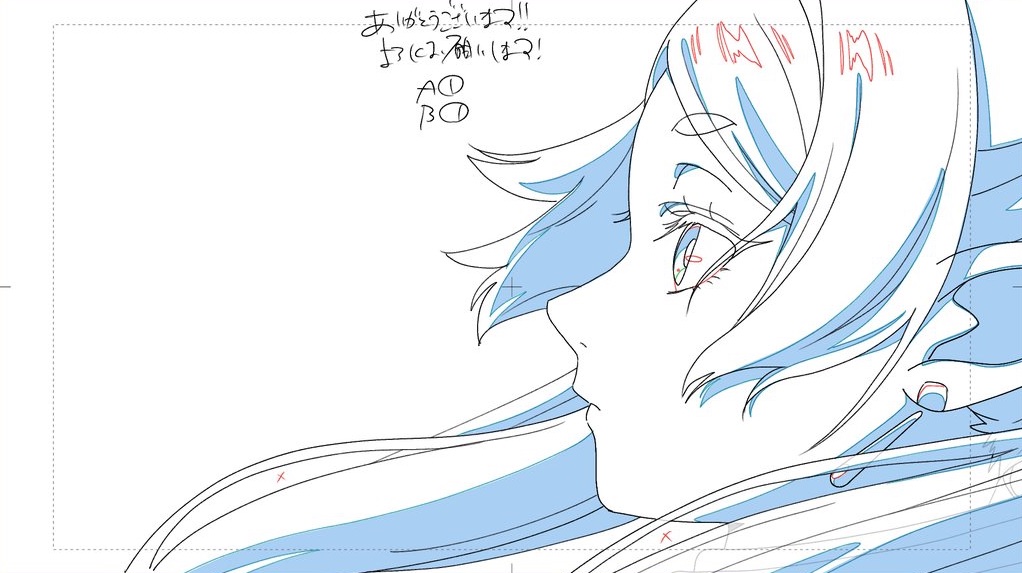
The charm of words

— Kitagawa-san, including Season One, what do you feel is the charm and appeal of “Sousou no Frieren”, and how are you trying to express it in anime?

Kitagawa: The original work is very solid and entertaining, and when adapting it, I’m constantly thinking about how to effectively translate that appeal into anime. The anime’s script contains quite a few original elements, so I also think about how to make them as entertaining. In “Sousou no Frieren”, there’s a slight gap between what the characters say and what they think; it’s a work that depicts the complexities of human emotions. When bringing it to animation, I direct with a focus on how to portray these aspects effectively onto the screen.

— Suzuki-san, how do you feel about the “charm of words” in “Sousou no Frieren”?

Suzuki: From the first time I read it, I felt it had a serene and soothing atmosphere, with careful and delicate use of language. The dialogues also have a pleasing sound when spoken aloud. In the first season, the Director’s spacious sense of rhythm carefully conveyed this tranquility, and I think it also emphasized the pleasantness of the words’ sound. The balance and pacing of the comedy scenes are also remarkable.

Kitagawa: Gags too are one of “Sousou no Frieren”‘s appeals. In Season Two as well, we continued to make them stand out properly, while also expanding on them a little. It has slice-of-life elements, it has comedy, and it has battles; it has everything people want to see, and it’s a work capable of depicting all of it. It feels so rewarding.

— Season One was met with a strong response from overseas as well.

Saito: I used to worry about whether its lyricism would resonate with viewers all around the world, but now, I’m really glad that people were able to really connect with the emotional qualities this work radiates. It also features flashy action sequences, so I think it was thanks to the series’ great balance as well.

Suzuki: It still doesn’t feel real, but I’m truly happy about that.

Kitagawa: As you mentioned, I felt that aspect too, so I wanted to make sure we kept that same balance in the second season as well.
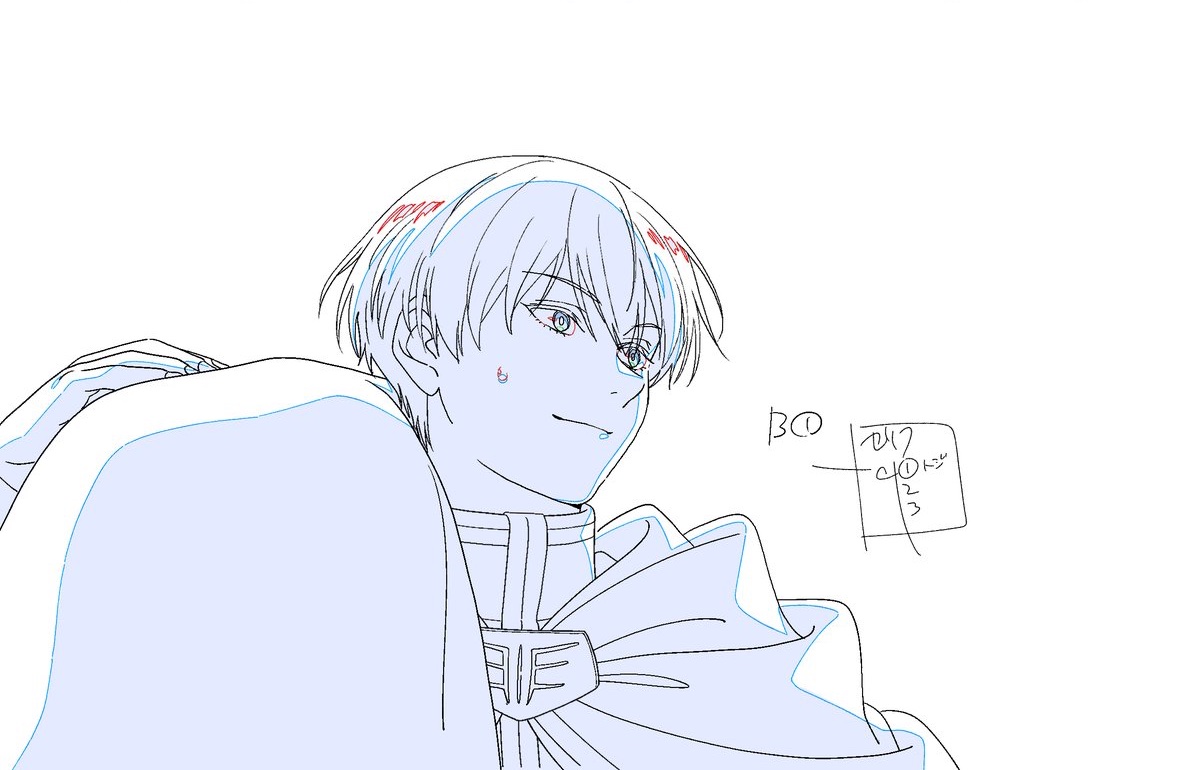
It’s fundamentally an extension of Season One, but…

— When writing the script for Season Two, what kind of discussions did you have?

Suzuki: At the very beginning, (Animation Producer) Fukushi-san said he wanted to maintain a consistent core throughout the series. He wanted to compile it in such a way you’d feel the desire to watch it all over again the moment you finish it. Kitagawa-san remarked how he wanted to show the main trio’s harmony and maturity gradually growing stronger, as well as how the flashbacks featuring Himmel slightly differ from Season One’s, as Frieren recalls them in a more assertive and proactive way. We talked about how we wanted to focus on that aspect.

Kitagawa: Season One featured many scenes of Frieren reminiscing and reflecting on Himmel’s words, and consequentially learning more and more about humans. Season Two however, is more about her teaching to Fern and Stark what she learned from Himmel. In that sense, I think what I want to deliver is the story of how the trio matures as a party, and how, thanks to Frieren’s presence, both Fern and Stark are able to grow. As this becomes more and more core to Season Two’s narrative, even the party’s battling style changes, with Fern evolving little by little by observing Frieren. I tried to incorporate this aspect into the show.

— Are there also aspects you changed in Season Two?

Kitagawa: It’s fundamentally an extension of Season One, so we tried to keep the already strong aspects exactly the way they were. I believe there are many who are fond of the peculiar tempo and atmosphere, so I made sure to preserve that feeling while centering the story around the trio’s journey.

Saito: I personally would have been fine with Season Two being completely re-imagined in Kitagawa-san’s own style and sensibility, but since they’re carefully modeling it on Season One, I can’t help but feel a bit conflicted (laughs). Of course, I also feel genuinely happy that they’re using the first season as the model.

— Even so, do you feel that Kitagawa-san‘s personal touch still manages to come through?

Saito: I do feel his style in subtle ways, but even in the first season, there were various Episode Directors involved, and I think it’s through the contributions of many people that a single work can come together.
In Season Two, the shot compositions and small pauses, as well as the mise-en-scène are a bit different from my own style, and I think that’s where Kitagawa-san‘s style, or rather, his idiosyncrasies come through. At the beginning of the first episode of Season Two, Kitagawa-san added a scene that originally wasn’t present in the script, and I believe it really communicates what he’s trying to achieve with this second season.

Kitagawa: It really isn’t that big of a deal, but the new season is finally about to begin after nearly two years, and Frieren and the others are back; I was thinking about how I could build up that sense of excitement, the feeling that a new journey is about begin. With that in mind, I made a few small additions, including how the title shows up on the screen.

— Kitagawa-san, you worked on the first season as well, but when it came to the production of Season Two, did you do any analysis or specific study of Season One?

Kitagawa: To avoid Season One’s atmosphere coming apart, I tried my best to bring it over to Season Two. I worked on elements like the depiction of natural landscapes, the sense of rhythm and the staging of important dialogues with the first season’s approach in mind. I also put careful thought into the division of cuts and transitions, so that the important lines won’t just get glossed over.

— A big topic of Season One was also its battle scenes. How about Season Two?

Kitagawa: There will be just as many, perhaps even more. The manga’s rhythm is very entertaining, but when adapting them into moving pictures, you have to be thoughtful of how to stage them. In Season Two, the trio’s battles become the main focus, so we staged them emphasizing their coordination and teamwork.

Saito: In Season One, I did everything I could in terms of Episode Direction and Editing, but a large part of the action came from having Iwasawa Toru-san on board as the Action Director and allowing him to fully showcase his skills.

Kitagawa: For the second season, we’re relying on the skills of the staff in charge of each episode and its action direction.

Saito: We have many animators who also worked on Season One, so I hope you have high expectations for it.
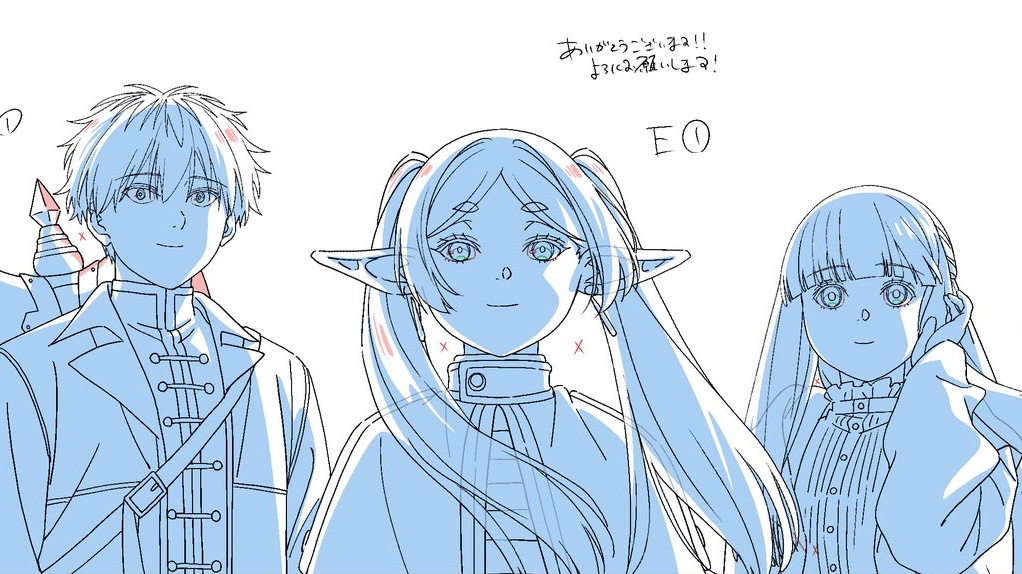
The change and growth of the main trio

— What are the intrinsically challenging aspects of “Sousou no Frieren”?

Saito: The delivery of the dialogues has to be convincing in a way that comes across naturally when the lines are spoken. So, we paid close attention to that when directing.

Kitagawa: We added some anime original parts as well, so I worked on the storyboard while thinking about how to make them appealing and entertaining to fans of the original work. There are also aspects that deviate from the manga in the way they’re portrayed. For example, in Episode 25 of Season One [this episode was storyboarded and directed by Tomoya Kitagawa himself t.n.] I changed the way kid Flamme is portrayed, and was worried it wouldn’t be well received by fans. I was focusing on how to adapt that scene into anime in order to make Serie’s feelings come through more effectively.

Suzuki: The original creators asked us to treat each line of dialogue with care. At the same time, they were very open and encouraging when it came to fleshing things out, which I’m deeply grateful for. That hasn’t changed in Season Two.

Saito: I think we expanded on more elements in Season Two than we did in Season One.

— How did you “expand” on the original work’s content?

Saito: At the early stages, we discuss the core ideas; then, Suzuki-san builds on them, and through ongoing discussions we deepen them even further.

Suzuki: It gets clearer once ideas are laid out, so I try to actively put proposals forward.

Saito: When looking at the series as a whole, we talked about showing how the characters change, while also discussing the aspects of them that remain the same.

— Finally, could you share a message for the viewers who’re looking forward to Season Two?

Kitagawa: In the second half of the first season, Stark mostly stayed on the sidelines, but in Season Two, he’s gonna play a much more central role. Please look forward to the trio’s teamwork and bonds!

Saito: This time, I’m only assisting in Direction Cooperation, but starting with Kitagawa-san, the amazing staff managed to craft some truly wonderful visuals, so please, have high expectations for it!

Suzuki: Because there was a long gap before Season Two aired, both Kitagawa-san and Saito-san have been working while focusing on maintaining a strong continuity with Season One. In the second half of the first season, our trio takes a break from their journey, but in this new season, they set off for new adventures. Centered on the themes of “change” and “growth”, I hope it becomes a work that leaves viewers with a warm feeling of fulfillment at the end. Please, enjoy it to the fullest!

Keiichiro Saito & Shoji Hata – Interview on Sousou no Frieren (Frieren: Beyond Journey’s End)

Original interview from Animage (April 2024 issue), genga by Yoshihiko Matsumura.


~ We crafted it together while figuring it out. ~

— I’ve heard from the members of the cast that they tried to feel more natural in their acting, how did you decide on this direction for their performance? 

Saito: I didn’t specifically request for them to act in a more natural way; personally, I listened to what they proposed, and we crafted it while figuring it out. It wasn’t necessarily a direction I gave, but I remember saying something along the lines of “I don’t know who these words are gonna resonate with, so I want you to do it conscientiously”. Rather than having direct and powerful lines, I felt it was a work whose words could smoothly move you. 

Hata: That’s right, the original work itself has a superb choice of words, so there was no need to exaggerate the acting to convey the message. I think that’s what the cast interpreted as “to act naturally”.  

Saito: All the cast members were people with great sensitivity, so I was the one to learn a lot from them. 

— I would like to ask you about what you particularly paid attention to when directing the main characters. Let’s start with Frieren.

Saito: Frieren isn’t a very expressive character, and her lines too are rather abrupt most of the times; I think that’s because she doesn’t want to give off a bad impression and just wants to be liked. So I told (Atsumi) Tanezaki-san that Frieren conveys more human warmth through her mild voice than her facial expressions. 

Hata: Because of Frieren’s personality, and the fact that, being an elf, she lives much longer than humans, I thought she would end up sounding detached and cold. But she was well conscious of the balance in her output, despite her expression being a poker face all the time she does have emotions, she wants to express them but she’s certainly not a character that puts lots of effort in talking. 

— How about Fern? I think she’s a character who carries human potential and possibilities on her shoulders.

Hata: Stark is like that too, but Fern lives with the human perception of time and is present in the show since she was little, so, while casting, we looked for someone who could express her growth in a realistic way. I had the impression that (Kana) Ichinose-san’s cool and determined voice was really in sync with Fern. 

Saito: I’ve worked with Ichinose-san several times, and I believed she could really fit into Fern’s character. To Ichinose-san and (Chiaki) Kobayashi-san, who plays the role of Stark, I didn’t give any direction on how to craft their characters. 

Hata: During the recording, Kobayashi-kun payed attention to Tanezaki-san and Ichinose-san’s performances as he acted, and thanks to that, I feel that the balance between the three of them was really good. 

Saito: He himself said that as they started recording he could feel that the right atmosphere between Frieren and Fern was already present in the recording room. I think Stark too has a caring side, or rather, he’s good at reading the room, so they too were a good match. 

— What did you pay particular attention to when directing Himmel, who appears in almost every flashback scene? 

Saito: Himmel is not only cool, but also an interesting and approachable person, and that’s how I wanted to depict him, representing these characteristics of him. 

Hata: To Frieren, her journey with Himmel’s party is the basis of her current journey understanding humans. In a sense, Himmel is the representation of humanity. Most of the times when he appears in Frieren’s memories, he doesn’t look like a hero or a savior, but rather, he feels human. If one’s heroism can been switched “on” and “off”, she remembers only the times when Himmel’s was “off”. That’s why we asked (Nobuhiko) Okamoto-san to soften his acting a little.

— It is true that when Frieren recalls Himmel, it’s often in mundane and everyday contexts. 

Hata: There are some scene where he’s actually actively working, like fighting demons (laughs). However, Frieren is currently becoming aware and realizing the meaning of all her interactions with Himmel when he was “off”; I think this is a key aspect of this work.

Saito: Also, I think Himmel’s vanity for his handsomeness is a complex feeling, on one hand, it’s something that he lets out because he’s aware of his position as a hero, and on the other, he’s also saving himself by doing do. 

— You mean that he’s saving his actual self?

Saito: Himmel himself said something similar to this, living an honest life and helping others is something that will return back to you and connect you with the future; I think this is what he really feels and holds on to. Then there’s also the part of him that just wants to look cool in Frieren’s eyes (laughs). But I believe that’s just his way of showing himself in public, and not some mere narcissism. He clearly understands that his and Frieren’s perceptions of time are different, and there’s a hint of sadness in him as well; I think he’s a character that can’t be taken too naively. 

— In the currently airing “First-Class Mage Exam Arc” a lot of new characters have made their appearance.

Hata: I think that in the Exam Arc there are a lot of characters that stand out for their symbolic meaning, but as the story progresses, it becomes clear how every one of them is carrying their own life on their shoulders. I wanted to carefully portray these characters in a way they won’t just end up standing out for being flashy or funny. 

Saito: They appeared all at once, so at first I had a hard time grasping all the characters; there are also some of them who play an active role in episodes beyond what this anime will cover, and the more you dig into it, the more flavors you get out of them. It was fun thinking of how to depict the way they act now, taking into account their future developments.

Hata: All the cast members actively looked deeply into their roles, and I feel they really got into their characters. 

Saito: There weren’t many characters we had trouble casting for, it went quite smoothly. Kanne is the type of character (Azumi) Waki-san is known to be good at, so I didn’t have to give her that many directions for her dubbing. (Sayumi) Suzushiro-san usually acts the roles of lively characters, but on the contrary, I thought she was a good fit for Lawine. Lawine’s cynicism is kind of defiant, or rather, she gives off the impression she’s like a child being a little too hard on herself. I thought Suzushiro-san might be able to bring out Lawine’s bold front. 

Hata: When it comes to casting, I believe Serie was the most difficult one.

Saito: It was rather troublesome.

Hata: Serie is a character full of mysteries even in the original work, you know. It’s that type of character you even wonder whether it’s male or female, or neither of the two. We couldn’t quite figure out who Serie was, so it was a difficult character.

— What was the deciding factor in casting Mariya Ise-san?

Saito: While we were looking for candidates for the role of Serie, Hata-san proposed the name of Ise-san

Hata: Among the staff members everyone had their own ideas, we couldn’t agree even on the type of voice. We didn’t know what kind of person Serie was, but on the contrary, that meant she could have become any kind of person from that point on; that’s why I thought Ise-san might be a good fit. 

Saito: It’s the same for Frieren, elves as characters have an aloof side to them, but also are a bit inattentive, it feels like they do have a weak spot somewhere. Serie too is by no means flawless, there’s a cute side to her too. I believe Ise-san’s acting is the perfect for that compromise. 

~ It’s a show with some not-so-realistic breaks in it. ~

— I think the comedy in this work is also impressive, it makes you giggle, and the more lively gags are exquisite too. Are there any aspects in this regard you particularly focused on when directing? 

Saito: Hmm, I wonder… (laughs). It’s hard to put into words, but it’s not like I consciously tried to make it funny, it’s intrinsically amusing and that’s what I tried to do. Also, when I’m directing comedic scenes, I always think of my sister, or rather, I always feel that “if it makes my family laugh, then it is funny”.

Hata: Generally speaking, I believe the behaviors of characters in this work are very conscientiously thought, and they feel real. The comical scenes too are not symbolical, and don’t disrupt the natural flow of the play. It’s not like we intentionally hold back with the direction to make it funny in the little details, but it feels like that’s what happened as a result. 

Saito: There are scene where we made Stark raise his voice to make the gag stick out, but fundamentally it’s funny because everyone is so worked up. I think what makes the gags funny is that the earnest feeling behind them usually results in unexpected outcomes. 

— But that time in Episode 3 when Fern says “Gulp” out loud was a direction you gave on set, wasn’t it.

Hata: Yeah (laughs). 

Saito: Well, it was sort of a gamble. I didn’t know whether it was fun or not, but I wanted to do it. Frieren [the show t.n.] could have been made in a more realistic way perhaps, but I wanted to make it a work with some breaks in it. I wanted to show the audience a work where you could hear “Gulp” said out loud. 

— I heard that the soundtrack for the first four episodes that aired as the 2 hours special and for some of the other episodes as well, was composed in film scoring [composed while watching the footage t.n.] to match the images on screen.

Hata: That’s right. For the whole first special episode, I had the soundtrack composed in film scoring, and after that, as an extra, I had it done that same way for some other crucial scenes too. As a result, the soundtracks for the final stages of Episode 8, the scene of Himmel’s ring in Episode 14 and the dance scene in Episode 15 were all composed that way (laughs).

Saito: (Laughs). In Episode 8, Frieren, Fern and Stark take action separately, so, in order to reach the climax, I had them composing a pretty long track.

Hata: I asked to arrange it in a way that, when it changes tracks adapting to the scenes and dialogue lines, it would feel like one big flow.

Saito: For Episode 14, we were thinking of making it play along the flashback between Frieren and Himmel, but then I decided to build up the climax from the moment Frieren goes up into the sky, so that’s where the soundtrack starts playing. 

Hata: For the dance scene in Episode 15, I didn’t want a usual ball-like track; I wanted to depict the sense of distance between Fern and Stark. Considering all these subtle and complex adjustments we requested for, (Call) Evan-san was the right person for the job. Even for the initial film scoring, he did a great job of depicting Frieren’s slight change in mood and Fern’s body temperature changing.

— Is there any track composed in film scoring for the “First-Class Mage Exam Arc” as well?

Saito: No. In the second cour the drama has more continuity to it, so instead of using film scoring to make a single episode memorable, I chose to use single tracks in order to convey the flow of the story. 

Hata: In the Exam Arc, a lot of mages make their appearance and battles are more frequent, but that’s not what I wanted to emphasize, in fact, I thought of it in a way not to make it too catchy. Even in the first cour there were some bloody episodes and battles with demons. What I wanted to focus on was the story of Frieren, Fern and Stark’s journey, or that of Frieren becoming more caring of humans. 

— I see. Then, what aspects did you consider when selecting the tracks? 

Hata: The emphasis on following the scenes’ mood and feel might have been a little different from what you see in other works. I think Evan-san’s speciality is writing songs that are able to touch people’s heartstrings, so this time too I asked him to write tracks to fit not what was happening, but rather the emotions and feelings of the scenes. Even from Episode 5 on, I chose the tracks that were in sync with the emotions I felt. and used the same track for the other scenes that made me feel the same way. 

~ Direction techniques not to depict emotions in a tasteless way. ~

— Anime original scenes, like the cut in Episode 1 when Frieren looks at her ring during Himmel’s funeral, or in Episode 14’s when Frieren makes a surprised expression when Himmel kneels, have become hot topics. 

Saito: There are a lot of elements scattered throughout the original work, and all these points are often connected in a line. And in the anime adaptation as well, I wanted to convey the feeling of these points being connected, I wanted to make it so that not only were the episodes enjoyable one by one, but the series as a whole formed one single story. Adding the ring cut in Episode 1 was also meant to hint at the development in Episode 14. 

— This was already brought up in the cast interview, but by paralleling the key visual for the first cour to the cover of the first volume of the original work, I had the impression that making Himmel look towards Frieren in the KV depicted his feelings for her in an even more powerful way.  

Saito: Rather than making it feel more powerful, the idea was to make it more “noticeable”. Personally, I think that anime, unlike manga, is fundamentally more fleeting, it’s a one-shot deal. Unlike manga, that you can read at your own pace and re-read over and over, I believe that with anime, that cannot be watched at one’s own pace, the opportunities to go back and watch it again aren’t that many. That’s why, while making it, I wanted to include things that would catch people’s attention and stick out to them when they watch it. The design of the KV too is one of these things. 

— The sound of the bells when Himmel puts the ring on Frieren in Episode 14 was impactful as well. 

Saito: That was an idea of Episode 14’s episode director and storyboard artist (Shinya) Iino-san

— What was the intention behind it?

Saito: It’s just the chime of the city’s time signal, so I think the interpretation is up to the viewer. This is something that Hata-san has mentioned but, there aren’t many words that hint at romantic elements in this work to begin with.

Hata: I noticed this while reading the original work, but the kanji for “love” is never used even once. The same goes for expressions like “I love…” [in a romantic way t.n.]

Saito: Just the time they explain that the meaning of the mirrored lotus in the flower language is “eternal love”, and that’s about it. 

Hata: That’s right. Personally, I hope it’s because there’s something planned for the future in relation to that. 

Saito: Therfore, whether or not Himmel has romantic feelings for Frieren is, after all, up to interpretation. For the scene where he gives her the ring, I focused on what was happening rather than the emotional side of it. To expose those feelings in the anime adaptation seemed tasteless.

Hata: The original work isn’t concluded yet, it’s still in the process of building things up. Considering Frieren is the main character, the story may go on many hundreds of years in the future. I believe the contrast between the different perceptions of time of elves and humans too is an interesting aspect of the original work, so, as I was getting involved in this work, I internalized an elf-like perception of time and might have slowed down the tempo a bit in some parts.  

— In a scene in Episode 17, whereas in the original work Stark carries Fern on his shoulders, he carries her in his arms instead, why was it changed that way?

Saito: That was because Stark carries his axe on his back, so… (laughs). 

Hata: (Laughs).

— So, it wasn’t a depiction of Stark’s growth or something like that (laughs). 

Saito: I just thought Stark would do it that way, I didn’t mean to add any particular meaning to it. Well, it’s more gentlemanlike of him to carry her that way, isn’t it (laughs). 

— Also, it’s a minor detail, but I think in the anime, the farewells convey more a feeling of gratitude.

Saito: Like at the end of Episodes 11 and 17, right? I made those scenes focusing on the flow of the emotions, not for the sake of drama. Besides, in Frieren, encounters and farewells with people are something that’s constantly being depicted. I think that in a sense, it’s right, or rather natural, to end things with a farewell. 

— Lastly, a massage to all the readers that are supporting the anime? 

Hata: This work has a lot of static and dynamic parts, and it feels like the words and lines are chosen very carefully. I think that lines that become cues to notice something, or subtle changes in facial expressions, or the drama where, at first glance, nothing seems to be happening, but underneath, the emotions are moving greatly, are the fascinating and appealing aspects of this work. I believe we were able to gain this much support thanks to the viewers carefully paying attention and not overlooking all this.  

Saito: In the original work, you can understand and notice new things as you re-read it, so as the creator of the anime, there are several things I’m really glad I haven’t failed to notice. I was quite nervous that if I was missing something, it would have been some serious trouble (laughs). 

Hata: (Laughs). There are some scenes where the lines can be conveyed properly without necessarily playing a track in the background. Also, another feature of this work is its loose and relaxed portrayal of the passage of time, and I think that too is an aspect people will enjoy. 

Saito: Earlier I mentioned the connections between past and present in this series, and Fern’s growth being one instance of these. Up until now, Frieren has passed many things on to Fern, but the climax shows Fern achieving something by herself. I put effort into it, and hope it will be an emotional ending for those who have watched over Fern since her childhood. I’d be really happy if you payed attention to what Fern has gained as she grew. 

Sousou no Frieren #28 – Direction Notes

It’s nothing new how incredibly polished and consistent Sousou no Frieren has been all the way since its first few episodes, so it’s to no one’s surprise that the last episode of this ambitious two consecutive cours project was remarkably good as well, to the point it might seem redundant or even effortless to write about it. And that might really be the case, actually, but I think that encapsulating the core values and themes of this entire adaptation (and story) in 24 minutes of animation to conclude a majestic 28 episodes long journey was no simple feat, and yet it was surely achieved in the best possible fashion, so much so that it does, indeed, deserve to be written about.

That being said, I’m in no way qualified to write a full-fledged review of Frieren‘s 28th episode, and any attempt to do so will most likely result in a pretentious mess of an article. So, instead of doing that, in this article I’ll be focusing on what caught my attention the most while watching the episode for the first time: Keiichirou Saitou‘s storyboard.

While I’m yet too unexperienced to write about one’s “style”, I can definitely provide some of my insights on certain scenes and shots and what tools they use to convey specific feelings or ideas in a visual way.

One of the aspect where Frieren shines the most, especially when it comes to this anime adaptation, is certainly the characterization of the space around the characters, with special attention to how and where they’re are placed and framed.
Frieren‘s world needs to be perceived as alive and dynamic, even outside of the character’s perspective; time passes and leaves its marks even if we’re not there to see it. In short, the space where the characters move in is not just a static, background entity, rather, it has an actual presence and a distinctive role which needs to be portrayed visually as well.
And it’s these almost contemplative shots, where the characters are immersed and engulfed in what’s around them instead of being the bigger presence in the frame themselves, that convey this idea so subtly. Suddenly they’re not the focus anymore, and are instead just one of the tiny elements of this grater, larger world, simply acting inside of it as many others are.

There are many other shots that rely on this kind of subtle and clever framing throughout the episode, highlighting, and more importantly embedding in it, this core theme of space.

Balancing the presence of the characters and the background in a frame is not the only interesting aspect of it, the (visual) relation between the characters and the background elements around them has a lot to tell for itself as well.

For example, just a quick glance at this frame will immediately make clear whose vision on magic has been more flourishing over the years; which great mage has put the most effort in understanding humanity, between Frieren and Serie. Framing the two of them at such an angle that the flowerbed appears bigger and thicker on Frieren‘s side and thinner on Serie‘s.

Before moving on to the next section, let’s stick with “space” for a bit and talk about another scene that caught my attention: Frieren‘s and Lenren‘s confrontation. Or rather, the moments before their actual confrontation.

Space is not only about the physical distance or placement of characters and elements in the background, but can as well be used to describe and portray the figurative distance between characters’s minds and feelings. This scene does a particularly good job at that, with some very clever storyboard at play.
The feeling of uneasiness (or that at least something not good is about to happen) is already present from the moment Lenren appears (aided by the dialogue he had with Serie in the previous episode), but the almost jarring close-up shots on the eyes of the two characters certainly help escalating the ominous tone of the scene.
Midway through their dialogue, the entire space in the frame is suddenly filled up with the eyes of Frieren first and Lenren second, cutting out everything else that was previously present in the frame; an intimate shot that abruptly nullifies the distance between us and the character’s true feelings and emotion in that moment, and in doing so also cuts Stark out of the scene (there’s no close-up eye shot of his), since he cannot see nor feel what the two mages are really seeing.

Space is a recurring theme in the whole series, but it’s definitely not the only one, and even more definitely, not the main one. The one topic that has been extensively present throughout Frieren as a whole, being the major thematic element of the story, is of course, time. The passage of time and its outcomes, to be precise.

Saitou has already proven his ability to impactfully portray this concept in the previous episodes he storyboarded (look no further than the very first episode of the series), so it’s only natural for it to shine in this last episode as well.
What I particularly liked about episode 28 though, is how seamless and dynamic the transitions between present and past were.

Although it was really well done, featuring an especially great art direction (which already is a major strength of Frieren‘s production as a whole), I’m leaving Wirbel‘s backstory aside to focus the attention on two specific scenes, one of which has got to be one of the best and most creative transitions I’ve seen in recent memory.

Using a simple physical movement to transition between both space and time sounds like a really clever and compelling idea, and it really is clever and compelling even in practice. Initiating the transition to a flashback, so a “movement in time”, with an actual “movement in space” with Frieren jumping down the wall she landed on, transferring her momentum to a snappy cut to the actual flashback as her boot touches the ground, is one of those little touches that prove how deeply refined this show is even in small details; the effort to design such an interesting way to transition to a flashback instead of relying on more conventional methods (let’s say, for example, a simple fade-in) conveys nothing but a heartfelt passion towards both the source material and the medium of animation.

Comparison between the two frames where the transition happens


Moving on to a more proper representation of the passage of time, the last scene before the credits start rolling is the perfect example.
We’ve certainly seen something like this many times before throughout the previous episodes (especially in the first cour), but a parallel between the present and the past for Frieren is the utmost perfect way to end this series, both thematically (or course) and as its “visual identity”.

When I said “seamless transition” before, this is exactly what I was talking about; the immersion of Frieren as she recalls her memories is beautifully portrayed as the background transitions to the one where the flashback takes place, while Frieren herself is the only element on the screen that does not change. This is made even more clear with the shot of the hero’s party directly paralleling the one of Frieren, Fern and Stark of a few cuts prior. The connection between past and present is strongly present in Frieren‘s narrative as much as it is visually, showing how much (and yet, at times, how little) things have changed; these kind of parallel shots have been a recurring visual element throughout the series and are indeed very effective at depicting that.

Hearing Himmel sharing his words of wisdom for one last time feels somewhat nostalgic already, but after a quick overview on how some of the other characters are going on with their lives as the ending theme plays, we’re back to the present, where our main party sets off for a new journey.


It’s gonna be hard to fill the gap Sousou no Frieren left in my weekly anime consumption, but at least its final episode was truly remarkable as much as the whole series was, encapsulating all its core elements on both a thematic and visual perspective. Really a delightful journey, packed with soul and passion, like we haven’t experienced in a while, but let’s keep this goodbye quick, since as Himmel said, it would be embarrassing when we (if ever) get to meet again.