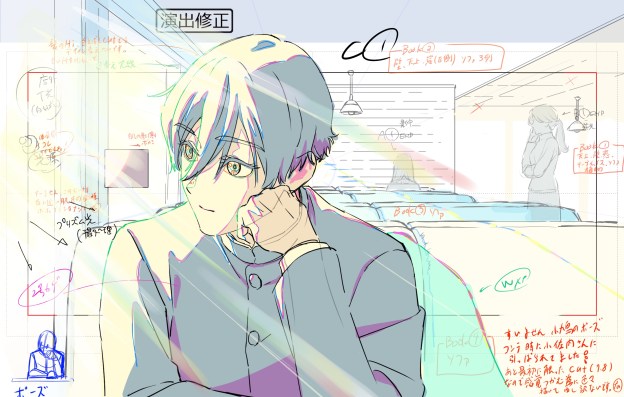
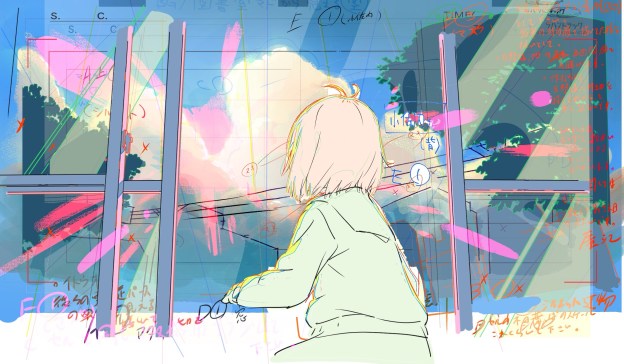
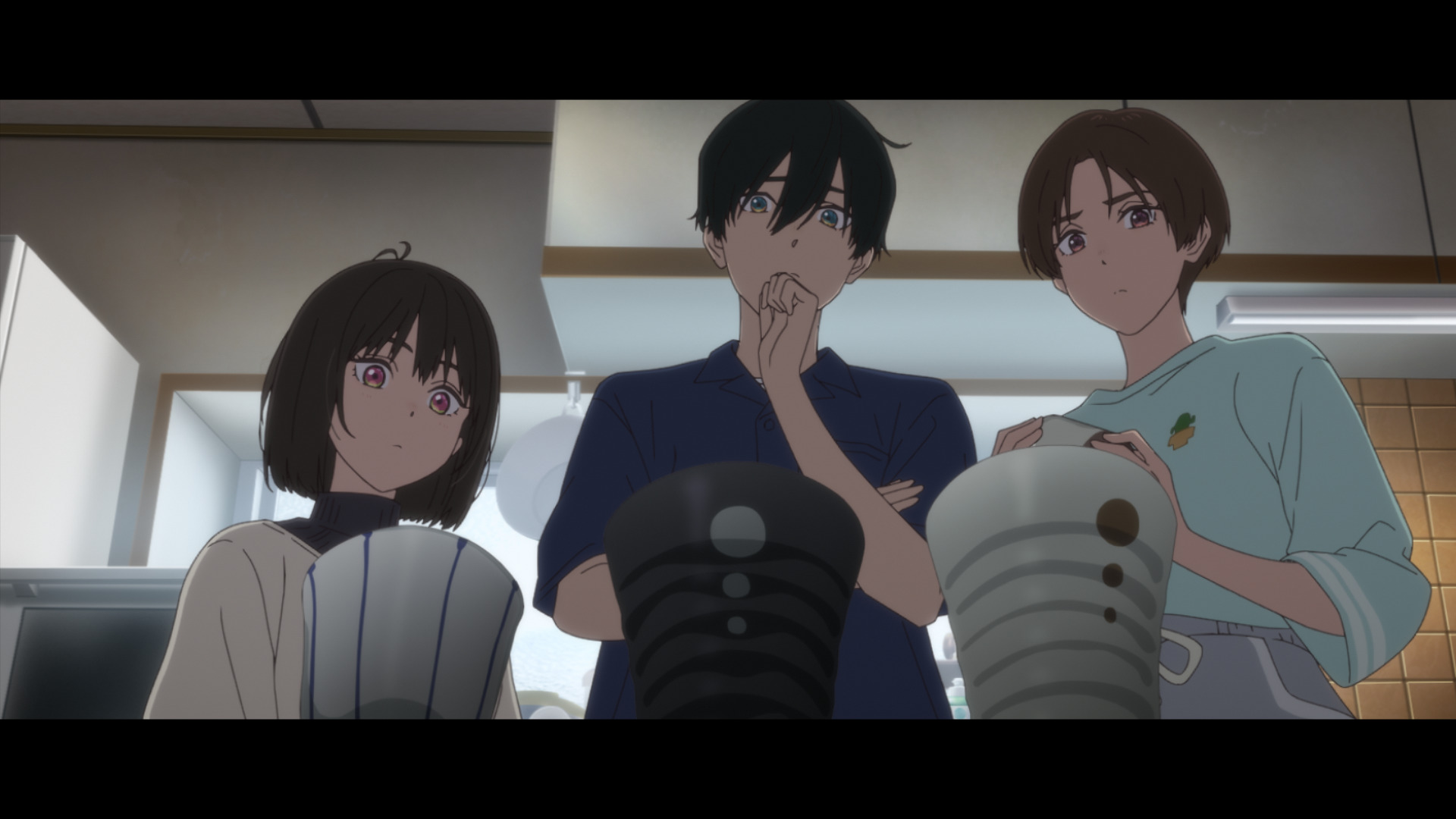
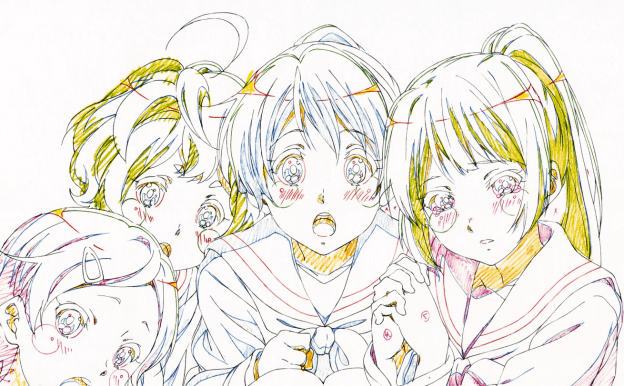
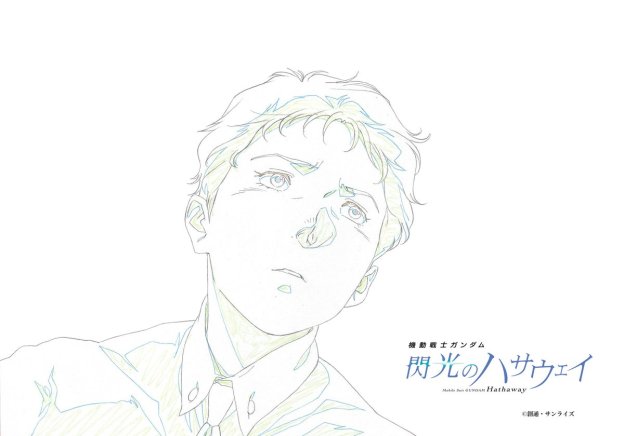
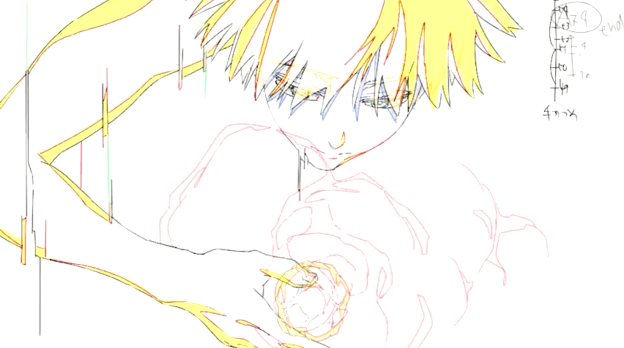
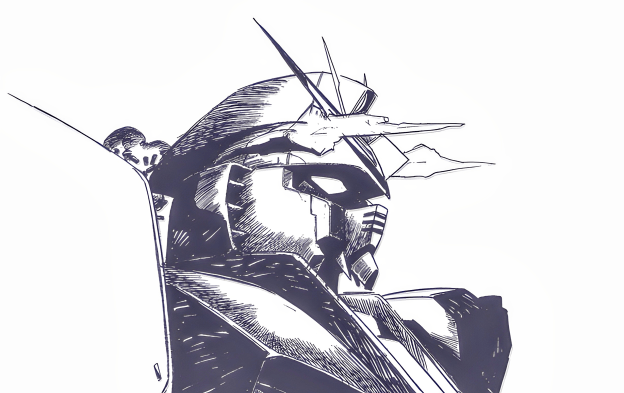
Original interview from Newtype (September 2024 issue), original interviewer: Haruyo Igeta; genga corrections by Keisuke Hiroe.
Since the music is used sparingly, the moment the main theme starts playing is very impactful
~ I put meticulous care into refining each and every sound ~
— What led you to become involved in this project, Obata-san?
I’ve always been familiar with the concept of ‘background music enhancing everyday scenes’, and I had previously worked together with director Kanbe on several projects in the same daily-life drama genre as this show. Because of that, I received an offer from producer Endo (Kazuki)-san. I am truly honored to have been able to work on the music for such a wonderful work.
— What were your impressions upon reading the original work?
At first, I thought it was just your usual school-drama, but the story of Kobato-kun and Osanai-san helping each other out in their mutually beneficial relationship, aiming to become ordinary, filled with enigmatic cases and a sequence of unfortunate events was something entirely different… I was shocked! (Laughs). The interactions between those two are charming and entertaining, and I was so captivated by them making such deductions that would easily put an adult’s to shame, that I ended up finishing all the volumes in no time!
— When producing the music, what did you pay particular attention to?
I wanted to use Celtic-like folk instruments for the main theme, and also put some vocals in it. The director instructed me that even if the setting was the suburbs of Gifu, a calm and quiet scenery with a serene river and a bridge, he wanted a slightly sharper component within it. While Kobato-kun and Osanai-san, who at a first glance appear to be ordinary people, are represented via the inclusion of the folk-like elements, in order to better suit the vision behind this work, I went through a trial-and-error process to compose the music, incorporating things like irregular time signatures and omitting a beat from the usual meter. While still retaining the idea of a peaceful suburban imagery, I paid attention to keeping intact the mysterious and enigmatic tone of the story. Additionally, I directly visited the real locations where the anime is set, and used the atmosphere I experienced there as a reference for composing the music.
— What kind of instruments were used in the soundtrack? Did you consider using different ones for each character?
While focusing on the idea of Celtic music, to convey the feeling of the suburban scenery I used instruments like a tin whistle, an ocarina, a 12-string acoustic guitar and a fiddle [most often a violin used for folk and country music, as opposed to classical and jazz] and depicted an imagery suited for this work. Additionally, I’m really fond of the bass clarinet, so I featured it in various tracks. During the recordings, I consulted with the saxophonist Suzuki Kei-san, and had him play in various styles depending on the tune—from low to high tones, including clarinet-like, bassoon-like, and free jazz styles. Also, this time, I thought up and composed the main theme with different instruments and arrangements to fit each character. For Osanai-san, while I used lovely and sweet-sounding instruments in the arrangement, in order to depict her inherent duality which we catch some glimpses of, I used two cello melodies layered on top of one another, with one of them eventually shifting in range to give the idea of two different voices playing at once. As for Kobato-kun, I opted for a straightforward melody. Since there are deduction scenes involving sweets, I was conscious of not making it sound too serious or stern. There are also tracks centered around instruments like the marimba and vibraphone. Additionally, the biggest contributor, who magnificently performed the main theme, is the amazing vocalist EUREKA REPUBLIC-san! Somewhere in her clear and pristine voice, you can feel a hint of mystery. I believe we were able to craft a musical piece in perfect harmony with this work.
— Which episode would you say left a strong impression on you, Obata-san?
A certain scene in episode 5. Originally, it wasn’t intended to use any music, but it felt a bit bleak so we decided to try and add a store’s background music-like track. I thought that adding a cheerful sound like the mandolin’s would have made Osanai-san cuteness stand out more, so I proposed the idea during the voice acting session. Discussing ideas like this with the whole team, we decided together what would have worked best for every episode. Director Kanbe told me that in this work, he didn’t want to use music very often, but for the scenes where he did, he wanted the tracks to play for nearly their full length. Especially in episode 1, since the music is used sparingly, the moment the main theme starts playing is very impactful, it was a new discovery for me as well!
— What were the enjoyable and interesting aspects of composing the music for this work?
Rather than picturing the show as a whole while writing the tracks, I’d say that thinking up each and every sound and composing one song at a time was a really nice experience, since it was a first time for me. Above all, the members of the stuff were all great people, heavily invested in the project, and I’m deeply thankful I was to work with them.
— Lastly, a message for the readers.
I hope that while watching this amazing work, Shoushimin Series, you’ll direct some of your interest to the soundtrack as well.
Original interview from Newtype (September 2024 issue), original interviewer: Haruyo Igeta; genga corrections by Keisuke Hiroe.
We have the visuals, so we should trust their power
~ A suggestive work that leaves room for imagination ~
— What were your feelings when you first came in contact with the original work?
I felt that the dynamic between Kobato and Osanai was really interesting, and that the fact that, despite being clearly eccentric people, they’re still trying to become ordinary had some cuteness and a hint of sadness in it. A subtle sense of humor is also distinctive of this work.
— Knowing you had to set up the script, what aspects did you pay particular attention to when reading the novel?
While I was reading it, I thought about how to portray the dialogue scenes and how to translate onto the screen the world as it was described in the text.
I’ve been doing this for a long time, so I suppose developed a certain knack for it. When it comes to a novel, the key is not just how well you grasp the main points, but how you shape them. As for the series composition, it’s also a matter of length and time, often the director asks what the of story is about in brief. Keeping that in mind, I start by outlining the essential elements that have to be included in each episode.
— What are those essential elements in Shoushimin Series?
The peculiar character dynamics, the setting and the atmosphere. I carefully ladled these elements out while imagining the scenery and flow of time in Gifu, the city where the story takes place. Also, there are fine and subtle expressions unique to the novel, so I carefully considered how to translate them into visuals as well.
— What instructions did you receive from the director?
Since it’s the third time I’ve worked with Kanbe-san, I knew that he, as the director, wouldn’t use narrators and monologues, and he would avoid conventional flashback scenes. This means that he values leaving room for imagination and not over-explaining things, and even if it made writing the script more challenging, I tried to abide to that approach. Not only the director’s, but considering everyone’s opinions, every week we met and discussed how to come up with thoughtful and appropriate depictions within the given limitations.
— When writing the script, how did you interpret Kobato’s, Osanai’s and Kengo’s characters?
Kobato-kun is the one I relate to the most. I too, due to the nature of my job, have a tendency to overthink things and end up placing excessive importance on my delusions, so I was able to understand how Kobato-kun’s thoughts don’t always line up with reality and how he gets overconfident when solving a mystery. As for Osanai-san, I don’t get her at all… that’s what I kept thinking while writing the script. Since the story is being told from Kobato-kun’s perspective, I believe that I too, from my position, could write it without fully understanding her and relying on my imagination. Regarding Kengo, I thought that I had a classmate like him in middle school as well. He’s an incredibly good person, and even if his personality is the opposite of Kobato’s, they’re a really charming duo. I wrote the script thinking that they might admire each other in some way.
— When delivering the mystery parts in the script, was there anything you paid particular attention to?
The moments when the main characters are stuck in the thoughts or when they feel like something’s off had to be portrayed properly. But at the same time, I gave careful thought to how to make those moments feel effortless and unobtrusive.
— Was there anything you gained, or any new things you discovered, from being involved in this project?
The fact that, even without extensive narration and even without over-explaining things, a story can still be functional and solid. Nowadays, anime and TV dramas tend to be overly talkative and overly descriptive, whereas this work goes completely against that direction, and both I and Kanbe-san are pleased that’s the case. We have the visuals, so we should trust their power. That’s the awareness you generally should have. But watching the works that are actually airing, the style of Shoushimin Series may feel surprisingly fresh.
— Touching on the highlights from episode 5 onwards, please, leave a message for the readers.
This work is a mystery, but that’s not just about the cases. The story is full of other mysteries as well: what it means to be ordinary, what’s going on in Kobato’s and Osanai’s minds, what they think about each other, whether and how their relationship is going to change… so I hope you can enjoy it by finding a mystery you like and making your own guesses about it. Also, it’s a mild work set in a very quiet town, but there are some unexpected developments coming up in the future and the relationship between Kobato-kun and Osanai-san is going to evolve, so I really hope you will look forward to that.
Original interview from Newtype (September 2024 issue), original interviewer: Haruyo Igeta; genga corrections by Keisuke Hiroe.
I hope it becomes something different from the usual
~ Incorporating new techniques to make this work’s world move ~
— Please, tell us the details on how you became involved in this project.
I received the offer directly from animation producer (Masakazu) Watanabe-san. Since the original work is a novel, adapting it into a visual medium is difficult, so my first reaction was: “What do I do now?”, I was perplexed (laughs).
— When you first read the novels, what were your impressions and your thoughts from the director’s perspective?
There were two points I felt I had to pay particular attention to when adapting it into an anime. First of all, the mystery approach that is crucial to this work. I thought I had to carefully depict the various elements typical of the mystery genre, such as the tricks and alibis. Second, the evolution of the relationship between (Jougoro) Kobato-kun and (Yuki) Osanai-san. I felt that that was the true charm of the story, so I had to portray it properly.
— Did you empathize with the characters or feel connected to them?
Upon reading the original work, my honest first impression was: “I really don’t understand these two”. It was while working on the storyboards that I gradually began to grasp what it was all about, and I felt my understanding of them deepened. I’m sure that (Toshiya) Ohno-san figured out a lot of things while writing the script, but in my case, I start to see things only in later stages. There are things you can only understand by actually getting your hands dirty.
— What kind of discussions did you have with Ohno-san?
We didn’t have very detailed or thorough discussions. We’ve already worked on several projects together, and this is our second mystery work. Ohno-san is good at grasping the concept quickly, so I trusted him and left it to him.
— Did you receive any specific request from Honobu Yonezawa-sensei?
When he said that “the novel and the anime are separate things” it left an impression on me. Also, we spent just one day scouting the locations together. In that occasion, I suggested making Kobato’s house into a traditional sweets shop, and he promptly approved of it.
— What kind of conversations did you have with character designer (Atsushi) Saito-san?
I think I just told him not to feel bound by the designs on the cover illustrations. Ultimately, I asked him to draw the designs based on the impressions he personally had.
— And what about art director (Akira) Ito-san?
Ito-san was busy and couldn’t participate in the location scouting, so I hand him over some pictures. It was an enormous amount, but he carefully inspected them and in the end, he became far more knowledgeable than us. Personally, I asked him to make the sky bluer than usual.
— In regards to the recording sessions, what kind of directions did you give to the cast?
Above all, I focused on asking them to speak in a whispery tone. I asked (Shuichiro) Umeda-san[Kobato’s voice actor] and (Hina) Yomiya-san[Osanai’s voice actor] to speak softly, almost as if they were in a quiet library. I wanted their acting to feel as realistic as possible. To the other voice actors, I asked to adapt to the atmosphere between the two [Umeda and Yomiya] and express themselves naturally.
— What did you discuss with sound director (Katsunori) Shimizu-san?
I’ve known Shimizu-san for a long time and I’m very familiar with him, so rather than the voice recordings, we talked more extensively about how to use the soundtrack. I wanted minimize the background music as much as possible… since it’s a dialogue-heavy work, I thought that the visuals would hold up well enough with just the dialogue alone.
— So, what kind of instructions did you give to composer (Takahiro) Obata-san?
At first, I thought it would have been a nice idea to make a couple of songs with lyrics and have them playing during the deduction scenes. After discussing this, Obata-san made a demo and it turned out to be so good that we ultimately decided to go with just that one song. He also incorporated elements of folk music and suggested using a 12-string guitar.
— You were in charge of the storyboard for episode 1. What were the key points you focused on, and what did you want to convey to the staff members who worked on the storyboards afterwards?
I had already decided to use the main theme song, so I made sure to draw the storyboard in a way the track would fit the climax well. Also, during dialogues, I made frequent use of a presentation technique where the location suddenly changes. For example, when in the mystery-solving scene Kobato reenacts the culprit’s movements. To prevent the dialogue-heavy drama from becoming tedious, I incorporated this technique as a unique element of this work’s presentation.
— Was there any idea from the other staff members that stood out to you?
Many ideas came up when writing out the script. From the order of the scenes to the ways of omitting or replacing the lines from the original work, I found myself thinking “I see” every time we had a meeting. I’ve acquired many great ideas from the people who were in charge of writing the script.
— What new things did you discover or gain from engaging in this project?
There are many things. The fact that using CinemaScope, which was a first for me, is surprisingly easy and convenient is one of them. I also think it kind of matches the atmosphere of this show. I experimented a bit this time, like with the technique to change the location in the middle of a dialogue, and I believe it turned out to be quite effective. I wanted this work to become something that differed from the usual imagery. I hope the viewers will notice in what ways it’s different.
— Lastly, a message for the readers.
From episode 5 onwards, this show becomes even more akin to a mystery. Especially between episodes 8 and 10, there’s a shift in the approach as the plot takes significant turns, so I hope you look forward to it. I also hope you’ll keep an eye on how the relationship between Kobato and Osanai evolves.
A one-week break between episodes 3 and 4, followed by the coming of August and thus my summer vacation that took me away from home for a couple of weeks, was a sequence of events that certainly didn’t help in retaining any semblance of the consistency this blog already lacked. What I did retain throughout the past month though, is my overflowing enthusiasm for this show (as those of you who follow me on Twitter are probably sick of hearing about) and naturally, it’s the last thing on my mind to give up on this series of blogposts breaking it down, no matter how behind schedule I am.
So, it’s with great pleasure that I finally present you with another instance of my ramblings about Shoushimin Series, this time covering episodes 3 & 4, Humpty Dumpty and Mind of a Lone Wolf.
Episode 3 – ハンプティ • ダンプティ: Humpty Dumpty
Right after the intro scene, which is already remarkable in itself and its successful approach to present the tension-filled classroom where Osanai and her fellow classmates are taking their exam, immersed in a diegetic silence with no background music in order to make the sound effect of the glass vase suddenly breaking stand out even more, we’re back to a very familiar scenery, one in which the emphasis on the layouts is the sole and most important visual trend.
Frame 1Frame 2
As episodes 1 and 2 got us well used to, in this show, presenting the differences (or the similarities, or even the boundaries) between the members of the main cast is a job best suited for the layouts. The way the characters are framed in relation to one anther (or to the background and foreground elements) almost always encodes a subtle description of themselves or their relationships. This much was true throughout the course of the first two episodes, and while unsurprising, it’s still surely a delight to see the same visual trend being brought over to episode 3.
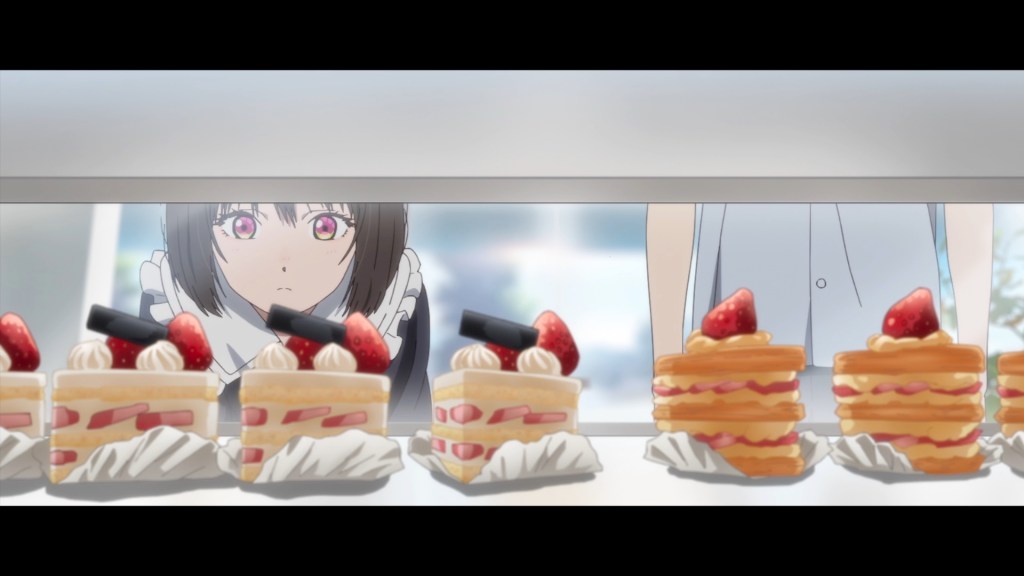
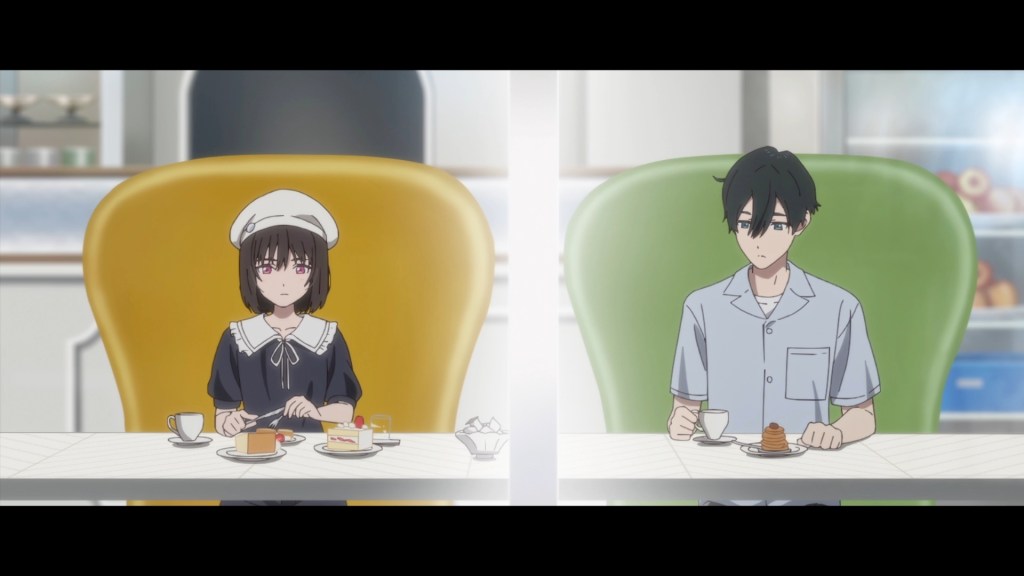
For example, both Frame 1 and Frame 2 effectively convey who, between Kobato and Osanai, is more fond of sweet foods and desserts, each one in its own way; for instance, in Frame 1, only Osanai‘s face is showing, directly staring at the cakes, and not only the number of sweets is larger on her side of the frame, but the cakes themselves look more elaborate and full of sweet ingredients compared to the ones on Kobato‘s side. Frame 2 on the other hand, takes a more direct approach, “physically” separating the two characters with the frame of the window in front of them (also using different colors for their seats), and making it clear at a glance whose order on the table is more substantial and overflowing with sugar (it’s also a nice detail how the bowl seemingly containing milk pods and the sugar for their drinks is, too, on Osanai‘s side of the frame).
Albeit not focused on distinctions and symmetries, the next sequence as well, when Kobato temporarily leaves Osanai alone at Humpty Dumpty to retrieve his smartphone from the locker in his classroom (as well as to investigate the truth behind this episode’s first case), features a layout-focused presentation that struggles to feel uninteresting, immersing Kobato inside the environment he’s intent on exploring.
If there’s something I love when it comes to visual-oriented storytelling (perhaps again thanks to Hyouka’s incredible direction in a similar circumstance), is when the passage of time, even if trivial, is left untold in the narrative and it’s instead conveyed through visual elements or small changes in them. There are obviously several “levels” to this, the most common and coincidentally least interesting one being a change in the lighting suggesting, for example, the transition from afternoon to evening with the sky turning red. Shoushimin, on its hand, handles it with a more sophisticated (and thus more subtle) technique, that is, showing us a still shot of the cakes on Osanai‘s side of the table as soon as Kobato gets back to the sweets shop. What such a shot has to do with the passage of time is pretty straightforward: the three plates in front of our gluttonous yet minute girl still have each a piece of cake on top, and more importantly, they’re completely different cakes from the ones she was eating before Kobato leaved earlier, implying enough time has passed for Osanai to finish up her previous order and make a new one (and, if it wasn’t clear enough already, that she really, really likes sweets).
As a side-note, the still shot also follows Kobato‘s movement directing his sight to the cakes, somewhat implying that he too was noticing this same detail.
Frame 3
Frame 4Frame 5
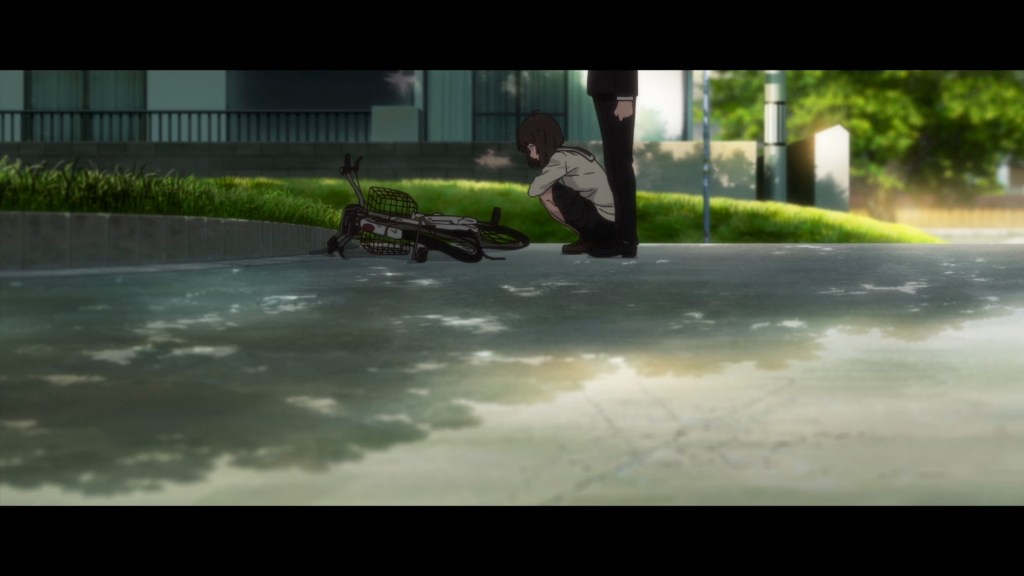
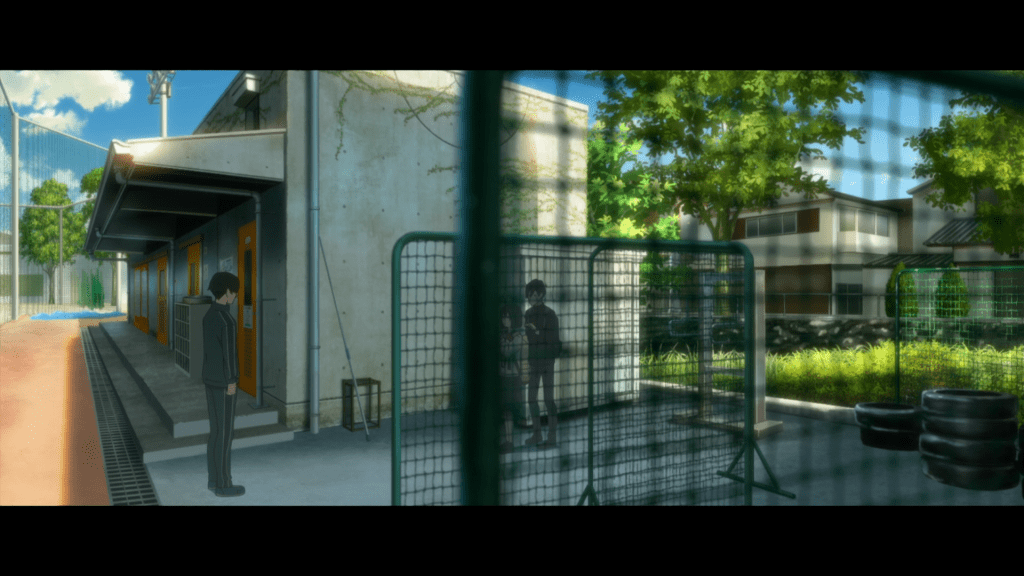
Moving on to the second part of the episode story-wise, we’re greeted with yet another strong showcase of expressive framing. The one I personally find the most interesting and clever is Frame 3; when our two main characters are chasing down Sakagami right after spotting him riding Osanai’s stolen bicycle, the moment their target becomes unreachable, the way the two pursuers are framed remarks their physical inability to go any further, complementarily to them actually stopping and talking about it. The fences in the foreground literally block Osanai and Kobato‘s movements, completely covering their bikes as well as the lower half of their bodies (i.e. their legs), making it extremely clear to the viewer that they are forced to stop there (and additionally conveying a slight sense of frustration and powerlessness).
The later instances, like in frames 4 and 5 (after the two figure out exactly what the culprit’s movements were, with Kobatoimpersonating him in a similar fashion to how episode 1 and 2 tackled the visualization of the characters’ thought processes), involve a strong use of negative space. In Frame 4 for example, Kobato‘s upper half is cut off, and only Osanai and her broken bike fit in the frame. Frame whose proportions feel odd and unbalanced, purposefully so, in order to gradually portray the sense of unease surrounding Osanai‘s mental state in regard to the unfortunate situation she’s unwillingly part of.
It’s noteworthy how, from the moment out sweets-loving girl starts to progressively show her true colors, an increasingly deeper sense of distance is implied by the storyboard (and by extension, the derived layouts) as Kobato and Osanai are almost never framed together, and when they are, they’re never placed on the same layer of depth.
Frame 6Frame 7
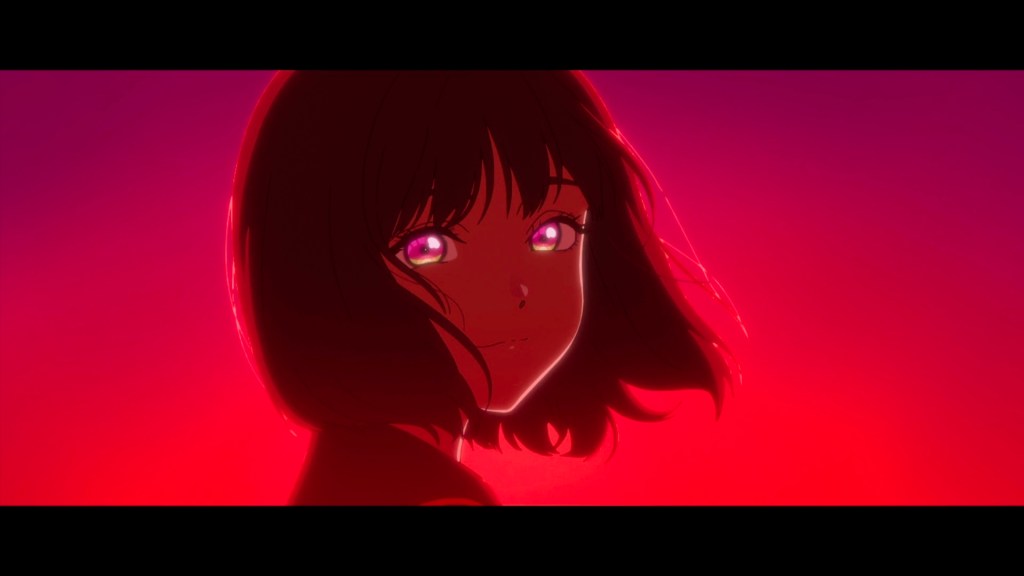
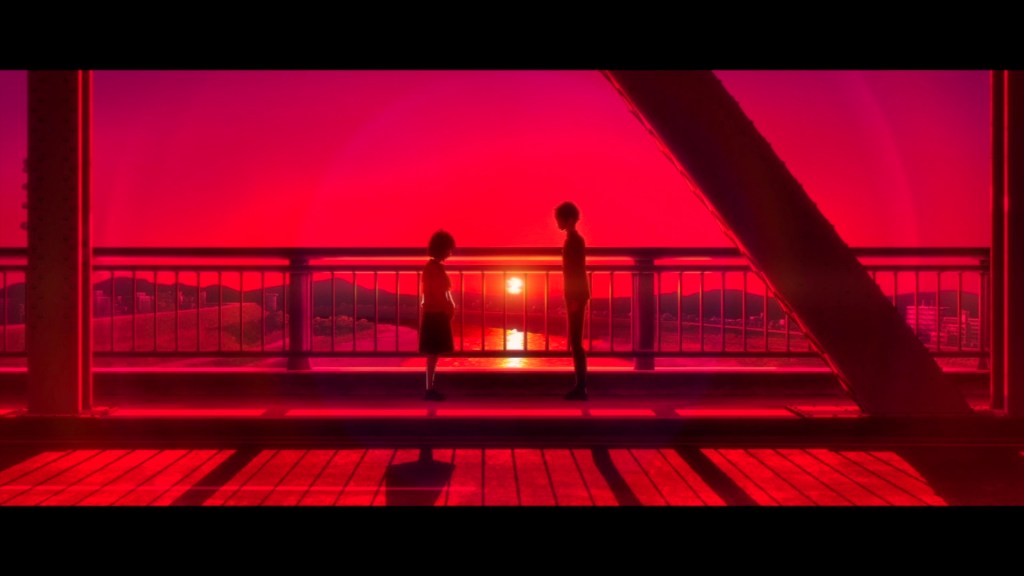
Talking about the true colors, the trope introduced right in the first episode of presenting the character’s mental spaces as physical manifestations is used once again, this time in a slightly different manner. What feels the most jarring here is not the spatial dislocation, but rather, the chronological one, as the blood-red colors of the sudden sunset that pervade the entire sequence instill a feeling of danger and fear throughout the scene (and are particularly successful at doing that thanks to the incredible color coordination work by Tomomi Kato and the photography at play). We, including Kobato, as hinted in Frame 7 that he is the foreign presence, have clearly been transported into Osanai‘s own mind, and are finally able to catch a glimpse of her true nature; or in other words, what restrains her from being a full-fledged “ordinary person“.
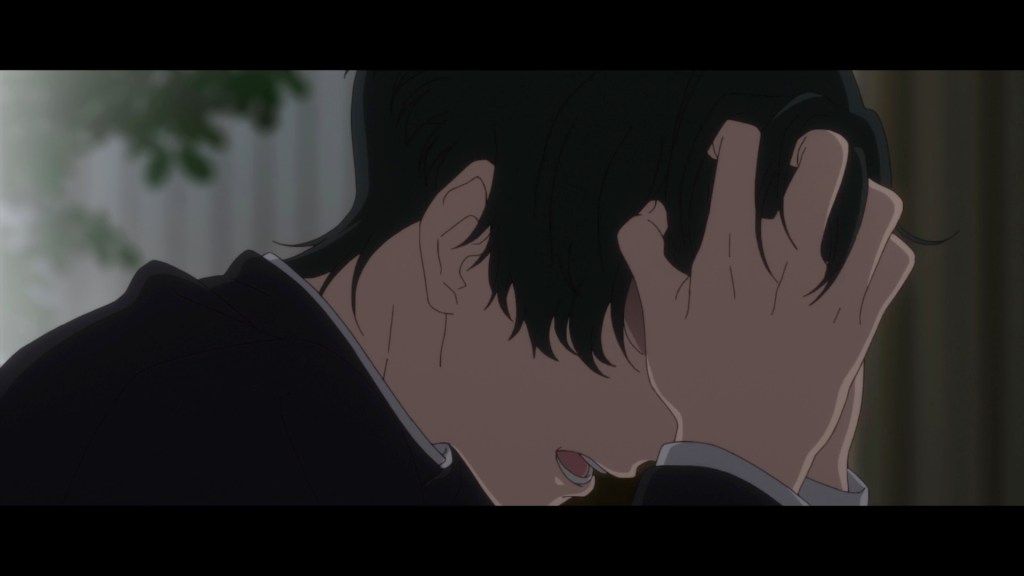
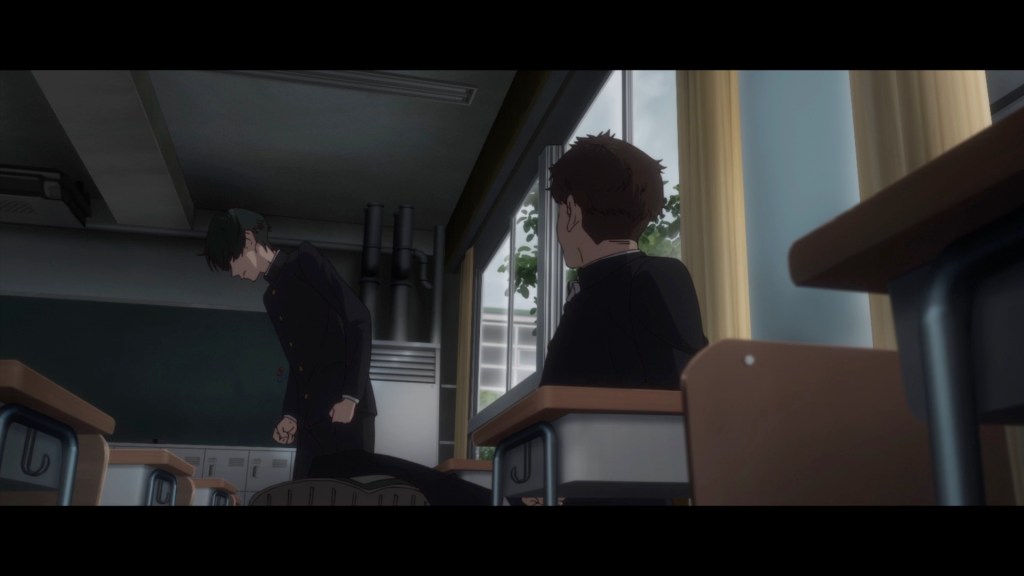
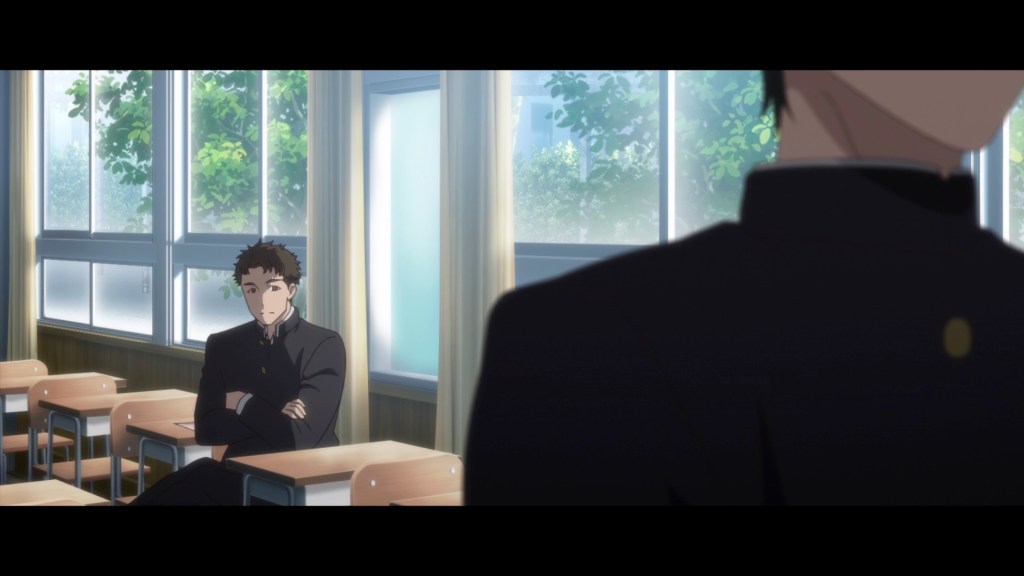
Before wrapping up, I can’t fail to mention how thorough and genuinely expressive the character acting has been all throughout the episode, especially so during the last sequence when Kobato is exhibiting his own discomfort to Kengo. This, paired with the incredibly polished and detailed drawings, allow this series to showcase its characters’ emotions in an essentially natural way, without falling into an overly dramatic presentation, retaining in fact the very grounded and heartfelt pragmatism central to the vision behind this adaptation.
One last neat detail worthy of mention is the use of the environment and weather to describe Kobato‘s feelings; as his mind gets clearer thanks to the exchange he had with his old friend, the cloudy and moody sky turns clearer as well, drastically lightening the tone of the scene. Although it’s by no means an innovative trope, the beautiful execution makes for a perfect conclusion to yet another amazing episode.
Episode 4 – 狐狼の心: Mind of the Fox & the Wolf
After the aforementioned one-week break, continuing directly from where the last episode left off, episode 4 begins in Kobato and Kengo‘s classroom, and it traps us there with the two of them for nearly the entire 23-minute runtime. A deliberate choice for sure, one that finds its reasons in both a specific directorial approach and a cost-efficiency need.
It might not be perfectly appropriate to call episode 4 as a whole a “bottle episode”, since, especially in its later phases, the location does change a few times and other characters make their appearance. However, in the first two-thirds of the episode, we’re presented with a continuous back-and-forth of similarly framed shots and cuts, depicting just the two friends more or less intent on finally piecing together this story-arc’s main case. Meticulously abiding by the 180-degree rule, this long-lasting exchange of questions, answers and theories is surprisingly able to keep the audience (or at the very least, me) engaged all throughout, despite nothing really happening during these 15 minutes we spend with Kobato and Kengo exclusively inside their classroom, with the exception of a specific instance that I’m going to adequately address later. In addition to being a successful visual approach, it’s also a relatively low-cost one at that, as it’s somewhat noticeable that the drawings look ever so slightly less polished than usual, and setting up the whole sequence to bounce between homogeneous shots like this helps mitigating the potential inconsistencies and irregularities a seemingly lower-budget episode might be subject to.
Overall, the usual visual theme of symmetry was also at timesfeatured throughout the episode, not prominently so, like in the previous ones, mostly due to a lack of necessity to convey yet some other details about the characters’ relationships, which are already well established by now.
The “particular exception” in the setting I mentioned earlier was, as you might have guessed, the physically abstract visualization of the characters’ minds we’re extremely used to at this point. Much like last episode’s, this scene too takes a slightly different approach compared to its predecessors; in the previous iterations, the locations where the characters were figuratively transported to only served a purpose in deallocating the mental processes from the physical world, creating a sense of immersion and isolation as I’ve already discussed in my previous blogpost, and as far as I could tell, had no intrinsic meaning inscribed into them. This time however, a strong emphasis is placed on the “movements” occurring inside this ephemeral space. Specifically, Kobato‘s interaction with the spiral staircase has a rather distinct symbolic utility. He’s the only one of the two who’s willingly and steadily climbing up the staircase, getting closer and closer to the solution, implying that between him and Kengo, he’s actually the only one who’s actively engaged in the thinking (as Kengo‘s body language also seems to suggest).
What I liked the most about this sequence though, was the implied continuity between the abstract space and the real world, as Kobato‘s movement starts on the metaphorical overpass and ends in front of the blackboard, back into the classroom. Not only it greatly improves the fluidity of the scene, but it also establishes a clear connection between the two worlds maintaining the same focus as earlier, set on the physical motion.
I believe this time, the real potential of these conceptual sequences was truly, fully realized, making the scene feel even more compelling and captivating than usual, not only in its presentation but also in the contributions it made to the actual narrative.
Frame 1Frame 2Frame 3
As a closing note, another scene towards the end of the episode that caught my eye, is the one where Kobato and Osanai are having a very high-pressure talk about their promise. Having both broken their vow to become ordinary people in some capacity over the course of the last few episodes, the future of their relationship as it stands now is precarious and unstable, and both of them feel somewhat uneasy about their recurring lack of abidance. This scene does a masterful job at conveying such palpable intensity, making use of increasingly tighter and suffocating camera angles, relentlessly stitched together until the discussion reaches its climax with the extremely close-up shots on the characters’ eyes (frames 1 and 2). It’s only when the two finally reach a satisfying conclusion that all the tension is promptly released in a wider, more spacious shot (Frame 3).
Putting to good use the various visual means animations has to offer is a non-trivial task, and Shoushimin Series has proved once again its inherent ability to do so.
Despite how late I am posting this commentary, I hope I’ve managed to offer some interesting insights nonetheless. There are always so many details and cues embedded in this show that I don’t think I’ll ever run out of things to say and point out in these breakdowns. My schedule is a bit tight right now, but I’m really looking forward to write about episodes 5 and 6 next!
It’s 2014, I’m a middle-school student and on my journey getting into anime I stumble across KyoAni‘s adaptation of Hyouka. Aside from its contents, which I’m still deeply attached to to this day, it’s exactly this show that years later (that is, a few years ago) got me interested in the production of Japanese animation as a whole, or to put it into the right, narrower context, in the “technical” aspects of it, such as storyboarding or direction. Hyouka being a masterclass example of both these things certainly helped, but who I really need to thank for getting me into this world of carefully designed visual exposition, is one of the creators whose content has taught me the most and has changed the way I engage with anime altogether: Replay Value. Specifically, with his Hyouka breakdown series, A Rose-Colored Dissection (which, of course, I encourage everyone who still hasn’t to check out).
Given how influential of a work it’s been for me, I’ve been thinking of writing a series of posts about Hyouka ever since before getting started with this blog, but for now it’s gonna remain an idea, as I think it would end up being just a (probably worse in exposition) repetition of what Replay Value has already done on his hand. Instead, what I’ll be doing today, trying to retain a semblance of consistency with the format I’ve already used with Kusuriya no Hitorigoto a few seasons back, is a commentary of the new anime series produced by studio Lapin Track, directed by Mamoru Kanbe, Shoushimin Series (localized as “SHOSHIMIN: How to Become Ordinary“).
Why the preamble on Hyouka then? Well, aside from my desire to address the biggest inspirations that led me to do what I’m doing, Shoushimin too is an adaptation of a novel by the pen of Honobu Yonezawa, and although I initially didn’t want to compare it to Hyouka, afraid that making such a connection would feel somewhat forced due to my (heavily) biased attachment to the latter, one episode was enough to hit me with a wave of nostalgia thanks to the intrinsic qualities unavoidably inscribed in its writing, that I couldn’t help but bringing it up anyways. What I was not expecting to see though, were the same idiosyncratic visual quirks (albeit in a different capacity) that made me fall in love with Hyouka (and by extension, animation) years ago. To be clear, I’m not implying nor meaning to say that the direction of Shoushimin Series has been influenced by Hyouka‘s, nor that they’re trying to replicate it in any way (in fact, I’d argue the two approaches don’t really have all that much in common). Instead, what I meant to say is that Shoushimin too is filled with expedients of visual storytelling, be it via clever framing or a descriptive use of light, that make for a perfect subject for my blogposts.
Well then, here I am, ready to bother you, dear reader, with my inconsistent ramblings about what I can already tell will be one of my favorite media experiences of the year, the Shoushimin Series anime adaptation.
Episode 1 – 羊の着ぐるみ: Sheep Costume
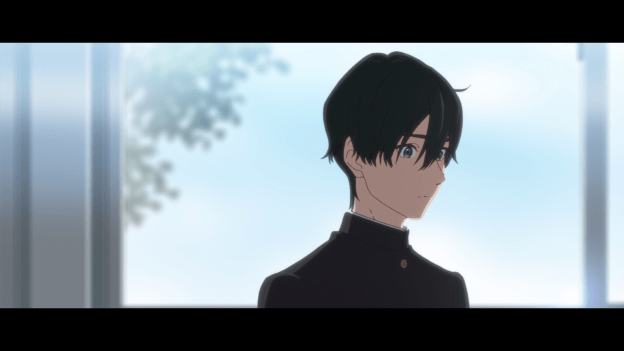
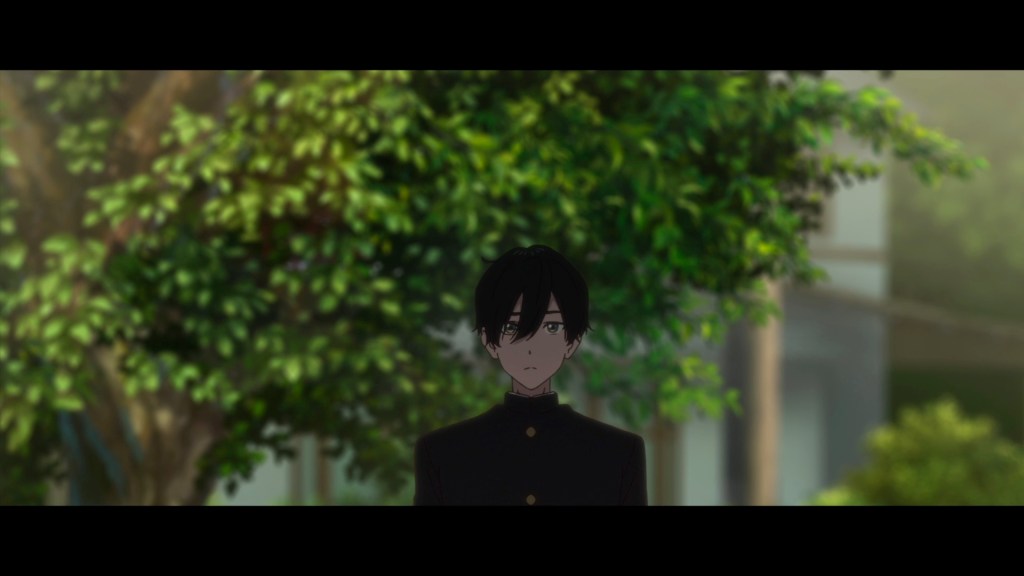
Right off the bat, I’d like to address some general “visual qualities” and features I noticed, like how, with good and refined drawings, the (purposefully) rather simple and malleable character designs by Atsushi Saito were delivered in a very expressive way, well capable of conveying the broad range of emotions exhibited in this premiere. (Literally) on top of that, the compositing also did a fairly good job at integrating the digital “cels” with the realistic backgrounds, making at times use of additional effects to render the scenes in a more true-to-life fashion (like blurring out the objects that are closer to the camera), or more deliberately, to convey a sense of “isolation” or “separation”, like with the fully blurred background in this shot. The color design in general, opting for a properly muted palette, also helped in setting the tone of this story, suggesting on his hand too the overall focus on the mundane.
Another visual feature, albeit not descriptive of the contents of the show, that’s pretty much impossible not to notice since the very beginning of the episode (including the visuals for the opening!) is the 21:9 aspect ratio, as opposed to the nowadays standard 16:9. It’s by no means an “unprecedented feature” in anime or anything on that level, though, it’s still pretty nice to see a TV show almost fully (as the ending visuals will go back to the now-traditional 16:9) committing to it.
Another aspect worth of mention, this time not related to the visuals, is the sound design. With the focus mainly set on reproducing accurate background and ambient noises, the degree of immersion this episode was able to achieve was rather high. This is to say, the well-designed sound effects and the softness (or in some instances, lack) of the soundtrack really helped making the depiction of the world, and the interactions the characters have with it, feel more concrete and grounded in reality.
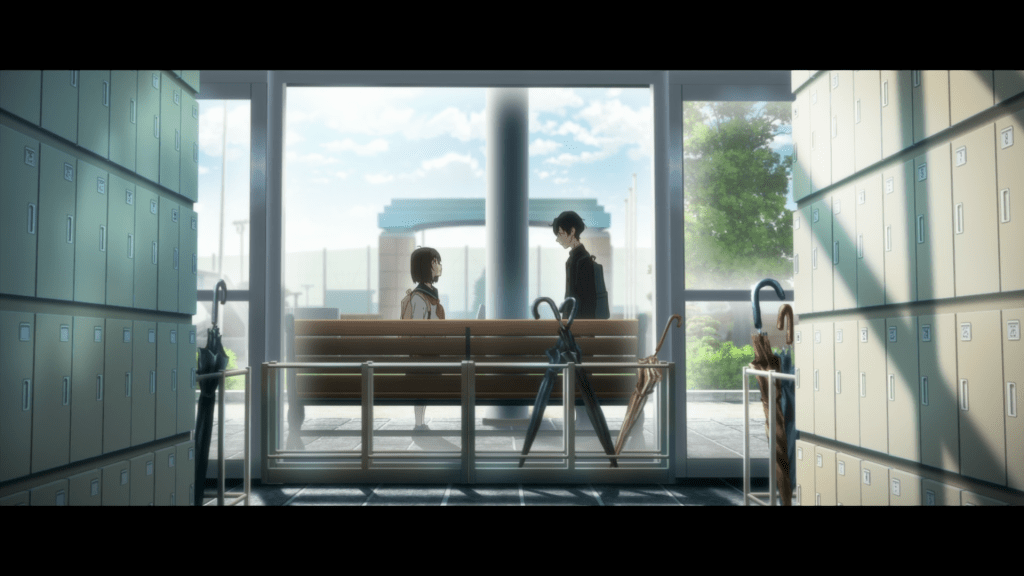
Frame 1Frame 2Frame 3
The main highlights for me were of course the many instances of visual storytelling present throughout the episode, which, by extension, I’d say suggest a broader approach to the direction of this show as a whole.
A lot can be inferred solely from a visual standpoint on the relationship between the two main characters, Osanai and Kobato. The way they’re often laid out, being parallel to each other in a frame whose space is equally divided by some element in the background or foreground (like in frames 1 and 2), implies some sort of contrast between the two, but not in a dichotomic way, rather, in a symmetrical one. As the episode makes clear in its later phases, the two of them are bond together by their mutually shared dream of “becoming ordinary”, which manifests in different but cohesive ways; they strive for the same goal, but they do have their own preferences and identity (for instance, Kobato not being fond of sweet food contrary to the gluttonous Osanai, a characteristic noticeably showcased by the striking difference in their orders in frame 1), which ultimately result in a different approach towards their objective. In other words, their symmetry implies complementarity, not contrast, to one another.
It’s when such visual equality is missing (like in frame 3) that the implications change, and the meaning shifts to another layer, like depicting the difference between being “in the light” or “in the dark” about the solution to a certain hazy case.
Frame 4Frame 5
Another type of clever framing and layout at play in this episode, certainly is one that implies actual “disconnection” or “distinction” (as in the case of frames 4 and 5). Uneven spacing and positioning in the frame, in addition to a feeling of unease and tension, convey a clear sense of distance that serves to delineate the sharp separation between the two parties, as well as the cohesion of one of them (namely, Kobato and Osanai).
What to me captured the eccentricity of this show’s direction the most, was undoubtedly this whole sequence (which the video above shows just the last portion of), basically, the “unraveling the mystery” sequence. While Kobato is explaining his theory for what had actually happened to Osanai, as the two walk home after having reached a conclusion with the interested party (the “thief”, Takada), we’re shown a visualization of Kobato‘s thought process with him “physically” retracing the culprit’s movements and actions. The sequence then ends with the portion attached above, that is, a compilation of disconnected cuts showcasing the two main characters talking, ultimately stating their will and promise to live as “ordinary people”, and making a little detour to the river on their way home. This a-spatial and a-chronological visual presentation effectively succeeds in feeling immersive and compelling, and in a sense prompts the viewer to actively engage with the scene, rather than experiencing it passively.
I’m calling it a “distinct trait of the direction” because as we’ll see in a moment, the very same peculiar approach is present in the second episode as well, and moreover, this way of presenting the story and the characters’ interactions is totally original to the anime (as one could probably correctly guess), and no trace of this “disconnected” exposition is present in the source novel (which, by the way, I couldn’t help but start reading).
Before jumping into episode 2, I’d like to mention how clever and, more importantly, well-realized of an idea the ending visuals are. Basically, what we’re looking at is a seriesoflive-actionphotos (albeit with some touch-ups) which the hand-drawn characters move in and interact with, as to once again convey how grounded in reality this whole setting is. On top of looking very nice, I believe it’s neat how every (visual and not) aspect of this show serves a purpose in realizing the well-defined vision behind this adaptation.
Episode 2 – おいしいココアの作り方: How to Make Delicious Hot Cocoa
Starting off in the strongest possible way to maintain the sense of realism established in the first episode, episode 2’s introduction takes place in a beautifullycrowdedshopping gallery, where the incredible lighting and (again) the very well-designed background sounds really make the already immersive setting feel as grounded in reality as it can possibly be. So grounded that in fact, following the steps of the previous episode, the locations where the events unfold are actually real places.
Some other of the aforementioned visual qualities have also naturally been brought over to this episode too, like the super pretty drawings once again putting to good use the ductile character designs, and the wide spectrum of emotions properly portrayed on the characters’ faces (and notably, the narrower aspect ratio is of course still here as well!).
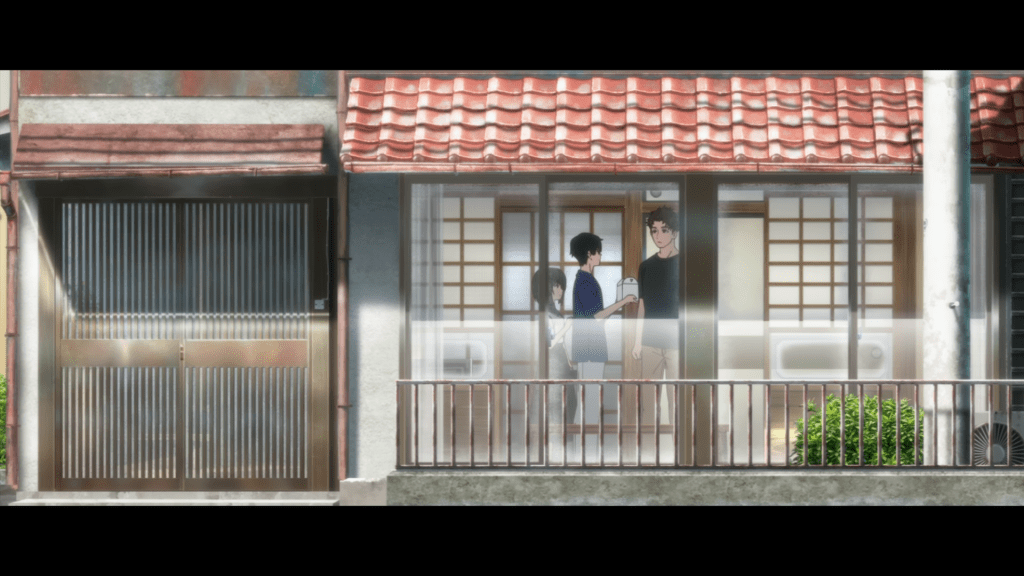
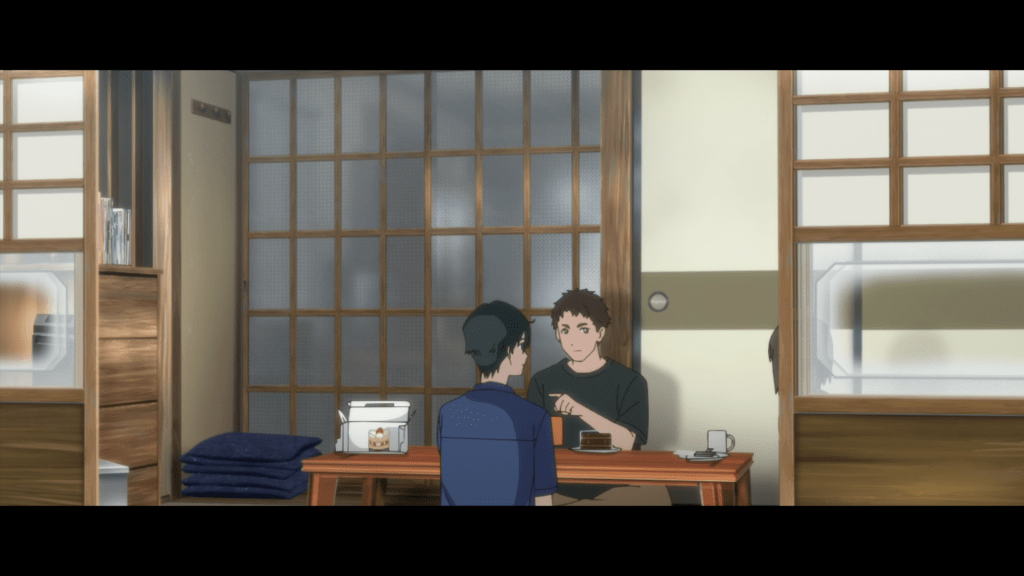
Frame 1Frame 2Frame 3
What I’m most happy to see again though, is obviously the same approach to express and convey in a visual way. In contrast to the first episode, it’s not background elements that draw lines between the characters, rather, this time, the background as a whole and its layout become means to define the boundaries between them.
It’s especially clear that Osanai kind of feels out of place visiting Kengo‘s, Kobato‘s friend, home. Frames 1 and 2 intelligibly hint at that, “encapsulating” the characters inside pre-defined portions of the background, and while Kobato and Kengo fit in the same space, Osanai is the only one that’s not entirely enclosed within the same physical limits. She’s also almost forcibly brought into that same space by Kobato, abruptly so (as the quick shift from the more far away to the really close-up view strongly suggest) with him taking the box with the cakes straight from her hands and offering it to Kengo.
As the two friends begin to talk, it’s quite noticeable how in frame 2, compared to frame 1, Osanai is growing more and more distant from the two; whereas in frame 1, just a small portion of her figure didn’t fit in the same area as Kobato and Kengo, now it’s only that very small portion that’s able to fit in, while the almost entirety of her body finds itself to be out of that boundary. Moreover, not only she’s practically in a different space than the two, she’s also nearly fully covered by the sliding door, as to indicate she’s more of a background presence than a foreground one in the scene.
The frame that does the best job at conveying the character’s “affiliations” with one another, and by extension their division, is definitely frame 3. Not only Kobato and Kengo are again the only ones to fit into the same space together (in this case, the reflection on the mirror) with Osanai being the one that’s now totally left out of it, purposefully placed in the farthest right corner of the frame, but the layout also suggests a broader outline on how the characters are grouped together. Dividing the frame in two sections, the inside the mirror and the outside of it, Kobato is able to fit in both at the same time, with his upper half in one and with his lower half in the other, designing him as the “common ground” between the characters; the mirror reflection contains Kengo but not Osanai, and the outer portion of the room contains Osanai but not Kengo, and Kobato is part of both.
The visual themes of “separation” and “division” are again extensively present throughout the episode, although in a formally different flavor, one that’s nonetheless still able to retain the same level of expressiveness and clarity.
As expected (and not only because I’ve hinted at it earlier), when the characters are putting their efforts into solving the (extremely mundane and unimportant) mystery, the presentation heavily relies on spatial and chronological dislocation, once again also exhibiting their thought processes and theories as a visualization of them actually acting as the culprit.
There’s something so beautifully dissonant in the sudden changes in location and time, especially as they happen without interrupting the flow of the dialogue, almost as if the “outside” is sort of a private, ethereal space, solely dedicated to the more introspective moments inside one’s mind. As they delve deeper into their abstractions and thoughts, they’re transported in another dimension altogether. The characters being in the same headspace is no more just a figurative image, instead, it manifests almost as a physical phenomenon. I certainly can’t say I’ve experienced other visual presentations of the same concept as eccentric and compelling as this one.
Another aspect of this episode I cannot possibly fail to mention, is the overall focus on body language and mannerism, depicted with such an utterly great accuracy that it truly feels real and heartfelt. The cut above is of course not the sole instance of that, many more examples, including Kengo‘s nervousness to introduce the uneasy topic of the conversation he wants to hold, and Kobato intimately sliding his finger on the border of his cup, are featured here and there all through the episode. Yet another quirk to make this world and characters feel vivid and real.
Lastly, a noteworthy element is the incredibly solid attention to detail when it comes to physical interactions with objects. It’s not every anime’s feat to make you feel the density of every single layer of a piece of cake as a character’s tries to cut through it. And not only that, incredibly accurate fluid animation seems to also be a given throughout this episode. It all makes perfect sense though, since the main topic of episode 2, as the title doesn’t try to hide in the slightest, is the not-so-secret preparation of a delicious cup of hot cocoa.
Hopefully, I was able to convey in this post even just a tiny bit of all my enthusiasm towards this new series, in addition to providing some maybe-interesting insights about its presentation. I was really anticipating Shoushimin since the day it was announced, but I would have never guessed it would hook me to this extent. It truly encapsulates everything I love about animation as a medium, and having a place (that is, this blog) to extensively talk about it really feels like a blessing to me.
Needless to say, I can’t wait for the next episodes to come out, and I’m sure they too will be filled with cool and neat stuff, well worthy of being written about.
Original interview from Febri, published in two parts, Part 1 on July 4th 2022 and Part 2 on July 6th 2024 titled: “「The Final Movement」that carefully depicted Kumiko’s story『Hibike! Euphonium 3』Director Tatsuya Ishihara Interview”, original interviewer: Daisuke Okamoto; genga from Hibike! Euphonium Season 1.
Part ①
The third season of the youth orchestra anime series “Hibike! Euphonium” (hereafter, just “Eupho”) has reached its final episode. This season focused on the struggles of Kitauji High School Concert Band club president Omae Kumiko, pursuing the long cherished dream of winning the gold prize at the nationals. Mixing in the many characters’ own stories, the series’ final movement ties up Kumiko’s three years of high school. Now that the show has finished airing, Febri had the pleasure to welcome in series director Tatsuya Ishihara, to speak at length, in two parts, about the thoughts and feelings he poured into the final movement. This first part covers the structure, direction and animation of all the 13 episodes.
~ Kumiko has “lost the battle but won the war”. ~
— At the time of this interview, the final episode hasn’t aired yet. What are your feelings at this point?
Actually, I’m still assiduously working on it and to be honest it’s taking quite long (laughs). Anyways, over the past 10 years of production, I’ve been going back and forth between the real world and Eupho’s world, so in a sense I have a feeling that the latter is about to end and disappear, which makes me feel both really moved and deeply desolate.
— I’d like to look back at all of the 13 episodes of season 3 and talk about them. As for the overall structure, the first half depicts Kumiko’s struggles as the club president, and the second half delves into Kumiko’s inner mind.
Focusing the second half on Kumiko’s story was an idea of scriptwriter (Jukki) Hanada-san. The overall flow in the anime has been adjusted a bit, such as moving the episode on (Tsukinaga) Motomu’s family problems, which in the original work happens a little later, in the first half. After all, it’s the “Final Movement”, so I too felt the same way about wanting to properly focus on Kumiko’s story at the end.
— In this season, the presence of the new character Mayu Kuroe has also become a topic of discussion. What kind of person did you think Mayu was?
Even if she’s Kumiko’s rival, their personalities are not completely opposite, so for Kumiko, she’s like a mirror image of herself. In an analogy to a role-playing video game, I think Kumiko has steadily leveled up and, by working hard has acquired a lot of good equipment. And when it was finally time for the last boss battle, who appeared was a boss with the exact same equipment as hers, but also slightly stronger (laughs). That’s the impression I got from Mayu’s character.
— Mayu was also the one who determined Kumiko’s future and career path.
That’s right. In the original work, Kumiko isn’t able to win over Mayu until the very end, but in the anime, we altered the final development of the original work so that their relationship evolves in such a way they ultimately respect and acknowledge each other.
— You mean the result of the final audition in episode 12, right?
Yes. To the fans who have read the original work, it might have been quite a surprise. However, for Kumiko, although she lost the battle called audition, in return she gained the powerful weapon known as Mayu, so to me she “lost the battle but won the war”. Since the moment she became the club president, rather than Kumiko growing as a player herself, I believe her leadership of the club was the aspect that grew stronger, so we made the ending even easier to understand.
— When portraying this kind of relationship between Kumiko and Mayu, was there anything you particularly focused on?
To Tomatsu Haruka-san, who played Mayu, I asked to act “giving off a gentle motherly feel”. There indeed is the aspect of her being Kumiko’s rival, and she does have a bit of a dark side to her too, but fundamentally she’s a caring and kind girl. I wanted the viewers to like Mayu, and I tried not to make her appear as an unpleasant girl.
~ I want to believe that Kumiko and Reina are still connected even after graduating. ~
— On the other had, how do you feel about the relationship between Kumiko and Reina that was portrayed throughout the series, director Ishihara?
I think the viewers should interpret it as they wish, but I personally believe they are complementary to each other. They’re two people with family backgrounds, talents, personalities and tastes that are completely different, so even if their connection through music were to be severed, I don’t think it will matter that much. Moreover, Kumiko became the Concert Band club advisor, so she and Reina still share the fact that they both have jobs related to music. I imagine their relationship is still ongoing even now, and I want to believe so.
— I see. This “future path” aspect was also an important theme of this season.
It’s something every high school student worries about. I personally decided early to get into the anime industry, so I don’t remember worrying about my future that much. Therefore, I can’t quite sympathize with Kumiko’s worries on this… I’m sorry (laughs).
— That being said, I believe there are many people who are able to sympathize with Kumiko.
I think you’re right. But even someone with so little sense of self-direction like Kumiko was able to grow into a proper adult, so I’m sure it’ll be fine. I’m sure Hazuki too was able to become a wonderful preschool teacher, so you’ll find your own path eventually.
— Well then, by episode 12, one part of Kumiko’s story has come to a conclusion. What scene was the most impactful to you so far?
The last scene of episode 12 was really impactful. That’s the climax of Kumiko’s drama, and I wanted to portray it with more care than usual. Also, personally, I really like the scene (in episode 7) where Kumiko and Hazuki attend the university information session, and then have a talk at a cafe drinking melon soda or something. Between the many serious scenes and episodes in this whole season, at least that moment felt a little more relaxed. Of course, Kumiko and the others were worrying about their post-graduation paths and there was some seriousness about it too, but I feel like by going outside of school and meeting with her seniors, she was able to set aside her role as the “club president” and felt like the old Kumiko. It’s also rare for her to go out with just Hazuki, so I really like that.
— In regards to the visuals, since Kumiko and the others are now third-year, they are all drawn to look more grown up. Was that done on purpose?
In terms of character design, since it was renewed in the movie “Hibike! Euphonium ~ Chikai no Finale ~” [劇場版 響け!ユーフォニアム~誓いのフィナーレ~ (Sound! Euphonium: The Movie – Our Promise: A Brand New Day), 2019], there haven’t been many changes. I haven’t asked the animators to make them look “more adult” either, but indeed when you look at their expressions and mannerisms, it feels like they’ve grown up a bit. I think that’s probably because their words, behavior and manners have become more mature. Especially the three managers have had more responsibilities, and also Hazuki and Midori (Sapphire) have had more interactions with their juniors. They often say “the environment changes people”, and I think that was the case here.
— Thank you. In the second part, I’m going to ask about the final episode in more detail.
Thank you.
Part ②
The second part delves deeper into the final episode, also touching on the secrets behind the storyboards director Ishihara has drawn himself.
~ Listening to “Disco Kid”, the storyboard kept flowing. ~
— The final episode was one of the best, well worthy of being the culmination of the series. Having held back with the musical performances up until now, in this episode you showed it all in the best possible fashion.
To put it bluntly, the cost of animating a musical performance scene is on another level entirely, so it’s not that easy to include one, especially in a TV series. You might argue we already did it in episode 5 of season 2, but that one used materials from the first season and the movie, so it wasn’t all animated from scratch. In that respect, this episode’s musical performance scene was all made up of newly animated cuts. Rather than having the performances distributed between the Sunrise Festival and the regional qualifications, it was decided from the scriptwriting stage to have just a bigger one in the final episode.
— It was clear from the early stages that “Hitotose no Uta” would have been performed, but the final episode was the first time it was played in its entirety.
I thought it would be difficult to empathize with a song if you’re listened to it for the first time, so I had the first movement play in episode 2, in the scene where Kumiko and Reina listen to the song sharing earphones, and then included in the eye-catches of each episode a short performance from every instrumental department, in order to make the song as familiar to the ear as possible.
— “Hitotose no Uta” is divided in four sections: spring, summer, autumn and winter, and it was staged in such a way that for each season, the memories of Kumiko and the others would flash back.
In the original work too, in this scene Kumiko is described to be remembering various things, and visually I felt that it would have been tedious to just show a musical performance for 6 minute straight. So, I had already decided from relatively early stages to portray it like that.
— Director Ishihara, you drew the storyboard for the last episode. Did you have a hard time choosing which scenes from the past to reuse?
I don’t remember having that hard of a time with it. I chose the scenes that I think are impactful and memorable not just for me but for the viewers as well. Also, like including sad and painful ones in the “Autumn” part, I chose scenes that matched the flow and mood of the song.
— Did you have any difficulties with the storyboard for the last episode?
The main problem were the length and number of cuts. In the “Hitotose no Uta” musical performance scene, of course I couldn’t leave out the scene where Kumiko and Reina play “Ai wo Mitsuketa Basho” [“The Place Where We Found Love”] on Mt. Daikichi, and I also wanted “Disco Kid” to play in the epilogue, so I started drawing from there. Then, I went on trying to figure out what to prioritize in the time that I had left, but it was a rather unconventional approach, so you might say I had some troubles with that.
— What’s the reason you wanted to play “Disco Kid” in the epilogue?
Sometime when I still hadn’t visualized the last scene of the final episode, I happened to listen to “Disco Kid”, and in that instant the image of the epilogue popped into my head. From that point on, the storyboard started to flow into my mind all the once, and I felt that that was the song I had to use.
— That song was also played at the beginning of episode 1, right?
That’s right, but the order was actually reversed. After having decided to play the song in the epilogue, we decided to use it in the prologue of the first episode as well. The prologue and the epilogue link together different moments in the timeline, so it was a natural choice.
— “Disco Kid” is a famous wind instrument piece, but that was the first time it was featured in the Eupho series.
That’s true. It was suggested by the producers, but I couldn’t quite find the right opportunity to use it. It’s not like I was saving it for the last chapter, but I think I was ultimately able to use it in the best way possible. In the scene of the epilogue where Kumiko walks, I made some minor adjustments like matching the rhythm of “Disco Kid” to her steps, so it’s very pleasant to watch. I like this epilogue so much I end up watching it over and over again.
~ I wanted to make the world of Eupho a continuation of reality. ~
— That aside, what other aspects of the epilogue did you focus on?
I already said this in the first part, but since it’s a work I’d been working on for ten years, I felt a strong sense of desolation, as if one of my own worlds had disappeared. Therefore, I thought that it would have been nice if I could create some sort of continuity between the work and reality, even a small one, so the epilogues brings us to the Uji of the present day.
— What do you mean?
Kumiko’s third year of high school is set in 2017, but the epilogue of the anime depicts present day (2024) Uji. By doing so, I hoped it would make it feel like Kumiko and the others are living in this same world we live in. This work already featured a truthful depiction of Uji, but we scouted each location again and reflected the changes in the scenery of the epilogue. Kumiko’s favorite bench has been renewed, the JR railways have been double-tacked, the factory chimney visible from the Uji Bridge is now just one, the torii gates at Uji Shrine have been replaced with metal ones… many minor things have changed. And also Tuba-kun is extremely worn out (laughs). I don’t know how much of it was noticed, but a lot of thought was put into it.
— Sounds like there are many things to discover rewatching the episode. One more thing, what was the difficulty related to the number of cuts you mentioned earlier?
The final episode has 500 cuts, and even excluding the so-called bank (reused scenes), it easily exceeds 300. I don’t think it’s a particularly high number compared to current anime standards, but it’s still a lot more than what it used to be, so it’s a source of troubles nonetheless. This isn’t just limited to the final episode, but I feel like drawing the storyboards was always a battle between the length and the number of cuts.
— Once again, thank you so much for your hard work over the past 10 years. What kind of work has Eupho been for you, director Ishihara?
Before I started working on Eupho, I knew nothing about wind instruments and concert bands, so I was basically studying everyday. In that sense, it’s a work I struggled with a lot, but depicting a real human drama set in a real, existing place was something I wanted to do, so I’m glad it allowed me to have this wonderful experience. Thanks to it, I’ve come to like wind instrument music, and I think that from now on I’ll keep listening to it as a hobby, outside of anime production.
— Aren’t you going to play yourself?
I’ve tried before, but I was discouraged that I couldn’t get any sound out of the instrument mouthpiece (laughs). For the time being, I’ll just enjoy listening to it.
— Well then, lastly, a message to the fans.
Thank you very much for your support throughout this many years. Eupho as a work encapsulates a society that interweaves characters in many different positions, like seniors and juniors, and teachers. Therefore, I believe depending on your age and position, the way you feel about it will change. I’d be happy if you came back to it from time to time. I hope you’ll keep supporting us for many years to come!
Original interview from Febri, published in two parts, Part 1 on June 18th 2021 and Part 2 on June 21ts 2021, original interviewer: Itsuki Mori; genga by Shuko Murase.
Part ①
The director of “Mobile Suit Gundam: Hathaway’s Flash”, who also worked on the anime movie adaptation of “Genocidal Organ” [虐殺器官 “Gyakusatsu Kikan”, 2017] and participated in “Mobile Suit Gundam Wing” [1995] and “Mobile Suit Gundam UC” [2010], is Shuko Murase. What was his approach in adapting Yoshiyuki Tomino’s novel into a movie? This interview will be presented in two parts.
~ Tomino-san told me not to ask him anything about the contents. ~
— Please, tell me the details of how you were appointed as the director.
It was a request from Sunrise animation producer Naohiro Ogata.
— “Mobile Suit Gundam: Hathaway’s Flash” (hereafter, “Hathaway’s Flash”), is a novel written by Yoshiyuki Tomino. What were your impressions when you heard this novel was going to be adapted into a movie?
Tomino-san wrote the Hathaway’s Flash novel without the intent of it being adapted into a movie by Sunrise. Then, times changed, and I think Sunrise spontaneously took the initiative to turn it into a movie.
— What was the concept behind this movie adaptation?
First, I went to greet Tomino-san since I was appointed as the director of the movie adaptation. At that time, he told me not to ask him anything about the contents (laughs), and from that moment on, I haven’t really asked him a single thing. However, when I met with him, he showed me two movies, saying “I want it to be like these”. They were live-action movies produced in Asia; the first one had two male and only one female leads, just like Hathaway’s Flash. At first, I earnestly tried to adjust the movie around that same nuance and style, but the setting and genre were so different it really didn’t fit well. So, I discussed with screenwriter (Yasuyuki) Muto-san and together we decided to change it back and make it align better with the contents of the novel.
~ The characters are reinterpreted in a Gundam-like style. ~
— This time, in addition to the design work by Pablo Uchida, color keys depicting important scenes from the storyboard were created. It’s a methodology that was never used in Gundam works before.
Regarding the color keys, I think Sunrise just didn’t actively make them. Even if we were to put together the ideas each section envisioned separately, the overall spatial lightning wouldn’t be unified, so we needed a single consolidated vision. Moreover, this time we had a genius designer by the name of Uchida-kun working with us, so we couldn’t not make use of his visual sense. However, there were still some difficulties in implementing this method on set, so I realized from now on we need to put in place a proper structure to accommodate for it.
— Uchida-san, Naoyuki Onda-san and Shigeki Kuhara-san were involved in the character design, and like Kenneth for example, the characters were substantially redesigned.
As for the characters, there’s a certain design style that’s typical of Gundam works, isn’t there? Haruhiko Mikimoto-san too, who designed the characters for the novel, had changed the taste between the novel and the game, so to some extent we reinterpreted the characters in a Gundam-like style. Hathaway’s about the same, whereas Kenneth was redesigned to fit the new visuals, and for Gigi, she’s in her teens in the novel but I found it difficult to portray her like that, so I raised her age a bit. I had Uchida-kun drawing the actual redesigns, I told him “you can bring out your own colors”. Including Onda-san’s animation design, I believe we’ve created well-balanced and realistic characters.
~ The base for the mechs is in CG, and only the necessary parts are hand-drawn. ~
— The mechs are made using CG, right?
We decided to use GC because of some physics-related issues. I’m an animator too, so I understood that, compared to the Unicorn Gundam, it would have been impossible to freely move around the Ξ (Xi) Gundam and the Penelope, both of which have over than double the amount of lines. Thus we decide to use CG as the base. We then proceeded by touching up solely where strictly necessary, and only hand-drawing over the parts we really wanted to. Towards the end of the production, there were also storyboards that were developed using CG, so in that sense it was a new way of making anime.
— It must have taken time to figure out how to make the CG models move.
Some of the designs for the CG models were delayed until almost the very last minute, so I regret that there wasn’t enough time to thoroughly finish the animations.
— That being said, the production was handled by Studio 1, the same one that worked on “Mobile Suit Gundam UC” and “Mobile Suit Gundam NT”, including first rate mechanical designers and animators by the likes of Hajime Katoki-san, Seiichi Nakatani-san and Nobuhiko Genma-san.
That’s right. But on the contrary, because so many people were involved, it took quite some time to adjust the boundaries of what ‘shouldn’t be done when it comes to the Gundam’ [Murase is likely talking about the Gundams’ design, which apparently raised some discussions among the staff]. There was a proposal to change the design from the novel, but Katoki-san put forward the idea to create a design that combined the one from the novel and the one from the games, so we decided to proceed in that direction.
— The three main cast members performed the recordings together, and I’ve heard they were given a thorough explanation of the story beforehand.
Until now, I had never done such things as explaining the story before the recordings. When working on adaptations, I usually just make slight adjustments to the image [of the character] the voice actors have already envisioned themselves. However, in the case of Hathaway’s Flash, its prequel “Mobile Suit Gundam: Char’s Counterattack” has different, parallel storylines between the movie and the novel versions, so when making this movie adaptation we had to make several choices and rearrangements. Therefore, I told Kensho Ono-san how I imagined Hathaway’s character to be in the movie. Initially, we were supposed to talk for just about 5 to 10 minutes, but before we knew it we had been talking for about an hour and a half (laughs). Gigi is also a character that’s hard to grasp, so I explained to Ueda Reina-san the direction I wanted for her character to take in the movie, and I did the same with Suwabe Junichi-san, who plays the role of Kenneth. I explained to each one of them the plan of action of their characters by going backwards, starting from future developments.
~ The contents can be enjoyed even by someone who’s watching Gundam for the first time. ~
— Having overcome such complex adjustments, you were able to complete the first episode of Hathaway’s Flash. What are your thought now that it’s finished?
Including the CG part and the hand-drawn part, there were delays in digitalizing the drawings, and there were many difficulties and problems on set. The compositing and editing processes have transitioned to digital, so I think it would all flow more smoothly if the environment could be unified a little more. As for the story, the first episode is nothing but the beginning of it all, so it’s still unknown how the relationships between the characters and the story will develop. Also, the most difficult part of adapting a novel into a movie is that I was constantly thinking about how the people who haven’t read the novel will perceive it. I wondered how to make it enjoyable also to the people who have never watched Gundam, or more importantly Char’s Counterattack, before. The original request was for the content to “appeal to both Gundam fans and those who have never experienced Gundam before”, so we aimed to appeal to both audiences.
— So, to make it enjoyable to those who have never watched any Gundam work before.
Therefore, I structured Hathaway’s Flash in way that those who first met Hathaway Noa in this movie would still be able to follow the story. Now I’m really interested to see how people like that will perceive this work.
Part ②
“Mobile Suit Gundam: Hathaway’s Flash” has finally been released [the movie was first released in Japanese theaters on June 11th 2021]. Differing from the previous iterations, this new Gundam is characterized by a more true-to-life look. In this second part of the interview with director Shuko Murase, we delve into the use of lighting and 3D for the visuals, as well as the support for Dolby Atmos for the audio and music.
~ Adapting the carefully detailed depictions that only novels can provide. ~
— What really impressed me upon watching the movie was the true-to-life and realistic use of light. The direction really emphasizes the ‘darkness’.
Rather than consciously deploying it for Gundam, many of the works I’ve been involved in before make use of dark scene compositions, so it’s more of a continuation of that. However, this time I thought it might have been bad to emphasize it too much, but following the opinion of mechanical designer (Nobuhiko) Genma-san, we made it darker. I was worried it was a bit too dark, but when I checked it out at the theater, contrary to what I thought I didn’t find it that hard to see, so I was relieved. This may have in part been due to the fact that it was produced to Dolby Cinema™ standards.
— And it also looked clearer in some scenes.
The darker parts are a bit brighter, or rather the range is wider. But I think we could still have improved the accuracy a bit.
— The three-dimensional visual direction of the battle scenes is a benefit of using 3DCG?
Although CG was used, the actual visible elements in the footage were made with analog methods. I believe the parts that look three-dimensional largely look so due to the camerawork that we tried to keep as dynamic as possible, as opposed to fixed and static angles. This doesn’t mean the camera is just rotating around in CG though. We did of course make use of CG models in the process, and we used 3D guides for the background, so I believe there is definitely some synergy in terms of the sense of speed and the perception of depth.
— The characters are also staged in a very subtle and careful way. Perhaps this is also part of the typical pace of “adapting a novel into a movie” you talked about earlier.
For me, it’s easier this way. I had in mind the very different pace at which TV shows are produced; the speed at with Tomino-san usually creates animation is so fast that it just flies by.
— It really is quick.
Instead, we adapted the carefully detailed depictions that only novels can provide.
~ This version of Gigi was created by Ueda-san’s performance. ~
— The very expressive Gigi Andalucia performance by Ueda Reina-san was also one of a kind.
Gigi is a girl that’s quite hard to understand even when reading the novel. Anyways, I really didn’t want to depict her as an unpleasant one. I wanted her to be that kind of girl that says unpleasant things but since she’s cute you end up forgiving her (laughs). So, if her design too wasn’t incredibly beautiful, it wouldn’t have worked. I’m really glad Pablo Uchida-kun was the one working on that. He’s also designed many costumes for her, and I believe that’s something beyond the scope of what a usual animator could create with just their own sense and intuition.
— I see.
Still, if I’m being honest, there were parts [of Gigi’s character] that I didn’t figure out until I heard Ueda-san’s voice. Actually, the type of voice I had in mind for Gigi was completely different to begin with.
— Is that so?
I thought her voice would sound slightly more cool, but during the auditions, Ueda-san’s acting was different from everyone else’s, and something inside me clicked. That’s when the image for Gigi’s character came into view. Her [= Ueda’s] sense of rhythm when acting created a version of Gigi that’s in some ways different from the novel’s.
~ The visuals are retro, but the sound was made in quite a modern way. ~
— With the introduction of Dolby Atmos audio, the sound department has also been renewed this time. The sound director is (Koji) Kasamatsu-san, right?
Kasamatsu-san was in charge of the sound effects for “∀ Gundam” and also had connection with this movie’s producer (Naohiro) Ogata, so he was appointed as the sound director.
— Including the sound of the beams, several changes were made this time.
I discussed with Kasamatsu-san on how there wasn’t really a necessity to remake every single sound effect. There already is a sound that’s typical of Gundam, and swapping it out for something completely different would be wrong. As a result, he was able to create new sounds while still respecting the identity of the past Gundam series, which I’m truly grateful for.
— How was it decided to implement the support for Dolby Atmos audio?
It was decided during production, and Kasamatsu-san too definitely wanted to do it if possible. Up until now I’ve been making things with support for standards like 5.1 surround, so I too am particular about the spatiality of sounds, the sense of ambience and things like that. Kasamatsu-san handled that aspect perfectly this time. In theaters that support Dolby Atmos audio, the sound can also come directly from above, so after watching the premiere, I had a talk with Watanabe Shinichiro-san, who helped with the storyboard, about how we’d like to use this effect again when directing for future productions.
— The soundtrack is composed by Sawano Hiroyuki-san. Was there anything you particularly asked for in regard to the soundtrack?
Sawano-san’s melodies are quite impactful, aren’t they? However, for this work my request was to slightly hold back in that regard. I consulted with Kasamatsu-san about how and where in the story to use the soundtrack that was submitted. There were actually more tracks with vocals other than the two that were used in the final product, but considering the overall balance, we asked for some adjustments such as removing the vocals.
— What are your impressions of Sawano-san’s soundtrack?
Watching through the movie, it’s noticeable how some common phrases are cleverly used throughout multiple tracks, and I think the overall balance is really good.
— I heard that Sawano-san himself wanted to create a soundtrack in line with the current trends.
That’s right. The things we did for the visuals of Hathaway’s Flash are retro, or rather, analog, but the sound, including sound effects and the soundtrack, was made in quite a modern way.
— Having now completed Episode 1, do you have a clear direction for Episodes 2 and 3?
I believe there still are some improvements in terms of production organization that we must address. Apparently, producer Ogata-san has also something to say, and it seems that Tomino-san got to know about it too.
— I see.
I’ve heard several different reactions (laughs)… but I think the overall structure as it stands now will be fine.
Original interview from WEBザテレビジョン published on April 1st 2023, titled: “<Tengoku Daimakyou> Director Hirotaka Mori, ‘the anime’s responsibility’ is to make the appeal of the original work live on and to convey it without distortions“, original interviewer: Rum; genga by Shuuto Enomoto.
— Please, tell us how you felt when you were asked to direct this show.
At first, I was worried whether or not I was fit for the position. However, I’ve known animation producer (Masafumi) Oohira-kun (from Production I.G.) for a long time, ever since I started directing episodes, and so I thought that together with him I could have done it.
— The anime PV, and also the social media pages, are full with positive comments sent from the fans who are anticipating the show.
I’m getting really nervous. All the expectations have strongly made me even more determined to create something of proper quality, and I hope I can live up to everyone’s expectations.
~ I payed special attention to the action scenes. ~
— Please, tell us about the appeal and charm of the original work.
The first time I read it, I was struck by how mysterious and strange it was. Although Maru and Kiruko’s “Makyo” [“Makyō” (魔境) literally means “the realm of demons”, it’s used in Zen meditation to refer to a kind of self-delusion resulting from an individual’s clinging to an experience; Director Moriis using it here referencing the manga’s original title “Tengoku Daimakyou” (天国大魔境) to denote the separation between Tokio’s storyline and Maru and Kiruko’s storyline, one being the “Tengoku” (Heaven) side, and the other the “(Dai) Makyō” side of the story] side and Tokio and the others’ “Heaven” side are two clearly separated settings, they both coexist in one work without feeling out of place. When you read one side of the story, you get more curious about the other. I think it’s amazing how despite the many elements that include foreshadowings, everything fits perfectly without any contradiction in one single work. You’re always curious of what will come next and want to keep reading more and more.
— Which aspects did you pay particular attention to when adapting the original work into anime?
First of all, I’d say the action scenes. I believe that by adding sound and movement they stand out even more, and that’s why there’s a point in making it into animation. So, I wanted to put my effort into it. Also, since a manga is fundamentally in black and white, I wanted to depict the ruined landscapes and the school facility, basically the world where they [the characters] live in, in an even more appealing way by adding color to them.
— Each character that appears in this work has their own distinct personality. What kind of people do you perceive Maru, Kiruko and Tokio, the three main characters, as?
About Maru, I think he’s really pure and I feel like he doesn’t really know anything yet. He being comfortable and lighthearted is what makes his character appealing. I have the impression that, unaware of his past, meeting Kiruko he gradually developed a sense of self, and I wonder what would have happened to him if he’d never met Kiruko. I guess he would have just lived his daily life without ever experiencing any emotion.
On the other hand, Kiruko’s circumstances are very complicated, with a past too heavy to bear alone; so I believe Kiruko too, if not for meeting Maru, would have ultimately been crushed. It’s impossible to narrate these two characters separately, ignoring either one of the two. I think their relationship is mutually complementary.
And, as for Tokio, she’s a purely adolescent character. Her purity is different from Maru’s; I feel like Maru, despite having experienced some pretty tough things, still retained his purity, whereas Tokio didn’t experience any pressure from the outside to begin with. I think her character represents the various interests and aversions that arise during adolescence.
— By the way, who is your favorite character, director Mori?
Personally, I like characters with a strong personality like the Academy’s Director and Juichi, whom Maru and Kiruko meet, simply because they’re fun to work with. However, I believe a lot of people like Mimihime; she feels like a heroine more than anyone else, and I feel like she’s loved.
~ I was inspired to become a creator by a university senior. ~
— What is it that made you pursue your current career? Please, tell us if there’s any work or creator that has inspired you.
Well, the reason was that the director of “Times of Eve” [“Eve no Jikan” (イヴの時間), 2008], Yasuhiro Yoshiura happened to be my senior at university. It’s not like we were actually in contact with each other, but I thought it was impressive that an individual could create something like that, so it might have been at that time that I started to think actually making it into my job.
— Well then, is there any message you want to convey to the viewers through this work?
I believe the message (Masakazu) Ishiguro-sensei wanted to convey is already contained in the original work, and there’s nothing the (anime) production team has added to it, but this work really goes over plenty of topics, like calamities, technology, gender, and can be viewed from many different standpoints. I hope that, out of all these scattered elements, each of viewers will be able to pick one out and choose how to enjoy it themself, and I also believe this work has the capacity to allow that.Therefore, I believe that to convey all that without distorting it too much is my responsibility in making this anime.
— Lastly, please tell us what to look forward to in the early part of the show.
As some foreshadowing is being set up from the first episode, I’d be happy if people could watch the show from various perspectives, like being interested in and curious about the mystery, or enjoying the storyline of Maru and Kiruko exploring the ruins, or many more. From the production-side of things, the first episode was the most difficult one to make. Since it’s the introduction to the story, I made it with the hope that people would fall in love with the world and the characters and would be intrigued to see what happens next.
From episode 2 onwards, there will be action scenes and the story will move forward, so I believe each episode will provide easy to follow standouts. All of the staff has been working hard to make a show that won’t fall short of the expectations and that the viewers will be able to enjoy, so I really appreciate your support.
For quite some time now I’ve had in the back of my mind the idea of a bigger, more substantial project (by my standards, that is), involving both translation work and writing in some capacity. Something that I have access to a large (or perhaps the largest available) amount of content of, and I’m both passionate and decently knowledgable about, would be what possibly is one of the most ambitious entries in a massive and massively influential franchise: the 1988 movie Mobile Suit Gundam: Char’s Counterattack.
I’ve already covered one long interview with director Yoshiyuki Tomino about CCA last year, even before actually getting started with this blog altogether (being one of my earliest translation works when it comes to interviews, it’s definitely not perfect and I should find the time to review it from start to finish someday). My goal with this article is to make use of all the knowledge I put together around this movie, be it through countless rewatches or thorough research, to translate and comment on the various production materials and notes collected in the Mobile Suit Gundam: Char’s Counterattack Complete Collection of Official Records ―BEYOND THE TIME―, specifically the “Making of” chapter, that I hold dear on my Gundam themed shelf.
For the structure of this write-up, I followed the same order in which the production material is arranged in the original book, thus dividing this article in four main sections:Mechanical Design,Character Design, Other Designs and Background Art. Lastly, a short Notes section at the end features the content included in the last few pages of the chapter. The scope of this project is not a broader look at the production of Char’s Counterattack as a whole, but rather a narrower look into very specific parts and aspects of it.
(The production material showcased in this article is only part of what’s included in the book, and not all of it for obvious copyright reasons. However, the comments and notes, or at least the most relevant ones, have all been translated and are directly quoted or integrated in each corresponding section).
Mechanical Design
This section features various drafts of the mechanical design works, along with commentaries by their respective artists, starting with the early drafts by Mamoru Nagano, who was originally appointed as the main mecha designer for the movie, then moving to Yutaka Izubuchi, who took over after Nagano was taken off the project. Additional commentary on the development of the mecha design by producer Kenji Uchida and Sunrise Planning and Viscial Design team members Kouichi Inoue, Nobushiki Tsukada and Shigeru Horiguchi is also featured throughout this section.
My intent is to present all this as one organic sequence, just occasionally quoting the commentaries directly, and instead incorporating them within the reconstruction of the working process. To keep things in order, this section is divided in sub-sections, each dedicated to a specific artist and his respective designs. The reconstruction tries to follow a chronological order based on the information included in the Official RecordsCollection itself, as well as in some other sources that I’ve listed at the end of the article.
Mamoru Nagano
Hi-S Gundam (and the E.F.S.F. Mobile Suits)
In a similar fashion to the original book, this reconstruction starts off with the very first design for the then-called “Hi-S Gundam“, likely named so after the title of a concurrent (at the time) project, the 1987 novel Mobile Suit Gundam High-Streamer, by the initial main mecha designer, Mamoru Nagano.
Nagano‘s involvement with Gundam is a rather intricate one; he originally widely contributed to the designs for Mobile Suit Z Gundam, and then stepped down around the end of 1984, just a few months before the first half of Zeta started to broadcast, likely due to the mixed (internal) reactions his work got, considering the heavily commercial context of TV mecha design of the time. Possibly around the spring of 1985, producer Kenji Uchida reached out to Nagano again, with the intention to bring him back in the production to design the “main robot” for the second half of the show. Consequentially to his return on Zeta, director Yoshiyuki Tomino asked Nagano directly to work as the main mecha designer on Gundam again, this time for the “next entry”, that would later be titled Mobile Suit Gundam ZZ. And so, by November of 1985, Nagano was already working on the rough designs for the ZZ and the new Zeon Mobile Suits, but despite initially getting the green light from the sponsors, he was fired right before the production began in December of the same year. As a result, Nagano distanced himself from Sunrise and Gundam for some time; not too long though, since in late 1986, following a request by (again) Tomino himself, he was already working on the designs for Char’s Counterattack, as reported in the 1996 winter issue of comic Newtype (as further confirmation of this dating, we also have Nagano‘s signature on the design sheets, “Mamoru Nagano 86“). Char’s Counterattack (which was already the tentative title at the time, according to the Official Records Collection) being a movie and not a TV series like Zeta and ZZ were, was convincing enough of a factor for him to return on the franchise once again; as Tomino pointed out in his invitation, “this time around” Nagano supposedly would have had “fewer pressure form the outside” and could have created “the final Gundam as he envisioned and pleased”. Unfortunately, that ended up not being the case that time either, as Nagano was taken off CCA as well (at least as the mecha designer), and Yutaka Izubuchi took his place.
Despite the unfortunate turn of events, Nagano‘s initial design works for CCA are still included in this collection (which indeed reaffirms itself as “Complete“), and specifically this Hi-S Gundam didn’t make its appearance to the public until relatively recently.
Nagano intended to pour his very own design concept and vision into this design for the Hi-SGundam (and for all the other mobile suits as well). Even though it ultimately ended up not being used in CCA, Nagano says he partially brought this same design concept of his over to Five Star Stories, which he was simultaneously working on at the time. An example of this is the design of the GTM Hi Rhiannon, which reused some of the concepts present in this initial version of Hi-S. This sharing of the same concepts and vision between the two works wasn’t just one directional though, as the opposite is true as well; for example, the designs for the Hi-S and the Psycho Doga were in turn influenced by the designs that were supposed to be used for the Mortar Headds in Five Star Stories instead, but given the “importance of the title ‘Gundam’” he was well aware of at the time, Nagano decided to prioritize the mobile suits‘ designs over the ones for his “own personal work”.
On a more technical note, Nagano remarks that the three rough designs on the right (which are dated “87.27.1“, so supposedly after he made the initial Hi-S design) were not solely meant for the Hi-SGundam, but rather as a general concept for all the Federation‘s mobile suits, as he was asked to work on all of them. Those “unfinished concept designs” were in fact later used as the basis for the RGM-89 Jegan, which does indeed look reminiscent of them. “The designs are so vague” he adds, “because [at the time I was working on them] the visual presentation [of the movie] in terms of direction hadn’t been decided yet”. A majority of the times, it was director Tomino himself who asked Nagano directly what was it that he personally wanted to do with the designs (this is to say, Nagano wasn’t pressured with a predetermined vision or some specific requests for the designs at all), and the two of them gradually figured things out together. That was about the same working methodology they’ve adopted ever since Zeta, or perhaps it’s more correct to say Tomino adopted, as Nagano recalls, aside from some minor adjustments or questions on his designs like the RMS-099Rick Dias‘, he ultimately was the one who had the final word on them; director Tomino on the other hand, instead of focusing on the designs themselves, primarily thought of “how he would use them in the storyboards or the scenario”. And the same was true not only for the mechanical designs, but also for Yoshikazu Yasuhiko‘s character designs.
Mamoru Nagano’s Zeta Gundam
Talking about Zeta, Nagano notes how the mobile suit referred to as “Zeta Gundam” in the design sheets (which are dated December 1986) was his own version of the Z, later used in CCA as the basis for the RGZ-91 Re-GZ, and it’s supposedly also the version that is “the true Z Gundam” to director Tomino.
Nagano was also responsible for the initial designs of the Hi-S Gundam‘s cockpit and the Psycommu Helmets. Unfortunately, he doesn’t remember much if anything at all about the cockpit, as he stated he “doesn’t even remember having designed it in the first place”. What he does remember though, is designing the Psycommu Helmets to be “stupidly big”, so that it would have been clear at a glance that the pilot was a newtype. When he submitted this idea, director Tomino responded with a bitter smile and Nagano immediately understood it didn’t appeal to him at all, and felt somewhat frustrated about it.
Nightingale (and the Neo Zeon Mobile Suits)
The other main mobile suitNagano designed in the initial phases of CCA‘s pre-production is the Nightingale (or, the “Naitiengeaile“, as Nagano himself wrote on the design sheet), that initially shared its name with its counterpart in the 1988 Mobile Suit Gundam:Char’s Counterattack –Beltorchika’s Children novel, and later evolved into its final iteration for the movie, the Sazabi. It’s interesting (but also unsurprising to some degree) that the initial tentative names for the two main mobile suits for Amuro and Char were much more akin (if not straight up the same) to the ones that were featured in both the previous and subsequent novelization related to CCA instead. Or, to put it another way, it’s cool to see how for the novel versions, especially Beltorchika’s Children that perhaps could be seen as a more “true to Tomino‘s vision” rendition of CCA, it was decided to feature these original names for the mobile suits in some capacity.
Much like with the Hi-S Gundam, the design concept for the Nightingale influenced (and was influenced by) some designs in Five Star Stories. Specifically, Nagano says its concept was then used for the Boowray MH, which does look strikingly similar.
Going back to the context of Gundam, Nagano says the only instruction Tomino gave him was to create something new, that “diverged from the mobile suits made up until that point”, but at the same time that “unified the technological backing and confusing design lines of Zeta and ZZ“. In short, the overall idea for CCA‘s mechanical design was to create something that felt fresh and new but also coherent to the technological advancements shown in the previous Universal Century installments.
Mamoru Nagano’s KIllah Dooga and Psycho Doola
Aside from Char‘s Nightingale, Nagano also worked on the initial designs for two other NeoZeon mobile suits: the “Killah Dooga” and the “Psycho Doola“, later reworked (seemingly from scratch, as their lack ofresemblance is remarkable) as the AMS-119 Geara Doga and (possibly) the MSN-03-2 Psycho Doga (which makes its appearance only in the aforementioned novel version of CCA, Beltorchika’s Children) respectively. Despite not remembering much about these two designs at the time of the commentary, he recalls how the idea was to create consistent designs for Zeon, using a silhouette similar to the Dom‘s and Gelgoog‘s (which coincidentally are the mechs that to Nagano best express the essence of a mobile suit, together with the original Zaku) in order to create an immediate and high-level visual distinction to the “Gundam side of mobile suits“.
Some of the concepts from these two designs as well were then partially brought over to the Five Star Stories‘ MHs, and Nagano remarks how both of the Killah Dooga and the Psycho Doola were drawn in the exact same and raw way he originally envisioned in his mind.
Battleships (Ra Cailum & Rewloola) and others
Regarding the battleships for both the Earth Federation (the Ra Cailum on the left) and Neo Zeon (the Rewloola on the right), Nagano explains how at the time he initially wanted to remove “traditional battleship elements” like the gun turrets and the bridges from the designs, as he couldn’t imagine such a futuristic and advanced war technology still held back by antiquated concepts like those. However, since “by that way of thinking even the mobile suits‘ presence would ultimately seem odd”, he decided to stick with a design more consistent with the mechanical world of Gundam.
Additional poses for the Hi-S Gundam (left) and the Nightingale (right) by animation director Hidetoshi Omori
The last piece of production material related to Nagano‘s mechanical designs that’s included in the Collection, are these additional sheets with poses for the two main mobile suits drawn by animation director Hidetoshi Omori. As he remarks, these drawings have “fewer lines” compared to Nagano‘s design sheets, in order to make it easier for the animators to understand the models and animate them.
To bring to a close this section dedicated to Mamoru Nagano, the dates on his design sheets allow us to make a more educated and precise guess on when he started working on Char’s Counterattack and when he ultimately left the project. Most of the designs are dated simply with “86“, but some include a full date, or at least a month written next to the year. The earliest date seems to be December 1986 (“86 Dec.“), on the Zeta Gundam and the Killah Dooga designs. We know for a fact that ZZ‘s pre-production was in its final phases by November of 1986 (or at least, that the latest documented piece of production material, the main cast character setting for the final episodes by Hiroyuki Kitazume, is dated as late as November 19th), so it might be safe to assume the CCA‘s conceptual phase, in which Nagano‘s involvement as the main mecha designer is inscribed, started around December of that same year. It’s interesting that the design of Hi-S Gundam is dated a generic “86” (much like the Nightingale‘s), but the general concept designs for the E.F.S.F. mobile suits are instead attributed to a later date, January 27th 1987 (“87.27.1“). The same goes for the Ra Cailum, as two different designs are included in the collection, one dated a generic “86“, and the other dated a generic “87“. Many other designs are also dated “87“, like the Hi-S‘ cockpit’s, the Psycho Doola‘s and some more in-detail views of the Nightingale. The latest design, the Rewloola‘s, is dated as late as February of 1987 (“87 Feb.“). The last clue we have are the dates on the proposals re-designs for the main Gundam, drawn consequentially to Nagano’s departure from the project by various artists, the earliest one being April 8th 1987.
To sum everything up, we can assume that Char’s Counterattack‘s pre-production began somewhere between late November and early December of 1986, with Nagano (naturally) already on the team. It was then around late February or early March of 1987 that the decision was made to take him off the project, and just a few weeks later, various other designers and artists submitted their aforementioned redesigns for Amuro‘s “newGundam“.
Yutaka Izubuchi
νGundam
Following Mamoru Nagano‘s departure from the project, around early spring of 1987, many other artists were tasked with creating their own designs for the new main Gundam, setting up an actual “Design Proposal Competition” as the Collection labels it. Among the artists who participated in this “competition”, were animation director Hidetoshi Omori (from whose comment we get to know that from around this time director Tomino wanted the new Gundam to “have a cape” on its back), Sunrise Viscial Design team members Kouichi Inoue, Shigeru Horiguchi and Nobushiki Tsukada, Masahisa Suzuki, Kazunori Nakazawa and notably Hideaki Anno, whose design are the first ones to refer to the mobile suit not as “Hi-S Gundam” but as “N Gundam“. By this time, Yutaka Izubuchi was appointed to work on the designs for Neo Zeon-side mobile suits instead.
Various design proposals for the new Gundam, respectively from left to right by: Shigeru Horiguchi, Kouichi Inoue, Kazunori Nakazawa (the last two designs). The last drawing on the right is by Kouichi Inoue and it’s one of the tracings over Kunio Okawara and Yoshikazu Yasuhiko’s original drawings
According to Inoue, it was hard to effectively put together all the requests made by Tomino and the sponsors for the new Gundam‘s design; in order to make the overall design concept clearer, director Tomino asked the designers to “go back to the original Gundam” and to make “something simple” in direct opposition to the complicated and transformable designs from the latest (at the time) installments, like ZZ‘s. Inoue reveals also that one of their inspirations were the Formula One machines, and that they tried to incorporate into the Gundam‘s designs the multi-layered structure of components like the SuperTrapp mufflers. What ultimately helped the team to get closer and closer to the simplicity requested in the design concept though, was a much more straightforward process: tracing over Kunio Okawara‘s designs and Yoshikazu Yasuhiko‘s perspective drawing sheets of the original RX-78Gundam.
A detail that may prove particularly interesting for those enthusiasts who are especially into the technological evolution and progression of the U.C., is that during these early stages of the designs for this new Gundam, the psycho-frame was supposed to be installed all over its body, like in the later RX-0 Unicorn Gundam, instead of just around the cockpit.
Shigeru Horiguchi’s final design for the Fin Funnels
The initial idea to use a “plate-shaped funnel” to make up the cape director Tomino asked for, which Inoue adds was not meant to be a “typical cape that covered one’s whole back” but rather something asymmetrical, “hanged on only one of the shoulders”, was conceptualized by the Viscial Design team. Reportedly, to convey their idea more intuitively to the producers and the director, instead of simply drawing a design sheet for it, the team used a 1/60 scale Gunpla and attached a cut-out cardboard panel on its back left side. That same plastic model was then shown directly to director Tomino by producer Uchida. Upon being approved, the task to refine such design for the Fin Funnels was handed over to Shigeru Horiguchi.
Horiguchi says he drew and redrew the funnels over and over several times, until he finally came up with an idea he was incredibly confident in: what he describes as the “bamboo-sushi-mat-like” funnels in the picture. He was so confident in fact, that on the final design sheets he showed director Tomino, carried away by his enthusiasm, he wrote unprofessional and self-admiring comments like “good!“, comments he refers to in the commentary as the “mistakes of one’s youth”, quoting Char‘s famous line from the original Mobile Suit Gundam. What surprised and pleased him the most though, was Tomino‘s immediate approval of the design.
Yutaka Izubuchi’s designs for the new Gundam: on the left a more rough study sketch and on the right a more refined design
When it comes to his design for the Proposal Competition (dated April 29th 1987), Izubuchi states he was very supportive of director Tomino‘s idea of returning to a simpler Gundam; the rough sketch on the left, he says, was likely a “study to integrate the overall simpler silhouette of the original Gundam into the new design”. His is also the very first design to have Amuro‘s logo printed on its left shoulder, albeit much more complex compared to the very minimal final version. As reported earlier, Izubuchi worked on the νGundam‘s design separately from the other artists and the Viscial Design team, this also explains why his designs are dated a few weeks later (some of the previously discussed designs are dated as early as April 6th). He knew how the other proposed designs looked like, but wasn’t in direct contact with any of the other artists, as producer Uchida acted as an intermediary for everything. Because the schedule was so tight, Izubuchi says he was kind of a “pinch hitter” for the project, and has been one since the time he was working as a “guest” mechanical designer on Aura Battler Dunbine. As another consequence of the pressing schedule, Izubuchi recalls that director Tomino didn’t provide many of his opinions or comments on the final νGundam design.
On a more technical note, as already partially described, some of the features in Izubuchi‘s final design were borrowed from the work of other artists, like the Fin Funnels “cape” concept ideated by the Viscial Design team, and the piece of armor that protects the ankle that was “suggested to him by producer Uchida and originally came from one of MasahisaSuzuki‘s designs”. Another detail he really liked but likely comes from another artist’s idea, is the double V antenna on the νGundam‘s head that thus has four spikes instead of the classic two.
Re-GZ
The RGZ-91 Re-GZ, as mentioned earlier in Mamoru Nagano‘s section, is meant to be a variant of the Zeta Gundam, specifically, a mass-produced (and lower-price, according to Izubuchi) version. The name Re-GZ stands in fact for Refined Gundam Zeta. One key point in designing the Re-GZ was to make it look like the Zeta, but at the same time not “too much like a Gundam“; basically, to make a simplified and stripped-down version of the Zeta. For this exact reason, some Gundam-like elements of the original design were removed or repositioned, like the V antenna that was changed into a simpler non-V antenna-like shape, and instead of being positioned on the front of the mobile suit‘s head, was attached to its top, pointing backwards.
Izubuchi just drew the overall rough design and a sketch of the transformation mechanism, and then entrusted the rest of the work to assistant designer Kouichi Ohata, as he was already busy designing the other mobile suits. Izubuchi says that at the time he had Ohata work in his home studio, so communication between the two was very quick and efficient. Ohata is also responsible for the original concept of the mobile suit‘s B.W.S. (Back Weapon System), that Izubuchi later polished and refined. He then asked mechanical designer Yoshinori Sayama to do the final clean-up for the whole Re-GZ.
Jegan
The RGM-89 Jegan is another of the E.F.S.F. mass-produces mobile suits, Izubuchi says, the successor to the Nemo line rather than the GM‘s. In the early rough designs, the Jegan has indeed overall slimmer proportions and a taller build, additional signs of it being initially inspired by the Nemo. The Vulcan Pod installed on the Jegan‘s head is a reference to the Zeta‘s Gundam Mk-II, and in general the design tries to incorporate many elements of the main machines from the previous (to CCA) Gundam installments.
According to Izubuchi, due to their similarity, many people compared the Jegan to the Ingram in Mobile Police Patlabor, that was released in April 1988, around the same time as CCA.
The initial rough design (on the left of the picture, complete with Tomino‘s corrections) was somewhat heavily revisited, following the instructions director Tomino and producer Uchida gave to the designer. For example, Uchida asked to remove the waist armor, a decision that ended up making the suit feel more sturdy and solid overall (but also “more similar to the Ingram“). Director Tomino, on the other hand, asked to revise the head which originally made the mobile suit look “too much like a weakling”, and also directed to make the nozzles on the backpack bigger in size.
The Jegan‘s a “long-lasting” mobile suit, appearing in following works like Mobile Suit Gundam F91, and whose variants have appeared even in more recent titles like Mobile Suit Gundam Unicorn and Mobile Suit GundamHathaway’s Flash. In this regard, Izubuchi believes it was a successful design for the Earth Federation‘s new “flagship” machine.
Sazabi
Not strictly related to its mechanical design, but much like what happened with the νGundam, the Sazabi too went through various renames during the pre-production phase of CCA. The very first name Char‘s new (and last) mobile suit was given was apparently “Nightingale“, as it was indeed referred to during the early stages of the project, when Nagano was still on board (and, as already pointed out earlier, as its counterpart in the Beltorichika’s Children novel ended up being called). The next name it was given (even though it’s not clear as to why “Nightingale” was changed) was “The Knack“, but ultimately this name too was changed to the final “Sazabi“, due to trademark issue. One thing that didn’t change in the process, unlike with the νGundam, was its overall design concept, that was most definitely solidly established ever since the early stages.
Izubuchi says that what he wanted for this design was for it to “inherit the Zeon-style traits” from the other mobile suits of the Principality. “Rather than being just a Zaku-type mobile suit” he intended it as “the successor to the Dom and the Gelgoog“, and this inheritance is seen in elements like the “wide skirt-like armor and the verniers on its shoulders and legs”. The head was instead inspired by the helmet Char himself wore during the One Year War, its design being replicated “as is”; the horn-like elements and the lines of the helmet were both incorporated in the head’s design. It was a motif intended “to make the impression upon people that the Sazabi was indeed Char‘s personal machine”.
A rather troublesome aspect of Sazabi‘s design, Izubuchi explains, was the placement of the cockpit. He initially thought it was placed in the mobile suit‘s torso as usual, but in director Tomino‘s boards it appeared to be placed on the mech’s head instead. The schedule was too thigh at the time, and Izubuchi says he regrets he couldn’t really think this through as much as he would have liked to: his original idea was to place the spherical cockpit directly inside the Sazabi‘s head, but it would have been way too smaller than it should have. Tomino then proposed to move it under the mobile suit‘s neck, but even in that case, Izubuchi says, the proportions didn’t really make full sense, and thus when towards the end of the movie the νGundam holds Char‘s cockpit in its hand, “it’s obvious that the cockpit’s size is wrong”.
A more detailed view of the Sazabi’s backpack, as well as other mechanical details. This sheet is dated May 26th 1987, and it’s interesting to note that the Sazabi was still called “The Knack” to this date.
Another interesting aspect of the design were the funnels. They were originally designed to be an evolution of the MAN-08 Elmeth and the AMX-004 Qubeley‘s remote-controlled bits, and as the name “funnel” suggests, they were also supposed to have an overall simple cylindrical structure. That would have been way too uninteresting however, so Izubuchi added a little “gimmick to them”, so that when launched, “their outer shielding would spread out like wings, making them look like cross-shaped objects from upfront”.
Lastly, various notes on the design sheets remark how, as opposed to the νGundam‘s, very few steps and corrections were required for the Sazabi‘s design, since its concept and design line were very clearly outlined from the beginning stages, and the first rough sketches were consequentially already really close to what ended up being the final design.
Jagd Doga
The Jagd Doga was initially supposed to be called “Pyscho Doga” (or “Doola“, as seen in Nagano‘s drafts). The reason its name was later changed to the on we know today is strikingly simple: Izubuchi says he “didn’t like the name Pyscho Doga at all”, so when he submitted his design proposal, he “submitted is as the ‘Jagd Doga‘ instead”, and that ended up being used as the final name for the Neo Zeon‘s mobile suit.
It was designed as a “Newtype-exclusive version” of the Geara Doga, and its image was to overall resemble that of a knight; its head’s shape was in fact meant to be similar to the the face guard of a knight’s armor. An interesting thing to note is that the Jagd Doga‘s colors, that look like yellow and gray in the final movie, were instead supposed to be gold and silver. As Izubuchi explains, “with today’s CG it would definitely be possible, but it was quite hard to recreate that effect at the time”. In this regard, he regrets that he could have made it look better overall.
This time too, the design hardly changed at all from the first rough drafts; aside from the head, the overall balance of the mobile suit was basically left unchanged. Around the same stage the head of the Jagd Doga was refined to look more like a knight’s armor, Gyunei‘s Beam Assault Rifle was also designed. The mech’s design itself wasn’t too difficult to put together (having the Geara Doga as its base), and the real highlight were instead its weapons, especially Quess‘ unit’s Mega Gatling Gun and the Heat Knife attached to its Beam Saber. The latter (“unfortunately”) ended up not being used in the movie, although “not very practical”, says Izubuchi, “it’s an interesting shape that was never quite used before” in Gundam, so it would have been fun to see how it could have worked in practice. The Mega Gatling Gun on the other hand was used in the story, and even though he didn’t know the extent of it (that is, the scene where Quess ends up killing her own father by blowing up the bridge of the battleship he was riding on), Izubuchi designed it as a flashy and brutal weapon. Unlike Gyunei‘s Beam Rifle, which wouldn’t have had quite the same impact, “making it a Gatling-type gun” allowed the scene to be even more brutal in its presentation.
Geara Doga
The Geara Doga is admittedly a mobile suitIzubuchi really likes. It was supposed to be the successor to the Zaku II, and it was quite successful in that regard, as the mechanical designer himself remarks. The whole idea was simply to make a “modern day Zaku“, and also embed in its design a little more of the “Spartan imagery” it already had.
As the Geara Doga is a mass produced, general-purpose suit like the Zaku II, a wide variety of weapons were designed for it to use. Another trait that extends not only to the Geara Doga and Zeon-side but also the the Earth Federation-side of mobile suits as well, that was conceptualized around this same time, was the idea for each side to have a distinct type of manipulator with peculiar differences on their mobile suits. For instance, the Zeonsuits having rounded fingers and the E.F.S.F.suits having squared ones also is a “trend” that started in that same period. Both the Geara Doga and the Jegan are “long-lasting designs” as Izubuchi says, “but in that sense, the manipulators’ designs are even more long-lasting”.
α Azieru
In Tomino‘s original scenario, Quess was supposed to pilot only the Psycho Doga (Jagd Doga) until the very end. Izubuchi however, wanted a “more impressive, gigantic and monstrous enemy to appear” in the movie, so he made and submitted the design in the picture. At that time, the name “Psycho Doga” was already replaced by his “Jagd Doga“, so he proposed this additional design to be the “new Psycho Doga” instead, even though its inspiration was clearly and integrally the MSN-02Zeong (whose name was also written on the first design Izubuchi submitted). Admittedly, he never thought a mech actually by the name of “Neo Zeong” would have appeared in later installments (it in fact appeared in the 2010 Mobile Suit Gundam Unicorn first, and in its sequel, Mobile Suit Gundam Narrative later), but that was indeed the idea and concept Izubuchi had in mind when conceptualizing his α Azieru for CCA.
The α Azieru was designed to be a “last-boss-like monstrous entity”, and its silhouette was meant to look like a cross from the distance. Talking about silhouette, it was around the same time he was figuring out how it would look (or should have looked) from different perspectives that Izubuchi decided to add a mechanism to detach the long propeller tanks from below the suit and have its silhouette drastically change as a consequence. Although it wasn’t prominently featured in the movie, a lot of thought was put into designing the mobile armor‘s transformation mechanism, as many sketches and corrections seem to suggest, both by the mechanical designer Izubuchi himself and by director Tomino, who, I guess, ended up liking the idea of adding this enormous mech to his story.
Its funnels, unlike the Sazabi‘s and the Jagd Doga‘s ones, are not in the newly established cylindrical shape, and instead look like the more classical remote-controlled bits. That was because if he were to enlarge the cylindrical-shaped funnels to match the α‘s size, “it would have then been difficult to properly convey the right sense of size” overall.
Hobby Hizack
There’s not much to say about the Hobby Hizack; as Izubuchi points out, it’s basically just “an Hizack stripped of all its weapons”. All its hand-held weapons are gone, the spikes on its shoulders are gone, and it’s just the same mobile suit with its edges rounded and softened. Interestingly, Izubuchi didn’t directly trace the Hizack‘s model drawings, but instead drew it from scratch. He didn’t really understand what a “civilian-use mobile suit” was supposed to be like, so he went with a sort of “amicable and gentle” design. On a more fun note, he adds that the gaudy final color scheme for the suit really surprised him.
Med
The Med is a small mobile worker, that is, a machine whose primary purpose is work rather than combat. “As the name suggests”, says Izubuchi (“Med” apparently comes from “met” from “helmet“), “its whole designed is centered around its head”, or rather its cockpit, that makes up basically all of its body. It was based on a similar machine, the ZZ‘s Petit Mobile Suit, but instead of the focus being on the legs, it was on the “head”.
Designs by art director Shigemi Ikeda
Ra Cailum
When it comes to the designs for the battleships, many more artists were widely involved in creating them, and not primarily just Yutaka Izubuchi. Many of these “side” mechanical design works, including also elements like the space shuttle, the base jabbersetc. were handed off to Gainax.
The Ra Cailum design in the picture in particular was drawn by art director Shigemi Ikeda; he recalls producer Uchida directly asking him to clean up Mamoru Nagano‘s early designs for the ships. What Izubuchi ended up doing on his hand, was just drawing some really rough sketches which he explains he doesn’t even remember drawing at all, as he was so busy with the other designs at the time. If he had designed the battleships (and all the other mechanical objects) himself, as he admittedly wishes he could have, Izubuchi says he wouldn’t have had enough time for the mobile suits, which understandably were the most central part of his work.
The (Gainax) designers ultimately responsible for the Ra Cailum‘s design were Hideaki Anno and Shoichi Masuo. The details that were adjusted or changed from Nagano and Izubuchi‘s rough sketches following the instructions by director Tomino, include making the turret longer and the Mega Particle Cannon larger (a correction that the director has presumably drawn himself). The design then evolved to have more angular lines, reminiscing of the Earth Federation‘s Salamis-class cruisers, and was later slightly changed again with the lines around the bridge and the bow being more curved and gentle.
Designs by art director Shigemi Ikeda
Rewloola
A similar fate befell the Rewloola, with Ikeda (eagerly, as he recalls having had much fun drawing these spaceships designs) cleaning up Nagano‘s early designs under request of producer Uchida. Ikeda‘s drawing were then used as a reference by the Gainax designers to refine their own, more conceptual designs. For the Neo Zeon‘s battleship too, Izubuchi barely had the time to draw rough sketches; interestingly, he says that for both the Rewloola and the Ra Cailum, he hadn’t seen Nagano‘s early designs, and created his drafts totally on his own.
The Rewloola‘s design too was handled by Anno and Masuo; the design was likely inspired by Zeon‘s previous cruisers such as the Musai-class and the Gwadan-class ones. By the time the Gainax artists submitted their first rough drafts, ideas like the shape of the hull were already part of the design. Concurrently to the Rewloola, the Musaka-class was being designed as well, but contrary to the former’s design, which got changed a lot in the process, the latter’s one was basically left unchanged since its early stages.
To conclude this section on the mechanical design, I think it’s worth noting that all the design were made between late April and late June of 1987. A lot of roughs for the Neo Zeon-side mobile suits are dated sometime in April, which lines up with Izubuchi being tasked with them early, when everyone else was working on the redesign for the Hi-S Gundam. Several of those very rough designs (“sketches” would be a better word perhaps), including one for the so-called “Berge Doga” based on the WWII German tank “Bergepanzer“, ultimately didn’t make their way to the final product, but that’s most likely by design, as they were intended just as a conceptualization of the design vision for Char’s Counterattack as a whole. By the first half of May, all the drafts and rough designs for both the Earth Federation and Neo Zeonmobile suits were completed, and between late May and late June, all the designs (including the weapon’s) were refined and cleaned up. The latest design sheet is the Med‘s final one, and is dated June 26th 1987.
Character Design
This second major section of the article, dedicated to the character design, aims to explore some of the drafts that were drawn by character designer Hiroyuki Kitazume before the designs were ultimately finalized. Much like the previous section, this one too will feature a commentary by the artist himself, but it won’t be divided in sub-sections. Instead, I’ll present the various character designs and corresponding commentaries in one longer, continuous piece.
Amuro Ray’s earliest rough character design
In the Records Collection book, this chapters starts off with several different design sheets for AmuroRay, the last one dated as late as April 11th 1987 and, while the first one is not explicitly dated, based off some other early designs (notably, the earliest CharAznable one) we can assume it was made around March 13th of the same year. Rather than directly commenting on Amuro‘s design, Kitazume starts with talking about the “overall picture”, that is, the overall concept and vision behind Char’s Counterattack‘s character design. Director Tomino started by simply asking Kitazume to “try drawing Amuro and Char in a new way, not just as an extension of Yoshikazu Yasuhiko‘s work” in the previous installments. Despite how simple of a request this may (or may not) sound, “Amuro was still Amuro, and Char had to still look like Char“, so the point of several different designs for the main characters being made was to find the correct “style” and design line by a trial-and-error-like process. Kitazume‘s first work as a character designer (for Gundam, and second in general) was ZZ, but that time he was asked to do things quite literally the opposite way; the concept for ZZ‘s character design was to continue on the same line and legacy left by Yasuhiko, and not only that, but another core point of the whole show was to lower the age of the target audience, so Kitazume “deliberately created designs that were easier to understand”. As said earlier, Tomino didn’t provide any specific instruction for Char’s Counterattack‘s designs, but the overall concept he outlined was not to make the characters “look like manga’s”, since his goal was to depict a “human drama”. As Kitazume explains, the director requested the character designer to refrain from creating what he describes as “deformed” designs, with “big heads and eyes”; aside from Quess, who being the “heroine” was allowed to be slightly deformed, all the other (main) characters had to convey real “human expressions”. In this regard, Kitazume‘s design process (for Amuro in this example) involved imagining how the character would have looked like when acted by voice actor Tooru Furuya, how expressive would it have been and whether or not it would still have looked like Amuro.
Beltorichika Irma’s character design
Right next to Amuro‘s character design, there’s one you may be a bit surprised to find here, or perhaps one that you did expect to find, if you instead know something about the original scenario for CCA. I’m talking about Beltorchika Irma‘s character design of course, dated March 13th 1987.
For those of you who’re unfamiliar with this topic, let me digress from the character design to clear things up a bit here. When it was decided for Char’s Counterattack to finally become a movie, the first script director Tomino submitted was somewhat quite different from the one that ended up being adapted in the actual movie. Which might sound reasonable, as it’s not so unlikely to change a thing or two about a movie’s script this early in the production. However, when it comes to CCA, Tomino‘s initial script was completely rejected. As for why that was, a more thorough answer was given by Tomino himself in the interview I mentioned before (which, by the way, is also featured in the Records Collection book just before the “Making of” chapter), but in short, it basically comes down to the presence of Beltorchika as Amuro‘s love interest, or to put it bluntly, actual partner. The relationship between her and the Gundam pilot seemed unappealing and unsuited for the “hero of a robot movie” in the eyes of the sponsors at the time, and since her role was pretty relevant and quite central in the narrative, the original script had to be rewritten almost from scratch. Fortunately, you can still experience that initial version of CCA through the 1988 novelization I’ve brought up quite a few times up to this point, Mobile Suit Gundam:Char’s Counterattack –Beltorchika’s Children (or, if you prefer, its subsequent 2014 manga adaptation), but the takeaway here is that ultimately Beltorchika Irma didn’t make her appearance in the movie version. I thought it was interesting nonetheless to spend a few words to her character design, which was drawn in the earliest stages of the production alongside Amuro‘s and Char‘s as the date seems to suggest, even though the book doesn’t offer any comment on it.
Chan Agi’s rough character design
Following Beltorchika, there’s Chan Agi‘s design; a choice that feels rather deliberate, as she was the new character introduced to take Beltorchika‘s place in the story. Chan‘s very first design is dated April 3rd; this information allows us to place the revision of the script during the second half of March 1987, since Beltorchika’s design is dated March 13th.
As Kitazume explains, Chan‘s design direction was hard to put together at first. He’d drawn many different sheets like with Amuro and Char‘s designs, but none of them matched what the director’s wanted for the character. Tomino (presumably, as the character designer says he’s not entirely sure it was actually Tomino) then asked Kitazume to approach her design from a different direction: he suggested to use a “real, living person as a model” and “incorporate that aspect in the design”. Of course, he didn’t mean to simply copy the look of an actual existing person and draw it as is, but rather to integrate the image of a real person into the character design. As a result, around April 20th, Chan‘s design started to look like the one we know from the movie, and with some minor adjustments to the hairstyle and the eyes, by April 23rd Chan‘s design was completed.
In regard to all his character design work (for CCA) in general, Kitazume remarks how director Tomino warned him about the length of the character’s necks. “If you think of Hollywood actors, their necks are longer than the average Japanese person’s one”, so in order to properly convey the right proportions in the character design, even if the character was “wearing military uniforms with stand-up collars, their neck lines had to be clearly visible”. Kitazume payed much attention to these details when working on the designs, and since Tomino reportedly wanted this attention to details and precision to be present in the actual animation as well, Kitazume remembers warning the animation directors too about this particular request.
Bright Noa’s rough character design
Noticeably, one feature of Captain Bright Noa‘s earliest design that didn’t make it to the final product is his beard. And by “the final product” I specifically mean the movie and the movie only, since in the Beltorchika’s Children manga he does still feature a beard.
Anyways, Kitazume explains how his intent behind this choice (to add the beard, that is) was to “make his presence even more important considering the passage of time”, as Bright had always been a character with “great presence and dignity” since the very first Mobile Suit Gundam. The idea was to make him look more like Blex Forer from Zeta, with a beard and also a larger waist. Kitazume says he was “just a young man around 24” by the time he drew this design, and admittedly “didn’t understand what it meant to be in one’s ‘prime of life’ yet”. Bright was just in his thirties, and “had no business looking like an old man like this”, so in the final design he looks a fair bit younger. Kitazume admits that at the time he had little knowledge and didn’t know “finer techniques” to draw adult characters, so he ultimately used to simply add a beard or mustaches to achieve the effect of making the characters look older.
Hathaway Noa’s rough character design
This initial rough design for Hathaway Noa, dated March 19th, was drawn exceptionally early, when the general direction for the character design was yet to be decided altogether. It’s no surprise then that it looks nothing like the final, refined one. Quoting Kitazume‘s own words, “it doesn’t look like Gundam at all”.
To make Hathaway look more like Bright and Mirai‘s son in his later design, Kitazume tried to replicate and incorporate in his design some of the facial features of his parents, like the eyes being smaller than usual. Hathaway is by no means a new character, for he was introduced as early as in Zeta, designed by the then-character designer Yoshikazu Yasuhiko. However, aside from the overall concept of not strictly sticking to Yasuhiko‘s designs, “the age difference was too great” for Hathaway‘s original design to serve as any kind of reference when making this new one.
Char Aznable’s earliest rough character design
Char Aznable‘s initial design proposals, says Kitazume, were probably influenced by the ZZ character design style, that is, as explained earlier, a character design aimed to a younger audience. Evidence of that influence can be seen in the “Neo Zeon uniform or in the long hair”. “The character design in anime started with Astro Boy (Tetsuwan Atom, 1963), then was developed further in Space Battleship Yamato (1974) and Mobile Suit Gundam (1979), and later evolved even further in Macross (1982) and Mobile Suit Zeta Gundam (1985)”. At that stage, character design in anime “had stepped up a gear”, as the demands and requirements for the designs for both the clothing and the characters themselves evolved significantly. That was “exactly what director Tomino wanted [for CCA]: to create characters suited to act out a ‘human drama'”.
Char Aznable’s second rough character design
Of course, that same concept and vision were applied when working on Char‘s character design as well, including his military uniform, which played an integral role in establishing the overall “sense of realism” in the design. The slicked back hairstyle that ended up in the final design, Kitazume recalls, was also one of his ideas. He thought it would have been rather odd for the leader and commander of Neo Zeon to have “long hair with a 7/3 haircut”. So, he proposed a hairstyle with a “more mature feel to it”, but that still retained some semblance of wildness. The final design ultimately featured an even more slicked back hairstyle, as the goal was to “get totally rid of the anime-like impression” in it, and since it was common back then for adult men to expose their foreheads more, it was decided for a more mature and dignified design for Char.
Nanai Miguel’s rough character design
Mirroring the arrangement of the designs for the Earth Federation side of the characters, following Char there’s his lover, Nanai Miguel. Much like what he was suggested to do with Chan‘s design, Kitazume used a real person as a reference for Nanai‘s design as well; he recalls using Japanese actresses as models for Chan‘s design and Hollywood actresses for Nanai‘s. Since he already established this very design direction when creating Chan, Nanai‘s design was pretty easy and straightforward to work on.
Quess Paraya’s first rough character design (left) and second rough character design (right)
The amount of drafts and how different the character looks in each of them clearly shows how much Kitazume struggled with Quess Paraya‘s character design. Director Tomino didn’t give him any specific instruction, which in a sense made things worse for the character designer, as he admits he “didn’t really know what kind of person the girl called Quess was”. In the very vague instructions the director gave to Kitazume, there was no mention of her appearance nor of her personality whatsoever.
“She’s not like Lalah, nor like Four, nor like Ple, but she’s a newtype girl”, that was pretty much it. Therefore, the very first rough design (on the left) Kitazume drew gives off a faint impression of a mix between Four and Ple; what’s not faint in the slightest is the “vivid depiction of how lost” he was. He’s not sure it’s something he purposefully intended to depict at the time, but Kitazume thinks “the asymmetry in Quess‘ design was a way to convey her dual nature”. Looking at it now, the asymmetrical hairstyle and clothes serve really well to express her inner instability, but at the time he probably drew it just as an aesthetic quirk.
Quess‘ clothing changes a lot every time she appears, so it was especially difficult to come up with all the design variations. Her clothes are “often frilly” which, looking back, may have been a way to convey “Quess‘ elusive girly side”. When working on the character design for ZZ, director Tomino often scolded Kitazume and told him to further study clothing design, advising him to use western children’s clothes as a reference.
Grave Guss’ first rough character design (left) and Gyunei Guss’ more refined character design (right)
GyuneiGuss‘s name in the original script was Grave Guss, the same name that (unexpectedly at this point) was later used in the Beltorichika’s Children novel, but his role and status in the story remained unchanged (for instance, he was always meant to be a cyber newtype from the start). Like with Char‘s, Gyunei‘s initial design (on the left) was somewhat reminiscent of the ZZ‘s style; “he had a villain-like feel” to him that was no good for CCA. An advice (or direction) director Tomino gave Izubuchi in this regard was that “bad guys shouldn’t have a bad face. Just because they play the role of the bad guy there’s no need to make them look bad”; the Zabi‘s faces in the original Gundam were those of bad guys, and it was fine at the time, but it ultimately “ends up making the design look too much anime-like”. So, consequentially, Gyunei‘s designs changed fairly drastically.
Towards the end of the animation process, Kitazume recalls a small talk he had with producer Uchida, who told him how his designs “were generally hard to draw”, seemingly in terms of consistency, “but Gyunei looked like Gyunei no matter who drew it”. In that sense, he believe it was a successful design, and personally he also thinks Gyunei‘s appearance really matched the voice and acting of voice actor Kouichi Yamadera, an aspect that consequentially greatly helped the character leaving a strong impression overall.
Kitazume describes Gyunei, Neo Zeon‘s Rezin Schnyder and the E.F.S.F.‘s Kayra Su as characters with “different vectors” that were all clearly outlined in the designs. Gyunei‘s a “cyber newtype, a rival-like character impulsive and ambitious at his core”. Rezin is a “professional fighter”, even though she’s an oldtype, she’s not too wary of the little things and gives off the impression of being a real “warmonger”. Lastly, Kayra too is a soldier and a pilot, but she’s “the polar opposite of Rezin“, being more of a naive girl. “She deeply values the greater cause” and moral aspects of war, while Rezin “cares solely about the combat”. Although they’re both highly skilled pilots, their stances are in complete opposition, and Kitazume believes he was able to reflect this aspect of their character in the designs.
A more refined Adenauer Paraya’s character designs
Concluding the character design section, there are a few comments on the remaining side characters’ designs. In Quess‘ father, Adenauer Paraya‘s early designs, he appeared either “too wide or too thin”, since the initial idea was to draw him as being at either one of the extremes. In the end, Kitazume settled with a more average build, he explains, as “it would have been out of place for a minor bureaucrat like him to have a body too well-built”. The other supporting characters weren’t at all difficult to draw, as the overall design direction had already been well established by that time. For characters like Cameron Bloom, who’d already made their appearance in previous entries, there was little to no trouble either. Kitazume admits that when it came to side characters, he’d exhausted his “design repertoire” with the Gaza Squadron trio in ZZ, but “older characters appeared all the time” and thanks to the experience he got drawing them in different ways, he became “more confident when it comes to designing supporting characters like these”. It’s generally hard to portray each character’s peculiar traits in their design, but thank to how much director Tomino had trained him in designing characters with specific roles, Kitazume says he hardly had any trouble with drawing all the different variations.
All the character designs were drawn starting early March of 1987 with the designs for the main cast, to early June for the supporting characters, the latest one being a cleaned-up and refined sheet for Cameron Bloom. The “oldest” character model included in the Collection is a variation of Nanai‘s design, in which she’s wearing a shirt instead of the usual uniform. This sheet is dated August 13th 1987, but as Kitazume explains it’s not, in fact, the “final design” (that was instead already refined by late April), but rather just one of the specific variations.
Other Designs
Besides mobile suits, battleships and characters, many other designs were necessary to support an immersive depiction of the Universal Century. Rough designs for elements like the normal suits, small props, and the display interfaces are featured in this section. Providing the commentary for this section, there’s again mechanical designer Yutaka Izubuchi.
Some rough sketches by Yutaka Izubuchi
A huge amount of sketches and roughs for the normal suits were drawn by various artists, but as Izubuchi explains, he doesn’t really remember under what circumstances each of the designs was used. Gainax artists by the likes of Shoichi Masuo were appointed to design the normal suits, but their initial results were “too realistic”, whereas the expectation (likely of the producers) was for the designs to have “more character to them”. Consequentially, Izubuchi tried to incorporate elements reminiscent of the designs generally used for the “heroes in tokusatu“, and upon being approved by director Tomino, the new designs were then used for Char‘s and Quess‘ pilot suits.
In the final product, many different types of normal suits were used: those for the Earth Federation soldiers and pilots, those for the Neo Zeon soldiers and pilots, Char‘s and Quess‘ ones, and even the shuttle suits for the civilians. The majority of the rough designs were drawn by Gainax members, remarkably including the name of Yoshiyuki Sadamoto.
Sketches of the firearms by Yutaka Izubuchi
Other elements that needed to be designed were the firearms carried by the soldiers, Izubuchi recalls, since Amuro and Char used them in the story. All the rough designs in the picture were drawn by Izubuchi himself; he remarks how there was no actual final design sheet for the rifle, as it was just carried by a Neo Zeon soldier guarding Beverly Hills Station in the Sweetwater space colony around the halfway mark of the movie.
Some other “minor” designs he worked on were the ones for the marks and logos for both the E.F.S.F. and Neo Zeon, specifically the one that ended up on the Sazabi‘s shield.
Some of the many reference drawings for the displays and interfaces
The images displayed on the monitors of both the spaceships and the mobile suits were drawn by hand instead of being made in CG like they are today, so reference drawings and concept designs were necessary to ensure a proper level of consistency throughout the movie.
Background Art
This last major section features rough sketches and preliminary drafts for the background art and setting, as well as some of the material and drawings used for the three-dimensional model of space colonies. Char’s Counterattack was the first Gundam entry to feature space colonies in CG. Art director Shigemi Ikeda provided the commentary for this section.
The Sweetwater space colony and a sketch of its internal landscape
The Sweetwater space colony, base to Neo Zeon, has an irregular shape clearly “outlining the unstable condition its inhabitants are forced to in”. With this premise, art director Shigemi Ikeda opens his commentary on the background art for Char’s Counterattack. The space colony is divided in two sections, the “open-type” one and the “close-type” one. The close-type part, as the name suggests, is a closed cylinder in shape, with just one line in the middle that serves as the main light source. The open-type one, on the other hand, to let the outside light in, has three giant mirrors on the outside wall, which can be opened and closed to simulate day and night. Give its peculiar appearance and functioning, Ikeda had to draw even specific parts and elements of it, like its mechanical joints.
The art director is personally “really fond of things like the space colonies”, so he recalls having had much fun drawing it. Director Tomino explained to him how in order for people to live inside of a space colony, which is an enclosed and thigh space, “it’s necessary to scrupulously recreate the scenery of Earth”, and a considerable “cost” is spent to achieve such a result. The reason why the inside of a space colony has to look somewhat old-fashioned, is because “people [living inside of it] would go crazy” if that wasn’t the case. Thus, Sweetwater inside looks like a “slightly old-fashioned New York cityscape”, a scenery Ikeda was able to depict only because he had actually traveled to America to do some research. He believes he wouldn’t have been able to recreate such a scenery, like the monorail and the train station, if he “hadn’t seen them with his own eyes”.
The Londenion space colony
Londenion, on the other hand, is a typical “open-type” space colony. What helped Ikeda the most while designing it was “a miniature model someone in the studio had made”. It wasn’t too sophisticated of a model, rather, it was something very simple, made out of a rolled up piece of animation cel with cut-outs corresponding to the mirrors. Still, it made “the way the inside of the colony was reflected on the mirrors” much easier to understand. Unfortunately, pictures of this miniature model aren’t featured in the Collection, but it remains a “very useful reference”, whose impact was then reflected in the final designs for the space colony, as well as in the movie’s actual visuals.
Rough sketches for the mass driver installed on the moon’s surface and the shuttle pad in New Hong Kong are also featured in this section of the Collection; all of these minor designs that blend between mechanical and art direction, were made by Gainax artists.
The Ra Cailum’s internals design
Back then, the internals of mechanical objects like the battleships were not part of the mechanical designer’s work like they are today, but rather it was “common sense” that “the mecha designer would draw the exterior, and the art direction team would do the interior”. Perhaps it was considered background art as it’s used as such in the final product, explains Ikeda, but since he particularly likes drawing battleships anyway, it was a fun work for him to create this kind of designs.
The overall image for the interior of the Ra Cailum (and the other Earth Federation ships in general) was for it to be “straight-lined, regular and symmetric”. This visual theme was present not only in the bridges, corridors and civilian-use rooms, but also in the design for the seats.
The idea to have not just one, but two bridges – a regular one and a combat one – inside the Ra Cailum came directly from director Tomino, who, according to Ikeda, is actually knowledgable about the “real military”, and thus requested him to add the combatbridge in addition to the regular one used for navigation.
The Rewloola’s internals design
When it comes to the internals of the Neo Zeon‘s ships, the visual motif is opposite to the one for Earth Federation, prominently featuring curved lines. This visual trope was actually present since the original Mobile Suit Gundam, with the Zeon‘s Musai-class battleships. Ikeda explains how working on Gundam was something he wanted since the very beginning of his career, so perhaps he put “everything he wanted to do” in his work for CCA.
The Rewloola is characterized by the use of vertical space in the bridge, and the mobile suits deck features a more “organic” design as opposed to the “straight-lined one of the Earth Federation-side” of battleships. Coming up with these kind of differences for each military side was reportedly a “fun task”.
Lastly, Ikeda concludes his commentary talking about the realization of one of the last scenes towards the end of the movie. The scene he’s referring to is obviously the one where the T-shaped “psycho-frame sample flies away, leaving behind a trail of light”, with a 3D earth rotating in the back. As many of you may already know, that 3D model of the earth wasn’t in fact a 3D model at all, instead it was an actual sphere that was rotated and filmed on set. Ikeda had peeled off the surface of an actual, roughly 20cm wide, earth globe, then painted the sky, clouds and land on it himself. He’d been taking care of that same earth globe until “recently” (that is, sometime around 2020 or 2021), keeping it with him in his personal office.
Notes
An additional document full of notes and warnings about the various aspect of the production, including mechanical and character designs, backgrounds and animation itself, is also part of the production material collected in the Making of chapter of Complete Collection. Animation director Hidetoshi Omori explains some of the main points discussed in this document.
One interesting note director Tomino left specifically addressed to Omori himself was to stop using solid black shadows since as a result, the shape of the mecha itself becomes invisible or hard to grasp. Such a style of shading is just the “preference of adults”, and wasn’t allowed in Gundam, which was intended as a product aimed at all ages. Despite the warning, Omori ended up using solid shadows in Char’s Counterattack, but just in one scene, admittedly because it was indeed his own “preference”. The scene he’s referring to is the one in the second half of the movie, when the propeller tanks are detached from the α Azieru, and a shadow, outlined with solid-blacks, falls on the Jadg Doga.
Notes on how the explosions should look like by animation director Hidetoshi Omori
Animation director Omori contributed in writing some of the notes in the document himself, especially (and unsurprisingly) the ones related to the animation itself. An aspect he particularly focused on were the explosions. He explains, he’s always admired the explosions in the original Gundam, and when he had the chance to inquire Yoshikazu Yasuhiko on how they came about, the former character designer and animation director said that on his hand he really liked the explosions in Lupin the Third to the point he wanted to try something like that for himself. Up until that point, the explosions in anime were just a simple “boom-like” effect and Yasuhiko didn’t like that, so he tried to do something different. In a similar fashion, Omori wanted to create his own proper effects for the explosions, so he left some notes specifically in that regard.
Notes on how the fin funnel’s beams should look like by animation director Hidetoshi Omori
Always concerning the animation, but this time coming from director Tomino instead, are some notes about the difference in speed between the mobile suits and the funnels. The director wanted to emphasize and highlight the dynamism of the funnels, so Omori took care of all the scenes where the funnels appear himself. He explains, the finfunnels in particular have a different shape, and the position of their thrusters, being all “concentrated in one place”, greatly alters the way they move. The animation director was also very particular about the change in direction and how the funnels moved consequentially to firing a beam. Another important point Tomino put special attention in, was the fact that the finfunnels are a beam weapon, not a laser weapon, hence he wanted to emphasize the mass of the particles that were fired by the funnels. To achieve this kind of emphasis, Omori thought of casing a shadow on the muzzles of the funnels every time a beam was fired, since particles, as opposed to lasers, do cast a shadow. To highlight the fact that the beam of light traveled in one specific direction, as well as to further emphasize the beam’s speed, he had the opposite, outer side of the muzzle in the dark. However, Omori believes that at the time not many people understood his choice in this regard.
A note on how the clash between two beam sabers should look like by animation director Hidetoshi Omori
One last note, again written by Omori himself, is that when two beam sabers clash, the impact forms a sphere of energy. That is to show that the beam saber with the greater power between the two is canceling out the opponent’s beam. This is exactly what Char meant when he said “my saber is weaker than his?!” while fighting Amuro during the final sequence of the movie, and this same effect was used in the animation.
Before wrapping up, I’d like to write a sort of bibliography, listing all the sources (both internal and external) that I’ve used while writing and researching for this post.
One “internal” source was the aforementioned interview with director Tomino, and another one, as obvious as it sounds, was the Complete Collection of Official Records itself (which, by the way, I believe you still can get a copy of yourself if you look in the right places).
Lastly, a major source of both information and inspiration was The animation of Char’s Counterattack from Animétudes, a post I’ve made extensive use of especially to check the consistency of what I reported with the timeline of the production, specifically when writing Mamoru Nagano‘s section.
This concludes “The Making of Mobile Suit Gundam: Char’s Counterattack“; as I mentioned at the very beginning, it was my first time working on a project of this scale, and (expectedly) it’s the post that took me the longest to make on this blog, as well as the longest one to date in terms of word and characters count. That’s to say, I’m pretty satisfied with how it turned out. I hope this comes across as a useful and informative article to every fan or enthusiast, or everyone in general who’s researching on this movie.
Original interview from AnimateTimespublished on April 13th 2024, titled: “Including the new character Mayu Kuroe, I want to portray each charcater as a human ―『Hibike! Euphonium 3』Director Tatsuya Ishihara x Assistant Director Taichi Ogawa Interview|The interesting aspect of 『Eupho』is that, since many different situations are portrayed, it’s relatable from any perspective.”, original interviewer:Daisuke Marumoto; gengafrom Sakugabooru.
“Hibike! Euphonium 3” began airing on Sunday, April 7th. It’s the final installment of the greatly popular series about the youth of high school students devoted to the school’s Concert Band. It’s also the first TV series in 7 years and 3 months, since “Hibike! Euphonium 2”, and has already attracted a lot of attention with its first episode.
In this second part of the Animate Times Interview Series [the first part consisted of an interview with Tomoyo Kurosawa, Chika Anzai and Haruki Ishiya] we present you an interview with Kyoto Animation’s Director Tatsuya Ishihara and Assistant Director Taichi Ogawa! We asked Director Tatsuya Ishihara, who’s worked as a director (chief director and supervisor in some other works), and Assistant Director Taichi Ogawa, who directed “Hibike! Euphonium: Todoketai Melody” and worked as the assistant director for “Sound! Euphonium: Special Edition ~Ensemble Contest~” which screened in theaters August of last year, about the highlights of the series from now on, while also touching the contents of the first episode that just aired.
~ We can finally portray Kumiko properly. ~
— In this installment, Kumiko and the other main characters are third-year students, and the series is finallyheading towards its conclusion. What are your feelings in regard to that?
Ishihara: It’s something I’ve experienced several times up to this point, but when I’m working on a project, I start to feel like I’m living inside its world, so when a series I’ve been involved in ends, I feel like it’s almost the actual end of the world; it’s like a real sense of loss. But well, my work is still ongoing now, so I don’t feel like this yet (laughs).
Ogawa: I, rather than feeling desolated, once a work is over, instead of just being consumed by it, I’m concerned about whether or not that work was able to leave something in the hearts of the people who watched it. I’m sure everyone has those kind of works that always remain in their heart, and I think there’s a reason, or some deciding factors behind that. What that is differs from person to person, but I’m working hard to create works like that, and hope that I’m able to convey that “something” to the people who watch them.
— Oumae Kumimo, Kato Hazuki, Kawashima Midori and Kosaka Reina, who entered Kitauji High School in the first installment, have finally become third year students in this one. What kind of image do you want to portray of the four of them, now that they have grown?
Ishihara: I believe that growth is not about a person trying to change, but rather the changes in the environment around them. This time too, I believe that Kuimiko, Reina, Midori and Hazuki will change depending on the position each one of them will assume. It’s strange to say this when we’re the ones creating this work, but I don’t want (their growth) to feel artificial or contrived. I think to me it’s ideal when it’s like a simulation of sorts, where you have a particular setting where you throw in some characters with their personalities, and they start to act on their own. So it’s not like “I want to portray this character like this…” or something. But of course, everyone has grown.
Ogawa: The third year of high school is a time when everyone has to think of their future and other various things, so it was interesting depicting that aspect of it, and I think that’s one of the highlights.
— Compared to the change in transitioning between first and second year, the one between second and third year feels even more significant.
Ogawa: That’s right. When you’re a first-year, you only have seniors [“senpai”], then in second year you have both seniors and juniors [“kōhai”], and in third year you only have juniors. I think the differences between these states are fascinating and make you think.
Ishihara: I thought that the school system was a strict and stiff place, but if you look at it that way, it’s surprisingly not that bad, or rather it’s an interesting system. When you enter higher education like a university, even though you’re still a student, you’re basically almost an adult. As I was depicting the third year of high school, the period exactly prior to that, I felt that this time the relationship between Kumiko and Taki (Noboru)-sensei was pretty significant.
— So, her relationship with Taki-sensei, the advisor of the school Concert Band, as an adult who’s close to her, will be featured in the series.
Ishihara: Perhaps because she’s about to become an adult, Kumiko’s eyes are turned towards him. Anyways, if I say anything more about the four main character’s growth, it would end up being a spoiler (laughs).
Ogawa: That’s because you let everything out, Ishihara-san (laughs).
— Then, out of these four characters, which one’s growth was particularly easy to figure out, or which character would you like to draw the attention to?
Ogawa: In think the one I want to stand out the most is Kumiko, after all.
Ishihara: Yeah, you’re right.
Ogawa: Now that we’ve reached the third season, we can finally portray Kumiko properly. I believe that’s the biggest thing.
— At a roundtable discussion held before the first episode aired, Kurosawa Tomoyo-san, who plays the role of Kumiko, also said that this time too there are a lot of things to work hard on.
Ishihara: We really have to work hard all the time (laughs).
Ogawa: Kurosawa-san was really worried this time around, wasn’t she?
Ishihara: I was watching her as well, and felt that way too. Saying that Kumiko is feeling down would be misleading, but as the club’s president there are many things she has to worry about.
Ogawa: Kurosawa-san too seemed to feel exactly that.
Ishihara: I’d like to talk directly with Kurosawa-san and ask her how she actually felt about that (laughs).
~ Mayu Kuroe is not just a plot device. ~
— At the end of Episode 1, the new spotlight character Mayu Kuroe also made her appearance. Without entering the spoiler territory, tell me about her appeal or some aspects of how you’re depicting her.
Ogawa: As the creator of the work, Mayu is a very difficult character.
Ishihara: I, for starters, wanted to portray her in a cute way.
Ogawa: That’s a unanimous feeling (laughs). Though, the same goes for every other character… Actually, it may not be appropriate to use the word “character” here, but I wanted to portray “Mayu Kuroe” as a proper, independent and self-reliant person. There are times (in other works) where a new character suddenly appears, seemingly to rival the protagonist, but as things go on, ultimately they end up being no match for the main character at all (laughs).
— There are times where it feels like their [= thesecondary characters’] presence is long gone by the middle-point of the story (laughs).
Ogawa: I believe that kind of development is possible at times, due to the structure of a story, but that’s not the case for Mayu Kuroe. She’s a character that’s supposed to taste more strongly the more you chew it, so I hope you look forward to her. I think it’s gonna be a pretty controversial part, or rather, the way people who watch it will feel about it, will change depending on their standpoint and experiences. So, personally, I’m looking forward to seeing how everyone will feel about it.
Ishihara: Well, personally I like Mayu.
Ogawa: She’s gentle and cute, and her temperament is pretty tender. But I think just learning that the transfer student plays the euphonium is enough to make people a bit nervous (laughs). To put it simply, she’s a mysterious character, and I believe that how all that will unravel, and also how Kumiko will receive it, are one of the highlights of this story.
— Director Ishihara, you mentioned that you like Mayu, but what exactly do you like about her?
Ishihara: Well, a lot things (laughs). At first, I thought she was just a rival character to Kumiko, a mirror image of her. However, as he just explained, Ogawa-san really valued the human side of Mayu Kuroe, so I think she’s no longer just a plot device.
— At last year’s “New Information Presentation” when it was announced that Haruka Tomatsu-san would have played Mayu’s role, Tomatsu-san said that before the recordings for the first episode, Ishihara-san said to her that “Mayu truly is a difficult character”.
Ogawa: You brought up this topic pretty roughly (laughs).
Ishihara: I simply meant that, even though I said she’s a difficult character, if you try putting yourself in Mayu’s state of mind, you can understand her.
— So, she is not an alien-like incomprehensible person?
Ishihara: Yeah, exactly. How Club President Kumiko will deal with her is one of the main aspects, I think.
— Including the four close friends Suzuki Kamaya, Yayoi Kamiishi, Kaho Hariya and Sari Yoshii, new first-year students have joined the club. Tell me about their appeal and the way you depicted them.
Ishihara: I can’t help but empathize with Kumiko, so I end up seeing them from her perspective, but in that sense they’re a “somewhat troublesome and cute group” (laughs).
Ogawa: Troublesome but cute, that’s exactly it (laughs). Also, the four of them are often together, and when it comes to each one’s personality, it’s just like how I said before with Mayu, I wanted to portray each one of them as a proper human.
— Their relationship and interactions, with Suzume and Yayoi’s incomprehensible gags and Kaho easily laughing at them, is really cute. Is it difficult, on the contrary, to portray as entertaining gagsthat are confusing and hard-to-get?
Ishihara: But Kansai’s laughter is so infectious, isn’t it.
Ogawa: They’re like slip gags[すべり芸, basically, gags not meant to be “understood”,but rather to create an awkward atmosphere]. But Yayoi and Suzume are not making gags in order for others to get them; they simply let the words flow out as they feel. And then, to keep a good balance, Kaho’s there to laugh at them. Yayoi and Suzume sure are happy to make her laugh, but it’s not like they’re deliberately trying to achieve that result.
— So, Kaho too isn’t doing that for them either, she genuinely finds them funny and that’s why she laughs, right?
Ogawa: Exactly. And then there’s Sari, who, being well used to that situation, is there to put things back in order (laughs). The balance between these four is very interesting, and I’d like people to simply enjoy this indescribably joyful space.
~ I wanted the first episode to focus on the joy that “Eupho has begun!”. ~
— Tell me what important points and aspects you wanted the first episode, which aired the other day, to mainly focus on.
Ishihara: After all, since this is the beginning of the story, we placed great importance on the relationship between Kumiko, Shuichi (Tsukamoto) and Reina, who are now the leaders of the Concert Band.
— Assistant Director Ogawa, you were in charge of the storyboard and episode direction for the first episode.
Ogawa: Personally, it was my first time storyboarding and directing the first episode of a TV series, but above all, I wanted to make an episode I myself would have been exited to watch.
Ishihara: First episodes are tough; you also have to properly introduce the characters.
— First episodes tend to have lots of tasks that need to be addressed in them.
Ogawa: Sure enough there are those kind of tasks, or rather there are some aspects like the one of introducing the characters, but beyond that, I think the most important duty to me was to make it so that people would get immersed into its world. That’s where an episode director can really show off his skills… I did my best (laughs). As Ishihara-san said, the positions of Kumiko, Shuichi and Reina have changed significantly from before, so while properly showing their relationship, I also personally sought to convey the joy that “Eupho has begun!”.
Ishihara: Episode 1 had a special opening, and I think that it starting off with brass instruments was extremely exciting.
Ogawa: Thank you very much. Also, third-year high school students are somewhat special, but at the same time they really aren’t, don’t you agree?
Ishihara: Huh? I think they are pretty special? I did feel special, like “ah, I’m already a third-year”.
Ogawa: Well, of course there’s something special about it. I guess it’s that since it’s your third year experiencing high school life, you’re well used to it at that point. So, it’s indeed a special year, but in terms of school life and club activities, you’re the most used to it and can naturally fit in. I feel like at that point I was a little more conscious of that aspect as well.
~ Even for those who have never seen Eupho before, the third season will still be interesting. ~
— Was there a scene in particular you were especially focused on, in regard to the storyboard and direction of Episode 1?
Ogawa: I really put a lot of effort into the opening scene, which Ishihara-san also mentioned. Since it’s the very beginning of Season 3, I wanted to make something compelling that connected to a feeling of excitement. This kind of things are not decided or included in the script, so figuring out how to structure it by myself was the most difficult aspect of it.
— I heard that for the regular opening that will play from Episode 2 onwards, Director Ishihara was in charge of the storyboard and direction, just like for the ones for the first and second seasons.
Ishihara: I feel like that, when I was making it, I focused primarily on how to show Kumiko’s position. However, looking at the finished product, it felt like a look back at the past, it was a little heartrending. I wasn’t really conscious of this aspect (laughs). Also, if you watch the opening again after watching every episode up to the last one, I believe you’ll realize what it’s all about.
— You’re saying that if you watch it again after the final episode, the way you feel about it will change?
Ishihara: I think so. Also, TRUE-san (whose real name is Miho Karasawa) who wrote the lyrics for the opening song (“ReCoda”), as always, truly understood what this work is all about. That’s why I feel like, compared to the lyrics of all the Eupho’s songs up to this point, this time they have a little different perspective, and it might be fun if you watch the series while thinking what this thing I just said means.
— Lastly, I ask you to give a message to the all readers who love “Hibike! Euphonium”, hinting some highlights from Episode 2 onwards.
Ogawa: I think you will enjoy it even more if you pay attention to the growth of every character. Also, I have the feeling that if you watch the episodes two or three times, you’ll be able to see different sceneries each time. I think there are many different ways to look at it, but there are also some things that you won’t be able to understand until you watch it to the end, so I’d be glad if you could watch it without missing anything. It’s been like this with all the previous series as well, albeit not always being about fun things (laughs). All in all, I think we were able to create a really good depiction of youth, so I hope you enjoy it until the end.
Ishihara: As I said at the beginning, I feel somewhat sad thinking that a work I’ve been working on for nearly 10 years has reached its first chapter. However, I’m grateful that I was able to depict this story all the way to its end, and since I think the viewers too feel the same way as I do, to all the people who have been watching since the first season, I hope you enjoy it till the very end. I also think that even for those who have never seen Euoho before, the third season will still be interesting. Anyways, since there’s the opportunity to watch the previous works on many different platforms, I believe you will enjoy it even more if you watch the first and second seasons first. As mentioned earlier, the third season becomes more interesting the more times you watch it; talking out of our experience, the dubbing process started around the time we finished making (the storyboard etc. for) the final episode, and during the recordings I ended up crying at scenes I didn’t expect to (laughs). So, I’ve first-handedly experienced how it gets more interesting when you watch the beginning again after knowing the ending. I’m sure everyone will feel this way too.
Ogawa: It’s like, being supplemented with many different information, you’re able to understand some things better by yourself. There are times when things unexpectedly come to your mind. So many different situations and positions are depicted in Eupho, and at times I thought that if I were to put myself in some of the characters’ shoes, I would have been to see things the same way they do. Eupho has been this kind of work since Season One, and in the making of it I was once again reminded that that’s what makes it such an interesting work.