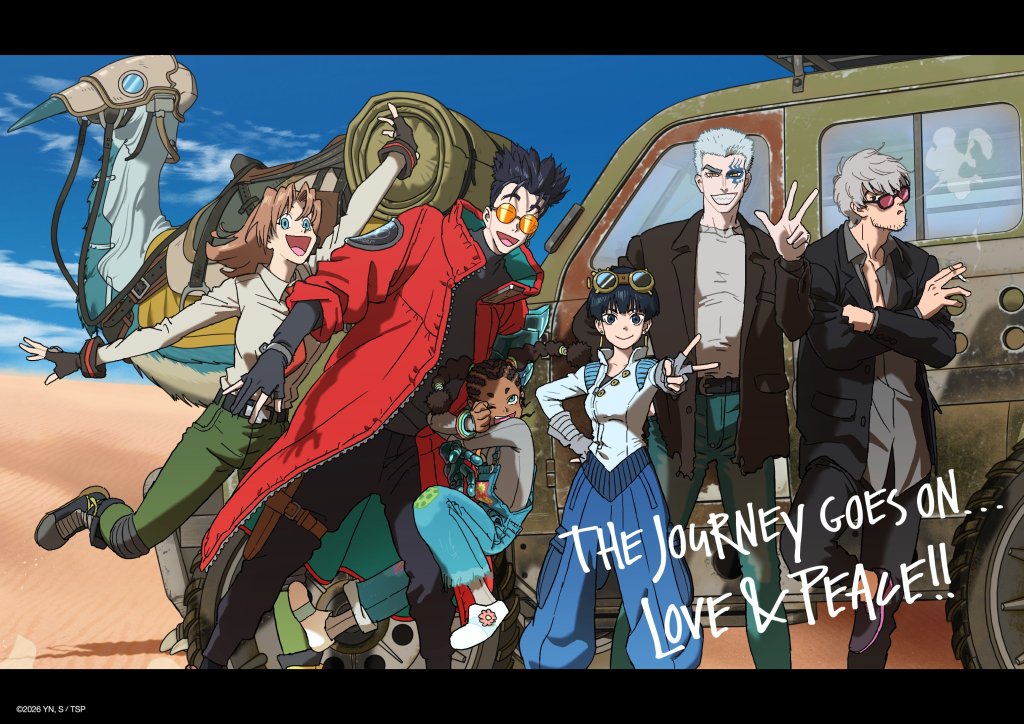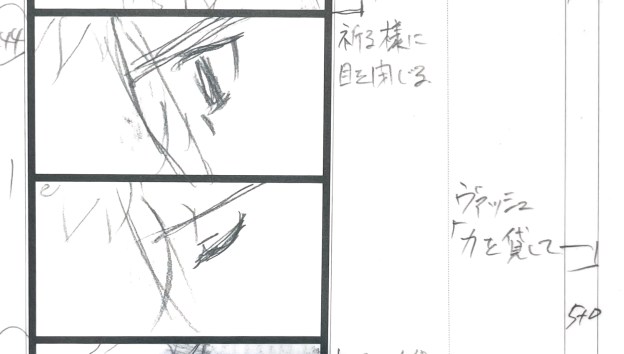
Original interview from PASH! (April 2026), original interviewer: 佐々木玲佳; storyboard from the TRIGUN STAMPEDE Exhibition in Ikebukuro (March 2025).
It’s a story that starts from the question: “Why do humans kill each other?”
— What do you think is the appeal of the original work TRIGUN?
I think it’s a work that confronts fundamental questions head-on. “Why do humans kill each other?”. And “Can it be stopped?”. I feel like this is a message that many can empathize with, and that can move many hearts.
— Is there anything that left a strong impression on you from your talks with Nightow-sensei?
Nightow-sensei has continued to watch over us with a supportive stance, always respecting the anime production. He always says: “You’re free to do as you like”, and I’m really grateful for it. We also had many opportunities to attend events together, and through interviews and similar occasions, I had the chance to see him speak about his approach to this work. Things like how he imaged Vash and Knives’ characters back when he was drawing them, and quotes like: “I want to depict what lies between heaven and earth”. As a reader myself, I’m really happy I was able to hear this kind of inside stories directly from the author himself.
— The title of this final season, TRIGUN STARGAZE, is very impactful. Could you tell us what feelings and intentions went into it?
It was a suggestion from the producer, but there are two reasons behind the choice. Firstly, one of the main elements of this season is the immigrant fleet coming from Earth, and secondly, more than anything, Vash is a dreamer at heart. So, we decided on this title with two meanings in mind: “One who watches the stars” and “One who dreams”.

— You mentioned that Vash is a dreamer. Could you tell us about your vision of Vash’s character in this work?
Fundamentally, he didn’t change from last season. He’s still chasing the ideal of not killing anyone and not wanting anyone to die, and in order to achieve that goal, he doesn’t mind if he gets hurt in the process. That’s Vash’s character. However, this time we are depicting a side of Vash that shows how he isn’t entirely a perfectly righteous person.
— A character who gets deeply involved with this Vash is Nicholas. What aspects did you place emphasis on in portraying him?
I believe he’s the character with whom the viewers can empathize the most in this story. Compared to the opposite extremes that Vash and Knives represent, Nicholas occupies a much more grounded position. His middle-ground role, having had a period of connection with Knives, while also being a dear friend to Vash, was something I was especially conscious of when portraying him.
— What about Meryl and Milly, what kind of position do they occupy as characters in this work?
Meryl is the “representative of humanity”, a bystander who has been following Vash and watching the story unfold since last season. I also think of her as a presence who carries the conscience of the story. Nicholas occupies a similar position, but he is even more pragmatic, whereas Meryl, like Vash, is someone who wants to keep chasing after an ideal. If Meryl and Milly were going to be in this show, I wanted them to truly have their moment. We do have some spotlight scenes prepared for them down the line, so I hope you’ll look forward to it.
— What struck me in the early scenes at the beginning of the season was how, even in the more serious situations, the two’s conversation lightened the atmosphere in just the right way.
Thank you! The scene where they first appeared together eating a banana split [they actually couldn’t eat it in the end] or Milly’s “Do you have any more?” [referring to bread she just called “so dry” and “not very tasty” t.n.] in the later car scene, both captured the two’s relationship very effectively. I believe they were two well-executed scenes.

A challenging script, shaped by the resolve to close this story.
— In regards to this works’s production, what’s the aspect that was the most troublesome and challenging for you, Director?
Definitely the script. This season stands in the very complex position of being the sequel to TRIGUN STAMPEDE, which substantially rearranged the content of the original’s story. I really racked my brain over how to build on that. I too watched TRIGUN STAMPEDE as a viewer, and felt that its ending was gut-wrenching and truly impactful. And TRIGUN STARGAZE had to take it from there. I felt that viewers would surely want to see it through to the end, so we decided to take the story all the way to the conclusion of the original. However, there simply wasn’t enough runtime to cover everything. Rearranging and adapting it was unavoidable, including all the parts that fans of the original had been waiting to see, so we spent a really long time talking it through.
— Nine episodes have aired so far. Is there a scene that has particularly moved you?
The performance by Vash’s voice actor, Matsuoka-san and Knives’ voice actor, Satou-san in episode 7. Listening to it, I felt something pressing deep into my chest, and I thought: “I’m really glad we could make this into anime”. They each have their own, strong conviction, and it really was a fierce confrontation between brothers. Vash and Knives are like the angel and the devil that live within a human being, and I believe that inner conflict is what their story is ultimately about.

— Is there anything that left a particular impression on you from the recording sessions?
If I have to bring up something other than episode 7, that would be episode 3, “Memento Mori”. The scene at the end where Vash says “I’m home” and breaks down crying. The actual take came out completely different from the rehearsal, and in that moment, something inside me clicked: “Yes, this is exactly Vash”.
— I heard that for this season, the voice work was recorded before the animation was finalized [“pre-scoring” t.n.]. Were there instances of the visuals changing in response to what the cast brought to their performances?
The animators have been working while listening to the performances, and the visuals themselves were heavily influenced by the voice actors’ work.
A CG that evolved in real time.
— Is there anything from the production that has particularly stuck with you?
This was my first time dealing with 3D animation. At the beginning, there were some expressions I was told would be difficult to make in 3D, but Studio Orange kept pushing their technology forward throughout production, and the parts that we had planned to handle with hand-drawn animation were replaced by CG one after the other. For example, the scene in episode 1 where Hoppered the Gauntlet combs Vash’s hair, or when Jessica breaks the egg’s shell in episode 4. And then there’s the metamorphosis sequence, where Knives, reduced to nothing but eyeballs, gradually forms bones and flesh from the energy of the Plants. Metamorphosis sequences have traditionally been the domain of cel animation, but this time, we took on that challenge with CG. I really hope you’ll pay close attention to the visual craft as well.
— The visuals really are a highlight of this season.
Thank you very much. The final battle between Vash and Knives is going to be the climax, both visually and narratively. I hope you’ll keep your eyes on how their conflict will ultimately resolve, and how Vash will confront the truth about what really lies in Knives’ heart.
— Lastly, a message to the fans.
To the fans who first met this series through TRIGUN STARGAZE, please consider giving the original manga a try. And to the fans who’ve been supporting this series for many years, we have something special in store that you won’t find anywhere else. I hope you’ll stay with us all the way to the end.