
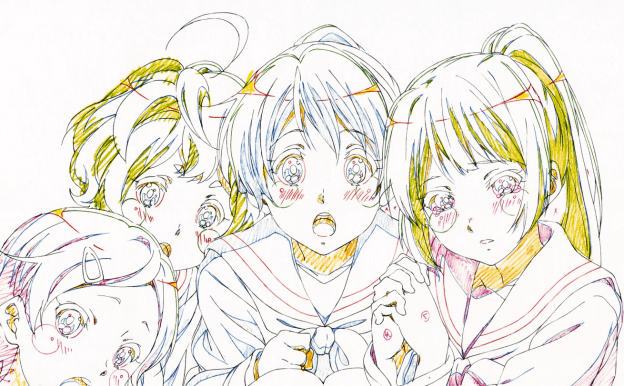
Original interview from Febri, published in two parts, Part 1 on July 4th 2022 and Part 2 on July 6th 2024 titled: “「The Final Movement」that carefully depicted Kumiko’s story『Hibike! Euphonium 3』Director Tatsuya Ishihara Interview”, original interviewer: Daisuke Okamoto; genga from Hibike! Euphonium Season 1.
Part ①
The third season of the youth orchestra anime series “Hibike! Euphonium” (hereafter, just “Eupho”) has reached its final episode. This season focused on the struggles of Kitauji High School Concert Band club president Omae Kumiko, pursuing the long cherished dream of winning the gold prize at the nationals. Mixing in the many characters’ own stories, the series’ final movement ties up Kumiko’s three years of high school. Now that the show has finished airing, Febri had the pleasure to welcome in series director Tatsuya Ishihara, to speak at length, in two parts, about the thoughts and feelings he poured into the final movement. This first part covers the structure, direction and animation of all the 13 episodes.
~ Kumiko has “lost the battle but won the war”. ~
— At the time of this interview, the final episode hasn’t aired yet. What are your feelings at this point?
Actually, I’m still assiduously working on it and to be honest it’s taking quite long (laughs). Anyways, over the past 10 years of production, I’ve been going back and forth between the real world and Eupho’s world, so in a sense I have a feeling that the latter is about to end and disappear, which makes me feel both really moved and deeply desolate.
— I’d like to look back at all of the 13 episodes of season 3 and talk about them. As for the overall structure, the first half depicts Kumiko’s struggles as the club president, and the second half delves into Kumiko’s inner mind.
Focusing the second half on Kumiko’s story was an idea of scriptwriter (Jukki) Hanada-san. The overall flow in the anime has been adjusted a bit, such as moving the episode on (Tsukinaga) Motomu’s family problems, which in the original work happens a little later, in the first half. After all, it’s the “Final Movement”, so I too felt the same way about wanting to properly focus on Kumiko’s story at the end.
— In this season, the presence of the new character Mayu Kuroe has also become a topic of discussion. What kind of person did you think Mayu was?
Even if she’s Kumiko’s rival, their personalities are not completely opposite, so for Kumiko, she’s like a mirror image of herself. In an analogy to a role-playing video game, I think Kumiko has steadily leveled up and, by working hard has acquired a lot of good equipment. And when it was finally time for the last boss battle, who appeared was a boss with the exact same equipment as hers, but also slightly stronger (laughs). That’s the impression I got from Mayu’s character.
— Mayu was also the one who determined Kumiko’s future and career path.
That’s right. In the original work, Kumiko isn’t able to win over Mayu until the very end, but in the anime, we altered the final development of the original work so that their relationship evolves in such a way they ultimately respect and acknowledge each other.
— You mean the result of the final audition in episode 12, right?
Yes. To the fans who have read the original work, it might have been quite a surprise. However, for Kumiko, although she lost the battle called audition, in return she gained the powerful weapon known as Mayu, so to me she “lost the battle but won the war”. Since the moment she became the club president, rather than Kumiko growing as a player herself, I believe her leadership of the club was the aspect that grew stronger, so we made the ending even easier to understand.
— When portraying this kind of relationship between Kumiko and Mayu, was there anything you particularly focused on?
To Tomatsu Haruka-san, who played Mayu, I asked to act “giving off a gentle motherly feel”. There indeed is the aspect of her being Kumiko’s rival, and she does have a bit of a dark side to her too, but fundamentally she’s a caring and kind girl. I wanted the viewers to like Mayu, and I tried not to make her appear as an unpleasant girl.
~ I want to believe that Kumiko and Reina are still connected even after graduating. ~
— On the other had, how do you feel about the relationship between Kumiko and Reina that was portrayed throughout the series, director Ishihara?
I think the viewers should interpret it as they wish, but I personally believe they are complementary to each other. They’re two people with family backgrounds, talents, personalities and tastes that are completely different, so even if their connection through music were to be severed, I don’t think it will matter that much. Moreover, Kumiko became the Concert Band club advisor, so she and Reina still share the fact that they both have jobs related to music. I imagine their relationship is still ongoing even now, and I want to believe so.
— I see. This “future path” aspect was also an important theme of this season.
It’s something every high school student worries about. I personally decided early to get into the anime industry, so I don’t remember worrying about my future that much. Therefore, I can’t quite sympathize with Kumiko’s worries on this… I’m sorry (laughs).
— That being said, I believe there are many people who are able to sympathize with Kumiko.
I think you’re right. But even someone with so little sense of self-direction like Kumiko was able to grow into a proper adult, so I’m sure it’ll be fine. I’m sure Hazuki too was able to become a wonderful preschool teacher, so you’ll find your own path eventually.
— Well then, by episode 12, one part of Kumiko’s story has come to a conclusion. What scene was the most impactful to you so far?
The last scene of episode 12 was really impactful. That’s the climax of Kumiko’s drama, and I wanted to portray it with more care than usual. Also, personally, I really like the scene (in episode 7) where Kumiko and Hazuki attend the university information session, and then have a talk at a cafe drinking melon soda or something. Between the many serious scenes and episodes in this whole season, at least that moment felt a little more relaxed. Of course, Kumiko and the others were worrying about their post-graduation paths and there was some seriousness about it too, but I feel like by going outside of school and meeting with her seniors, she was able to set aside her role as the “club president” and felt like the old Kumiko. It’s also rare for her to go out with just Hazuki, so I really like that.
— In regards to the visuals, since Kumiko and the others are now third-year, they are all drawn to look more grown up. Was that done on purpose?
In terms of character design, since it was renewed in the movie “Hibike! Euphonium ~ Chikai no Finale ~” [劇場版 響け!ユーフォニアム~誓いのフィナーレ~ (Sound! Euphonium: The Movie – Our Promise: A Brand New Day), 2019], there haven’t been many changes. I haven’t asked the animators to make them look “more adult” either, but indeed when you look at their expressions and mannerisms, it feels like they’ve grown up a bit. I think that’s probably because their words, behavior and manners have become more mature. Especially the three managers have had more responsibilities, and also Hazuki and Midori (Sapphire) have had more interactions with their juniors. They often say “the environment changes people”, and I think that was the case here.
— Thank you. In the second part, I’m going to ask about the final episode in more detail.
Thank you.
Part ②
The second part delves deeper into the final episode, also touching on the secrets behind the storyboards director Ishihara has drawn himself.
~ Listening to “Disco Kid”, the storyboard kept flowing. ~
— The final episode was one of the best, well worthy of being the culmination of the series. Having held back with the musical performances up until now, in this episode you showed it all in the best possible fashion.
To put it bluntly, the cost of animating a musical performance scene is on another level entirely, so it’s not that easy to include one, especially in a TV series. You might argue we already did it in episode 5 of season 2, but that one used materials from the first season and the movie, so it wasn’t all animated from scratch. In that respect, this episode’s musical performance scene was all made up of newly animated cuts. Rather than having the performances distributed between the Sunrise Festival and the regional qualifications, it was decided from the scriptwriting stage to have just a bigger one in the final episode.
— It was clear from the early stages that “Hitotose no Uta” would have been performed, but the final episode was the first time it was played in its entirety.
I thought it would be difficult to empathize with a song if you’re listened to it for the first time, so I had the first movement play in episode 2, in the scene where Kumiko and Reina listen to the song sharing earphones, and then included in the eye-catches of each episode a short performance from every instrumental department, in order to make the song as familiar to the ear as possible.
— “Hitotose no Uta” is divided in four sections: spring, summer, autumn and winter, and it was staged in such a way that for each season, the memories of Kumiko and the others would flash back.
In the original work too, in this scene Kumiko is described to be remembering various things, and visually I felt that it would have been tedious to just show a musical performance for 6 minute straight. So, I had already decided from relatively early stages to portray it like that.
— Director Ishihara, you drew the storyboard for the last episode. Did you have a hard time choosing which scenes from the past to reuse?
I don’t remember having that hard of a time with it. I chose the scenes that I think are impactful and memorable not just for me but for the viewers as well. Also, like including sad and painful ones in the “Autumn” part, I chose scenes that matched the flow and mood of the song.
— Did you have any difficulties with the storyboard for the last episode?
The main problem were the length and number of cuts. In the “Hitotose no Uta” musical performance scene, of course I couldn’t leave out the scene where Kumiko and Reina play “Ai wo Mitsuketa Basho” [“The Place Where We Found Love”] on Mt. Daikichi, and I also wanted “Disco Kid” to play in the epilogue, so I started drawing from there. Then, I went on trying to figure out what to prioritize in the time that I had left, but it was a rather unconventional approach, so you might say I had some troubles with that.
— What’s the reason you wanted to play “Disco Kid” in the epilogue?
Sometime when I still hadn’t visualized the last scene of the final episode, I happened to listen to “Disco Kid”, and in that instant the image of the epilogue popped into my head. From that point on, the storyboard started to flow into my mind all the once, and I felt that that was the song I had to use.
— That song was also played at the beginning of episode 1, right?
That’s right, but the order was actually reversed. After having decided to play the song in the epilogue, we decided to use it in the prologue of the first episode as well. The prologue and the epilogue link together different moments in the timeline, so it was a natural choice.
— “Disco Kid” is a famous wind instrument piece, but that was the first time it was featured in the Eupho series.
That’s true. It was suggested by the producers, but I couldn’t quite find the right opportunity to use it. It’s not like I was saving it for the last chapter, but I think I was ultimately able to use it in the best way possible. In the scene of the epilogue where Kumiko walks, I made some minor adjustments like matching the rhythm of “Disco Kid” to her steps, so it’s very pleasant to watch. I like this epilogue so much I end up watching it over and over again.
~ I wanted to make the world of Eupho a continuation of reality. ~
— That aside, what other aspects of the epilogue did you focus on?
I already said this in the first part, but since it’s a work I’d been working on for ten years, I felt a strong sense of desolation, as if one of my own worlds had disappeared. Therefore, I thought that it would have been nice if I could create some sort of continuity between the work and reality, even a small one, so the epilogues brings us to the Uji of the present day.
— What do you mean?
Kumiko’s third year of high school is set in 2017, but the epilogue of the anime depicts present day (2024) Uji. By doing so, I hoped it would make it feel like Kumiko and the others are living in this same world we live in. This work already featured a truthful depiction of Uji, but we scouted each location again and reflected the changes in the scenery of the epilogue. Kumiko’s favorite bench has been renewed, the JR railways have been double-tacked, the factory chimney visible from the Uji Bridge is now just one, the torii gates at Uji Shrine have been replaced with metal ones… many minor things have changed. And also Tuba-kun is extremely worn out (laughs). I don’t know how much of it was noticed, but a lot of thought was put into it.
— Sounds like there are many things to discover rewatching the episode. One more thing, what was the difficulty related to the number of cuts you mentioned earlier?
The final episode has 500 cuts, and even excluding the so-called bank (reused scenes), it easily exceeds 300. I don’t think it’s a particularly high number compared to current anime standards, but it’s still a lot more than what it used to be, so it’s a source of troubles nonetheless. This isn’t just limited to the final episode, but I feel like drawing the storyboards was always a battle between the length and the number of cuts.
— Once again, thank you so much for your hard work over the past 10 years. What kind of work has Eupho been for you, director Ishihara?
Before I started working on Eupho, I knew nothing about wind instruments and concert bands, so I was basically studying everyday. In that sense, it’s a work I struggled with a lot, but depicting a real human drama set in a real, existing place was something I wanted to do, so I’m glad it allowed me to have this wonderful experience. Thanks to it, I’ve come to like wind instrument music, and I think that from now on I’ll keep listening to it as a hobby, outside of anime production.
— Aren’t you going to play yourself?
I’ve tried before, but I was discouraged that I couldn’t get any sound out of the instrument mouthpiece (laughs). For the time being, I’ll just enjoy listening to it.
— Well then, lastly, a message to the fans.
Thank you very much for your support throughout this many years. Eupho as a work encapsulates a society that interweaves characters in many different positions, like seniors and juniors, and teachers. Therefore, I believe depending on your age and position, the way you feel about it will change. I’d be happy if you came back to it from time to time. I hope you’ll keep supporting us for many years to come!

