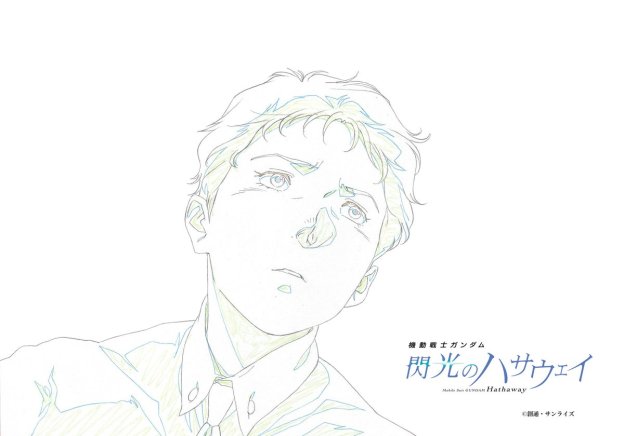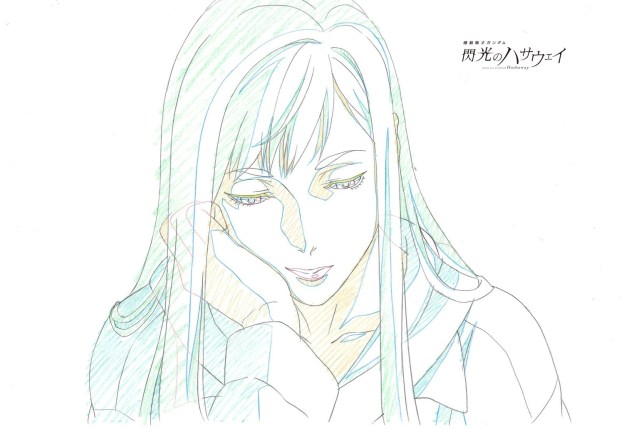
Original interview from Gundam Info published on June 25th 2021, titled: “Exclusive long interview!『Mobile Suit Gundam: Hathaway’s Flash』director Shuko Murase on the ‘broken’ Hathaway and the ‘indecipherable’ Gigi“, original interviewer: Ryota Fujitsu; genga from the official Mobile Suit Gundam: Hathaway’s Flash Twitter account.
— I believe that adapting the 3-volume novel written by Director Yoshiyuki Tomino into a movie trilogy calls for a lot of ingenuity and intuition. In the case of “Mobile Suit Gundam: Hathaway’s Flash” Part 1, the opening features the sound of a ticking clock, and the film ends with a scene where the clock left behind by the protagonist, Hathaway, is in Gigi’s hands, creating the impression that “the time that had stopped started to move again”.
Actually, the sound of the ticking clock at the beginning was an idea of (Koji) Kasamatsu-san [the movie’s sound director]. To begin with, the clock that Hathaway buys was introduced as a prop to remind Gigi of him as the two eventually drift apart. After learning about this idea, Kasamatsu-san decided to add the ticking clock sound in the opening. When I asked him if that [“creating the impression that the time that had stopped started to move again” t.n.] was his intention with the addition, he confirmed it. Kasamatsu-san wondered if he might have gone a bit overboard with it, but since it was such a great idea, I decided to use it as it was.

— So the cohesive feel of the addition was the result of that kind of exchange. By the way, had you already read the novel, Director Murase?
I read it for the first time after taking on the role of director. Short after the novel was released, I started working on Mobile Suit Gundam F91 [March 1991, Murase worked on the movie as an animation director and key animator] so I was aware of its existence, but I did’t read it at the time.
— What were your thoughts after reading the novel from the director’s perspective?
(Reading through the novel) I could clearly picture the scenes. It felt as if it was written like a storyboard. Though, of course, the characters’ emotions and thoughts were much more detailed. There were parts where I actually felt that Director Tomino himself had written it with the same mindset he had when writing TV series. For example, early on, characters with names are introduced, but then they never appear again. I think that was probably the result of trying out many different characters and keeping only the ones that seemed interesting or had potential. I intend to follow along with that result in the movies, without changing the story too much. I want to make it clear that characters like Mihessia and Hundley Yeoksam were deliberately shown on camera in the first part, but their relevance doesn’t go much beyond that.
— Talking about the movie, the Davao air raid sequence around the midpoint, spanning from midnight to dawn, was truly impressive in many ways. For instance, in terms of the mecha direction, I was impressed by how many shots featured interactions between mobile suits and humans.
For the consecutive battle scenes about halfway through the movie, I explained to the mecha animators that I didn’t want them to depict the mobile suits, but rather to portray the phenomenon of their presence. The mobile suits themselves weren’t the focus of the sequence; instead, the real focus was on the people in the foreground and the reactions happening around them. The presence of mobile suits, which are far bigger in size than humans, involves things like trees being eradicated and falling to the ground, strong wind passing through… That was the kind of phenomenon I wanted to depict. I feel like we were able to somehow bring that out on screen.
― Did you place the emphasis there because you thought that you needed to go that far in order to make a mobile suit battle scene interesting?
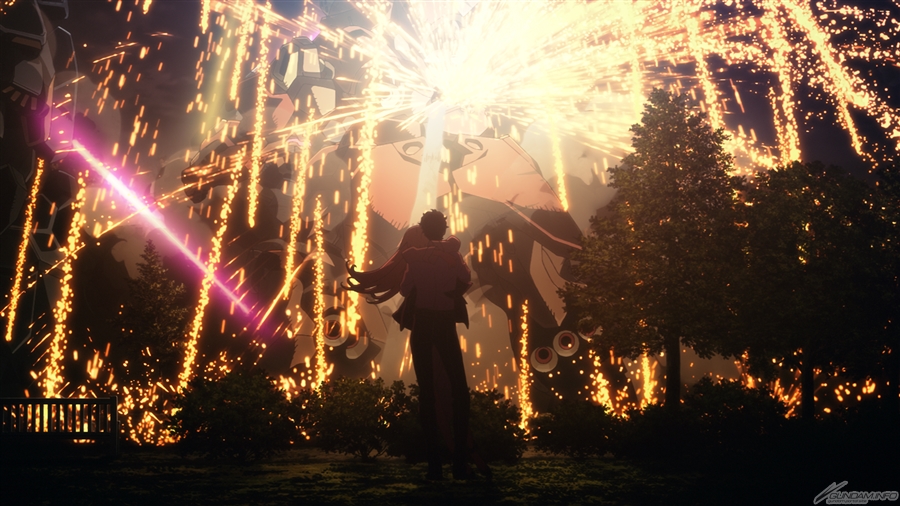
No, it was because that’s how it’s written in the novel itself. The scene of the Gustav Karl landing on the rooftop of a building and then sliding off from there was also staged and arranged just as it was in the novel, and even the fireworks-like sparks flying around when mobile suits clash into one another and beam particles scattering around and damaging the surroundings are all portrayed exactly according to the novel. The previous works up until now hadn’t been able to bring all that to life, so I thought that if we adapted the novel faithfully, it would surely be interesting. After writing Hathaway’s Flash, Director Tomino went on to direct F91, and a similar scene was featured there as well. Coincidentally, I was the one responsible for the animation in that scene. I tried to achieve the same result in F91 but it didn’t work out, so I wanted to make sure to get it right this time.
— Watching the movie, the way mobile suits like the Gustav Karl or the Messer were staged really gave them a “giant” feel, but personally, I thought the Penelope went beyond that and was portrayed almost like a “kaiju”.
That’s right. I wanted the Penelope to feel monstrous, something completely different from the other mobile suits. The way light flows and moves across the Minovsky Craft Unit of the machine was also influenced by the parts of kaiju that used to have a similar glowing effect when they moved. The novel also mentions the unique flying sound, but I thought it would be better if it left a lingering sensation after it flew away, as if it were moving by some mysterious force, so I opted for that chirping-like sound effect. For the Penelope, I intentionally created shots with poses that emphasized a bird-like image, such as the flight form, rather than the more conventional standing pose.
— On the topic of mobile suits’ advancement, the Gundam universe has a lot of setting constraints, what are your thoughts on that?
That is indeed a crucial point. The Gundam universe is so vast that even if you ask people who could be considered Gundam experts, each one of them would have a different individual tolerance for what is considered acceptable (laughs). That being said, if we don’t decide on some sort of foundation, those things will always be an inconclusive mess. Therefore, this time we decided to be very strict in regard to those aspects. For instance, the fact that communication isn’t possible under Minovsky particle dispersion is something we’ve strictly adhered to. The novel also includes a scene where Kenneth and Lane are unable to communicate, and we’ve made sure to follow that thoroughly. Fortunately, even with such strict adherence to the setting and constraints, there was no need to alter the story, so that was a relief.
— On the drama side, there’s a depiction of Hathaway, who, despite having to reunite with his comrades, finds himself unable to leave Gigi’s side. This development too follows the novel, but bringing it to the screen with a stronger emphasis really drives home the feeling that Hathaway is a character torn between “emotions” and “ideals”.
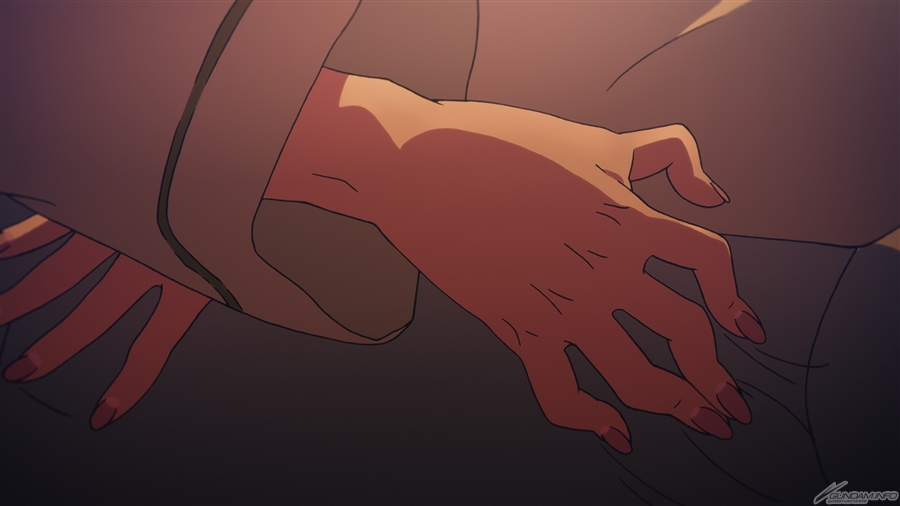
The sequence where Hathaway embraces Gigi while catching a glimpse of his comrade, Emerelda, is a bit chaotic in the novel. By condensing and rearranging it slightly, I believe the meaning of the scene comes across more clearly.
— In terms of adapting this work into a movie, how did you approach Hathaway’s characterization?
Why did Hathaway become Mafty? The novel does provide a reason, but I still find it somewhat unconvincing. Under the name of Mafty, Hathaway carries on Char’s ideal, but why would he embrace the ideology of an opponent he once fought against? The novel just skips over that part, doesn’t it? But I’m sure there must have been another layer to it. I believe that’s the key point of this work. That is the core of Hathaway’s character in the movie.
— You mean, there must have been a turning point that led Hathaway to become Mafty.
Exactly. On the surface, we’re staying faithful to the novel, but I’m aiming to clarify the meaning and motivations behind Hathaway’s actions, presenting them as part of a coherent guiding principle for his character. As for what exactly happened, we’re going to concretely portray it in the future; the first movie doesn’t touch on it, and even at the recording sessions I didn’t offer any explanations. The only thing I explained was that Hathaway is a “broken person”, someone who “thinks of himself as integral but is, in reality, broken”.
— On the other hand, what about the heroine, Gigi?
Gigi’s a character with a dual natureーshe has an incredibly pure side and yet is also able to perfectly adapt to the adult world. But because there are hardly any people like that, the novel was my only reference, which made it extremely challenging. On the other hand, there was also the difficulty that if I portrayed her exactly as she was in the novel, she would come across as an unpleasant woman. Gigi is a character archetype that often appears in Tomino’s works, but if I portrayed her exactly as she is, I felt like it would make people wonder “why is everyone so drawn to this girl?”. So, I made sure not to have her come across just as an unpleasant woman. I believe she’s probably the kind of person who can get away with saying something unpleasant, not just because she’s beautiful, but because she has a certain charm to her too. In that regard, her design helped out a lot.
— So Gigi was an even harder character than Hathaway.
That’s right. Director Tomino depicts these type of characters all the time, so it’s probably something he’s fond of. But for me, that’s not the case. However, I chose to portray her including all the sides of her character that I didn’t fully understand, and I believe that’s how the current balance was achieved. If I had made her into something I could fully understand, Gigi wouldn’t have been the person she is (laughs). Adding Ueda Reina-san’s acting to all that, I believe Gigi’s character came together with a great balance.
— Personally, I found the orange accents in Gigi’s eyes very impactful.
That was the work of (the character designer) Pablo Uchida-kun. It’s not something you’d typically think of, adding orange highlights like that. He said that it wouldn’t be really noticeable from a distance, but it definitely works well as an accent. It was very effective.

— In the movie, you used the scene where Kenneth rides a horse as a trigger to show the relationship between Quess and Hathaway as depicted in Char’s Counterattack. That scene was placed at the end of the Davao airstrike episode.
When I rewatched Char’s Counterattack in preparation for Hathaway’s Flash, I realized clearly that the moment when Quess rushes toward Char is the true starting point of Hathaway’s Flash. Perhaps one could say that a more concrete starting point would be when Hathaway killed a person on the battlefield, but that scene slightly differs between the movie and the novel versions [Mobile Suit Gundam: Char’s Counterattack — Beltorchika’s Children, 1988], and besides, I believe that was more of a “consequence” than a starting point. I believe that, after all, not being able to stop Quess there was the spark that started it all. For those who haven’t seen Char’s Counterattack, this scene might be confusing, but I felt it was a good addition, even just visually.

— This is mainly related to the visual aspect, but when Hathaway is recalling his memory of Quess, his face becomes a silhouette and you can’t see his expression. Watching your past works, it seems like you, Director Murase, have a sort of fixation on dark visuals. Could you share the intention behind that?
Perhaps it’s because many of my works tackle that kind of themes. And using dark images is relatively easier. Also, I personally like staging scenes with silhouettes.
— In this move too there are a few cuts where the ground crew is portrayed as silhouettes.
There are indeed. When thinking about the balance between the backgrounds and the characters drawings, usually, you would make the characters brighter and keep the backgrounds from standing out too much, but personally I like to make the characters almost fade in and the backgrounds look cleaner. And by staging the scenes with silhouettes, it allows the imagination to expand, so to speak…
— Using dark backgrounds allows for a more effective use of light too, right?
By using light, you can create a sense of depth, or make the viewer feel the space. If you light up everything, the sense of scale disappears. If you depict giant things like mobile suits as silhouettes and light up just one part of them, it properly conveys their dimension. Even a flat surface gains a sense of distance when light is cast only on certain areas. I made sure to pay close attention to those aspects in my direction. But I also understand the animators’ dissatisfaction when the screen is so dark that you can’t see their drawings and line-arts. In order to draw a clean silhouette, you need to make sure the interior is properly defined as well. The inner lines are still absolutely necessary. So, at first glance, they might look like silhouettes, but if you look closely, you can just barely make out the lines inside—I believe that’s the best balance. In that regard, there wasn’t much room for me to provide precise and detailed guidance this time, but I believe it turned out pretty good in the end.

— For the production of this movie, I’ve heard you created color keys [colored illustrations of important cuts from the storyboard to convey the director’s ideas to the various members of the staff] for some of the scenes. What was the purpose behind them?
In anime, even though there’s a general plan and vision, it’s common to create the materials separately—the backgrounds are handled by one team, and the animation by another—and in the end, it’s up to the photography team to pull everything together. As a result, each section can easily become frustrated if the final use of their work doesn’t align with what they envisioned during the process. I figured that if I gave a general sense of direction by providing exact instructions like “I want this scene to look like this, so put a shadow there”, I could solve this problem altogether.
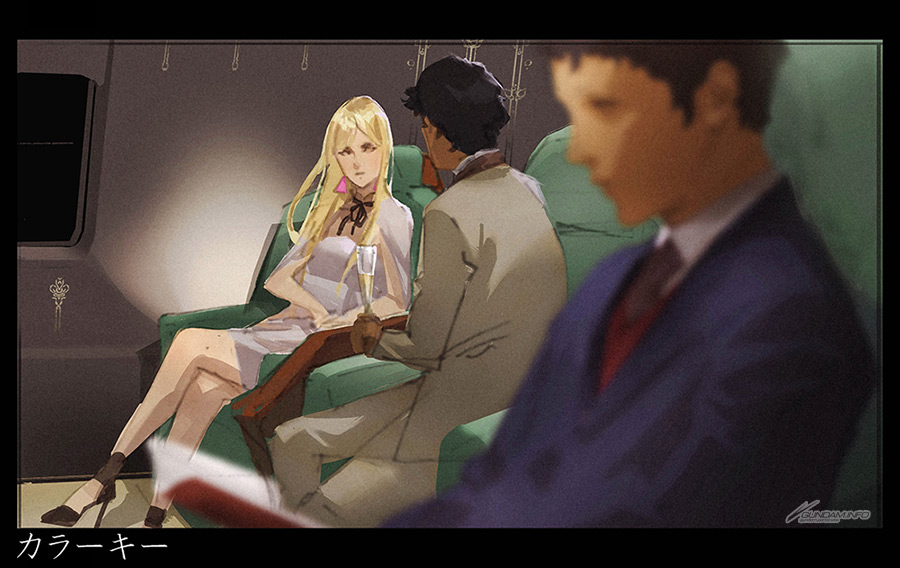
— Earlier, you mentioned that there wasn’t enough time for you to provide guidance for the final visuals. How do you typically give guidance when you have the chance? Do you write notes, or do you use something like (Adobe) Photoshop to actually compose the screen?
I used to use Photoshop, but while working on Genocidal Organ [虐殺器官 (Gyakusatsu Kikan), 2017] I switched to (Adobe) After Effects. I usually show how I want things like perspectives, incident light, and subtle lighting effects to be handled.
— Do you end up handling the photography [combining materials such as background art, cels, and CG elements into a single piece of footage, while also adding elements like camera work and lighting effects; also referred to as “compositing”] yourself?
The final compositing is completely different. By adjusting the separately crafted materials during the photography phase, the level of completion of the images changes a lot. Unfortunately, I couldn’t do that this time, but I did manage it in key moments, such as the teaser with Hathaway sitting on the beach, the sequence we were talking about earlier where he recalls Quess, and the final shots of Hathaway walking on the ship’s deck. In previous projects, I even joked about working on them just for the fun on the final compositing (laughs). So, it’s actually a very important process that I want to focus on, but since it’s the last step, we often find ourselves racing against the schedule.
— When did you first realize how enjoyable and fun the photography process is?
I guess it was after I became a director… When I was working on Witch Hunter ROBIN [2002], it was a TV production so I didn’t have much leeway to make major adjustments, but when I directed the final episode, I managed to do some compositing arrangements (compiling materials together). From that time on, whenever I direct episodes, I often handle the compositing arrangement work as well. There were also times when I handled it for all the cuts.
— In this movie, there are many three-dimensional camera movements; did you find it difficult to convey certain ideas through traditional, hand-drawn 2D storyboards?
I did. We used video-storyboards (v-boards) this time, but v-boards themselves are 2D as well. I believe there are many scenes that might make viewers think they’re in 3D, but they’re actually 2D. Many things can be made to appear three-dimensional through camera work and the sliding of 2D materials. One good thing about v-boards in that I can convey the speed and timing of the camerawork myself, but tn the actual production process, we had no choice but to create paper storyboards at some point, and I thought there were various challenges in coordinating and connecting the two.
— Did you create the v-boards using some storyboarding software?
No, I used After Effects. I tried using specialized software too, but personally, I’m more familiar with After Effects so I prefer sticking with that.

— Looking back at Part 1, what do you think went especially well, Director Murase?
I’d say the overall balance. At first, I was concerned that it might drag on a bit. Even though I tried to cut and tighten it as much as possible, the first half still feels a little sluggish. However, when I look at the total picture, it didn’t feel that long, and with the battles scenes added in there was a good sense of pacing, so I was relieved. A big part of that is thanks to the sound team’s direction. Also, when it comes to “pauses” in the dialogues, I think the influence of Tomino-lines in the novel played a big role (laughs). Up until now, in dialogue scenes I would carefully structure the timing so that the characters make sure to listen to the others’ words before responding. But Tomino-san’s style is more like a rapid-fire back-and-forth (laughs). Keeping that in mind, I didn’t focus on my usual timing this time. There are very few pauses this way, but that might have helped making the dialogues feel more connected. Though, I’m sure it must have been somewhat uncomfortable for Director Tomino to have his own lines directed by someone else (laughs).
— The second part seems like it will have even more intense battle scenes compared to the first part…
When depicting battle scenes on a brighter screen, things that we could previously conceal in the darkness can no longer be hidden. The challenge lies in how to elevate those elements. As for Part 1, it may have ultimately been a technical blessing that the battles were set at night.