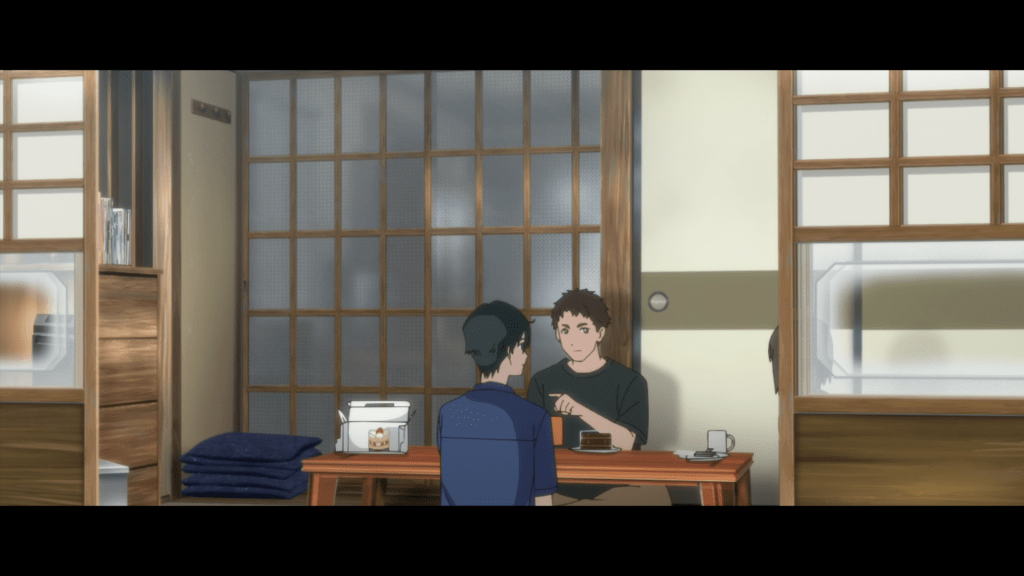
Tag Archives: Shoushimin Series

Shoushimin Series #16 – Direction Notes

“Consistency” certainly isn’t the most fitting word to describe my production on this blog. That’s especially true for this series of posts aimed at breaking down the direction and visual presentation of some of the shows I watch on a weekly basis. Starting with the fact that (as alluded to in my previous post) I finally decided to change its name to “Direction Notes”, just a little over a year since I started writing these pieces, and just a little under a year since I began calling them “Episode Notes”.
But this sort of rebranding happens all the time, doesn’t it? What’s far more important is that it’s been roughly 9 months since I published my last write-up about Shoushimin Series, specifically, about episodes #3 and #4. Believe me when I say that I still have all the notes, timestamps and screen-caps I took of (almost) every remaining episodes of the first cour, but for one reason or another, I ultimately never got around to putting them together into actual posts.

Fortunately, the episode that came out last Saturday, 6 weeks since the second cour started airing back in April, felt so strong and cathartic that I believe it’s the perfect opportunity to get back on track with this series, momentarily glossing over the episodes I skipped (in the hope I’ll manage to address them sometime in the future), and spending a few words directly on Episode #16, “Midsummer Night” —the climax of The Autumn-Exclusive Kuri Kinton Case Arc.


Episode 16 – 真夏の夜: Midsummer Night

Storyboard: Nobuyuki Takeuchi | Episode Direction: Shoshi Ishikawa

Before I start, I’d like to point out that, as usual, I won’t be covering or analyzing the content and themes at play in the episode; there’s who already has very skillfully written at length about those aspects, far more insightfully than I ever could.
Instead, what I’ll be doing is focusing primarily on the directorial aspects of the episode, the mise-en-scène and visual arrangement that brilliantly framed Honobu Yonezawa‘s story and brought to our screens all the intensity permeating through its climax.

Frame 1

The first impression I got from the very first scene of the episode was how dark everything looked, or rather, how stark the contrast between the background and the lit-up elements felt. To put it yet another way, the emphasis on lighting is something the episode outlines and insists on from the very first shot we’re presented with.

Light, especially its color, and even more-so its source, is indeed the main visual theme throughout the entire runtime of the episode, playing a central role in more than just one way.
What this suggests, on a broader outlook on the approach this episode takes on the mandatory taste of visual storytelling ever-present in this show, is a strong focus on crafting the perfect ambience to keep the viewer engaged, almost luring us in, allowing its subtleties to be conveyed in a more passive and engulfing way.
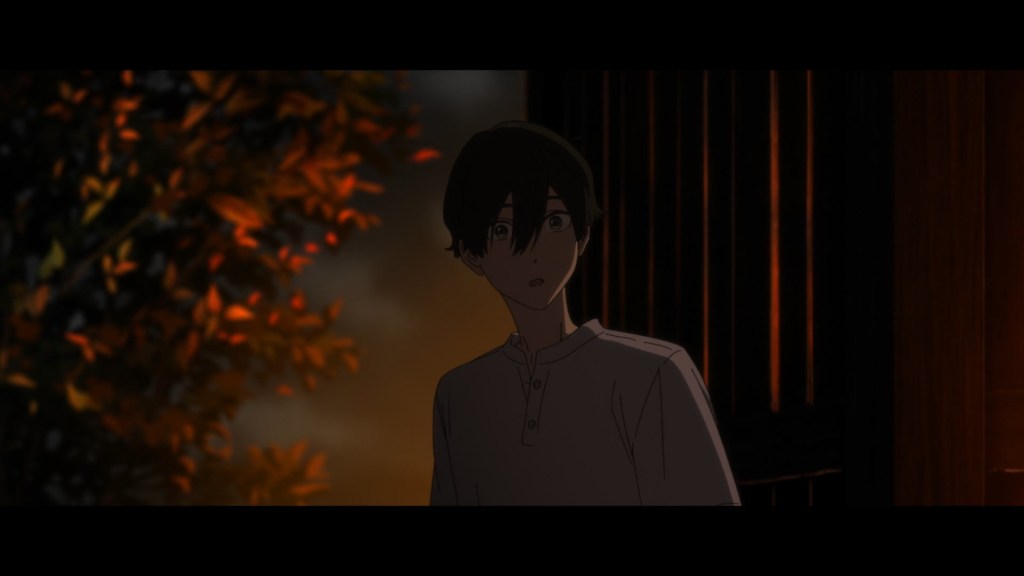
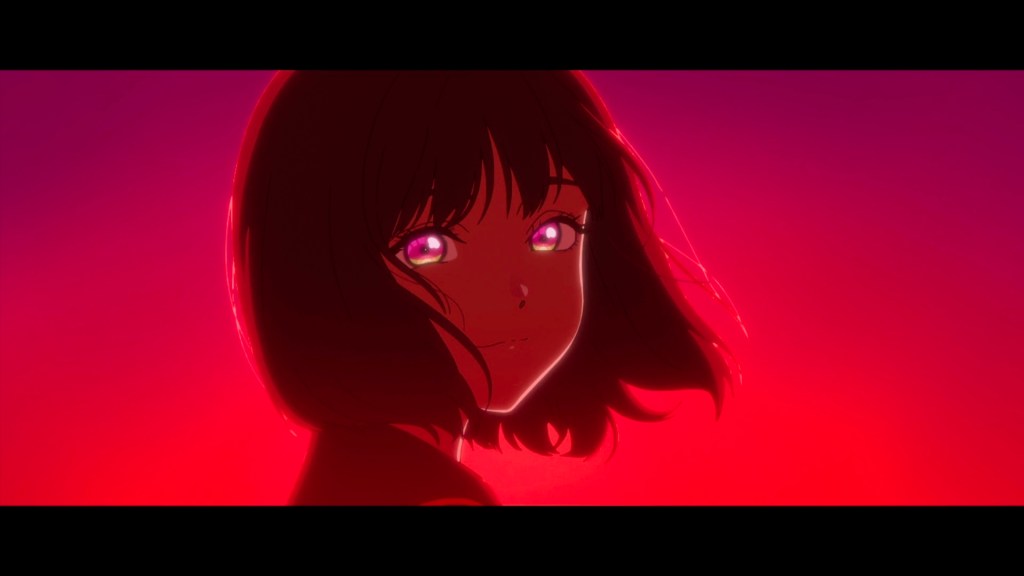
After the brief introduction featuring a conversation as important as it is short between Kobato and Kengo, we’re welcomed by an alarming yet somewhat comfortingly beautiful red palette. This serves as the stage for a highly anticipated reunion: the one of Kobato and Osanai —the fox and the wolf— and what better setting than the warm light of a raging fire, set by the unidentified serial arsonist on the loose? Yet, despite the unnerving tone of situation and the imminent threat of some fuel tanks potentially catching on fire and exploding (the framing of which doesn’t fail to subtly embed a sense of powerlessness and tease another visual theme that’ll play a major role later in the episode), the sequence is filled with an inexplicable feeling of delight and lightheartedness, if anything, remarking once and for all that there’s absolutely nothing ordinary about our main duo and their relationship.

Much like a moth lured in by lightbulbs, with all his vehemence Urino reaches Kobato and Osanai following the light from the fire, and after a very brief and inconclusive confrontation, our inexperienced make-believe detective runs after the fleeting Osanai one could say, majestically falling for her trap.
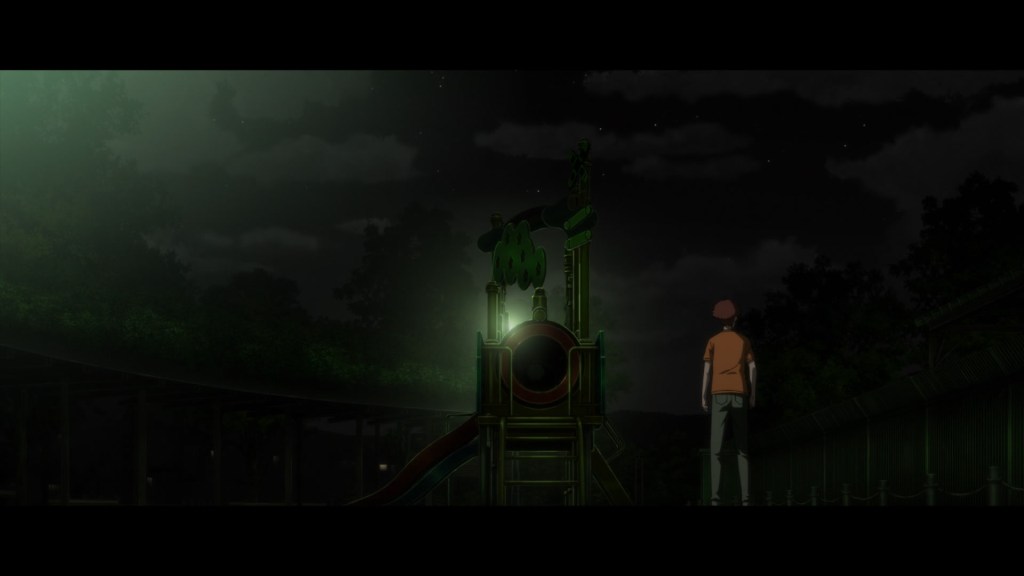
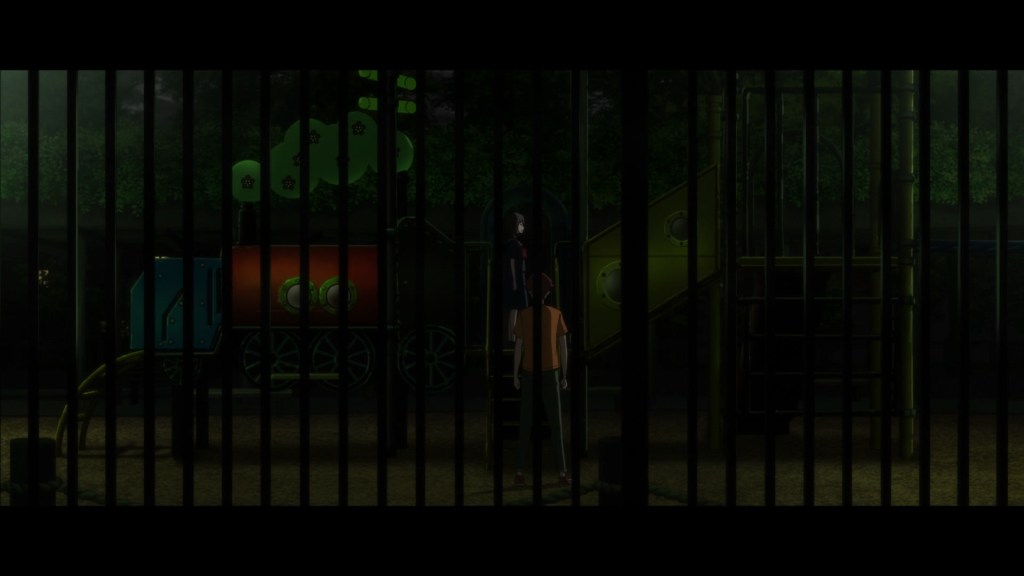
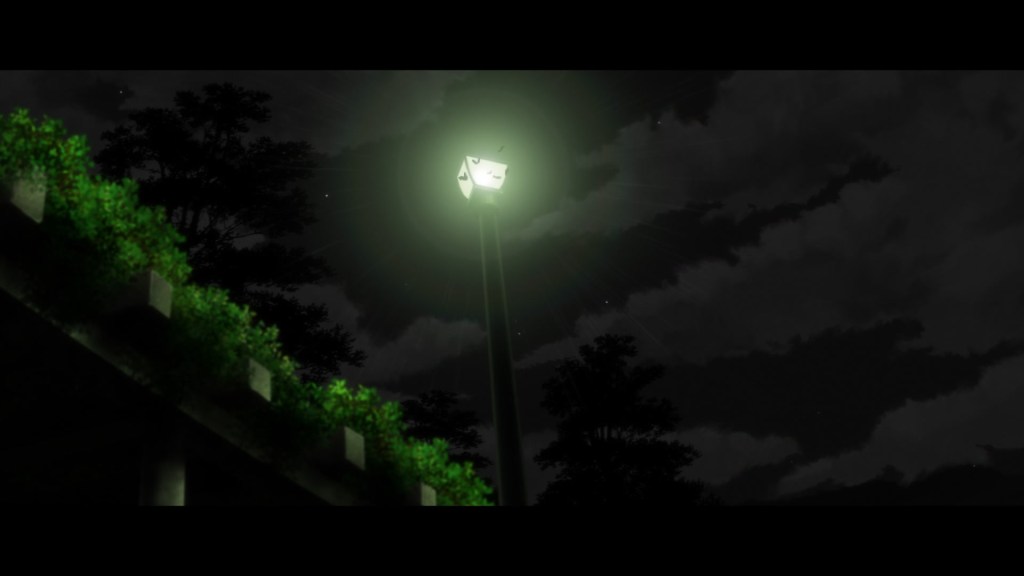
The location changes to an eerie public park, lit-up only by the dim light of a streetlamp enveloping everything in a poignant and ominous green tint.
As Frames 5 to 7 suggest, that of confinement is the main visual theme of this next sequence; Urino, having been successfully lured into the wolf’s den, is as far as he can possibly be from a position of control, despite him supposedly being the one who cornered the culprit.

This idea of Urino being the one who’s actually trapped is rendered very explicitly, with the foreground layer literally depicting a stretch of imposing fences, trapping him from many different angles. At the same time, the same concept is also conveyed in a more intrinsic way, via a very telling use of spacing within the frame, paired with a focal shift effect at the end, leaving him little to no room to breathe.
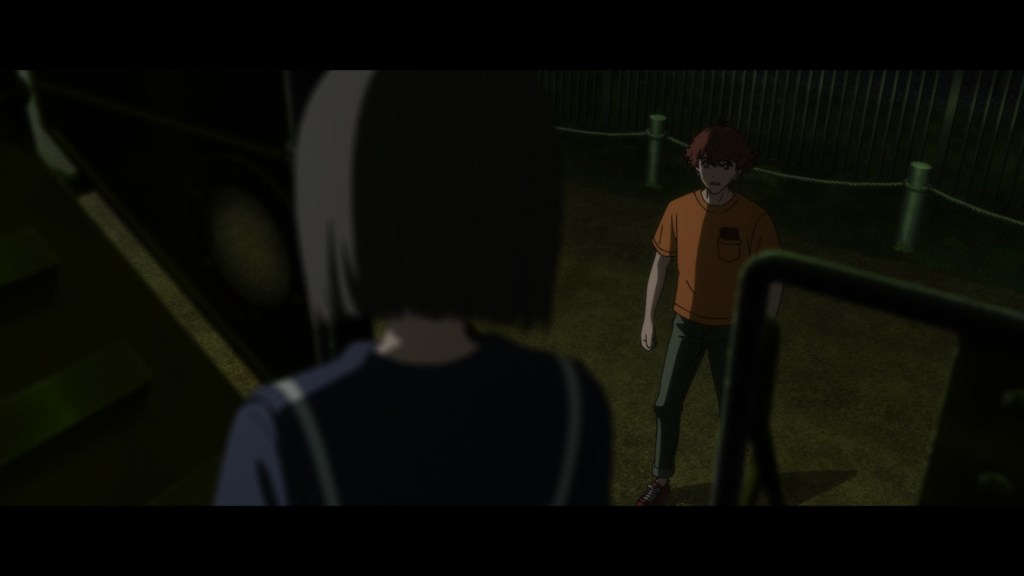
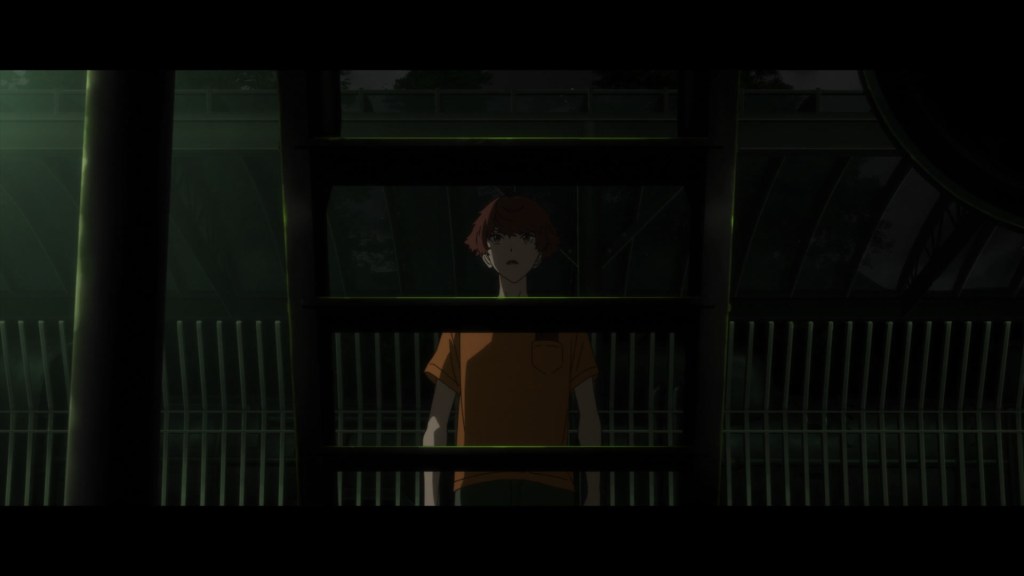
If it wasn’t already clear enough, another deliberate choice that establishes Osanai‘s presence as the one in control of the situation, is the very physical detail that she, until the end of their confrontation, is always positioned above Urino, the latter forced to constantly raise his gaze in order to meet hers, who’s always looking downwards. Furthermore, Osanai is the only one that gets to move around freely in this environment, while Urino stands still in the same spot almost all the time —after all, it’s her den, not his.

In another unconcealed symbolism, the direction cleverly indulges in a particular framing of the lamp, shot from below much like Osanai during the entire sequence, where increasingly many bugs are lured in by the lightbulb. The cold and dim light emanated from the lamp serves as an obvious metaphor for our small (in size, but certainly not in ego) girl and her pale warmth towards the School Newspaper Club President, while the moths represent of course Urino, and his mis-directed deductions.
As clouds partially obscure the moon, lost but confident in the middle of the night, he ends up clinging to an artificial and contrived source of light, unable to see —let alone reach— the far away truth his own ambitions set out to unveil.

Frame 10

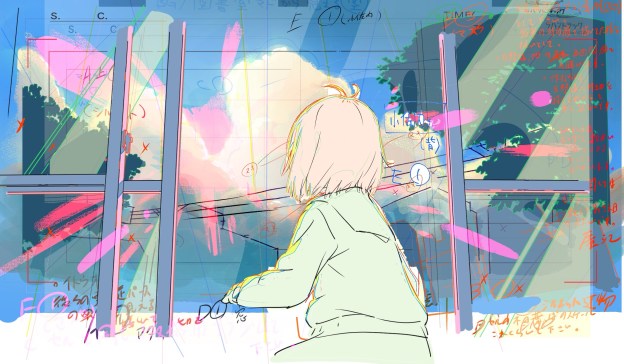
Even in the confidence of his flashbacks, the framing leaves no room for doubts in conveying Urino‘s flawed approach. His impulsive and overzealous personality isn’t exactly fit for the role he appointed himself to play, as neither back then nor now his figure is able to break out of the very narrow perspective, outlined by the window’s frame, that he confined himself into by failing to even consider taking a broader look at the situation before drawing the conclusions.

I haven’t mentioned it yet, but an unnerving feeling of tension unsurprisingly lingers throughout the whole sequence, which lasts for about 3/4 of the entire 23 minutes runtime of the episode. Contributing in making this sensation feel even more palpable, is a subtle matter of rhythm. While Urino and Osanai are having their conversation, the former’s lines are often visually cut in half; in other words, the camera erratically changes position or angle while he still isn’t done talking. It’s jarring, deliberately so, since it’s something that rarely happens under normal circumstances. Here though, it’s a very tastefully employed trick to make his assertions feel questionable and hesitant before he’s even given the chance to fully articulate them.

Speaking of dialogues, I cannot fail to mention the incredible performance by Hina Youmiya, Osanai‘s voice actress, reaffirming hers as one of the best castings in recent times. Her whispery tone seems to come directly from the character’s lips, precisely controlling the many emotions she’s feeling during the sequence, whether it’s fervid excitement, utter disappointment, or both.

In the final phase of the episode, when Osanai reveals the last and definitive piece of the puzzle to the poor Urino, the camera trembles like it never did before; his self-confidence shatters and the lingering feeling of uneasiness coalesces in a cathartic sense of impotence. The visual verticality of the scene is once again crucial to its presentation, as Urino raises his gaze even higher, and finally gets a proper, humiliating glance at the moon, which too is looking down at him, now clear of any obstacle.

Defeated, the ill-fated prey runs away, while Osanai is juxtaposed with the very same streetlamp from before —this time, with no bugs flying around its light anymore.
Emerging from the depth of the wolf’s den, there’s Kobato, who naturally finds himself at home there, and has been patiently waiting for this sophisticated hunt to reach its end.


In all honesty, as soon as this second cour of Shoushimin Series started airing I was already sure I would end up writing at least one blogpost about it. It’s been quite a while now, so whether or not this short piece meets the quality standards of my previous posts on the show, I leave up to you to decide. Nonetheless, I hope I was able to provide some interesting insights on this shows’ ever so resourceful direction, that you may (or may not) have missed while watching through the episode.
I had a lot of fun putting this write-up together today, but I don’t plan on making a return to a regular publishing schedule any time soon. That being said, if the opportunity arises again for another sporadic post like this one, I might find myself back at the keyboard sooner than expected…

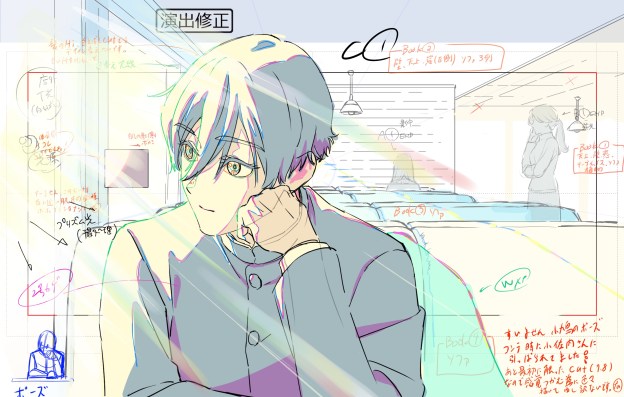
Takahiro Obata – Interview on Shoushimin Series

Original interview from Newtype (September 2024 issue), original interviewer: Haruyo Igeta; genga corrections by Keisuke Hiroe.


Since the music is used sparingly, the moment the main theme starts playing is very impactful

~ I put meticulous care into refining each and every sound ~

— What led you to become involved in this project, Obata-san?

I’ve always been familiar with the concept of ‘background music enhancing everyday scenes’, and I had previously worked together with director Kanbe on several projects in the same daily-life drama genre as this show. Because of that, I received an offer from producer Endo (Kazuki)-san. I am truly honored to have been able to work on the music for such a wonderful work. 

— What were your impressions upon reading the original work?

At first, I thought it was just your usual school-drama, but the story of Kobato-kun and Osanai-san helping each other out in their mutually beneficial relationship, aiming to become ordinary, filled with enigmatic cases and a sequence of unfortunate events was something entirely different… I was shocked! (Laughs). 
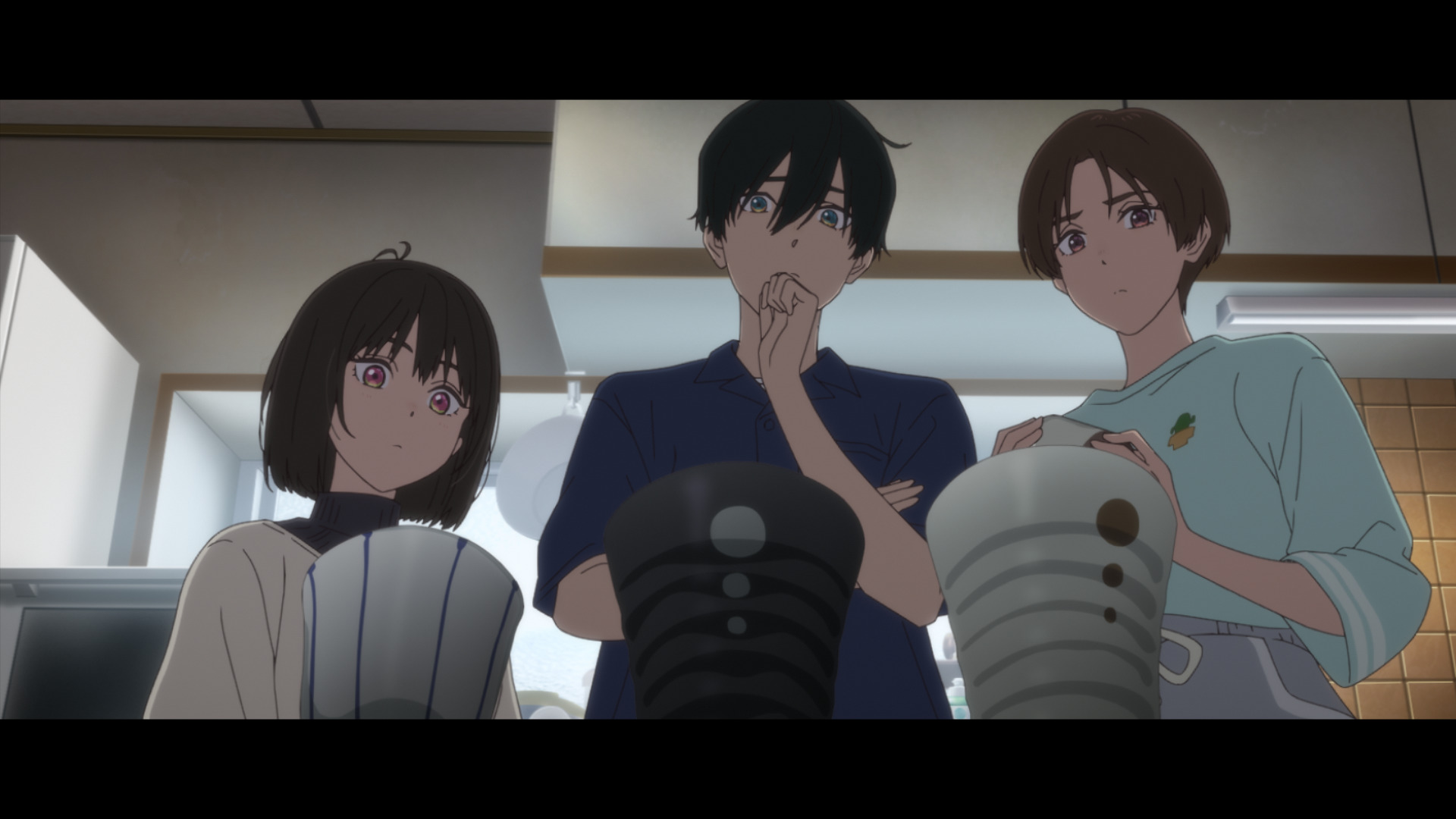
The interactions between those two are charming and entertaining, and I was so captivated by them making such deductions that would easily put an adult’s to shame, that I ended up finishing all the volumes in no time!

— When producing the music, what did you pay particular attention to?

I wanted to use Celtic-like folk instruments for the main theme, and also put some vocals in it. The director instructed me that even if the setting was the suburbs of Gifu, a calm and quiet scenery with a serene river and a bridge, he wanted a slightly sharper component within it. While Kobato-kun and Osanai-san, who at a first glance appear to be ordinary people, are represented via the inclusion of the folk-like elements, in order to better suit the vision behind this work, I went through a trial-and-error process to compose the music, incorporating things like irregular time signatures and omitting a beat from the usual meter. While still retaining the idea of a peaceful suburban imagery, I paid attention to keeping intact the mysterious and enigmatic tone of the story. Additionally, I directly visited the real locations where the anime is set, and used the atmosphere I experienced there as a reference for composing the music.

— What kind of instruments were used in the soundtrack? Did you consider using different ones for each character?

While focusing on the idea of Celtic music, to convey the feeling of the suburban scenery I used instruments like a tin whistle, an ocarina, a 12-string acoustic guitar and a fiddle [most often a violin used for folk and country music, as opposed to classical and jazz] and depicted an imagery suited for this work. Additionally, I’m really fond of the bass clarinet, so I featured it in various tracks. During the recordings, I consulted with the saxophonist Suzuki Kei-san, and had him play in various styles depending on the tune—from low to high tones, including clarinet-like, bassoon-like, and free jazz styles. Also, this time, I thought up and composed the main theme with different instruments and arrangements to fit each character. For Osanai-san, while I used lovely and sweet-sounding instruments in the arrangement, in order to depict her inherent duality which we catch some glimpses of, I used two cello melodies layered on top of one another, with one of them eventually shifting in range to give the idea of two different voices playing at once. As for Kobato-kun, I opted for a straightforward melody. Since there are deduction scenes involving sweets, I was conscious of not making it sound too serious or stern. There are also tracks centered around instruments like the marimba and vibraphone. Additionally, the biggest contributor, who magnificently performed the main theme, is the amazing vocalist EUREKA REPUBLIC-san! Somewhere in her clear and pristine voice, you can feel a hint of mystery. I believe we were able to craft a musical piece in perfect harmony with this work. 

— Which episode would you say left a strong impression on you, Obata-san?

A certain scene in episode 5. Originally, it wasn’t intended to use any music, but it felt a bit bleak so we decided to try and add a store’s background music-like track. I thought that adding a cheerful sound like the mandolin’s would have made Osanai-san cuteness stand out more, so I proposed the idea during the voice acting session. Discussing ideas like this with the whole team, we decided together what would have worked best for every episode. Director Kanbe told me that in this work, he didn’t want to use music very often, but for the scenes where he did, he wanted the tracks to play for nearly their full length. Especially in episode 1, since the music is used sparingly, the moment the main theme starts playing is very impactful, it was a new discovery for me as well!

— What were the enjoyable and interesting aspects of composing the music for this work?

Rather than picturing the show as a whole while writing the tracks, I’d say that thinking up each and every sound and composing one song at a time was a really nice experience, since it was a first time for me. Above all, the members of the stuff were all great people, heavily invested in the project, and I’m deeply thankful I was to work with them. 

— Lastly, a message for the readers.

I hope that while watching this amazing work, Shoushimin Series, you’ll direct some of your interest to the soundtrack as well. 


Part 1 – Interview with director Mamoru Kanbe
Part 2 – Interview with scriptwriter Toshiya Ohno

Toshiya Ohno – Interview on Shoushimin Series

Original interview from Newtype (September 2024 issue), original interviewer: Haruyo Igeta; genga corrections by Keisuke Hiroe.


We have the visuals, so we should trust their power

~ A suggestive work that leaves room for imagination ~

— What were your feelings when you first came in contact with the original work?

I felt that the dynamic between Kobato and Osanai was really interesting, and that the fact that, despite being clearly eccentric people, they’re still trying to become ordinary had some cuteness and a hint of sadness in it. A subtle sense of humor is also distinctive of this work.

— Knowing you had to set up the script, what aspects did you pay particular attention to when reading the novel?

While I was reading it, I thought about how to portray the dialogue scenes and how to translate onto the screen the world as it was described in the text.

— The director said you are “really good at capturing the essence of the original works” [Part 1 of the interview with Director Mamoru Kanbe].

I’ve been doing this for a long time, so I suppose developed a certain knack for it. When it comes to a novel, the key is not just how well you grasp the main points, but how you shape them. As for the series composition, it’s also a matter of length and time, often the director asks what the of story is about in brief. Keeping that in mind, I start by outlining the essential elements that have to be included in each episode. 

— What are those essential elements in Shoushimin Series?

The peculiar character dynamics, the setting and the atmosphere. I carefully ladled these elements out while imagining the scenery and flow of time in Gifu, the city where the story takes place. Also, there are fine and subtle expressions unique to the novel, so I carefully considered how to translate them into visuals as well.

— What instructions did you receive from the director?

Since it’s the third time I’ve worked with Kanbe-san, I knew that he, as the director, wouldn’t use narrators and monologues, and he would avoid conventional flashback scenes. This means that he values leaving room for imagination and not over-explaining things, and even if it made writing the script more challenging, I tried to abide to that approach. Not only the director’s, but considering everyone’s opinions, every week we met and discussed how to come up with thoughtful and appropriate depictions within the given limitations.

— When writing the script, how did you interpret Kobato’s, Osanai’s and Kengo’s characters?

Kobato-kun is the one I relate to the most. I too, due to the nature of my job, have a tendency to overthink things and end up placing excessive importance on my delusions, so I was able to understand how Kobato-kun’s thoughts don’t always line up with reality and how he gets overconfident when solving a mystery. As for Osanai-san, I don’t get her at all… that’s what I kept thinking while writing the script. Since the story is being told from Kobato-kun’s perspective, I believe that I too, from my position, could write it without fully understanding her and relying on my imagination. Regarding Kengo, I thought that I had a classmate like him in middle school as well. He’s an incredibly good person, and even if his personality is the opposite of Kobato’s, they’re a really charming duo. I wrote the script thinking that they might admire each other in some way.

— When delivering the mystery parts in the script, was there anything you paid particular attention to?

The moments when the main characters are stuck in the thoughts or when they feel like something’s off had to be portrayed properly. But at the same time, I gave careful thought to how to make those moments feel effortless and unobtrusive.

— Was there anything you gained, or any new things you discovered, from being involved in this project?

The fact that, even without extensive narration and even without over-explaining things, a story can still be functional and solid. Nowadays, anime and TV dramas tend to be overly talkative and overly descriptive, whereas this work goes completely against that direction, and both I and Kanbe-san are pleased that’s the case. We have the visuals, so we should trust their power. That’s the awareness you generally should have. But watching the works that are actually airing, the style of Shoushimin Series may feel surprisingly fresh.

— Touching on the highlights from episode 5 onwards, please, leave a message for the readers.

This work is a mystery, but that’s not just about the cases. The story is full of other mysteries as well: what it means to be ordinary, what’s going on in Kobato’s and Osanai’s minds, what they think about each other, whether and how their relationship is going to change… so I hope you can enjoy it by finding a mystery you like and making your own guesses about it. Also, it’s a mild work set in a very quiet town, but there are some unexpected developments coming up in the future and the relationship between Kobato-kun and Osanai-san is going to evolve, so I really hope you will look forward to that.


Part 1 – Interview with director Mamoru Kanbe
Part 3 – Interview with composer Takahiro Obata

Mamoru Kanbe – Interview on Shoushimin Series

Original interview from Newtype (September 2024 issue), original interviewer: Haruyo Igeta; genga corrections by Keisuke Hiroe.


I hope it becomes something different from the usual

~ Incorporating new techniques to make this work’s world move ~

— Please, tell us the details on how you became involved in this project. 

I received the offer directly from animation producer (Masakazu) Watanabe-san. Since the original work is a novel, adapting it into a visual medium is difficult, so my first reaction was: “What do I do now?”, I was perplexed (laughs). 

— When you first read the novels, what were your impressions and your thoughts from the director’s perspective?

There were two points I felt I had to pay particular attention to when adapting it into an anime. First of all, the mystery approach that is crucial to this work. I thought I had to carefully depict the various elements typical of the mystery genre, such as the tricks and alibis. Second, the evolution of the relationship between (Jougoro) Kobato-kun and (Yuki) Osanai-san. I felt that that was the true charm of the story, so I had to portray it properly.

— Did you empathize with the characters or feel connected to them? 

Upon reading the original work, my honest first impression was: “I really don’t understand these two”. It was while working on the storyboards that I gradually began to grasp what it was all about, and I felt my understanding of them deepened. I’m sure that (Toshiya) Ohno-san figured out a lot of things while writing the script, but in my case, I start to see things only in later stages. There are things you can only understand by actually getting your hands dirty. 

— What kind of discussions did you have with Ohno-san

We didn’t have very detailed or thorough discussions. We’ve already worked on several projects together, and this is our second mystery work. Ohno-san is good at grasping the concept quickly, so I trusted him and left it to him. 

— Did you receive any specific request from Honobu Yonezawa-sensei?

When he said that “the novel and the anime are separate things” it left an impression on me. Also, we spent just one day scouting the locations together. In that occasion, I suggested making Kobato’s house into a traditional sweets shop, and he promptly approved of it. 

— What kind of conversations did you have with character designer (Atsushi) Saito-san?

I think I just told him not to feel bound by the designs on the cover illustrations. Ultimately, I asked him to draw the designs based on the impressions he personally had. 

— And what about art director (Akira) Ito-san?

Ito-san was busy and couldn’t participate in the location scouting, so I hand him over some pictures. It was an enormous amount, but he carefully inspected them and in the end, he became far more knowledgeable than us. Personally, I asked him to make the sky bluer than usual. 

— In regards to the recording sessions, what kind of directions did you give to the cast?

Above all, I focused on asking them to speak in a whispery tone. I asked (Shuichiro) Umeda-san [Kobato’s voice actor] and (Hina) Yomiya-san [Osanai’s voice actor] to speak softly, almost as if they were in a quiet library. I wanted their acting to feel as realistic as possible. To the other voice actors, I asked to adapt to the atmosphere between the two [Umeda and Yomiya] and express themselves naturally. 

— What did you discuss with sound director (Katsunori) Shimizu-san?

I’ve known Shimizu-san for a long time and I’m very familiar with him, so rather than the voice recordings, we talked more extensively about how to use the soundtrack. I wanted minimize the background music as much as possible… since it’s a dialogue-heavy work, I thought that the visuals would hold up well enough with just the dialogue alone. 

— So, what kind of instructions did you give to composer (Takahiro) Obata-san?

At first, I thought it would have been a nice idea to make a couple of songs with lyrics and have them playing during the deduction scenes. After discussing this, Obata-san made a demo and it turned out to be so good that we ultimately decided to go with just that one song. He also incorporated elements of folk music and suggested using a 12-string guitar. 

— You were in charge of the storyboard for episode 1. What were the key points you focused on, and what did you want to convey to the staff members who worked on the storyboards afterwards?

I had already decided to use the main theme song, so I made sure to draw the storyboard in a way the track would fit the climax well. Also, during dialogues, I made frequent use of a presentation technique where the location suddenly changes. For example, when in the mystery-solving scene Kobato reenacts the culprit’s movements. To prevent the dialogue-heavy drama from becoming tedious, I incorporated this technique as a unique element of this work’s presentation. 

— Was there any idea from the other staff members that stood out to you?

Many ideas came up when writing out the script. From the order of the scenes to the ways of omitting or replacing the lines from the original work, I found myself thinking “I see” every time we had a meeting. I’ve acquired many great ideas from the people who were in charge of writing the script. 

— What new things did you discover or gain from engaging in this project?

There are many things. The fact that using CinemaScope, which was a first for me, is surprisingly easy and convenient is one of them. I also think it kind of matches the atmosphere of this show. I experimented a bit this time, like with the technique to change the location in the middle of a dialogue, and I believe it turned out to be quite effective. I wanted this work to become something that differed from the usual imagery. I hope the viewers will notice in what ways it’s different.  

— Lastly, a message for the readers. 

From episode 5 onwards, this show becomes even more akin to a mystery. Especially between episodes 8 and 10, there’s a shift in the approach as the plot takes significant turns, so I hope you look forward to it. I also hope you’ll keep an eye on how the relationship between Kobato and Osanai evolves. 


Part 2 – Interview with scriptwriter Toshiya Ohno
Part 3 – Interview with composer Takahiro Obata

Shoushimin Series #3 #4 – Direction Notes

A one-week break between episodes 3 and 4, followed by the coming of August and thus my summer vacation that took me away from home for a couple of weeks, was a sequence of events that certainly didn’t help in retaining any semblance of the consistency this blog already lacked. What I did retain throughout the past month though, is my overflowing enthusiasm for this show (as those of you who follow me on Twitter are probably sick of hearing about) and naturally, it’s the last thing on my mind to give up on this series of blogposts breaking it down, no matter how behind schedule I am.

So, it’s with great pleasure that I finally present you with another instance of my ramblings about Shoushimin Series, this time covering episodes 3 & 4, Humpty Dumpty and Mind of a Lone Wolf.


Episode 3 – ハンプティ • ダンプティ: Humpty Dumpty

Right after the intro scene, which is already remarkable in itself and its successful approach to present the tension-filled classroom where Osanai and her fellow classmates are taking their exam, immersed in a diegetic silence with no background music in order to make the sound effect of the glass vase suddenly breaking stand out even more, we’re back to a very familiar scenery, one in which the emphasis on the layouts is the sole and most important visual trend.

As episodes 1 and 2 got us well used to, in this show, presenting the differences (or the similarities, or even the boundaries) between the members of the main cast is a job best suited for the layouts. The way the characters are framed in relation to one anther (or to the background and foreground elements) almost always encodes a subtle description of themselves or their relationships. This much was true throughout the course of the first two episodes, and while unsurprising, it’s still surely a delight to see the same visual trend being brought over to episode 3.

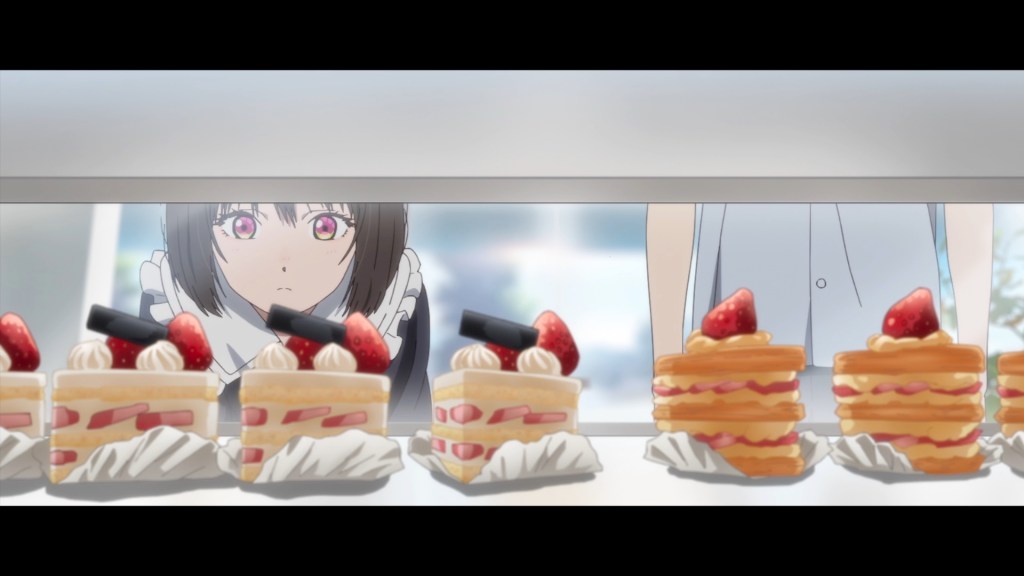
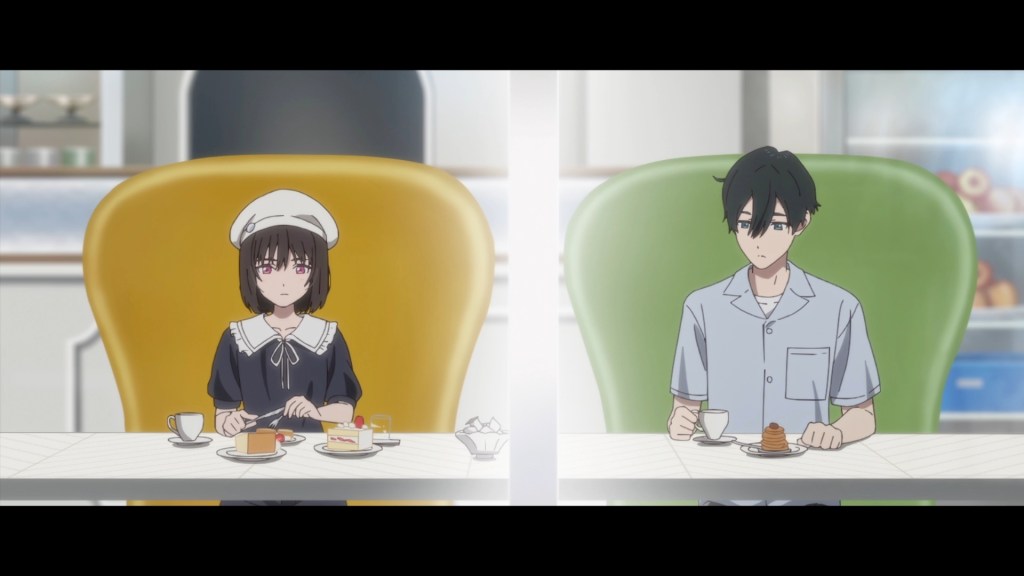
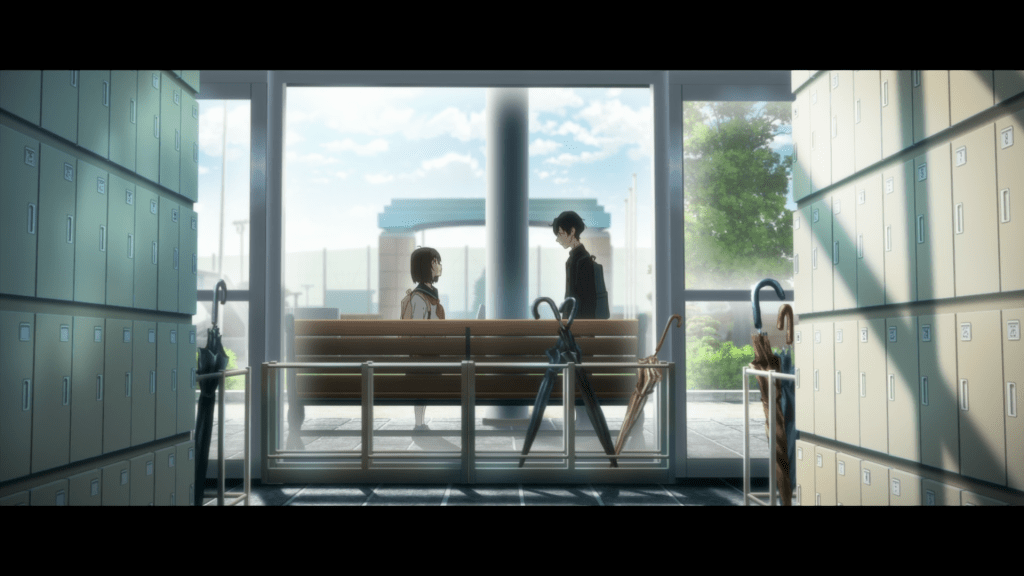
For example, both Frame 1 and Frame 2 effectively convey who, between Kobato and Osanai, is more fond of sweet foods and desserts, each one in its own way; for instance, in Frame 1, only Osanai‘s face is showing, directly staring at the cakes, and not only the number of sweets is larger on her side of the frame, but the cakes themselves look more elaborate and full of sweet ingredients compared to the ones on Kobato‘s side. Frame 2 on the other hand, takes a more direct approach, “physically” separating the two characters with the frame of the window in front of them (also using different colors for their seats), and making it clear at a glance whose order on the table is more substantial and overflowing with sugar (it’s also a nice detail how the bowl seemingly containing milk pods and the sugar for their drinks is, too, on Osanai‘s side of the frame).

Albeit not focused on distinctions and symmetries, the next sequence as well, when Kobato temporarily leaves Osanai alone at Humpty Dumpty to retrieve his smartphone from the locker in his classroom (as well as to investigate the truth behind this episode’s first case), features a layout-focused presentation that struggles to feel uninteresting, immersing Kobato inside the environment he’s intent on exploring.

If there’s something I love when it comes to visual-oriented storytelling (perhaps again thanks to Hyouka’s incredible direction in a similar circumstance), is when the passage of time, even if trivial, is left untold in the narrative and it’s instead conveyed through visual elements or small changes in them. There are obviously several “levels” to this, the most common and coincidentally least interesting one being a change in the lighting suggesting, for example, the transition from afternoon to evening with the sky turning red. Shoushimin, on its hand, handles it with a more sophisticated (and thus more subtle) technique, that is, showing us a still shot of the cakes on Osanai‘s side of the table as soon as Kobato gets back to the sweets shop. What such a shot has to do with the passage of time is pretty straightforward: the three plates in front of our gluttonous yet minute girl still have each a piece of cake on top, and more importantly, they’re completely different cakes from the ones she was eating before Kobato leaved earlier, implying enough time has passed for Osanai to finish up her previous order and make a new one (and, if it wasn’t clear enough already, that she really, really likes sweets).

As a side-note, the still shot also follows Kobato‘s movement directing his sight to the cakes, somewhat implying that he too was noticing this same detail.

Moving on to the second part of the episode story-wise, we’re greeted with yet another strong showcase of expressive framing.
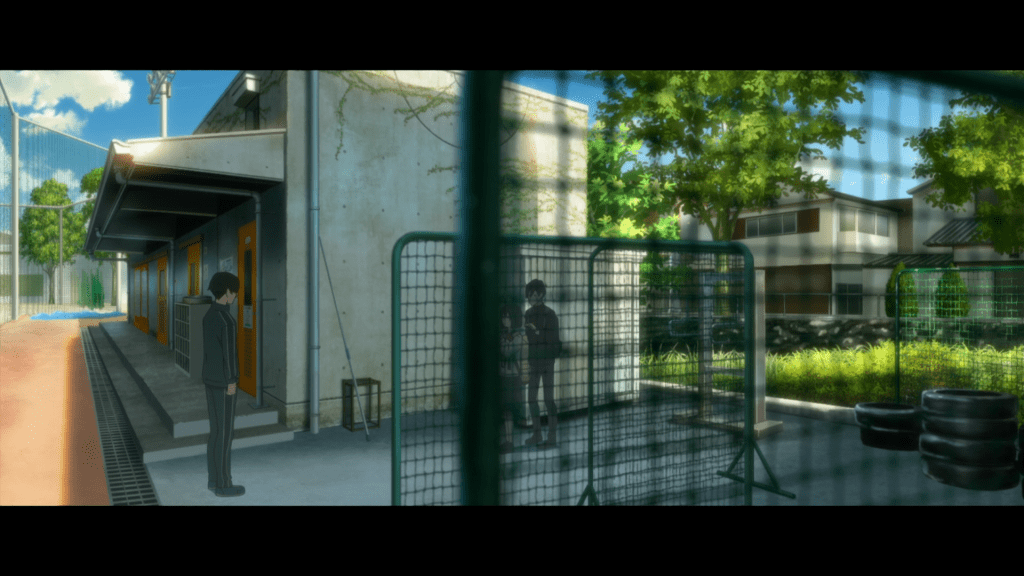
The one I personally find the most interesting and clever is Frame 3; when our two main characters are chasing down Sakagami right after spotting him riding Osanai’s stolen bicycle, the moment their target becomes unreachable, the way the two pursuers are framed remarks their physical inability to go any further, complementarily to them actually stopping and talking about it. The fences in the foreground literally block Osanai and Kobato‘s movements, completely covering their bikes as well as the lower half of their bodies (i.e. their legs), making it extremely clear to the viewer that they are forced to stop there (and additionally conveying a slight sense of frustration and powerlessness).

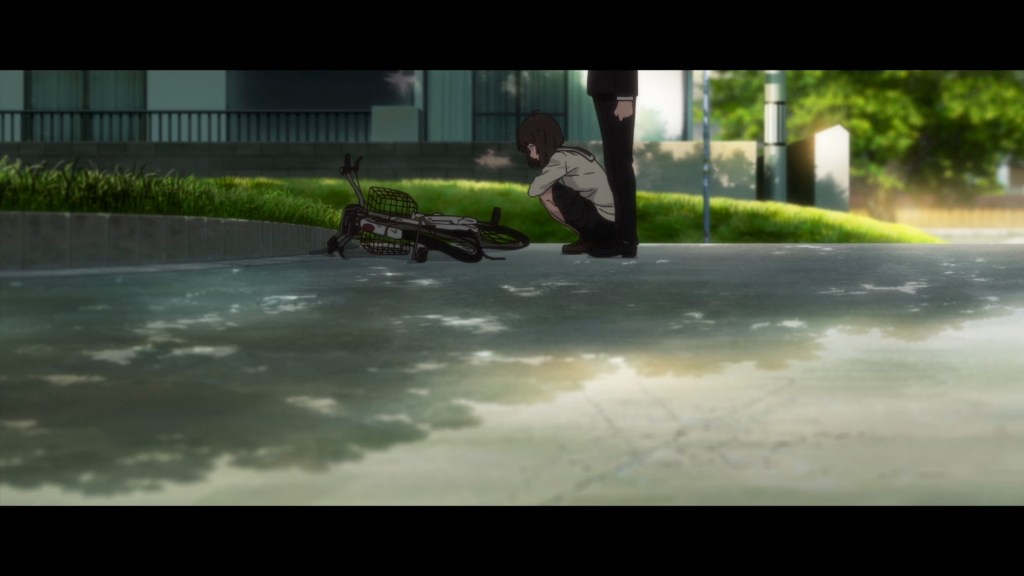
The later instances, like in frames 4 and 5 (after the two figure out exactly what the culprit’s movements were, with Kobato impersonating him in a similar fashion to how episode 1 and 2 tackled the visualization of the characters’ thought processes), involve a strong use of negative space. In Frame 4 for example, Kobato‘s upper half is cut off, and only Osanai and her broken bike fit in the frame. Frame whose proportions feel odd and unbalanced, purposefully so, in order to gradually portray the sense of unease surrounding Osanai‘s mental state in regard to the unfortunate situation she’s unwillingly part of.

It’s noteworthy how, from the moment out sweets-loving girl starts to progressively show her true colors, an increasingly deeper sense of distance is implied by the storyboard (and by extension, the derived layouts) as Kobato and Osanai are almost never framed together, and when they are, they’re never placed on the same layer of depth.

Talking about the true colors, the trope introduced right in the first episode of presenting the character’s mental spaces as physical manifestations is used once again, this time in a slightly different manner.
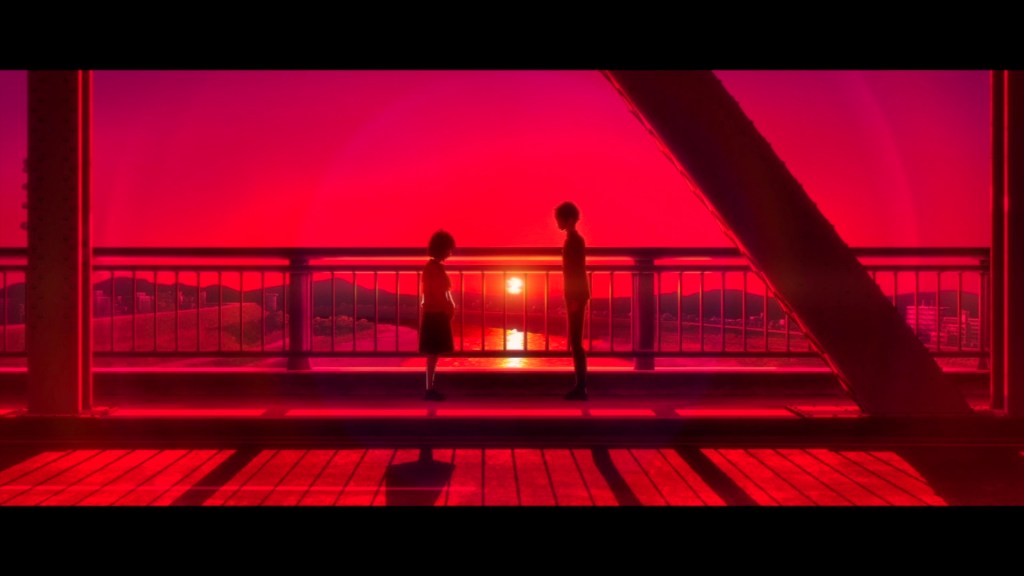
What feels the most jarring here is not the spatial dislocation, but rather, the chronological one, as the blood-red colors of the sudden sunset that pervade the entire sequence instill a feeling of danger and fear throughout the scene (and are particularly successful at doing that thanks to the incredible color coordination work by Tomomi Kato and the photography at play). We, including Kobato, as hinted in Frame 7 that he is the foreign presence, have clearly been transported into Osanai‘s own mind, and are finally able to catch a glimpse of her true nature; or in other words, what restrains her from being a full-fledged “ordinary person“.

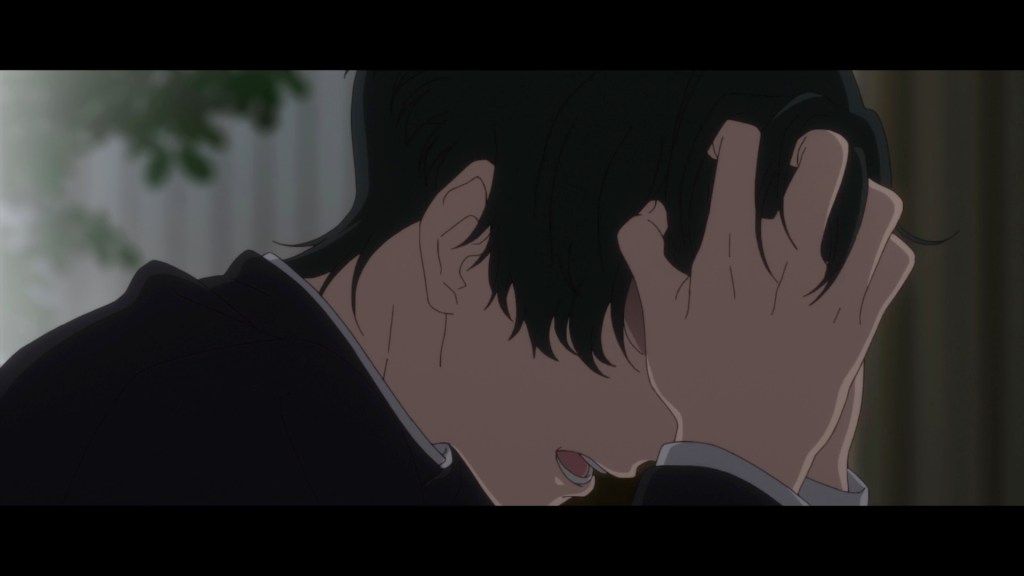
Before wrapping up, I can’t fail to mention how thorough and genuinely expressive the character acting has been all throughout the episode, especially so during the last sequence when Kobato is exhibiting his own discomfort to Kengo. This, paired with the incredibly polished and detailed drawings, allow this series to showcase its characters’ emotions in an essentially natural way, without falling into an overly dramatic presentation, retaining in fact the very grounded and heartfelt pragmatism central to the vision behind this adaptation.

One last neat detail worthy of mention is the use of the environment and weather to describe Kobato‘s feelings; as his mind gets clearer thanks to the exchange he had with his old friend, the cloudy and moody sky turns clearer as well, drastically lightening the tone of the scene. Although it’s by no means an innovative trope, the beautiful execution makes for a perfect conclusion to yet another amazing episode.


Episode 4 – 狐狼の心: Mind of the Fox & the Wolf

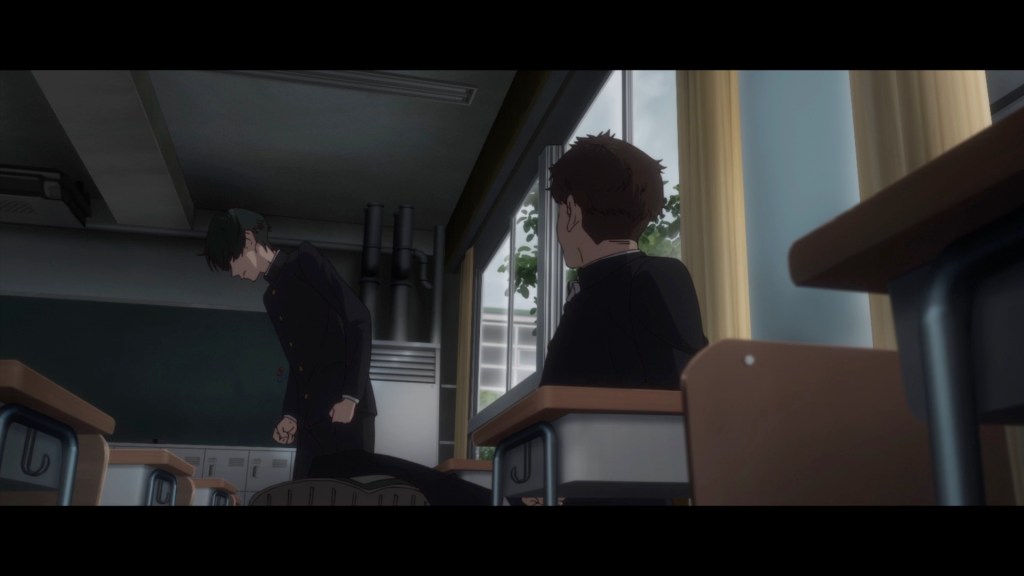
After the aforementioned one-week break, continuing directly from where the last episode left off, episode 4 begins in Kobato and Kengo‘s classroom, and it traps us there with the two of them for nearly the entire 23-minute runtime. A deliberate choice for sure, one that finds its reasons in both a specific directorial approach and a cost-efficiency need.

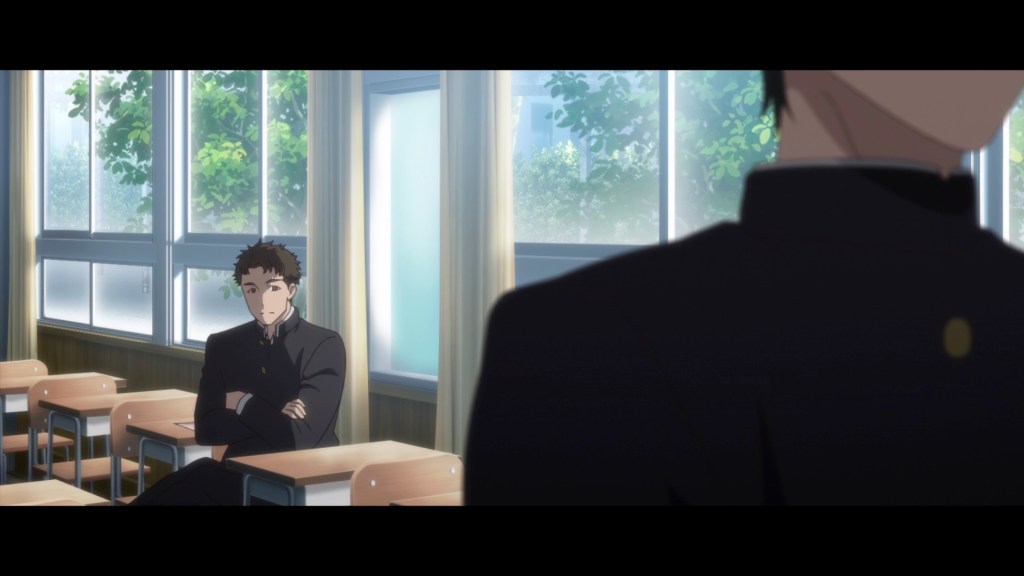
It might not be perfectly appropriate to call episode 4 as a whole a “bottle episode”, since, especially in its later phases, the location does change a few times and other characters make their appearance. However, in the first two-thirds of the episode, we’re presented with a continuous back-and-forth of similarly framed shots and cuts, depicting just the two friends more or less intent on finally piecing together this story-arc’s main case. Meticulously abiding by the 180-degree rule, this long-lasting exchange of questions, answers and theories is surprisingly able to keep the audience (or at the very least, me) engaged all throughout, despite nothing really happening during these 15 minutes we spend with Kobato and Kengo exclusively inside their classroom, with the exception of a specific instance that I’m going to adequately address later.
In addition to being a successful visual approach, it’s also a relatively low-cost one at that, as it’s somewhat noticeable that the drawings look ever so slightly less polished than usual, and setting up the whole sequence to bounce between homogeneous shots like this helps mitigating the potential inconsistencies and irregularities a seemingly lower-budget episode might be subject to.

Overall, the usual visual theme of symmetry was also at times featured throughout the episode, not prominently so, like in the previous ones, mostly due to a lack of necessity to convey yet some other details about the characters’ relationships, which are already well established by now.

The “particular exception” in the setting I mentioned earlier was, as you might have guessed, the physically abstract visualization of the characters’ minds we’re extremely used to at this point.
Much like last episode’s, this scene too takes a slightly different approach compared to its predecessors; in the previous iterations, the locations where the characters were figuratively transported to only served a purpose in deallocating the mental processes from the physical world, creating a sense of immersion and isolation as I’ve already discussed in my previous blogpost, and as far as I could tell, had no intrinsic meaning inscribed into them. This time however, a strong emphasis is placed on the “movements” occurring inside this ephemeral space. Specifically, Kobato‘s interaction with the spiral staircase has a rather distinct symbolic utility. He’s the only one of the two who’s willingly and steadily climbing up the staircase, getting closer and closer to the solution, implying that between him and Kengo, he’s actually the only one who’s actively engaged in the thinking (as Kengo‘s body language also seems to suggest).

What I liked the most about this sequence though, was the implied continuity between the abstract space and the real world, as Kobato‘s movement starts on the metaphorical overpass and ends in front of the blackboard, back into the classroom. Not only it greatly improves the fluidity of the scene, but it also establishes a clear connection between the two worlds maintaining the same focus as earlier, set on the physical motion.

I believe this time, the real potential of these conceptual sequences was truly, fully realized, making the scene feel even more compelling and captivating than usual, not only in its presentation but also in the contributions it made to the actual narrative.

As a closing note, another scene towards the end of the episode that caught my eye, is the one where Kobato and Osanai are having a very high-pressure talk about their promise. Having both broken their vow to become ordinary people in some capacity over the course of the last few episodes, the future of their relationship as it stands now is precarious and unstable, and both of them feel somewhat uneasy about their recurring lack of abidance. This scene does a masterful job at conveying such palpable intensity, making use of increasingly tighter and suffocating camera angles, relentlessly stitched together until the discussion reaches its climax with the extremely close-up shots on the characters’ eyes (frames 1 and 2). It’s only when the two finally reach a satisfying conclusion that all the tension is promptly released in a wider, more spacious shot (Frame 3).

Putting to good use the various visual means animations has to offer is a non-trivial task, and Shoushimin Series has proved once again its inherent ability to do so.


Despite how late I am posting this commentary, I hope I’ve managed to offer some interesting insights nonetheless. There are always so many details and cues embedded in this show that I don’t think I’ll ever run out of things to say and point out in these breakdowns. My schedule is a bit tight right now, but I’m really looking forward to write about episodes 5 and 6 next!


Support Shinseiki on Ko-fi

Shoushimin Series #1 #2 – Direction Notes

It’s 2014, I’m a middle-school student and on my journey getting into anime I stumble across KyoAni‘s adaptation of Hyouka. Aside from its contents, which I’m still deeply attached to to this day, it’s exactly this show that years later (that is, a few years ago) got me interested in the production of Japanese animation as a whole, or to put it into the right, narrower context, in the “technical” aspects of it, such as storyboarding or direction. Hyouka being a masterclass example of both these things certainly helped, but who I really need to thank for getting me into this world of carefully designed visual exposition, is one of the creators whose content has taught me the most and has changed the way I engage with anime altogether: Replay Value. Specifically, with his Hyouka breakdown series, A Rose-Colored Dissection (which, of course, I encourage everyone who still hasn’t to check out).

Given how influential of a work it’s been for me, I’ve been thinking of writing a series of posts about Hyouka ever since before getting started with this blog, but for now it’s gonna remain an idea, as I think it would end up being just a (probably worse in exposition) repetition of what Replay Value has already done on his hand.
Instead, what I’ll be doing today, trying to retain a semblance of consistency with the format I’ve already used with Kusuriya no Hitorigoto a few seasons back, is a commentary of the new anime series produced by studio Lapin Track, directed by Mamoru Kanbe, Shoushimin Series (localized as “SHOSHIMIN: How to Become Ordinary“).

Why the preamble on Hyouka then? Well, aside from my desire to address the biggest inspirations that led me to do what I’m doing, Shoushimin too is an adaptation of a novel by the pen of Honobu Yonezawa, and although I initially didn’t want to compare it to Hyouka, afraid that making such a connection would feel somewhat forced due to my (heavily) biased attachment to the latter, one episode was enough to hit me with a wave of nostalgia thanks to the intrinsic qualities unavoidably inscribed in its writing, that I couldn’t help but bringing it up anyways. What I was not expecting to see though, were the same idiosyncratic visual quirks (albeit in a different capacity) that made me fall in love with Hyouka (and by extension, animation) years ago.
To be clear, I’m not implying nor meaning to say that the direction of Shoushimin Series has been influenced by Hyouka‘s, nor that they’re trying to replicate it in any way (in fact, I’d argue the two approaches don’t really have all that much in common). Instead, what I meant to say is that Shoushimin too is filled with expedients of visual storytelling, be it via clever framing or a descriptive use of light, that make for a perfect subject for my blogposts.

Well then, here I am, ready to bother you, dear reader, with my inconsistent ramblings about what I can already tell will be one of my favorite media experiences of the year, the Shoushimin Series anime adaptation.


Episode 1 – 羊の着ぐるみ: Sheep Costume

Right off the bat, I’d like to address some general “visual qualities” and features I noticed, like how, with good and refined drawings, the (purposefully) rather simple and malleable character designs by Atsushi Saito were delivered in a very expressive way, well capable of conveying the broad range of emotions exhibited in this premiere. (Literally) on top of that, the compositing also did a fairly good job at integrating the digital “cels” with the realistic backgrounds, making at times use of additional effects to render the scenes in a more true-to-life fashion (like blurring out the objects that are closer to the camera), or more deliberately, to convey a sense of “isolation” or “separation”, like with the fully blurred background in this shot. The color design in general, opting for a properly muted palette, also helped in setting the tone of this story, suggesting on his hand too the overall focus on the mundane.

Another visual feature, albeit not descriptive of the contents of the show, that’s pretty much impossible not to notice since the very beginning of the episode (including the visuals for the opening!) is the 21:9 aspect ratio, as opposed to the nowadays standard 16:9. It’s by no means an “unprecedented feature” in anime or anything on that level, though, it’s still pretty nice to see a TV show almost fully (as the ending visuals will go back to the now-traditional 16:9) committing to it.

Another aspect worth of mention, this time not related to the visuals, is the sound design. With the focus mainly set on reproducing accurate background and ambient noises, the degree of immersion this episode was able to achieve was rather high. This is to say, the well-designed sound effects and the softness (or in some instances, lack) of the soundtrack really helped making the depiction of the world, and the interactions the characters have with it, feel more concrete and grounded in reality.

The main highlights for me were of course the many instances of visual storytelling present throughout the episode, which, by extension, I’d say suggest a broader approach to the direction of this show as a whole.

A lot can be inferred solely from a visual standpoint on the relationship between the two main characters, Osanai and Kobato. The way they’re often laid out, being parallel to each other in a frame whose space is equally divided by some element in the background or foreground (like in frames 1 and 2), implies some sort of contrast between the two, but not in a dichotomic way, rather, in a symmetrical one. As the episode makes clear in its later phases, the two of them are bond together by their mutually shared dream of “becoming ordinary”, which manifests in different but cohesive ways; they strive for the same goal, but they do have their own preferences and identity (for instance, Kobato not being fond of sweet food contrary to the gluttonous Osanai, a characteristic noticeably showcased by the striking difference in their orders in frame 1), which ultimately result in a different approach towards their objective. In other words, their symmetry implies complementarity, not contrast, to one another.

It’s when such visual equality is missing (like in frame 3) that the implications change, and the meaning shifts to another layer, like depicting the difference between being “in the light” or “in the dark” about the solution to a certain hazy case.

Another type of clever framing and layout at play in this episode, certainly is one that implies actual “disconnection” or “distinction” (as in the case of frames 4 and 5). Uneven spacing and positioning in the frame, in addition to a feeling of unease and tension, convey a clear sense of distance that serves to delineate the sharp separation between the two parties, as well as the cohesion of one of them (namely, Kobato and Osanai).

What to me captured the eccentricity of this show’s direction the most, was undoubtedly this whole sequence (which the video above shows just the last portion of), basically, the “unraveling the mystery” sequence. While Kobato is explaining his theory for what had actually happened to Osanai, as the two walk home after having reached a conclusion with the interested party (the “thief”, Takada), we’re shown a visualization of Kobato‘s thought process with him “physically” retracing the culprit’s movements and actions. The sequence then ends with the portion attached above, that is, a compilation of disconnected cuts showcasing the two main characters talking, ultimately stating their will and promise to live as “ordinary people”, and making a little detour to the river on their way home. This a-spatial and a-chronological visual presentation effectively succeeds in feeling immersive and compelling, and in a sense prompts the viewer to actively engage with the scene, rather than experiencing it passively.

I’m calling it a “distinct trait of the direction” because as we’ll see in a moment, the very same peculiar approach is present in the second episode as well, and moreover, this way of presenting the story and the characters’ interactions is totally original to the anime (as one could probably correctly guess), and no trace of this “disconnected” exposition is present in the source novel (which, by the way, I couldn’t help but start reading).

Before jumping into episode 2, I’d like to mention how clever and, more importantly, well-realized of an idea the ending visuals are. Basically, what we’re looking at is a series of live-action photos (albeit with some touch-ups) which the hand-drawn characters move in and interact with, as to once again convey how grounded in reality this whole setting is. On top of looking very nice, I believe it’s neat how every (visual and not) aspect of this show serves a purpose in realizing the well-defined vision behind this adaptation.


Episode 2 – おいしいココアの作り方: How to Make Delicious Hot Cocoa

Starting off in the strongest possible way to maintain the sense of realism established in the first episode, episode 2’s introduction takes place in a beautifully crowded shopping gallery, where the incredible lighting and (again) the very well-designed background sounds really make the already immersive setting feel as grounded in reality as it can possibly be. So grounded that in fact, following the steps of the previous episode, the locations where the events unfold are actually real places.

Some other of the aforementioned visual qualities have also naturally been brought over to this episode too, like the super pretty drawings once again putting to good use the ductile character designs, and the wide spectrum of emotions properly portrayed on the characters’ faces (and notably, the narrower aspect ratio is of course still here as well!).

What I’m most happy to see again though, is obviously the same approach to express and convey in a visual way. In contrast to the first episode, it’s not background elements that draw lines between the characters, rather, this time, the background as a whole and its layout become means to define the boundaries between them.

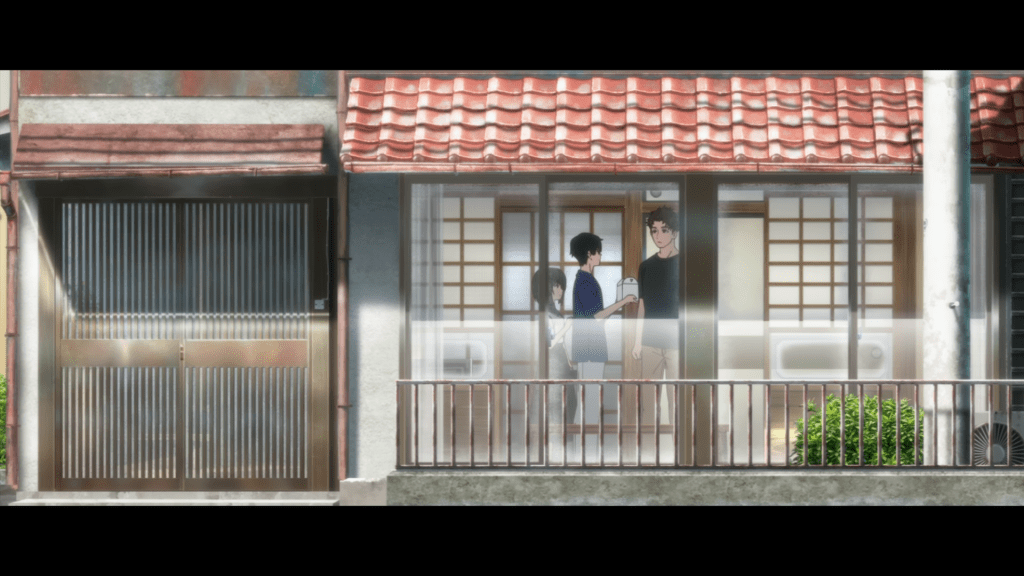
It’s especially clear that Osanai kind of feels out of place visiting Kengo‘s, Kobato‘s friend, home. Frames 1 and 2 intelligibly hint at that, “encapsulating” the characters inside pre-defined portions of the background, and while Kobato and Kengo fit in the same space, Osanai is the only one that’s not entirely enclosed within the same physical limits. She’s also almost forcibly brought into that same space by Kobato, abruptly so (as the quick shift from the more far away to the really close-up view strongly suggest) with him taking the box with the cakes straight from her hands and offering it to Kengo.

As the two friends begin to talk, it’s quite noticeable how in frame 2, compared to frame 1, Osanai is growing more and more distant from the two; whereas in frame 1, just a small portion of her figure didn’t fit in the same area as Kobato and Kengo, now it’s only that very small portion that’s able to fit in, while the almost entirety of her body finds itself to be out of that boundary. Moreover, not only she’s practically in a different space than the two, she’s also nearly fully covered by the sliding door, as to indicate she’s more of a background presence than a foreground one in the scene.

The frame that does the best job at conveying the character’s “affiliations” with one another, and by extension their division, is definitely frame 3. Not only Kobato and Kengo are again the only ones to fit into the same space together (in this case, the reflection on the mirror) with Osanai being the one that’s now totally left out of it, purposefully placed in the farthest right corner of the frame, but the layout also suggests a broader outline on how the characters are grouped together. Dividing the frame in two sections, the inside the mirror and the outside of it, Kobato is able to fit in both at the same time, with his upper half in one and with his lower half in the other, designing him as the “common ground” between the characters; the mirror reflection contains Kengo but not Osanai, and the outer portion of the room contains Osanai but not Kengo, and Kobato is part of both.

The visual themes of “separation” and “division” are again extensively present throughout the episode, although in a formally different flavor, one that’s nonetheless still able to retain the same level of expressiveness and clarity.

As expected (and not only because I’ve hinted at it earlier), when the characters are putting their efforts into solving the (extremely mundane and unimportant) mystery, the presentation heavily relies on spatial and chronological dislocation, once again also exhibiting their thought processes and theories as a visualization of them actually acting as the culprit.

There’s something so beautifully dissonant in the sudden changes in location and time, especially as they happen without interrupting the flow of the dialogue, almost as if the “outside” is sort of a private, ethereal space, solely dedicated to the more introspective moments inside one’s mind. As they delve deeper into their abstractions and thoughts, they’re transported in another dimension altogether. The characters being in the same headspace is no more just a figurative image, instead, it manifests almost as a physical phenomenon.
I certainly can’t say I’ve experienced other visual presentations of the same concept as eccentric and compelling as this one.

Another aspect of this episode I cannot possibly fail to mention, is the overall focus on body language and mannerism, depicted with such an utterly great accuracy that it truly feels real and heartfelt. The cut above is of course not the sole instance of that, many more examples, including Kengo‘s nervousness to introduce the uneasy topic of the conversation he wants to hold, and Kobato intimately sliding his finger on the border of his cup, are featured here and there all through the episode. Yet another quirk to make this world and characters feel vivid and real.

Lastly, a noteworthy element is the incredibly solid attention to detail when it comes to physical interactions with objects. It’s not every anime’s feat to make you feel the density of every single layer of a piece of cake as a character’s tries to cut through it. And not only that, incredibly accurate fluid animation seems to also be a given throughout this episode.
It all makes perfect sense though, since the main topic of episode 2, as the title doesn’t try to hide in the slightest, is the not-so-secret preparation of a delicious cup of hot cocoa.


Hopefully, I was able to convey in this post even just a tiny bit of all my enthusiasm towards this new series, in addition to providing some maybe-interesting insights about its presentation. I was really anticipating Shoushimin since the day it was announced, but I would have never guessed it would hook me to this extent. It truly encapsulates everything I love about animation as a medium, and having a place (that is, this blog) to extensively talk about it really feels like a blessing to me.

Needless to say, I can’t wait for the next episodes to come out, and I’m sure they too will be filled with cool and neat stuff, well worthy of being written about.


Support Shinseiki on Ko-fi