
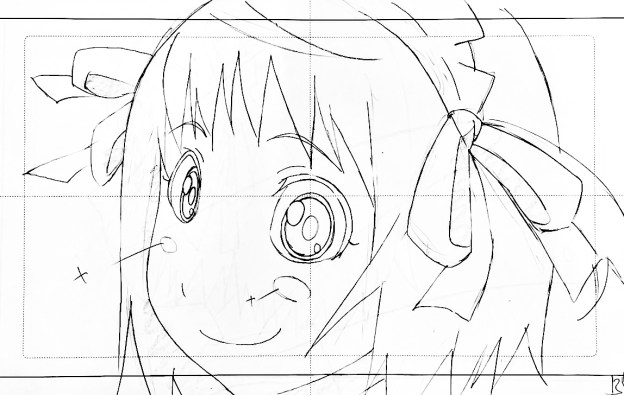
Original interview from Akiyuki Shinbo x SHAFT Chronicle (2019).
Check out this interview with better editing and pictures on the SoreMachi fansite too, who I wholeheartedly thank for the opportunity!
— Ishiguro Masakazu-san’s manga And Yet the Town Moves [Soredemo Machi wa Mawatteiru, hereafter referred to as “SoreMachi”] is a slice-of-life story set in a traditional downtown shopping district. However, it also incorporates elements from science fiction and mystery, making it a work with a slightly mysterious feel to it – akin to Fujiko F. Fujio-san’s unique concept of “a little wonder”.
Shinbo: You’re right, I indeed believe Ishiguro-san’s SoreMachi does have a taste of Fujiko Fujio-san’s charm to it. And it’s not just about the chapters with aliens, it’s about the fragrance of the whole work. It has a classic, traditional feel to it and I’m relieved that works like this still exist to this day.
— Tatsuwa-san, I hear you were already a fan of the original manga.
Tatsuwa: I’d been reading SoreMachi since the start of its serialization. I believe SoreMachi is a work such that if a hundred people read it, they’ll all end up with a different take on it, so at first I thought I would have been very difficult to adapt it into an anime.
Shinbo: For this project we intentionally used old-fashioned camera angles. Anime nowadays don’t use shots with characters reflecting onto objects or fish-eye angles anymore, but they’re all techniques that were frequently used in tokusatsu and the like back then. When I first became a director, I used to use them pretty often but at some point I thought “maybe it’s enough” and stopped. That’s the approach I adopted for SoreMachi. Also making the wall glass-paneled and shooting through it was one of the techniques.
— Some floors and desks were also made of glass, weren’t they? The shots where you could see the characters through the transparent glass were really unique and striking.
Tatsuwa: You’re finally unveiling the directing techniques you kept secret until now.
Shinbo: Yeah. With fish-eyes and reflections I wanted to convey a sense of mystery and strangeness. In the original, both chapters about everyday life and chapters with aliens in them unfold seamlessly in the same world. So, even in chapters where nothing out of the ordinary happens, I wanted to maintain the atmosphere where it wouldn’t feel strange if something weird suddenly occurred. If the bright and refreshing slice-of-life atmosphere and the one where mysterious things might happen were depicted in different ways, it wouldn’t feel as one cohesive world. One of the two sides would feel forced and out of place. However, I think that showing things through their reflections on other objects conveys that slightly mysterious vibe. In the original work, the sci-fi elements feel like are just on the edge, barely maintaining an everyday-life mood, right? In order to balance both, I realized it was necessary to consistently establish that kind of atmosphere.
— Oh, is that so. The scenes at the Maid Café Seaside or in the classrooms, set in the evening or with slightly dim lighting, also gave off a mysterious atmosphere.
Tatsuwa: I personally have a gloomy image of classrooms, so I tend to make them look darker. When I was a student, in the morning I used to get to school earlier than anyone else to study by myself, and I’d get really annoyed when the lights were turned on, so I guess that’s why I have a dark image of classrooms. I used to stay in the classroom with the lights off even after everyone else had already left. Also, I watch a lot of horror movies so maybe that’s also why I end up making things gloomier. Though, I do wonder if it’s a problem since the characters’ faces end up in the dark…
— In the first episode there was a scene where you suddenly hear something pass above the school and a shadow falls across the classroom, right? I remember wondering what that was.
Shinbo: Using just the sound, I wanted to leave a feeling of mystery surrounding what had just passed by. It could have been an helicopter, as well as a UFO. I wanted to try making a classroom scene using just sound and light for a while. I did something like that in another work already, but that time I was only in charge of the storyboard and ultimately it didn’t work at all. So that was a revenge aspect to it too. I’m glad it gave off a slightly mysterious vibe.
— The camera angles too switched perspectives in many ways, right? I feel like there were a lot of shots from below…
Shinbo: In the original, Hotori’s “slightly bottom-heavy” appearance is emphasized, so I wanted to highlight that as well. Especially in the scene where Hotori is wearing jeans, I could really sense Ishiguro-san’s attention to detail in the way he drew it. Though, there aren’t many scenes where she wears jeans, are they. If her legs are more exposed it gives off an ordinary image, so if she’s not wearing jeans it’s hard do convey that impression. When creating a work, I like to incorporate some fetishistic-like aspects in a way.
— So in this work, you’ve intentionally emphasized the fluffiness of Hotori’s thighs, right?
Shinbo: I hope that aspect comes through. In my previous work, Natsu no Arashi! [2009] it was the belly button instead.
Tatsuwa: …is that so?! I’ve never heard that one before (laughs).
Shinbo: I didn’t want to show it too blatantly, I meant to just subtly hint at it. But it appears it didn’t work well.
Tatsuwa: You should have brought that up when discussing the direction too… (with tears).
— (Laughs). Tatsuwa-san, you were in charge of the storyboards for episodes 1 and 2, did you consult with Director Shinbo about it?
Shinbo: We talked about reducing the number of cuts.
Tatsuwa: Up until now I used to pile up cuts to quickly show the characters’ faces from many angles, but this time I drew the storyboards keeping in mind a limit of 360 cuts [the average number of cuts in anime is around 300]. However, being too conscious of that limit I ended up submitting storyboards that felt awkward and lacking in flow… The Director did many additions and I learned a lot from it. But in the end, the number of cuts ended up being higher than usual (laughs).
Shinbo: But episodes 3 and 4 have a pretty low cut count, no?
Tatsuwa: Episode 3’s isn’t that low at all. It’s got at least about 380 cuts…
Shinbo: At first it had like 280 or so, right?
Tatsuwa: And then you added yours…
Shinbo: I added 100 cuts?!
Tatsuwa: …you added 100 cuts (laughs).
Shinbo: Oh (laughs).
— What kind of parts did you feel like adding cuts to, Director Shinbo?
Shinbo: Where I thought the initial cuts were too few to bring the scene across. However, the reality is that other anime are made with fewer cuts, and from the perspective of viewers who are used to that, it might come across as excessive direction. The number of cuts in Shaft’s works has suddenly risen. The other day, I found the storyboard for the first episode of Tsukuyomi [Tsukuyomi: MOON PHASE, 2006] that I drew myself, and by briefly looking at it I noticed there were only 308 cuts. I was really surprised.
— What is the average number of cuts now?
Shinbo: It’s about 400 I’d say.
Tatsuwa: I wonder since when it started to increase.
Shinbo: Back when we did Negima!? [Negima!? Magister Negi Magi, 2006] there was one episode we made with over 500 cuts, with the intention of it being a one-time thing.
— By using many cuts are you able to achieve a more refined and sophisticated presentation?
Shinbo: Using a lot of cuts can also help compensate in directing, when the key animation alone isn’t quite able to convey everything. One time in the past, I wanted to create an action scene with nothing but static drawings, but I wasn’t able to put it into practice. When I asked the production team “It’s fine even if they’re all just still shots, so let me make 300 cuts for the action scene”, they told me that would be a problem in itself. By packing that many cuts into such short sequences, I think you can still convey a lot just through the visuals, even without much movement. It’s the same with live-action, even if the actors don’t actually act in the action scenes, by stringing together many short cuts it can appear as if there is movement. Also, it’s slow.
— I see. A major appeal of Shaft’s works is the use of short cuts to create visually persistent footage, but the scene in episode one of SoreMachi where Hotori does the ‘maid greeting’ at the dry cleaners was also striking in terms of its cut composition. Hotori’s close-up, then a high-angle shot, then a low-angle shot, then a shot from directly below… it keeps changing rapidly.
Tatsuwa: That part was one where the director made his additions to. That scene is an highlight of the episode, isn’t it.
Shinbo: I tried to avoid letting it flow too smoothly. If it had felt too familiar, it might have made the viewer think “Yeah, there probably was a scene like that…” and it could have slipped by unnoticed. Instead, by cramming an absurd amount of cuts into the scene, I made sure it left a lasting impression on the viewer.
— The shots come in at various different tempos too. I felt like slow cuts were used quite often in SoreMachi, was incorporating slow-motion also a key point in creating the flow of the scenes?
Shinbo: That’s right. Slow and quick cuts create a sense of rhythm. When drawing key frames you have to be conscious of the rhythm as well, right? Animators too consciously incorporate that into the structure of their scenes.
Tatsuwa: You’re right. Figuring that out is the fun part. Things like, “I want this pose to stick with the viewer, so I’ll make it slow-motion”.
Shinbo: Yeah, also like when you want the viewer to focus on the character’s expression so you make it slow-motion.
— I see. In the ‘maid greeting’ scene, there was also a cut of a glass floating in the air in slow-motion. That glass wasn’t there in the original work, was it?
Shinbo: I wanted something, like an object or sound, to create a sense of impact. I had it written in the script too to avoid forgetting about it.
Tatsuwa: At first it was supposed to be a sugar pot, but it seemed there were non in the café… (laughs). So, I initially drew a milk pot instead but that too felt unnatural so it ultimately became a glass.
Shinbo: When thinking about a café, for some reason I always think of a glass of water with ice.
— I find it very impactful that even the more ordinary and everyday scenes in SoreMachi are shown through interesting moments and cameo angles. For example, in the scene where Hotori and Tattsun are talking at the café table, there’s strangely a lot of movement in their upper bodies. Slice of life works don’t have obvious action scenes, so I guess a lot of creativity is needed to figure out the flow and presentation of the movements.
Tatsuwa: That’s right. For the second episode, I made a conscious effort to ensure that, within the everyday scenes, nothing felt too static. I wanted to make sure that none of the scenes appeared static. Episode 2 is one of my favorites because it’s the first one where the people from the shopping district appears and also features a separate story centered around them. This episode was the first one we made for the event, and I wanted to showcase the atmosphere of the shopping district since all those characters make their first appearance. (Shigeru) Chiba-san [the voice actor for police officer Shunsaku Matsuda] really helped a lot.
— Chiba-san’s appearance was incredibly impactful. It was a stellar cast, wasn’t it?
Shinbo: It was Ishiguro-san who wanted Chiba-san as the voice actor, and his recommendation went through. It’s amazing, isn’t it?
Tatsuwa: In the dialogue scene with Chiba-san, I really like the line by (Chiaki) Omigawa-san [the voice actress for Hotori] “my mom’s going to yell at me!” too. So much so that I want to set it as my ringtone and carry it around with me (laughs). In episode two, (Katsuhiko) Takayama-san [the scriptwriter] added in the script Tattsun’s line “can you write the kanji for ‘coffee shop’?” and I felt like it would be a waste if it just passed by without emphasis, so I included a shot of Hotori’s memo where she wrote the kanji wrong.
— It’s such a subtle detail that expanded on the original work, it was really interesting. There are some scenes here and there where a few lines were added. For example, in the scene where Hotori says the line from AKIRA, “Let’s go, Tetsuo!” [“いくぞテツオ”, AKIRA 00:06:49], in the anime she also adds “It’s too wild. You couldn’t handle it” [“ピーキーすぎてお前には無理だよ”, AKIRA 00:03:26] (laughs).
Tatsuwa: That’s right. But as a line to say in that scene, it’s definitely wrong (laughs).
Shinbo: That too was an addition by scriptwriter Takayama-san, the AKIRA reference I mean.
— I’d also like to touch on the opening. Yasuomi Umetsu-san, who has a charismatic popularity among anime fans, was in charge of the storyboard, direction and animation direction, how did it come about that he was asked to take on these roles?
Shinbo: We’ve asked Umetsu-san to take part in other works as well whenever possible, but particularly this time we knew Ishiguro-san was a fan of his so we absolutely wanted him to work on it. It just so happened that Umezu-san’s schedule worked out, so we were finally able to get the opportunity. It was a fateful event given Ishiguro-san’s admiration, so I’m glad it worked out.
— What requests did you have for Umetsu-san for the opening visuals, Shinbo-san?
Shinbo: I asked for musical-style elements and for the subtitles to be integrated with the visuals. However, the text differs between the broadcast version and the home video version, with the home video version being the proper one. There are quite a few changes compared to the broadcast version.
— In the opening, you can quite see the panties, right?
Shinbo: Yeah, with the light coming in… that’s the kind of mysterious light you often see these days. Many anime are using it. The home video version is the one where you can see them. Also, Kon-senpai’s dance was also changed. It’s good in the broadcast version too, though.
— Everyone’s dance and poses are cute and fun, and the drawings are really gorgeous. You can really feel Umetsu-san’s touch. What were your thoughts when you saw the opening for the first time?
Shinbo: I thought, “Aah, it’s amazing…”.
Tatsuwa: Same here…!!!
Shinbo: But Umetsu-san doesn’t like it when someone says “It’s definitely made by Umetsu-san”. Because he tailors his work to fit the project. He said that he made it so that the fans would love it. As for us, we really like the unique touch of Umetsu-san that comes through from that, so I’m glad it turned out that way.
— That’s right. As for the ending, Tatsuwa-san was in charge of it, right?
Tatsuwa: Since the song and group is titled “Maids”, I wanted it to give it a band-like vibe. But making Kon appear in a maid dress before the episode she’s introduced might have been a mistake…… In the original work, the bass in Kon’s room is different from the one she plays at the school festival. In the ending, she plays the one in her room. It’s a budget version of a StingRay bass, which is a detail Ishiguro-sensei insisted on, since “she’s just a high-schooler, there’s no way she could afford the real thing”. However, for the ending, since it’s supposed to be a live music event, I decided to have her play an actual StingRay. Kon is a character I really like.
— Tattsun’s energetic movements as she plays the violin felt really peculiar and eccentric.
Tatsuwa: Thank you very much. I was unsure whether Tattsun’s movements should match the melody or be more lively. But since Hotori and Tattsun’s instruments are like an air violin and an air accordion, I figured that movement would work just fine. On the other hand, Kon’s finger movements match the song precisely.
— Those finger movements are extremely precise. So they really matched the song after all…!!
Tastuwa: Hotori and Tattsun’s movements too are pretty airy (laughs).
Shinbo: I think the ending was really well done too. As a character-focused ending, I think it’s the best. Together with the opening, it’s very straightforward and I like it. As for the song, the energy of the ending feels like it could have perfectly worked as the opening as well, and just a while back, the opening track’s style would have been more fitting as an ending theme, wouldn’t it?
Tatsuwa: You’re right. I really like Maids’ song, it’s such a memorable piece, one that sticks with you, isn’t it? Apparently, the rhythm tends to be more memorable when the lyrics follow a “5-7-5” pattern.
— The songs used in Shaft’s works often have a tune that just makes you want to hum along. This ending in particular was composed by the Pearl Brothers [パール兄弟, a Japanese rock band formed in 1983] right?
Tatsuwa: Every time, the director is very particular about selecting the song. This time, since Ishiguro-sensei apparently already really liked Metrofarce [メトロファルス, a Japanese band formed in 2004], the music producers had the song composed by Metrofarce’s Bakabon Suzuki-san and the lyrics written by Saeki Kenzo-san, who has connections with the Pearl Brothers. The music that Ishiguro-san loves ended up fitting perfectly.
— So Ishiguro-san had a few requests as well. I’m changing the topic a bit, but I was really surprised to learn that the voice of the chief maid, Uki, was a male voice actor…!
Tatsu wa: It was the director’s decision. Apparently, from the beginning, both the director and Ishiguro-san intended to have a male voice actor for the role.
Shinbo: I think having a man play the role of an old lady follows the flow of Granny Mischief [Ijiwaru Baasan, 1970]. I believe my generation has a strong impression of Aoshima Yukio playing in Granny Mischief. If elderly characters become too realistic, they can sometimes come across as painful to watch when something happens to them. It would be fine it’s a cool and stylish old lady character, but if not, I think it’s better to take a slightly different approach. Also, both Hotori’s and Tattsun’s voice actors are pretty young, so I believe it’s good for the balance as well. (Takahiro) Sakurai-san [the voice actor for Uki] was really great, don’t you think? I thought “Woah, he’s really something”. It’s also amazing that he was able to pull off playing an elderly character in such a different direction.
— That’s right. I heard that Hotori’s voice actress, Omigawa-san too was selected by Director Shinbo and Ishiguro-san, was she close to the image you had of the character?
Shinbo: She felt extremely annoying (laughs). As for Ishiguro-san, he said she was more in line with the “cute” part of the “annoyingly cute” concept. Her voice pitch changes and the moments before them really aligned with Ishiguro-san’s image of the character.
Tatsuwa: I think Hotori’s voice was great too. I believe there was no other choice.
— The slightly unstable and unique quality of her voice when she does the pitch changes is really charming. Well then, to wrap up, I’d like to ask something about the upcoming second half of the show.
Tatsuwa: Half of episode 8 will be original content. We had Ishiguro-sensei write the scenario for it. Episode 9 is scheduled to air two days after the release of that chapter in Young King OURs [the magazine where SoreMachi was serialized].
— That’s amazing! Having the original work and the anime adaptation release the same chapter at the same time was something that Director Shinbo’s had been talking about wanting to do for a while, right?
Shinbo: Yes, that’s right. I read the manga and made it in one day (laughs).
Tatsuwa: You finally made it huh (laughs). Right now, we’re putting our all into the final episode. I can’t reveal too much, but the final episode is “SoreMachi”…!
Shinbo: I’d like people to see the opening from the home video version on the BD or DVD, since it’s different from the broadcast version.
Tatsuwa: I’d be happy if people buy it in anticipation for the second season… (laughs).
