
During my journey exploring the various attractions Kyoto has to offer to its many tourists, I visited the Kyoto International Manga Museum, arguably one of the most significant efforts in manga preservation throughout the entire country; out of professional habit, I especially enjoyed the anime section—despite the facility being a manga museum first and foremost—which offers not only great insights on the anime production pipeline, via some neat schemes and graphs that thoroughly describe the entire process, but also a few volumes worth of genga, layouts and corrections (along with the corresponding timesheets) from Production I.G’s 2012 short movie Wasurenagumo (わすれなぐも, Li’l Spider Girl) you can browse through while watching the cuts they cover play step by step throughout the production process, from their storyboard-form to shiage.

Here is one of the aforementioned “neat graphs” displayed at the Kyoto International Manga Museum, visualizing each single step of the anime production pipeline in a vertical timeline, ordered from Pre-Production (プリプロ) to Production (プロダクション) to Post-Production (ポスプロ), giving a clear idea of the sequentiality of the process while also introducing its many intricate and convoluted building blocks.
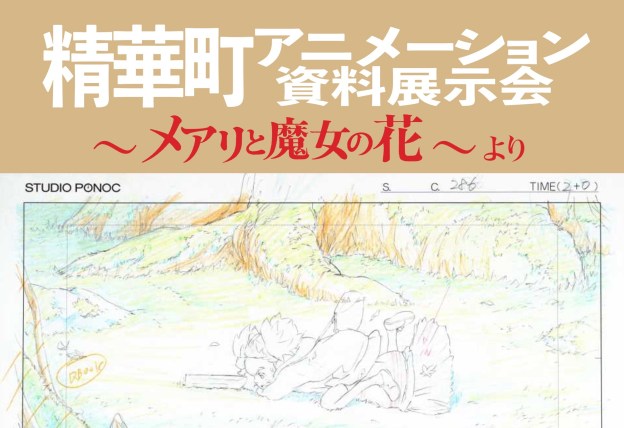
Anyhow, after spending more than an hour in the anime room alone, on my way out of the museum I spotted a poster that read:
Seika ArchiveD, the organization that aims at digitally archiving animation material, will showcase its recent results in an exhibition of genga data and materials from Studio Ponoc’s 2017 movie “Mary and the Witch’s Flower” on February 23rd at the Tsuki no Niwa Gallery in Keihanna Commemorative Park.
Needless to say, I went to the exhibition and spent there my entire Sunday afternoon, and I want to take this opportunity to write not only about my experience there, but also about Seika ArchiveD; what they do, how they do it, and why it matters.
Seika ArchiveD
Seika Anime・Archive・Digitalize, ArchiveD for short, where the capital A stands for “Anime” and “Analog” and the capital D stands for “Data” and “Digitalize“, is—borrowing the words directly from their official website—an industry-academia-government collaboration between Onebilling Inc., Kyoto Seika University and Seika Town, with the goal to digitalize the important intermediate deliverables that anime production materials (timesheets, layouts and key frames) represent, into high resolution data through the use of a digital camera, and then utilize this data for eduction, research or commercialization purposes.
Their home-page also highlights how this is the first instance of an anime-archiving initiative led by a local-government institution (Seika Town, in this case), as well as the first time a digitalization mechanism relying on a digital cameraーas opposed to a regular scannerーis being deployed in the context of anime material digitalization.

The above graph illustrates the working process at Seika ArchiveD: cut-packs (カット袋, folders containing the aforementioned production materials for each cut of animation from a particular project) are delivered directly to them; the materials are then carefully extracted from the folders, photographed with the digital camera, and thoroughly catalogued via software one after the other. Once the digitalization process is complete, the cut-packs are repackaged and sent back to the original animation studio or entity they belong to. The high resolution data is ultimately used for a variety of purposes, including education and exhibitions—like the one I had the pleasure to visit yesterday—further academic research or business analysis, and also commercialization through art books or anime records collections, or, notably, digital key-frame collections like the popular E-SAKUGA, which you may have already heard of, or even got a copy of yourself, and which also happens to be an initiative backed by the same Onebilling Inc. mentioned earlier.
One thing you may be wondering is, why using a digital camera instead of a regular scanner? Well, thankfully, the exhibition’s booklet provides a very straightforward answer to that question, and the reason might be much more practical than you think. The amount of drawings produced in the process of creating anime is, unsurprisingly, very huge, averaging at around 5000 sheets per episode (according to the data directly from the booklet). Multiply that for 13 episodes, and you get to a staggering 65000 drawings per TV anime cour. Using a scanner to digitalize all those drawings might sound pretty reasonable at first, so much so that it’s in fact the norm when it comes to anime digitalization as things stand now, but as Seika ArchiveD points out in the booklet, scanning anime drawings takes effort and precision, as the scanner’s lid needs to be pressed relatively hard to avoid shadows and wrinkles of the paper being captured in the final image. On the other hand, with their special digital camera setup, the time it takes for a single drawing to be digitalized is significantly reduced; and not only that, but it’s also substantially easier and quicker to produces higher quality image files as well, capturing the many pencil strokes in much better detail than a regular scanner could possibly achieve.

To make all this actually possible though, their digital camera is set up in a special way, aimed at optimizing the speed and precision of the digitalization process. At yesterday’s exhibition, they showed a neat recording of this special setup in-action: the camera is placed on a stand facing downwards, where a bunch of properly adjusted lights shine on a glass panel, under which the drawing—whether it’s a key-frame, a layout or a timesheet—is placed, tightly pressed down to avoid any distortions in the final image. On the monitor right next to it, the operator can see real-time footage from the camera, and dedicated software plots perpendicular guidelines over the image to help adjusting the drawing’s position in the frame. With just a click, the picture is quickly saved, and after typing in the necessary details, the drawing is fully digitalized and archived in a matter of minutes.
Iterating through this simple process over and over for countless times is what lead to the creation of a massive library of digitalized production materials, like the ones from Studio Ponoc’s Mary and the Witch’s Flower showcased in yesterday’s exhibitions at Seika Town’s Keihanna Park.
The Mary and the Witch’s Flower Exhibition
There isn’t much I can actually show you in this section, since, as obvious as it sounds, cameras were strictly prohibited inside the exhibition room. So, instead, I’ll do my best to describe and explain what I was able to see and experience in there.
The Tsuki no Niwa Gallery is a small space located inside of the Keihanna Commemorative Park in Seika Town, south of Kyoto City; yesterday, the entire room was used to host the Animation Material Exhibition, showcasing the results of ArchiveD’s efforts to digitalize timesheets, layout, key & in-between frames from Studio Ponoc’s 2017 anime movie, Mary and the Witch’s Flower (メアリと魔女の花).
Aside from a few physical layouts and genga displayed in a glass case at the center of the room, the gallery was equipped with a dozen of tablets, each containing the digitalized drawings—timesheets, layout, keyframes and in-betweens—from a different cut of the movie, for a total of well over a thousand distinct materials from the film.
The interactiveness of the setup was the main attraction of the exhibition: you could browse through each of the displayed cuts by interacting with the corresponding tablet, swiping through each key-frame or quickly scrolling through the sequence by rapidly tapping on the screen; you could even pinch and zoom-in on each drawing to appreciate the incredible level of detail the camera-captured image had to offer—as they claim in the booklet, you could really feel the bump in resolution and overall clarity of the picture compared to a regularly scanned image.
The experience was really fun, and the amount of data they were able to archive was nothing short of impressive. What (positively) surprised me the most though, was the number of people who attended the exhibition; granted, the sunny weather on a Sunday afternoon, the fact that it was held in the city’s largest park, and the complete lack of an entrance fee, all definitely played a role in its success, especially considering many of the visitors I saw during the few hours I spent at the exhibition (and at the nearby café while writing this post) were families with little kids, likely attracted by the movie’s title more than anything else. However, a consistent portion of the attendees—spanning across all demographics—was really, really invested in the exhibited materials, reading with visible interest through the explanations on the various steps of the anime production pipeline hung on the walls throughout the room, or thoroughly browsing the countless key-frames and layouts at display, appreciating all their details and intricacies (I believe the strong interactive element of the tablet-setup really helped in making the material feel more fascinating and intriguing to engage with).
And if this is sounding like it’s no big deal, since, well, we’re in Japan, the land of anime, of course the locals would be more interested in stuff like this, you may be correct in assuming as much, but I believe that’s only part of the truth here. Anime as a medium (as well as its aesthetics in general) is deeply rooted in the cultural and social context of Japan, to the point literally everything can be intertwined with it—and believe me when I say this, you’ll see anime everywhere here, from train station stamps and mascots, to life-size anime-miko cardboard cutouts at shrines… That is one thing, but being interested and invested in the creation and production of the craft is an entirely different story, and even more so is appreciating the considerable effort put into archiving and preserving the material that comes out of such creative process—the “valuable intermediate deliverable”, as ArchiveD refer to it on their home-page—especially here in Japan, where the idea of preserving analog media has only recently begun to gain traction, with Seika ArchiveD standing as one of the very few contributors when it comes to archiving production material related to anime.
The bottomline is, events and exhibitions like yesterday’s, raising the interest and engagement of the general public towards the more niche aspects of anime production, that may still be broadly perceived as aimed specifically at the enthusiasts of the field, are truly remarkable, and certainly a step in the right direction for analog media preservation as a whole. Moreover, seeing industrial and government-backed initiatives like Seika ArchiveD successfully garner such interest as the result of their hard work, truly felt like the cherry on top of this collaborative and steadily growing effort.
This concludes my little report on yesterdays’s peculiar event. I hope the content of this piece—quite unusual for the standards of this blog, I know—was able to pique your interest nonetheless, and maybe bring to your attention the current state and recent advancements of cultural preservation here in the Land of the Rising Sun, that you may not have been aware of.
I won’t deny that this article is, in a way, an experiment on my end as well, so I apologize if the exposition feels somewhat messy or yet unpolished. That being said, I have to admit I had a lot of fun writing this piece, and I truly hope the opportunity to further explore this format will present itself again in the future. Until then…

