Tag Archives: Kyoto Animation

Tatsuya Ishihara – Interview on Hibike! Euphonium Season 3 – “Final Movement”

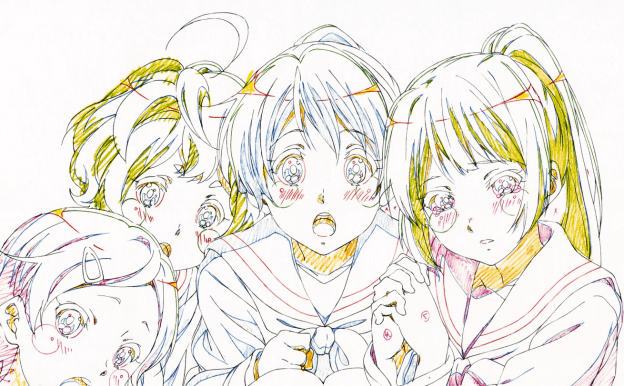
Original interview from Febri, published in two parts, Part 1 on July 4th 2022 and Part 2 on July 6th 2024 titled: “「The Final Movement」that carefully depicted Kumiko’s story『Hibike! Euphonium 3』Director Tatsuya Ishihara Interview”, original interviewer: Daisuke Okamoto; genga from Hibike! Euphonium Season 1.


Part ①

The third season of the youth orchestra anime series “Hibike! Euphonium” (hereafter, just “Eupho”) has reached its final episode. This season focused on the struggles of Kitauji High School Concert Band club president Omae Kumiko, pursuing the long cherished dream of winning the gold prize at the nationals. Mixing in the many characters’ own stories, the series’ final movement ties up Kumiko’s three years of high school. Now that the show has finished airing, Febri had the pleasure to welcome in series director Tatsuya Ishihara, to speak at length, in two parts, about the thoughts and feelings he poured into the final movement. This first part covers the structure, direction and animation of all the 13 episodes.


~ Kumiko has “lost the battle but won the war”. ~

— At the time of this interview, the final episode hasn’t aired yet. What are your feelings at this point?

Actually, I’m still assiduously working on it and to be honest it’s taking quite long (laughs). Anyways, over the past 10 years of production, I’ve been going back and forth between the real world and Eupho’s world, so in a sense I have a feeling that the latter is about to end and disappear, which makes me feel both really moved and deeply desolate. 

— I’d like to look back at all of the 13 episodes of season 3 and talk about them. As for the overall structure, the first half depicts Kumiko’s struggles as the club president, and the second half delves into Kumiko’s inner mind. 

Focusing the second half on Kumiko’s story was an idea of scriptwriter (Jukki) Hanada-san. The overall flow in the anime has been adjusted a bit, such as moving the episode on (Tsukinaga) Motomu’s family problems, which in the original work happens a little later, in the first half. After all, it’s the “Final Movement”, so I too felt the same way about wanting to properly focus on Kumiko’s story at the end.

— In this season, the presence of the new character Mayu Kuroe has also become a topic of discussion. What kind of person did you think Mayu was? 

Even if she’s Kumiko’s rival, their personalities are not completely opposite, so for Kumiko, she’s like a mirror image of herself. In an analogy to a role-playing video game, I think Kumiko has steadily leveled up and, by working hard has acquired a lot of good equipment. And when it was finally time for the last boss battle, who appeared was a boss with the exact same equipment as hers, but also slightly stronger (laughs). That’s the impression I got from Mayu’s character. 

— Mayu was also the one who determined Kumiko’s future and career path.

That’s right. In the original work, Kumiko isn’t able to win over Mayu until the very end, but in the anime, we altered the final development of the original work so that their relationship evolves in such a way they ultimately respect and acknowledge each other.

— You mean the result of the final audition in episode 12, right?

Yes. To the fans who have read the original work, it might have been quite a surprise. However, for Kumiko, although she lost the battle called audition, in return she gained the powerful weapon known as Mayu, so to me she “lost the battle but won the war”. Since the moment she became the club president, rather than Kumiko growing as a player herself, I believe her leadership of the club was the aspect that grew stronger, so we made the ending even easier to understand. 

— When portraying this kind of relationship between Kumiko and Mayu, was there anything you particularly focused on?

To Tomatsu Haruka-san, who played Mayu, I asked to act “giving off a gentle motherly feel”. There indeed is the aspect of her being Kumiko’s rival, and she does have a bit of a dark side to her too, but fundamentally she’s a caring and kind girl. I wanted the viewers to like Mayu, and I tried not to make her appear as an unpleasant girl. 

~ I want to believe that Kumiko and Reina are still connected even after graduating. ~

— On the other had, how do you feel about the relationship between Kumiko and Reina that was portrayed throughout the series, director Ishihara?

I think the viewers should interpret it as they wish, but I personally believe they are complementary to each other. They’re two people with family backgrounds, talents, personalities and tastes that are completely different, so even if their connection through music were to be severed, I don’t think it will matter that much. Moreover, Kumiko became the Concert Band club advisor, so she and Reina still share the fact that they both have jobs related to music. I imagine their relationship is still ongoing even now, and I want to believe so.

— I see. This “future path” aspect was also an important theme of this season.

It’s something every high school student worries about. I personally decided early to get into the anime industry, so I don’t remember worrying about my future that much. Therefore, I can’t quite sympathize with Kumiko’s worries on this… I’m sorry (laughs). 

— That being said, I believe there are many people who are able to sympathize with Kumiko. 

I think you’re right. But even someone with so little sense of self-direction like Kumiko was able to grow into a proper adult, so I’m sure it’ll be fine. I’m sure Hazuki too was able to become a wonderful preschool teacher, so you’ll find your own path eventually.   

— Well then, by episode 12, one part of Kumiko’s story has come to a conclusion. What scene was the most impactful to you so far?

The last scene of episode 12 was really impactful. That’s the climax of Kumiko’s drama, and I wanted to portray it with more care than usual. Also, personally, I really like the scene (in episode 7) where Kumiko and Hazuki attend the university information session, and then have a talk at a cafe drinking melon soda or something. Between the many serious scenes and episodes in this whole season, at least that moment felt a little more relaxed. Of course, Kumiko and the others were worrying about their post-graduation paths and there was some seriousness about it too, but I feel like by going outside of school and meeting with her seniors, she was able to set aside her role as the “club president” and felt like the old Kumiko. It’s also rare for her to go out with just Hazuki, so I really like that. 

— In regards to the visuals, since Kumiko and the others are now third-year, they are all drawn to look more grown up. Was that done on purpose?

In terms of character design, since it was renewed in the movie “Hibike! Euphonium ~ Chikai no Finale ~[劇場版 響け!ユーフォニアム~誓いのフィナーレ~ (Sound! Euphonium: The Movie – Our Promise: A Brand New Day), 2019], there haven’t been many changes. I haven’t asked the animators to make them look “more adult” either, but indeed when you look at their expressions and mannerisms, it feels like they’ve grown up a bit. I think that’s probably because their words, behavior and manners have become more mature. Especially the three managers have had more responsibilities, and also Hazuki and Midori (Sapphire) have had more interactions with their juniors. They often say “the environment changes people”, and I think that was the case here. 

— Thank you. In the second part, I’m going to ask about the final episode in more detail.

Thank you.


Part ②

The second part delves deeper into the final episode, also touching on the secrets behind the storyboards director Ishihara has drawn himself. 


~ Listening to “Disco Kid”, the storyboard kept flowing. ~

— The final episode was one of the best, well worthy of being the culmination of the series. Having held back with the musical performances up until now, in this episode you showed it all in the best possible fashion.

To put it bluntly, the cost of animating a musical performance scene is on another level entirely, so it’s not that easy to include one, especially in a TV series. You might argue we already did it in episode 5 of season 2, but that one used materials from the first season and the movie, so it wasn’t all animated from scratch. In that respect, this episode’s musical performance scene was all made up of newly animated cuts. Rather than having the performances distributed between the Sunrise Festival and the regional qualifications, it was decided from the scriptwriting stage to have just a bigger one in the final episode. 

— It was clear from the early stages that “Hitotose no Uta” would have been performed, but the final episode was the first time it was played in its entirety.

I thought it would be difficult to empathize with a song if you’re listened to it for the first time, so I had the first movement play in episode 2, in the scene where Kumiko and Reina listen to the song sharing earphones, and then included in the eye-catches of each episode a short performance from every instrumental department, in order to make the song as familiar to the ear as possible.

“Hitotose no Uta” is divided in four sections: spring, summer, autumn and winter, and it was staged in such a way that for each season, the memories of Kumiko and the others would flash back.

In the original work too, in this scene Kumiko is described to be remembering various things, and visually I felt that it would have been tedious to just show a musical performance for 6 minute straight. So, I had already decided from relatively early stages to portray it like that. 

— Director Ishihara, you drew the storyboard for the last episode. Did you have a hard time choosing which scenes from the past to reuse? 

I don’t remember having that hard of a time with it. I chose the scenes that I think are impactful and memorable not just for me but for the viewers as well. Also, like including sad and painful ones in the “Autumn” part, I chose scenes that matched the flow and mood of the song. 

— Did you have any difficulties with the storyboard for the last episode?

The main problem were the length and number of cuts. In the “Hitotose no Uta” musical performance scene, of course I couldn’t leave out the scene where Kumiko and Reina play “Ai wo Mitsuketa Basho[“The Place Where We Found Love”] on Mt. Daikichi, and I also wanted “Disco Kid” to play in the epilogue, so I started drawing from there. Then, I went on trying to figure out what to prioritize in the time that I had left, but it was a rather unconventional approach, so you might say I had some troubles with that. 

— What’s the reason you wanted to play “Disco Kid” in the epilogue?

Sometime when I still hadn’t visualized the last scene of the final episode, I happened to listen to “Disco Kid”, and in that instant the image of the epilogue popped into my head. From that point on, the storyboard started to flow into my mind all the once, and I felt that that was the song I had to use. 

— That song was also played at the beginning of episode 1, right?

That’s right, but the order was actually reversed. After having decided to play the song in the epilogue, we decided to use it in the prologue of the first episode as well. The prologue and the epilogue link together different moments in the timeline, so it was a natural choice.  

— “Disco Kid” is a famous wind instrument piece, but that was the first time it was featured in the Eupho series.

That’s true. It was suggested by the producers, but I couldn’t quite find the right opportunity to use it. It’s not like I was saving it for the last chapter, but I think I was ultimately able to use it in the best way possible. In the scene of the epilogue where Kumiko walks, I made some minor adjustments like matching the rhythm of “Disco Kid” to her steps, so it’s very pleasant to watch. I like this epilogue so much I end up watching it over and over again. 

~ I wanted to make the world of Eupho a continuation of reality. ~

— That aside, what other aspects of the epilogue did you focus on?

I already said this in the first part, but since it’s a work I’d been working on for ten years, I felt a strong sense of desolation, as if one of my own worlds had disappeared. Therefore, I thought that it would have been nice if I could create some sort of continuity between the work and reality, even a small one, so the epilogues brings us to the Uji of the present day.

— What do you mean?

Kumiko’s third year of high school is set in 2017, but the epilogue of the anime depicts present day (2024) Uji. By doing so, I hoped it would make it feel like Kumiko and the others are living in this same world we live in. This work already featured a truthful depiction of Uji, but we scouted each location again and reflected the changes in the scenery of the epilogue. Kumiko’s favorite bench has been renewed, the JR railways have been double-tacked, the factory chimney visible from the Uji Bridge is now just one, the torii gates at Uji Shrine have been replaced with metal ones… many minor things have changed. And also Tuba-kun is extremely worn out (laughs). I don’t know how much of it was noticed, but a lot of thought was put into it. 

— Sounds like there are many things to discover rewatching the episode. One more thing, what was the difficulty related to the number of cuts you mentioned earlier?

The final episode has 500 cuts, and even excluding the so-called bank (reused scenes), it easily exceeds 300. I don’t think it’s a particularly high number compared to current anime standards, but it’s still a lot more than what it used to be, so it’s a source of troubles nonetheless. This isn’t just limited to the final episode, but I feel like drawing the storyboards was always a battle between the length and the number of cuts. 

— Once again, thank you so much for your hard work over the past 10 years. What kind of work has Eupho been for you, director Ishihara? 

Before I started working on Eupho, I knew nothing about wind instruments and concert bands, so I was basically studying everyday. In that sense, it’s a work I struggled with a lot, but depicting a real human drama set in a real, existing place was something I wanted to do, so I’m glad it allowed me to have this wonderful experience. Thanks to it, I’ve come to like wind instrument music, and I think that from now on I’ll keep listening to it as a hobby, outside of anime production.  

— Aren’t you going to play yourself?

I’ve tried before, but I was discouraged that I couldn’t get any sound out of the instrument mouthpiece (laughs). For the time being, I’ll just enjoy listening to it. 

— Well then, lastly, a message to the fans. 

Thank you very much for your support throughout this many years. Eupho as a work encapsulates a society that interweaves characters in many different positions, like seniors and juniors, and teachers. Therefore, I believe depending on your age and position, the way you feel about it will change. I’d be happy if you came back to it from time to time. I hope you’ll keep supporting us for many years to come! 

Tatsuya Ishihara & Taichi Ogawa – Interview on Hibike! Euphonium Season 3

Original interview from Animate Times published on April 13th 2024, titled: “Including the new character Mayu Kuroe, I want to portray each charcater as a human ―『Hibike! Euphonium 3』Director Tatsuya Ishihara x Assistant Director Taichi Ogawa Interview|The interesting aspect of 『Eupho』is that, since many different situations are portrayed, it’s relatable from any perspective.”, original interviewer: Daisuke Marumoto; genga from Sakugabooru.


“Hibike! Euphonium 3” began airing on Sunday, April 7th. It’s the final installment of the greatly popular series about the youth of high school students devoted to the school’s Concert Band. It’s also the first TV series in 7 years and 3 months, since “Hibike! Euphonium 2”, and has already attracted a lot of attention with its first episode. 

In this second part of the Animate Times Interview Series [the first part consisted of an interview with Tomoyo Kurosawa, Chika Anzai and Haruki Ishiya] we present you an interview with Kyoto Animation’s Director Tatsuya Ishihara and Assistant Director Taichi Ogawa! We asked Director Tatsuya Ishihara, who’s worked as a director (chief director and supervisor in some other works), and Assistant Director Taichi Ogawa, who directed “Hibike! Euphonium: Todoketai Melody” and worked as the assistant director for “Sound! Euphonium: Special Edition ~Ensemble Contest~” which screened in theaters August of last year, about the highlights of the series from now on, while also touching the contents of the first episode that just aired. 


~ We can finally portray Kumiko properly. ~

— In this installment, Kumiko and the other main characters are third-year students, and the series is finally heading towards its conclusion. What are your feelings in regard to that?

Ishihara: It’s something I’ve experienced several times up to this point, but when I’m working on a project, I start to feel like I’m living inside its world, so when a series I’ve been involved in ends, I feel like it’s almost the actual end of the world; it’s like a real sense of loss. But well, my work is still ongoing now, so I don’t feel like this yet (laughs).

Ogawa: I, rather than feeling desolated, once a work is over, instead of just being consumed by it, I’m concerned about whether or not that work was able to leave something in the hearts of the people who watched it. I’m sure everyone has those kind of works that always remain in their heart, and I think there’s a reason, or some deciding factors behind that. What that is differs from person to person, but I’m working hard to create works like that, and hope that I’m able to convey that “something” to the people who watch them. 

— Oumae Kumimo, Kato Hazuki, Kawashima Midori and Kosaka Reina, who entered Kitauji High School in the first installment, have finally become third year students in this one. What kind of image do you want to portray of the four of them, now that they have grown?

Ishihara: I believe that growth is not about a person trying to change, but rather the changes in the environment around them. This time too, I believe that Kuimiko, Reina, Midori and Hazuki will change depending on the position each one of them will assume. It’s strange to say this when we’re the ones creating this work, but I don’t want (their growth) to feel artificial or contrived. I think to me it’s ideal when it’s like a simulation of sorts, where you have a particular setting where you throw in some characters with their personalities, and they start to act on their own. So it’s not like “I want to portray this character like this…” or something. But of course, everyone has grown. 

Ogawa: The third year of high school is a time when everyone has to think of their future and other various things, so it was interesting depicting that aspect of it, and I think that’s one of the highlights. 

— Compared to the change in transitioning between first and second year, the one between second and third year feels even more significant. 

Ogawa: That’s right. When you’re a first-year, you only have seniors [“senpai”], then in second year you have both seniors and juniors [“kōhai”], and in third year you only have juniors. I think the differences between these states are fascinating and make you think. 

Ishihara: I thought that the school system was a strict and stiff place, but if you look at it that way, it’s surprisingly not that bad, or rather it’s an interesting system. When you enter higher education like a university, even though you’re still a student, you’re basically almost an adult. As I was depicting the third year of high school, the period exactly prior to that, I felt that this time the relationship between Kumiko and Taki (Noboru)-sensei was pretty significant. 

— So, her relationship with Taki-sensei, the advisor of the school Concert Band, as an adult who’s close to her, will be featured in the series.

Ishihara: Perhaps because she’s about to become an adult, Kumiko’s eyes are turned towards him. Anyways, if I say anything more about the four main character’s growth, it would end up being a spoiler (laughs).

Ogawa: That’s because you let everything out, Ishihara-san (laughs).

— Then, out of these four characters, which one’s growth was particularly easy to figure out, or which character would you like to draw the attention to?

Ogawa: In think the one I want to stand out the most is Kumiko, after all. 

Ishihara: Yeah, you’re right. 

Ogawa: Now that we’ve reached the third season, we can finally portray Kumiko properly. I believe that’s the biggest thing. 

— At a roundtable discussion held before the first episode aired, Kurosawa Tomoyo-san, who plays the role of Kumiko, also said that this time too there are a lot of things to work hard on.

Ishihara: We really have to work hard all the time (laughs).

Ogawa: Kurosawa-san was really worried this time around, wasn’t she?

Ishihara: I was watching her as well, and felt that way too. Saying that Kumiko is feeling down would be misleading, but as the club’s president there are many things she has to worry about.

Ogawa: Kurosawa-san too seemed to feel exactly that.

Ishihara: I’d like to talk directly with Kurosawa-san and ask her how she actually felt about that (laughs).

~ Mayu Kuroe is not just a plot device. ~

— At the end of Episode 1, the new spotlight character Mayu Kuroe also made her appearance. Without entering the spoiler territory, tell me about her appeal or some aspects of how you’re depicting her. 

Ogawa: As the creator of the work, Mayu is a very difficult character. 

Ishihara: I, for starters, wanted to portray her in a cute way. 

Ogawa: That’s a unanimous feeling (laughs). Though, the same goes for every other character… Actually, it may not be appropriate to use the word “character” here, but I wanted to portray “Mayu Kuroe” as a proper, independent and self-reliant person. There are times (in other works) where a new character suddenly appears, seemingly to rival the protagonist, but as things go on, ultimately they end up being no match for the main character at all (laughs). 

— There are times where it feels like their [= the secondary characters’] presence is long gone by the middle-point of the story (laughs). 

Ogawa: I believe that kind of development is possible at times, due to the structure of a story, but that’s not the case for Mayu Kuroe. She’s a character that’s supposed to taste more strongly the more you chew it, so I hope you look forward to her. I think it’s gonna be a pretty controversial part, or rather, the way people who watch it will feel about it, will change depending on their standpoint and experiences. So, personally, I’m looking forward to seeing how everyone will feel about it.

Ishihara: Well, personally I like Mayu. 

Ogawa: She’s gentle and cute, and her temperament is pretty tender. But I think just learning that the transfer student plays the euphonium is enough to make people a bit nervous (laughs). To put it simply, she’s a mysterious character, and I believe that how all that will unravel, and also how Kumiko will receive it, are one of the highlights of this story. 

— Director Ishihara, you mentioned that you like Mayu, but what exactly do you like about her?

Ishihara: Well, a lot things (laughs). At first, I thought she was just a rival character to Kumiko, a mirror image of her. However, as he just explained, Ogawa-san really valued the human side of Mayu Kuroe, so I think she’s no longer just a plot device. 

— At last year’s “New Information Presentation” when it was announced that Haruka Tomatsu-san would have played Mayu’s role, Tomatsu-san said that before the recordings for the first episode, Ishihara-san said to her that “Mayu truly is a difficult character”.

Ogawa: You brought up this topic pretty roughly (laughs). 

Ishihara: I simply meant that, even though I said she’s a difficult character, if you try putting yourself in Mayu’s state of mind, you can understand her.

— So, she is not an alien-like incomprehensible person? 

Ishihara: Yeah, exactly. How Club President Kumiko will deal with her is one of the main aspects, I think.

— Including the four close friends Suzuki Kamaya, Yayoi Kamiishi, Kaho Hariya and Sari Yoshii, new first-year students have joined the club. Tell me about their appeal and the way you depicted them. 

Ishihara: I can’t help but empathize with Kumiko, so I end up seeing them from her perspective, but in that sense they’re a “somewhat troublesome and cute group” (laughs). 

Ogawa: Troublesome but cute, that’s exactly it (laughs). Also, the four of them are often together, and when it comes to each one’s personality, it’s just like how I said before with Mayu, I wanted to portray each one of them as a proper human. 

— Their relationship and interactions, with Suzume and Yayoi’s incomprehensible gags and Kaho easily laughing at them, is really cute. Is it difficult, on the contrary, to portray as entertaining gags that are confusing and hard-to-get?

Ishihara: But Kansai’s laughter is so infectious, isn’t it.

Ogawa: They’re like slip gags [すべり芸, basically, gags not meant to be “understood”, but rather to create an awkward atmosphere]. But Yayoi and Suzume are not making gags in order for others to get them; they simply let the words flow out as they feel. And then, to keep a good balance, Kaho’s there to laugh at them. Yayoi and Suzume sure are happy to make her laugh, but it’s not like they’re deliberately trying to achieve that result. 

— So, Kaho too isn’t doing that for them either, she genuinely finds them funny and that’s why she laughs, right?

Ogawa: Exactly. And then there’s Sari, who, being well used to that situation, is there to put things back in order (laughs). The balance between these four is very interesting, and I’d like people to simply enjoy this indescribably joyful space. 

~ I wanted the first episode to focus on the joy that “Eupho has begun!”.  ~

— Tell me what important points and aspects you wanted the first episode, which aired the other day, to mainly focus on. 

Ishihara:  After all, since this is the beginning of the story, we placed great importance on the relationship between Kumiko, Shuichi (Tsukamoto) and Reina, who are now the leaders of the Concert Band. 

— Assistant Director Ogawa, you were in charge of the storyboard and episode direction for the first episode. 

Ogawa: Personally, it was my first time storyboarding and directing the first episode of a TV series, but above all, I wanted to make an episode I myself would have been exited to watch.

Ishihara: First episodes are tough; you also have to properly introduce the characters. 

— First episodes tend to have lots of tasks that need to be addressed in them.

Ogawa: Sure enough there are those kind of tasks, or rather there are some aspects like the one of introducing the characters, but beyond that, I think the most important duty to me was to make it so that people would get immersed into its world. That’s where an episode director can really show off his skills… I did my best (laughs).
As Ishihara-san said, the positions of Kumiko, Shuichi and Reina have changed significantly from before, so while properly showing their relationship, I also personally sought to convey the joy that “Eupho has begun!”. 

Ishihara: Episode 1 had a special opening, and I think that it starting off with brass instruments was extremely exciting. 

Ogawa: Thank you very much. Also, third-year high school students are somewhat special, but at the same time they really aren’t, don’t you agree?

Ishihara: Huh? I think they are pretty special? I did feel special, like “ah, I’m already a third-year”. 

Ogawa: Well, of course there’s something special about it. I guess it’s that since it’s your third year experiencing high school life, you’re well used to it at that point. So, it’s indeed a special year, but in terms of school life and club activities, you’re the most used to it and can naturally fit in. I feel like at that point I was a little more conscious of that aspect as well. 

~ Even for those who have never seen Eupho before, the third season will still be interesting.  ~

— Was there a scene in particular you were especially focused on, in regard to the storyboard and direction of Episode 1?

Ogawa: I really put a lot of effort into the opening scene, which Ishihara-san also mentioned. Since it’s the very beginning of Season 3, I wanted to make something compelling that connected to a feeling of excitement. This kind of things are not decided or included in the script, so figuring out how to structure it by myself was the most difficult aspect of it.  

— I heard that for the regular opening that will play from Episode 2 onwards, Director Ishihara was in charge of the storyboard and direction, just like for the ones for the first and second seasons. 

Ishihara: I feel like that, when I was making it, I focused primarily on how to show Kumiko’s position. However, looking at the finished product, it felt like a look back at the past, it was a little heartrending. I wasn’t really conscious of this aspect (laughs).
Also, if you watch the opening again after watching every episode up to the last one, I believe you’ll realize what it’s all about. 

— You’re saying that if you watch it again after the final episode, the way you feel about it will change?

Ishihara: I think so. Also, TRUE-san (whose real name is Miho Karasawa) who wrote the lyrics for the opening song (“ReCoda”), as always, truly understood what this work is all about. That’s why I feel like, compared to the lyrics of all the Eupho’s songs up to this point, this time they have a little different perspective, and it might be fun if you watch the series while thinking what this thing I just said means. 

— Lastly, I ask you to give a message to the all readers who love “Hibike! Euphonium”, hinting some highlights from Episode 2 onwards.

Ogawa: I think you will enjoy it even more if you pay attention to the growth of every character. Also, I have the feeling that if you watch the episodes two or three times, you’ll be able to see different sceneries each time. I think there are many different ways to look at it, but there are also some things that you won’t be able to understand until you watch it to the end, so I’d be glad if you could watch it without missing anything. It’s been like this with all the previous series as well, albeit not always being about fun things (laughs). All in all, I think we were able to create a really good depiction of youth, so I hope you enjoy it until the end. 

Ishihara: As I said at the beginning, I feel somewhat sad thinking that a work I’ve been working on for nearly 10 years has reached its first chapter. However, I’m grateful that I was able to depict this story all the way to its end, and since I think the viewers too feel the same way as I do, to all the people who have been watching since the first season, I hope you enjoy it till the very end.
I also think that even for those who have never seen Euoho before, the third season will still be interesting. Anyways, since there’s the opportunity to watch the previous works on many different platforms, I believe you will enjoy it even more if you watch the first and second seasons first. As mentioned earlier, the third season becomes more interesting the more times you watch it; talking out of our experience, the dubbing process started around the time we finished making (the storyboard etc. for) the final episode, and during the recordings I ended up crying at scenes I didn’t expect to (laughs). So, I’ve first-handedly experienced how it gets more interesting when you watch the beginning again after knowing the ending. I’m sure everyone will feel this way too.

Ogawa: It’s like, being supplemented with many different information, you’re able to understand some things better by yourself. There are times when things unexpectedly come to your mind. So many different situations and positions are depicted in Eupho, and at times I thought that if I were to put myself in some of the characters’ shoes, I would have been to see things the same way they do. Eupho has been this kind of work since Season One, and in the making of it I was once again reminded that that’s what makes it such an interesting work.