
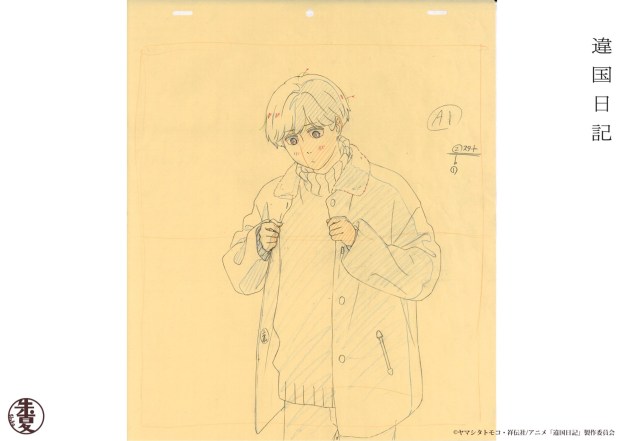
Original interview from the Animate Times series of interviews on Ikoku Nikki, published on February 16th 2026, original interviewer: 西澤駿太郎; genga from the official studio Shuka Twitter account.
I walked in the direction the work itself led me.
— You’ve worked as the script writer for many different series, what feelings and sensations do you approach writing with?
I really just write down what I honestly think… If anything, I believe that when I’m entrusted with an original work and make it into a script, that work’s own atmosphere and wave-like thing are sure to have an influence on me.
So, rather than me writing it, I think it’s more accurate to say that the original work itself, together with all the discussions I have during the various meetings, led me to write it. Therefore, I don’t really have a know-how or a secret trick, nor I have any established methodology.
— In Episode 7, which aired just recently, Makio says that “After all, writing is a lonely craft”. What do you think?
It really is a lonely craft. It’s my profession, so whenever I say this, everyone ends up thinking “There he goes again…”, but… I’m really not cut to be a writer.
— There he goes again…
(Laughs). I’m really not good at the process of writing itself, or rather, it’s a really harsh craft. Because you have to think of everything by yourself. Sometimes, at night, I look at the totally useless single line I managed to write that day and think: “Wow, I really couldn’t write anything more than this”, and it makes me feel sad. I think it really is like Makio-san describes it: “a lonely craft”.
Though, what I and Makio-san write are mechanically different things. I write scenarios and scripts, it’s something that’s written with the assumption that it will be handed to someone who stands before the viewers or an audience. I create it while discussing it with the very person who will receive it in the end, so the time spent talking about it is really a salvation for me.
Makio-san is a novelist, an author. So, I believe the people she can talk to while working are very limited. I guess it’s probably just her editor. Therefore, in her case, the extent to which writing is a lonely craft is even larger. I really respect those who can write novels.
When it comes down to novels, if you don’t actually finish writing one, no one will even take you seriously. Just saying “I kind of want to try writing something” doesn’t earn you any money. In the end, you really just have to write on your own, then take the finished piece to someone and say, “Please read this”. Moreover, you have to immerse yourself in the craft for the entire time.
I believe that to its core, writing is a confrontation with your own loneliness. I think that Makio-san is a really tough person.
— Right. Ff you think about it, when she’s working, Makio doesn’t even talk to Asa.
But maybe a person like Asa coming into Makio’s life could potentially help stepping her up to the next phase as an artist. Sure, I also believe she feels that things have become more difficult because of that too…
But maybe if she accepts it, the things she can write could also increase and become more proficient, and she might also encounter thoughts she would’ve otherwise never come up with by herself. I’d like to think that Asa will be a good influence to Makio-san as an artist.
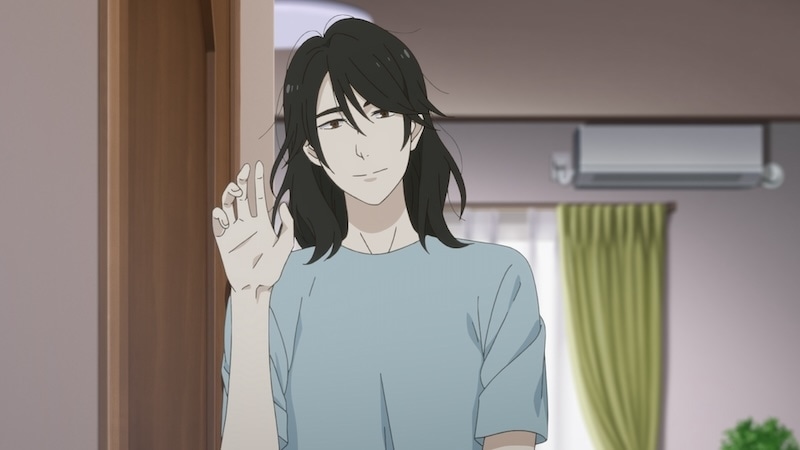
— The comment you released last September began with the line: “It’s been two and a half years since I handed over the script for the final episode”.
Of course, I didn’t mean it in a weird way, but it felt like it left my hands quite a long time ago. How should I put it… it’s like when you see a relative’s kid you haven’t met in a while, and suddenly they’ve grown up so much (laughs).
— (Laughs).
It’s just like, “Wow, that’s amazing!” (laughs). It’s really moving. So, I just set aside any worries about “What’s become of my script”, and instead just think things like “The theme song is great” or “Oh, the PV even gives us little glimpses of scenes further ahead”, and I’m watching it with a really pure sense of enjoyment.
The production of this anime is still constantly in motion, with everyone continuing to build it up piece by piece. That’s the kind of atmosphere I can feel.
— How was the screenplay written for this anime?
I’m essentially an “original work fundamentalist” no matter what, meaning, if there’s an original, my approach is: “It’s fine if it stays the way it is”.
However, translating something that’s originally drawn on paper into moving pictures means changing the vehicle through which it’s conveyed. Even if I feel sorry about it, there are some parts you must change. For Ikoku Nikki, I didn’t want to harm the original’s unique atmosphere, but I also thought it was the type of original work that’s hard to preserve exactly as it is.
Furthermore, it wasn’t just a matter of “translating it into moving pictures”; since it was a TV anime adaptation, I thought it would need to be treated properly as video, not only to keep the people watching it every week engaged, but also to capture the attention of viewers who might happen to come across the show unexpectedly.
As a result, I had to rearrange the order of certain scenes, or fill in the gaps between panels or dialogues, or sometimes even cut a few. I ended up making quite a few modifications.
Yamashita-san [the original manga’s author t.n.] kindly read the script very thoroughly and payed careful attention to every small detail, asking about my intent behind even the smallest change. She generously provided me with suggestions whenever I asked for advises on how to adapt certain scenes; the people on the original manga’s side of things, including the editor, took all actively part in the creation of the script.
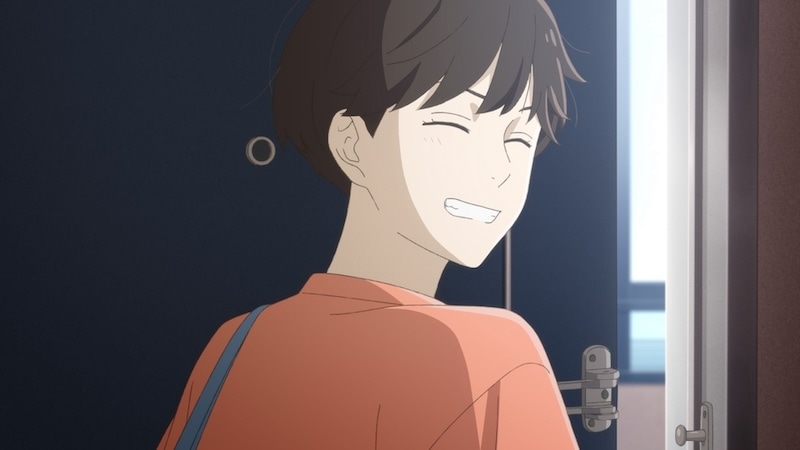
— Is there anything that left a strong impression on you from your meetings and discussions with Director Miyuki Ooshiro?
I don’t recall having any intricate or complex discussions with Ooshiro-san. We already settled it at the time of the first meeting, with a brief “Ok then, so let’s approach it this way”. I thought our visions were already relatively aligned, and she really approached things in the same way as I do. So, personally, don’t really have any memories of the production being difficult.
— The process of writing scripts doesn’t always go smoothly; there are times when it naturally gets complicated, right?
There certainly are works like that. To put it oddly, when it comes to Ikoku Nikki, I didn’t really have to work hard on it. I was able to write it honestly without forcing myself to embellish or exaggerate it.
I considered how to make it stand out when viewed in TV-size, but I had a strong desire to change it as little as possible. I think there were no misunderstandings or disconnections between the staff because, of course, the rest of the production team also understood the strengths of the original work.
— You were guided by the work itself, so to speak.
It’s exactly as you said. I walked in the direction the work itself led me.
I’m not sure if this really answers your question, though (laughs).
— Kiyasu-san, when you first encountered Makio and Asa, what kind of impression did they left on you?
As I kept reading it, the impression I had of the two changed between the earlier parts of the story and the later ones. I believe that wasn’t because of the characters themselves actually changing; instead, I think it was because I started to discover the bond between Yamashita-san and her work, or rather, the things she wanted write.
Her degree of understanding of the characters gets gradually higher and more vivid. This was my first impression.
When I reached the second half, the two characters become gradually more multi-faceted, and even so, or rather, because of that, they became easier to understand. I thought that was surprisingly interesting.
Also, I too am pretty much of a creator myself, so of the two, I found myself to empathize more with Makio-san. Even in the way she deals with Asa, I feel it’s easier for me to understand Makio-san‘s distress.
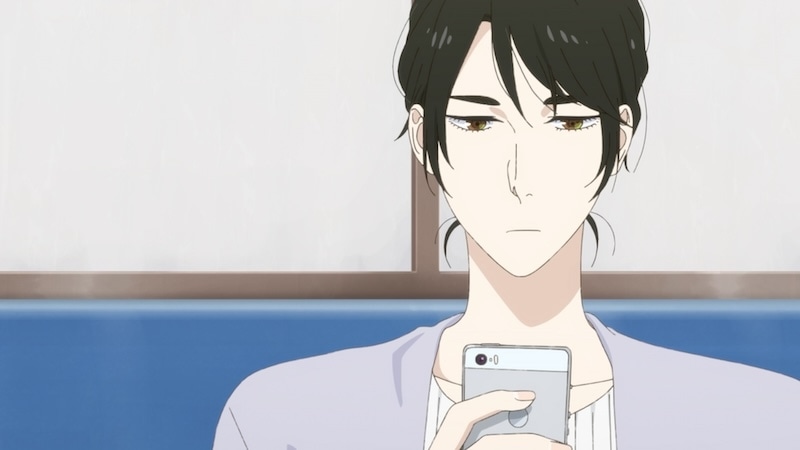
— When watching the anime, I had the impression that you could strongly feel the perspective of both sides.
I haven’t emphasized this much, but episode by episode, I’ve been alternating, shifting the perspective just slightly toward one of the two characters (Makio or Asa).
For example, episode one leans toward Asa. Makio comes across as something like a mentor figure to Asa. Episode two, by contrast, I had decided would close on the “I’m going home”, so things unfold from Makio’s perspective. In the dialogues with her friends, Makio, who is supposed to be the mentor, is the one who gets unsettled. Then in episode three that follows, the first half is Makio, and from there it shifts toward Asa’s inner feelings. That’s the kind of thing I was mindful of.
Rather than framing either of them as the protagonist, I thought it would be nice to compose the story in such a way the focus would be constantly placed on both of them, and they’d keep developing one after the other.
— That’s a very distinctive way of structuring a story, isn’t it?
It is. It’s not something you do all the time. But it’s not the type of story in which you can meticulously follow one character’s development and then go, “And before you knew it, the other one developed as well”. So, I wanted to structure it by shifting from one’s perspective to the other’s.
Ikoku Nikki is Makio and Asa’s storyteller, as it is a story where they both grown together influencing each other.
— I believe it’s impossible to describe those two’s relationship in a handful of words, but how should we, as the spectators, understand and imagine them?
Right. Their dynamic isn’t quite that of a mother and daughter, not it is that of sisters. Given a little more time, they might become friends who are just a few years apart, but as friends, they stepped into each other’s lives more than a regular friendship would entail. That’s why I think it’s dramatic.
You can’t express their relationship in a few words. That’s why you need Ikoku Nikki as a story. If it were about two people who could be described that easily, you wouldn’t need a story about them. So, I think leaning in a little toward the two of them, their hard-to-define relationship, the shifts in their positions, and the movements of their hearts, is the most enjoyable way to experience it. I’m not sure if this really answers your question, though (laughs).
— The sense of distance of an “aunt” and “niece” relationship fits this dynamic perfectly.
You can often say more than you could in a parent-child relationship, and I think it’s a wonderful dynamic. But seeing it portrayed like this in a work gives it a whole new perspective. In their backgrounds, things like the discord between sisters or the hollowness of the father figure are laid out, and they end up influencing the way they (Makio and Asa) act and talk. I believe this is also one of the main strengths of the original manga.
Also, to the people looking from outside, Makio-san might seem like an unsociable and severe person, but as you come to understand her backbone, her struggles and the difficulties she faces in life become clearer. There are also moments when her background might overlap with ours, as readers or viewers.
And it’s in moments like that that you start to understand many things, including those about yourself. It’s this kind of work. That’s why I think it’s so fascinating.
— Please, tell us about your impressions of when you first heard Makio’s and Asa’s voices.
At the beginning of episode one, Mori-san is singing, right? That song… she was really amazing! It got kind of funny, because then the opening started playing, but her singing matched the song perfectly, so it basically played twice… and I just laughed.
In the manga, to express some like “being good at singing”, it’s sufficient to just write it. That’s a peculiarity of the medium. But in anime, you really have to be good at singing otherwise it won’t work. I think it’s a tough role for a voice actor. She (Mori-san) accepted it and played that role magnificently; I thought she was amazing.
The timing between Makio and Asa… or you could say their harmony… In a way, I think that’s the heart of this work. Their conversations aren’t always comfortable; at times they’re painful, at times exciting. But if those conversations were to lack their charming force, the entire work would end up being tedious and uninteresting.
I’m really glad that Sawashiro-san and Mori-san carefully captured their interactions happening in the room, and thanks to that, it’s a work I can keep watching without looking away from the screen.
— Please, tell us about the difficulties you had in structuring the rhythm and play of the many conversations present in the manga.
I started by thinking about “where in the story to place the climax”, but to put it bluntly, even if the two of them (Makio and Asa) are just talking in a room the whole time, it holds. That said, I still had to think about what would happen if someone unexpectedly stumbled across a scene from this anime; how do I get them to stop and stay in that moment? Working within the bounds of not undermining what makes the original great, while also sparking the curiosity of people who come to it through the anime first… I think it’s a very delicate process.
If you get too carried away with it, you end up with a presentation that feels obnoxious and overstated, so finding that balance was difficult. Especially translating manga into moving pictures might be the most tricky and troublesome in a way.
— Why is that?
For starters, that’s because it already exists visually. And it’s not like you just have to connect together “finished” pieces either.
In the case of a novel for instance, even if what you proposed to the audience was different from what they imagined, the two interpretations could complement each other and blend together well. But with a manga, it’s a process of deconstructing the image created by the drawings and the speech balloons, and reconstructing it into something new while maintaining the original’s goodness and strengths. I believe it’s much more delicate.
With TV broadcasting in particular, viewers can’t go back and re-read like they can with manga. As I mentioned earlier, you have to make that moment count, and by the time it’s over, you need the viewers feeling like “I’ll tune in again next week”. As time flows forward, you constantly need to have some kind of hook in place to keep drawing the audience in.
The way you think about the passage of time is a little different between manga and anime, so I mainly make adjustments like changing the order of lines in dialogue, reworking things so that the most important parts land in a place where they’re easier to take in.
— Can you tell us about the sense of fulfillment you feel in your work handling scripts and series composition, and about why you do this job?
When I have the opportunity to participate in a work, I get to meet with the people who are crafting it, and if it’s an adaptation of an original work, I also get to meet and chat with the original authors. Being able to talk with people who are crafting things and hear their opinions is probably the reason why I decided to take this role. That’s because, as I said earlier, and I’m really not just being humble, I’m not a good writer.
As part of my own personal work, I’d like to “gather” casual conversations. It really is nothing but casual chat… But out of my total working time, I want the writing itself to only take up to 10 or 20 percent. I’d like to spend the remaining 80 talking about something, or understanding something, or figuring something out.
Then, use all the material I gathered as a foundation, and spend that 20 percent actually writing. This is my ideal workflow, and I write because I look forward to this time.
— It’s sort of a thirst for knowledge, or a drive to absorb it.
“This person has interpreted that book in this way” or “this is the direction they came up with”. It’s so interesting to hear all these things. Perhaps I write scripts as material for conversation, as something to exchange with others.
— And I wonder, is there any difference when writing a script for, say, an anime and a TV drama?
I think there is. There are differences, and I’ll tell you more, there even are differences between working on a “late night drama” and a “Sunday drama”. Of course, it’s the same for anime; I think it’s something that changes from genre to genre.
— So you have to be flexible, and adapt your output based on the context. That might be why you need so many inputs.
Exactly. If you really want to have fun in a certain place, you have to talk to many different people from that place and figure out how you can have fun there. It’s a feeling of listening to all kinds of people, taking what I’ve received from them, and carrying it forward, putting it to use at the next project, and the next, and the next…
Keeping a journal is much better than I thought.
— Connecting to one of the keywords of this show, “Journal”, I’d like to hear about your thoughts and memories linked to the idea of a journal.
When I was young I could never keep a journal at all, I was the type who would just make things up for those summer vacation journal assignments you get as school homework. I might have had the knack for writing since back then (laughs). I was even making up my book reports, after all.
— What parts of your book reports were you making up…?
I would write my thoughts about books that didn’t exist. When it came to writing book reports, the reading part felt really tiresome. I thought I would write the reports without reading the books, but I’d get caught immediately if I fabricated something about a book that actually existed. So, there was a time when I imagined a non-existing book and wrote my report about it. This was back in elementary school. Something like a slightly tweaked version of an existing children’s story.
To that extent, I really was someone with absolutely no attachment to writing, and yet here I am at this age, keeping a journal consistently. On days when I’m really not feeling it, I just write down two or three lines about what happened, nothing more. But even so, I’ve come to feel that journals are a wonderful thing. They truly become a “lighthouse”, in the most literal sense.
— So it really was like Makio said.
It’s been a while since I started keeping it, and for example, when I inadvertently happened to glance at an entry from a year ago, I found a version of me that wrote something cheerful, and there was something reassuring about it. Thoughts like, “I did have good times”, and “It’s not like it’s always this bad”. From just a single line like “Today was this person’s birthday“, I can tell that on that day, I celebrated a birthday, and it lets me think that maybe the version of me on that day did something a little good.
Also, I’ve come to feel that it’s a good thing to leave records behind. Even on days when it feels like a chore, I still write. And if I’ve slacked off for about three days and fallen behind, I’ll squeeze out all three days’ worth as best I can, writing down the memories I’d kept stored up, little by little. That’s how I keep it going.
But I don’t think it’s something you do because you’re forced to. Rather, it’s something you write when there’s something within you that needs to come out. I just carry my notebook with me wherever I go so I can write whenever that happens, and I repeat the cycle of writing some days and not others, hoping that little by little it all accumulates.
Keeping a journal is much better than I thought. That’s my current impression.
— Was there something in particular that prompted you to start keeping the journal?
Because of work, I have to spend many hours looking at a computer screen, and I started to feel like it was really tiring me out. I wanted to write by hand rather than on the computer from time to time.
At first… I just noted down stuff like my lucky food that I saw on the horoscope on social media; I think that’s how it started. After that, I gradually began using it as a container for my ideas, and sometimes I’ll take a kanji that came up while typing on the computer, one I would never write by hand in my everyday life, and write it out large to practice it. Like 盥 (tarai), for instance.
As I did that more and more frequently, I started thinking “I should just write down what happened today”. So, it’s never been about “keeping a journal” in the first place. Mine might be a peculiar case, though…
— When I was a student, I used to think writing by hand was annoying, but recently I started to feel like it’s good.
It feels pretty good, doesn’t it? And as you start feeling that way, you even start to care about pens, for example. It’s fun to choose things that match you (laughs).
That’s why I think that rather than forcing yourself to write, you’ll keep going for longer if you start appreciating and having fun even with the equipment surrounding it.
…I’m the type who finds even reminders from diet apps to be intensely annoying (laughs). It makes me feel like, “Alright, I get it already!”. So, maybe not everyday, but I also write down what I ate on a specific day. There are days where I’ll write something like “I’ve finished off Happy Turn [a popular rice cracker snack t.n.] three days in a row”, and it’s actually had a dieting effect.
— Writing on a journal is an “output” in itself, but you might also get some inputs from the very things you wrote.
That might be the case. And besides, when it comes to output, there’s no point in trying to look cool about it. It’s a crude way of putting it, but a notebook is something like a bathroom in a way. You write out everything that’s come into you and feel refreshed. A diary feels like an extension of that same thing.
— So, you should integrate this process as a natural part of your daily life.
In that sense too, I understand even more what Makio-san said. I also think that “You don’t have to write things you don’t want to write”, and even if it’s insults you want to write, you should write what you want.
I feel like if you stop thinking that you must write things like “This is what happened that day, and this is what I thought about it”, everyone can actually keep a journal.
— Thank you very much. Well then, to close, could you tell us once more about the appeal of the TV anime Ikoku Nikki as you see it, Kiyasu-san?
The entire staff working on it, starting from the Director, are very fond and conscious of Ikoku Nikki‘s delicacy and warmth, as well as its sharpness that might end up cutting your fingertip if you try to touch it carelessly. They’ve worked to translate the original’s very feelings into moving animation, and I believe the professional staff deeply understands the significance of adapting such a work into anime.
The places where it stays true to the original, and the places where I’ve deliberately made changes; if you have any interest in that, I think enjoying the differences between the two would let you experience the world of this work in a more multi-layered way.
And on a personal note, in the parts of the story that come after this, there are a few scenes I wrote in ways that I think are going to be quite challenging from a directing standpoint, so I’m looking forward to watching them as just one viewer myself (laughs).
