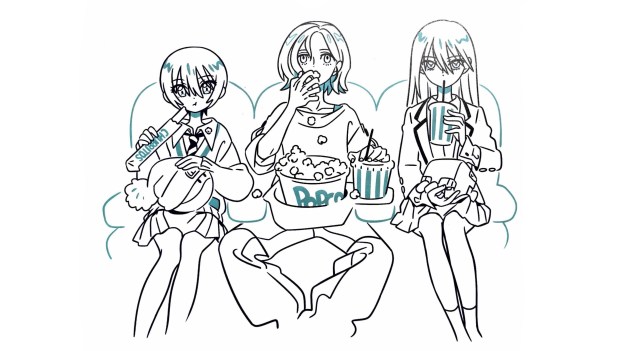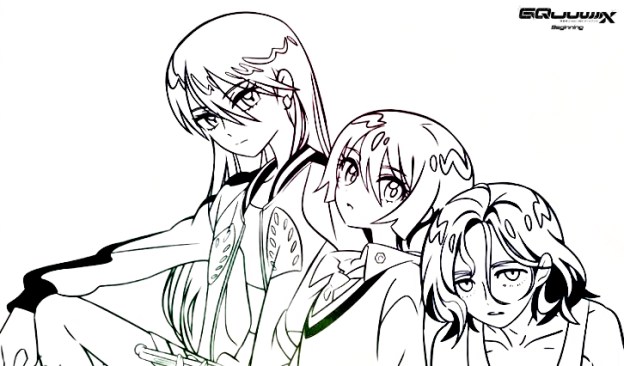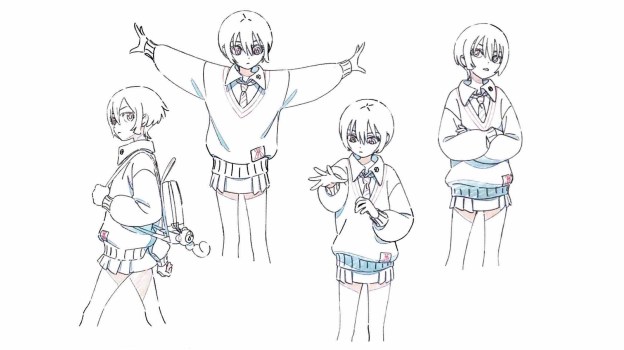
Original interview from Monthly Newtype (May 2025), original text by Hisashi Maeda and Makoto Ishii; cover image: official character design sheets from the “Mobile Suit Gundam GQuuuuuuX: -Beginning- MATERIALS” pamphlet by Yumi Ikeda.
I thought that by depicting the feelings I’ve experienced under the Cold War, I could convey a unique atmosphere unlike that of any other Gundam before
A “Cold War” feeling in the Universal Century
— When talking about this work, you’ve often mentioned the genres of “Alternative” or “Fictional War Stories”, what do you think the appeal of these genres is?
Rather than the militaristic component, I’d say the interesting and thrilling part is the SF one. The first half of the theatrical pre-release version, “Beginning”, is an alternative version of the One Year War, so I mentioned the words “Alternative War Stories” before, but in terms of composition, I think it’s more like a “Historical What If”, a genre close to SF, about a world set in the aftermath of a rewritten history. An alternative history work I like is “Red Sun Black Cross” [レッドサン ブラッククロス, a board game and novel by Daisuke Sato]…
— The one by Sato Daisuke?
Yes, that one. Do you remember how it starts? As a whole, it’s an alternative history version of the Second World War, but it starts off depicting the beginning of the Fourth World War set in 1990. Right off the bat, it threw us into a world we knew nothing about —a world where, forget World War II, even World War III was already over. I keep coming back to its prologue, and it still excites me even to this day.
I feel that this sense of excitement, at least for me personally, is the kind of thrill distinctive to SF.
— Talking about Sato Daisuke’s works, there’s “Nobunaga-den”, in which he ponders how Japan could have won the Second World War, and arrives at the conclusion that “Oda Nobunaga shouldn’t have died at the Honno-ji Temple”.
In a sense, I felt that this idea was similar to GQuuuuuuX.
I just told you how, to me, GQuuuuuuX is a “Historical What If Science Fiction”, but originally, the idea of a story set in a world where “Zeon won the war” was more akin to the alternative history genre. I believe there are two main approaches to alternative history works; the first one is to make a historical change in the initial setting or premise of the story, and then develop what happens next like a simulation. The second one, is develop the events that lead up to the historical change, thinking in what way history would need to be altered to make that change possible in the future.
In GQuuuuuuX’s case, it’s clearly the latter, and there’s this point often discussed among Gundam fans that “The Federation wasn’t able to defeat Zeon just thanks to the efforts of Amuro and the single Gundam unit alone”… Though, it’s mostly the military fanatics that bring this up… (laughs)
— Like bringing up the difference between a “tactical victory” and a “strategic victory”.
That’s why, to lead up to GQuuuuuuX’s future, there are some more military-oriented, realistic changes to the OYW, like for example “Zeon’s colony drop being successful and the Federation suddenly losing their headquarters in Jaburo”. But then I thought: “This is Gundam, after all” (laughs) “and since it’s Gundam, the existence of the Gundam itself has to be the trigger for the turning point in history”. That’s when I came up with the idea of “What if the pilot of the Gundam was Char instead?”.
That’s the exact opposite of how (Hideaki) Anno, who wrote the script for the One Year War part, conceptualized it. I believe he wrote that script starting from his desire to write a version of the war in which Char pilots the Gundam and achieves great things. Though, ultimately, they’re still both like an alternative history work.
— The place where the protagonists, Machu and the others live, Izuma Colony, is an interesting setting. Starting from the name itself, it has a Japanese flavor to it, and overall it somewhat resembles modern day Japan.
There are two reasons why I decided on such a setting. The first one is that I wanted to use Japanese language. At the time of “Top wo Nerae 2!” [Gunbuster 2: Diebuster (トップをねらえ2!DIEBUSTER), 2004, it was prohibited to show (Japanese) characters and writings, and in terms of direction, it was a nightmare to work around it (wry smile). I thought that using written characters would have made it so much easier to express many different things.
The other reason is, if you watch any Universal Century episode up until now, it’s clear that English is the official language. However, there are a few colonies, like Moon Moon or the Texas Colony for example, rooted in a special and distinctive culture of their own. So, I thought it would be fine if there was a colony whose customs were heavily influenced by Japanese ones. Side 6 from the first “Mobile Suit Gundam” was originally designed as a caricature of Japan. I thought it would be okay if there was a colony with many residents of Japanese origin.
— And what about the time setting?
To tell the truth, I wanted Machu and the others to be born after the end of the war; I thought they would give off a stronger impression of being a “new generation” that way. But in the end, things happened and we decided on UC 0085 as the time setting.
— I find that “I wanted Machu and the others to be born after the end of the war” really interesting. What are your thoughts and feelings on dealing with a post-war scenario?
Rather than a post-war, I’d say it’s a Cold War. When I was a kid, we were right in the mist of the Cold War; the US and the USSR never fought each other directly, but it felt like the next war could break out at any moment. There were novels or movies about the USSR army suddenly landing on our territory and turning Japan into a battlefield, and back then, it didn’t feel all that unrealistic.
When we decided on UC 0085 as the time setting for GQuuuuuuX, a certain member of the staff pointed out that “You’re doing Gundam but you’re not writing about war?”. All the previous Gundam up until now have portrayed a war of some sort, be it a full-scale war between different powers, or a factional struggle within the military, almost like a civil war. So I thought that writing about a “Cold War” would have worked as well. I thought that by depicting the feelings I’ve experienced under the Cold War, I could convey a unique atmosphere unlike that of any other Gundam before.
— It’s true that, despite not being directly at war, there’s palpable tension between the two factions, and the atmosphere in the colony turns really tense just by the arrival of a battleship like the Sodon. It really gives the impression of a Cold War. Those under 40 today only became aware of the world after the Cold War was already over, so they don’t know what that atmosphere felt like.
That’s right. I think (Yoshiyuki) Tomino-san’s generation is the last to have known the experience of war throughout their childhood. My generation, of course, didn’t experience actual war, but we do understand the feelings of the Cold War. Naturally, conveying those sensations to the current, young generation is very difficult, but in today’s reality as well war has broken out in Ukraine, and conflicts and civil wars continue unabated in the Middle East. It’s not outside the realm of possibility for the current situation to escalate in a world-wide conflict. I believe that, to some extent, the prospect of a “future war” between nations has unfortunately become a reality among the young people of today.
That’s something that hasn’t been felt for about 30 years since the collapse of the Soviet Union, isn’t it?
— Indeed, I understand the feeling that the thread of terrorism has taken us back to the terror of the Cold War.
I think a world where a space colony, while certainly not depriving the characters of their freedom, still somewhat feels like a claustrophobic place that’s tying them down, is reminiscent of your previous works…
Well, that’s the influence of what I felt like when I was young. I grew up in the middle of the rice fields in Niigata, and even though the horizon stretched out in all directions, it still somehow felt “narrow”. Of course, if I walked all the way past the mountain, I’d eventually reach Tokyo, but that wasn’t actually feasible, was it? I felt like I was trapped inside my small, familiar garden, and I wondered, “Am I going to spend my whole life in this place?”. I depicted that fear in “FLCL” [フリクリ, 2000], as well as in this work.
It’s not like Machu thinks that “A space colony is too narrow, I hate it”, but she feels like “The world has to be much more vast, more free…”. She could, in principle, go to other nearby colonies, but in reality, she doesn’t. She lacks the freedom to say “whenever I want to go, I can do it in an instant!”; that’s especially true for children. I’m depicting the same things I myself felt in the past.
— So, that’s really a theme you want to focus on in the works you direct?
It’s rather because I want young people to watch my works. When I ponder what kind of feelings the youth of today would actually feel, I think it has to be something similar to the sense of confinement, or the fear and the anxiety about the future I too felt back then.
— Machu being bothered that the gravity inside a space colony isn’t real is too an extension of those feelings?
That in particular incorporates another slightly different thematic. Is the Red Gundam that Shuji pilots the real one? Are Newtypes and their abilities real to begin with? Is the alternative world of GQuuuuuuX itself real at all?
This idea of whether something is “real or not” is present in many ways within the story, and I believe it might be another element especially interesting for the young viewers.
— What do you mean by that?
For example, thoughts like “I wanna become a mangaka” or “I wanna become a musician” always come together with doubts like “Is this talent actually real?” or “It works in class or at cultural festivals, but would it really work as a profession for the future?”, “Is it a real, genuine talent comparable to that of famous mangaka or artists that everyone knows, or does it only work among friends?”. In this sense, I feel like it’s a very valuable theme.
— From what you said today, I feel like what you’re trying to do is depicting a sensibility close to that of the 80s and 90s, in which anxieties about the world and adolescence are mixed together, in a new, modern way.
You’re right. Even if I were to research the feelings of today’s youth, I doubt I’d be able to properly portray them on screen… (laughs)
— From this perspective, I’m really looking forward to see how the three main characters, Machu, Nyaan and Shuji will be portrayed. Talking about young characters, there’s also the poor Xavier…
Xavier’s a character I like. I hope I was able to portray him in an interesting way. Please, look forward to it.