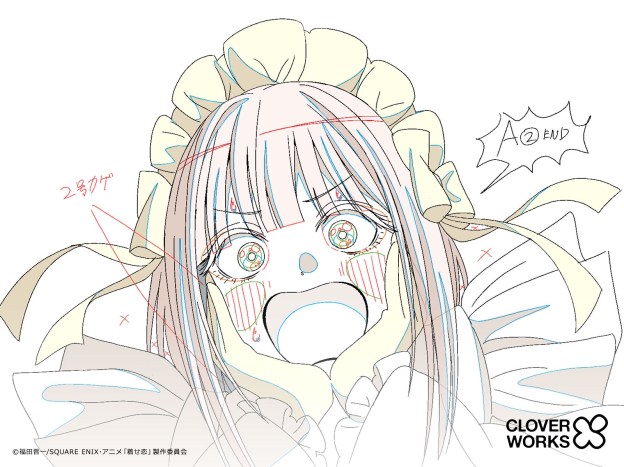
Original interview from Monthly Newtype (September 2025), original interviewer: Hisashi Maeda; genga from studio ClowerWorks’s official Twitter account.
Episode 14: Storyboards and Direction that bring the drawings to life
— I’ve been watching you two chat for a while, you seem to get along really well.
Yamamoto: Well, we’ve been working together on this project for a while now, so… (laughs)
Takahashi: And besides, we’ve known each other for way longer.
Yamamoto: We first met on “Wonder Egg Priority” [Winter 2021], and after that we’ve continued working together at CloverWorks, so we’d often chat like this. Also, we’re close in age which I think played a big role too.
Takahashi: You’re right. Now that a lot of younger people have joined the production team, there actually aren’t many people around our age. That’s part of it, the fact that we’re both in our early thirties and talk a lot probably plays a big role. We can talk comfortably with each other.
— Your roles in this production are Assistant Director and Main Animator. First, can you tell me what kind of work the Assistant Director does?
Yamamoto: It changes from production to production, but in this case, I’m helping out in as many episodes as possible. That, and starting from the script planning, I participated in basically all sorts of meetings together with Director (Keisuke) Shinohara, and helped brainstorming ideas when he needed support. I really wanted to be actively involved in the main story as well.
— I see. What about the Main Animator? You had the same credit on Season 1, so tell me about the differences you’ve been experiencing in this role between Season 1 and 2, if there are any.
Takahashi: In Season 1, as the Main Animator I was mainly in charge of the standout cuts, those that would make the entire series look more spectacular. In Season 2 though, it’s been more like “handling a lot of key animation within a single episode”, so that was a new challenge for me.
Yamamoto: In Season 1, Naoya-kun provided crucial support for many of the good scenes in each episode. For example, the love hotel scene in Episode 11, when Gojo-kun grabs Marin-chan’s hips, her phone goes flying and the lights go out…. And other similar sequences.
— That’s a very memorable scene from the episode you, Yamamoto-san, directed and drew the storyboard for, isn’t it?
Yamamoto: I believe that scene really shows Naoya-kun’s distinctive touch and sense, but that aside, there were cuts like the one of the bed springs bouncing up and down, where even if I drew the storyboard myself, I was sitting there thinking: “How the hell are the animators gonna handle this?” (laughs). I’m extremely grateful Naoya-kun took on them.
Takahashi: It’s because I understand your feeling of wanting to express those scenes in a certain way. Cases like that, even if the animation is tricky to figure out, just make you want to do it.
Yamamoto: There aren’t many animators out there with that mindset, you know (laughs).
Naoya-kun’s taste gradually built up on the screen during Season 1, and concentrating it into a powerful burst was something we were aiming for for Season 2.
That’s why we asked him to handle half the animation work for Episode 14 all by himself. Having a single person work on half the cuts for an episode takes a lot of time, and it’s just extremely difficult with the way anime production works nowadays.
But by doing it that way, you really can bring out such a rich flavor.
— And so that’s why for Episode 14 Takahashi-san handled all three, storyboard, episode direction and animation direction (together with Maring Song). What was the main focus when working on that episode then?
Yamamoto: From the get-go, keeping the number of key animators as low as possible was the goal for Episode 14. Naoya-kun was the perfect fit, and it was indeed a great success.
While his primary focus was the animation direction for the first part, he drew a ton of key frames too. And as a result, Naoya-kun’s distinctive taste really shined throughout the episode, exactly as we aimed for. I’m really happy with the result.
— Talking about Takahashi-san’s peculiar taste, what is it concretely?
Yamamoto: With key animation, animators mainly focus on movement and layout composition, but I always want to say: “No, Takahashi-kun’s drawings are really good!” (laughs). His key frames are really good drawings in and of themselves. That’s why for this episode we consulted with Chief Animation Director Yamazaki Jun-san and decided not to correct them much. Yamazaki-san too wanted to keep Naoya-kun’s drawing as they were.
But then of course, Naoya-kun is also great at drawing movement, so overall it has this well-grounded, interesting quality to it; that’s my impression of Episode 14.
Takahashi: Thank you so much (laughs).
Yamamoto: I really like how Naoya-kun’s Marin-chan is very cute and Gojo-kun is super cool. Thanks to this extra drawing quality, you can really feel a stronger sense of acting. Often, even if the drawings themselves are good, once you add movement the nuance ends up changing completely. But in this case, he really grasped the intentions behind the storyboard and the direction, so the whole thing came together as a unified and cohesive piece of film. That was undoubtedly thanks to Naoya-kun.
Takahashi: It does convey a strong sense of unity. But really, Nara-kun’s [Yamamoto’s nickname] storyboard and direction make it very easy and comfortable to work with. It’s easy to understand what he wants to do, or rather, I think he’s someone who’s really focused on “creating fun film”. It might be a very vague way to put it, but throughout the process, I was really looking forward to seeing how it would turn out once I added my own idea of a “good drawing” to it.
— This decisiveness on what Yamamoto-san wants to achieve, what specifically do you grasp it from for example?
Takahashi: Above all, I think it’s the variety of directorial ideas he has, all stemming from his wish to entertain the viewers. Nara-kun too was originally an animator, and from there he moved to episode direction. The thing is, directors that start off as animators inevitably tend to put the spotlight on the animation itself. They usually put a lot of weight on stuff like the quality of the animation, or how the good shots look, and how smooth the transition between cuts feel. And there’s nothing wrong with that either, but Nara-kun keeps changing and adapting his approach and style, always putting “entertaining the audience” first when drawing his storyboards. It’s of course important that viewers are moved by seeing beautiful, high-quality drawings, but he actually places more emphasis on something else.
In that sense, I feel like we were able to make Episode 14 because we share a similar way of thinking.
Yamamoto: I too like things that showcase good animation, or rather, “good acting”, but since I fundamentally enjoy fun things, I just naturally tend to lean in that direction. Sometimes, my storyboard lack that element of acting to the point where, as a director who came from animation, I can’t help but wonder if I’m really doing it right (laughs).
Takahashi: It’s rare, isn’t it? Directors that started their career as animators can often feel intimidated about using 3DCG or live-action reference. They end up worrying about things like: “Wouldn’t this be easier for the viewers to understand if done with regular hand-drawn drawings?” or “Isn’t the rhythm a bit off in this specific sequence?”.
But Nara-kun goes ahead without hesitation. He’s got incredible guts.
Yamamoto: Though, every now and then the Director or others will step in and say: “Alright, maybe that’s a bit too much” (laughs).
I think that’s a nice balance. But for Episode 14, the core intent was to let the quality of Naoya-kun’s drawings go all-out. Talking about very precise and detailed cuts, the cooking scene had me like: “No way, that’s absolutely incredible! He managed to make it this good?!”, I was moved.
Of course, it was all stuff I had drawn myself in the storyboard, but Naoya-kun went totally wild too (laughs).
Takahashi: I worked really hard (laughs).
Yamamoto: He’s working in a realm that’s way beyond what I could possibly pull off myself. The cooking scene made me think things like: “Wow, it looks delicious” and “He’s cooking with so much care”, it’s truly amazing.
Takahashi: I’m really glad to hear that.
Yamamoto: That’s what I thought while watching the line-art, before the coloring step. And once it got colored, it was even more amazing. This really is the joy of making anime.
Takahashi: There were many situations where drawing movement would have been very challenging, so I relied on still drawings to create the appropriate sense of pacing. In those cases, if the drawings aren’t well made, it just cannot work, so I gave my best in that aspect as well.
Yamamoto: When it came to those scenes, I relied on Naoya-kun’s power as an Animation Director. I had faith the capabilities of Studio CloverWorks as well, but since I knew I could work with him, I drew very demanding storyboards specifically tailored around Naoya-kun.
— In other word, it’s an episode born from the deep mutual trust between the two of you.
Takahashi: It was definitely hard of course, but working together was very comfortable.
Yamamoto: Your help was essential. It was so much fun.
More in this series: