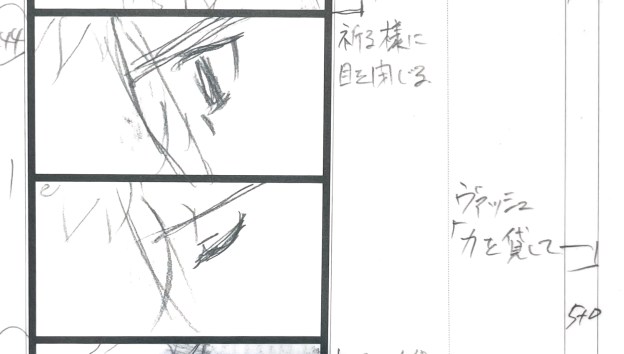
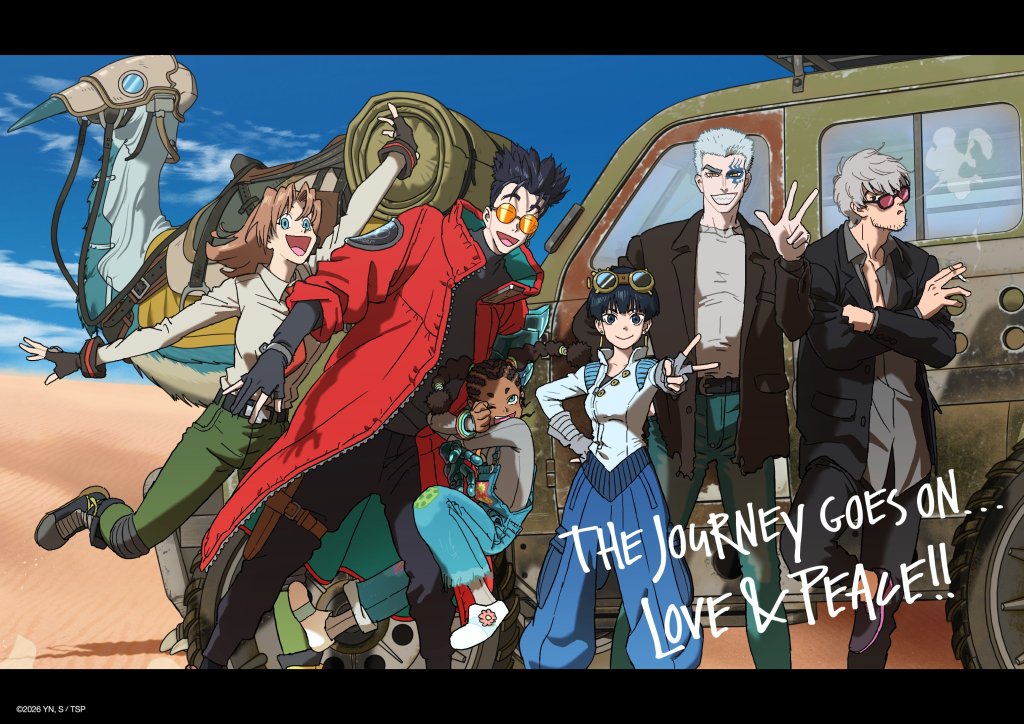
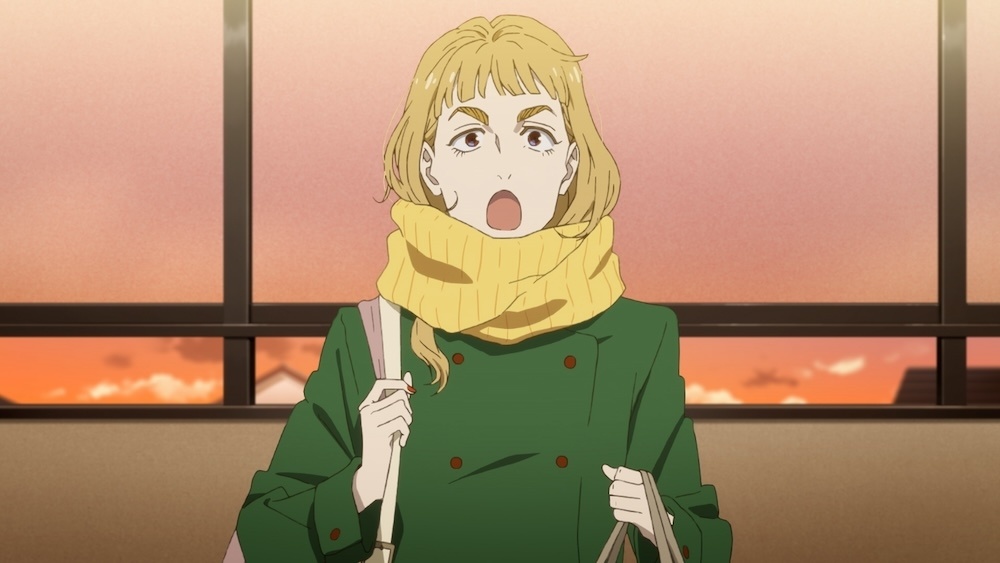
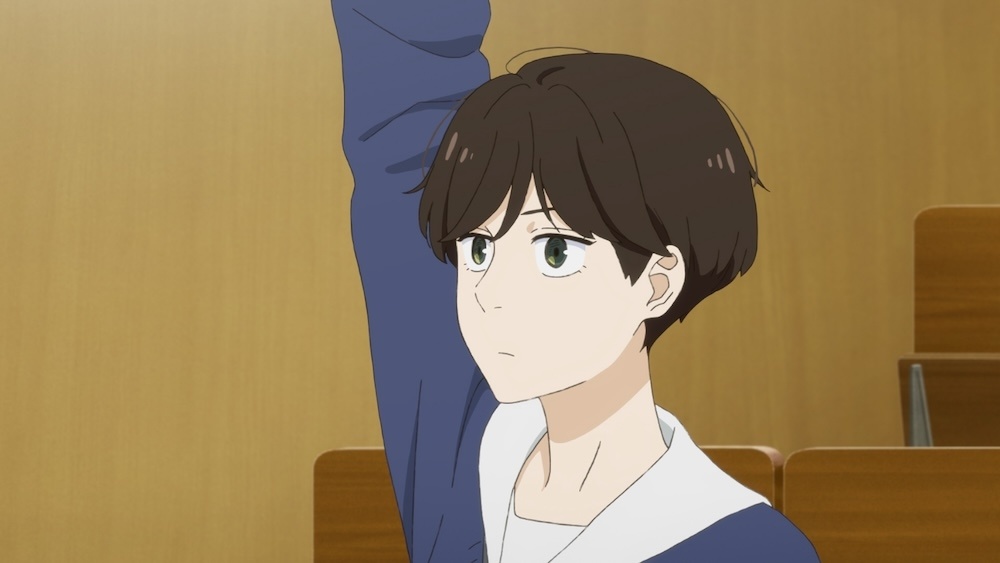
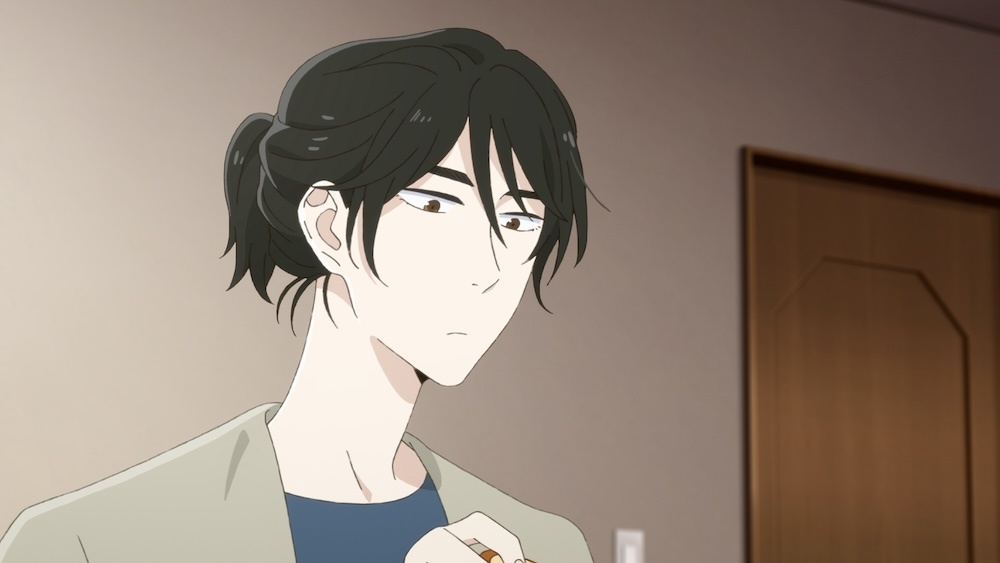
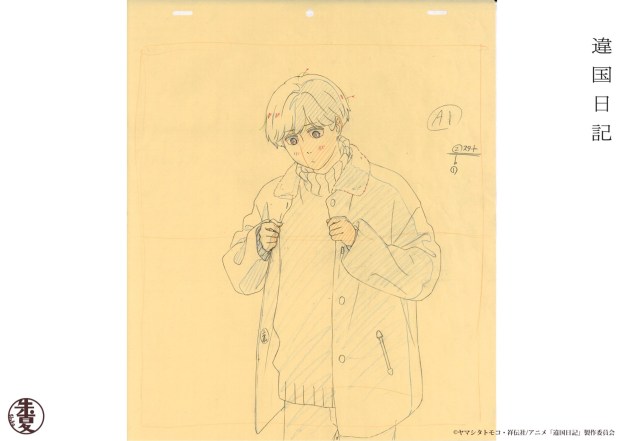
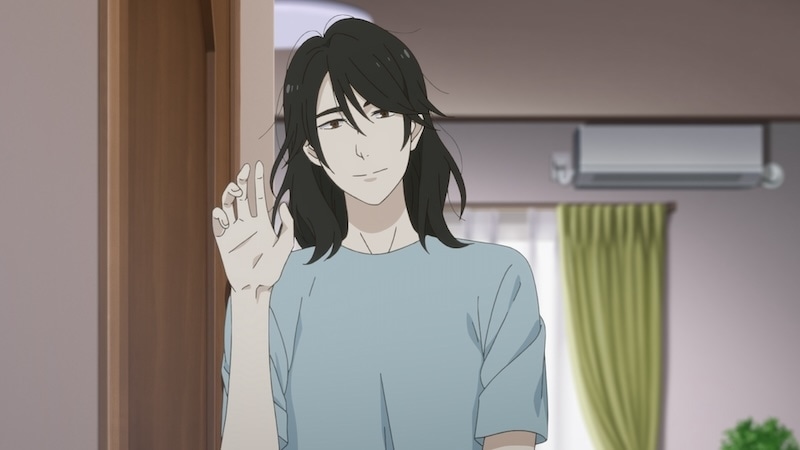
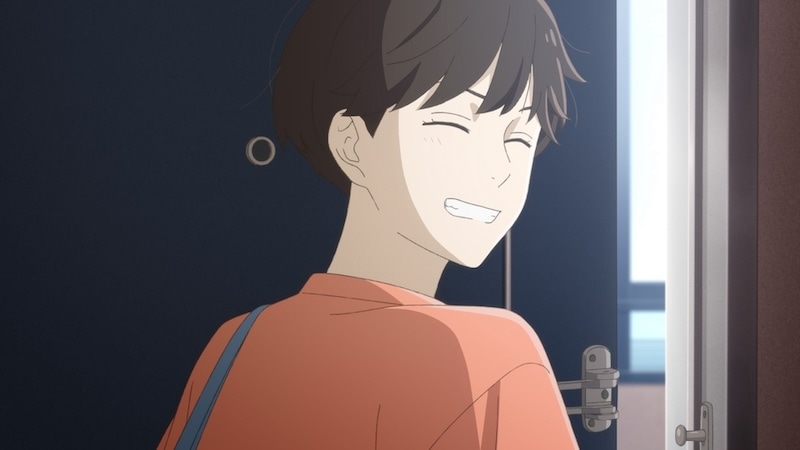
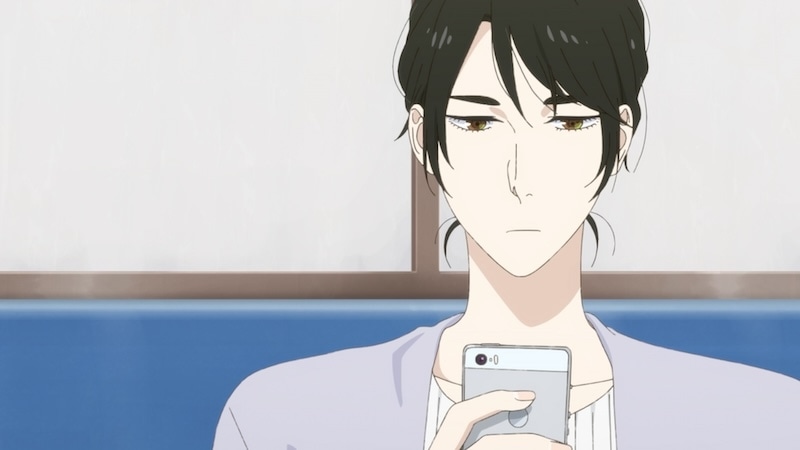
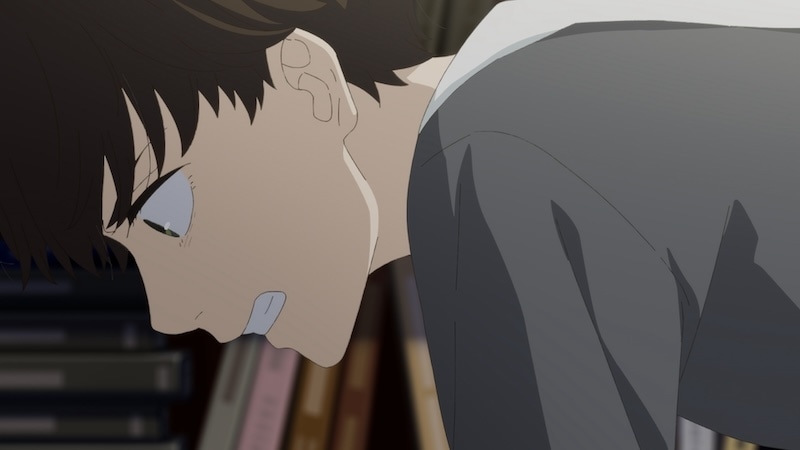
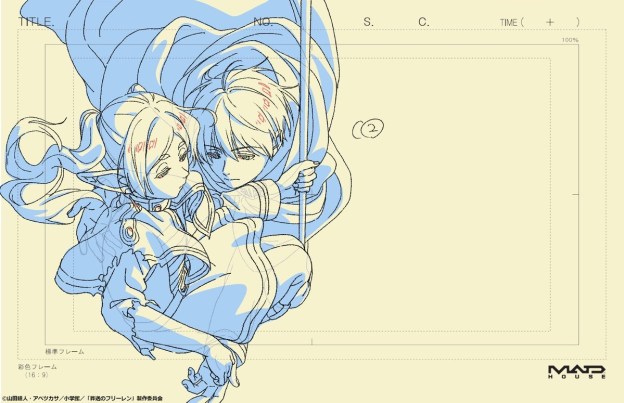
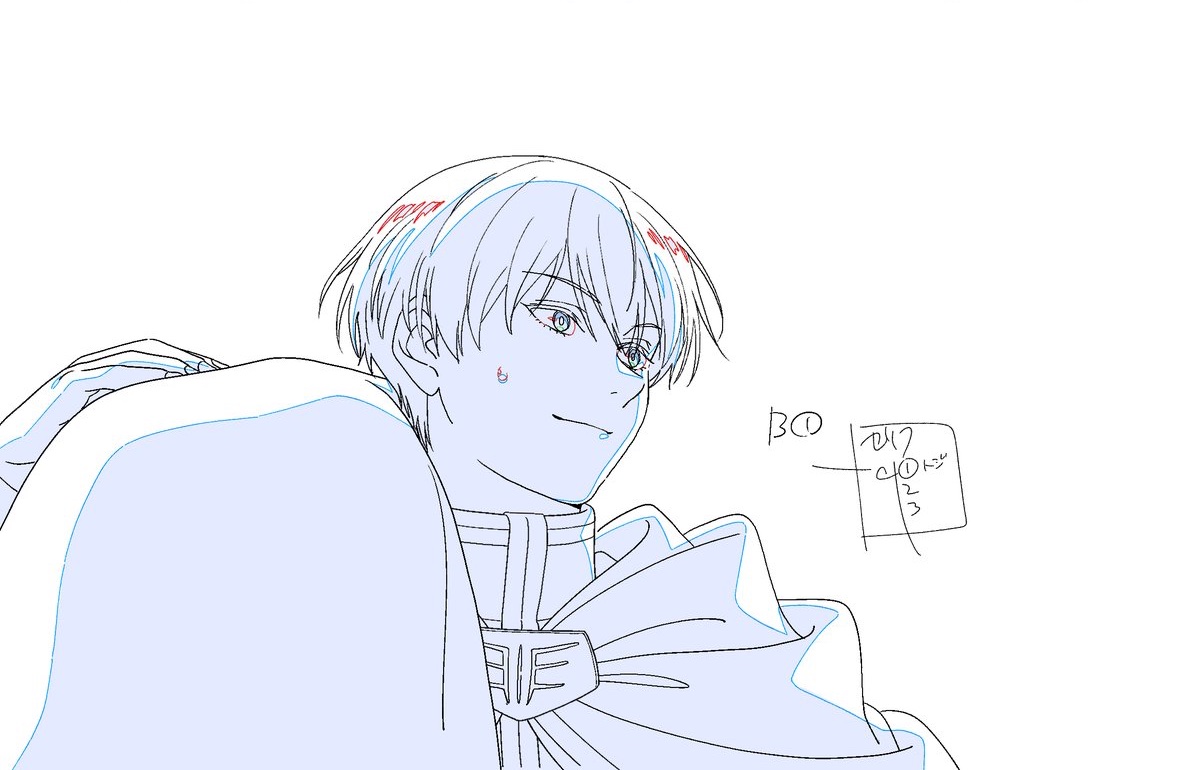
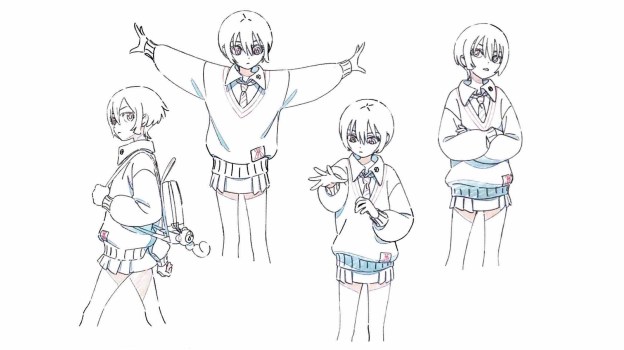
Original interview from PASH! (April 2026), original interviewer: 佐々木玲佳; storyboard from the TRIGUN STAMPEDE Exhibition in Ikebukuro (March 2025).
It’s a story that starts from the question: “Why do humans kill each other?”
— What do you think is the appeal of the original work TRIGUN?
I think it’s a work that confronts fundamental questions head-on. “Why do humans kill each other?”. And “Can it be stopped?”. I feel like this is a message that many can empathize with, and that can move many hearts.
— Is there anything that left a strong impression on you from your talks with Nightow-sensei?
Nightow-sensei has continued to watch over us with a supportive stance, always respecting the anime production. He always says: “You’re free to do as you like”, and I’m really grateful for it. We also had many opportunities to attend events together, and through interviews and similar occasions, I had the chance to see him speak about his approach to this work. Things like how he imaged Vash and Knives’ characters back when he was drawing them, and quotes like: “I want to depict what lies between heaven and earth”. As a reader myself, I’m really happy I was able to hear this kind of backstage stories directly from the author himself.
— The title of this final season, TRIGUN STARGAZE, is very impactful. Could you tell us what feelings and intentions went into it?
It was a suggestion from the producer, but there are two reasons behind the choice. Firstly, one of the main elements of this season is the immigrant fleet coming from Earth, and secondly, more than anything, Vash is a dreamer at heart. So, we decided on this title with two meanings in mind: “One who watches the stars” and “One who dreams”.
— You mentioned that Vash is a dreamer. Could you tell us about your vision of Vash’s character in this work?
Fundamentally, he didn’t change from last season. He’s still chasing the ideal of not killing anyone and not wanting anyone to die, and in order to achieve that goal, he doesn’t mind if he gets hurt in the process. That’s Vash’s character. However, this time we are depicting a side of Vash that shows how he isn’t entirely a perfectly righteous person.
— A character who gets deeply involved with this Vash is Nicholas. What aspects did you place emphasis on in portraying him?
I believe he’s the character with whom the viewers can empathize the most in this story. Compared to the opposite extremes that Vash and Knives represent, Nicholas occupies a much more grounded position. His middle-ground role, having had a period of connection with Knives, while also being a dear friend to Vash, was something I was especially conscious of when portraying him.
— What about Meryl and Milly, what kind of position do they occupy as characters in this work?
Meryl is the “representative of humanity”, a bystander who has been following Vash and watching the story unfold since last season. I also think of her as a presence who carries the conscience of the story. Nicholas occupies a similar position, but he is even more pragmatic, whereas Meryl, like Vash, is someone who wants to keep chasing after an ideal. If Meryl and Milly were going to be in this show, I wanted them to truly have their moment. We do have some spotlight scenes prepared for them down the line, so I hope you’ll look forward to it.
— What struck me in the early scenes at the beginning of the season was how, even in the more serious situations, the two’s conversation lightened the atmosphere in just the right way.
Thank you! The scene where they first appeared together eating a banana split [they actually couldn’t eat it in the end] or Milly’s “Do you have any more?”[referring to bread she just called “so dry” and “not very tasty” t.n.] in the later car scene, both captured the two’s relationship very effectively. I believe they were two well-executed scenes.
A challenging script, shaped by the resolve to close this story.
— In regards to this works’s production, what’s the aspect that was the most troublesome and challenging for you, Director?
Definitely the script. This season stands in the very complex position of being the sequel to TRIGUN STAMPEDE, which substantially rearranged the content of the original’s story. I really racked my brain over how to build on that. I too watched TRIGUN STAMPEDE as a viewer, and felt that its ending was gut-wrenching and truly impactful. And TRIGUN STARGAZE had to take it from there. I felt that viewers would surely want to see it through to the end, so we decided to take the story all the way to the conclusion of the original. However, there simply wasn’t enough runtime to cover everything. Rearranging and adapting it was unavoidable, including all the parts that fans of the original had been waiting to see, so we spent a really long time talking it through.
— Nine episodes have aired so far. Is there a scene that has particularly moved you?
The performance by Vash’s voice actor, Matsuoka-san and Knives’ voice actor, Satou-san in episode 7. Listening to it, I felt something pressing deep into my chest, and I thought: “I’m really glad we could make this into anime”. They each have their own, strong conviction, and it really was a fierce confrontation between brothers. Vash and Knives are like the angel and the devil that live within a human being, and I believe that inner conflict is what their story is ultimately about.
— Is there anything that left a particular impression on you from the recording sessions?
If I have to bring up something other than episode 7, that would be episode 3, “Memento Mori”. The scene at the end where Vash says “I’m home” and breaks down crying. The actual take came out completely different from the rehearsal, and in that moment, something inside me clicked: “Yes, this is exactly Vash”.
— I heard that for this season, the voice work was recorded before the animation was finalized [“pre-scoring” t.n.]. Were there instances of the visuals changing in response to what the cast brought to their performances?
The animators have been working while listening to the performances, and the visuals themselves were heavily influenced by the voice actors’ work.
A CG that evolved in real time.
— Is there anything from the production that has particularly stuck with you?
This was my first time dealing with 3D animation. At the beginning, there were some expressions I was told would be difficult to make in 3D, but Studio Orange kept pushing their technology forward throughout production, and the parts that we had planned to handle with hand-drawn animation were replaced by CG one after the other. For example, the scene in episode 1 where Hoppered the Gauntlet combs Vash’s hair, or when Jessica breaks the egg’s shell in episode 4. And then there’s the metamorphosis sequence, where Knives, reduced to nothing but eyeballs, gradually forms bones and flesh from the energy of the Plants. Metamorphosis sequences have traditionally been the domain of cel animation, but this time, we took on that challenge with CG. I really hope you’ll pay close attention to the visual craft as well.
— The visuals really are a highlight of this season.
Thank you very much. The final battle between Vash and Knives is going to be the climax, both visually and narratively. I hope you’ll keep your eyes on how their conflict will ultimately resolve, and how Vash will confront the truth about what really lies in Knives’ heart.
— Lastly, a message to the fans.
To the fans who first met this series through TRIGUN STARGAZE, please consider giving the original manga a try. And to the fans who’ve been supporting this series for many years, we have something special in store that you won’t find anywhere else. I hope you’ll stay with us all the way to the end.
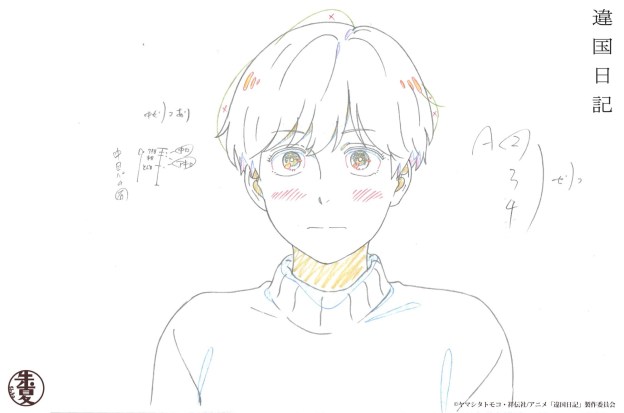
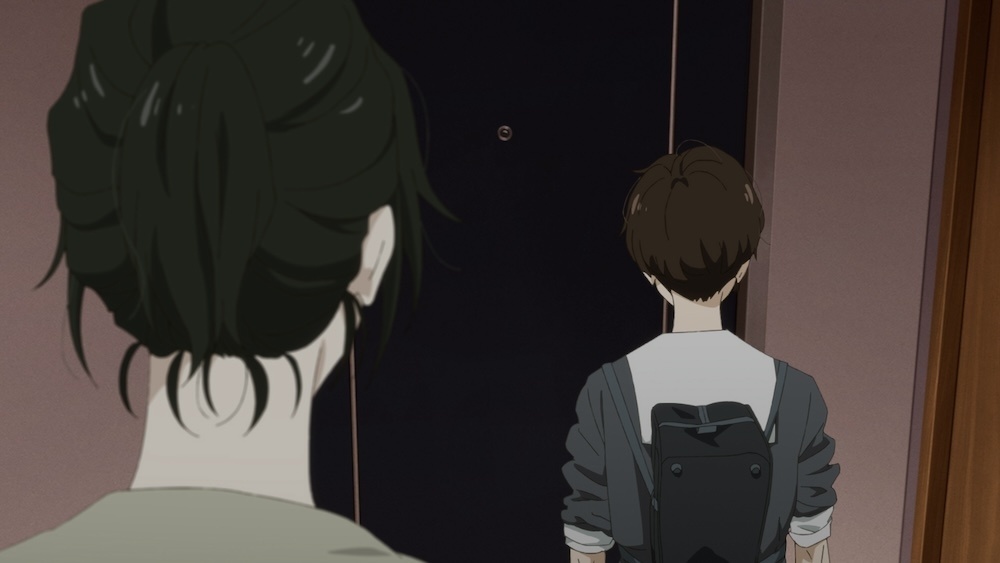
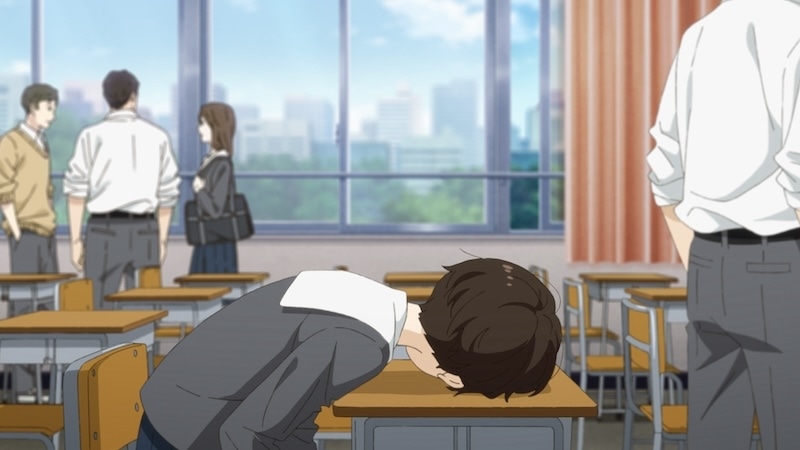
Original interview from the Animate Timesseries of interviews on Ikoku Nikki, published on March 29th 2026, original interviewer: M.TOKU; gengafrom the official studio Shuka Twitter account.
I believe there doesn’t exist another work that depicts negative emotions quite as plainly as this one.
— I heard that you already liked the original manga. What do you think the main appeal of this work is?
This is something I’ve only recently found the words for. This work depicts human emotions while telling simple stories of daily life; those emotions aren’t always beautiful or positive, they can also have negative parts, and in this work, the negatives are portrayed in a way that is intentionally not exaggerated. I believe this is the reason why I find it so compelling.
— I think this delicate and not overstated presentation makes it feel more real and relatable.
Exactly. There are so many human dramas out there, but I believe there doesn’t exist another work that depicts negative emotions quite as plainly as this one. I feel like there are more works that exaggerate the unpleasant aspects as unpleasant, and even go so far as to depict them as excessively negative, sometimes to the point of creating outright antagonistic relationships. This work however, isn’t like that, and that’s why it feels more realistic. I remember that Yamashita-sensei mentioned in some interview that she’s not “trying to create bad people”, and I believe that’s the main reason why I like Ikoku Nikki so much.
— Why did you think to adapt this work into an anime?
In part because I’ve been asked: “Is there any work you like?”, and also because, since I don’t think there are many anime adaptations of works with this sort of expressions, it felt a bit challenging. I wanted to test out if it was possible to translate it into moving pictures while also maintaining its atmosphere intact.
— I’ve always thought it would be quite a challenging work to adapt.
That’s right. I didn’t intend to direct it in a too unconventional way, but judging from the viewers’ reactions, I feel like it ended up being the kind of anime you don’t see often these days.
Don’t make the presentation excessively tear-jerking.
— When working on an anime adaptation, I believe that carefully choosing the members of the staff is especially important. For this project, Kiyasu Kohei-san was in charge of the script and series composition. Why did you ask him?
When I had the chance to read a bit of the scripts Kiyasu-san wrote for other works, I got the impression that he’s a writer who does some pretty interesting things. I also felt he was a stoic person, and potentially a good fit for this project, so I invited him. I’m glad he took an interest in the original work.
— What kind of conversations did you have with Kiyasu-san when discussing the script?
At the time, the original hadn’t concluded yet, so at first I told him I wanted to start with adapting Volumes 1 to 7 into a 1 cour anime. Then, I remember talking about how I wanted the anime to feel as close as possible to the sensations that reading the original leaves you with. We didn’t really discuss many practical things. After that, Kiyasu-san turned in the initial draft of the script, and it was already amazingly perfect, so I didn’t have to worry about anything.
— When it came to writing the script, did you get any specific requests from the original work-side?
In particular, they requested that we “didn’t make the presentation excessively tear-jerking”. I payed attention to this during the script-writing and story-boarding stages, but when you add the voice and music, the flavor changes substantially… Of course, I didn’t try to overdo it, but after episode 1 aired, I read a lot of comments saying: “That made me cry so much”. Maybe I really did exaggerate it…? That made me a little worried. I’d rather it be more subtle, like you start shedding tears before you realize it. That’s the ideal way for me (laughs).
— Let’s also talk about the visuals. Hayama Kenji-san was in charge of character design and the animation direction. What were your requests for him?
From the beginning, I had the impression that Hayama-san was very close to this work as a person. Additionally, he’s just overwhelmingly good at drawing, so I didn’t provide him with any specific instructions. There has never been anything I worried about in that regard.
— When we interviewed Hayama-san for this series, he said that he was “Very worried about his work and might have caused troubles to the staff”.
It’s true, he does have a reputation of drawing rather muscular and brawny male characters. But in a previous work titled “Kuragehime”[“Princess Jellyfish”, 2010] he also depicted more comedic-styled art, and the delicate linework you might associate with a female creator. So, personally, I wasn’t too worried. And watching his work as an animation director, I really realized how amazing he is. Especially when it comes to acting and expressions. He adjusted the facial expressions with his corrections in ways I didn’t expect, which resulted in the final drawings being even more compelling.
The higher the quality the better, but too much movement tends to pull your focus in that direction.
— Including the designs, please tell us about the things you particularly focused on and kept in mind when creating the visuals.
Now that I think of it, I didn’t want the animation to get in the way. If the animation is too intrusive, it distracts the audience from the story. So, I tried not to overdo it, while also handling it with care. It’s not like it’s a work that needs to be flashy about movement anyways.
— I feel like what you’re talking about nowis something on a different level of what’s usually referred to as “quality”.
Of course, the higher the quality the better, but when there’s too much movement, it tends to pull your focus in that direction. In a scene where I want the main focus to be on the voice acting and the music, if the drawings move excessively, they end up pulling the viewer’s attention away. That might be what people call “incredible sakuga”, but there are times when that’s not what I want to convey. What to move and what not to move is something I’ve been payed special attention to since the story-boarding phase.
— It’s about the balance of what you show.
Yes, exactly that! I think there are all kinds of anime out there, but personally, I’m the type who gets tired watching something that’s constantly moving. I believe everything should have a good sense of rhythm and variation in pace.
— Thank you so much for this valuable discussion. I also felt that this work put a lot of care into its cooking scenes.
It’s a drama about everyday life, so cooking scenes require a certain degree of realism to them. When I wanted the cooking to look tasty, I specifically asked for tasty-looking drawings, and when in turn I wanted the food to not look good, like the sushi in episode 1 for example, I adjusted the colors to be less vibrant.
— A direction technique to make the food look not tasty!
It was pretty difficult, you know. You also need technique to make it look not good. To figure out what “un-tasty food” would look like, we actually went and bought some sushi, and left it sitting in the fridge for a while. From there, we studied things like how the highlights fell on that dried-out sushi. Looking back now, eating that sad, dried-out sushi together with the staff is a fond memory I have of this project (laughs).
— Experimenting and seeing things first-hand is very important when you don’t understand them fully.
There really are many things you can’t understand unless you see them. Not just the animators, I think that we were able to bring upon that level or realism because we all observed and examined the real thing. I heard that the sound effects team actually went and made some deep-fried food to record the sound it makes. That’s amazing, isn’t it?
Makio was saying “I see”, not “I understand”.
— Ushio Kensuke-san was in charge of the music for this work. What kind of requests did you make to him at first?
I told him I’d love the piano to be the main instrument, and that’s about it. The music composition began around the time we had finished recording up through episode 2, and it was actually Ushio-san who suggested: “I’ll look at the materials and footage available at this point and try composing a few tracks based on the impression I get from them”. The tracks he created after that were already amazing, so we decided on that direction. Then, I lightheartedly requested for more tracks that could be played during everyday scenes, as well as a more bright and a more sad track, which he proceeded to compose right after.
— Personally, I had the impression that many of the tracks were quiet and gentle.
That’s likely what Ushio-san perceived from the work itself. Actually, separately from my meetings with Ushio-san, sound director Omori Takahiro-san and I had been talking about not wanting to score the music too densely. Omori-san already had the same interpretation, and he shared the same vision as mine. The music Ushio-san composed was already exactly in line with that intention as well. I had a lot of fun listening to his tracks.
— Please, tell us about the recording sessions and casting as well. The two characters at the heart of this story, Kodai Makio and Takumi Asa, are voiced by Sawashiro Miyuki-san and Mori Fuko-san respectively. What were the deciders for these castings?
Both roles were decided through an audition. Starting with Sawashiro-san, she was overwhelmingly Makio. When we first heard her voice, everyone went “She’s Makio”, and we all agreed on entrusting the role to her. The deciding factors for Mori-san were her bright and innocent tone. Her voice quality left a positive impression on me; the fact I couldn’t feel any darkness in her voice was really Asa-like. Another factor might have been that, including her freshness, she really reminded me of Asa.
— Did you make any specific requests to them in regard of the voice acting?
As for Makio, I felt like at first her emotions were coming through a little too strongly in some places. Sawashiro-san is very charming and considerate, she’s a very nice person. On the other hand, Makio is blunt and easy to misunderstand. I imagine there are quite a few differences between Sawashiro-san and Makio, and probably many aspects of her character she had a hard time grasping. A few times, I asked her to dial her emotions back a little, but without feeling downright cold, while still having a mechanical quality to her acting. I understand it was a very difficult request.
— I think you made such a complex request precisely because you knew Sawashiro-san could pull it off.
You’re right. One that stands out in my memory is the desert imagery scene in episode 1. There’s a line that goes: “I get it. This is what they call… loneliness”, but with the initial take, I felt that in that moment, she was leaning a little too close to Asa. It’s not like Makio is pushing Asa away in that scene, but she’s not quite trying to get closer to her either. But the difference in nuance between “understanding” and “sympathy” is particularly different to evoke. Sawashiro-san too was struggling to figure out how to express it. Then, Yamashita-sensei told her that “Makio was saying I see, not I understand”, and after hearing those words, Sawashiro-san‘s performance was truly magnificent!
— A single direction or piece of advice can completely change a performance. In every sense, I think this is what professional work looks like.
I agree. I’d be really happy if you watched that scene again. I believe Sawashiro-san had a hard time at first, but episode after episode, she gradually started to sound more and more like Makio and I was really moved.
— What about Asa’s voice actress, Mori-san? Did you make any particular request to her?
Mori-san has interpreted Asa naturally from the very beginning, and there was almost nothing I needed to ask her. She had clearly done a thorough read of the source material, yet she was also flexible enough to adapt in the many back-and-forths during the sessions. Also, she is really talented at singing. I believe you were all able to hear her by now. She did a fantastic job.
Daigo inhales while laughing, you know.
— Other than that, was there anything else from the recording sessions that left an impression on you?
The performance for Minori in episode 7 was really outstanding. Despite it being the same line, the emotional warmth of Ohara Sayaka-san‘s delivery in the opening scene where Minori is speaking, and in the later scene when the image of her appears as Asa is reading her journal, felt completely different. I was deeply moved. Ohara-san too happened to like the original work, so she acted with an extraordinarily high degree of understanding of source material. For (Shingo) Kasamachi-kun, Suwabe Junichi-san delivered a very sexy performance. Actually, it was a bit too arousing, so I had to ask him to dial it down a bit (laughs).
— So that was your request for him (laughs).
However, I believe Kasamachi-kun has this innate seductiveness to him, so it wasn’t entirely out of place. He was able to carefully enact a different performance for the younger Kasamachi-kun, which I thought was really remarkable. (Kazunari) Tono-san‘s voice actor, Kondo Takashi-san too immediately felt like he was a perfect fit for the character since the moment of the audition. He was such a perfect match it almost made me laugh. It moved me. (Nara) Emiri’s actress, Morohoshi Sumire-san was also super good. Especially in episode 3. I could see it form her performance that she was really worried sick for Asa until she finally called her. I found her acting to be incredibly convincing. The fact that she can make you cry with just her their voice is really incredible.
— So you were feeling, in every little moment, the added richness that the voice brings.
Exactly. Speaking of which, there’s Daigo (Nana) in episode 2. Actually, during the recording session, Yamashita-sensei mentioned to me: “Daigo inhales while laughing, you know”. And indeed, when I had read the lines written out in the original work, I did think they were a little unusual. But I never imagined they were meant to express that kind of laughter.
— Yamashita-sensei has a very clear image of her character in her mind, doesn’t she?
I was really surprised, but at the same time, I had to go with that. The only problem was that, when writing the script, we didn’t realize she had that peculiar way of laughing, so we had to adjust the timing of the lines. And Matsui Eriko-san was also able to adjust her performance accordingly, including this peculiar quirk. She tried right away, and asked: “Is it something like this?”. By the time Daigo appeared again in episode 7, Matsui-san had already mastered the inhaled laugh, and was able to perform her role smoothly and naturally. I realized how amazing voice actors really are.
— I believe this peculiarity of Daigo’s character became easier to notice thanks to the anime medium.
I believe the impression she gives off changed now that she actually has a voice. These shifts in perception between mediums is really interesting, isn’t it?
The creator’s intent is ultimately just one element that makes up and supports the story.
— Is there any other things we didn’t talk about yet that you focused on while working on this project?
When I first read the original, I figured that the scenes in the imaginary desert were a key of this work, so I absolutely wanted to recreate them in the anime. However, I thought that if I inserted those scenes with the same timing and flow as the manga, it would often end up feeling too abrupt. So, I added those scenes only at selected points, when they would feel as less obtrusive as possible. I wanted the timing to be as seamless as possible too. I started adding it little by little from the very first episode, in order to get the viewers gradually more acquainted with it, so that this change of setting to an imaginary landscape wouldn’t feel out of place.
— What you just mentioned is essentially one of those creative choices stemming from the inherent differences between “reading a comic” and “watching an anime”.
Exactly. In a comic, the passage of time can be defined as the space between panels. So, if when you turn the page, the setting has turned into an imaginary landscape, it doesn’t feel off. But as video, pictures come in sequentially, so it will inevitably feel out of place. That’s why I intentionally added many of those scenes, to the point a fan of the original might think: “Aren’t they overdoing it a bit?”… (wry smile). I did add them in on purpose, though. That said, without something like this interview, this kind of thing is hard to get across, isn’t it.
— Maybe it’s not something you should expect viewers to pick up on in the first place.
I think so too. That kind of intent is ultimately just one element that makes up and supports the story. If you’re making the audience conscious of your intentions, that might actually mean that they couldn’t properly focus on the story. And that would be putting the cart before the horse. I’m always striving to make sure the audience can just lose themselves in the story above all else.
— Thank you so much for the valuable conversation we had today. Lastly, with the show now approaching its climax, could you tell us once more what you see as its highlights?
In order to wrap things up as a single-cour anime, there are quite a few original developments woven in around the final episodes. I am a bit worried about how they’ll be received, but I believe it is shaped to end satisfyingly, so I hope you will enjoy it. There are also some hidden touches, so once you’ve seen the final episode, I’d be really happy if you went back and watched it all again from episode one.
Original interview from the Animate Timesseries of interviews on Ikoku Nikki, published on February 16th 2026, original interviewer: 西澤駿太郎; gengafrom the official studio Shuka Twitter account.
I walked in the direction the work itself led me.
— You’ve worked as the script writer for many different series, what feelings and sensations do you approach writing with?
I really just write down what I honestly think… If anything, I believe that when I’m entrusted with an original work and make it into a script, that work’s own atmosphere and wave-like thing are sure to have an influence on me. So, rather than me writing it, I think it’s more accurate to say that the original work itself, together with all the discussions I have during the various meetings, led me to write it. Therefore, I don’t really have a know-how or a secret trick, nor I have any established methodology.
— In episode 7, which aired just recently, Makio says that “After all, writing is a lonely craft”. What do you think?
It really is a lonely craft. It’s my profession, so whenever I say this, everyone ends up thinking “There he goes again…”, but… I’m really not cut to be a writer.
— There he goes again…
(Laughs). I’m really not good at the process of writing itself, or rather, it’s a really harsh craft. Because you have to think of everything by yourself. Sometimes, at night, I look at the totally useless single line I managed to write that day and think: “Wow, I really couldn’t write anything more than this”, and it makes me feel sad. I think it really is like Makio-san describes it: “a lonely craft”. Though, what I and Makio-san write are mechanically different things. I write scenarios and scripts, it’s something that’s written with the assumption that it will be handed to someone who stands before the viewers or an audience. I create it while discussing it with the very person who will receive it in the end, so the time spent talking about it is really a salvation for me. Makio-san is a novelist, an author. So, I believe the people she can talk to while working are very limited. I guess it’s probably just her editor. Therefore, in her case, the extent to which writing is a lonely craft is even larger. I really respect those who can write novels. When it comes down to novels, if you don’t actually finish writing one, no one will even take you seriously. Just saying “I kind of want to try writing something” doesn’t earn you any money. In the end, you really just have to write on your own, then take the finished piece to someone and say, “Please read this”. Moreover, you have to immerse yourself in the craft for the entire time. I believe that to its core, writing is a confrontation with your own loneliness. I think that Makio-san is a really tough person.
— Right. Ff you think about it, when she’s working, Makio doesn’t even talk to Asa.
But maybe a person like Asa coming into Makio’s life could potentially help stepping her up to the next phase as an artist. Sure, I also believe she feels that things have become more difficult because of that too… But maybe if she accepts it, the things she can write could also increase and become more proficient, and she might also encounter thoughts she would’ve otherwise never come up with by herself. I’d like to think that Asa will be a good influence to Makio-san as an artist.
— The comment you released last September began with the line: “It’s been two and a half years since I handed over the script for the final episode”.
Of course, I didn’t mean it in a weird way, but it felt like it left my hands quite a long time ago. How should I put it… it’s like when you see a relative’s kid you haven’t met in a while, and suddenly they’ve grown up so much (laughs).
— (Laughs).
It’s just like, “Wow, that’s amazing!” (laughs). It’s really moving. So, I just set aside any worries about “What’s become of my script”, and instead just think things like “The theme song is great” or “Oh, the PV even gives us little glimpses of scenes further ahead”, and I’m watching it with a really pure sense of enjoyment. The production of this anime is still constantly in motion, with everyone continuing to build it up piece by piece. That’s the kind of atmosphere I can feel.
— How was the screenplay written for this anime?
I’m essentially an “original work fundamentalist” no matter what, meaning, if there’s an original, my approach is: “It’s fine if it stays the way it is”. However, translating something that’s originally drawn on paper into moving pictures means changing the vehicle through which it’s conveyed. Even if I feel sorry about it, there are some parts you must change. For Ikoku Nikki, I didn’t want to harm the original’s unique atmosphere, but I also thought it was the type of original work that’s hard to preserve exactly as it is. Furthermore, it wasn’t just a matter of “translating it into moving pictures”; since it was a TV anime adaptation, I thought it would need to be treated properly as video, not only to keep the people watching it every week engaged, but also to capture the attention of viewers who might happen to come across the show unexpectedly. As a result, I had to rearrange the order of certain scenes, or fill in the gaps between panels or dialogues, or sometimes even cut a few. I ended up making quite a few modifications. Yamashita-san[the original manga’s author t.n.] kindly read the script very thoroughly and payed careful attention to every small detail, asking about my intent behind even the smallest change. She generously provided me with suggestions whenever I asked for advises on how to adapt certain scenes; the people on the original manga’s side of things, including the editor, took all actively part in the creation of the script.
— Is there anything that left a strong impression on you from your meetings and discussions with Director Miyuki Ooshiro?
I don’t recall having any intricate or complex discussions with Ooshiro-san. We already settled it at the time of the first meeting, with a brief “Ok then, so let’s approach it this way”. I thought our visions were already relatively aligned, and she really approached things in the same way as I do. So, personally, don’t really have any memories of the production being difficult.
— The process of writing scripts doesn’t always go smoothly; there are times when it naturally gets complicated, right?
There certainly are works like that. To put it oddly, when it comes to Ikoku Nikki, I didn’t really have to workhard on it. I was able to write it honestly without forcing myself to embellish or exaggerate it. I considered how to make it stand out when viewed in TV-size, but I had a strong desire to change it as little as possible. I think there were no misunderstandings or disconnections between the staff because, of course, the rest of the production team also understood the strengths of the original work.
— You were guided by the work itself, so to speak.
It’s exactly as you said. I walked in the direction the work itself led me.
I’m not sure if this really answers your question, though (laughs).
— Kiyasu-san, when you first encountered Makio and Asa, what kind of impression did they left on you?
As I kept reading it, the impression I had of the two changed between the earlier parts of the story and the later ones. I believe that wasn’t because of the characters themselves actually changing; instead, I think it was because I started to discover the bond between Yamashita-san and her work, or rather, the things she wanted write. Her degree of understanding of the characters gets gradually higher and more vivid. This was my first impression. When I reached the second half, the two characters become gradually more multi-faceted, and even so, or rather, because of that, they became easier to understand. I thought that was surprisingly interesting. Also, I too am pretty much of a creator myself, so of the two, I found myself to empathize more with Makio-san. Even in the way she deals with Asa, I feel it’s easier for me to understand Makio-san‘s distress.
— When watching the anime, I had the impression that you could strongly feel the perspective of both sides.
I haven’t emphasized this much, but episode by episode, I’ve been alternating, shifting the perspective just slightly toward one of the two characters (Makio or Asa). For example, episode 1 leans toward Asa. Makio comes across as something like a mentor figure to Asa. Episode 2, by contrast, I had decided would close on the “I’m going home”, so things unfold from Makio’s perspective. In the dialogues with her friends, Makio, who is supposed to be the mentor, is the one who gets unsettled. Then in episode three that follows, the first half is Makio, and from there it shifts toward Asa’s inner feelings. That’s the kind of thing I was mindful of. Rather than framing either of them as the protagonist, I thought it would be nice to compose the story in such a way the focus would be constantly placed on both of them, and they’d keep developing one after the other.
— That’s a very distinctive way of structuring a story, isn’t it?
It is. It’s not something you do all the time. But it’s not the type of story in which you can meticulously follow one character’s development and then go, “And before you knew it, the other one developed as well”. So, I wanted to structure it by shifting from one’s perspective to the other’s. Ikoku Nikki is Makio and Asa’s storyteller, as it is a story where they both grown together influencing each other.
— I believe it’s impossible to describe those two’s relationship in a handful of words, but how should we, as the spectators, understand and imagine them?
Right. Their dynamic isn’t quite that of a mother and daughter, not it is that of sisters. Given a little more time, they might become friends who are just a few years apart, but as friends, they stepped into each other’s lives more than a regular friendship would entail. That’s why I think it’s dramatic. You can’t express their relationship in a few words. That’s why you need Ikoku Nikki as a story. If it were about two people who could be described that easily, you wouldn’t need a story about them. So, I think leaning in a little toward the two of them, their hard-to-define relationship, the shifts in their positions, and the movements of their hearts, is the most enjoyable way to experience it. I’m not sure if this really answers your question, though (laughs).
— The sense of distance of an “aunt” and “niece” relationship fits this dynamic perfectly.
You can often say more than you could in a parent-child relationship, and I think it’s a wonderful dynamic. But seeing it portrayed like this in a work gives it a whole new perspective. In their backgrounds, things like the discord between sisters or the hollowness of the father figure are laid out, and they end up influencing the way they (Makio and Asa) act and talk. I believe this is also one of the main strengths of the original manga. Also, to the people looking from outside, Makio-san might seem like an unsociable and severe person, but as you come to understand her backbone, her struggles and the difficulties she faces in life become clearer. There are also moments when her background might overlap with ours, as readers or viewers. And it’s in moments like that that you start to understand many things, including those about yourself. It’s this kind of work. That’s why I think it’s so fascinating.
— Please, tell us about your impressions of when you first heard Makio’s and Asa’s voices.
At the beginning of episode one, Mori-san is singing, right? That song… she was really amazing! It got kind of funny, because then the opening started playing, but her singing matched the song perfectly, so it basically played twice… and I just laughed. In the manga, to express some like “being good at singing”, it’s sufficient to just write it. That’s a peculiarity of the medium. But in anime, you really have to be good at singing otherwise it won’t work. I think it’s a tough role for a voice actor. She (Mori-san) accepted it and played that role magnificently; I thought she was amazing. The timing between Makio and Asa… or you could say their harmony… In a way, I think that’s the heart of this work. Their conversations aren’t always comfortable; at times they’re painful, at times exciting. But if those conversations were to lack their charming force, the entire work would end up being tedious and uninteresting. I’m really glad that Sawashiro-san and Mori-san carefully captured their interactions happening in the room, and thanks to that, it’s a work I can keep watching without looking away from the screen.
— Please, tell us about the difficulties you had in structuring the rhythm and play of the many conversations present in the manga.
I started by thinking about “where in the story to place the climax”, but to put it bluntly, even if the two of them (Makio and Asa) are just talking in a room the whole time, it holds. That said, I still had to think about what would happen if someone unexpectedly stumbled across a scene from this anime; how do I get them to stop and stay in that moment? Working within the bounds of not undermining what makes the original great, while also sparking the curiosity of people who come to it through the anime first… I think it’s a very delicate process. If you get too carried away with it, you end up with a presentation that feels obnoxious and overstated, so finding that balance was difficult. Especially translating manga into moving pictures might be the most tricky and troublesome in a way.
— Why is that?
For starters, that’s because it already exists visually. And it’s not like you just have to connect together “finished” pieces either. In the case of a novel for instance, even if what you proposed to the audience was different from what they imagined, the two interpretations could complement each other and blend together well. But with a manga, it’s a process of deconstructing the image created by the drawings and the speech balloons, and reconstructing it into something new while maintaining the original’s goodness and strengths. I believe it’s much more delicate. With TV broadcasting in particular, viewers can’t go back and re-read like they can with manga. As I mentioned earlier, you have to make that moment count, and by the time it’s over, you need the viewers feeling like “I’ll tune in again next week”. As time flows forward, you constantly need to have some kind of hook in place to keep drawing the audience in. The way you think about the passage of time is a little different between manga and anime, so I mainly make adjustments like changing the order of lines in dialogue, reworking things so that the most important parts land in a place where they’re easier to take in.
— Can you tell usabout the sense of fulfillment you feel in your work handling scripts and series composition, and about why you do this job?
When I have the opportunity to participate in a work, I get to meet with the people who are crafting it, and if it’s an adaptation of an original work, I also get to meet and chat with the original authors. Being able to talk with people who are crafting things and hear their opinions is probably the reason why I decided to take this role. That’s because, as I said earlier, and I’m really not just being humble, I’m not a good writer. As part of my own personal work, I’d like to “gather” casual conversations. It really is nothing but casual chat… But out of my total working time, I want the writing itself to only take up to 10 or 20 percent. I’d like to spend the remaining 80 talking about something, or understanding something, or figuring something out. Then, use all the material I gathered as a foundation, and spend that 20 percent actually writing. This is my ideal workflow, and I write because I look forward to this time.
— It’s sort of a thirst for knowledge, or a drive to absorb it.
“This person has interpreted that book in this way” or “this is the direction they came up with”. It’s so interesting to hear all these things. Perhaps I write scripts as material for conversation, as something to exchange with others.
— And I wonder, is there any difference when writing a script for, say, an anime and a TV drama?
I think there is. There are differences, and I’ll tell you more, there even are differences between working on a “late night drama” and a “Sunday drama”. Of course, it’s the same for anime; I think it’s something that changes from genre to genre.
— So you have to be flexible, and adapt your output based on the context. That might be why you need so many inputs.
Exactly. If you really want to have fun in a certain place, you have to talk to many different people from that place and figure out how you can have fun there. It’s a feeling of listening to all kinds of people, taking what I’ve received from them, and carrying it forward, putting it to use at the next project, and the next, and the next…
Keeping a journal is much better than I thought.
— Connecting to one of the keywords of this show, “Journal”, I’d like to hear about your thoughts and memories linked to the idea of a journal.
When I was young I could never keep a journal at all, I was the type who would just make things up for those summer vacation journal assignments you get as school homework. I might have had the knack for writing since back then (laughs). I was even making up my book reports, after all.
— What parts of your book reports were you making up…?
I would write my thoughts about books that didn’t exist. When it came to writing book reports, the reading part felt really tiresome. I thought I would write the reports without reading the books, but I’d get caught immediately if I fabricated something about a book that actually existed. So, there was a time when I imagined a non-existing book and wrote my report about it. This was back in elementary school. Something like a slightly tweaked version of an existing children’s story. To that extent, I really was someone with absolutely no attachment to writing, and yet here I am at this age, keeping a journal consistently. On days when I’m really not feeling it, I just write down two or three lines about what happened, nothing more. But even so, I’ve come to feel that journals are a wonderful thing. They truly become a “lighthouse”, in the most literal sense.
— So it really was like Makio said.
It’s been a while since I started keeping it, and for example, when I inadvertently happened to glance at an entry from a year ago, I found a version of me that wrote something cheerful, and there was something reassuring about it. Thoughts like, “I did have good times”, and “It’s not like it’s always this bad”. From just a single line like “Today was this person’s birthday“, I can tell that on that day, I celebrated a birthday, and it lets me think that maybe the version of me on that day did something a little good. Also, I’ve come to feel that it’s a good thing to leave records behind. Even on days when it feels like a chore, I still write. And if I’ve slacked off for about three days and fallen behind, I’ll squeeze out all three days’ worth as best I can, writing down the memories I’d kept stored up, little by little. That’s how I keep it going. But I don’t think it’s something you do because you’re forced to. Rather, it’s something you write when there’s something within you that needs to come out. I just carry my notebook with me wherever I go so I can write whenever that happens, and I repeat the cycle of writing some days and not others, hoping that little by little it all accumulates. Keeping a journal is much better than I thought. That’s my current impression.
— Was there something in particular that prompted you to start keeping the journal?
Because of work, I have to spend many hours looking at a computer screen, and I started to feel like it was really tiring me out. I wanted to write by hand rather than on the computer from time to time. At first… I just noted down stuff like my lucky food that I saw on the horoscope on social media; I think that’s how it started. After that, I gradually began using it as a container for my ideas, and sometimes I’ll take a kanji that came up while typing on the computer, one I would never write by hand in my everyday life, and write it out large to practice it. Like 盥 (tarai), for instance. As I did that more and more frequently, I started thinking “I should just write down what happened today”. So, it’s never been about “keeping a journal” in the first place. Mine might be a peculiar case, though…
— When I was a student, I used to think writing by hand was annoying, but recently I started to feel like it’s good.
It feels pretty good, doesn’t it? And as you start feeling that way, you even start to care about pens, for example. It’s fun to choose things that match you (laughs). That’s why I think that rather than forcing yourself to write, you’ll keep going for longer if you start appreciating and having fun even with the equipment surrounding it. …I’m the type who finds even reminders from diet apps to be intensely annoying (laughs). It makes me feel like, “Alright, I get it already!”. So, maybe not everyday, but I also write down what I ate on a specific day. There are days where I’ll write something like “I’ve finished off Happy Turn [a popular rice cracker snack t.n.] three days in a row”, and it’s actually had a dieting effect.
— Writing on a journal is an “output” in itself, but you might also get some inputs from the very things you wrote.
That might be the case. And besides, when it comes to output, there’s no point in trying to look cool about it. It’s a crude way of putting it, but a notebook is something like a bathroom in a way. You write out everything that’s come into you and feel refreshed. A diary feels like an extension of that same thing.
— So, you should integrate this process as a natural part of your daily life.
In that sense too, I understand even more what Makio-san said. I also think that “You don’t have to write things you don’t want to write”, and even if it’s insults you want to write, you should write what you want. I feel like if you stop thinking that you must write things like “This is what happened that day, and this is what I thought about it”, everyone can actually keep a journal.
— Thank you very much. Well then, to close, could you tell us once more about the appeal of the TV anime Ikoku Nikki as you see it, Kiyasu-san?
The entire staff working on it, starting from the Director, are very fond and conscious of Ikoku Nikki‘s delicacy and warmth, as well as its sharpness that might end up cutting your fingertip if you try to touch it carelessly. They’ve worked to translate the original’s very feelings into moving animation, and I believe the professional staff deeply understands the significance of adapting such a work into anime. The places where it stays true to the original, and the places where I’ve deliberately made changes; if you have any interest in that, I think enjoying the differences between the two would let you experience the world of this work in a more multi-layered way. And on a personal note, in the parts of the story that come after this, there are a few scenes I wrote in ways that I think are going to be quite challenging from a directing standpoint, so I’m looking forward to watching them as just one viewer myself (laughs).
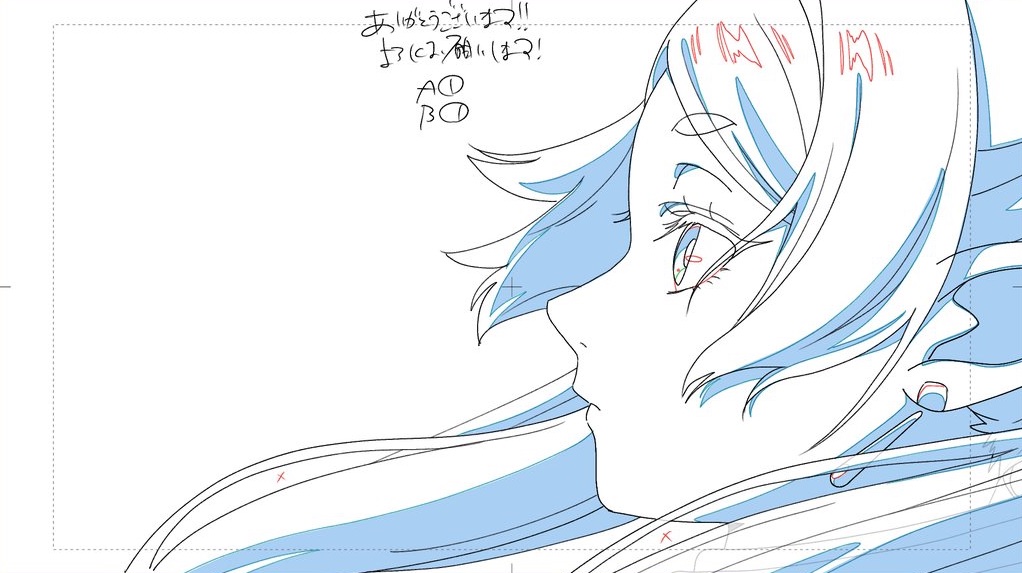
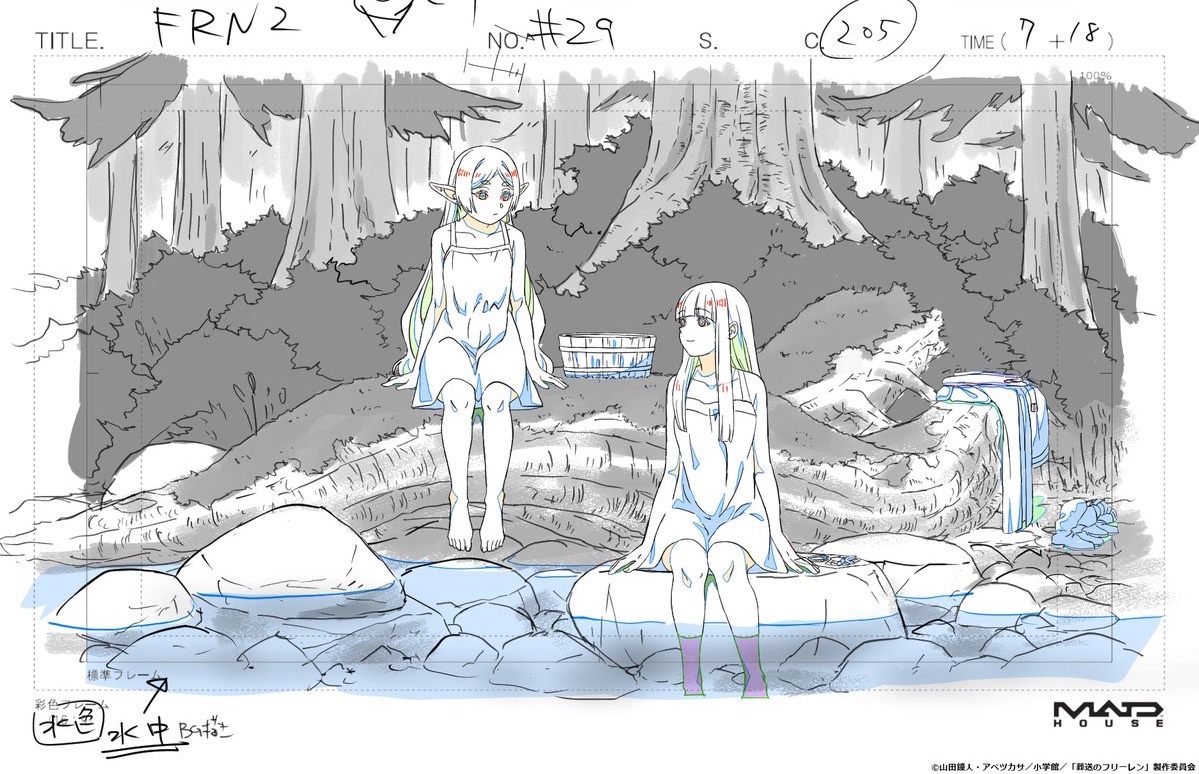
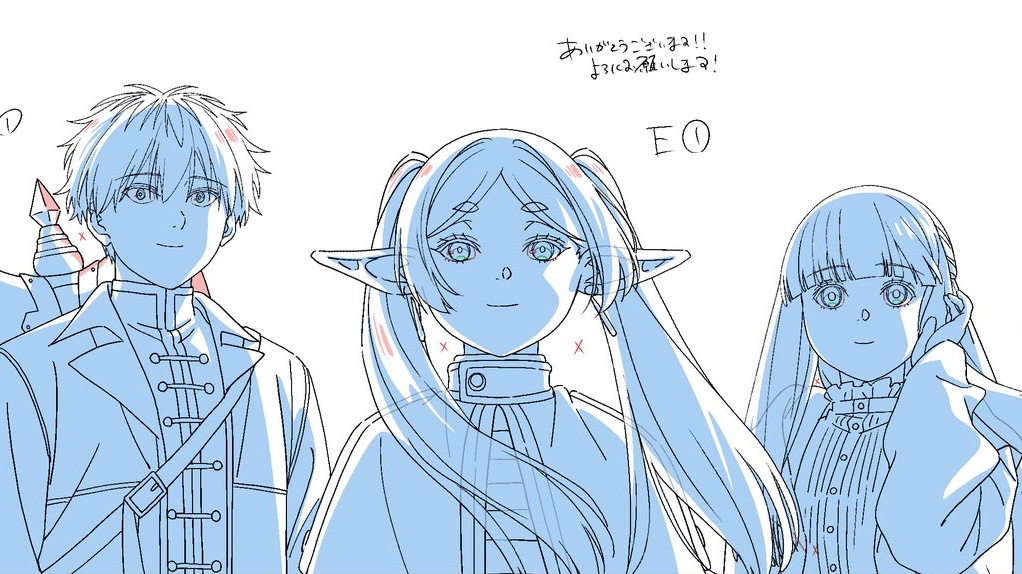
Original interview from MANTANWEBpublished on January 2nd 2026, original interviewer: 阿仁間満; genga correctionsby Akiko Takase, from the official studio Madhouse Twitter account.
The second season of the anime adaptation of “Sousou no Frieren”, the manga series written by Kanehito Yamada and illustrated by Tsukasa Abe currently serialized on “Weekly Shōnen Sunday” (Shougakukan), is airing every Friday at 11 p.m. on NIPPON TV’s “Friday Anime Night” slot, starting January 16th 2026. The manga series boasts a total circulation of more than 32 million copies, and the first season of its anime adaptation aired on “Friday Anime Night” from September 2023 to March 2024, attracting widespread attention for its careful direction and visual beauty. This second season features Season One’s episodes 2 & 8 and second cour’s chief Episode Director Kitagawa Tomoya-san as the Director, and Season One’s Director Saito Keiichiro-san supporting the production as Direction Cooperation. How will the second season take shape under a new Director? We spoke with Kitagawa-san, Saito-san, and Series Composition & Scriptwriter Suzuki Tomohiro-san.
What does the “Direction Cooperation” do?
— What’s the division of roles between Kitagawa-san and Saito-san, and how did this team come together?
Saito: When Season One ended, discussions began about what to do for Season Two. I had already poured all of my energy into the first season, and when thinking about how to deliver “Frieren” to the world in an even stronger form, I realized I genuinely wanted to take a short break from on-site production, and assist the team by sharing my know-how and knowledge with them. That’s how I ended up participating under the Direction Cooperation credit. I supervised the script and storyboards, and worked as an advisor, suggesting corrections and revisions. I also took on practical tasks when it was necessary. For the second episode of Season Two, I was in charge of part of the storyboard, and in connection with that, I was also present during editing as well. At first, I intended to be involved in pre-production only, but ultimately I ended up lending a hand in post-production as well.
— What’s the reason Kitagawa-san was selected as the Director?
Saito: When working together in Season One, I felt like Kitagawa-san‘s thinking and technique were really solid and on point. There were things I really should have overseen myself, but I couldn’t keep up with everything and Kitagawa-san helped me a lot with them. When it came to asking someone for the Director role, there really was no other candidate except for him, so that’s the why I asked Kitagawa-san.
Kitagawa: When I was offered the Director role, I was genuinely very happy, but also felt the pressure of being in charge of such a popular series. I’ve put my best effort into this production, in order for it to live up to the viewers’ expectations.
— Have you two worked together on other projects before?
Kitagawa: I worked on the TV show “Sonny Boy”[2021] in the same roles of Storyboarder and Episode Director. At that time, I had Saito-san participating as a key animator in an episode I supervised, and we’ve been working closely together ever since.
— Are there many members of the staff who also worked on Season One?
Kitagawa: Yes. There are many, including main staff like the Art Director, Color Designer and Director of Photography, as well as many Episode Directors and animators, who have continued to participate, and it’s really reassuring. There are some new entries too.
Saito: Fukushi-san (the Animation Producer, Fukushi Yuuichiro-san) has continued managing things on-site, and the talented team from the first season is once again bringing the full extent of their strength to this second season.
— Since you’ve been building upon the know-how of Season One, are there even more things you could achieve in this new season, compared to the first one?
Saito: I believe there are. At times, overseeing the works for Season Two made me feel a little jealous (laughs). Aspects we couldn’t fully bring to life in Season One are now being executed to their full potential.
— How do you feel about the current state of the production?
Kitagawa: Everyone, from the Scriptwriter Suzuki-san, to the sound team, the voice actors, the animators and photography team, the background artists —I can’t list each one of them, but we’re all highly motivated and working hard in order to make this into a great work. I believe it’s turning out to be a very entertaining show.
The charm of words
— Kitagawa-san, including Season One, what do you feel is the charm and appeal of “Sousou no Frieren”, and how are you trying to express it in anime?
Kitagawa: The original work is very solid and entertaining, and when adapting it, I’m constantly thinking about how to effectively translate that appeal into anime. The anime’s script contains quite a few original elements, so I also think about how to make them as entertaining. In “Sousou no Frieren”, there’s a slight gap between what the characters say and what they think; it’s a work that depicts the complexities of human emotions. When bringing it to animation, I direct with a focus on how to portray these aspects effectively onto the screen.
— Suzuki-san, how do you feel about the “charm of words” in “Sousou no Frieren”?
Suzuki: From the first time I read it, I felt it had a serene and soothing atmosphere, with careful and delicate use of language. The dialogues also have a pleasing sound when spoken aloud. In the first season, the Director’s spacious sense of rhythm carefully conveyed this tranquility, and I think it also emphasized the pleasantness of the words’ sound. The balance and pacing of the comedy scenes are also remarkable.
Kitagawa: Gags too are one of “Sousou no Frieren”‘s appeals. In Season Two as well, we continued to make them stand out properly, while also expanding on them a little. It has slice-of-life elements, it has comedy, and it has battles; it has everything people want to see, and it’s a work capable of depicting all of it. It feels so rewarding.
— Season One was met with a strong response from overseas as well.
Saito: I used to worry about whether its lyricism would resonate with viewers all around the world, but now, I’m really glad that people were able to really connect with the emotional qualities this work radiates. It also features flashy action sequences, so I think it was thanks to the series’ great balance as well.
Suzuki: It still doesn’t feel real, but I’m truly happy about that.
Kitagawa: As you mentioned, I felt that aspect too, so I wanted to make sure we kept that same balance in the second season as well.
It’s fundamentally an extension of Season One, but…
— When writing the script for Season Two, what kind of discussions did you have?
Suzuki: At the very beginning, (Animation Producer) Fukushi-san said he wanted to maintain a consistent core throughout the series. He wanted to compile it in such a way you’d feel the desire to watch it all over again the moment you finish it. Kitagawa-san remarked how he wanted to show the main trio’s harmony and maturity gradually growing stronger, as well as how the flashbacks featuring Himmel slightly differ from Season One’s, as Frieren recalls them in a more assertive and proactive way. We talked about how we wanted to focus on that aspect.
Kitagawa: Season One featured many scenes of Frieren reminiscing and reflecting on Himmel’s words, and consequentially learning more and more about humans. Season Two however, is more about her teaching to Fern and Stark what she learned from Himmel. In that sense, I think what I want to deliver is the story of how the trio matures as a party, and how, thanks to Frieren’s presence, both Fern and Stark are able to grow. As this becomes more and more core to Season Two’s narrative, even the party’s battling style changes, with Fern evolving little by little by observing Frieren. I tried to incorporate this aspect into the show.
— Are there also aspects you changed in Season Two?
Kitagawa: It’s fundamentally an extension of Season One, so we tried to keep the already strong aspects exactly the way they were. I believe there are many who are fond of the peculiar tempo and atmosphere, so I made sure to preserve that feeling while centering the story around the trio’s journey.
Saito: I personally would have been fine with Season Two being completely re-imagined in Kitagawa-san’s own style and sensibility, but since they’re carefully modeling it on Season One, I can’t help but feel a bit conflicted (laughs). Of course, I also feel genuinely happy that they’re using the first season as the model.
— Even so, do you feel that Kitagawa-san‘s personal touch still manages to come through?
Saito: I do feel his style in subtle ways, but even in the first season, there were various Episode Directors involved, and I think it’s through the contributions of many people that a single work can come together. In Season Two, the shot compositions and small pauses, as well as the mise-en-scène are a bit different from my own style, and I think that’s where Kitagawa-san‘s style, or rather, his idiosyncrasies come through. At the beginning of the first episode of Season Two, Kitagawa-san added a scene that originally wasn’t present in the script, and I believe it really communicates what he’s trying to achieve with this second season.
Kitagawa: It really isn’t that big of a deal, but the new season is finally about to begin after nearly two years, and Frieren and the others are back; I was thinking about how I could build up that sense of excitement, the feeling that a new journey is about begin. With that in mind, I made a few small additions, including how the title shows up on the screen.
— Kitagawa-san, you worked on the first season as well, but when it came to the production of Season Two, did you do any analysis or specific study of Season One?
Kitagawa: To avoid Season One’s atmosphere coming apart, I tried my best to bring it over to Season Two. I worked on elements like the depiction of natural landscapes, the sense of rhythm and the staging of important dialogues with the first season’s approach in mind. I also put careful thought into the division of cuts and transitions, so that the important lines won’t just get glossed over.
— A big topic of Season One was also its battle scenes. How about Season Two?
Kitagawa: There will be just as many, perhaps even more. The manga’s rhythm is very entertaining, but when adapting them into moving pictures, you have to be thoughtful of how to stage them. In Season Two, the trio’s battles become the main focus, so we staged them emphasizing their coordination and teamwork.
Saito: In Season One, I did everything I could in terms of Episode Direction and Editing, but a large part of the action came from having Iwasawa Toru-san on board as the Action Director and allowing him to fully showcase his skills.
Kitagawa: For the second season, we’re relying on the skills of the staff in charge of each episode and its action direction.
Saito: We have many animators who also worked on Season One, so I hope you have high expectations for it.
The change and growth of the main trio
— What are the intrinsically challenging aspects of “Sousou no Frieren”?
Saito: The delivery of the dialogues has to be convincing in a way that comes across naturally when the lines are spoken. So, we paid close attention to that when directing.
Kitagawa: We added some anime original parts as well, so I worked on the storyboard while thinking about how to make them appealing and entertaining to fans of the original work. There are also aspects that deviate from the manga in the way they’re portrayed. For example, in Episode 25 of Season One [this episode was storyboarded and directed by Tomoya Kitagawa himself t.n.] I changed the way kid Flamme is portrayed, and was worried it wouldn’t be well received by fans. I was focusing on how to adapt that scene into anime in order to make Serie’s feelings come through more effectively.
Suzuki: The original creators asked us to treat each line of dialogue with care. At the same time, they were very open and encouraging when it came to fleshing things out, which I’m deeply grateful for. That hasn’t changed in Season Two.
Saito: I think we expanded on more elements in Season Two than we did in Season One.
— How did you “expand” on the original work’s content?
Saito: At the early stages, we discuss the core ideas; then, Suzuki-san builds on them, and through ongoing discussions we deepen them even further.
Suzuki: It gets clearer once ideas are laid out, so I try to actively put proposals forward.
Saito: When looking at the series as a whole, we talked about showing how the characters change, while also discussing the aspects of them that remain the same.
— Finally, could you share a message for the viewers who’re looking forward to Season Two?
Kitagawa: In the second half of the first season, Stark mostly stayed on the sidelines, but in Season Two, he’s gonna play a much more central role. Please look forward to the trio’s teamwork and bonds!
Saito: This time, I’m only assisting in Direction Cooperation, but starting with Kitagawa-san, the amazing staff managed to craft some truly wonderful visuals, so please, have high expectations for it!
Suzuki: Because there was a long gap before Season Two aired, both Kitagawa-san and Saito-san have been working while focusing on maintaining a strong continuity with Season One. In the second half of the first season, our trio takes a break from their journey, but in this new season, they set off for new adventures. Centered on the themes of “change” and “growth”, I hope it becomes a work that leaves viewers with a warm feeling of fulfillment at the end. Please, enjoy it to the fullest!
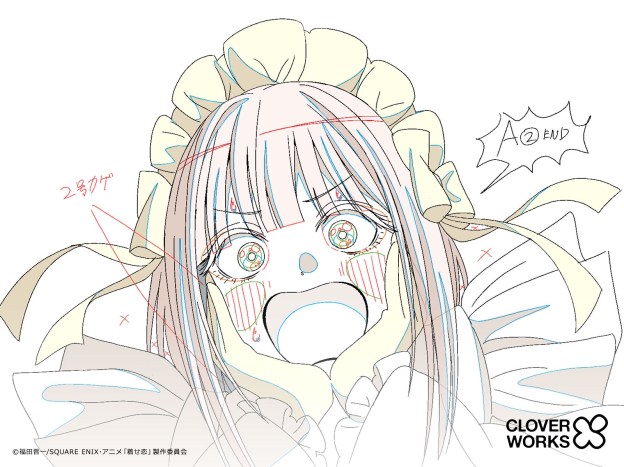
Original interview from Monthly Newtype (September 2025), original interviewer: Hisashi Maeda; genga from studio ClowerWorks’s official Twitter account.
Episode 14: Storyboards and Direction that bring the drawings to life
— I’ve been watching you two chat for a while, you seem to get along really well.
Yamamoto: Well, we’ve been working together on this project for a while now, so… (laughs)
Takahashi: And besides, we’ve known each other for way longer.
Yamamoto: We first met on “Wonder Egg Priority”[Winter 2021], and after that we’ve continued working together at CloverWorks, so we’d often chat like this. Also, we’re close in age which I think played a big role too.
Takahashi: You’re right. Now that a lot of younger people have joined the production team, there actually aren’t many people around our age. That’s part of it, the fact that we’re both in our early thirties and talk a lot probably plays a big role. We can talk comfortably with each other.
— Your roles in this production are Assistant Director and Main Animator. First, can you tell me what kind of work the Assistant Director does?
Yamamoto: It changes from production to production, but in this case, I’m helping out in as many episodes as possible. That, and starting from the script planning, I participated in basically all sorts of meetings together with Director (Keisuke) Shinohara, and helped brainstorming ideas when he needed support. I really wanted to be actively involved in the main story as well.
— I see. What about the Main Animator? You had the same credit on Season 1, so tell me about the differences you’ve been experiencing in this role between Season 1 and 2, if there are any.
Takahashi: In Season 1, as the Main Animator I was mainly in charge of the standout cuts, those that would make the entire series look more spectacular. In Season 2 though, it’s been more like “handling a lot of key animation within a single episode”, so that was a new challenge for me.
Yamamoto: In Season 1, Naoya-kun provided crucial support for many of the good scenes in each episode. For example, the love hotel scene in Episode 11, when Gojo-kun grabs Marin-chan’s hips, her phone goes flying and the lights go out…. And other similar sequences.
— That’s a very memorable scene from the episode you, Yamamoto-san, directed and drew the storyboard for, isn’t it?
Yamamoto: I believe that scene really shows Naoya-kun’s distinctive touch and sense, but that aside, there were cuts like the one of the bed springs bouncing up and down, where even if I drew the storyboard myself, I was sitting there thinking: “How the hell are the animators gonna handle this?” (laughs). I’m extremely grateful Naoya-kun took on them.
Takahashi: It’s because I understand your feeling of wanting to express those scenes in a certain way. Cases like that, even if the animation is tricky to figure out, just make you want to do it.
Yamamoto: There aren’t many animators out there with that mindset, you know (laughs). Naoya-kun’s taste gradually built up on the screen during Season 1, and concentrating it into a powerful burst was something we were aiming for for Season 2. That’s why we asked him to handle half the animation work for Episode 14 all by himself. Having a single person work on half the cuts for an episode takes a lot of time, and it’s just extremely difficult with the way anime production works nowadays. But by doing it that way, you really can bring out such a rich flavor.
— And so that’s why for Episode 14 Takahashi-san handled all three, storyboard, episode direction and animation direction (together with Maring Song). What was the main focus when working on that episode then?
Yamamoto: From the get-go, keeping the number of key animators as low as possible was the goal for Episode 14. Naoya-kun was the perfect fit, and it was indeed a great success. While his primary focus was the animation direction for the first part, he drew a ton of key frames too. And as a result, Naoya-kun’s distinctive taste really shined throughout the episode, exactly as we aimed for. I’m really happy with the result.
— Talking about Takahashi-san’s peculiar taste, what is it concretely?
Yamamoto: With key animation, animators mainly focus on movement and layout composition, but I always want to say: “No, Takahashi-kun’s drawings are really good!” (laughs). His key frames are really good drawings in and of themselves. That’s why for this episode we consulted with Chief Animation Director Yamazaki Jun-san and decided not to correct them much. Yamazaki-san too wanted to keep Naoya-kun’s drawing as they were. But then of course, Naoya-kun is also great at drawing movement, so overall it has this well-grounded, interesting quality to it; that’s my impression of Episode 14.
Takahashi: Thank you so much (laughs).
Yamamoto: I really like how Naoya-kun’s Marin-chan is very cute and Gojo-kun is super cool. Thanks to this extra drawing quality, you can really feel a stronger sense of acting. Often, even if the drawings themselves are good, once you add movement the nuance ends up changing completely. But in this case, he really grasped the intentions behind the storyboard and the direction, so the whole thing came together as a unified and cohesive piece of film. That was undoubtedly thanks to Naoya-kun.
Takahashi: It does convey a strong sense of unity. But really, Nara-kun’s [Yamamoto’s nickname] storyboard and direction make it very easy and comfortable to work with. It’s easy to understand what he wants to do, or rather, I think he’s someone who’s really focused on “creating fun film”. It might be a very vague way to put it, but throughout the process, I was really looking forward to seeing how it would turn out once I added my own idea of a “good drawing” to it.
— This decisiveness on what Yamamoto-san wants to achieve, what specifically do you grasp it from for example?
Takahashi: Above all, I think it’s the variety of directorial ideas he has, all stemming from his wish to entertain the viewers. Nara-kun too was originally an animator, and from there he moved to episode direction. The thing is, directors that start off as animators inevitably tend to put the spotlight on the animation itself. They usually put a lot of weight on stuff like the quality of the animation, or how the good shots look, and how smooth the transition between cuts feel. And there’s nothing wrong with that either, but Nara-kun keeps changing and adapting his approach and style, always putting “entertaining the audience” first when drawing his storyboards. It’s of course important that viewers are moved by seeing beautiful, high-quality drawings, but he actually places more emphasis on something else. In that sense, I feel like we were able to make Episode 14 because we share a similar way of thinking.
Yamamoto: I too like things that showcase good animation, or rather, “good acting”, but since I fundamentally enjoy fun things, I just naturally tend to lean in that direction. Sometimes, my storyboard lack that element of acting to the point where, as a director who came from animation, I can’t help but wonder if I’m really doing it right (laughs).
Takahashi: It’s rare, isn’t it? Directors that started their career as animators can often feel intimidated about using 3DCG or live-action reference. They end up worrying about things like: “Wouldn’t this be easier for the viewers to understand if done with regular hand-drawn drawings?” or “Isn’t the rhythm a bit off in this specific sequence?”. But Nara-kun goes ahead without hesitation. He’s got incredible guts.
Yamamoto: Though, every now and then the Director or others will step in and say: “Alright, maybe that’s a bit too much” (laughs). I think that’s a nice balance. But for Episode 14, the core intent was to let the quality of Naoya-kun’s drawings go all-out. Talking about very precise and detailed cuts, the cooking scene had me like: “No way, that’s absolutely incredible! He managed to make it this good?!”, I was moved. Of course, it was all stuff I had drawn myself in the storyboard, but Naoya-kun went totally wild too (laughs).
Takahashi: I worked really hard (laughs).
Yamamoto: He’s working in a realm that’s way beyond what I could possibly pull off myself. The cooking scene made me think things like: “Wow, it looks delicious” and “He’s cooking with so much care”, it’s truly amazing.
Takahashi: I’m really glad to hear that.
Yamamoto: That’s what I thought while watching the line-art, before the coloring step. And once it got colored, it was even more amazing. This really is the joy of making anime.
Takahashi: There were many situations where drawing movement would have been very challenging, so I relied on still drawings to create the appropriate sense of pacing. In those cases, if the drawings aren’t well made, it just cannot work, so I gave my best in that aspect as well.
Yamamoto: When it came to those scenes, I relied on Naoya-kun’s power as an Animation Director. I had faith the capabilities of Studio CloverWorks as well, but since I knew I could work with him, I drew very demanding storyboards specifically tailored around Naoya-kun.
— In other word, it’s an episode born from the deep mutual trust between the two of you.
Takahashi: It was definitely hard of course, but working together was very comfortable.
Yamamoto: Your help was essential. It was so much fun.
Original interview from Monthly Newtype (September 2025), original interviewer: Hisashi Maeda; genga from studio ClowerWorks’s official Twitter account.
A Season 2 I would find “fun” myself
— Many of the people who worked on Season 1 are participating in Season 2 as well.
It’s something I’m truly grateful for. Since they already know the work’s atmosphere, I don’t need to explain much, and it makes it easier to request episodes that lean more into the series’ specific taste. Anime production is a very fluid environment and it’s hard for staff members to stick with a particular project, but this time they relatively did. Since everyone’s highly motivated and talented, if we prioritize creating high-quality and fun works, there’s hardly any reason to leave, is there? The communication is very lively, so I believe those who fit well together feel at home here.
— That’s all thanks to your charisma and power to attract people, Director Shinohara!
No, I don’t think that’s the case… But I’d be very happy if I could be even just one factor in keeping people around. The animators participating in this project are all extremely skillful, but talented animators usually tend to choose production environments with other talented people, or with brilliant episode and series directors. Objectively speaking, I don’t have the kind of directing talent that can draw people in like that. What I wish to achieve is to offer these very talented people a comfortable and free environment to work in, and capture the charm of the original work on the screen. Regarding Episode 13, I believe we managed to create something fun. However, it wasn’t exactly a relaxed process for everyone. On top of requiring a lot of precision and carefulness, it was a tremendous amount of work. That episode was made possible by imposing excessive demands on the staff for a TV series. The accuracy even in the in-between animation and the photography was really outstanding, and I’m truly impressed we could reach that level of quality with almost no need for retakes.
— That’s very nice to hear. I was surprised that Episode 13 started off with an episode of the in-universe show.
Following the original manga’s flow, I initially meant to start with the encounter with (Himeno) Amane, but that way it didn’t feel like “KiseKoi was back”. I really like the story in Amane’s episodes, but I felt it would have been too emotional as an opener. Changing the order a bit and starting with the TsuCom (“We’re the Tsukiyono♡Company”) episode, this second season could open with Marin and Wakana’s costume-making endeavors, and I felt that was more like KiseKoi. Also, I’m really glad I was able to ask Ikarashi Kai-kun to handle the designs and key-animation for the TsuCom part.
— He really went all out with it.
For TsuCom, I wanted visuals that would both convey its cuteness and have a strong initial impact. Ikarashi-kun handled both aspect really well, and apparently he’s a fan of the series too, so he was the perfect fit. Fans who follow the staff might view him as someone with a distinctive style, but he’s a rare talent who not only accurately grasps the director’s intent, but also creates richer visuals beyond expectations. We’re friends, but I’m also a big fan of his.
— I’d also like to hear about your storyboard work for the TsuCom part.
TsuCom was rather condensed in the original work, so we added more content during the storyboard stage. However, I worked only the very first rough draft, then I had Assistant Director (Yuusuke) Yamamoto-kun cleaning it up and adding ideas. He balanced out the parts that felt overdone in my original draft, making it easier for the audience to follow. Without Yamamoto-kun’s help, I don’t think Gojo-kun would’ve found it “so fun”.
— The tempo for the dynamite gag was perfect, it really made me laugh.
I’m really glad you liked it. While staying true to the elements in the original work, we wanted to overwhelm the audience with visuals fully packed of information. I believe we somewhat succeeded. Something like, “It was fun, but what the heck was that…?”.
— Speaking of inside-shows, “The Student Council President is the No.1 Host” must have been pretty challenging.
In-universe series like that are always a lot of work.
— I thought so. In terms of settei, it must be like creating an entirely different anime.
PrezHost took up about half an episode worth of screen-time, right…? When it comes to in-universe shows like that, the most difficult part is making a complete change in style. “Flower Princess Blaze!!” was playful and easy to make in Season 1, but then the number of series grew, and we couldn’t just re-use the same assets every time, so we sort of ran out of ideas. There are more coming up later in this season, so I hope you look forward to them.
— Even in the direction for the actual story, I really the strobe effect on Marin for example. It made me realize how rich an anime this is.
That’s the scene on the stairs in Episode 13, right? Thank you very much. I wanted to make Season 2 feel “even richer”. In a TV series, I believe including expressions that aren’t necessarily realistic lets the creators enjoy the process more, and makes it more entertaining for viewers too. It’s not like Season 1 was strictly realistic either, but this time, I wanted to go for a more expressive approach. Even at the script stage for Episode 13, leaving aside the karaoke scene, it felt kind of like a repetition of Season 1. I thought it might have been more enjoyable if we added a little extra creativity in how it was presented. Also, Yamamoto-kun was really overflowing with ideas and he came up with things I would have never thought of myself, which was really a huge help. For Episode 15, we focused on more down-to-earth approach, and (Tomoki) Yoshikawa-san handled the drama-oriented direction, which I think made the series feel tighter and more polished. It’s a little reminiscent of the more tender episodes from Season 1.
— So, fundamentally, you’re still following the flow of Season 1, but are there any aspects you intentionally changed?
It connects to what I was saying earlier, but most importantly, I wanted to make it more fun. On top of that, I took on various personal challenges. For Episode 13, I tried to approach the storyboard with a particular style of acting that you don’t often see in TV series. Rather than aiming for a more realistic feel, I wanted to build the characters’ acting around the idea that people sometimes move in unexpectedly funny ways. But I didn’t want to simply over-exaggerate it, nor to use stylized or caricatured movements. The animators had to devote themselves entirely to drawing the character acting, so I think it was really challenging. Then, the tempo. There’s always a gap between the pacing you carefully worked out on paper and how it actually appears on screen, so I’ve been trying various approaches to better match the ideal sense of pacing. Visually, the art direction and color palette has also changed from Season 1. For the background art, I asked for a solid amount of detail, but made sure not to overdo it. I’ve been asking to simplify and remove elements from the drawings, so that the characters won’t disappear into the background. Thinking about this while drawing takes a lot of consideration, so it’s truly a demanding task for the background artists.
— Lastly, what do you, Director Shinohara, think are the highlights of this Season 2 to look forward to?
Of course the story is one of them, but we’re also aiming to create an anime that’s fun and enjoyable just to watch. As of right now (when the interview was conducted) the PrezHost part in Episode 16 hasn’t aired yet, so I feel a little anxious. By the time this interview will be out, the very popular cultural festival arc from the manga will already be underway, so I hope viewers will keep their expectations high for the story’s exciting moments as well. I believe it’s a fun anime all the way to the end, so I’d be very happy if you could look forward to it until then.
I really wanted to portray the “connection between people”
— First of all, Director Ozaki, please tell us what you believe the appeal of Your Forma is.
Your Forma has the look of a regular SF, but actually, I believe it’s a very contemporary work. For example, the virtual world depicted in the story is like having the functions of a smartphone embedded directly in your brain, and AIs like Harold, assisting humans in their daily lives, already exists in our society, albeit not in the form of humanoid robots. It creates an easily recognizable and familiar worldview by cleverly incorporating topics of interest of today’s society, and I believe that’s one of the appealing aspects of this work. Then, the ubiquitous human drama that unfolds within this SF-like setting is the real essence of the story, and I think it’s its greatest appeal.
— Adapting such story in a single-cour anime, what are the important points you primarily focused on?
It connects back to what I was just saying, but what I really wanted to portray through this work is ultimately the “connection between people”. Therefore, rather than the SF aspects, what I valued most was placing emphasis on the human drama. This story features “Amicus”, robots in the shape of humans, but the way I approached it was by treating every character as a real human being. We humans have a tendency to treat others, whether they are robots or dolls, objects or even nature itself, as if they “have a heart”, don’t we? That sense of familiarity you feel when chatting with an AI, for example. If that “heart” we feel was actually real, then what exactly would it be connecting us to one another? I want to explore this direction as one possibility.
— Did you receive any specific request from the author of the original novel, Kikuishi-sensei?
Kikuishi-sensei often came to observe the dubbing sessions, and willingly collaborated with us during production, which I’m really grateful for. It was all basically left up to us, and we didn’t receive any significant requests. Though, since the original is a novel and has no visuals, we asked many times for advices about the SF-esque items and elements. For example, in the novel, the 3D images that serve as user interfaces are called “holograms”, and the screens visible to ordinary humans are called “holo browsers”; at first, I confused them to be the same thing. But thanks to an advice by Kikuishi-sensei, I was able to understand the difference.
Additionally, the story takes places in many different countries, and I thought that the customs and habits of each were meticulously taken into account. I’m sure that Kikuishi-sensei did a lot of thorough research when writing the original novel. Cultural differences between countries were a rather tricky and complex aspect. For example, in Russia, people wear their wedding rings on the right hand, a custom that’s different from Japan, so it’s easy to get wrong if you don’t pay enough attention. It would have been great if we, the anime production team, could have gone to each location to do further research, but due to the instability of the global situation in these past few years, for this project we ended up gathering information through the internet and other sources.
— Please tell us about the appeal of the protagonist duo, Echika and Harold.
Echika, a cold, machine-like human, and Harold, a robot who’s friendly with everyone. At a first glance, the two seem like polar opposites, but in reality, they share a common ground: their complete inability to convey their true feelings and inner thoughts to others. Throughout this drama, they misunderstand each other repeatedly, and only come to understand each other’s true emotions at the end. I think this clumsiness is part of their charm and what makes them so endearing.
— What are your thoughts on Kana Hanazawa-san and Kenshou Ono-san, Echika and Harold’s voice actors’ performances?
I always had the impression that Ono-san speaks in a gentle and friendly tone, so I felt he was a perfect fit right from the start. On the contrary, at first I couldn’t picture Hanazawa-san playing an introverted and clumsy role like Echika. However, when I actually heard her perform the role, she conveyed the emotional intensity so brilliantly that I was genuinely impressed; exactly what you’d expect from someone of her caliber. Her performance holding back her voice while still letting the emotion spill through, is really wonderful, and even the casual conversations between Echika and Harold are incredibly engaging. I hope viewers too will pay attention to the natural flow of their conversations, like when Harold, with a hint of mischief, teases Ethica with a question and she responds to him in kind.
— Lastly, a message to the viewers looking forward to episode 1!
This is a drama that simply portrays the connection between people, so I hope you won’t find it too difficult to watch, and that you’ll grow fond of Echika and Harold as you enjoy following their story. I hope you’ll stay by our side and watch the story unfold until the final episode. I look forward to your support!
Original interview from Monthly Newtype (May 2025), original text by Hisashi Maeda and Makoto Ishii; cover image: official character design sheets from the “Mobile Suit Gundam GQuuuuuuX: -Beginning- MATERIALS” pamphlet by Yumi Ikeda.
My number one goal is to create an interesting and enjoyable work
What Director Tsurumaki wanted to do
— Mobile Suit Gundam GQuuuuuuX is the first TV series directed by Director (Kazuya) Tsurumaki, so what was your approach in gathering the staff?
First of all, both the Director and I had already decided to ask Ikuto Yamashita-san for the mechanical design. As for the character design, when I asked the Director if he had anyone in mind, he immediately answered “I want Take-san”. We went with the first choices without any trouble. Previous to this work, there was this project called “Nihon Animator Mihonichi”[日本アニメ(ーター)見本市, Japan Anima(tor)’s Exhibition, 2014], where many different creators made a short animated movie each. In that project’s context, Director Tsurumaki made the short titled “I can Friday by day!”.
— It was re-released on YouTube just the other day, right?
Exactly. Take-san did the character design for that work too, and it’s a short I personally really like as well. The concept behind the “Nihon Animator Mihonichi” project was to have the creators make their animated shorts as freely as possible, exactly the way they liked and envisioned. So, once again, I had the confirmation that Director Tsurumaki really likes Take-san’s designs (laughs). For the rest of the staff, I basically picked the people who I knew could truly understand and realize what the Director wanted to do. As a result, a lot of them naturally turned out to be people who had already worked with him in previous occasions.
— What’s your personal understanding of Director Tsurumaki’s vision and intentions for this work?
Well… at the stage when he told me about Take-san, I figured the characters would take on a pop direction. Defining the scenery and backgrounds is largely up to the art director’s discretion, so I asked Hiroshi Kato-san, who always deeply understands Director Tsurumaki’s taste and intent. Rather than making something entirely new and unique, I believed this project should go for the “usual Tsurumaki imagery”. Last time I asked the Director to “create something exactly the way he wanted” the result was “I can Friday by day!”, after all. Even if it’s Gundam —so it slightly leaned into the “real” direction— I interpreted the director’s intent as going for that very pop and stylish kind of imagery.
— Sugitani-san, you temporarily worked under Sunrise[now Bandai Namco Filmworks] and were involved in the production of “Mobile Suit Gundam Unicorn”. Did you intend to carry the “Gundam-ness” you felt back then over to this project?
Being involved in the production of a proper, legitimate Universal Century Gundam work like Unicorn, was really a great experience for me —it was like a dream coming true. Now, I want to make sure readers understand this clearly; my desire to “work on a Gundam series” was entirely fulfilled that time. So, for this new project, my original aspiration was to have Director Tsurumaki create something beyond my expectations, like anything I’ve seen before, that wouldn’t be bound to the same outline and framework of the past Gundam entries. While of course being approved by Sunrise, I wanted to create something with a totally new and fresh approach that only Director Tsurumaki could come up with, something that could be only made at Studio Khara. To put it bluntly, I believe that if another company were to make a Gundam series trying to incorporate elements from Evangelion in it, the chances of it being received poorly would be very high. On the other hand, I thought it might actually work if it were the very studio that created Eva attempting to put its unique elements into Gundam, in a way only they were capable of. In that sense, when we were planning the project, I remember telling Director Tsurumaki that “I wanted to create something that could be only made at Studio Khara”.
— Going back to the previous topic, what about the other members of the main staff, aside from Yamashita-san, Take-san and Kato-san?
In the initial phases, the first person I contacted was Hajime Ueda-san. Director Tsurumaki told me that before starting the new project, he wanted to have a talk with Ueda-san. I didn’t know about it, but it seems that the two of them had already discussed a project with a girl as the protagonist in the past. That was the first meeting with Ueda-san; then, during the second or third meeting, the Director already proposed his idea of a story set in a world where Zeon had won the One Year War, and the direction for the project was decided. After that, we invited Yoji Enokido-san to join as the scriptwriter.
— I’m starting to see how it came together now.
That was how the story came about, so now I guess it’s the visuals’ turn. With Yamashita-san as the main mechanical designer, I thought the mechanical animation designer and chief mechanical animation director couldn’t be anyone other than Sejoon Kim-san. For him too, “Nihon Animator Mihonichi” was the occasion where we first met. There, he did the mechanical animation direction for Yamashita-san’s short “Iconic Field”, then he worked again as the mecha animation director for “Shin Evangelion Movie:||”[シン・エヴァンゲリオン劇場版:||, EVANGELION:3.0+1.01 THRICE UPON A TIME, 2021], and besides, he’s been heavily involved in Gundam before. GQuuuuuuX’s mecha designer is Yamashita-san, and it’s a Gundam series, so there was no one more fitting than Kim-san. To be honest, I was really hoping for him to accept, or I would have been in big troubles (laughs).
— And what about the animation character design?
For the characters, it might have been audacious, but we held a competition aiming to find someone who would cover both the roles of animation character designer and chief animation director at once. Out of the people who took part in the competition, the Director selected Yumi Ikeda-san and Shie Kobori-san. These two were hired as douga staff at Studio Khara, and are what you’d call homegrown members of the studio. As someone who has worked with them since the days of production management, I was truly happy to be able to ask them to join this project. Actually, Director Tsurumaki has been looking over their drawings since their very first days as douga animators.
— What do you mean by that?
When douga staff are hired at Studio Khara, Director Tsurumaki is the one to first review their portfolios at the document screening stage, and he’s also responsible for the hiring exam. He oversaw the exams to promote douga staff to key animators as well. And even aside from all that, he’s basically responsible for the guidance and supervision of young animators at Studio Khara. Having gone through that process, these two were originally members who Director Tsurumaki had recognized for their talent —what you might call the “Tsurumaki children” (other members of GQuuuuuuX’s staff who joined the studio around the same time include Gen Asano, now working as the mechanical animation director, and episode director Touko Yatabe). It feels like the seeds Director Tsurumaki has been steadily and carefully sowing have finally started to sprout.
— There’s a real sense of continuity with the studio’s history.
Also, the CG for every episode is directed by Khara’s in-house member Takashi Suzuki-san, and the color design is made by Wish, who we always work together with. T2 studio is in charge of the compositing, and I believe the experience and know-how accumulated during Eva’s production are being put to excellent use.
— As the producer, what are your personal goals with this project, Sugitani-san?
I’ll be repeating the same things from earlier, but what I wanted the most was to see what would happen if the staff who worked on Eva made a Gundam series. Fortunately, I’ve been involved as a production manager and producer in both franchises, so seamlessly merging together the good elements I found in each of them was also one of my goals. This aspect was emphasized as the tagline for the work, wasn’t it? I hope this will also be an opportunity for those of the younger generation who don’t know “Mobile Suit Gundam” yet, to experience the franchise for the first time. But ultimately, my number one goal is to create an interesting and enjoyable work. I’m a huge, huge Gundam fan myself. That’s why I’d be incredibly happy if we managed to create a Gundam series that the viewers would find “interesting” too. And if it becomes an opportunity for more people to approach Eva as well, I’d be even more grateful. After all, both Gundam and Eva are extremely important works to me.
Original interview from Monthly Newtype (May 2025), original text by Hisashi Maeda and Makoto Ishii; cover image: official character design sheets from the “Mobile Suit Gundam GQuuuuuuX: -Beginning- MATERIALS” pamphlet by Yumi Ikeda.
There are going to be some quite high tension developments, like a roller coaster
The characters are all going to take it to the limit
— How did you approach Machu, Nyaan and Shuji’s characters when writing the script?
Machu is sort of a textbook protagonist, so it went relatively smoothly with her. In the first episode, she’s introduced as a regular girl living her simple, daily life, and then, all of a sudden, she sneaks inside of a Mobile Suit. It might seem like she’s a bit reckless and eccentric… but in my interpretation, the most unique trait of Machu’s personality is that she doesn’t have prejudices.
— She doesn’t have prejudices?
Side 6 is basically a normal, everyday world, somewhat resembling present day Japan. But there’s an area inside the colony where immigrants —both legal and illegal— and refugees live, people who are relatively discriminated against within the colony. Even in a society with such a dark side, Machu doesn’t hold any prejudice towards the refugees and the illegal immigrants there. Whether that’s because she fundamentally lacks the concept of prejudice, or because she simply doesn’t want to acknowledge it, even I am not totally sure. If a normal girl were to come in contact with a smuggler of illegal Installer Keys like Nyaan, she’d probably report her to the police immediately. But not Machu, she’d just go ask for the “compensation for her broken smartphone” or something. This is to say, Machu basically considers Nyaan to be her equal. In this sense, inside that Side 6, she’s certainly a peculiar girl.
— I see.
It’s exactly because Machu sees Nyaan as her equal that the moment she notices the bruise on Nyaan’s face left by the military police, she feels so angry inside. She’s thinking, “Why is the police beating up a girl about the same age as me!?”. And then, she gets even angrier at Nyaan’s attitude of it being only natural that they’re being violent against someone like her. Machu’s inner anger reached its limit when the military police Mobile Suits started to arbitrarily destroy the buildings in the refugee settlements, with the excuse that “they’re illegal anyways”. It’s at that point that she decides to sneak in the Mobile Suit —it was a manifestation of all the anger she was bottling up deep inside herself. Actually, it’s very similar to the anger Amuro felt in the first episode of “Mobile Suit Gundam”[機動戦士ガンダム, 1979], when he saw Fraw Bow’s family getting bombed. That’s why I believe I was able to get Machu to step into the Mobile Suit in the proper, traditional way of a Gundam protagonist.
— So, she might not be hot-tempered, but in terms of sense of justice…
She has one. Perhaps, that sensation is something very closely linked to the abilities of Newtypes.
— What about Nyaan’s character?
Contrary to Machu, Nyaan was very difficult for me to handle. I couldn’t quite grasp the balance Director Tsurumaki wished for. It felt like a déjà vu… it was the same with “FLCL”’s [フリクリ, 2000] Mamimi. No matter how many times I asked the Director to explain that character to me, I couldn’t fully understand her. In the same way, I would make Nyaan feel somewhat like a refugee, then more like a smuggler… but each time, I’d get told there was “something not quite right” about her. In the end, we settled for a “shy illegal smuggler fearful of strangers”. Although, of course, there is a fully correct interpretation of her character still inside the Director’s mind.
— What about Shuji? I think he’s a pretty mysterious character…
As a scriptwriter, Shuji was a rather troublesome character. The Director told me he’s “a character who doesn’t talk much”… Well, thinking of it, characters who don’t speak much are always the Newtype-y ones (laughs)
— Writing the dialogues is a big part of the scriptwriter’s job, after all.
Right. Gundam as a series doesn’t have many characters with signature lines or catchphrases, but I thought it would be better for Shuji to have one; that’s when I came up with his “…that’s what the Gundam is saying” line. Basically, I interpreted the Director’s order that “he doesn’t talk much” as “he doesn’t express his own thoughts much”. So, using the “that’s what the Gundam is saying” line, it’s not Shuji who’s talking, but the Gundam. And Shuji comes across as a character who doesn’t speak all that much. And then of course, I also hoped that the line would stick with the viewers and catch on (laughs)
— Ahaha. You can tell some of the lines are pretty intentional. Like the smugglers’ “Hello, are you in a hurry?”.
Yes, yes. Reusing that passphrase from Mobile Suit Gundam’s Miharu was my idea —it was like a declaration of intent that “I’ll reference the First Gundam whenever I get the chance to”. I feel like references to the First have been made in so many works to the point of exhaustion, but that’s precisely why I’ll be intentionally making the most fanatic-level, exotic references I can (laughs).
— Talking about lines, the poetic ones that don’t make perfect logical sense, like [Machu’s]“I don’t really get it, but I sort of get it!”, feel really good.
Director Tsurumaki hates explaining things through dialogues, you know. To him, “It’s okay even if it’s not clear”; he’s inclined to think of dialogues with the premise that “that’s how real life conversations work to begin with”.
— But a script is something written rather logically, isn’t it? It must be hard…
It really is! (Wry smile). I can’t quite write like that unless I become a Newtype myself. Oh, but in that case, that would make me an Artificial Newtype (laughs)
— (Laughs). Well then, lastly, please tell us what to expect from the future developments of the story.
It’s going to be like a roller coaster, with some quite high tension developments, so keep your expectations high. Machu, Nyaan, Challia Bull, Shuji, Xavier… They’re all going to take it to the limit, so brace yourself for what lies ahead!
Original interview from Monthly Newtype (May 2025), original text by Hisashi Maeda and Makoto Ishii; cover image: official character design sheets from the “Mobile Suit Gundam GQuuuuuuX: -Beginning- MATERIALS” pamphlet by Yumi Ikeda.
I thought that by depicting the feelings I’ve experienced under the Cold War, I could convey a unique atmosphere unlike that of any other Gundam before
A “Cold War” feeling in the Universal Century
— When talking about this work, you’ve often mentioned the genres of “Alternative” or “Fictional War Stories”, what do you think the appeal of these genres is?
Rather than the militaristic component, I’d say the interesting and thrilling part is the SF one. The first half of the theatrical pre-release version, “Beginning”, is an alternative version of the One Year War, so I mentioned the words “Alternative War Stories” before, but in terms of composition, I think it’s more like a “Historical What If”, a genre close to SF, about a world set in the aftermath of a rewritten history. An alternative history work I like is “Red Sun Black Cross” [レッドサン ブラッククロス, a board game and novel by Daisuke Sato]…
— The one by Sato Daisuke?
Yes, that one. Do you remember how it starts? As a whole, it’s an alternative history version of the Second World War, but it starts off depicting the beginning of the Fourth World War set in 1990. Right off the bat, it threw us into a world we knew nothing about —a world where, forget World War II, even World War III was already over. I keep coming back to its prologue, and it still excites me even to this day. I feel that this sense of excitement, at least for me personally, is the kind of thrill distinctive to SF.
— Talking about Sato Daisuke’s works, there’s “Nobunaga-den”, in which he ponders how Japan could have won the Second World War, and arrives at the conclusion that “Oda Nobunaga shouldn’t have died at the Honno-ji Temple”. In a sense, I felt that this idea was similar to GQuuuuuuX.
I just told you how, to me, GQuuuuuuX is a “Historical What If Science Fiction”, but originally, the idea of a story set in a world where “Zeon won the war” was more akin to the alternative history genre. I believe there are two main approaches to alternative history works; the first one is to make a historical change in the initial setting or premise of the story, and then develop what happens next like a simulation. The second one, is develop the events that lead up to the historical change, thinking in what way history would need to be altered to make that change possible in the future. In GQuuuuuuX’s case, it’s clearly the latter, and there’s this point often discussed among Gundam fans that “The Federation wasn’t able to defeat Zeon just thanks to the efforts of Amuro and the single Gundam unit alone”… Though, it’s mostly the military fanatics that bring this up… (laughs)
— Like bringing up the difference between a “tactical victory” and a “strategic victory”.
That’s why, to lead up to GQuuuuuuX’s future, there are some more military-oriented, realistic changes to the OYW, like for example “Zeon’s colony drop being successful and the Federation suddenly losing their headquarters in Jaburo”. But then I thought: “This is Gundam, after all” (laughs) “and since it’s Gundam, the existence of the Gundam itself has to be the trigger for the turning point in history”. That’s when I came up with the idea of “What if the pilot of the Gundam was Char instead?”. That’s the exact opposite of how (Hideaki) Anno, who wrote the script for the One Year War part, conceptualized it. I believe he wrote that script starting from his desire to write a version of the war in which Char pilots the Gundam and achieves great things. Though, ultimately, they’re still both like an alternative history work.
— The place where the protagonists, Machu and the otherslive, Izuma Colony, is an interesting setting. Starting from the name itself, it has a Japanese flavor to it, and overall it somewhat resembles modern day Japan.
There are two reasons why I decided on such a setting. The first one is that I wanted to use Japanese language. At the time of “Top wo Nerae 2!”[Gunbuster 2: Diebuster (トップをねらえ2!DIEBUSTER), 2004, it was prohibited to show (Japanese) characters and writings, and in terms of direction, it was a nightmare to work around it (wry smile). I thought that using written characters would have made it so much easier to express many different things. The other reason is, if you watch any Universal Century episode up until now, it’s clear that English is the official language. However, there are a few colonies, like Moon Moon or the Texas Colony for example, rooted in a special and distinctive culture of their own. So, I thought it would be fine if there was a colony whose customs were heavily influenced by Japanese ones. Side 6 from the first “Mobile Suit Gundam” was originally designed as a caricature of Japan. I thought it would be okay if there was a colony with many residents of Japanese origin.
— And what about the time setting?
To tell the truth, I wanted Machu and the others to be born after the end of the war; I thought they would give off a stronger impression of being a “new generation” that way. But in the end, things happened and we decided on UC 0085 as the time setting.
— I find that “I wanted Machu and the others to be born after the end of the war” really interesting. What are your thoughts and feelings on dealing with a post-war scenario?
Rather than a post-war, I’d say it’s a Cold War. When I was a kid, we were right in the mist of the Cold War; the US and the USSR never fought each other directly, but it felt like the next war could break out at any moment. There were novels or movies about the USSR army suddenly landing on our territory and turning Japan into a battlefield, and back then, it didn’t feel all that unrealistic. When we decided on UC 0085 as the time setting for GQuuuuuuX, a certain member of the staff pointed out that “You’re doing Gundam but you’re not writing about war?”. All the previous Gundam up until now have portrayed a war of some sort, be it a full-scale war between different powers, or a factional struggle within the military, almost like a civil war. So I thought that writing about a “Cold War” would have worked as well. I thought that by depicting the feelings I’ve experienced under the Cold War, I could convey a unique atmosphere unlike that of any other Gundam before.
— It’s true that, despite not being directly at war, there’s palpable tension between the two factions, and the atmosphere in the colony turns really tense just by the arrival of a battleship like the Sodon. It really gives the impression of a Cold War. Those under 40 today only became aware of the world after the Cold War was already over, so they don’t know what that atmosphere felt like.
That’s right. I think (Yoshiyuki) Tomino-san’s generation is the last to have known the experience of war throughout their childhood. My generation, of course, didn’t experience actual war, but we do understand the feelings of the Cold War. Naturally, conveying those sensations to the current, young generation is very difficult, but in today’s reality as well war has broken out in Ukraine, and conflicts and civil wars continue unabated in the Middle East. It’s not outside the realm of possibility for the current situation to escalate in a world-wide conflict. I believe that, to some extent, the prospect of a “future war” between nations has unfortunately become a reality among the young people of today. That’s something that hasn’t been felt for about 30 years since the collapse of the Soviet Union, isn’t it?
— Indeed, I understand the feeling that the thread of terrorism has taken us back to the terror of the Cold War. I think a world where a space colony, while certainly not depriving the characters of their freedom, still somewhat feels like a claustrophobic place that’s tying them down, is reminiscent of your previous works…
Well, that’s the influence of what I felt like when I was young. I grew up in the middle of the rice fields in Niigata, and even though the horizon stretched out in all directions, it still somehow felt “narrow”. Of course, if I walked all the way past the mountain, I’d eventually reach Tokyo, but that wasn’t actually feasible, was it? I felt like I was trapped inside my small, familiar garden, and I wondered, “Am I going to spend my whole life in this place?”. I depicted that fear in “FLCL”[フリクリ, 2000], as well as in this work. It’s not like Machu thinks that “A space colony is too narrow, I hate it”, but she feels like “The world has to be much more vast, more free…”. She could, in principle, go to other nearby colonies, but in reality, she doesn’t. She lacks the freedom to say “whenever I want to go, I can do it in an instant!”; that’s especially true for children. I’m depicting the same things I myself felt in the past.
— So, that’s really a theme you want to focus on in the works you direct?
It’s rather because I want young people to watch my works. When I ponder what kind of feelings the youth of today would actually feel, I think it has to be something similar to the sense of confinement, or the fear and the anxiety about the future I too felt back then.
— Machu being bothered that the gravity inside a space colony isn’t real is too an extension of those feelings?
That in particular incorporates another slightly different thematic. Is the Red Gundam that Shuji pilots the real one? Are Newtypes and their abilities real to begin with? Is the alternative world of GQuuuuuuX itself real at all? This idea of whether something is “real or not” is present in many ways within the story, and I believe it might be another element especially interesting for the young viewers.
— What do you mean by that?
For example, thoughts like “I wanna become a mangaka” or “I wanna become a musician” always come together with doubts like “Is this talent actually real?” or “It works in class or at cultural festivals, but would it really work as a profession for the future?”, “Is it a real, genuine talent comparable to that of famous mangaka or artists that everyone knows, or does it only work among friends?”. In this sense, I feel like it’s a very valuable theme.
— From what you said today, I feel like what you’re trying to do is depicting a sensibility close to that of the 80s and 90s, in which anxieties about the world and adolescence are mixed together, in a new, modern way.
You’re right. Even if I were to research the feelings of today’s youth, I doubt I’d be able to properly portray them on screen… (laughs)
— From this perspective, I’m really looking forward to see how the three main characters, Machu, Nyaan and Shuji will be portrayed. Talking about young characters, there’s also the poor Xavier…
Xavier’s a character I like. I hope I was able to portray him in an interesting way. Please, look forward to it.