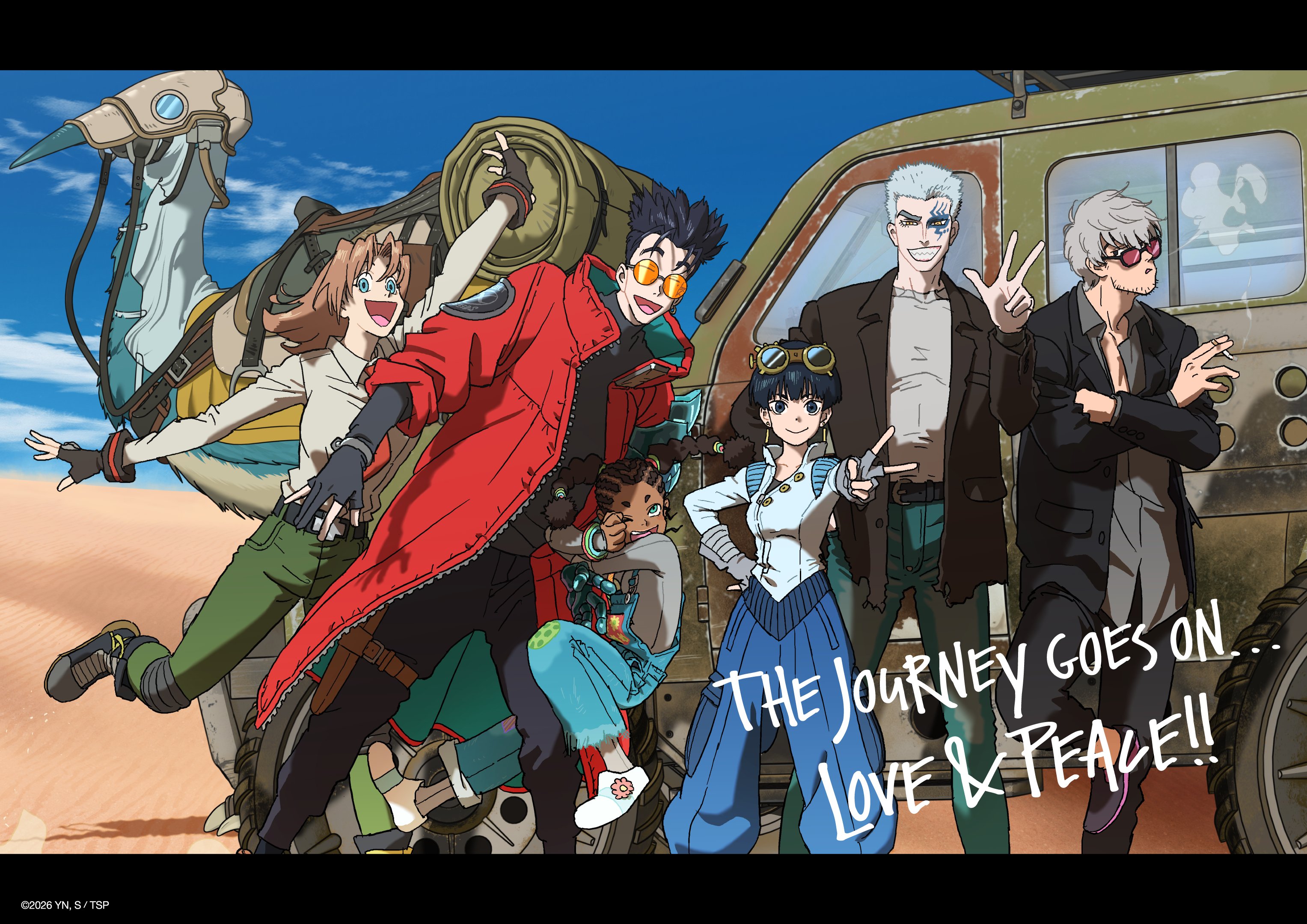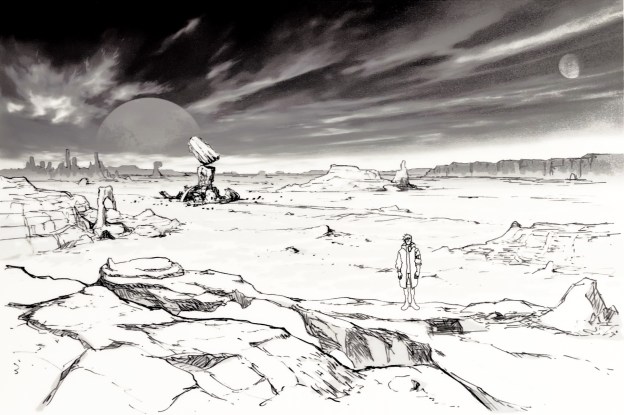
Original interview from Animage (May 2026); concept art from the TRIGUN STAMPEDE Exhibition in Ikebukuro (March 2025).
I wanted it to close it as a story that carries hope and brightness.
— Can you tell us about how you come to be involved in this project?
The first time I received word about it was quite a while ago, around the end of 2021. TRIGUN STAMPEDE was being developed as an original story, and they asked me if I was willing to direct its second season. At the time, there were many different concepts being discussed for this project, and one proposal was to make it a sequel to the original manga, since STAMPEDE was something like a prequel to it. But I thought that after watching STAMPEDE, the viewers would rather see the story follow the original’s all the way through to the end, so we started working on it with the idea of adapting the manga Trigun Maximum up to its conclusion. However, Maximum is a very long story, and there was no way to fit it within our available runtime in its entirety. So, we carefully selected which parts of the story to include and which to cut, with the goal of depicting how the confrontation between Vash and Knives ultimately concludes.
— So, you’re saying it was quite difficult to adapt the full story into TRIGUN STARGAZE?
We struggled a lot along the way. As a fan of the original myself, I really wanted to see a complete and faithful anime adaptation of the story, but the circumstances just didn’t allow for it. We had to cut a lot of elements quite decisively, and the screenplay alone took over a year to complete. Nicholas in particular was a difficult case; if he were to die as he does in the original, we would have necessarily also needed to depict Vash confronting the weight of having taken a human life, something he had spent so long desperately trying to avoid. There was simply no way to fit that into the runtime, no matter how we looked at it. After a lot of back and forth, we ultimately decided to let Nicholas live in this version.
— I believe Nicholas meeting a different fate compared to the original is something long-time fans would be happy to see, even if it was ultimately the result of your deeply considered structural decisions.
If fans received it as a happy ending, that’s honestly a bit of a relief. Episode 3 of STAMPEDE was quite a brutal one, involving the mass slaughter of the people of the town, and I heard that after reading the script, the original author Nightow Yasuhiro-sensei was a bit skeptical, wondering if they hadn’t gone a bit too far. Yet, after it aired, the reception was quite positive. That made me feel just how difficult it is to judge where the right line is when it comes to the tone and balance of the storytelling in Trigun.
— Did you receive any specific request from Nightow-san when it came to making the finale?
It wasn’t exactly a request, but when we first talked about it, he said something along the lines of “For the people who haven’t read the original, this is what Trigun will mean to them”, and I remember that made me realize the weight of what we were taking on. Nightow-sensei is incredibly generous when it comes to anime adaptations. After that initial talk, we would show him our progress at key stages, like “We’ve gotten this far, what do you think?”, and he would give us thorough feedback along the way. But it wasn’t a matter of him stepping in heavily, it felt more like he was watching over us warmly from a distance.
— The setting of this story is No Man’s Land, a desolate and arid world. What aspects did you focus on in particular when creating the visuals for it?
At the end of the story, part of No Man’s Land turns into a green, fertile planet. I wanted to really emphasize how lush and moist the land becomes, so we steadily depicted the desert world as extremely dry and arid at first, in order to make that contrast land more decisively at the end. I remember discussing about whether we could express this contrast effectively through color. The portrayal of the desert was a key aspect, so we did quite a lot for it, like pushing the contrast harder, or making the sky a sharp, vivid blue. I also asked the photography team to add effects like the light reflecting up from below, or to convey the hazy quality of sand in the air. I think that paid off well.
— What about the acting and movements of the characters?
Essentially, all the every-day acting was taken via motion capture and then reworked by hand. In this season, thanks to the new character Milly, the atmosphere became considerably more joyful and lighthearted, but we were wary that leaning too far into the comedy would risk making her come across as just a silly airhead, so we made quite a few adjustments there. As for Vash and Nicholas, we were really conscious of their poses and demeanor in the original when capturing their movements. There were moments where Meryl would get pulled along by Milly and start acting slightly out of character, so we were careful not to let that go too far.
— Despite being a 3D production, it has such a natural feel to it that you might almost mistake it for cel animation. Would you say the technology has advanced considerably?
From the feedback I hear, even though Orange is a 3DCG studio, a lot of people say things like “I forgot it was even 3D” or “It holds up beautifully as cel animation too”. I’ve always worked with cel animation and this was my first time with 3D, but it’s not like we actively tried to achieve a “cel anime look” for this project. If you want something to have a “cel anime look”, then you should just work with cel animation, and on the other hand, if you’re using 3DCG, I believe the result should look like 3D animation. Quite some time had passed since STAMPEDE‘s production, and it seemed like what was achievable in 3D had expanded as well. On top of that, the individual animators had grown in skill too, and the expressions came out really well. We received a lot of praise along the lines of “They feels so soft and tender”. In this sense, if you felt it was more natural, I believe it’s all thanks to the hard work and efforts of the staff.
— Since it’s the final season, you had to properly portray the connection and relationship between Vash and Knives. What’s your understanding of the two characters, and what did you want to convey when portraying them?
I personally believe Vash and Knives are a pair, they’re like the angel and the devil that live within a human being. They each represent an opposite extreme. However, this season depicts sides of Knives that show he isn’t just a straightforward villain, as well as sides of Vash that show he isn’t simply a hero either. I wanted to portray them as flawed, “not infallible” characters who carry their own wounds. I also wanted to make sure the humans weren’t absolved either, and tried not to portray them as blameless.
— Compared to the original, the finale had a different tension to it. What feelings and emotions did you pour into the ending?
At first, I wanted to close this story with Vash and Knives annihilating each other. Then, scriptwriter Fudeyasu Kazuyuki-san suggested “What if we ended it with that lively, chaotic energy like the early key visual for STAMPEDE?”, and ultimately we adopted that idea. One thing I was very mindful of for this project, was making sure it never became a story that incites hatred. When working on the world of Trigun, it’s easy to fall into depicting people as consumed by hatred for one another. But when I thought about the viewers who might become fans of this work and want to keep enjoying it long after its conclusion, maybe through cosplay or by repeating and treasuring their favorite lines, I felt that sending them off with a dark and hopeless ending just wasn’t the right choice. I wanted it to close it as a story that carries the hope and brightness of the characters choosing to live their lives with admirable resilience on the harsh planet of No Man’s Land.
— Lastly, could you share a message for fans who want to keep enjoying this work even more deeply?
For the viewers who discovered the world of Trigun through STAMPEDE and STARGAZE, I really hope you’ll read the original manga from start to finish. Then, come back and rewatch the anime series to discover all the differences, and the things that are only possible in STARGAZE, like the Nicholas and Livio team-up, enjoying an even more complex and layered experience of this work.