Monthly Archives: April 2025

Your Forma #1-4 – Direction Notes

It’s been quite some time since I last wrote at length about anime on this blog, my last post being the one on Cardcaptor Sakura from last November —a staggering 5 months ago— and to be honest, calling that post “writing at length” seems a bit like cheating, considering all it was is ultimately just a refined and remastered version of a bunch of jumbled Twitter threads. This brings us back even further to August 2024, when I published the last, to date, episode of the Episode Notes series (seriously, I should consider doing some radical rebranding here), talking about Shoushimin‘s direction.

But with the current Spring Season having shaped up pretty nicely by now, my writing power seems to be back in shape as well, as one show in particular has been piquing my interest ever since before it even started airing. No, I’m not talking about the second cour of Shoushimin —which by the way, contrary to no one’s expectations it’s been just as incredible as the first one— nor am I talking about the second season of another anime that’s been featured on this blog before, Kusuriya no Hitorigoto.
The show that I’m currently finding myself to be attracted to the most this season is a seemingly unknown and overlooked (here in the West, at least) project by Geno Studio, Your Forma.


Directed by Takaharu Ozaki (who’s been recently interviewed about this very series), Your Forma is an anime adaptation of a currently releasing Sci-Fi Drama light novel, but you’re not here for formalities, so let me get straight to the point: why do I find this show interesting?
Answering this question requires at least a little flashback, so bear with me for a little more.

As you may or may not know, I’ve been in Japan for three months starting last January, so I left just in time to see the blooming of the cherry blossoms, and more importantly an insane amount of marketing and advertising all around Tokyo for the shows that were going to air this season, like, you guessed it, Your Forma.
The first time I saw the PV was, I believe, in Shinjuku, and despite having never heard of it before, I got immediately hooked by its visuals and style, to me very reminiscent of the imagery from Ghost in the Shell.

Flash-forward to today, four episodes have come out and while it’s by no means a “sakuga show” nor something as directionally idiosyncratic as Shoushimin might be, the visual identity it managed to build up since its premiere is nothing short of impressive.

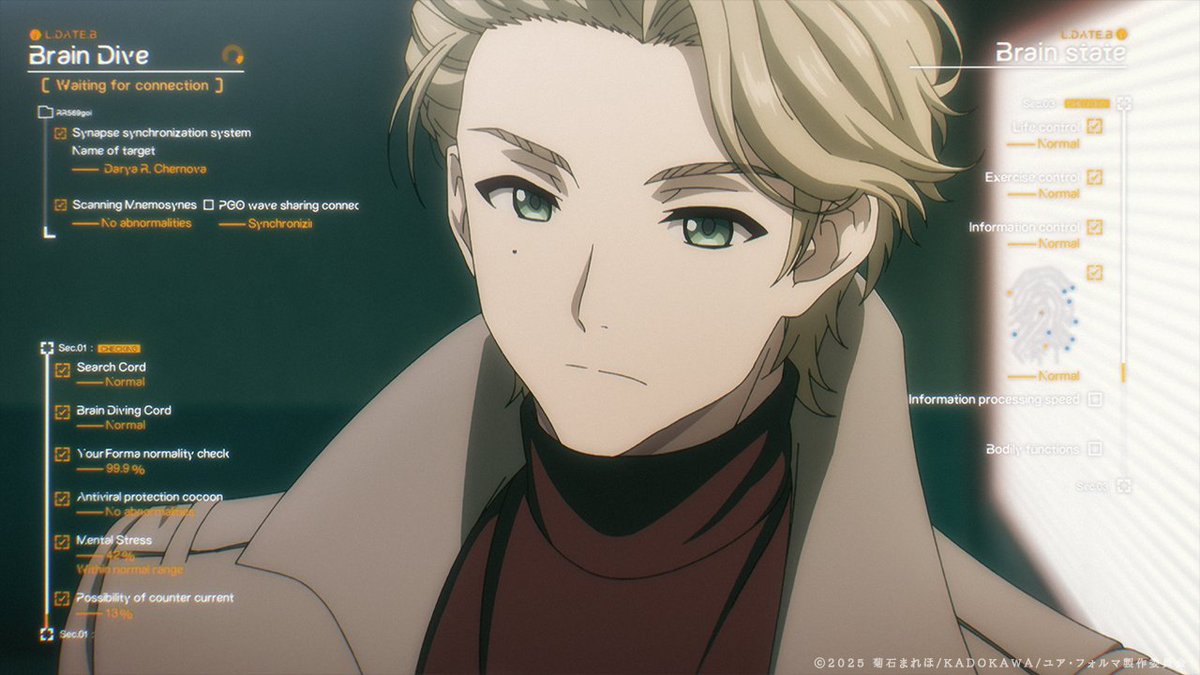
Starting with the holographic user interface the character view directly through their eyes, it’s clear that much work went into its design, both statically and dynamically as the many windows and pop-ups feature personalized animations and styles for each character. Enhanced by a spot-on sound design, that places the digital assistant’s voice uncomfortably too far back in the head, the way these interfaces are portrayed feels realistically invasive and obnoxious, with the POV cuts strengthening our compassion and bond with the characters right off the bat. As it’ll become more relevant later on, emphasizing the human aspect of this story, rather than the Sci-Fi one, is indeed a deliberate choice by Director Ozaki, as he himself has stated multiple times in the interview mentioned earlier.
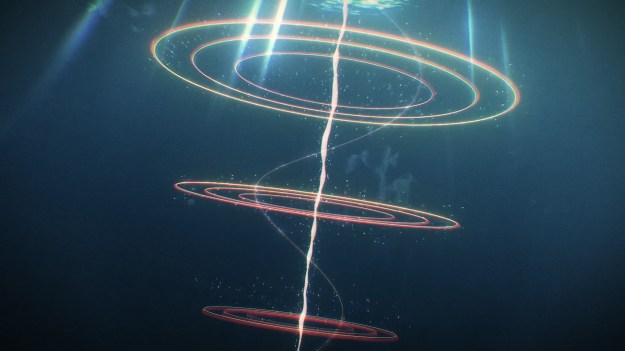
Before shifting the focus over to that however, I want to at least mention the Brain Diving sequence.
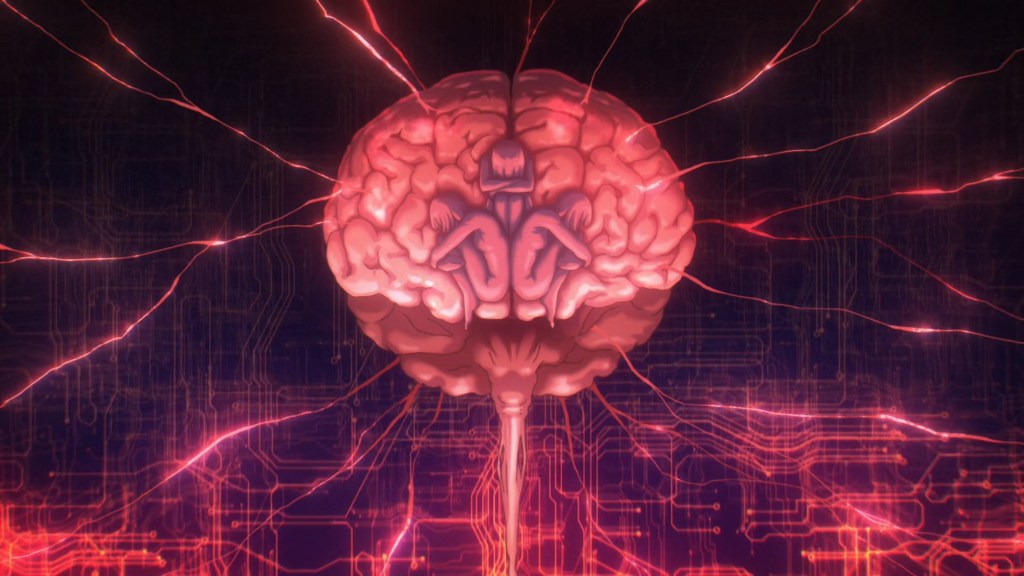
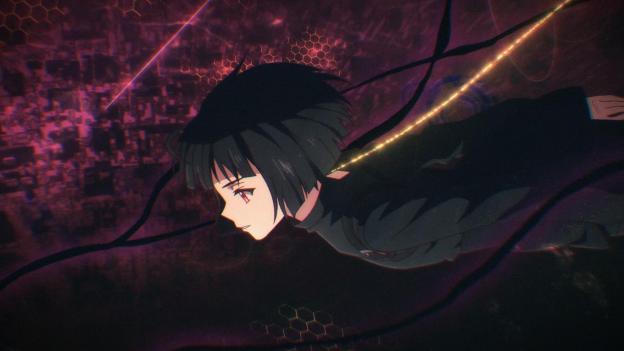
Akin to the transformation scene of a magical girl, it’s shown every time our female lead electronic investigator Echika Hieda performs the so-called “Brain Dive”, a procedure that, through the use of special cable, lets her connect and dive into the brain of the victims, in order to find clues about the crimes she and her robotic partner Harold are in charge of investigating.

The imagery showcased throughout this sequence (again, accompanied by a perfectly matching sound design) evokes dissonant and eerie feelings —slightly stepping into body horror territory, with that weirdly uncomfortable depiction of three Echikas engraved into the surface of a brain— and the mixing of different techniques, palettes, and compositing filters really drives the point home that brain diving isn’t exactly for everyone, and more importantly, contributes greatly in defining the visual language of the show as a whole.

Another seemingly small but actually very significant detail, that plays a big role in shaping up the visual identity of an anime, is definitely its typography. Take Eva‘s title cards for example, no matter what context you see that font it in, it’s become iconic to a point you’ll always instinctively be reminded of the series. Nowadays, it’s not that uncommon for TV anime to have stylized and dedicated title cards, but it isn’t exactly common either, at least not in the same fashion as in Your Forma.

When the first episode’s title card popped up on the screen, it left me completely stunned; the fonts, colors, layout, compositing, background animations and sound effects are all perfectly designed and perfectly executed, working in seamless sync with one another to make the handful of seconds that the title card is shown on the screen absolutely memorable. It’s like a declaration of intent, concise yet comprehensive, condensing all of the show’s visual identity in a brief, fleeting image. For a moment, I thought I clicked on the wrong episode and somehow ended up watching something from the 2000s era.

Deep down, as soon as I saw that title card, I knew this show would be the catalyst that would get me back into writing after so many months of break.


I have to admit that one of the reasons this show has me so hooked lies in its writing; more than one perhaps, as I’m very interested, academically and professionally so, in the topics of AI and its interpersonal and ethical impact on society. Focusing on the writing is not what this blog is inherently for, but nonetheless I’d like to briefly talk about it for this show.

As Director Takaharu Ozaki explained, while it’s still undeniably science fiction, the world of Your Forma feels very familiar and contemporary. I strongly agree with this sentiment, since the “fiction” aspect of Your Forma‘s science lies mostly in its shape rather than its technology. This is to say, with the continuous release of better and better (on the surface, at least) large language models, an AI assistant capable of manipulating language in a way it seriously gives off the impression of thinking like a real human being has already become a reality in our very world.
Your Forma is clearly not the first show to tackle these thematics, far from it, but “gives off the impression” are the keywords here. Since the very first episode, I’ve found Your Forma‘s take on the “will AI ever become human?” dilemma to be very grounded and nuanced, especially in comparison with the general superficiality this topic is usually treated with in Sci-Fi-like settings. If anything, the characters’ stances on (in-universe) AI developments feel very informed, repeatedly remarking how Amicus (the AI-powered humanoid assistants like Harold) are just “making it look like they’re thinking” but deep down really aren’t, or how “it’s not that easy to replicate a human” since “things that resemble humans don’t necessarily become similar to them on a fundamental level”.

This kind of concepts being at the very core of the drama Your Forma aims to depict, makes its narrative feel grounded and relevant, because it finally tackles the same issues we’re dealing with with today’s AI models, in a way that doesn’t neglect their currently well-known and researched technical limitations. It builds its foundations on top of a more informed outlook on today’s technology, resulting in an even more engaging discussion on an already hot topic. This gives further, non-trivial relevance to the characters’ dialogues and internal struggles in relation to the societal issue they’re facing, making the human drama side of the story stand out significantly more.

And it’s exactly this focus on the human aspect that narratively shined the brightest throughout the first four episodes. Again, it’s not surprising at all, given the Director’s own words on it:

What I really wanted to portray through this work is ultimately the “connection between people”.

This focus on the characters is not just related to the writing though, as the direction cleverly indulges on shots that aim specifically at conveying the thoughts and emotions the characters are feeling before they even get the chance to state them themselves.
This attention to the layouts is especially clear in the first episode, when Echika is shown to be conflicted about her own perception of her partner Harold, after learning another Amicus of the same model as his was found guilty of assaulting a human. The very spacious yet asphyxiating layouts, isolating the investigator from the people around her, yet completely surrounding her with elements smacked onto the foreground, give a very clear outlook on her reflective and introverted personality, voluntarily trapping herself in the maze of her own intricate thoughts.
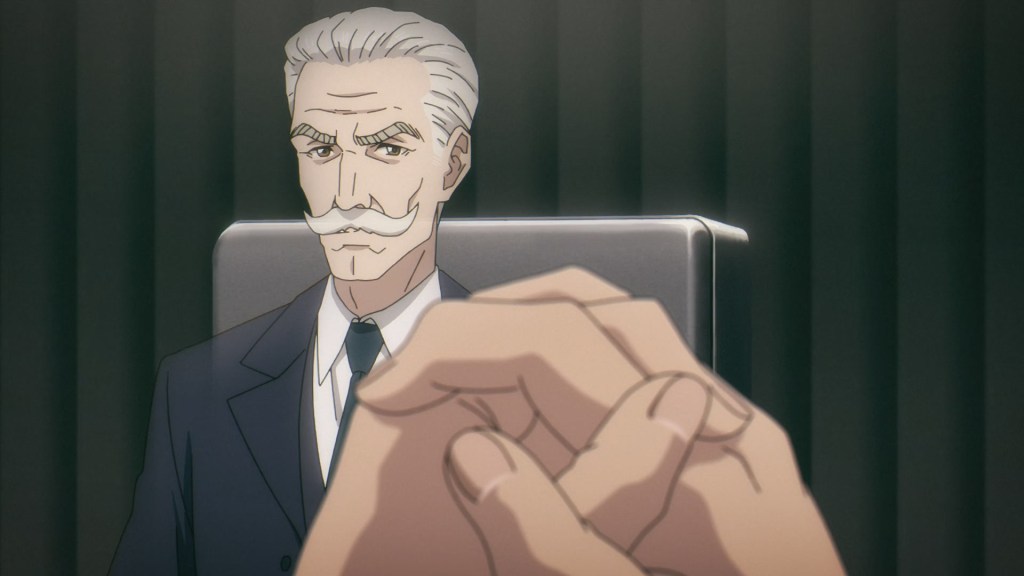
Another clever use of framing and space can be found again in episode 1, when Echika‘s taking part in an augmented-reality meeting with the International AI Ethics Committee. As expected, the discussion forces her to face her doubts again, and the clear difference between the narrow and confined layouts when the other participants’s holograms are “visible” to the camera, and the wide-open shots of her sitting alone in the physically empty meeting room, precisely convey what’s going on in Echika‘s mind without the need for any additional word.
The positioning of the camera is also pretty functional; while the committee members are actively discussing the matters, the camera stays low and neutral, shooting them directly from the front. But as the focus moves on Echika‘s thoughts, the camera is suddenly watching from above, making the already dense atmosphere inside the dimly lit room feel even more oppressive and suffocating.

Purposeful layouts aren’t the only approach to visual storytelling though, and a very clever (yet straightforward) scene in episode 4 makes instead use of the character’s movement to spice up the nuance of Echika‘s actions.

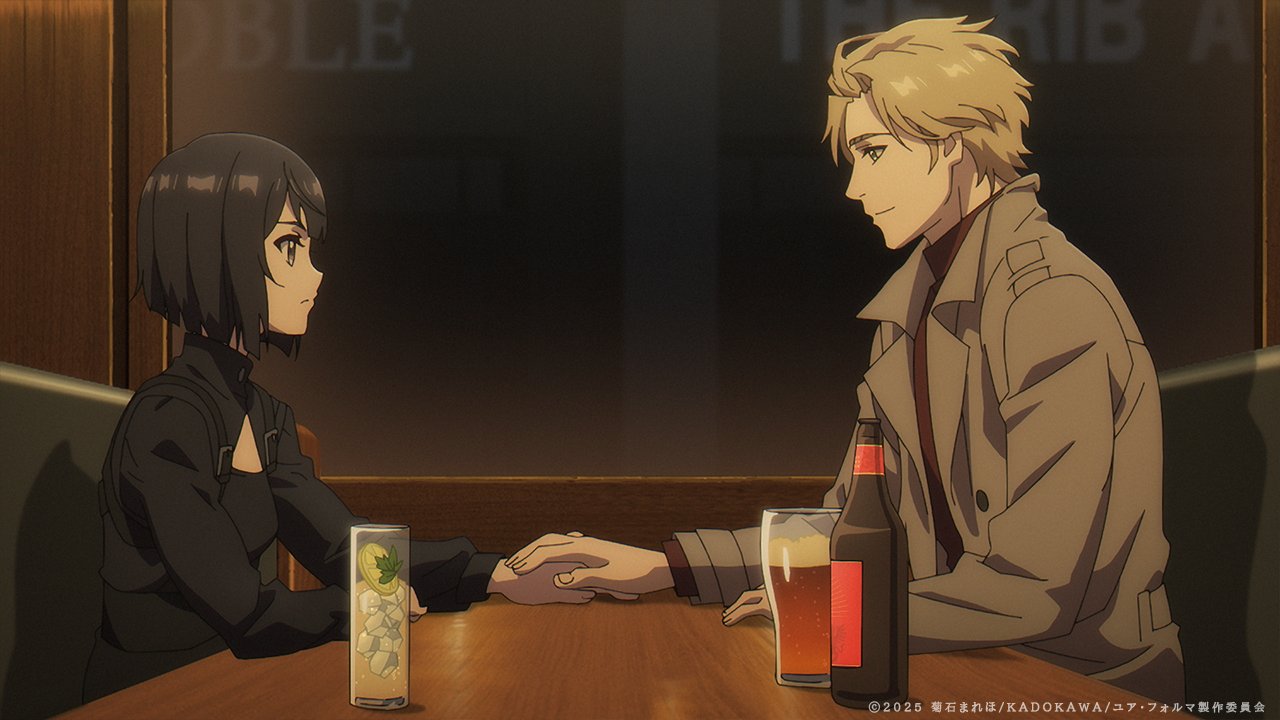
The repetition of misunderstandings and reunification between the core cast, Echika and Harold, is an established theme of the show. Closing the first arc of the story, there’s a scene where the investigator decides to forgive her assistant after a fundamental mismatch in approach they had early on, and in the act of doing so, she physically steps out of the darkness engulfing her, to reach out to the light shining all around her partner.
This contrast of lights and shadows is a very rudimental visual tool, as effective as it is straightforward, and combined with Echika‘s act of stepping out of the shadow of her own volition, it strengthens the idea that she’s actively making an effort to understand Harold‘s mind, and willingly work on her relationship with him.

The palpable sense of rhythm throughout the sequence, slowing down with the final pan-up, makes the viewer not only more invested in the scene per se, but also aware of the positive tension between the two characters, resulting in a satisfying and well-earned conclusion to this first chapter of their relationship.

Another highlight of the fourth episode was certainly the very voluminous and warm character acting. Even if it’s not consistent throughout the 23-minute runtime, I found these cuts by animator Takaya Sunagawa to be a really nice finishing touch, the cherry on top of an already very convincing and engaging sequence.
The last cut of the episode too, again animated by Sunagawa (whose involvement in the project isn’t all that surprising given the presence of his close friend Shunji Akasaka as the sub-character designer) takes on a more abstract note, reinforcing once again the unanimous direction Echika and Harold‘s relationship is going to take from this moment onwards.

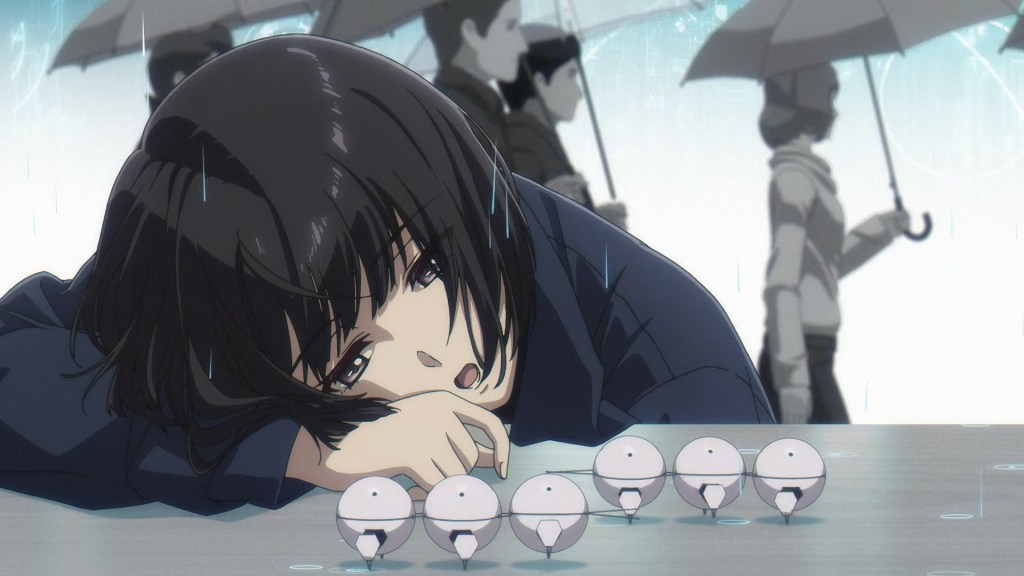
Talking about engaging character acting, nothing beats an ending sequence featuring the characters singing along with the singer, and Your Forma‘s ending does exactly that. A choice that, if it wasn’t clear enough already, seems to further reaffirm the human aspect of the story as central, giving its characters a familiar human dimension even outside of the narrative itself.

It’s this attention to details that can make an overall average production like Your Forma stand out between many others, and if it also happens to be backed up by a strong and firm vision like Ozaki‘s, the stage is set to create something truly valuable and well worth spending a few words about.


In a season filled with so many high-profile titles like this spring, I certainly didn’t expect a relatively under-the-radar production to be the one I’d end up rambling about on here, let alone it being the main focus of my first post in months. That being said, I’m glad I managed to find the time to write this piece all in one go, and I’m also really glad I was able to address all the points I planned on tackling, even though my writing skills have gotten pretty rusty to say the least.
I’m not sure whether I’ll come back to this show in the future, or when the next Episode Notes post will come out, but nevertheless, I hope this somewhat organized stream of consciousness was able to pique your interest even just a tiny bit, and as always, I’m really grateful for your time. Until next time…

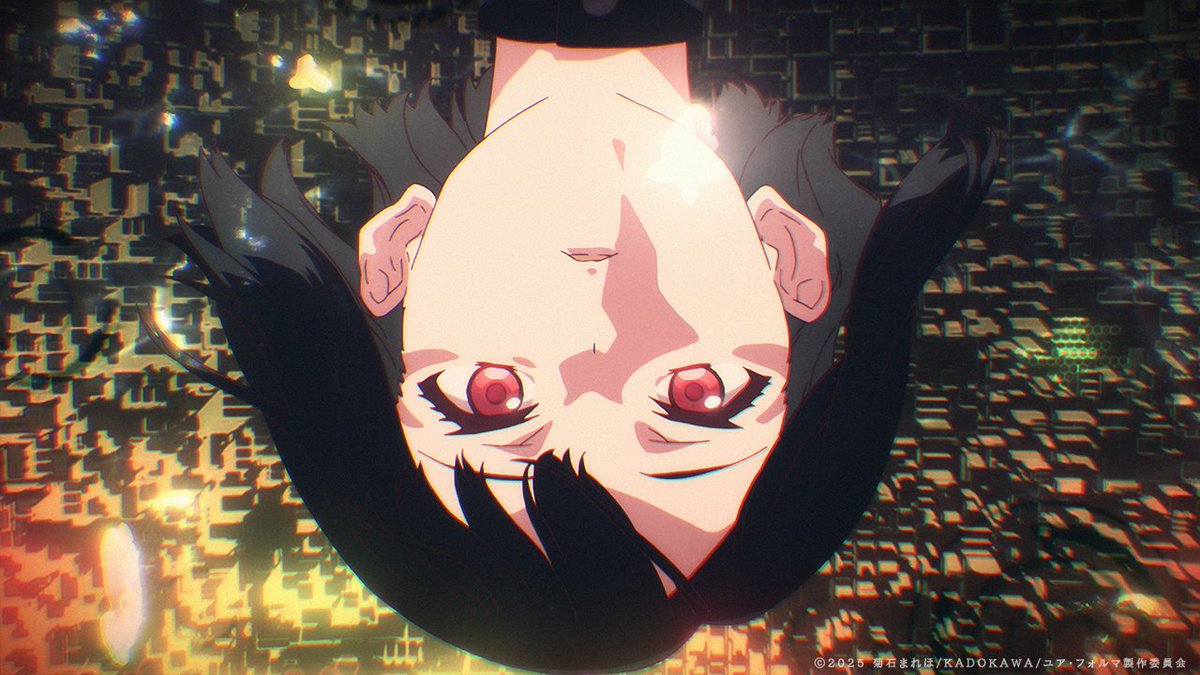
Takaharu Ozaki – Interview on Your Forma [Part 1]

Original interview from the official Your Forma website; genga from the official Studio Geno Twitter account. All the images used in this post are directly sourced from the official Your Forma Twitter account.


I really wanted to portray the “connection between people”

— First of all, Director Ozaki, please tell us what you believe the appeal of Your Forma is.

Your Forma has the look of a regular SF, but actually, I believe it’s a very contemporary work. For example, the virtual world depicted in the story is like having the functions of a smartphone embedded directly in your brain, and AIs like Harold, assisting humans in their daily lives, already exists in our society, albeit not in the form of humanoid robots.
It creates an easily recognizable and familiar worldview by cleverly incorporating topics of interest of today’s society, and I believe that’s one of the appealing aspects of this work.
Then, the ubiquitous human drama that unfolds within this SF-like setting is the real essence of the story, and I think it’s its greatest appeal.

— Adapting such story in a single-cour anime, what are the important points you primarily focused on?

It connects back to what I was just saying, but what I really wanted to portray through this work is ultimately the “connection between people”. Therefore, rather than the SF aspects, what I valued most was placing emphasis on the human drama.
This story features “Amicus”, robots in the shape of humans, but the way I approached it was by treating every character as a real human being. We humans have a tendency to treat others, whether they are robots or dolls, objects or even nature itself, as if they “have a heart”, don’t we? That sense of familiarity you feel when chatting with an AI, for example. If that “heart” we feel was actually real, then what exactly would it be connecting us to one another? I want to explore this direction as one possibility.

— Did you receive any specific request from the author of the original novel, Kikuishi-sensei?

Kikuishi-sensei often came to observe the dubbing sessions, and willingly collaborated with us during production, which I’m really grateful for. It was all basically left up to us, and we didn’t receive any significant requests. Though, since the original is a novel and has no visuals, we asked many times for advices about the SF-esque items and elements. For example, in the novel, the 3D images that serve as user interfaces are called “holograms”, and the screens visible to ordinary humans are called “holo browsers”; at first, I confused them to be the same thing. But thanks to an advice by Kikuishi-sensei, I was able to understand the difference.

Additionally, the story takes places in many different countries, and I thought that the customs and habits of each were meticulously taken into account. I’m sure that Kikuishi-sensei did a lot of thorough research when writing the original novel. Cultural differences between countries were a rather tricky and complex aspect. For example, in Russia, people wear their wedding rings on the right hand, a custom that’s different from Japan, so it’s easy to get wrong if you don’t pay enough attention. It would have been great if we, the anime production team, could have gone to each location to do further research, but due to the instability of the global situation in these past few years, for this project we ended up gathering information through the internet and other sources.

— Please tell us about the appeal of the protagonist duo, Echika and Harold.

Echika, a cold, machine-like human, and Harold, a robot who’s friendly with everyone. At a first glance, the two seem like polar opposites, but in reality, they share a common ground: their complete inability to convey their true feelings and inner thoughts to others. Throughout this drama, they misunderstand each other repeatedly, and only come to understand each other’s true emotions at the end. I think this clumsiness is part of their charm and what makes them so endearing. 

— What are your thoughts on Kana Hanazawa-san and Kenshou Ono-san, Echika and Harold’s voice actors’ performances?

I always had the impression that Ono-san speaks in a gentle and friendly tone, so I felt he was a perfect fit right from the start. On the contrary, at first I couldn’t picture Hanazawa-san playing an introverted and clumsy role like Echika. However, when I actually heard her perform the role, she conveyed the emotional intensity so brilliantly that I was genuinely impressed; exactly what you’d expect from someone of her caliber. Her performance holding back her voice while still letting the emotion spill through, is really wonderful, and even the casual conversations between Echika and Harold are incredibly engaging. I hope viewers too will pay attention to the natural flow of their conversations, like when Harold, with a hint of mischief, teases Ethica with a question and she responds to him in kind.

— Lastly, a message to the viewers looking forward to episode 1!

This is a drama that simply portrays the connection between people, so I hope you won’t find it too difficult to watch, and that you’ll grow fond of Echika and Harold as you enjoy following their story. I hope you’ll stay by our side and watch the story unfold until the final episode. I look forward to your support!

Yuki Sugitani – Interview on Mobile Suit Gundam GQuuuuuuX

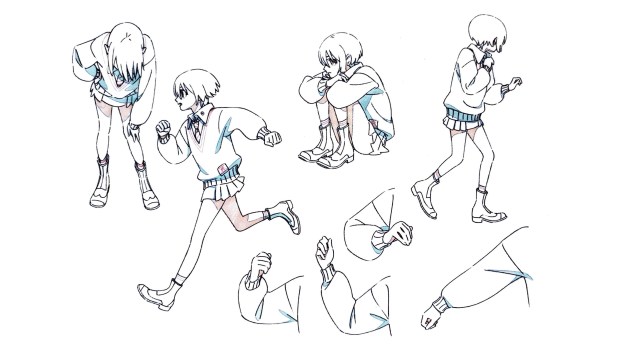
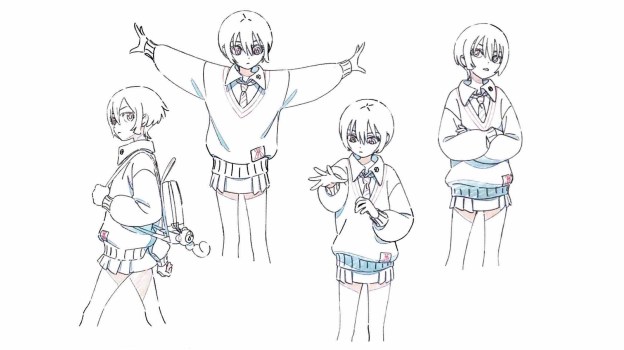
Original interview from Monthly Newtype (May 2025), original text by Hisashi Maeda and Makoto Ishii; cover image: official character design sheets from the “Mobile Suit Gundam GQuuuuuuX: -Beginning- MATERIALS” pamphlet by Yumi Ikeda.


My number one goal is to create an interesting and enjoyable work

What Director Tsurumaki wanted to do

Mobile Suit Gundam GQuuuuuuX is the first TV series directed by Director (Kazuya) Tsurumaki, so what was your approach in gathering the staff?

First of all, both the Director and I had already decided to ask Ikuto Yamashita-san for the mechanical design. As for the character design, when I asked the Director if he had anyone in mind, he immediately answered “I want Take-san. We went with the first choices without any trouble.
Previous to this work, there was this project called “Nihon Animator Mihonichi” [日本アニメ(ーター)見本市, Japan Anima(tor)’s Exhibition, 2014], where many different creators made a short animated movie each. In that project’s context, Director Tsurumaki made the short titled “I can Friday by day!”

— It was re-released on YouTube just the other day, right?

Exactly. Take-san did the character design for that work too, and it’s a short I personally really like as well. The concept behind the “Nihon Animator Mihonichi” project was to have the creators make their animated shorts as freely as possible, exactly the way they liked and envisioned. So, once again, I had the confirmation that Director Tsurumaki really likes Take-san’s designs (laughs). 
For the rest of the staff, I basically picked the people who I knew could truly understand and realize what the Director wanted to do. As a result, a lot of them naturally turned out to be people who had already worked with him in previous occasions.

— What’s your personal understanding of Director Tsurumaki’s vision and intentions for this work?

Well… at the stage when he told me about Take-san, I figured the characters would take on a pop direction. Defining the scenery and backgrounds is largely up to the art director’s discretion, so I asked Hiroshi Kato-san, who always deeply understands Director Tsurumaki’s taste and intent. Rather than making something entirely new and unique, I believed this project should go for the “usual Tsurumaki imagery”. Last time I asked the Director to “create something exactly the way he wanted” the result was “I can Friday by day!”, after all.
Even if it’s Gundam —so it slightly leaned into the “real” direction— I interpreted the director’s intent as going for that very pop and stylish kind of imagery.

— Sugitani-san, you temporarily worked under Sunrise [now Bandai Namco Filmworks] and were involved in the production of “Mobile Suit Gundam Unicorn”. Did you intend to carry the “Gundam-ness” you felt back then over to this project?

Being involved in the production of a proper, legitimate Universal Century Gundam work like Unicorn, was really a great experience for me —it was like a dream coming true. Now, I want to make sure readers understand this clearly; my desire to “work on a Gundam series” was entirely fulfilled that time. So, for this new project, my original aspiration was to have Director Tsurumaki create something beyond my expectations, like anything I’ve seen before, that wouldn’t be bound to the same outline and framework of the past Gundam entries. While of course being approved by Sunrise, I wanted to create something with a totally new and fresh approach that only Director Tsurumaki could come up with, something that could be only made at Studio Khara.
To put it bluntly, I believe that if another company were to make a Gundam series trying to incorporate elements from Evangelion in it, the chances of it being received poorly would be very high. On the other hand, I thought it might actually work if it were the very studio that created Eva attempting to put its unique elements into Gundam, in a way only they were capable of.
In that sense, when we were planning the project, I remember telling Director Tsurumaki that “I wanted to create something that could be only made at Studio Khara”.

— Going back to the previous topic, what about the other members of the main staff, aside from Yamashita-san, Take-san and Kato-san?

In the initial phases, the first person I contacted was Hajime Ueda-san. Director Tsurumaki told me that before starting the new project, he wanted to have a talk with Ueda-san. I didn’t know about it, but it seems that the two of them had already discussed a project with a girl as the protagonist in the past. That was the first meeting with Ueda-san; then, during the second or third meeting, the Director already proposed his idea of a story set in a world where Zeon had won the One Year War, and the direction for the project was decided. After that, we invited Yoji Enokido-san to join as the scriptwriter. 

— I’m starting to see how it came together now.

That was how the story came about, so now I guess it’s the visuals’ turn. With Yamashita-san as the main mechanical designer, I thought the mechanical animation designer and chief mechanical animation director couldn’t be anyone other than Sejoon Kim-san. For him too, “Nihon Animator Mihonichi” was the occasion where we first met. There, he did the mechanical animation direction for Yamashita-san’s short “Iconic Field”, then he worked again as the mecha animation director for “Shin Evangelion Movie:||” [シン・エヴァンゲリオン劇場版:||, EVANGELION:3.0+1.01 THRICE UPON A TIME, 2021], and besides, he’s been heavily involved in Gundam before. GQuuuuuuX’s mecha designer is Yamashita-san, and it’s a Gundam series, so there was no one more fitting than Kim-san. To be honest, I was really hoping for him to accept, or I would have been in big troubles (laughs).

— And what about the animation character design?

For the characters, it might have been audacious, but we held a competition aiming to find someone who would cover both the roles of animation character designer and chief animation director at once. Out of the people who took part in the competition, the Director selected Yumi Ikeda-san and Shie Kobori-san. These two were hired as douga staff at Studio Khara, and are what you’d call homegrown members of the studio. As someone who has worked with them since the days of production management, I was truly happy to be able to ask them to join this project. Actually, Director Tsurumaki has been looking over their drawings since their very first days as douga animators.

— What do you mean by that?

When douga staff are hired at Studio Khara, Director Tsurumaki is the one to first review their portfolios at the document screening stage, and he’s also responsible for the hiring exam. He oversaw the exams to promote douga staff to key animators as well. And even aside from all that, he’s basically responsible for the guidance and supervision of young animators at Studio Khara. Having gone through that process, these two were originally members who Director Tsurumaki had recognized for their talent —what you might call the “Tsurumaki children” (other members of GQuuuuuuX’s staff who joined the studio around the same time include Gen Asano, now working as the mechanical animation director, and episode director Touko Yatabe).
It feels like the seeds Director Tsurumaki has been steadily and carefully sowing have finally started to sprout.

— There’s a real sense of continuity with the studio’s history.

Also, the CG for every episode is directed by Khara’s in-house member Takashi Suzuki-san, and the color design is made by Wish, who we always work together with. T2 studio is in charge of the compositing, and I believe the experience and know-how accumulated during Eva’s production are being put to excellent use.

— As the producer, what are your personal goals with this project, Sugitani-san?

I’ll be repeating the same things from earlier, but what I wanted the most was to see what would happen if the staff who worked on Eva made a Gundam series. Fortunately, I’ve been involved as a production manager and producer in both franchises, so seamlessly merging together the good elements I found in each of them was also one of my goals. This aspect was emphasized as the tagline for the work, wasn’t it?
I hope this will also be an opportunity for those of the younger generation who don’t know “Mobile Suit Gundam” yet, to experience the franchise for the first time. But ultimately, my number one goal is to create an interesting and enjoyable work. I’m a huge, huge Gundam fan myself. That’s why I’d be incredibly happy if we managed to create a Gundam series that the viewers would find “interesting” too. And if it becomes an opportunity for more people to approach Eva as well, I’d be even more grateful. After all, both Gundam and Eva are extremely important works to me.

Yoji Enokido – Interview on Mobile Suit Gundam GQuuuuuuX

Original interview from Monthly Newtype (May 2025), original text by Hisashi Maeda and Makoto Ishii; cover image: official character design sheets from the “Mobile Suit Gundam GQuuuuuuX: -Beginning- MATERIALS” pamphlet by Yumi Ikeda.


There are going to be some quite high tension developments, like a roller coaster

The characters are all going to take it to the limit

— How did you approach Machu, Nyaan and Shuji’s characters when writing the script?

Machu is sort of a textbook protagonist, so it went relatively smoothly with her. In the first episode, she’s introduced as a regular girl living her simple, daily life, and then, all of a sudden, she sneaks inside of a Mobile Suit. It might seem like she’s a bit reckless and eccentric… but in my interpretation, the most unique trait of Machu’s personality is that she doesn’t have prejudices.

— She doesn’t have prejudices?

Side 6 is basically a normal, everyday world, somewhat resembling present day Japan. But there’s an area inside the colony where immigrants —both legal and illegal— and refugees live, people who are relatively discriminated against within the colony. Even in a society with such a dark side, Machu doesn’t hold any prejudice towards the refugees and the illegal immigrants there. Whether that’s because she fundamentally lacks the concept of prejudice, or because she simply doesn’t want to acknowledge it, even I am not totally sure.
If a normal girl were to come in contact with a smuggler of illegal Installer Keys like Nyaan, she’d probably report her to the police immediately. But not Machu, she’d just go ask for the “compensation for her broken smartphone” or something. This is to say, Machu basically considers Nyaan to be her equal. In this sense, inside that Side 6, she’s certainly a peculiar girl.

— I see.

It’s exactly because Machu sees Nyaan as her equal that the moment she notices the bruise on Nyaan’s face left by the military police, she feels so angry inside. She’s thinking, “Why is the police beating up a girl about the same age as me!?”. And then, she gets even angrier at Nyaan’s attitude of it being only natural that they’re being violent against someone like her. Machu’s inner anger reached its limit when the military police Mobile Suits started to arbitrarily destroy the buildings in the refugee settlements, with the excuse that “they’re illegal anyways”. It’s at that point that she decides to sneak in the Mobile Suit —it was a manifestation of all the anger she was bottling up deep inside herself.
Actually, it’s very similar to the anger Amuro felt in the first episode of “Mobile Suit Gundam” [機動戦士ガンダム, 1979], when he saw Fraw Bow’s family getting bombed. That’s why I believe I was able to get Machu to step into the Mobile Suit in the proper, traditional way of a Gundam protagonist.

— So, she might not be hot-tempered, but in terms of sense of justice…

She has one. Perhaps, that sensation is something very closely linked to the abilities of Newtypes.

— What about Nyaan’s character?

Contrary to Machu, Nyaan was very difficult for me to handle. I couldn’t quite grasp the balance Director Tsurumaki wished for. It felt like a déjà vu… it was the same with “FLCL”’s [フリクリ, 2000] Mamimi. No matter how many times I asked the Director to explain that character to me, I couldn’t fully understand her. In the same way, I would make Nyaan feel somewhat like a refugee, then more like a smuggler… but each time, I’d get told there was “something not quite right” about her. In the end, we settled for a “shy illegal smuggler fearful of strangers”. Although, of course, there is a fully correct interpretation of her character still inside the Director’s mind. 

— What about Shuji? I think he’s a pretty mysterious character…

As a scriptwriter, Shuji was a rather troublesome character. The Director told me he’s “a character who doesn’t talk much”… Well, thinking of it, characters who don’t speak much are always the Newtype-y ones (laughs)

— Writing the dialogues is a big part of the scriptwriter’s job, after all.

Right. Gundam as a series doesn’t have many characters with signature lines or catchphrases, but I thought it would be better for Shuji to have one; that’s when I came up with his “…that’s what the Gundam is saying” line. Basically, I interpreted the Director’s order that “he doesn’t talk much” as “he doesn’t express his own thoughts much”. So, using the “that’s what the Gundam is saying” line, it’s not Shuji who’s talking, but the Gundam. And Shuji comes across as a character who doesn’t speak all that much.
And then of course, I also hoped that the line would stick with the viewers and catch on (laughs)

— Ahaha. You can tell some of the lines are pretty intentional. Like the smugglers’ “Hello, are you in a hurry?”.

Yes, yes. Reusing that passphrase from Mobile Suit Gundam’s Miharu was my idea —it was like a declaration of intent that “I’ll reference the First Gundam whenever I get the chance to”. I feel like references to the First have been made in so many works to the point of exhaustion, but that’s precisely why I’ll be intentionally making the most fanatic-level, exotic references I can (laughs). 

— Talking about lines, the poetic ones that don’t make perfect logical sense, like [Machu’s] “I don’t really get it, but I sort of get it!”, feel really good.

Director Tsurumaki hates explaining things through dialogues, you know. To him, “It’s okay even if it’s not clear”; he’s inclined to think of dialogues with the premise that “that’s how real life conversations work to begin with”

— But a script is something written rather logically, isn’t it? It must be hard…

It really is! (Wry smile). I can’t quite write like that unless I become a Newtype myself. Oh, but in that case, that would make me an Artificial Newtype (laughs)

— (Laughs). Well then, lastly, please tell us what to expect from the future developments of the story.

It’s going to be like a roller coaster, with some quite high tension developments, so keep your expectations high. Machu, Nyaan, Challia Bull, Shuji, Xavier… They’re all going to take it to the limit, so brace yourself for what lies ahead!

Kazuya Tsurumaki – Interview on Mobile Suit Gundam GQuuuuuuX

Original interview from Monthly Newtype (May 2025), original text by Hisashi Maeda and Makoto Ishii; cover image: official character design sheets from the “Mobile Suit Gundam GQuuuuuuX: -Beginning- MATERIALS” pamphlet by Yumi Ikeda.


I thought that by depicting the feelings I’ve experienced under the Cold War, I could convey a unique atmosphere unlike that of any other Gundam before

A “Cold War” feeling in the Universal Century

— When talking about this work, you’ve often mentioned the genres of “Alternative” or “Fictional War Stories”, what do you think the appeal of these genres is?

Rather than the militaristic component, I’d say the interesting and thrilling part is the SF one. The first half of the theatrical pre-release version, “Beginning”, is an alternative version of the One Year War, so I mentioned the words “Alternative War Stories” before, but in terms of composition, I think it’s more like a “Historical What If”, a genre close to SF, about a world set in the aftermath of a rewritten history. An alternative history work I like is “Red Sun Black Cross[レッドサン ブラッククロス, a board game and novel by Daisuke Sato]

— The one by Sato Daisuke?

Yes, that one. Do you remember how it starts? As a whole, it’s an alternative history version of the Second World War, but it starts off depicting the beginning of the Fourth World War set in 1990. Right off the bat, it threw us into a world we knew nothing about —a world where, forget World War II, even World War III was already over. I keep coming back to its prologue, and it still excites me even to this day.
I feel that this sense of excitement, at least for me personally, is the kind of thrill distinctive to SF. 

— Talking about Sato Daisuke’s works, there’s “Nobunaga-den”, in which he ponders how Japan could have won the Second World War, and arrives at the conclusion that “Oda Nobunaga shouldn’t have died at the Honno-ji Temple”.
In a sense, I felt that this idea was similar to GQuuuuuuX.

I just told you how, to me, GQuuuuuuX is a “Historical What If Science Fiction”, but originally, the idea of a story set in a world where “Zeon won the war” was more akin to the alternative history genre. I believe there are two main approaches to alternative history works; the first one is to make a historical change in the initial setting or premise of the story, and then develop what happens next like a simulation. The second one, is develop the events that lead up to the historical change, thinking in what way history would need to be altered to make that change possible in the future.
In GQuuuuuuX’s case, it’s clearly the latter, and there’s this point often discussed among Gundam fans that “The Federation wasn’t able to defeat Zeon just thanks to the efforts of Amuro and the single Gundam unit alone”… Though, it’s mostly the military fanatics that bring this up… (laughs)

— Like bringing up the difference between a “tactical victory” and a “strategic victory”.

That’s why, to lead up to GQuuuuuuX’s future, there are some more military-oriented, realistic changes to the OYW, like for example “Zeon’s colony drop being successful and the Federation suddenly losing their headquarters in Jaburo”. But then I thought: “This is Gundam, after all” (laughs) “and since it’s Gundam, the existence of the Gundam itself has to be the trigger for the turning point in history”. That’s when I came up with the idea of “What if the pilot of the Gundam was Char instead?”.
That’s the exact opposite of how (Hideaki) Anno, who wrote the script for the One Year War part, conceptualized it. I believe he wrote that script starting from his desire to write a version of the war in which Char pilots the Gundam and achieves great things. Though, ultimately, they’re still both like an alternative history work.

— The place where the protagonists, Machu and the others live, Izuma Colony, is an interesting setting. Starting from the name itself, it has a Japanese flavor to it, and overall it somewhat resembles modern day Japan. 

There are two reasons why I decided on such a setting. The first one is that I wanted to use Japanese language. At the time of “Top wo Nerae 2!” [Gunbuster 2: Diebuster (トップをねらえ2!DIEBUSTER), 2004, it was prohibited to show (Japanese) characters and writings, and in terms of direction, it was a nightmare to work around it (wry smile). I thought that using written characters would have made it so much easier to express many different things.
The other reason is, if you watch any Universal Century episode up until now, it’s clear that English is the official language. However, there are a few colonies, like Moon Moon or the Texas Colony for example, rooted in a special and distinctive culture of their own. So, I thought it would be fine if there was a colony whose customs were heavily influenced by Japanese ones. Side 6 from the first “Mobile Suit Gundam” was originally designed as a caricature of Japan. I thought it would be okay if there was a colony with many residents of Japanese origin. 

— And what about the time setting?

To tell the truth, I wanted Machu and the others to be born after the end of the war; I thought they would give off a stronger impression of being a “new generation” that way. But in the end, things happened and we decided on UC 0085 as the time setting.

— I find that “I wanted Machu and the others to be born after the end of the war” really interesting. What are your thoughts and feelings on dealing with a post-war scenario?

Rather than a post-war, I’d say it’s a Cold War. When I was a kid, we were right in the mist of the Cold War; the US and the USSR never fought each other directly, but it felt like the next war could break out at any moment. There were novels or movies about the USSR army suddenly landing on our territory and turning Japan into a battlefield, and back then, it didn’t feel all that unrealistic.
When we decided on UC 0085 as the time setting for GQuuuuuuX, a certain member of the staff pointed out that “You’re doing Gundam but you’re not writing about war?”. All the previous Gundam up until now have portrayed a war of some sort, be it a full-scale war between different powers, or a factional struggle within the military, almost like a civil war. So I thought that writing about a “Cold War” would have worked as well. I thought that by depicting the feelings I’ve experienced under the Cold War, I could convey a unique atmosphere unlike that of any other Gundam before. 

— It’s true that, despite not being directly at war, there’s palpable tension between the two factions, and the atmosphere in the colony turns really tense just by the arrival of a battleship like the Sodon. It really gives the impression of a Cold War. Those under 40 today only became aware of the world after the Cold War was already over, so they don’t know what that atmosphere felt like.

That’s right. I think (Yoshiyuki) Tomino-san’s generation is the last to have known the experience of war throughout their childhood. My generation, of course, didn’t experience actual war, but we do understand the feelings of the Cold War. Naturally, conveying those sensations to the current, young generation is very difficult, but in today’s reality as well war has broken out in Ukraine, and conflicts and civil wars continue unabated in the Middle East. It’s not outside the realm of possibility for the current situation to escalate in a world-wide conflict. I believe that, to some extent, the prospect of a “future war” between nations has unfortunately become a reality among the young people of today.
That’s something that hasn’t been felt for about 30 years since the collapse of the Soviet Union, isn’t it?

— Indeed, I understand the feeling that the thread of terrorism has taken us back to the terror of the Cold War.
I think a world where a space colony, while certainly not depriving the characters of their freedom, still somewhat feels like a claustrophobic place that’s tying them down, is reminiscent of your previous works… 

Well, that’s the influence of what I felt like when I was young. I grew up in the middle of the rice fields in Niigata, and even though the horizon stretched out in all directions, it still somehow felt “narrow”. Of course, if I walked all the way past the mountain, I’d eventually reach Tokyo, but that wasn’t actually feasible, was it? I felt like I was trapped inside my small, familiar garden, and I wondered, “Am I going to spend my whole life in this place?”. I depicted that fear in “FLCL” [フリクリ, 2000], as well as in this work.
It’s not like Machu thinks that “A space colony is too narrow, I hate it”, but she feels like “The world has to be much more vast, more free…”. She could, in principle, go to other nearby colonies, but in reality, she doesn’t. She lacks the freedom to say “whenever I want to go, I can do it in an instant!”; that’s especially true for children. I’m depicting the same things I myself felt in the past.

— So, that’s really a theme you want to focus on in the works you direct?

It’s rather because I want young people to watch my works. When I ponder what kind of feelings the youth of today would actually feel, I think it has to be something similar to the sense of confinement, or the fear and the anxiety about the future I too felt back then. 

— Machu being bothered that the gravity inside a space colony isn’t real is too an extension of those feelings?

That in particular incorporates another slightly different thematic. Is the Red Gundam that Shuji pilots the real one? Are Newtypes and their abilities real to begin with? Is the alternative world of GQuuuuuuX itself real at all?
This idea of whether something is “real or not” is present in many ways within the story, and I believe it might be another element especially interesting for the young viewers.

— What do you mean by that?

For example, thoughts like “I wanna become a mangaka” or “I wanna become a musician” always come together with doubts like “Is this talent actually real?” or “It works in class or at cultural festivals, but would it really work as a profession for the future?”, “Is it a real, genuine talent comparable to that of famous mangaka or artists that everyone knows, or does it only work among friends?”. In this sense, I feel like it’s a very valuable theme.

— From what you said today, I feel like what you’re trying to do is depicting a sensibility close to that of the 80s and 90s, in which anxieties about the world and adolescence are mixed together, in a new, modern way. 

You’re right. Even if I were to research the feelings of today’s youth, I doubt I’d be able to properly portray them on screen… (laughs)

— From this perspective, I’m really looking forward to see how the three main characters, Machu, Nyaan and Shuji will be portrayed. Talking about young characters, there’s also the poor Xavier…

Xavier’s a character I like. I hope I was able to portray him in an interesting way. Please, look forward to it.