
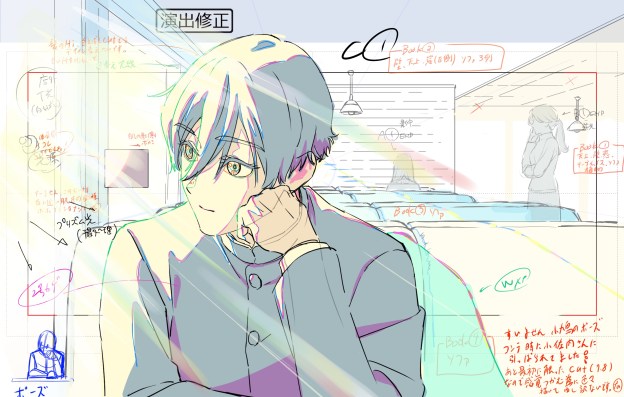
Original interview from Newtype (September 2024 issue), original interviewer: Haruyo Igeta; genga corrections by Keisuke Hiroe.
We have the visuals, so we should trust their power
~ A suggestive work that leaves room for imagination ~
— What were your feelings when you first came in contact with the original work?
I felt that the dynamic between Kobato and Osanai was really interesting, and that the fact that, despite being clearly eccentric people, they’re still trying to become ordinary had some cuteness and a hint of sadness in it. A subtle sense of humor is also distinctive of this work.
— Knowing you had to set up the script, what aspects did you pay particular attention to when reading the novel?
While I was reading it, I thought about how to portray the dialogue scenes and how to translate onto the screen the world as it was described in the text.
— The director said you are “really good at capturing the essence of the original works” [Part 1 of the interview with Director Mamoru Kanbe].
I’ve been doing this for a long time, so I suppose developed a certain knack for it. When it comes to a novel, the key is not just how well you grasp the main points, but how you shape them. As for the series composition, it’s also a matter of length and time, often the director asks what the of story is about in brief. Keeping that in mind, I start by outlining the essential elements that have to be included in each episode.
— What are those essential elements in Shoushimin Series?
The peculiar character dynamics, the setting and the atmosphere. I carefully ladled these elements out while imagining the scenery and flow of time in Gifu, the city where the story takes place. Also, there are fine and subtle expressions unique to the novel, so I carefully considered how to translate them into visuals as well.
— What instructions did you receive from the director?
Since it’s the third time I’ve worked with Kanbe-san, I knew that he, as the director, wouldn’t use narrators and monologues, and he would avoid conventional flashback scenes. This means that he values leaving room for imagination and not over-explaining things, and even if it made writing the script more challenging, I tried to abide to that approach. Not only the director’s, but considering everyone’s opinions, every week we met and discussed how to come up with thoughtful and appropriate depictions within the given limitations.
— When writing the script, how did you interpret Kobato’s, Osanai’s and Kengo’s characters?
Kobato-kun is the one I relate to the most. I too, due to the nature of my job, have a tendency to overthink things and end up placing excessive importance on my delusions, so I was able to understand how Kobato-kun’s thoughts don’t always line up with reality and how he gets overconfident when solving a mystery. As for Osanai-san, I don’t get her at all… that’s what I kept thinking while writing the script. Since the story is being told from Kobato-kun’s perspective, I believe that I too, from my position, could write it without fully understanding her and relying on my imagination. Regarding Kengo, I thought that I had a classmate like him in middle school as well. He’s an incredibly good person, and even if his personality is the opposite of Kobato’s, they’re a really charming duo. I wrote the script thinking that they might admire each other in some way.
— When delivering the mystery parts in the script, was there anything you paid particular attention to?
The moments when the main characters are stuck in the thoughts or when they feel like something’s off had to be portrayed properly. But at the same time, I gave careful thought to how to make those moments feel effortless and unobtrusive.
— Was there anything you gained, or any new things you discovered, from being involved in this project?
The fact that, even without extensive narration and even without over-explaining things, a story can still be functional and solid. Nowadays, anime and TV dramas tend to be overly talkative and overly descriptive, whereas this work goes completely against that direction, and both I and Kanbe-san are pleased that’s the case. We have the visuals, so we should trust their power. That’s the awareness you generally should have. But watching the works that are actually airing, the style of Shoushimin Series may feel surprisingly fresh.
— Touching on the highlights from episode 5 onwards, please, leave a message for the readers.
This work is a mystery, but that’s not just about the cases. The story is full of other mysteries as well: what it means to be ordinary, what’s going on in Kobato’s and Osanai’s minds, what they think about each other, whether and how their relationship is going to change… so I hope you can enjoy it by finding a mystery you like and making your own guesses about it. Also, it’s a mild work set in a very quiet town, but there are some unexpected developments coming up in the future and the relationship between Kobato-kun and Osanai-san is going to evolve, so I really hope you will look forward to that.
Part 1 – Interview with director Mamoru Kanbe
Part 3 – Interview with composer Takahiro Obata

Pingback: Mamoru Kanbe – Interview on Shoushimin Series | SHINSEIKI
Pingback: Takahiro Obata – Interview on Shoushimin Series | SHINSEIKI