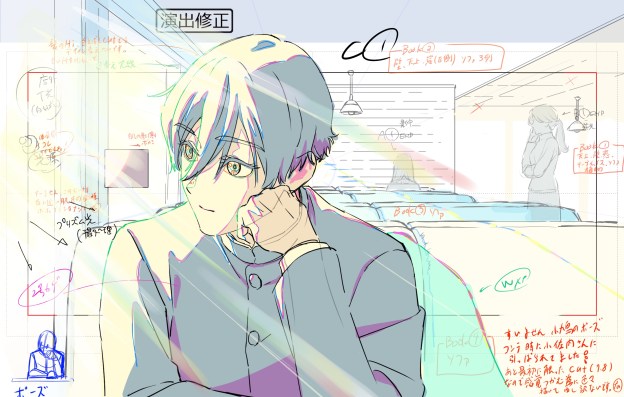
Original interview from Newtype (September 2024 issue), original interviewer: Haruyo Igeta; genga corrections by Keisuke Hiroe.
Since the music is used sparingly, the moment the main theme starts playing is very impactful
~ I put meticulous care into refining each and every sound ~
— What led you to become involved in this project, Obata-san?
I’ve always been familiar with the concept of ‘background music enhancing everyday scenes’, and I had previously worked together with director Kanbe on several projects in the same daily-life drama genre as this show. Because of that, I received an offer from producer Endo (Kazuki)-san. I am truly honored to have been able to work on the music for such a wonderful work.
— What were your impressions upon reading the original work?
At first, I thought it was just your usual school-drama, but the story of Kobato-kun and Osanai-san helping each other out in their mutually beneficial relationship, aiming to become ordinary, filled with enigmatic cases and a sequence of unfortunate events was something entirely different… I was shocked! (Laughs).
The interactions between those two are charming and entertaining, and I was so captivated by them making such deductions that would easily put an adult’s to shame, that I ended up finishing all the volumes in no time!
— When producing the music, what did you pay particular attention to?
I wanted to use Celtic-like folk instruments for the main theme, and also put some vocals in it. The director instructed me that even if the setting was the suburbs of Gifu, a calm and quiet scenery with a serene river and a bridge, he wanted a slightly sharper component within it. While Kobato-kun and Osanai-san, who at a first glance appear to be ordinary people, are represented via the inclusion of the folk-like elements, in order to better suit the vision behind this work, I went through a trial-and-error process to compose the music, incorporating things like irregular time signatures and omitting a beat from the usual meter. While still retaining the idea of a peaceful suburban imagery, I paid attention to keeping intact the mysterious and enigmatic tone of the story. Additionally, I directly visited the real locations where the anime is set, and used the atmosphere I experienced there as a reference for composing the music.
— What kind of instruments were used in the soundtrack? Did you consider using different ones for each character?
While focusing on the idea of Celtic music, to convey the feeling of the suburban scenery I used instruments like a tin whistle, an ocarina, a 12-string acoustic guitar and a fiddle [most often a violin used for folk and country music, as opposed to classical and jazz] and depicted an imagery suited for this work. Additionally, I’m really fond of the bass clarinet, so I featured it in various tracks. During the recordings, I consulted with the saxophonist Suzuki Kei-san, and had him play in various styles depending on the tune—from low to high tones, including clarinet-like, bassoon-like, and free jazz styles. Also, this time, I thought up and composed the main theme with different instruments and arrangements to fit each character. For Osanai-san, while I used lovely and sweet-sounding instruments in the arrangement, in order to depict her inherent duality which we catch some glimpses of, I used two cello melodies layered on top of one another, with one of them eventually shifting in range to give the idea of two different voices playing at once. As for Kobato-kun, I opted for a straightforward melody. Since there are deduction scenes involving sweets, I was conscious of not making it sound too serious or stern. There are also tracks centered around instruments like the marimba and vibraphone. Additionally, the biggest contributor, who magnificently performed the main theme, is the amazing vocalist EUREKA REPUBLIC-san! Somewhere in her clear and pristine voice, you can feel a hint of mystery. I believe we were able to craft a musical piece in perfect harmony with this work.
— Which episode would you say left a strong impression on you, Obata-san?
A certain scene in episode 5. Originally, it wasn’t intended to use any music, but it felt a bit bleak so we decided to try and add a store’s background music-like track. I thought that adding a cheerful sound like the mandolin’s would have made Osanai-san cuteness stand out more, so I proposed the idea during the voice acting session. Discussing ideas like this with the whole team, we decided together what would have worked best for every episode. Director Kanbe told me that in this work, he didn’t want to use music very often, but for the scenes where he did, he wanted the tracks to play for nearly their full length. Especially in episode 1, since the music is used sparingly, the moment the main theme starts playing is very impactful, it was a new discovery for me as well!
— What were the enjoyable and interesting aspects of composing the music for this work?
Rather than picturing the show as a whole while writing the tracks, I’d say that thinking up each and every sound and composing one song at a time was a really nice experience, since it was a first time for me. Above all, the members of the stuff were all great people, heavily invested in the project, and I’m deeply thankful I was to work with them.
— Lastly, a message for the readers.
I hope that while watching this amazing work, Shoushimin Series, you’ll direct some of your interest to the soundtrack as well.
Part 1 – Interview with director Mamoru Kanbe
Part 2 – Interview with scriptwriter Toshiya Ohno