
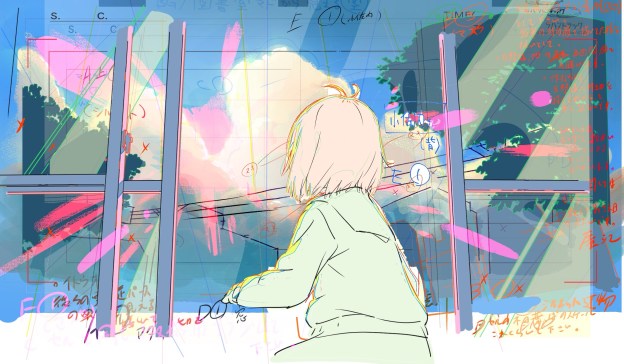
Original interview from Newtype (September 2024 issue), original interviewer: Haruyo Igeta; genga corrections by Keisuke Hiroe.
I hope it becomes something different from the usual
~ Incorporating new techniques to make this work’s world move ~
— Please, tell us the details on how you became involved in this project.
I received the offer directly from animation producer (Masakazu) Watanabe-san. Since the original work is a novel, adapting it into a visual medium is difficult, so my first reaction was: “What do I do now?”, I was perplexed (laughs).
— When you first read the novels, what were your impressions and your thoughts from the director’s perspective?
There were two points I felt I had to pay particular attention to when adapting it into an anime. First of all, the mystery approach that is crucial to this work. I thought I had to carefully depict the various elements typical of the mystery genre, such as the tricks and alibis. Second, the evolution of the relationship between (Jougoro) Kobato-kun and (Yuki) Osanai-san. I felt that that was the true charm of the story, so I had to portray it properly.
— Did you empathize with the characters or feel connected to them?
Upon reading the original work, my honest first impression was: “I really don’t understand these two”. It was while working on the storyboards that I gradually began to grasp what it was all about, and I felt my understanding of them deepened. I’m sure that (Toshiya) Ohno-san figured out a lot of things while writing the script, but in my case, I start to see things only in later stages. There are things you can only understand by actually getting your hands dirty.
— What kind of discussions did you have with Ohno-san?
We didn’t have very detailed or thorough discussions. We’ve already worked on several projects together, and this is our second mystery work. Ohno-san is good at grasping the concept quickly, so I trusted him and left it to him.
— Did you receive any specific request from Honobu Yonezawa-sensei?
When he said that “the novel and the anime are separate things” it left an impression on me. Also, we spent just one day scouting the locations together. In that occasion, I suggested making Kobato’s house into a traditional sweets shop, and he promptly approved of it.
— What kind of conversations did you have with character designer (Atsushi) Saito-san?
I think I just told him not to feel bound by the designs on the cover illustrations. Ultimately, I asked him to draw the designs based on the impressions he personally had.
— And what about art director (Akira) Ito-san?
Ito-san was busy and couldn’t participate in the location scouting, so I hand him over some pictures. It was an enormous amount, but he carefully inspected them and in the end, he became far more knowledgeable than us. Personally, I asked him to make the sky bluer than usual.
— In regards to the recording sessions, what kind of directions did you give to the cast?
Above all, I focused on asking them to speak in a whispery tone. I asked (Shuichiro) Umeda-san [Kobato’s voice actor] and (Hina) Yomiya-san [Osanai’s voice actor] to speak softly, almost as if they were in a quiet library. I wanted their acting to feel as realistic as possible. To the other voice actors, I asked to adapt to the atmosphere between the two [Umeda and Yomiya] and express themselves naturally.
— What did you discuss with sound director (Katsunori) Shimizu-san?
I’ve known Shimizu-san for a long time and I’m very familiar with him, so rather than the voice recordings, we talked more extensively about how to use the soundtrack. I wanted minimize the background music as much as possible… since it’s a dialogue-heavy work, I thought that the visuals would hold up well enough with just the dialogue alone.
— So, what kind of instructions did you give to composer (Takahiro) Obata-san?
At first, I thought it would have been a nice idea to make a couple of songs with lyrics and have them playing during the deduction scenes. After discussing this, Obata-san made a demo and it turned out to be so good that we ultimately decided to go with just that one song. He also incorporated elements of folk music and suggested using a 12-string guitar.
— You were in charge of the storyboard for episode 1. What were the key points you focused on, and what did you want to convey to the staff members who worked on the storyboards afterwards?
I had already decided to use the main theme song, so I made sure to draw the storyboard in a way the track would fit the climax well. Also, during dialogues, I made frequent use of a presentation technique where the location suddenly changes. For example, when in the mystery-solving scene Kobato reenacts the culprit’s movements. To prevent the dialogue-heavy drama from becoming tedious, I incorporated this technique as a unique element of this work’s presentation.
— Was there any idea from the other staff members that stood out to you?
Many ideas came up when writing out the script. From the order of the scenes to the ways of omitting or replacing the lines from the original work, I found myself thinking “I see” every time we had a meeting. I’ve acquired many great ideas from the people who were in charge of writing the script.
— What new things did you discover or gain from engaging in this project?
There are many things. The fact that using CinemaScope, which was a first for me, is surprisingly easy and convenient is one of them. I also think it kind of matches the atmosphere of this show. I experimented a bit this time, like with the technique to change the location in the middle of a dialogue, and I believe it turned out to be quite effective. I wanted this work to become something that differed from the usual imagery. I hope the viewers will notice in what ways it’s different.
— Lastly, a message for the readers.
From episode 5 onwards, this show becomes even more akin to a mystery. Especially between episodes 8 and 10, there’s a shift in the approach as the plot takes significant turns, so I hope you look forward to it. I also hope you’ll keep an eye on how the relationship between Kobato and Osanai evolves.
Part 2 – Interview with scriptwriter Toshiya Ohno
Part 3 – Interview with composer Takahiro Obata
