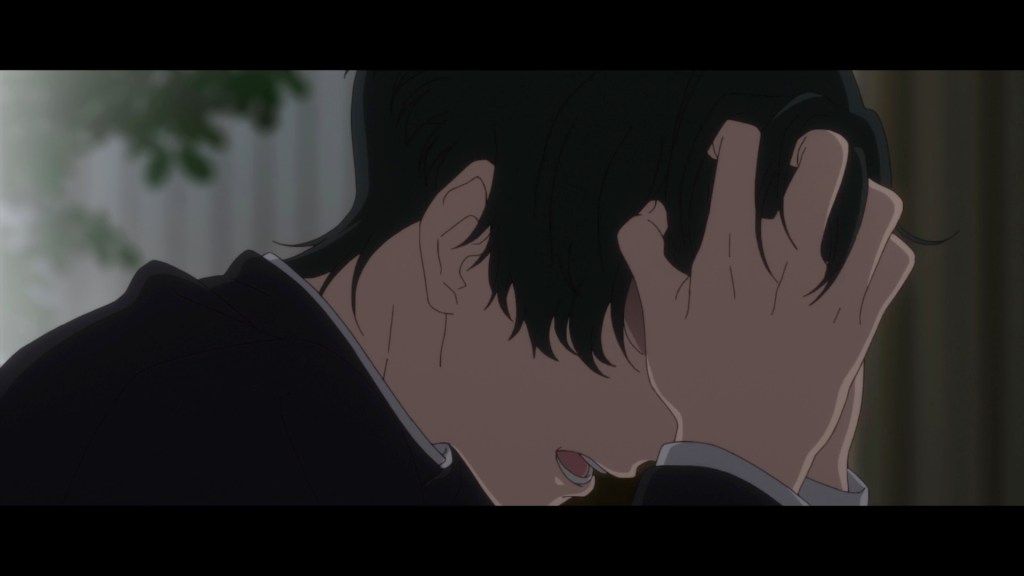
Original interview from Newtype (September 2024 issue), original interviewer: Haruyo Igeta; genga corrections by Keisuke Hiroe.
I hope it becomes something different from the usual
~ Incorporating new techniques to make this work’s world move ~
— Please, tell us the details on how you became involved in this project.
I received the offer directly from animation producer (Masakazu) Watanabe-san. Since the original work is a novel, adapting it into a visual medium is difficult, so my first reaction was: “What do I do now?”, I was perplexed (laughs).
— When you first read the novels, what were your impressions and your thoughts from the director’s perspective?
There were two points I felt I had to pay particular attention to when adapting it into an anime. First of all, the mystery approach that is crucial to this work. I thought I had to carefully depict the various elements typical of the mystery genre, such as the tricks and alibis. Second, the evolution of the relationship between (Jougoro) Kobato-kun and (Yuki) Osanai-san. I felt that that was the true charm of the story, so I had to portray it properly.
— Did you empathize with the characters or feel connected to them?
Upon reading the original work, my honest first impression was: “I really don’t understand these two”. It was while working on the storyboards that I gradually began to grasp what it was all about, and I felt my understanding of them deepened. I’m sure that (Toshiya) Ohno-san figured out a lot of things while writing the script, but in my case, I start to see things only in later stages. There are things you can only understand by actually getting your hands dirty.
— What kind of discussions did you have with Ohno-san?
We didn’t have very detailed or thorough discussions. We’ve already worked on several projects together, and this is our second mystery work. Ohno-san is good at grasping the concept quickly, so I trusted him and left it to him.
— Did you receive any specific request from Honobu Yonezawa-sensei?
When he said that “the novel and the anime are separate things” it left an impression on me. Also, we spent just one day scouting the locations together. In that occasion, I suggested making Kobato’s house into a traditional sweets shop, and he promptly approved of it.
— What kind of conversations did you have with character designer (Atsushi) Saito-san?
I think I just told him not to feel bound by the designs on the cover illustrations. Ultimately, I asked him to draw the designs based on the impressions he personally had.
— And what about art director (Akira) Ito-san?
Ito-san was busy and couldn’t participate in the location scouting, so I hand him over some pictures. It was an enormous amount, but he carefully inspected them and in the end, he became far more knowledgeable than us. Personally, I asked him to make the sky bluer than usual.
— In regards to the recording sessions, what kind of directions did you give to the cast?
Above all, I focused on asking them to speak in a whispery tone. I asked (Shuichiro) Umeda-san[Kobato’s voice actor] and (Hina) Yomiya-san[Osanai’s voice actor] to speak softly, almost as if they were in a quiet library. I wanted their acting to feel as realistic as possible. To the other voice actors, I asked to adapt to the atmosphere between the two [Umeda and Yomiya] and express themselves naturally.
— What did you discuss with sound director (Katsunori) Shimizu-san?
I’ve known Shimizu-san for a long time and I’m very familiar with him, so rather than the voice recordings, we talked more extensively about how to use the soundtrack. I wanted minimize the background music as much as possible… since it’s a dialogue-heavy work, I thought that the visuals would hold up well enough with just the dialogue alone.
— So, what kind of instructions did you give to composer (Takahiro) Obata-san?
At first, I thought it would have been a nice idea to make a couple of songs with lyrics and have them playing during the deduction scenes. After discussing this, Obata-san made a demo and it turned out to be so good that we ultimately decided to go with just that one song. He also incorporated elements of folk music and suggested using a 12-string guitar.
— You were in charge of the storyboard for episode 1. What were the key points you focused on, and what did you want to convey to the staff members who worked on the storyboards afterwards?
I had already decided to use the main theme song, so I made sure to draw the storyboard in a way the track would fit the climax well. Also, during dialogues, I made frequent use of a presentation technique where the location suddenly changes. For example, when in the mystery-solving scene Kobato reenacts the culprit’s movements. To prevent the dialogue-heavy drama from becoming tedious, I incorporated this technique as a unique element of this work’s presentation.
— Was there any idea from the other staff members that stood out to you?
Many ideas came up when writing out the script. From the order of the scenes to the ways of omitting or replacing the lines from the original work, I found myself thinking “I see” every time we had a meeting. I’ve acquired many great ideas from the people who were in charge of writing the script.
— What new things did you discover or gain from engaging in this project?
There are many things. The fact that using CinemaScope, which was a first for me, is surprisingly easy and convenient is one of them. I also think it kind of matches the atmosphere of this show. I experimented a bit this time, like with the technique to change the location in the middle of a dialogue, and I believe it turned out to be quite effective. I wanted this work to become something that differed from the usual imagery. I hope the viewers will notice in what ways it’s different.
— Lastly, a message for the readers.
From episode 5 onwards, this show becomes even more akin to a mystery. Especially between episodes 8 and 10, there’s a shift in the approach as the plot takes significant turns, so I hope you look forward to it. I also hope you’ll keep an eye on how the relationship between Kobato and Osanai evolves.
A one-week break between episodes 3 and 4, followed by the coming of August and thus my summer vacation that took me away from home for a couple of weeks, was a sequence of events that certainly didn’t help in retaining any semblance of the consistency this blog already lacked. What I did retain throughout the past month though, is my overflowing enthusiasm for this show (as those of you who follow me on Twitter are probably sick of hearing about) and naturally, it’s the last thing on my mind to give up on this series of blogposts breaking it down, no matter how behind schedule I am.
So, it’s with great pleasure that I finally present you with another instance of my ramblings about Shoushimin Series, this time covering episodes 3 & 4, Humpty Dumpty and Mind of a Lone Wolf.
Episode 3 – ハンプティ • ダンプティ: Humpty Dumpty
Right after the intro scene, which is already remarkable in itself and its successful approach to present the tension-filled classroom where Osanai and her fellow classmates are taking their exam, immersed in a diegetic silence with no background music in order to make the sound effect of the glass vase suddenly breaking stand out even more, we’re back to a very familiar scenery, one in which the emphasis on the layouts is the sole and most important visual trend.
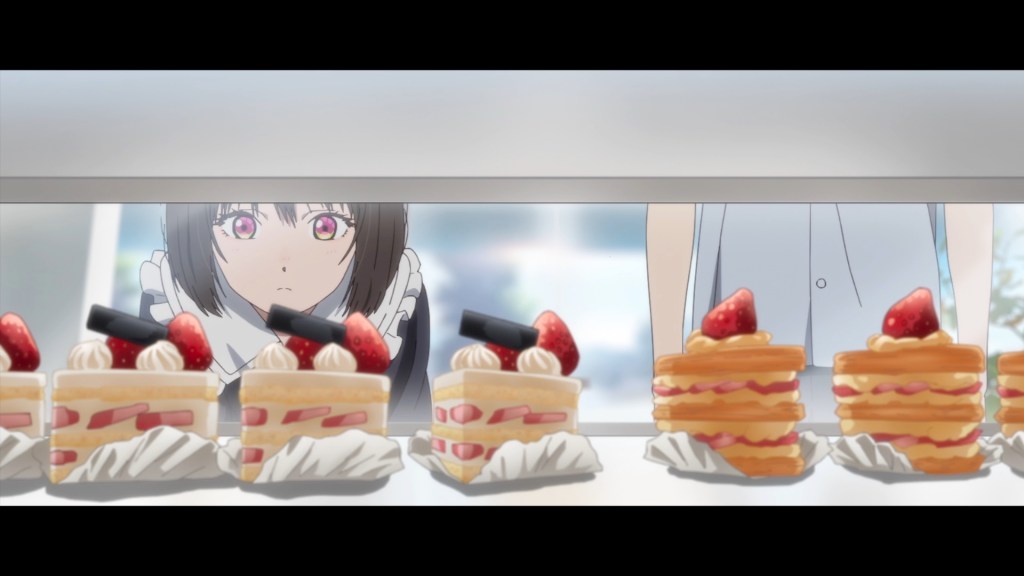
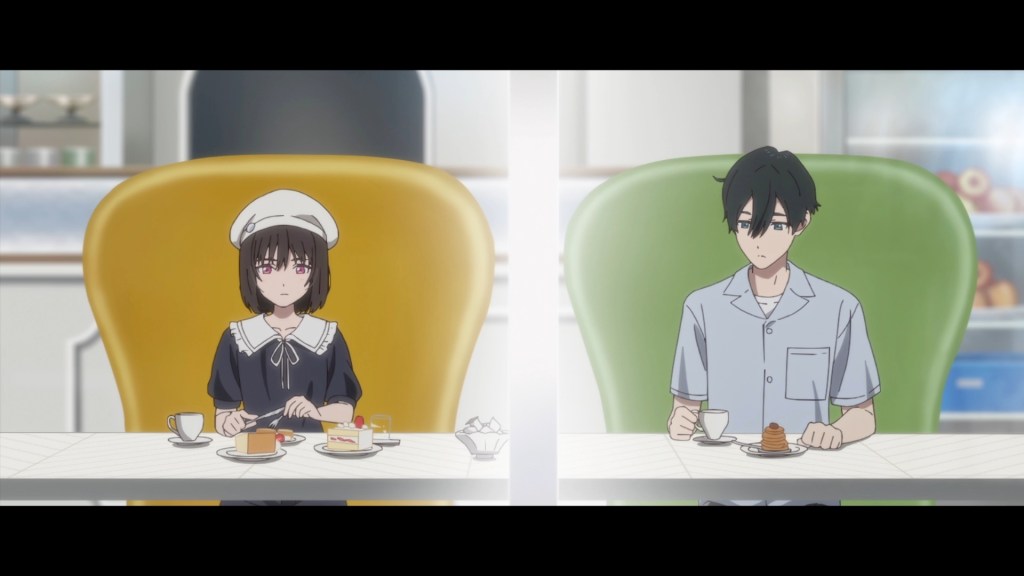
Frame 1Frame 2
As episodes 1 and 2 got us well used to, in this show, presenting the differences (or the similarities, or even the boundaries) between the members of the main cast is a job best suited for the layouts. The way the characters are framed in relation to one anther (or to the background and foreground elements) almost always encodes a subtle description of themselves or their relationships. This much was true throughout the course of the first two episodes, and while unsurprising, it’s still surely a delight to see the same visual trend being brought over to episode 3.
For example, both Frame 1 and Frame 2 effectively convey who, between Kobato and Osanai, is more fond of sweet foods and desserts, each one in its own way; for instance, in Frame 1, only Osanai‘s face is showing, directly staring at the cakes, and not only the number of sweets is larger on her side of the frame, but the cakes themselves look more elaborate and full of sweet ingredients compared to the ones on Kobato‘s side. Frame 2 on the other hand, takes a more direct approach, “physically” separating the two characters with the frame of the window in front of them (also using different colors for their seats), and making it clear at a glance whose order on the table is more substantial and overflowing with sugar (it’s also a nice detail how the bowl seemingly containing milk pods and the sugar for their drinks is, too, on Osanai‘s side of the frame).
Albeit not focused on distinctions and symmetries, the next sequence as well, when Kobato temporarily leaves Osanai alone at Humpty Dumpty to retrieve his smartphone from the locker in his classroom (as well as to investigate the truth behind this episode’s first case), features a layout-focused presentation that struggles to feel uninteresting, immersing Kobato inside the environment he’s intent on exploring.
If there’s something I love when it comes to visual-oriented storytelling (perhaps again thanks to Hyouka’s incredible direction in a similar circumstance), is when the passage of time, even if trivial, is left untold in the narrative and it’s instead conveyed through visual elements or small changes in them. There are obviously several “levels” to this, the most common and coincidentally least interesting one being a change in the lighting suggesting, for example, the transition from afternoon to evening with the sky turning red. Shoushimin, on its hand, handles it with a more sophisticated (and thus more subtle) technique, that is, showing us a still shot of the cakes on Osanai‘s side of the table as soon as Kobato gets back to the sweets shop. What such a shot has to do with the passage of time is pretty straightforward: the three plates in front of our gluttonous yet minute girl still have each a piece of cake on top, and more importantly, they’re completely different cakes from the ones she was eating before Kobato leaved earlier, implying enough time has passed for Osanai to finish up her previous order and make a new one (and, if it wasn’t clear enough already, that she really, really likes sweets).
As a side-note, the still shot also follows Kobato‘s movement directing his sight to the cakes, somewhat implying that he too was noticing this same detail.
Frame 3
Frame 4Frame 5
Moving on to the second part of the episode story-wise, we’re greeted with yet another strong showcase of expressive framing. The one I personally find the most interesting and clever is Frame 3; when our two main characters are chasing down Sakagami right after spotting him riding Osanai’s stolen bicycle, the moment their target becomes unreachable, the way the two pursuers are framed remarks their physical inability to go any further, complementarily to them actually stopping and talking about it. The fences in the foreground literally block Osanai and Kobato‘s movements, completely covering their bikes as well as the lower half of their bodies (i.e. their legs), making it extremely clear to the viewer that they are forced to stop there (and additionally conveying a slight sense of frustration and powerlessness).
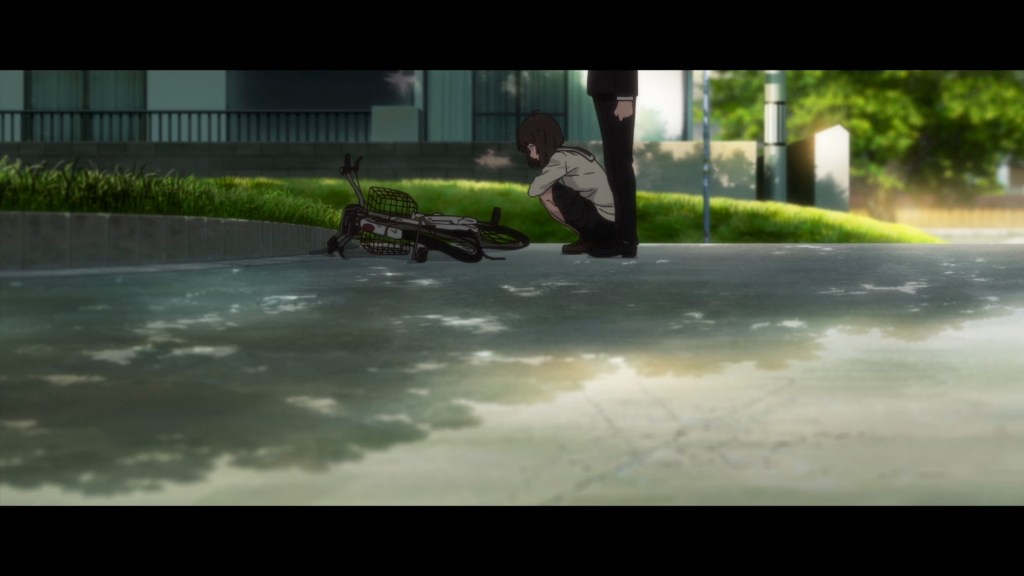
The later instances, like in frames 4 and 5 (after the two figure out exactly what the culprit’s movements were, with Kobatoimpersonating him in a similar fashion to how episode 1 and 2 tackled the visualization of the characters’ thought processes), involve a strong use of negative space. In Frame 4 for example, Kobato‘s upper half is cut off, and only Osanai and her broken bike fit in the frame. Frame whose proportions feel odd and unbalanced, purposefully so, in order to gradually portray the sense of unease surrounding Osanai‘s mental state in regard to the unfortunate situation she’s unwillingly part of.
It’s noteworthy how, from the moment out sweets-loving girl starts to progressively show her true colors, an increasingly deeper sense of distance is implied by the storyboard (and by extension, the derived layouts) as Kobato and Osanai are almost never framed together, and when they are, they’re never placed on the same layer of depth.
Frame 6Frame 7
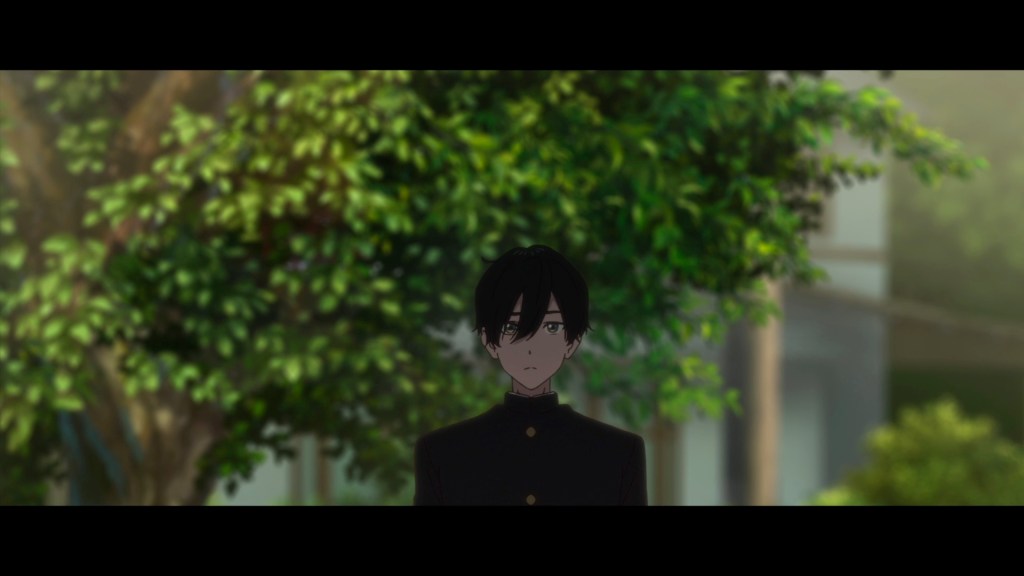
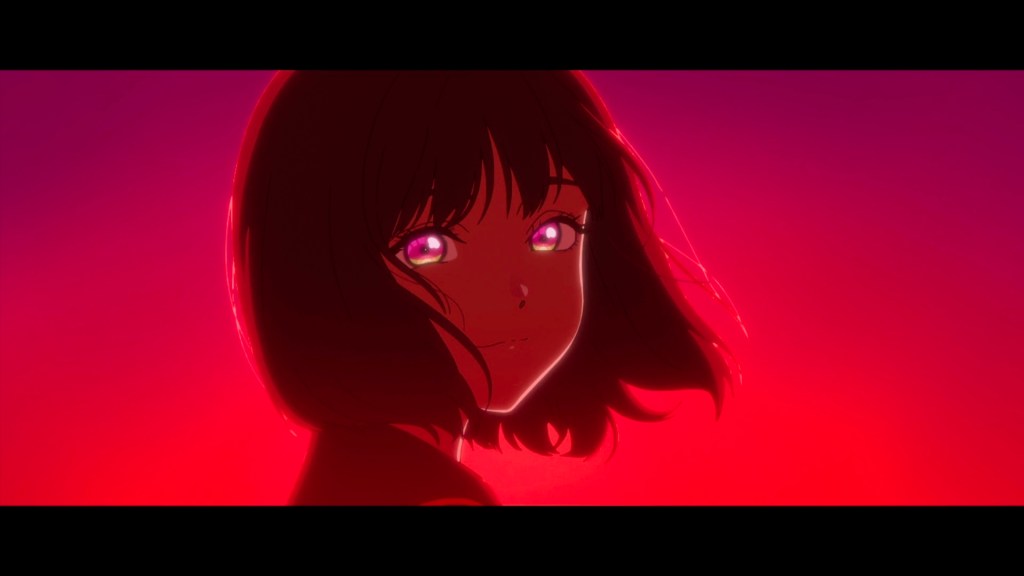
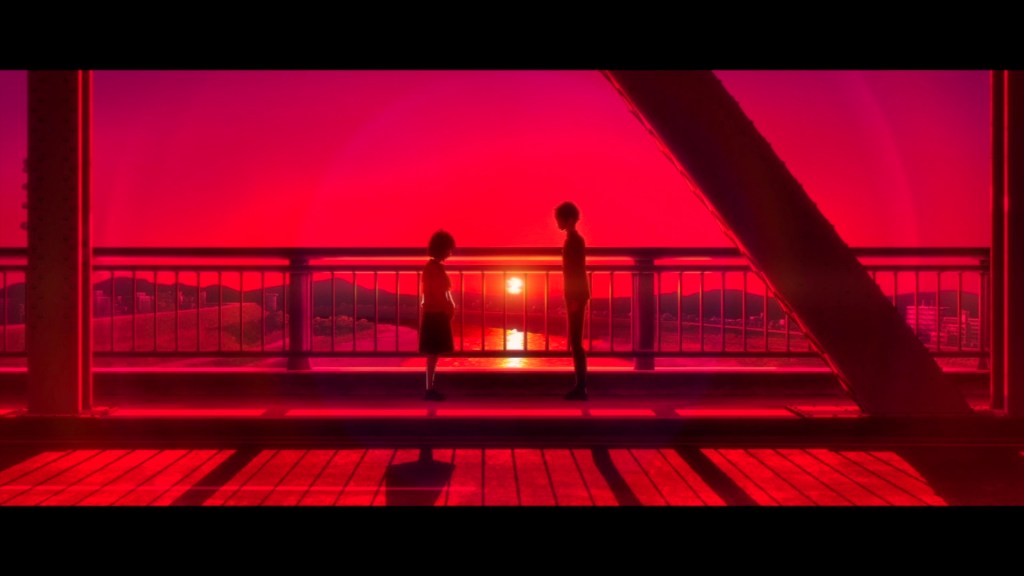
Talking about the true colors, the trope introduced right in the first episode of presenting the character’s mental spaces as physical manifestations is used once again, this time in a slightly different manner. What feels the most jarring here is not the spatial dislocation, but rather, the chronological one, as the blood-red colors of the sudden sunset that pervade the entire sequence instill a feeling of danger and fear throughout the scene (and are particularly successful at doing that thanks to the incredible color coordination work by Tomomi Kato and the photography at play). We, including Kobato, as hinted in Frame 7 that he is the foreign presence, have clearly been transported into Osanai‘s own mind, and are finally able to catch a glimpse of her true nature; or in other words, what restrains her from being a full-fledged “ordinary person“.
Before wrapping up, I can’t fail to mention how thorough and genuinely expressive the character acting has been all throughout the episode, especially so during the last sequence when Kobato is exhibiting his own discomfort to Kengo. This, paired with the incredibly polished and detailed drawings, allow this series to showcase its characters’ emotions in an essentially natural way, without falling into an overly dramatic presentation, retaining in fact the very grounded and heartfelt pragmatism central to the vision behind this adaptation.
One last neat detail worthy of mention is the use of the environment and weather to describe Kobato‘s feelings; as his mind gets clearer thanks to the exchange he had with his old friend, the cloudy and moody sky turns clearer as well, drastically lightening the tone of the scene. Although it’s by no means an innovative trope, the beautiful execution makes for a perfect conclusion to yet another amazing episode.
Episode 4 – 狐狼の心: Mind of the Fox & the Wolf
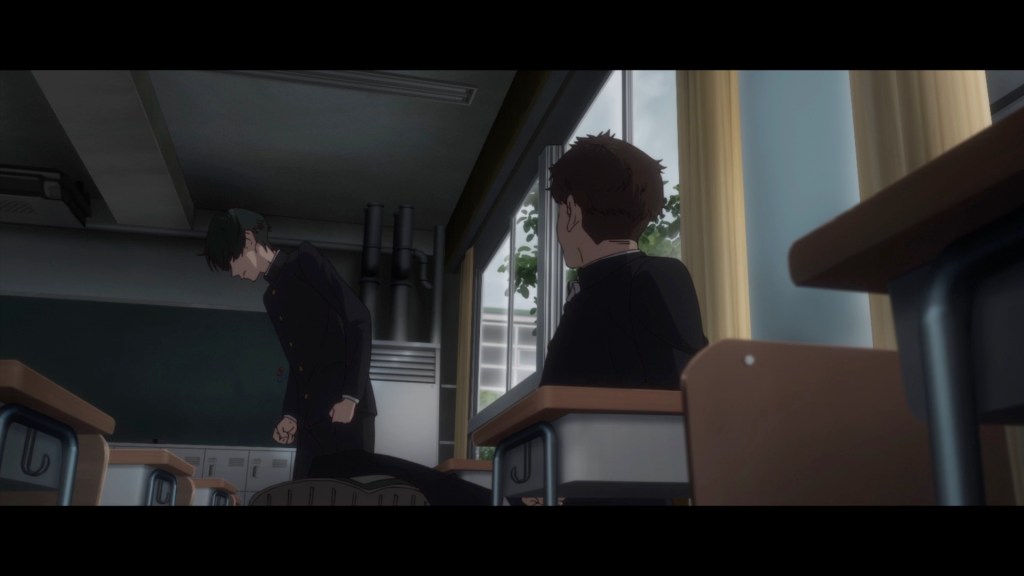
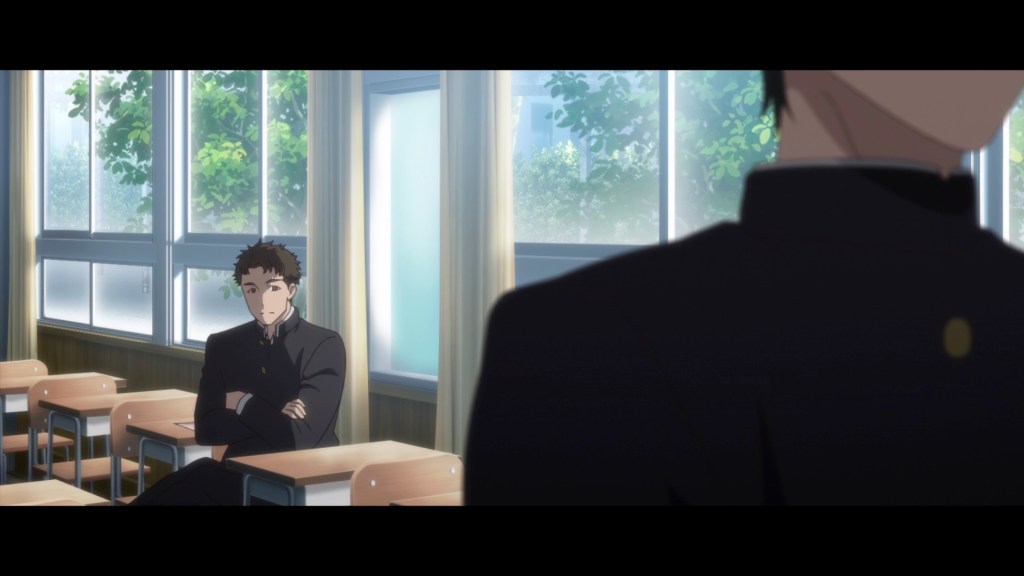
After the aforementioned one-week break, continuing directly from where the last episode left off, episode 4 begins in Kobato and Kengo‘s classroom, and it traps us there with the two of them for nearly the entire 23-minute runtime. A deliberate choice for sure, one that finds its reasons in both a specific directorial approach and a cost-efficiency need.
It might not be perfectly appropriate to call episode 4 as a whole a “bottle episode”, since, especially in its later phases, the location does change a few times and other characters make their appearance. However, in the first two-thirds of the episode, we’re presented with a continuous back-and-forth of similarly framed shots and cuts, depicting just the two friends more or less intent on finally piecing together this story-arc’s main case. Meticulously abiding by the 180-degree rule, this long-lasting exchange of questions, answers and theories is surprisingly able to keep the audience (or at the very least, me) engaged all throughout, despite nothing really happening during these 15 minutes we spend with Kobato and Kengo exclusively inside their classroom, with the exception of a specific instance that I’m going to adequately address later. In addition to being a successful visual approach, it’s also a relatively low-cost one at that, as it’s somewhat noticeable that the drawings look ever so slightly less polished than usual, and setting up the whole sequence to bounce between homogeneous shots like this helps mitigating the potential inconsistencies and irregularities a seemingly lower-budget episode might be subject to.
Overall, the usual visual theme of symmetry was also at timesfeatured throughout the episode, not prominently so, like in the previous ones, mostly due to a lack of necessity to convey yet some other details about the characters’ relationships, which are already well established by now.
The “particular exception” in the setting I mentioned earlier was, as you might have guessed, the physically abstract visualization of the characters’ minds we’re extremely used to at this point. Much like last episode’s, this scene too takes a slightly different approach compared to its predecessors; in the previous iterations, the locations where the characters were figuratively transported to only served a purpose in deallocating the mental processes from the physical world, creating a sense of immersion and isolation as I’ve already discussed in my previous blogpost, and as far as I could tell, had no intrinsic meaning inscribed into them. This time however, a strong emphasis is placed on the “movements” occurring inside this ephemeral space. Specifically, Kobato‘s interaction with the spiral staircase has a rather distinct symbolic utility. He’s the only one of the two who’s willingly and steadily climbing up the staircase, getting closer and closer to the solution, implying that between him and Kengo, he’s actually the only one who’s actively engaged in the thinking (as Kengo‘s body language also seems to suggest).
What I liked the most about this sequence though, was the implied continuity between the abstract space and the real world, as Kobato‘s movement starts on the metaphorical overpass and ends in front of the blackboard, back into the classroom. Not only it greatly improves the fluidity of the scene, but it also establishes a clear connection between the two worlds maintaining the same focus as earlier, set on the physical motion.
I believe this time, the real potential of these conceptual sequences was truly, fully realized, making the scene feel even more compelling and captivating than usual, not only in its presentation but also in the contributions it made to the actual narrative.
Frame 1Frame 2Frame 3
As a closing note, another scene towards the end of the episode that caught my eye, is the one where Kobato and Osanai are having a very high-pressure talk about their promise. Having both broken their vow to become ordinary people in some capacity over the course of the last few episodes, the future of their relationship as it stands now is precarious and unstable, and both of them feel somewhat uneasy about their recurring lack of abidance. This scene does a masterful job at conveying such palpable intensity, making use of increasingly tighter and suffocating camera angles, relentlessly stitched together until the discussion reaches its climax with the extremely close-up shots on the characters’ eyes (frames 1 and 2). It’s only when the two finally reach a satisfying conclusion that all the tension is promptly released in a wider, more spacious shot (Frame 3).
Putting to good use the various visual means animations has to offer is a non-trivial task, and Shoushimin Series has proved once again its inherent ability to do so.
Despite how late I am posting this commentary, I hope I’ve managed to offer some interesting insights nonetheless. There are always so many details and cues embedded in this show that I don’t think I’ll ever run out of things to say and point out in these breakdowns. My schedule is a bit tight right now, but I’m really looking forward to write about episodes 5 and 6 next!