
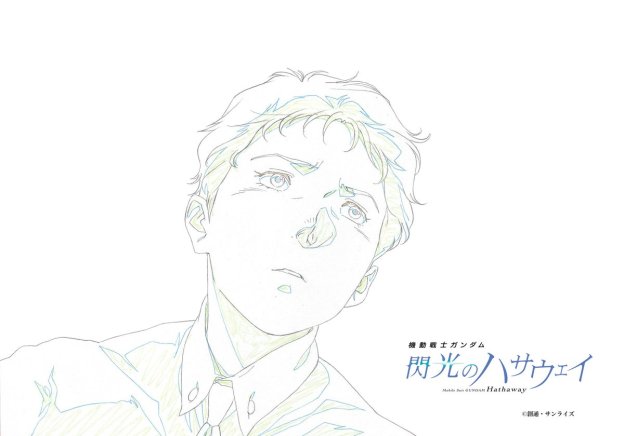
Original interview from Febri, published in two parts, Part 1 on June 18th 2021 and Part 2 on June 21ts 2021, original interviewer: Itsuki Mori; genga by Shuko Murase.
Part ①
The director of “Mobile Suit Gundam: Hathaway’s Flash”, who also worked on the anime movie adaptation of “Genocidal Organ” [虐殺器官 “Gyakusatsu Kikan”, 2017] and participated in “Mobile Suit Gundam Wing” [1995] and “Mobile Suit Gundam UC” [2010], is Shuko Murase. What was his approach in adapting Yoshiyuki Tomino’s novel into a movie? This interview will be presented in two parts.
~ Tomino-san told me not to ask him anything about the contents. ~
— Please, tell me the details of how you were appointed as the director.
It was a request from Sunrise animation producer Naohiro Ogata.
— “Mobile Suit Gundam: Hathaway’s Flash” (hereafter, “Hathaway’s Flash”), is a novel written by Yoshiyuki Tomino. What were your impressions when you heard this novel was going to be adapted into a movie?
Tomino-san wrote the Hathaway’s Flash novel without the intent of it being adapted into a movie by Sunrise. Then, times changed, and I think Sunrise spontaneously took the initiative to turn it into a movie.
— What was the concept behind this movie adaptation?
First, I went to greet Tomino-san since I was appointed as the director of the movie adaptation. At that time, he told me not to ask him anything about the contents (laughs), and from that moment on, I haven’t really asked him a single thing. However, when I met with him, he showed me two movies, saying “I want it to be like these”. They were live-action movies produced in Asia; the first one had two male and only one female leads, just like Hathaway’s Flash. At first, I earnestly tried to adjust the movie around that same nuance and style, but the setting and genre were so different it really didn’t fit well. So, I discussed with screenwriter (Yasuyuki) Muto-san and together we decided to change it back and make it align better with the contents of the novel.
~ The characters are reinterpreted in a Gundam-like style. ~
— This time, in addition to the design work by Pablo Uchida, color keys depicting important scenes from the storyboard were created. It’s a methodology that was never used in Gundam works before.
Regarding the color keys, I think Sunrise just didn’t actively make them. Even if we were to put together the ideas each section envisioned separately, the overall spatial lightning wouldn’t be unified, so we needed a single consolidated vision. Moreover, this time we had a genius designer by the name of Uchida-kun working with us, so we couldn’t not make use of his visual sense. However, there were still some difficulties in implementing this method on set, so I realized from now on we need to put in place a proper structure to accommodate for it.
— Uchida-san, Naoyuki Onda-san and Shigeki Kuhara-san were involved in the character design, and like Kenneth for example, the characters were substantially redesigned.
As for the characters, there’s a certain design style that’s typical of Gundam works, isn’t there? Haruhiko Mikimoto-san too, who designed the characters for the novel, had changed the taste between the novel and the game, so to some extent we reinterpreted the characters in a Gundam-like style. Hathaway’s about the same, whereas Kenneth was redesigned to fit the new visuals, and for Gigi, she’s in her teens in the novel but I found it difficult to portray her like that, so I raised her age a bit. I had Uchida-kun drawing the actual redesigns, I told him “you can bring out your own colors”. Including Onda-san’s animation design, I believe we’ve created well-balanced and realistic characters.
~ The base for the mechs is in CG, and only the necessary parts are hand-drawn. ~
— The mechs are made using CG, right?
We decided to use GC because of some physics-related issues. I’m an animator too, so I understood that, compared to the Unicorn Gundam, it would have been impossible to freely move around the Ξ (Xi) Gundam and the Penelope, both of which have over than double the amount of lines. Thus we decide to use CG as the base. We then proceeded by touching up solely where strictly necessary, and only hand-drawing over the parts we really wanted to. Towards the end of the production, there were also storyboards that were developed using CG, so in that sense it was a new way of making anime.
— It must have taken time to figure out how to make the CG models move.
Some of the designs for the CG models were delayed until almost the very last minute, so I regret that there wasn’t enough time to thoroughly finish the animations.
— That being said, the production was handled by Studio 1, the same one that worked on “Mobile Suit Gundam UC” and “Mobile Suit Gundam NT”, including first rate mechanical designers and animators by the likes of Hajime Katoki-san, Seiichi Nakatani-san and Nobuhiko Genma-san.
That’s right. But on the contrary, because so many people were involved, it took quite some time to adjust the boundaries of what ‘shouldn’t be done when it comes to the Gundam’ [Murase is likely talking about the Gundams’ design, which apparently raised some discussions among the staff]. There was a proposal to change the design from the novel, but Katoki-san put forward the idea to create a design that combined the one from the novel and the one from the games, so we decided to proceed in that direction.
— The three main cast members performed the recordings together, and I’ve heard they were given a thorough explanation of the story beforehand.
Until now, I had never done such things as explaining the story before the recordings. When working on adaptations, I usually just make slight adjustments to the image [of the character] the voice actors have already envisioned themselves. However, in the case of Hathaway’s Flash, its prequel “Mobile Suit Gundam: Char’s Counterattack” has different, parallel storylines between the movie and the novel versions, so when making this movie adaptation we had to make several choices and rearrangements. Therefore, I told Kensho Ono-san how I imagined Hathaway’s character to be in the movie. Initially, we were supposed to talk for just about 5 to 10 minutes, but before we knew it we had been talking for about an hour and a half (laughs). Gigi is also a character that’s hard to grasp, so I explained to Ueda Reina-san the direction I wanted for her character to take in the movie, and I did the same with Suwabe Junichi-san, who plays the role of Kenneth. I explained to each one of them the plan of action of their characters by going backwards, starting from future developments.
~ The contents can be enjoyed even by someone who’s watching Gundam for the first time. ~
— Having overcome such complex adjustments, you were able to complete the first episode of Hathaway’s Flash. What are your thought now that it’s finished?
Including the CG part and the hand-drawn part, there were delays in digitalizing the drawings, and there were many difficulties and problems on set. The compositing and editing processes have transitioned to digital, so I think it would all flow more smoothly if the environment could be unified a little more. As for the story, the first episode is nothing but the beginning of it all, so it’s still unknown how the relationships between the characters and the story will develop. Also, the most difficult part of adapting a novel into a movie is that I was constantly thinking about how the people who haven’t read the novel will perceive it. I wondered how to make it enjoyable also to the people who have never watched Gundam, or more importantly Char’s Counterattack, before. The original request was for the content to “appeal to both Gundam fans and those who have never experienced Gundam before”, so we aimed to appeal to both audiences.
— So, to make it enjoyable to those who have never watched any Gundam work before.
Therefore, I structured Hathaway’s Flash in way that those who first met Hathaway Noa in this movie would still be able to follow the story. Now I’m really interested to see how people like that will perceive this work.
Part ②
“Mobile Suit Gundam: Hathaway’s Flash” has finally been released [the movie was first released in Japanese theaters on June 11th 2021]. Differing from the previous iterations, this new Gundam is characterized by a more true-to-life look. In this second part of the interview with director Shuko Murase, we delve into the use of lighting and 3D for the visuals, as well as the support for Dolby Atmos for the audio and music.
~ Adapting the carefully detailed depictions that only novels can provide. ~
— What really impressed me upon watching the movie was the true-to-life and realistic use of light. The direction really emphasizes the ‘darkness’.
Rather than consciously deploying it for Gundam, many of the works I’ve been involved in before make use of dark scene compositions, so it’s more of a continuation of that. However, this time I thought it might have been bad to emphasize it too much, but following the opinion of mechanical designer (Nobuhiko) Genma-san, we made it darker. I was worried it was a bit too dark, but when I checked it out at the theater, contrary to what I thought I didn’t find it that hard to see, so I was relieved. This may have in part been due to the fact that it was produced to Dolby Cinema™ standards.
— And it also looked clearer in some scenes.
The darker parts are a bit brighter, or rather the range is wider. But I think we could still have improved the accuracy a bit.
— The three-dimensional visual direction of the battle scenes is a benefit of using 3DCG?
Although CG was used, the actual visible elements in the footage were made with analog methods. I believe the parts that look three-dimensional largely look so due to the camerawork that we tried to keep as dynamic as possible, as opposed to fixed and static angles. This doesn’t mean the camera is just rotating around in CG though. We did of course make use of CG models in the process, and we used 3D guides for the background, so I believe there is definitely some synergy in terms of the sense of speed and the perception of depth.
— The characters are also staged in a very subtle and careful way. Perhaps this is also part of the typical pace of “adapting a novel into a movie” you talked about earlier.
For me, it’s easier this way. I had in mind the very different pace at which TV shows are produced; the speed at with Tomino-san usually creates animation is so fast that it just flies by.
— It really is quick.
Instead, we adapted the carefully detailed depictions that only novels can provide.
~ This version of Gigi was created by Ueda-san’s performance. ~
— The very expressive Gigi Andalucia performance by Ueda Reina-san was also one of a kind.
Gigi is a girl that’s quite hard to understand even when reading the novel. Anyways, I really didn’t want to depict her as an unpleasant one. I wanted her to be that kind of girl that says unpleasant things but since she’s cute you end up forgiving her (laughs). So, if her design too wasn’t incredibly beautiful, it wouldn’t have worked. I’m really glad Pablo Uchida-kun was the one working on that. He’s also designed many costumes for her, and I believe that’s something beyond the scope of what a usual animator could create with just their own sense and intuition.
— I see.
Still, if I’m being honest, there were parts [of Gigi’s character] that I didn’t figure out until I heard Ueda-san’s voice. Actually, the type of voice I had in mind for Gigi was completely different to begin with.
— Is that so?
I thought her voice would sound slightly more cool, but during the auditions, Ueda-san’s acting was different from everyone else’s, and something inside me clicked. That’s when the image for Gigi’s character came into view. Her [= Ueda’s] sense of rhythm when acting created a version of Gigi that’s in some ways different from the novel’s.
~ The visuals are retro, but the sound was made in quite a modern way. ~
— With the introduction of Dolby Atmos audio, the sound department has also been renewed this time. The sound director is (Koji) Kasamatsu-san, right?
Kasamatsu-san was in charge of the sound effects for “∀ Gundam” and also had connection with this movie’s producer (Naohiro) Ogata, so he was appointed as the sound director.
— Including the sound of the beams, several changes were made this time.
I discussed with Kasamatsu-san on how there wasn’t really a necessity to remake every single sound effect. There already is a sound that’s typical of Gundam, and swapping it out for something completely different would be wrong. As a result, he was able to create new sounds while still respecting the identity of the past Gundam series, which I’m truly grateful for.
— How was it decided to implement the support for Dolby Atmos audio?
It was decided during production, and Kasamatsu-san too definitely wanted to do it if possible. Up until now I’ve been making things with support for standards like 5.1 surround, so I too am particular about the spatiality of sounds, the sense of ambience and things like that. Kasamatsu-san handled that aspect perfectly this time. In theaters that support Dolby Atmos audio, the sound can also come directly from above, so after watching the premiere, I had a talk with Watanabe Shinichiro-san, who helped with the storyboard, about how we’d like to use this effect again when directing for future productions.
— The soundtrack is composed by Sawano Hiroyuki-san. Was there anything you particularly asked for in regard to the soundtrack?
Sawano-san’s melodies are quite impactful, aren’t they? However, for this work my request was to slightly hold back in that regard. I consulted with Kasamatsu-san about how and where in the story to use the soundtrack that was submitted. There were actually more tracks with vocals other than the two that were used in the final product, but considering the overall balance, we asked for some adjustments such as removing the vocals.
— What are your impressions of Sawano-san’s soundtrack?
Watching through the movie, it’s noticeable how some common phrases are cleverly used throughout multiple tracks, and I think the overall balance is really good.
— I heard that Sawano-san himself wanted to create a soundtrack in line with the current trends.
That’s right. The things we did for the visuals of Hathaway’s Flash are retro, or rather, analog, but the sound, including sound effects and the soundtrack, was made in quite a modern way.
— Having now completed Episode 1, do you have a clear direction for Episodes 2 and 3?
I believe there still are some improvements in terms of production organization that we must address. Apparently, producer Ogata-san has also something to say, and it seems that Tomino-san got to know about it too.
— I see.
I’ve heard several different reactions (laughs)… but I think the overall structure as it stands now will be fine.
