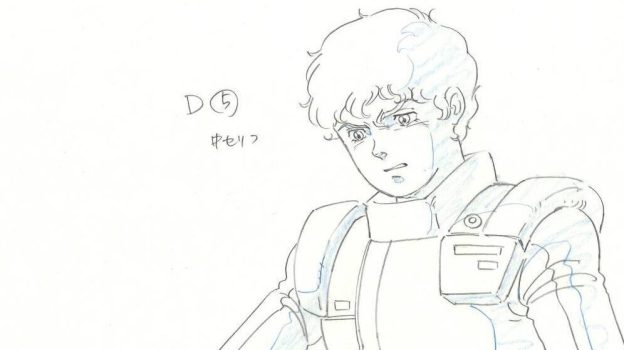
Original interview from the 1988 MOVIC Cinemabook, transcribed from “Char’s Counterattack Complete Collection of Official Records —BEYOND THE TIME—” (2022).
This translation is pretty outdated and may contain some inconsistencies or inaccuracies! It might get a revision sometime in the future…
~ It became a story where I didn’t like Beltorchika to appear in any way, so I chose to leave her out. ~
— “Mobile Suit Gundam” is, as of now, composed of three series; where is this new movie “Mobile Suit Gundam: Char’s Counterattack” placed in relation to the aforementioned shows?
Of course it’s not unrelated to them. It’s the successor to “Mobile Suit Gundam” and “Mobile Suit Z Gundam”. However, it does not inherit “everything” from them, “Char’s Counterattack” is a story that was constructed step by step. “Not everything” means things like why Beltorchika Irma, a character introduced in Mobile Suit Z Gundam, is not present in Char’s Counterattack. Basically, I can’t say it inherits everything in terms of how the characters were arranged.
Why doesn’t it? Originally, it should have inherited everything, but when I initially wrote the script that way, it was rejected. If I had more freedom with that, and Beltorchika would have appeared as Amuro’s significant other, the two of them would have ended being married. Basically, if they were married, perhaps they also had lived together for a long while, and at that point the sponsoring company was doubtful that a protagonist like that could have worked in a robot movie. I thought it was a very reasonable doubt. But while I was actually working on the plan and writing the script for “Char’s Counterattack”, I couldn’t think of that much myself. Basically, because I imaged “Char’s Counterattack” to be the sequel to “Z Gundam” which was the sequel to the first “Gundam”, I was sure Beltorichika had to be there. However, when I realized it wasn’t appropriate to make her appear in this movie due to the aforementioned developments, I removed her from the story, and I also made sure not to mention any information about her character. If I still included things like that in the movie, it would have quickly exceeded the 2 hours limit.
However, that wasn’t the only reason I stopped her from appearing in this movie.
When I finished writing the first script, I realized there was another major problem: it ended up becoming a story where the human power was so strong that Mobile Suits weren’t needed anymore. This too would have been a critical issue for the affiliated company that kindly sponsored “Char’s Counterattack”. And for me as well, it was something I didn’t like. After all, it is “Gundam” because it has mobile suits, like the Gundam itself.
Eventually, it became a story where I didn’t like Beltorchika to appear in any way, so I chose to leave her out.
— It sounds like the result of really hard work.
Nevertheless, on the other hand, it’s also natural to wonder why I had to leave her out of the story for a reason like that. However, to me, a movie should fundamentally be a one-episode self-contained story. You might ask what the previous “Mobile Suit Gundam (I, II, III)” movies are then, but the difference is that they’re the remaking of the tv series. So, if you ask me if it’s ok for movies like that to exist, since I too make them, I’d say it is (laughs). But it’d be a problem if every movie was like that. Also, for me personally, I wouldn’t like people to think that even if, for example, I divided “Char’s Counterattack” in “Part 1” and “Part 2”, it would have still been profitable, and since I was making a movie to be the conclusion to the first “Gundam”, I wanted it to be a one-shot episode no matter what.
In other words, if I had those claims on my part, and the affiliated company that invested in the project acknowledged them, I instead think that the story I proposed, in which Amuro may be married and the Mobile Suits are not needed, must have been suppressed. This isn’t a give-and-take situation, rather a requirement that must be met in order for the movie to succeed.
I fully accepted all these things as I was realizing them myself, and I’m glad it turned out to be a lighter movie this way. If Beltorchika made her appearance in order to have more natural-feeling dialogues throughout the movie, it would have been a little different from the kind of movies you simply watch and enjoy, it would have been something more true-to-life. However, there are two editors currently publishing the novel versions of “Char’s Counterattack”, and I know that there already are a lot of opinions that the version of the story in the novels, where Beltorchika is present, is better. I think it’s a good thing. Now you might ask why I didn’t forcedly do it then, and that is because if I did, “Gundam” as a product wouldn’t have been able to go on. It’s not just for practical reasons like investors not putting their money in it; if I possessed the power to do that myself, and actually made that happen, I would have become unable to write anything about Mobile Suits at all after that. If you’re wondering whether a story that denies the role of Mobile Suits would still be good or not, after all, the answer is no. Basically, what needed to be included in the novel adaptation was the first version of the script I wrote.
After all, a movie should not be made solely based on the ideas from a single staff member. For a movie, first you have to think of the audience, then come the investors and the director. Then many more people need to be involved, like animators, art directors, voice actors, and the people who took the recordings. If it was to be based on the preferences of only one person, then creating a movie wouldn’t need to involve that many people. But even so, ultimately, a movie is still influenced by its director’s intentions, so it can be said that it does belong to the director. The work of balancing these aspects is what makes a move so interesting.
— You’re saying it’s the result of the intentions of many people, but it must also be the result of one single person’s will.
There’s often debate about whether it’s right for directors to convey their egos into their movies or not, but the answer is no. If you look at successful movies, they’re made with the collective effort not to let individual egos shine. Those movies feel like actual movies because they’re made oppressing the director’s ego and accepting many different opinions. It’s when movies are made that way that I think they’re successful, and I believe “Char’s Counterattack” is like that too. At least, I believe it didn’t turn out to be that kind of heavy and painful works that just conveyed their director’s ideas.
That’s why, in my case, I can only say that I couldn’t think of “Char’s Counterattack” as something to watch after the previous tv series, but I could only create it as a one-shot story that just inherited something from them. It’s not something to compare to the tv series, and at the same time it does not have incongruences with everything that has happened until now. It’s the only result of all these things.
— New characters, like Quess Paraya, made their appearance in “Char’s Counterattack”, can you say something about them?
After deciding Beltorchika wouldn’t have appeared in the movie, I thought it was necessary to add something to spice up the film, and after all, a female character to shoulder the protagonist was what was needed, that’s why I made Chan Agi to be Amuro’s partner.
Also, since “Char’s Counterattack” is the story between Amuro and Char, the characters are arranged in a very particular way so that they’re not simply divided into enemies and allies. In order to achieve that, when I was thinking of Char and the antagonist-side, I thought a character to form a connection between the two sides was necessary. When I was thinking of that character’s disposition, I couldn’t think of anything different than someone like Quess Paraya. So I made her a supporting character, so that even though the parties are divided into allies and enemies, there’s a connection between them. For that reason, if Beltorchika was to appear in the movie, she would have ended up covering the roles of both Chan and Quess by herself. Under such circumstances, a new character had to be introduced. And what I came up with after that was “Char’s Counterattack”.
— Besides Beltorchika, what about the other characters from the previous “Gundam” and “Z Gundam” that didn’t make an appearance?
While making “Char’s Counterattack” I didn’t think at all of the other characters. As for why I didn’t consider other parts, this is also my personal opinion but, movies should have a good pacing, and if I had to expand on other parts as well, the pacing would have gotten worse, and on top of that, considering I knew for certain that drawings and animation wouldn’t have been completed in time, I removed most if not all of the parts that felt superfluous.
Well, the running time of the movie was exactly as I planned. The cuts that got removed were about 300, all originally prepared because they were necessary to explain things like the human relationships between characters in the movie, there was no element [that got removed] other than that.
~ I believe that if they work hard and get their job done, and gain experience from that, truly amazing animation can be produced. ~
— What do you think about the production staff?
The fact that there are seven animation directors who worked together is clear to anyone who watches the movie. As for why there were seven of them, it’s simply because no animation director alone was able to do as good as Yoshikazu Yasuhiko did with “Gundam”. At the same time, creating something like “Gundam” after Yasuhiko, would require a tremendous amount of strength. The reason for this is that “Gundam” has a certain volume to it. Expecting people who are barely 25 years old to be able to handle that kind of work would be a pretty cruel thing. As the production process continued, what made an impression on me was that especially in the first four months, to put it bluntly, not a single cut was completed. Supposing things were going smoothly, over these four months I believe even the after recording and dubbing processes would have been completed to a good extent.
As for why it ended up like this, there are many other reasons. Anyways, regarding only the “Gundam” part, it had a “certain volume” to it, meaning it was pretty demanding work, and because of that the staff must have been nervous and even if they tried their best, they couldn’t make it. That one cut took a lot of time and even when it was finished, the end result wasn’t really great.
In short, the desire to work harder made them waste more time. It’s the same thing I said earlier, when I wrote a version of the story in which Beltorchika appeared as the first script. I wanted to do my best and I had to, so I ended up writing a story in which Amuro had become like an old man, all to be told in the end that that kind of thing couldn’t have worked in the movie; in this exact same way, everyone was burdened with that cut and couldn’t move on at all. In other words, this proves that wanting to do your best only by yourself will never bring good results.
If that wasn’t the case then, someone experienced like me should have seen this situation coming and prevented it, and I deeply regret I didn’t. As a result, I felt that young people were put under undue pressure. I am sorry for what happened. When I saw all those young staff members of today being stuck trying to do their best, I thought they must have been all very nervous. However, feeling this nervousness when doing business is extremely troublesome. It becomes a negative factor. All this nervousness creates is a loss in terms of time and money, and these inconveniences end up affecting even other aspects like the post-recording and dubbing, creating even more inconveniences to other people. My message to all staff members is to try to maintain a good balance in this regard.
And also, when it comes to work, it is also a problem to take things too seriously. In other words, I think that all the staff needs to be trained in order to become able to skillfully handle this middle-of-the-road aspects, and if they got trained like that, most of the staff members that worked on “Char’s Counterattack” would become able to effectively utilize their skills in the field to complete their works. There are some exceptional individuals, but most people already possess really good skills and understanding of the fundamentals of animation. I believe that if they work on two or three more projects like this one, and gain more experience, truly amazing animation can be produced here in Tokyo. This isn’t just cheap flattery. That’s why I want them to take real care of the power they have right now.
— Moving on to another topic, did you as the Director draw designs or rough sketches for this project?
No, I don’t do that kind of work anymore. That’s because it’s no longer at a level an amateur can handle, so I don’t get my hands on it anymore. However, as I said earlier when we were talking about the staff, the main trouble was that, although the skill level of each individual has improved greatly, unfortunately, they neglected the more fundamental issues and focused only on the less relevant and smaller details. That’s no good. Because of that, they had hard times especially with the mechanical design. To the point they felt genuinely angry.
I recognize that the animation, or rather, the drawings that form the animation are really good. But the essential thing is that this is animation, you don’t have to draw with an illustration-level finish. That’s not animation, that’s illustration. You can’t make drawings like that move. That’s why they’d come to a point where almost no one could think of the action lines for the animation. Moreover, even if you know how to depict the movements that have been popular in tv animation for the past two to three years now, that’s not animation. There are a lot of people who, in order to learn just that technique, have forgotten how to do ordinary animation.
Even when it comes to mechanical design, I know they’re supposed to draw mobile suits and mechs with a new and fresh feel to them, but when I look at the designs, I feel I’ve already seen them somewhere before. The details on the exterior are drawn in a cool and meticulous way, but in the end if you remove everything on the surface, it’s just the copy of another character. That’s why I want people to understand not to let details fool them, and that a design detailed like an illustration can’t be made to move around in animation.
The end result is that the animation of the last few years, especially the one that comes out of the world of video editing software, all looks the same. It’s not an independent work.
However, I’m not doing any design work myself. It’s all done by the individual designers. Anyways, because we had to spend so much time just to get to that point, the finish ended up being a bit sluggish, and the fact that it wasn’t really an independent work was painful.
— Going back once more to the work itself, it looks like “Char’s Counterattack” brings a breakpoint in “Gundam”, did you feel something in this regard?
Unfortunately, after finishing editing this film, I realized I didn’t really hit a breakpoint with it, so I don’t have that kind of feelings about it. To be honest, now that the prologue is finally over, I’m just looking forward for “Gundam” to start all over again.
I’ve come to the realization that I myself have been living inside of “Gundam”.
— What do you want people to see in “Char’s Counterattack”?
The reason I made this movie is that I wanted the audience to see it and I had something to tell them through it, so all I can say is please watch it. And whether they like it or not, it’s not just the audience’s business. As the creator, I can only ask “I made the work this way, what do you think?”. If it was just to say “I made the work this way, so please understand it”, I wouldn’t have gone out of my way to make a whole movie, I would have just written a publication or a novel, and a pamphlet with dozens of pages explaining what I meant to write in the movie. But if I did that, there would have been no reason to make the movie at all, and if there’s no movie, there’s no pamphlet either, so that would have been a contradiction (laughs).
Also, those who have already watched “Char’s Counterattack” will understand, but I really don’t know whether the things I did in the movie, like withdrawing Beltorchika or the last scene with Amuro and Char, are good or bad. I’m not saying I just summed it up and made it that way. The screening time was limited to at most two hours. If I wanted to add more details, it would have exceeded that time limit. It might have been possible to create a great work even exceeding the time limit, but I didn’t have the self confidence to do so.
Anyways, it’s not related to the main body of the work, but there’s something on a technical extent I would like people to notice. My approach in direction for this movie was to make it look like a regular animation movie. I can say with total certainty that there’s no basis to say this is a just regular movie, however, I thought this kind of baseline would have worked, so I made “Char’s Counterattack” this way. This type of technical attention, like how the drawings are connected to each other, should be reflected on the screen.
If possible, it would really be educational if, instead of thinking “why does it look like this?”, you thought “what did the director do to make it look like this?” and tried to figure out the answer. However, this is something highly technical that cannot be really put into words. Even if I explained it, it would be really hard to understand, instead I would really like you to learn it by looking with your own eyes. If, while watching “Char’s Counterattack”, you felt something was strange, like how it looked or didn’t look like a regular movie, that’s what I’m talking about. Also, if you wondered how the story of the movie seemed to fly by so quickly, if you pay special attention to it, you will understand how to connect the moving drawings together [to make it feel so quick T.N.]. When you’ll have the chance to make a movie in the future, that will become some very remarkable knowledge to have.
~ If I were offered to make a live action robot movie, I would want to create a work that doesn’t let the animation say anything. ~
— Except for your own works, what kind of other works do you like?
Speaking of movies, I don’t like them to a point I can actually say “I like it”. However, if it’s just a matter of preference, I would say I like the black-and-white version of “King Kong” that was produced in the United States in 1933.
— Did “King Kong” have any influence on you as a movie creator?
I wouldn’t say so. And that’s because it’s a movie with a low degree of perfection. However, I like it because it conveys something that makes me feel like saying “I love King Kong”. I guess that’s what movies are all about, that feeling of having fun. Also it’s because I think the stupidity of the people who created such movies, still in black and white, at the time when talkies (vocal films) began to spread before World War II, might be the true spirit that animates filmmakers at their core.
Accordingly, that’s why I really hate the color version of “King Kong” that was shot on 70mm film. As for why that is, [in the b&w 1933’s version] their true intentions were unusually apparent and the unhinged nature was on full display, if it were me I would think that was great, and their attitude towards their work was totally positive. In other words, now that color film has become commonplace and anyone with the right financial backing can set up such a large location, arrange a 70m camera and do it, I can’t stand hearing the staff from that movie saying that was the real “King Kong”.
— Is there a recent movie that caught your attention?
I told you, I don’t really like movies, so I think that last year (1987) I haven’t watched a single one…
Oh, I forgot to mention, when it comes to movies, horrors are absolutely a no go for me.
— Is that because they don’t personally suit your personality?
Rather than not suiting my likings, I just can’t bear them. So when I accidentally went to watch “Alien”, I was so scared that I closed my eyes for about an hour (laughs). I’m just that kind of person (laughs).
— There’s quite the difference in genre between “Alien” and “Alien 2”, the latter being more of an action movie. What’s your opinion on “Alien 2”?
“Alien 2” is kind of a stupid movie (laughs). At least I’m glad it wasn’t that scary. The first one was really scary… I want to whack whoever makes it air on tv. Don’t you think? But when it’s broadcast on TV, it’s not that scary. Isn’t that callous approach the same as the callousness of the color version of “King Kong”?
Anyways, I really don’t watch many movies. Of course I do have interest in the ones I work on and I’m glad if they do well, but generally I hate even my own films. That’s because if I end up liking my own movie and get absorbed into it, I always have the fear somewhere in my heart that I won’t be able to come up with the next one.
And yet, when I watched “Mobile Suit Gundam III: Encounters in Space” about four or five years after its release, I was moved (laughs). “There really are people who can make such great movies out here, that’s remarkable”, I thought (laughs). Basically it’s because I hate them for a while, that somehow I don’t see them as my own work. In that sense, I am a relentlessly forgetful person (laughs).
— Lately, “RoboCop” has been a hot topic when it comes to movies, it’s a shame that robots, a speciality of animation, has been stolen by live action movies, don’t you think?
I knew this was going to happen three or four years ago already. I’m angry at myself for not making “Live Gundam”. Perhaps if the talks for “Live Gundam” had been concluded well, it could have been released around fall of last year.
— Do you think animated robots can break out of the current difficult situation?
No, they cannot. There’s no clear reason why. But it’s definitely the case. For example, if I were offered to do a live action robot movie, I would want to do it. If that happens, I would like to create a work that doesn’t let the animation say anything. I think I’ll have that kind of opportunity sometime before I die (laughs).
There’s a part of me that foolishly believes that. It’s also true that I would like to believe that even right now, from a practical standpoint. I would like to think about what the mechs would be like in such situations. Maybe not right now that “Char’s Counterattack” just got released, but when summer comes I would love to forget about my current job and think more about that. Maybe this joke will turn out to be true in the future (laughs). Even though I don’t know how far in the future it may be, since I believe it, I’m already starting to make plans.
In that sense, if the staff who helped with “Char’s Counterattack” works on several other animation products over the course of, say, three years from now, and doing so also learns the skills to create real animation, and becomes able to make a real movie, then, when that time comes, it’d may be possible to create an [animated] movie that can silence the live action robots produced by Hollywood.
Actually, I do believe that’s possible. In fact, I would love to make an animated movie that even makes people want to see a live action adaptation of such a movie instead. And this means that if you don’t believe in this like the joke I talked about earlier, you have to seriously plan a route to this end. If you just have a vague idea to do something, you’ll get nowhere. I believe it can be done.
— After all, if you don’t start thinking about it, it’s not fun.
It’s not that it’s not fun, it’s that you won’t be able to take it seriously unless you think about it. It is because we believe in this that we are able to create things.
~ If Char was really a lolicon, he would have teased Mineva and it would have been a rotten story. So, let’s assume he forgot about her. ~
— Let me change the topic back to “Char’s Counterattack”; I would like to hear something about the voice actors.
Well, I had no freedom in that regard anyway. I mean, some of the voice actors were already an obligatory choice, right? A lot of them, actually. As a filmmaker, when creating a new movie I want to refresh things a bit. And first of all, there were a lot of characters that appealed to me in that sense. On top of that, to select the voices for the new characters, I had to listen to about 80 audition tapes, but I had the impression that the new aspiring voice actors sound all the same, they all act the same way. But for this movie, we had no choice but to use this kind of cast. It really bothers me from the bottom of my heart.
However, this does not mean there is something wrong with the people who performed in “Char’s Counterattack”. On the contrary, there isn’t anything wrong at all with the people who played the roles. What I’m trying to say is that new options have become so narrow. Also, I would have loved to work with a young, fit-looking girl (laughs). However, I couldn’t abuse my authority to that extent (laughs). In other words, the pool of voice actors has become narrower. It’s the same thing I talked about before regarding the animators. Well, it made me realize that the nature of various things has become narrower nowadays, and also that we need to create a world where we can work with people with different tastes and characteristics. Compared to about 4 years ago, it seems like there are fewer options, and it really came in as a surprise to me.
After all, the cause of this are the new tendencies like to have a predetermined image of what animation is, or for production companies to bring in cute girls, and I would want this to stop immediately. I would like to say that animation is not a place as narrow as this. Anyways, this is not a problem for the individual voice actors to solve, but for the animation industry as a whole.
— It’s similar to the idol singers being all the same type of cute girls, isn’t it?
Yes, it’s exactly the same. Whether they’re good singers or not is a problem that comes after. This kind of thing depend on the horizons and personal fondness of the people at the top who select these girls.
— For this movie, the dubbing process lasted for three whole days, right?
If you ask me, three days were not enough. But there are many practical issues regarding budgets and guarantees in the Japanese television and animation industry, so we could not ask for any more than that. That’s the current state of things, and I hate it. However, I also think I understand that everyone else too isn’t working under ideal conditions.
— Not to ask about the parts of the story that weren’t depicted this time, but I’m really curious as to why Mineva Lao Zabi wasn’t there alongside Char. She would be already 14 years old, so she should be old enough to express her thoughts on her own now, right?
Well, about that. I didn’t make her appear because of my personal preference, so I didn’t mention anything about her. If I did that, it would have ended up becoming the story of Char and Mineva. And that’s an entirely different story. If Amuro were to interfere in such a story, it would have only become more complicated. It would have ended up in a similar fashion as that feeling of intricacy and confusion when Haman Karn appeared in “Z Gundam”. So I instinctively avoided writing a story like that.
So then, in response to the question of what kind of relationship is there between Char and Mineva in “Char’s Counterattack”, ultimately, Char solved his issues with the Zabi family, so even making him kill Mineva wouldn’t have made sense as any kind of vengeance story at all, so think that he just let her be or forgot about her. Otherwise, the story would have easily focused on how tragic of a character Mineva is, and I didn’t want to dive into that kind of thing.
It’s briefly mentioned in the movie, but if Char really is a lolicon, for better or worse, he would teased Mineva. She would have been harassed and tormented, or even molested. But either way, it would have been a torture for her. I personally don’t like stories like that. This kind of desire to portray the inherently sadistic side of humans doesn’t really suit robot stories. So, let’s assume that Char forgot about her. Otherwise, it would be a rotten story…
Obviously, I completely understand your interest to know about the story of the two of them. Maybe it’s because “Char’s Counterattack” has finally left my mind, but the truth is that I could create another story about both Mineva and Char.
— Mineva too is a character with a considerable weight in the story, isn’t she?
For this very reason, isn’t it okay for at least one little girl to be forgotten for once? In Beltorchika’s case, I had plans for her but then withdrew them, so it’s fine. I guess it’s because this aspect of choosing which character to pick up is an inherent trait of “Gundam” as a work. That’s why I think I shouldn’t always use every single character. I feel like if I did everything too methodically, it would become an unhealthy practice. I think I’ll definitely include Mineva in the extra edition and deal with her… no, I won’t (laughs).
Anyways, if I were to deal with her, I would probably do it with an adult Mineva. Otherwise it’ll end up naughty and I’ll feel bad, so I’d wait for her to come of age and not be a child anymore. Once you become an adult, it’s okay for you to decide things by yourself. Now that I have this idea in my mind, I’ll use it for the next “Gundam”… (laughs).
~ Even if Amuro and Char died in “Char’s Counterattack”, their existence will never disappear. ~
— Well then, lastly, I wanted to ask about Amuro and Char in “Char’s Counterattack”, which of these two characters do you personally prefer?
Well… as their creator, I shouldn’t answer that; I know them both very well. Anyways, Amuro is an ordinary character, while Char is more like a recipient for the desires and ambitions of many people. However, everyone knows that to become something like Char is highly dangerous, so I have the feeling that if I have to choose which one I prefer, Amuro would be my choice. Also, Char as a person is what I tried to become myself, and since I couldn’t, sometimes I feel like I can’t stand that bastard. This is just a comparison between the two, but I really cannot say which one of them I like the most in my heart.
However, as a deep emotion I feel towards both of them, I do feel both Amuro and Char did a great job until now. I also think there is some problem with the meaning of “Counterattack” in this movie.
— I believe that at their core, their personality is the same for both of them. Did you make them with this in mind?
If that’s what you feel, there’s nothing I, as the creator, can say. But it’s not like I made them with that intent in mind.
— There have been moments when I figured it wouldn’t be strange if the two of them were swapped.
I see, I too totally understand that. That’s why Amuro and Char should be able to become good friends. Yet, people with the same “character” can never become one. Especially in a community, whether it’s a nation or a company, only one person can stand at the top. The remaining people have no choice but to become their assistants or subordinates. But Amuro and Char are both men who stand at the top. And that’s exactly why they can’t exist simultaneously. To make that possible, it would take the world to change.
Ultimately, “Gundam” is a war story because mobile suits are there; if I were to depict only Amuro and Char in a different way than the others, it would no longer need to be a war drama. That’s right, “Gundam” has created a world that led to characters like those two to appear, in other words, it gave life to characters whose personality even I cannot change. In that sense too, it was impossible for me to deliberately mess with them.
— It often happens that characters become independent from their creator.
Yeah, it’s like that. It’s not as easy as it sounds on the surface, but it’s definitely as you said. They exist as humans with actual personalities. That’s why even if Amuro and Char died in “Char’s Counterattack”, their existence will never disappear.
— Thank you for your time.